Final Fantasy IV – NDS

A beatifully animated, fully-rendered 3D opening sequence, the style of which you never see again. Why does Rosa look like she has swine flu?

A beatifully animated, fully-rendered 3D opening sequence, the style of which you never see again. Why does Rosa look like she has swine flu?

I you will permit me, I’d like to start on a serious note, preferably without discourse as to whether or not my usual candor qualifies as humorous. I just finished Final Fantasy IV, something I claim to have done no more than twenty or thirty times in the past, and suddenly I can put my finger on why I appreciate Japanese storytelling more than Western writing. That whole dichotomy between good and evil and the struggle there between, falls a little flat, and as people have a pesky habit of applying fiction to moral decisions (for which I recommend reading Kurt Vonnegut or Charles Dickens) rather than, you know, just treating people well, such a dichotomy tends to screw up society.

ffiv-infernoHow so? Start with Beowulf. The draugr Grendel came from the lineage of Cain. And if that doesn’t earn him his own private hell, he also killed people and ate them. Then Beowulf shows up and slays him to punish evil. Excellent, right? Well, let’s take a jaunt over to this week’s game and look at Kain, who came from a noble lineage of dragoons. Golbez manipulates him into committing evil acts on his behalf. Then Cecil shows up, decides not to kill him, and you get a wonderful exception to normal RPG party limits that lets you fight with a fifth member. Now skip on over to Star Wars where we find Darth Vader, the Father of all Incarnations of Pure Evil. Except George Lucas wanted to show him redeem himself at the end, atone for his crimes and bring balance to the Force. But no one took it that way and we all talk about Vader as a badass so evil that he makes Satan sith his pants in terror; this pisses off Lucas, so he makes us sit through a crappy prequel trilogy to show us how badly we misunderstood this character. Then in Final Fantasy, Golbez pulls the classic Vader twist, Cecil struggles with the news, but eventually forgives Golbez, who goes on to clear out the first form of the big bad Zemus for you, then goes into self-imposed exile out of remorse. And this trend runs throughout Asian religion and literature from Journey to the West to Dragonball; no one possesses absolute good or evil, and everyone can atone. Full disclosure: Cecil’s atonement on Mt. Ordeals *always* gives me chills, and I’ve played the game forty or fifty times.

They put enough thought into the new translation so as to actually appear as though they put thought into the translation.

They put enough thought into the new translation so as to actually appear as though they put thought into the translation.

Despite everyone’s praise for FFVII, this installment changed the world of electronic RPGs more than anything else, having introduced novel ideas such as actually giving a character a personality and a conflict to resolve, and introducing thematic congruity throughout the story. Also, having a story. And dear god, music so good that Japanese schools instituted it as mandatory curriculum. I might even confess that I played the FF Main Theme, which played during Rosa and Cecil’s wedding, as the opening to my own wedding. While I have a special relationship with FFVI as the first RPG I ever played (and played and played…), I find myself playing FFIV about once per year, and only in part because they port and remake the game with a regularity that anyone over the age of 70 would envy. (Seriously…FFIV (Japan), FFII (USA), FFIV Easy Type, FF Chronicles, FFIV for the Wonderswan, the GBA, a few systems I probably missed, and then this version.) So when I found out that the game would receive such a drastic makeover as they gave FFIII, building it up in three dimensions with voice-acted cut scenes, I actually played the game in Japanese because I didn’t want to wait for the North American release (and thankfully, I lived in Korea at the time). Also I intend to argue that that qualifies me as bilingual and that I don’t have to pass a language proficiency test ever again.

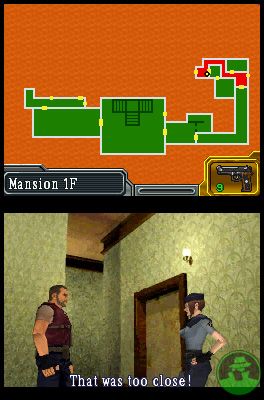
A more appropriate representation of in-game cut scenes, the character design obviously symbolises that neither Cecil nor Kain can see the path before them. Because of their helmets.

A more appropriate representation of in-game cut scenes, the character design obviously symbolises that neither Cecil nor Kain can see the path before them. Because of their helmets.

So other than the aesthetic makeover, why should I waste my time on yet another release of a game I’ve already played sixty or seventy times? Square decided that simply milking it for cash wouldn’t cut it in the long run, so they added some chocolate to that milk. Many enemies have different attack patterns, and certain attacks and spells function differently; for example, if you expect simply to bounce Bahamut’s megaflare back at him, you’ll soon discover the reflect spell has all the defensive capabilities of a burlap sack soaked in gasoline. These changes tailor the game to develop strategies, without which you will pass through the game with the ease of a golf-ball sized kidney stone. To help ease said passing, characters now can augment their abilities using items mostly looted from the corpses of their dead friends. As the name suggests, these augments will give characters extra commands to use in battle or enhance their qualities akin to the relics in FFVI. Unfortunately, the game explains this system with all the clarity of Sylvester Stallone explaining quantum physics while running a garbage disposal at 6:00 in the morning. It fails to tell anyone who’s played the game before that you won’t waste your augments by giving them to characters who won’t stay in your party. Instead, it’ll let you loot even more powerful abilities from them. Thanks, game. I could have used that information during the early game when I usually drudge through the road from Damcyan to Fabul, ruing Squaresoft for giving me a bard and wondering why anyone in their right mind would ever choose to play as a bard.

And while discussing the merits–or lack thereof–of things no one ever uses, they’ve added an entire garage sale full of assorted junk to the roster of items. You know those too-pointless-to-use magic items that Square seems to love handing out? The ones that cast low-level spells at a fraction of the stats that their black mage counterparts have available? And you usually get them when you’ve had their upgraded version in your regular magic menu for hours? Yeah, the game chucks them at you like a Double Dare physical challenge. And they’ve added a mapping feature to make use of the dual screens–any time you complete drawing a map of a dungeon floor, you get an item. Or five or ten. I’ve found uses for some of them; they’ve added items that permanently upgrade HP or MP, while helped keep Rydia and Rosa alive and not useless in battle. But usually you’ll get an antarctic wind or a bomb core or–my personal favorite–items that cast status spells that never work anyway. You no longer have to replenish arrows–each one gives you an infinite set, which takes a bit of the fear out of using Rosa, lest she run out of anything useful to do and end up tossing pebbles, but now Cecil can’t equip bows, making him all but a burden in the Lodestone Cavern.
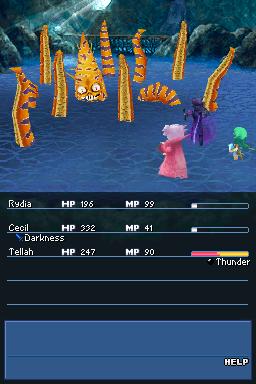
ffiv_battleUnfortunately, for all the clever re-figuring that they did when assembling the DS version, even with augments and strategies and piles of crap looted from caves, eventually (and often) you will run into an enemy–not even necessarily bosses–that hits your entire party for more damage than you can take in a single blow, or that spams an attack faster than you can keep up with it, and you only have the option of leveling up in order to resist. Having played the game once before, I knew this and kept a steady pace of leveling up through the game. I did all right in most places, but the final dungeon clearly took offense at my presumption that I could fight through basic battles at a paltry level 65. So thank you, Square-Enix, for taking one of my favorite games of all time and adding just the right dose of tedium to turn it into a fucking level grinder.
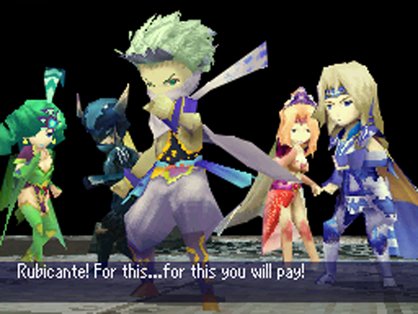
FFIV DS group shot

I can only really recommend this game for the die-hard FFIV fans who have played the other versions eighty or ninety times, like me. I liked it. Mostly. The voice acting impressed me when I heard it in Japanese, and it only got better when I listened to it in English and actually understood it. Also, I appreciate the recognition that people still want to play certain games even twenty years after their first release. But it requires a certain level of patience and know-how to both grind and solve strategic puzzles (the only kind that actually belong in non-puzzle based video games!), and it might turn off first-time players (as well as some second-, third-, and tenth-time players). Still, the dramatic points in the game still awe me after a hundred times through the game, and finishing the game rewarded me with the realization that Yang, our blonde-mustachioed Asian Fabio, can attend a wedding bare-chested without the slightest sense of impropriety.

Mystique Sex Games (Round 2) – Atari 2600

Here, the game challenges you to figure out the secret input to continue: up, down, repeat.

Here, the game challenges you to figure out the secret input to continue: up, down, repeat.

When I first started out as a wee little blogger, WordPress eased me into the online community by recommending that I follow those with similar interests, so I looked into a few other people writing about video games and left a comment or two here and there. Out of that original group, I can proudly boast that only I still update on a regular basis. Or at all. Writing doesn’t come easy, even to me, and few things can discourage a writer more than having a stat counter that only proves no one reads your work. However, one year later not only do I still post, but I have averaged about five views per day since I started. Not that I always had this many readers. Well…viewers. Who knows if they actually read each dissertation I write?

My luck turned around about three or four months back with one entry that I rushed through and didn’t feel confident about. In it, I mocked the Mystique/Playaround line of sex games for the Atari 2600, naively thinking that no one in their right mind–no one!–could actually get interested in super-low resolution sprites of naked men and women engaged in simple, mechanical two-sprite animations meant to resemble sex acts. To give you an idea of the magnitude of my misjudgment, after that entry my readership jumped up to an average of about 23 views per day. So to show my appreciation for the unnatural pleasure I take from constantly looking at the graphs on my stats page, I’d let you take some unnatural pleasure in the other three Mystique games.

For those of you who missed the previous entry, Mystique, later rebranded as Playaround, tried to make games for the Atari 2600 that appealed to adults. Horny, creepy, perverted adults. They released the 1982 equivalent of M rated games on extra-long cartridges that had two games in one (because you simply can’t pleasure yourself if you can’t jam your extra-long toy in at both ends). These games, sold under the description of “Swedish Erotica,” came out (hehe…) as six paired cartridges, with each pair offering essentially the same game with reverse gender roles.

An improved version of "Breakout." Nothing to shake a dick...I mean, nothing to shake a stick at.

An improved version of “Breakout.” Nothing to shake a dick…I mean, nothing to shake a stick at.

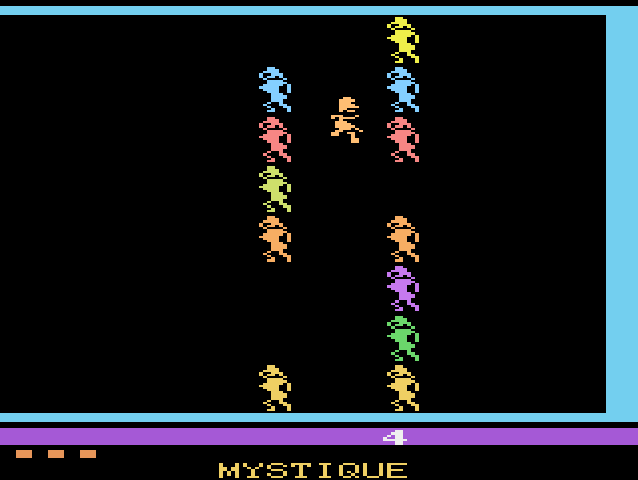
If you look at games like Bachelor Party / Bachelorette Party, you may notice they didn’t set the bar very high. In fact, they just re-made Breakout. A crappy, watered-down version of Breakout. And I didn’t like Breakout to begin with.  The player’s pong paddle blocks a tiny naked man, in Bachelor Party, or a woman in Bachelorette Party, who bounces through a small field of naked people of the opposite gender. These people act like the blocks in Breakout. There. You know all about the game. Yes, I guess I could elaborate and tell you that it has four game modes, two of them sporting a zig-zag pattern of debauchery while the other forms a straight double line of fornication, each version having an easy mode with multiple…uh…guys versus the hard mode with only one.  As the player…uh…hits on?…more naked people, then run faster and faster (although we can hardly fault the little guys for getting excited), but apparently they need you as the trusty wing man to make sure they run back to the women rather than darting for your escape. Honestly, no, I don’t get it, but they modeled the game after Breakout and what more do you need than naked people?! Huh?!

RetroArch-0306-185436I can say this much about these games, though: they don’t discriminate. Your player picks up women/men of every color! Black, white, yellow, red . . . blue. . . and green. Damn it! Breakout, people! Why don’t you understand that?  Oddly enough, though, the game treats you to a jingle from Auld Lang Syne every time you start. I don’t entirely know what possessed them to do that. Maybe you’ve known these naked people for ages and don’t want to forget them…in bed? Or perhaps you’ve planned the party on New Year’s Eve, a night known for drunken hedonism? Or perhaps they simply selected a well-known public domain song? As much as I’d like to believe any one of those suggestions, they use “happy birthday” for Bachelorette Party, which easily shatters all of those hypotheses. (Yes, Happy Birthday still falls under copyright protection. I didn’t believe it either, but I looked it up on Snopes.)

Rule #1: Don't point your weapon at anything you don't intend to...well...

Rule #1: Don’t point your weapon at anything you don’t intend to…well…

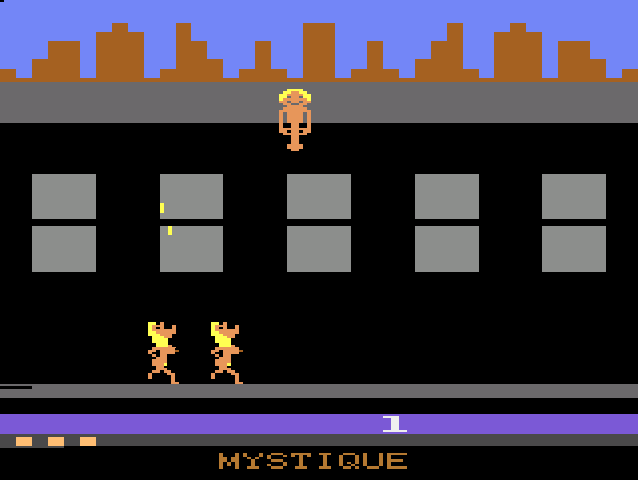
Next in our line-up comes Beat ‘em and Eat ‘em / Philly Flasher, and I only have one word to say about these masterpieces. “Gross.” In Beat ‘em and Eat ‘em, a naked man so well-endowed that he probably needs leg braces and a special sling to walk masturbates off the roof of a building. The player controls two nude women (or one in the second game mode) who dash madly back and forth…to catch the drops…with their mouths….I guess some people get their kicks that way, and hey, semen has a lot of protein and ingesting it supposedly helps prevent depression, so I guess this game promotes good health. You know, in addition to public indecency.

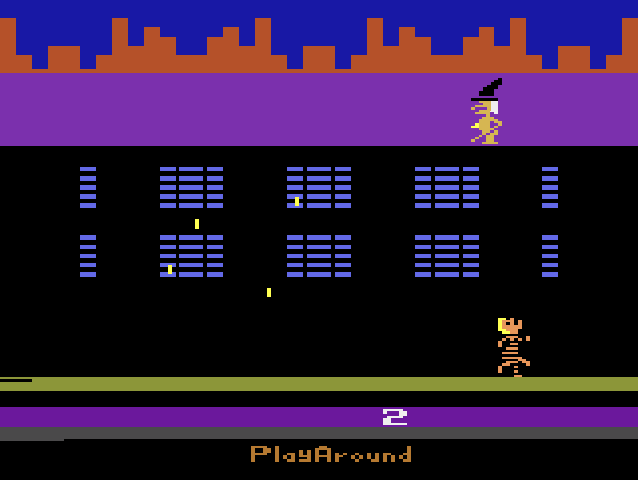
Because witches lactate, right?

Because witches lactate, right?

In the reverse gender role version, Philly Flasher, they don’t change much, the men who dash for the droplets of I-don’t-want-to-know-what for some reason have stripes. Like a bee. A big, naked bee that masturbates after successful catches. But hey, bees cover themselves in pollen, and doesn’t pollen work like flower semen? Gross? Yeah, I know. Also the lady on the roof top sports a witch hat for some reason. This game seemed infatuated with the concept of “for some reason.” Unfortunately, the game doesn’t have anything going for it other than the concept (which while appealing to some, does not appeal to me). Darting back and forth doesn’t really create stimulating gameplay, and…well…nope. I can’t criticize anything else. You just dart back and forth. I might suggest skipping this one.

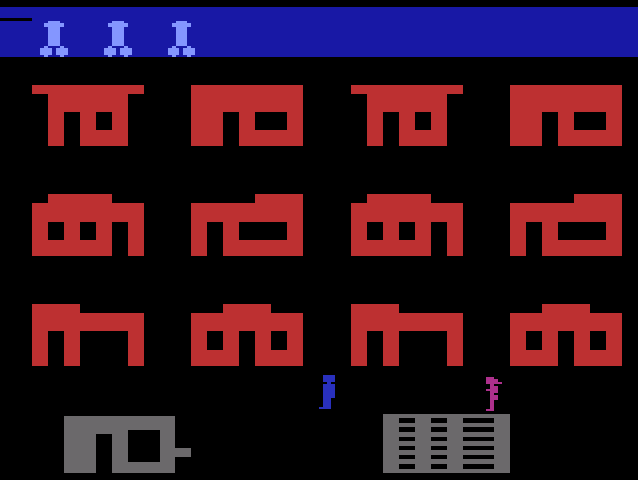
However, like in my first review on Mystique games, one of them actually stands out as kind of fun to play. Theoretically. If you get used to it.  Cathouse Blues / Gigolo stars a man and woman respectively, out for a night on the town.  The player has three objectives: one, when the police release all their prostitutes into the wild, you need to memorize which houses they go to. Two, you have to swing by the ATM. Three…well, I should hope you’ve figured it out by now. Just don’t get caught. The police will drag you to jail and you’ll lose a life, or the thief (or so I assume) will take all your cash, resulting in an automatic game over.

They say video games make kids believe they have extra lives in reality. Not Mystique: they only deal in spare genitalia.

They say video games make kids believe they have extra lives in reality. Not Mystique: they only deal in spare genitalia.

For an Atari 2600 game, Cathouse Blues and Gigolo have a surprising level of sophistication. They have multiple goals, require different skills, and they have a mostly plausible premise (except, you know, for the guy who has sex seven times in one evening. They didn’t have Viagra in 1982.) While recommending anything by Mystique falls on the line of suggesting which hardcore, illegal narcotic might best fit your needs, if you had to choose one, go for this one. While it does dull the senses somewhat, at least you get a small rush before losing all sensation and waking up the next morning with a crushing sense of regret and shame.

Anyway, thanks for reading, and if you haven’t stormed off in disgust after your search for “sex pc game” led you to an obscure, non-graphical Atari cartridge that would cost anywhere from $50 to $1000 on ebay, consider reading, following, and/or commenting on some of my other entries. Look for upcoming articles on the Kingdom Hearts games, or if I get really ambitious, “Captain N: The Game Master.” Feel free to leave suggestions for games you’d like me to write about, and I know some of the guys on youtube get actual copies of the games from fans who want to see Jon Tron or the Completionist cover their favorite…so, you know, if any of you really want me to write about Conker’s Bad Fur Day, just know that I wouldn’t cry if you absolutely needed me to plug that into my lineup.

Kingdom Hearts – PS2

You hated him as an adult; now loath him as a child! At least this game also implies that he dies.

You hated him as an adult; now loath him as a child! At least this game also implies that he dies.

When you walk away
You don’t hear me say
Please, oh baby, don’t go!
Simple and clean is the way that you’re making me feel tonight.
It’s hard to let it go.

Sounds sexy. This music opens up the Disney-Square-Enix joint production, Kingdom Hearts, and when the dark tones start playing, you know that only a sleek, sexy story could follow. If these lyrics mean anything, you’ll never encounter any teeny-bopper heroes, cutsey cartoon characters, or teen idol singers signed under the Disney label. But seriously; have you ever listened to the lyrics to “Simple and Clean”? No one could have written them but the Langston Hughes of blathering nonsense.

Anyway, the story behind the game goes that after Square lost about fifty million dollars on “The Spirits Within,” a movie whose failure any Final Fantasy player could have predicted on account of it resembling a Final Fantasy game as much as the World Wrestling Federation resembles the book of Deuteronomy, they risked going under and had to sell the rights to many of their most famous characters, such as Cloud, Squall, chocobos and moogles, to the only organization that could afford them: Disney.  Suddenly owning all these video game characters, Disney puzzled over what to do with them, and finally decided, “Let’s make a video game?” Then they had to find someone with the expertise to make an epic game using Final Fantasy–and Disney–characters, leading them straight back to Square.

Played by a Billy Zane pissed off that they cut him from Back to the Future III.

Played by a Billy Zane pissed off that they cut him from Back to the Future III.

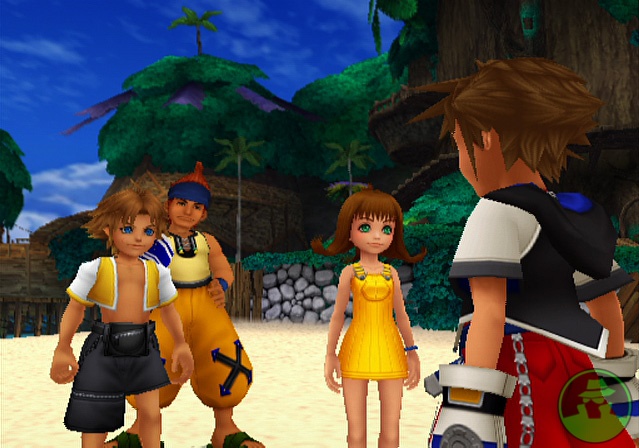
This story never really happened. But still, the concept of a game where the main character travels through a universe full of worlds populated with a bizarre potpourri of animation contains a brilliance and innovation only matched by its convoluted, mind-numbing confusion. The story opens with Sora and his two friends, Riku and Kairi. They live on an island that gets devoured by cutesy black monsters called heartless. They somehow tumble through outer space to land on separate worlds. Sora discovers his destiny to wield the “Keyblade,” a stunning swing-and-miss attempt by Disney to reduce the image of violence in games while still letting the protagonist use a sword, and Disney’s own Donald and Goofy task him with traveling from world to world, using the keyblade (more of a key-club, really.) to lock each one away from the heartless who want to devour those worlds too. And on the way, Sora looks for Riku and Kairi.

Anyone who has ever visited one of their theme parks (Tokyo Disneyland, 2008!) will immediately realize that Disney has always liked to think of their characters as coexisting in the same universe, so while the story feels a bit like a flimsy excuse to parade cameos in front of our noses the way my grocery store tries to entice me into buying their day-old pastries by stacking them up on tables by the front entrance, Disney does that. They buy into all their talk of “magic,” and they don’t view Peter Pan or Maleficent as any less fresh than Elsa or Simba or the princess from that kinda racist movie set on the bayou. Rather than look at it that way, I considered this game like one of those “re-envisioning such-and-such as an anime” videos you find on youtube. (Look up the one for Miyazaki films)

Most of the gameplay occurs in a hack-and-slash RPG style in which Sora mercilessly gives the heartless (and occasional Disney villain) concussions, contusions, and other forms of blunt trauma with his “blade.” Sora can learn skills, techniques and magic like in a Final Fantasy game, but the fast-paced active combat style doesn’t fit well with the menu system, which demands simultaneous use of the left analog stick and d-pad, and disables any useful right-handed action while scrolling through. I guess since I get through battles all right, I can chalk this up as adding challenge, but I don’t really admire heroes with narcolepsy, who slip into brief comas in the middle of battle. As a result, while Sora can perform neat attacks and spells, I almost only ever use the basic attack and the three spells you can add to a quick-cast menu.

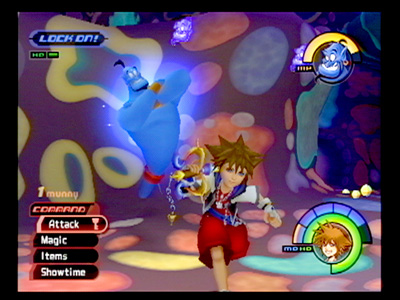
Genie fighting monsters in a psychadelic whale bowel. Because it makes sense.

Genie fighting monsters in a psychadelic whale bowel. Because it makes sense.

While traveling between worlds, the game becomes an over-the-shoulder perspective space shooter. This accomplishes very little except padding out the game for time and adding useless junk to find in each world.  These segments mostly consist of holding the X button for a steady stream of lasers and wiggling the analog stick ever so slightly to prevent impaling your ship on objects that will do as little damage as possible, then let you pass right through them. After finishing the first three worlds, you get a warp drive that lets you bypass this part, making it even less relevant to the game. You have the option of making custom ships by collecting blueprints, finding gummi blocks, and putting together or customizing existing models. However, the default ship provides as much challenge as deer hunting via carpet bombing with napalm, and at that point upgrading to an atom bomb really won’t cause any noticeable difference. Plus, I’ve conducted Korean-language ATM transactions more easily than using the gummi ship building interface, an extra-convoluted program that rival Adobe products for being non-intuitive.  While the player can mostly ignore these gummi-Galaga sections, it does intrude on the main quest by making gummi blocks the most common prize in hard-to-reach treasure chests. So when you finally have the proper skills and abilities, backtrack to old worlds, and get the platform-leaping aspects (honestly, why does anyone still make platformers?) right, the game rewards all your time and effort with an item as relevant as a Playboy magazine at a strip club.

Do I get the adult, powerful, many-antlered Bambi? Nope. I summon a baby deer to aid me in battle.

Do I get the adult, powerful, many-antlered Bambi? Nope. I summon a baby deer to aid me in battle.

I don’t want to mislead you into avoiding this game. It does have good qualities to outweigh the bad. You get to fly in Neverland and you turn into a mermaid…er, mer–Sora and swim through Atlantica. You can summon Mushu, the Genie and…for some reason, Bambi (and not the adult, mega-antlered, fearsome Bambi. The young, little Bambi).  I did enjoy the half-dozen Disney heroes as playable characters, especially the Beast, and major Disney villains like Jafar, Ursula, Maleficent and Hades carry a certain amount of weight.  Since playing a Disney character binds you to them for life, most original actors reprise their roles; however, one absence stands out, and without Robin Willaims’ manic ad-libbing, I feel a little awkward every time the Genie tries to crack a joke, even Sora tries not to make eye contact until the moment passes. Then act three arrives and Square says, “Fuck this Disney shit,” the plot turns dark, and the rest of the game riffs on themes of darkness, despair, and nihilism.

Pooh (n), winny the: Small yellow bear with honey fetish. See also pooh (v)

Pooh (n), winny the: Small yellow bear with honey fetish. See also pooh (v)

Oh, and don’t forget the absolute necessity for any action-adventure RPG where a heroic warrior fights his way through demons to conquor encroaching oblivion; Winnie the Pooh. No really, didn’t Aragorn have to defend Minas Tirith’s carrot gardens from bouncing orcs? I think Luke Skywalker’s biggest test on Dagobah required him to free Yoda’s head from a honey jar.  Okay, so the Hundred Acre Woods level doesn’t fit, and I can’t quite envision Pooh as belonging in an epic fantasy story. Sora doesn’t fight any heartless; instead he just plays the lamest mini-games since blitzball.

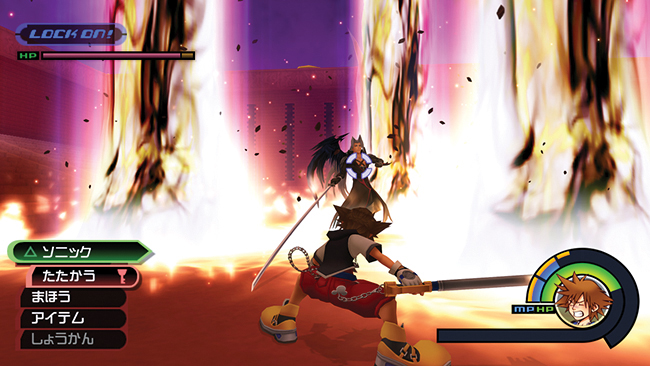
Played by Lance Bass. Because when I think "Sephiroth," I think soft pop music for pre-teen girls.

Played by Lance Bass. Because when I think “Sephiroth,” I think soft pop music for pre-teen girls.

On a final note, Kingdom hearts has some amazing optional bosses. I believe during my review of Final Fantasy VII, I described Sephiroth using the phrase “anemic guinea pig.” Well, this game finally does him some justice. To all those people on forums claiming Sephiroth’s difficulty compares to the final boss, well, no. Final boss fights need to display flashy effects and epic, cinematic moments. The final boss tells a story, but has to let the player through relatively easily. No one needs to fight Sephiroth. So by removing any and all requirements (seriously, you get nothing for beating him except bragging rights), Square finally made him hard as all fuck to beat. Oh, and they cast ‘N Sync’s Lance Bass to voice him. So I guess the anemic guinea pig still fits.

Fatal Frame II: Crimson Butterfly – PS2, XBox

Fatal-frame-II-screenshot-fatal-frame-ii-crimson-butterfly-11732067-640-480

I have to confess that this week’s entry has put me in a situation not unlike walking in on a room full of beautiful, lonely lesbians; I may have just discovered the best thing in existence, but I can’t praise it because of a single catch in the logic that renders it of absolutely no use to me. To give you an idea of how confused this game makes me, that previous sentence took approximately fifteen minutes to write.  Have you ever played a game so brilliantly designed that you wanted to erect a statue of it and place it at the top of the highest mountain so that everyone could see your rather weird graven image, but one thing about it just kept driving you insane until you decided you’d rather construct an effigy of the game and hang it, set it on fire, then pee on the ashes? Well, if not, I recommend Fatal Frame 2: Crimson Butterfly.

Fatal Frame 2 tells the story of twin girls Mio and Mayu, who after a shaky-cam montage that the player can only pray to the game to explain, find themselves in an abandoned traditional village after nightfall. After a bit of exploration, the girls start hearing noises and seeing glimpses of movement here and there.  Doors begin to unlock by themselves, and items appear in rooms when Mio and Mayu leave to search other rooms. Soon, they come across a camera with a note explaining, in terms only slightly more scientific than the average paranormal investigator uses to describe their own equipment, that it has the power to exorcise ghosts. And then Mayu displays the most astounding lack of survival skills in the history of horror, running off into the village full of angry spirits without her sister, who now holds the only means of defense against the supernatural menace.

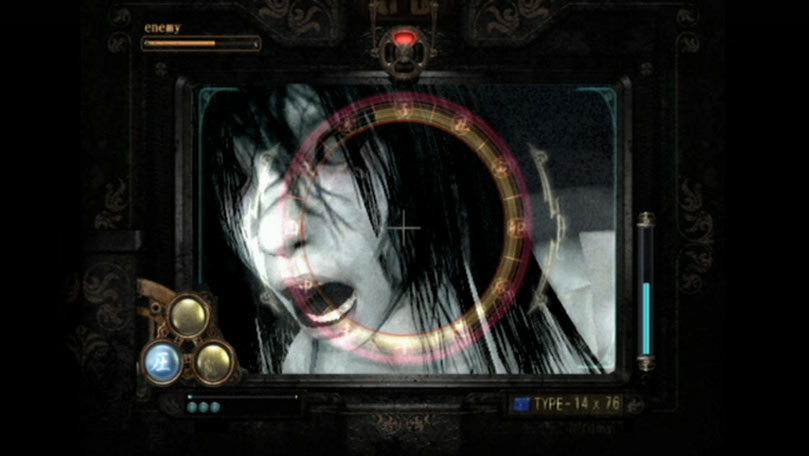
Most people believe they don't look good in pictures. Some people truly don't.

Most people believe they don’t look good in pictures. Some people truly don’t.

Fatal Frame 2 combines all the best aspects of successful survival horror games.  Like Resident Evil, the noises Mio makes as she traipses through the environment sometimes sound enough like ghost noises to keep you panicking.  Like Silent Hill, it creates an atmosphere of total isolation, garnished with introspection and the slight hint of a dark past.  The horror builds off of Japanese culture, especially the significance of twins and the mythology of butterflies, which many Western players will find unfamiliar enough to spook them (but relax; if you’ve seen “The Ring,” the game offers one scene of a ghost girl climbing out of a well). Furthermore, they took away the standard issue gun and replaced it with a camera, making the player feel completely helpless in the face of adversity–it even requires letting ghosts get close and attack in order to do any meaningful damage to them. Imagine a donut made out of birthday cake, filled with chocolate chip cookie dough ice cream, frosted with Oreo cream and topped with M&Ms; this game feels like that. (I’ve recently cut back on sweets…can you tell?)

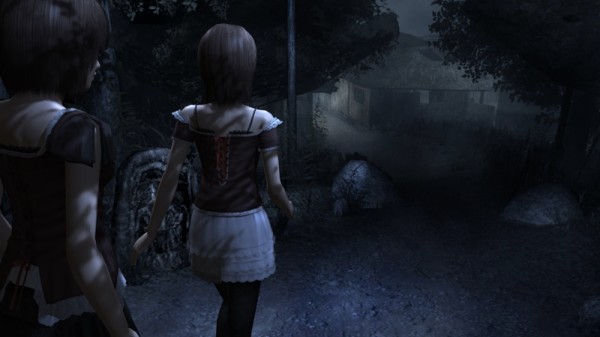
Now picture this without the edges of the screen, the girl following you, most of the girl leading, the house, the road, the trees and...well, see that lightly glowing spot at the center? I didn't see much more than that.

Now picture this without the edges of the screen, the girl following you, most of the girl leading, the house, the road, the trees and…well, see that lightly glowing spot at the center? I didn’t see much more than that.

However, Fatal Frame’s Fatal Flaw might just negate all of that.  Have you ever played a survival horror game that asked you at the beginning to “adjust the brightness until you can just barely see the gray line”? Well, this game doesn’t do that. It just assumes you like it dark. In fact, not only do you not want to see the gray line, but you don’t really care to see the text asking you the question, either.  What? You can’t see Mio? Well, you shouldn’t look at her anyway, given her young age. If you need to know what your environment looks like, you have a map. Use it! (I honestly spent less time following my GPS through downtown Minneapolis than I did checking the map screen for Fatal Frame).

If you manage to find a bright enough TV screen, you get to see an excellent rendering of a run-down, abandoned town.

If you manage to find a bright enough TV screen, you get to see an excellent rendering of a run-down, abandoned town.

While I understand what Tecmo intended by making the game darker than a chain smoker’s lung, and while I have to begrudgingly admit that certain scenes would not come across as terrifying in a lighter environment, I often needed to check the map to see what direction Mio faced, and due to the adoption of Resident Evil’s shifting camera angles, even that didn’t guarantee that I knew how to get her to move forward instead of back, slightly to the left, or directly into the nearby wall. Horror relies on senses, and the deprivation of one heightens the unknown, forcing you to interpret information more heavily with your other senses.  Good horror can overload those senses. However, video games lack texture.  You can drop a character into a pitch black room, but the player doesn’t entirely come along for the ride. A vibrating controller simply doesn’t substitute for placing your hand on something warm and gooey that you can’t see. One might as well climb into a sensory deprivation chamber and then have a friend dump a bucket of spiders on the outside. Yeah, it might scare you if you think about it hard enough, but you have a good layer of insulation protecting you.

It turns out that other people have had this problem as well, but no one could offer an infallible solution. Despite the game having the option to increase brightness, you can only increase it enough by finding a TV that naturally has a more vivid contrast. For the record, none of mine could do it. They both interpret an increase of brightness as watering down the picture with more white pixels. All in all, not very helpful.

See! This girl creeps me out more than any of the ghosts in the game

See! This girl creeps me out more than any of the ghosts in the game

I wish I could get past that because I did enjoy the game (at least what I could see of it). I can only describe the initial ghost encounters as “pants dampeningly scary,” and by the time the shock wears off, it feels as if some sort of character growth happened…somewhere. (I don’t know. They don’t really talk much.) Despite occasionally pairing up with Mayu, it doesn’t turn into a babysitting mission. Still, they managed to make her creepy enough that I started to feel safer without her around. True to the genre, the player learns Mio’s story as Mio in turn learns the story of the village. Also true to the genre, she does this by picking up scattered notebooks, letters, and other writings left around the village because apocalyptic horrors always result from a breakdown in private filing systems. If you ever notice disembodied pages from diaries lying around town, get out while you can; those places collect monsters like Gamestop collects used Madden games.

Because black and white scares people, reminding themof the dark days before Kodachrome and Technicolor

Because black and white scares people, reminding themof the dark days before Kodachrome and Technicolor

Unfortunately, not only did the lack of  vision and direction ruin the experience, but a plot full of dangling details never fully explained make the ending not quite satisfying (I played the PS2 version, but I heard they added endings for the XBox and Wii). Plus, while having doors unlock on their own adds to the creepy factor, it doesn’t give you that solid line on where to go next, like Resident Evil does when it hands you a specifically marked key.  And while the four houses in the village don’t really qualify it as sprawling, I’ve never enjoyed the “just walk around until something happens” mentality, which only pisses me off and sends me rifling through the internet for a walkthrough, a cardinal no-no in my book of game design flaws. Still, I have to give them credit for minimizing puzzles.

So I should probably lay out all the information to see my ultimate opinion of the game: creepy as hell, great atmosphere, nice departure from guns-n-ammo approach to horror, no stupid puzzle solving. On the con side: walking from room to room feels like solving a puzzle, shifting camera angles in the dark causes Mio to dance in little circles, and the ending falls just shy of explaining anything.  I can honestly say I have never played a better survival horror game, nor have I played a worse one.

Gauntlet – Arcade, NES, GBA, Sega Genesis

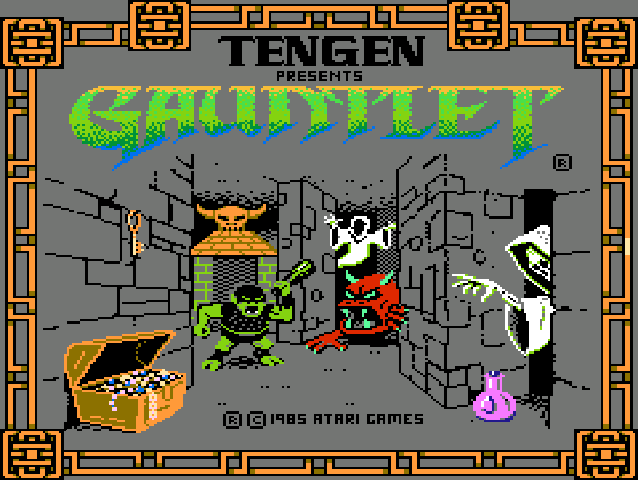
As none of my screenshots from the Sega version seemed to take, you get this title screen.

As none of my screenshots from the Sega version seemed to take, you get this title screen.

The more astute readers may have noticed already that the title of this week’s game doesn’t precisely match up with the list of consoles. Technically, I suppose, each of the installments merits their own entry, but even my power has limits; how much can I really write about a dungeon crawler with virtually no story involving extremely simple quests and objectives–namely, “get to the exit!” Because there you have it: my summary of the story. You choose your character at the beginning of the game; Thor the Barbarian, Merlin the Wizard, uh…er…Brunhilda (?) the Valkyrie or…let me look this up…really?…”Questor” the elf. Yep. They named the elf after his primary function in the game. Whatever…once the game begins, you make a mad dash for the exit of a small but labyrinthine map, after which the game whisks you away to the next bit o’ labyrinth. Oh, and on your way, monsters beat down on you from all sides as you gently push your way through them like rush hour in the Tokyo subway. Or you can shoot them, which I guess makes it more like the New York subway. And you keep this up for…good god, 108 levels?

I swear I went through this level about twenty times, each with a slightly different variation on the maze.

I swear I went through this level about twenty times, each with a slightly different variation on the maze.

Gauntlet, I’ll say, truly deserves its title. The game never relents in its struggle to violently dismantle both character and player; I could appropriately use the terms “rent” and “asunder”. And, full disclosure, I didn’t finish. Even after two and a half hours and an endless supply of credits, I got to level 52 and promptly celebrated by going to sleep. But even though I didn’t plow through another two hours straight of the crawliest dungeon of all, I came away from the experience with a deeper understanding of myself and the world around me. No really. You can learn some pretty profound truths playing Gauntlet. For example, gold really doesn’t have any value, even though you know you want as much of it as you can gather. Furthermore, your health ticks downward like a clock. Just like life. Also, as a single coin won’t get you to your second birthday party, Gauntlet reminds us that life favors the rich. Even without taking damage from a single enemy, you’ll gasp your last poorly-synthesized breath long before seeing the later levels of the dungeon, unless you keep feeding quarters into the machine like it’s that plant from Little Shop of Horrors; poverty-stricken valkyries can’t buy anything except the farm.

Also–true story–people with friends live longer. Gauntlet becomes exponentially easier with each player joining in, while reminding us why we hated group projects in school. Many of the corridors can only fit one at a time, so one player ends up doing all the work while the others kick up their heels and coast by without damage. Plus, each character has different stats, so while Speedy Gonzales the elf might lock on to the exit like a baby xenomorph going for a guy’s face, he’ll have to stand there and wait–his own health ticking downward, while his cousin, Slowpoke Rodriguez the Barbarian, catches up. Death appears as an enemy in the game, as much a bitch as in real life. Other enemies will vanish forever if you touch them (also like real life). Not death, though. You can shield yourself from him-hide behind a wall or something-but you can’t win and he won’t leave until he takes what he wants from you.

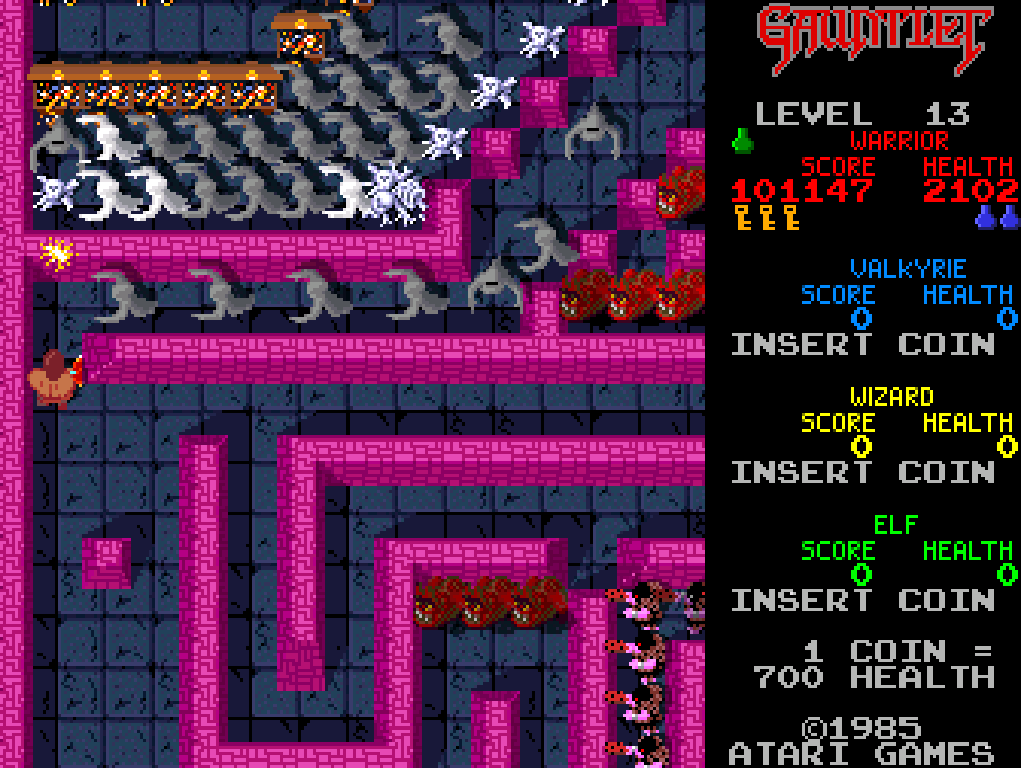
Note that a lot of these screenshots look alike. Gauntlet doesn't exactly offer much in the way of scenery.

Note that a lot of these screenshots look alike. Gauntlet doesn’t exactly offer much in the way of scenery.

But other than those random observations, the game offers as much variety as grocery store muzak, thus limiting anything really worth saying about it. Even magical, fantasy-themed maze solving starts to feel as exciting as fishing in an empty pond after the first few hours. Fortunately, the arcade version spawned a series not just of sequels, but different versions of the original–with each one even more original than the last!

After my last attempt to cycle through the same levels, plow through the same enemies, unlocking the same doors, and glancing over to check the same clock, a thought struck me; didn’t I buy a Game Boy Advance port of this game years ago? Might that have refined this system into something I could pause and come back to later without sacrificing all those hours of my life? After about twenty minutes of rifling through my Nintendo DS cases wishing I had periodically alphabetized the GBA cartridges stored there, I found it, plugged it in, and immediately shut it off. Here’s some advice to any developer/publisher interested in porting an arcade game–remember to let the players insert coins! This port didn’t change much from the original, but they bundled it with “Rampart” and stripped away any function that arcade cabinets could do that the GBA couldn’t. So don’t bother looking for coins. They give you one credit. Granted, they don’t skimp on the health, but I wouldn’t call them “generous.” Your health insurance can’t pay 100,000 for a pediatric checkup at birth and then call it good for life. Also, on this lifetime limit of health, you have to get through all 108 levels alone. The GBA doesn’t have a second-player controller, so the port doesn’t offer more than one player. I want to issue a challenge: anyone who can beat the Game Boy Advance port of Gauntlet, take a picture or video of the end–with the GBA or NDS visible in the frame–and I will immortalize your name alongside Odysseus, Aeneas, Beowulf and Arthur by writing–and posting–an epic poem about your victory.

However, while immortal fame remains inaccessible to me in handheld dungeons, the Sega Genesis port (released as Gauntlet IV) solves the issues from the GBA port. Amazing foresight, I’d say, considering it predated the Game Boy Advance version by over a decade. Gauntlet IV introduced different modes to the game. Arcade mode simulates the original hardware, allowing players who apparently never have more than $2.25 to their name, to “insert coins” for more health. You don’t get much health per credit, so this doesn’t immediately make the game playable, but you can fiddle with difficulty settings and maximum credits (as previously mentioned, up to a total of 9). Record mode helps a little; players can’t die and can use passwords to continue, but they have extra loading screens to breakdown their progress and weigh out their score based on health, enemies killed, and gold collected. I do take some issue with the game, as they felt the need to completely redesign most of the levels. It still feels like the arcade game, but all the cash you dropped into the machine as a kid won’t prepare you for the Sega release.

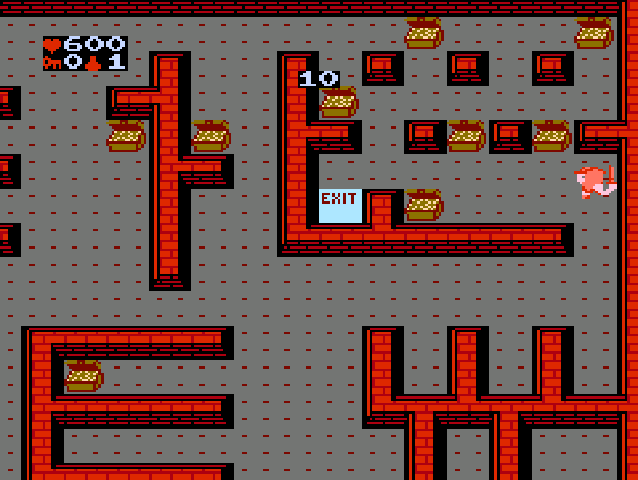
While pillaging and murdering your way through the dungeon, don't forget to stop and loot once in a while.

While pillaging and murdering your way through the dungeon, don’t forget to stop and loot once in a while.

Fortunately, quest mode rocks. Gauntlet IV introduced the concept of 4 towers to complete to gain access to a castle. Each tower consists of the same small-ish labyrinths, but they differ from all previous installments by giving the players the ability to freely move up and down levels, adding a vertical component to labyrinth-solving. The player has to locate specialized “trap” tiles that remove walls from key pathways, enabling them to get to the top. (Or the bottom. Apparently they felt that some towers needed inverting.) At the final floor of each tower, you fight a dragon. You can fight towers in any order, but difficulty increases (along with gold and exp received) each time you kill a dragon. Each tower has a specialized tile that impairs the player while standing on it. Unlike other installments, you can level up and purchase equipment, but enemies level up along with you, making the game as effective as using an exercise bike as your main mode of transportation; even if you get better at it, it doesn’t move any faster. Even so, I beat this version. Let me shout that from the mountain tops: I actually finished one installment of Gauntlet!

But I still have to navigate your stupid dungeons? Fuck you!

But I still have to navigate your stupid dungeons? Fuck you!

Even so, I don’t think I enjoy Gauntlet IV quite as much as the NES “port.” I say “port” lightly, since it features different graphics (downgraded for 8-bit), completely new levels, and six world maps with labyrinthine routes dependent on which exits you take in each level. Gold has a purpose; collect enough and your maximum health increases. Periodic treasure rooms (a staple of the series, previously as useful as Mega Man’s score system) now refill health if you find the exit in time. Best of all, you can pick up your progress using a password system (provided your hardware doesn’t fail when you try to start the game after you die….). The game does have one obnoxious drawback, though, in that along the way you have to collect parts of a password to get you into the final level. You can only find these in select rooms along the way, and you usually can’t access these rooms unless you find the secret exit in a previous level that takes you there. And if you miss the password, the game keeps going, but you can’t finish. Yay.

This exciting screen. Every. Bleeping. Level. It adds about an hour on to your play time.

This exciting screen. Every. Bleeping. Level. It adds about an hour on to your play time.

But for all the obnoxious tedium of these early Gauntlet games, I should clarify that, while I enjoy finishing games, I can enjoy a game without finishing it. While the term “dungeon crawler” usually sends me screaming for higher ground, I actually rather enjoy this, and I can probably recommend any of these games–well, maybe not the GBA port–as long as you don’t expect to see the end. And if you do see the end…let me know.


Jurassic Park: Operation Genesis – PS2, XBox, PC

jurassicgene_003-large
If you follow my blog regularly, rather than flip through in disappointment after your search for “sex” and “video game” turns up nothing but a wall of text with a few irreverently captioned images, you’ve probably found more than one review complaining about game series that sold out by porting a downgraded version of their original to a same-generation console just to make a few bucks (or a few thousand yen). While I do love to put on my big, black sanctimonious robes and pound my gavel in condemnation for these cash-grab attempts, I would disgrace the dignity and sex appeal of my big, curly powdered wig if I didn’t admit I can’t really make a general rule out of that practice. Fortunately, another sell-out genre of video game lets me keep up the pretence of blanket hatred on a much more regular basis: movie-based games.

Because Spielberg thought people would prefer an obscure species of predator to the historical favorite for the third film. Yeah. Smart move there.

Because Spielberg thought people would prefer an obscure species of predator to the historical favorite for the third film. Yeah. Smart move there.

I loved Jurassic Park. It came out the summer before fifth grade, and I never remember a movie scaring me more than that.  Give me a chair moving very slightly in a ghost story and I’ll pucker my naval in boredom. On the other hand, give the shark from Jaws a pair of lungs, legs, the intelligence to open doors, and a plausible-sounding explanation of how scientists might make them a reality, and I’ll lie awake at night, terrified, unable to sleep until eighth grade. Granted, some of that stemmed from the fear that the sun would go supernova and incinerate me in my sleep, but still…raptors! So you can imagine that after years of games like the weird top-down/first-person SNES adaptation or the Sega version where you play as a raptor, when I found a copy of Jurassic Park: Operation Genesis for $3 at my local Savers, I reacted with an emphatic WTF (and not just because I found out later that the game sells for upwards of $80 on ebay).

As the game simulates an alternative reality where John Hammond succedes, capitalism seeps into every aspect of the game, including visitor deaths.

As the game simulates an alternative reality where John Hammond succedes, capitalism seeps into every aspect of the game, including visitor deaths.

Operation Genesis shows an odd sense of self-awareness, showing the main characters from the film selling out their principles to make piles of cash.  John Hammond apparently has made a full recovery from his lesson in human endangerment for the sake of capitalism (or if we follow the book’s plot, his death by compies) and puts himself to the task of opening another park and profiting off tourists, despite the occasional fatality. Rather than advising about ethical ramifications of cloning a long-extinct ecosystem, Dr. Grant now digs fossils for the explicit purpose of extracting DNA for use by the park (however, the fact that they manage to obtain DNA from solid rock, which has completely replaced any organic material, causes me to question the validity of the cloned animals).  Dr. Sattler has apparently renounced her paleobotanist ways and now works as a nurse for sick dinosaurs.  And John Arnold, no longer holding a grudge against the dinosaurs that dismembered and devoured him, returns as the park’s operations manager.

Gameplay resembles sim games, with construction mechanics similar to Sim City, but with tourists walking through the park, apparently completely incapable of finding things like restrooms, restaurants, and the dinosaurs standing right on the other side of viewing enclosures. Oh yeah, and the game also includes dinosaur cloning.  Although the game drops you right onto the island with no instructions after a paltry five-minute loading time, if you’ve ever played a sim game in your life, it doesn’t take too much effort to pick up the tasks. The park needs an entrance, fences, and at least one dinosaur before you can open, at which point park admissions becomes your primary source of revenue, along with charges for viewing, eating, and for the serious dick players, using the bathrooms. Restaurants, cleaning stations, ranger stations, and other buildings help tourists leave to spread the word about how satisfied they felt after wandering, eating, peeing, and not getting gored to death in your park, raising your rating and by extension, your potential to profit.

Most of the amenities and attractions require research before you can build them because apparently your staff simply can’t grasp how a gift shop might work without someone writing a dissertation on the subject first. I know why they include this mechanic in the game–it lets the player prioritize, adding variety to each play through, and insuring that the park could, theoretically, fail. It also adds some credibility to the scientific aspects of the game.  I just fail to see how developing a vaccine for previously unknown diseases that will work on species whose biology we’ve only ever known through rocks shaped like their bones takes the same amount of time to figure out as how to drive a jeep through a field of duck-billed hadrosaurs.

They call this building the hatchery. I think it looks suspiciously like a raptor pen.

They call this building the hatchery. I think it looks suspiciously like a raptor pen.

The process of cloning dinosaurs from DNA adds a layer of complexity to the game, requiring just about every step actually involved in real-life cloning except for the applications and approval from ethics boards. You start by digging fossils from a randomly selected dig site which, props for authenticity, coincides with real-life locations where each dinosaur species lived. You can purchase extra dig teams to make the excavation faster, but each team costs twice as much as the one before it and the process still feels like it takes sixty-five million years to get anything you can use. Also, sometimes they’ll dig up gold, silver, or opals, which have no use, but you can sell them. I usually use the money on store-bought fossils. You know why? Because I’d rather have fossils than gold, silver, or opals.  Once you have fossils, you have to extract DNA from them. Each sample gives you a small portion of DNA for a single species. You need 55% or more to clone a dinosaur. Yeah. It takes a while. And at 55%, they die off rather quickly. I like to imagine mixed characteristics of dinosaurs and frogs. Slimy, amphibious raptors hopping around their pens, or T-rexes trying to catch flies with their tongues. Anyway, once you have enough, and pay a hefty fee, your dinosaur hatchery (which you need to build) will start incubating and raising your park’s attractions: one animal at a time.

Allosaurus, a member of the Tyrannosaur family, struts for the camera. See, even T-Rex has relatives that embarass him at Thanksgiving.

Allosaurus, a member of the Tyrannosaur family, struts for the camera. See, even T-Rex has relatives that embarass him at Thanksgiving.

While at thirty years old, I still love the idea of dinosaur cloning and hope for the possibility to visit a real Jurassic Park one day, I don’t really know if the main focus of the game should force players to watch the research in real-time. While you start with enough material to produce at least one dinosaur species, it can take years of in-game time to get a second. Each dig site has only three species, and the fossils put up for sale only match the species of fossils you’ve found. Furthermore, out of the nine sites available, you can only access three per save file, so you can’t actually get all the dinosaurs in the game for your park. The game moves at the speed of fish climbing out of the ocean, but it only takes four or five hours of gameplay before you realize that, even though the game itself has other options, it won’t let you do anything to make your establishment more awesome.

Theoretically, disasters can add some panic into the game. Apparently tropical storms and disgruntled employees shutting off the power don’t quite match up with the excitement of the occasional twister (what, did you just copy and paste the coding from Sim City?), which can either add mild amusement in the need to follow along behind it immediately repairing fences, or it can game over you if it happens too early on.  Dinosaur rampages–supposedly–cause more trouble, but I’ve never had an animal break out of its fence, even when I had the T-rex in minimum security pens.

Nausea mode: where the camera jiggles, and the vomiting player simulates shooting dinosaurs on the ground below.

Nausea mode: where the camera jiggles, and the vomiting player simulates shooting dinosaurs on the ground below.

The game also offers a mission mode, with some alternative gameplay. The first mission asked me to drive a jeep around an island, photographing various species to prove to investors that the park really did clone dinosaurs–or knows how to use Photoshop. The second mission put me in a helicopter, gunning down rampaging carnivores.  The game lost me on that one–for a vehicle designed with the ability to hover, it handled like a gift shop balloon in a strong breeze.  Again, if they intended to nauseate their players, mission accomplished, but I just couldn’t live up to the task of operating a helicopter, machine gun, and vomit bucket at the same time. The reward for completing ten missions  lets you release all your dinosaurs onto an island without disease or people and just watch. No thank you.

You know what I’d rather do? Go read the damn book.

Assassin’s Creed 2 – PS3, XBox 360, PC, OSX

Ezio enjoys fine wine, long walks on the rooftop, and flinging himself off towering buildings as if a plate of steel and a pile of hay will help him survive.

Ezio enjoys fine wine, long walks on the rooftop, and flinging himself off towering buildings as if a plate of steel and a pile of hay will help him survive.

Years ago, a friend of mine had me play a little bit of Assassin’s Creed to kill time.  I didn’t get through much–just the first few tutorials–but it intrigued me.  Then after hearing the entire video game community collectively climax over the series (and finding a copy of Assassin’s Creed II for $6 at GameStop), I decided I needed to see what had absconded with everyone’s attention for so long.  Having just finished the game, I think I can capture its true essence with one sentence; Assassin’s Creed II allows players the rare opportunity to travel through time to visit the wonders of Renaissance Italy, see the sights from the heights of marvelous buildings, travel through the streets of Venice in a gondola, and meet historical personalities both famous and infamous…and then kill them.

Our hero: daring, bold, eager, cross-eyed, and 100% irrelevant to the plot.

Our hero: daring, bold, eager, cross-eyed, and 100% irrelevant to the plot.

Mixing sandbox-ish and platform-ish designs, Assassin’s Creed II provides 20-ish hours of interesting-ish gameplay.  The game opens with Desmond Miles busting out of  an Abstergo holding cell with his noticeably cross-eyed love interest in a thrilling escape sequence that I assume would make sense had I played the first game.  After establishing some stuff about the battle between the Templars and the Assassins, Desmond straps himself into a virtual reality machine called the Animus in order that we, as players, may forget everything we just learned about Desmond to focus on the real story; Ezio Auditore, a cross-eyed,15th-century nobleman, takes revenge on a conspiracy for the murder of his cross-eyed father and brothers. After their deaths, Ezio discovers his heritage as part of the Assassin organization, and he sheds his plain, average garb of a Florentine in favor of a gaudy white robe, hood, and armor that…helps him blend in with the average folk around him.

I know the frame story would (likely) make more sense in the context of the other games, but honestly I just don’t care. Video games have never needed story arcs or direct sequels before, and it actually sort of helps if they don’t. After all, Hollywood can expect people to pay three dollars at a Redbox if they want to understand the latest money-desperate sequel before, but games that charge a minimum of $30 and then require an hour of gameplay per dollar spent, I’d much prefer skipping to the better games rather than paying the time and money to play them sequentially.  Case in point: when I bought this game, I asked the guy at GameStop which Assassin’s Creed game he recommended I start with.  He suggested this one, and I thanked him for his expertise. Then Anne asked the girl working in the store whether she could recommend Disgaea 3 or 4.  She suggested starting with 3 because “It comes first, so you don’t want to miss out on the story,” and we both wondered how often she sleeps with the manager to keep her job.

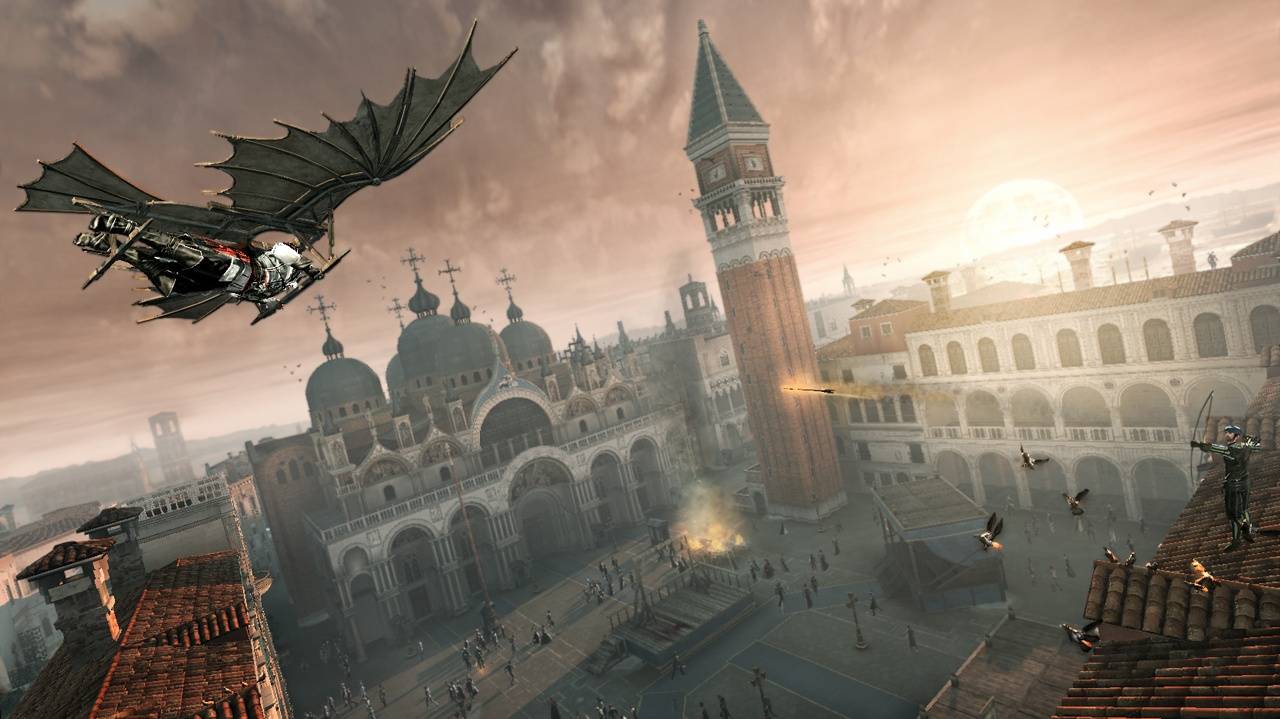
Ezio flying on a da Vinci prototype. I wanted to make a joke on decoding, but they actually have Leonardo crack codes--with all seriousness--regularly in the game.

Ezio flying on a da Vinci prototype. I wanted to make a joke on decoding, but they actually have Leonardo crack codes–with all seriousness–regularly in the game.

Still, even with the solid storyline following Ezio, I didn’t exactly burn with desire to uncover the story–even with the plot-based sub-quest with its own menu section cleverly titled “The Truth.”  Ezio’s–and by extension the game’s–existence depends on killing people, the story does the bare minimum to prop up that premise. But since the term “assassin” implies a political murder, and since they seemed to want a fairly credible historical plot–at least until they start casting magic spells during the final boss fight–the writers had their hands full trying to tie together a series of actual murders, while also referring to any minor skirmishes along the way as “assassinations” as well.

At its heart, ACII revolves around stealth, which along with babysitting missions and quick time events, end up topping lists of things most likely to inspire players to send dead animals to the game designers.  However, while not quite as effective as Batman: Arkham Asylum, the stealth mechanics don’t detract from the game. Note that I say “don’t detract from,” not “add to.”  They don’t really encourage covert behavior, as the player has too many options for reducing notoriety among the NPCs.  For instance, you could lure citizens away with a handful of coins tossed into the street, then drop the body of a guard killed quietly on a rooftop down to draw the attention of a larger group of guards, then blend in with a crowd until you reach the guarded treasure–or you could just stab the guards in broad daylight, then turn around to find one of hundreds of posters plastered throughout the city with your face on it, tear it down, and everyone will forget that anything happened, despite the 99 other posters still hanging in plain view.  I ended up running, leaping, climbing and flipping through city streets littered with corpses, all with blood trails leading directly to me, and no one cared.  And if anyone did voice concern that I ought to not hang out on the roof of the palace, I could just stab them in the throat, rip down another poster, and continue on with my business.

I so rarely get the chance to depict a complete combat sequence using a photo instead of a video. . .

I so rarely get the chance to depict a complete combat sequence using a photo instead of a video. . .

While I have to admit in a certain level of satisfaction in walking up to an unsuspecting victim and thrusting my long, hard, rod of steel into their skulls, or leaping down from the sky to flatten them beneath me, breaking my fall with their spines, I mastered that very quickly in the game.  Because Ubisoft focused on historicity and realism, though, they didn’t escalate the abilities of enemies.  While yes, I have often wondered how so many Final Fantasy enemies can withstand explosions, gunshots, and swords through their torsos without so much as a strong cough throwing them off balance, I understand the reason for this; it keeps the game from getting stale.  ACII starts off at a reasonably simple difficulty setting, then as the player gains stronger weapons and armor it…well it doesn’t really change much at all.  Equipment doesn’t noticeably change your performance, enemies do just as little damage to you all throughout the game; even as you gain more health, it only allows you to stumble off of taller and taller buildings. And no matter how sharp your knives get, they can’t murder someone any more than “completely dead.” It gave me the option of using a poisoned blade at one point. I never even figured out how to use it, since stabbing them in the throat proved just a little more effective.  So the game basically provides a series of platforms to help an Italian guy kill enemies in one hit by falling on their heads. Great, Ubisoft. You’ve invented Super Mario. Except cross-eyed.

Ezio staring at the hand of the King of the Cosmos, which could easily go unnoticed as the player doesn't need to focus on much except the radar in the lower-right.

Ezio staring at the hand of the King of the Cosmos, which could easily go unnoticed as the player doesn’t need to focus on much except the radar in the lower-right.

“Up yours, Jake!” You say? “This won game of the year!” Yes…so have lots of games. Each year, I might add. People hand out game of the year awards like copies of The Watchtower. I know I’ve pretty much panned a super-popular game, but if you’ll stay with me, I want you to consider one more thing; pretend you don’t see anything that doesn’t actually have a function. If entire cities become either smooth or climbable walls guarding the occasional treasure chest full of money that becomes obsolete by chapter five, or platforms to walk on or swim through, then you’ll stop seeing any variation in the different locations. Each city contains the same assortment of posts, ladders, haystacks, etc, and except for the framing story not allowing access to certain parts of the map, you can access any area regardless of skills learned, immediately. All the sandbox-ish missions blend together–run through some section of town very fast, get in a fight, or kill some guy–with no bearing on the plot and no reward except the practically useless cash.  Even the main missions only redeem themselves by advancing the story.

Our cross-eyed hero, from the front. Seriously. While it doesn't add anything that the previous shot didn't show you, I literally could not find another shot of gameplay.

Our cross-eyed hero, from the front. Seriously. While it doesn’t add anything that the previous shot didn’t show you, I literally could not find another shot of gameplay.

While most games offer less actual variety of play than they seem, ACII pretty much consists of nothing except follow your radar to the next point on the map. Occasionally, you press a button once you get there–and not even like a quick time event, either.  At the very beginning of the game, Desmond approached the Animus virtual reality simulator and the game told me to “press any button.” No timer. No encroaching threat. Nothing. While quick time events have always annoyed me, Ubisoft found something even more pointless: the slow time event.  They provide an over-abundance of most missions with little or no variation in them, and it ends up turning into a geographical scavenger hunt more than anything else. Furthermore, traditional platformers required the player to properly assess the physics engine so as not to fling themselves past ledges and into the gaping abyss beyond like a Depression-era stock broker, but as this makes 3D platforming about as easy as juggling angry magpies, so the player only needs to hold down the X button to automatically hit the next ledge, pole or brick conspicuously sticking out of the wall for the eager climber.  But not to sacrifice difficulty, they made the controls hypersensitive to directly, so at any moment–usually while the camera auto-rotates–Ezio could flip along his public trapeze and then suddenly turn and leap crotch-first into the nearest wall, then slide down to his death like the world’s least-funny Looney Toon.

I don’t really understand the hype around this game.  Look at the pictures I posted; notice how little gameplay you see? When you google screenshots for a game and only get photos from the trailer, you can guarantee the developers did that to hide the lack of interesting gameplay from the market.  So I guess it kept my interest, and I got through the whole thing, mostly in the way my students get through the books I assign–they get bored halfway through, then skip to the end, using Spark Notes to fill in the gaps. And seriously…with as much detail as the PS3 can render, why does everyone have crossed eyes?

Final Fantasy VII – Playstation, PC

Title

Thank god they fixed this! Why, I could almost hear the fabric of society bunching up around my nethers!

Thank god they fixed this! Why, I could almost hear the fabric of society bunching up around my nethers!

“They say words like ‘hell’ and ‘damn’ in it,” my friend John told me about Final Fantasy VII in ninth grade. This sums up the major features of the game quite nicely. Sure, at the time it came out, people hailed it as a demonstration of the cinematic powers of CD-based game consoles, but anyone who played it knew that it really demonstrated Tifa’s enormous rack as it jiggled like two shopping bags full of Jello when the explosion at the northern crater shook the Highwind–the game also demonstrated what Squaresoft could do when not oppressed by Nintendo of America’s horribly oppressive censorship requirements.

...Cloud, on the other hand, looks like he'd prefer some private time.

…Cloud, on the other hand, looks like he’d prefer some private time.

Final Fantasy VII almost needs no summary. Everyone knows about it by now. It changed the video game scene; believe me, I took weeks to decide whether I’d say that or not. People have made that claim about FFVII all over the internet–as they have about FFIV, FFVI, FFX and just about any new piece of technology that comes out. If you locked me in a room with ten dozen donuts, you wouldn’t especially look at the first one I ate and credit it with having special sprinkles with the power to break my will; it would have happened eventually.  However, the events surrounding the game’s release did successfully allow a number of things to happen.  Well, mostly it only took Square getting royally pissed at Nintendo for not giving them a CD-based console to work with, so that let them make the switch to Sony, which propped up Playstation as a major competitor in the market, leaving Nintendo wallowing in the dust trying to figure out how to entice their customers back without actually offering any good games.

"Must look intimidating...can't let them see...hair burning..."

“Must look intimidating…can’t let them see…hair burning…”

Still, I’ll concede that not everyone reading this has played the game, so I’ll sum it up: The multi-conglomerate Orwellian corporation known as Shinra, or in short, “Big Mako” have discovered an energy source even better than the sludge left over from decomposed corpses–the souls that used to inhabit those corpses.  Pulling the spirits of the dead out of the planet, they compress them and convert them into electricity so people can play video games (among other things), which naturally pisses off the local hippies.  Except rather than a skinny little white guy with a guitar and bloodshot eyes, a seven-foot tall powerhouse of a black man with a machine gun grafted onto his arm leads them, along with his double-D companion, Tifa, and her brooding, stormy, anti-social childhood friend, Cloud. Their game of cat-and-also-cat ends when one of Shinra’s old mistakes–a genetically engineered super-soldier with the DNA of an ancient monster sent to destroy the planet–arrives and plants a Nodachi two meters long into the President. Yada yada. Sephiroth burned down Cloud’s and Tifa’s hometown and now plans to destroy the planet, Cloud and his friends stop him.  The game ends, and the player looks up pictures of Tifa’s breasts on the internet.

So what do you think...they look fake, don't they?

So what do you think…they look fake, don’t they?

Although I joke about Tifa and her apparent fan following of CGI Animators on redtube, I truly believe in the necessity of adding a character with a large amount of sex appeal.  And not just her, but also Barret, his constant stream of profane tough-guy talk, his place as the only black guy in the entire fantasy genre except for that one dude from the Neverending Story, and the subtle gay vibe between him and Cloud.  Also, the comical string of obscenities that Cid spews forth could scour the rust off a car.  These things indicated that Squaresoft wanted to treat their audience like adults.  Games have aged since Donkey Kong, and so have their players; gone are the days of staring at Celes’s 16-bit pixilated sprite and trying to imagine something a little more photo-realistic.  I love the whimsical nature of those early games, but people actually seem to live in this world. Characters have speech patterns and dialects and everything.

Furthermore, in designing the combat system, Squaresoft took this notion of well-developed, distinct characters…and chucked it right into Ifrit’s hellfire. Custom characters have long attracted players to the Final Fantasy series. Games like Final Fantasy IV gave us special abilities like Kain’s jump or Rosa’s pray. Three and five (and later Tactics) allowed characters to learn skills permanently to equip in specialized combinations. Six mixed that, with character-specific skills and the ability to permanently use magic and raise stats. So naturally, we would expect something brilliant and revolutionary, now that we have 32-bits to utilize, right?

Same old ATB, stand-in-a-straight-line combat system, but with runaway summon animations lasting over two minutes!

Same old ATB, stand-in-a-straight-line combat system, but with runaway summon animations lasting over two minutes!

Nope! Forget all that–it all boils down to materia.  From the beginning of the game, any character can equip any materia–crystalized mako energy containing the knowledge of the ancients–which can let them cast magic, summon monsters, perform special abilities, augment other materia, or raise stats. The game only limits you by how much materia you can afford/find and how many slots your weapons and armor has to put them in. Characters can’t retain any of this once unequipped, so only limit breaks–powerful attacks only available once a character has received an amount of damage proportional to the power of the attack–and physical appearance in battle differentiate one character from another. And the game chucks characters at you like it wants you to sign up for its online dating service; with nine characters, parties of three or less, plus the old-school restriction of requiring the protagonist to lead your party at all times, I always have two or three who sit on the sidelines for the whole game, just to save money equipping them and to focus on building up the limit breaks for the more interesting characters. Which, yes, I usually choose based on physical appearance, in light of anything else. Which means the dog and the toy cat usually get bumped in favor of Tifa and Yuffie. And quite possibly Barret.

Anyone who's ever raced a chocobo knows the triumph every time you defeat Teioh...and the pathetic reward that usually follows.

Anyone who’s ever raced a chocobo knows the triumph every time you defeat Teioh…and the pathetic reward that usually follows.

Fortunately, though, Squaresoft packed more into this game than a hackneyed combat system and a questionable set of feelings for an electronically generated configuration of polygons.  In fact, I usual enjoy playing this game to completion.  Likely in attempt to show off the Playstation’s capabilities, FFVII includes a plethora of mini-games including a submarine battle, motorcycle chase, and a snowboard sequence so obnoxiously difficult that it only proves Cloud can run into more walls than Wile E. Coyote.  Furthermore, at the end of the game you open up the option to breed generations upon generations of chocobos–obviously the best hobby to take up with only seven days left to global annihilation.  You can raise chocobos to race, or try to raise special colors to help find all those hard-to-reach areas of the world map.  Again, I enjoy this, but sometime the task takes way too long, and the games variables don’t really feel truly random–while each race offers a 1 in 6 chance of winning the good prize, I seldom actually walk away with anything I couldn’t buy in any one of the hundreds of identical shops in the game, and quite often when trying to breed chocobos that can mate with each other, you’ll end up getting the wrong gender or the wrong color several dozen times in a row.

Final Fantasy VII also offers two bonus bosses, similar to the hidden bosses from FFV and the original Final Fantasy.  The Emerald and Ruby weapons make up for the plateau of difficulty toward the end of the game.  This presents a conundrum though because even though these bosses exist to add challenge to the game, in order to take them down you have to level up far more than necessary for anything else in the game, and it takes the punch out of anything else you’d do.  And while Sephiroth stands as one of the most iconic, impressive villains in any fantasy storyline, it generally disappoints me when I get to that final battle and he fights back with all the strength of an anemic guinea pig.

He's too sexy for his shirt, so sexy it hurts! He's too sexy for that sword...

He’s too sexy for his shirt, so sexy it hurts! He’s too sexy for that sword…

However, despite the overpowered characters in act three, frustrating random number generator, and a protagonist with forearms like Popeye, the storyline makes this game well worth playing. The save-the-planet eco themes offer, well…actual themes in a game’s storyline.  Sephiroth captivated so much attention by defying the obnoxious tradition that fantasy has of presenting magic-using villains, and the final scene with him carrying two meters of solid steel and dressed like a Chippendale dance only cements the fact that for once, just once, the villain earned his role in the story by acting like a dick to the protagonist, rather than because we all need to learn about how idolatry will lead us straight to Hell (thank you, C.S. Lewis, for welding Christianity into fantasy literature for all time…can we please talk about something else?). And, of course, spoiler alert, while FF characters have died before, nothing tops the moment when we lose Aerith forever. As I explained to my class the other day while doing the video-games-as-literature lecture, “When this happened, I cried like a baby!…no, you don’t understand, this happened like, two weeks ago.”

So to all those people who “debate” whether FFVII or FFVIII leads the series as the best game…WTF? You totally can’t compare the two.

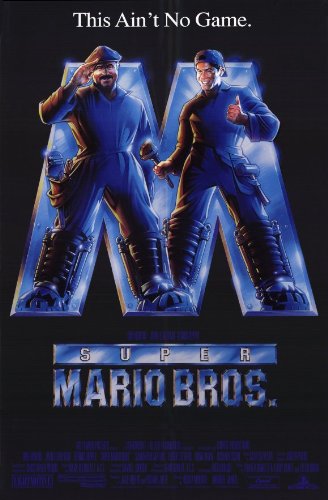
Super Mario Bros. – 1993 Movie

Out of all the decisions this movie made that I don't like, I actually agree with their choice of tagline.

Out of all the decisions this movie made that I don’t like, I actually agree with their choice of tagline.

Not many people respected video games in 1993. I had spent the better part of four years obsessed with the idea, though, and after begging and pleading for my parents to let me buy a used Nintendo and a hoard of crappy sports games from one of my dad’s students, I finally got my wish and had my very own box of magic entertainment—which they promptly made me sell if I wanted to buy the Super Nintendo. Needless to say, I often felt treated like a leper for basically wanting to entertain myself. My community of friends at school extended about half the distance of a normal nine-year-old, so I had a great deal of trouble seeking out like-minded individuals to discuss the finer points of proper Mega Man boss order, how to make Link’s tools from scrap wood lying around the house, and whether or not a power-up mushroom would jump back out of the lava and let you grow to nearly the size of the screen (Note: It never happened…until the New Super Mario Bros. I think Nintendo had spies listening in on our playground conversations).

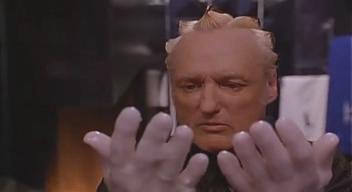
King Koopa: Fearless, terrible, all-powerful, and obsessive germophobe

King Koopa: Fearless, terrible, all-powerful, and obsessive germophobe

Captain N: The Game Master and the Super Mario Bros. Super Show aired irregularly and infrequently, so when they announced a live action film version of the game, I just about had a nine-year-old aneurysm from over-stimulation. A video game movie! How did God approve that one? Did the grown ups know about this? Fuck yeah, they knew. They just didn’t care—as evident by the movie itself. See, I recently looked up this milestone film for old time’s sake…then shut it off halfway through. But then I obtained the rifftrax file to sync up with the movie and then…then! I could get through the film without vomiting out of my ears from the horror.

The keen observer may notice several subtly placed allusions to the Super Mario Bros video game series. To examine the effort they put into making this movie, I want you to read the excerpt from the NES instruction manual (I assume from the movie’s title that they decided to skip Donkey Kong and Mario Bros and go straight to Mario’s upgrade to Super):

“One day the kingdom of the peaceful mushroom people was invaded by the Koopa, a tribe of turtles famous for their black magic. The quiet, peace-loving Mushroom People were turned into mere stones, bricks and even field horsehair plants, and the Mushroom Kingdom fell into ruin. The only one who can undo the magic spell on the Mushroom People and return them to their normal selves is the Princess Toadstool, the daughter of the Mushroom King. Unfortunately, she is presently in the hands of the great Koopa turtle king. Mario, the hero of the story (maybe) hears about the Mushroom People’s plight and sets out on a quest to free the Mushroom Princess from the evil Koopa and restore the fallen kingdom of the Mushroom People. You are Mario! It’s up to you to save the Mushroom People from the black magic of Koopa!”

We all know about Mario's predeliction for sea food...no jokes about Bertha swallowing him whole, though.

We all know about Mario’s predeliction for sea food…no jokes about Bertha swallowing him whole, though.

Excellent! A single eighth of a page of source material, and the screenwriters have plenty of information to work with. The first sentence alone provides us with a premise, a setting, a victim, description of the villain and a pretty strong clue as to their methods. As a writer myself, I know exactly where I could go with mushroom kingdom and black-magic wielding turtles—obviously to mammalian, humanoid evolutions of dinosaurs in modern day Brooklyn. Perfect match!

Seriously, if you need compelling evidence that the free market economy does not follow natural rules that inevitably leave customers with the highest-quality product that will satisfy them, look no further than this movie (although any other video game movie offers pretty good support to this thesis). I imagine they met with the screenwriter and said, “So we have a simple premise. A plumber…”

“Yeah yeah. Whatever. Mario rides that Yoshi guy my kid won’t shut up about, right? Some story about dinosaurs. Got it, got it. Now leave me alone.”

I have to credit the writers with creativity, though. For those of you who know the premise of the game…well, forget it because it will only confuse you. A mysterious narrator who only appears for the film’s opening explains that the meteor at the end of the Cretaceous period didn’t kill the dinosaurs, but split them off into a parallel dimension where they evolved in a way that eliminated the need for hiring a costume design team. Koopa, in the only fraction of the film that resembles the game in any way (kinda), turned the King into a fungus using his…magical?…de-evolution machine and set himself up as an Orwellian despot, keen on invading neighboring dimensions for lack of any actual neighbors to invade. Although Princess…uh, Daisy (really? The one from the game boy? Okay then…), while not possessing a mushroom’s sack worth of power to challenge Koopa, happens to have a fragment of the meteor that somehow can unite the two dimensions, sort of like a cyberpunk Dark Crystal. Except her mother abandoned her in Brooklyn, where she grew up and fell in love with…uh, Luigi? Really? What, did the director really feel that fans would respond better to Mario dating someone out of My Cousin Vinnie than the Mushroom Princess?

Who could forget the loveable, chestnut-mushroom...hulking ape-lizards that...dance?

Who could forget the loveable, chestnut-mushroom…hulking ape-lizards that…dance?

Meh. Forget the story. If you really want to understand how badly these guys missed the mark, they cast Dennis Hopper as Koopa. Dennis. Fricken. Hopper. Why not just hire Quentin Tarantino to write the script and hand it to Martin Scorsese to direct? Silence of the Lambs came out only two years earlier…I think Anthony Hopkins could have done an excellent job as Mario, don’t you think? Who casts Dennis Hopper in a light-hearted fantasy about mushroom people? And they didn’t stop themselves with turning Koopa into a calculating, predatory monster. Nope. Goombas (and I think koopa troopas?) became towering, 8-foot tall behemoths. Big Bertha became a bad-ass gangster woman who outweighs Mario and Luigi put together. Toad appears as a folk singer. A folk singer! I rather enjoy folk music, but when the source material describes his job as “Mushroom Retainer,” I expect him to pick up his sword and stoically fight off Koopa’s minions to his last feudalistic breath, not sparking up a doobie and serenading us about the evils of anti-union robber barons. The harmonica doesn’t quite have the same power to change the course of politics as a claymore to the skull.

Oh, God! Dennis! Keep that thing to yourself. You already make us feel uncomfortable.

Oh, God! Dennis! Keep that thing to yourself. You already make us feel uncomfortable.

Let’s run down a list of game elements that may potentially remind Mario lovers why they wanted to see this movie. Mushrooms? Nope. Castles? Nope. Fire flowers? A few enemies use flame throwers, but I think those found themselves in the film by accident. Jumping—you know, Mario’s original name? Accomplished once or twice—sorta—via rocket-powered shoes. Koopa Kids? Turned into Koopa’s cousins (well, one of them, at least), but bear a stronger resemblance to Dumb and Dumber than anything else. Yoshi? Looks like either an emaciated velociraptor or a baby skeksis who might die under the weight of a saddle. Turtles of any kind? They didn’t even spring for used costumes from the Teenage Mutant Ninja Turtles movie. Going through pipes? Maybe once, I think. They didn’t even have the decency to make anything in the movie out of bricks.

“Well, you got anything from the game?”

“Mario uses a bob-omb.”

“What? No catches?”

“Well, it wears Reeboks.”

“Perfect. They’ll love it!”

Over twenty years have passed since people started making movies based on video games, and no one has yet figured out that these movies wouldn’t epitomize the finest points of turtle shit if they bothered to write a script actually based on the games. I’d like to make an offer, and since most google searches that lead to my blog involve the terms “bdsm pc game,” I can reasonably expect plenty of viewers from Hollywood; I will, free of charge, write you a good script based on a video game. Absolutely free. I guarantee I know how to do it better than anyone who has ever written a video game movie. I only demand that if people actually like it, you have to do every video game movie the same way.

Mamma mia! Did we a-just make-a this piece-a of shit?

Mamma mia! Did we a-just make-a this piece-a of shit?

I’d love for a chance to re-make Resident Evil into a horror film, or write a Silent Hill script that follow’s James Sunderland’s crippling guilt. I wish I didn’t have to point out to Square Enix how they screwed up Final Fantasy: The Spirits Within by making it sci-fi instead of fantasy, setting it in New York instead of Midgar, leaving out swords, moogles, chocobos, airships, summoned monsters and everything else that actually makes it a Final Fantasy storyline. At least they haven’t gotten their meat hooks into Metroid or Castlevania.

And Hollywood, if you don’t take my offer…at least give us the Mario Bros remake with Hopkins, Tarantino and Scorsese. Now that I’ve had a chance to think it over, I’d actually like to see that.

Resident Evil: Deadly Silence – NDS

You should take solace in the fact that the spiders still qualify both as "big" and "hairy."

You should take solace in the fact that the spiders still qualify both as “big” and “hairy.”

I might compare art to beautiful prostitutes; lovely, inspiring, everyone has seen them, and people everywhere feel an instinctual need to do them both, but no one wants to get caught giving them money.  Sadly, despite all our magnanimous feelings toward art, if it doesn’t turn a profit at the end of the day, it doesn’t happen, and as the $400 average price for a current generation system will attest, video games, while creative and artistic endeavors, still need to turn tricks to keep afloat. If you’ve read my recent entries, you’ve heard me rant about Nintendo’s efforts to package the portability of Game Boy games over any actual quality of games. Their breakthrough efforts with the DS gave us an onslaught of games, and statistically speaking we could expect many good ones in the pile of broken coding. However, that didn’t stop them from porting the 1996 classic, Resident Evil to yet another system to make a quick buck on making it portable.

...these guys. Still hate 'em.

…these guys. Still hate ’em.

To Capcom’s credit, they try to make this game more interesting every time they expect us to shell out more cash for their new edition. The major feature of Deadly Silence builds off the DS (I see what you did there!) hardware.  Although cheap and gimmicky in places, I can’t really lament REDS the way I would other game ports.  The game practically invented modern survival horror, and as such it works because it embraces horror elements such as fear and surprise. While essentially the same as the original PS1 version, I have to begrudgingly admit that they’ve altered it enough so as to keep it fresh and startling.  Since the game actually features two modes–classic and rebirth–and since they didn’t really do anything but a straight-up port for classic, I’ll concentrate on rebirth mode here.

Immediately I noticed they fixed the knife mechanics. I really enjoyed the knife in RE4, and found it quite satisfying to take down monsters by a quick jab to the knee caps and repeatedly plunging the blade into their parasite-ridden flesh like Dexter, reveling in the squishy noises until that last groan tells me to to look for a new victim. Unfortunately, the knives in earlier games don’t provide such a cathartic experience, and serve only to sacrifice the number of useful items you can carry in exchange for the ability to play “here comes the airplane” with zombies, thrusting what can only look like a juicy piece of meat directly into their all-too-willing jaws. Instead of offering yourself up as bait, the knife remains equipped like it does in RE4, under control of the left shoulder button, and it actually damages the zombies enough to make it a worthwhile weapon. And I know that people say it’s always worked against the spider, but do you know what works better? A fricken flame thrower.

...because he should really see a doctor if his blood has the color and consistency of the green ketchup.

…because he should really see a doctor if his blood has the color and consistency of the green ketchup.

As another nice feature, which completes my list of any actual differences between the original and the remake/port, the top screen of the DS displays both a map of the mansion and the player’s current health status. While the flashing colors to display injuries doesn’t make it less cryptic, still leading to the inevitable question of whether or not it hurts enough to only take a few aspirin or to inject that case full of morphine directly into your brain, it at least removes the need to open a menu and give the character time to reflect on the nature of wounds and come to grips with their inevitable mortality.

Jill learned this in 'Nam.

Jill learned this in ‘Nam.

Some of the puzzles have different mechanisms for solving: use the microphone to blow out a candle, use the stylus to draw in wires or jiggle a sword out of a door. These really add nothing to the game other than the altered layout of items forces you to take a new route, which causes you to backtrack through areas that may or may not have new challenges. Keepin’ it fresh, eh, Capcom? The real addition involves a mini-game sequence activated semi-randomly as you enter a room. The player shifts to a first-person perspective and requires use of the stylus to hack and slash a rush of monsters. Specific attacks can stun monsters, otherwise they plow through to your tasty brains, oblivious to the holes opening up in their torsos. I enjoyed this, more or less, but during the more frustrating onslaughts I couldn’t help but ask, “If Jill had a fully loaded shotgun as she walked through that door, why did she feel the need to combat this 15-meter, venomous snake like a boyscout whittling a marshmallow-roasting stick?”

Yes. We get it. Jill Sandwich. Sounds funny. Now shut up and edit the script.

Yes. We get it. Now shut up and edit the script.

Beating the game once unlocks a more developed version of this, called “Master of Knifing,” which also suggests that Capcom decided to embrace, rather than repair, acting so bad that the actors refuse to list their full names on IMDB. Yes, we all know about the “Master of Unlocking” and the “Jill Sandwich” lines, but seriously, the actors read every line like a mommy reading to an infant that doesn’t speak English yet. And the mommy has never heard anyone speak English or use inflections or tone of voice. They had the decency to rethink the puzzles and the layout and to fix the knife and all that; did it never occur to them to wander over to the nearest high school, pull a handful of the extras out of an Our Town rehearsal and spend ten minutes with them to get a performance far superior to the original cast?  Did that take bit of energy cross the line, or did they just really enjoy a performance stitched together from the discarded audio of 1980s cleaning supply infomercials?  Just because the game sold well and people had a good laugh at the lousy actors doesn’t mean it should stay that way.  Resident Evil built its fame on setting tone and using creepy sounds to scare the shit out of both ends of the player; the acting not only breaks that tone, but reverses its effect.  Humor relieves stress, and in a game designed for tension, they can’t really relent on stress.  Just pack up the original recording as an unlockable feature if you love it so much.

For those times when using a shotgun just wouldn't give you the same rush. Thinking of these two as adrenaline junkies really changes the tone of the game.

For those times when using a shotgun just wouldn’t give you the same rush. Thinking of these two as adrenaline junkies really changes the tone of the game.

Mostly though, I can’t complain.  The puzzle redesign puts certain items in places where the unaltered story may not send you–but hey, I’ll tell you right now that you find the wolf medal in the guard house, but be prepared to knife the giant snake for it.  Otherwise, well, the game won’t surprise you too much.  Same thing, but different. But mostly the same.

____

Even though I thought I’d disappear for a while, I’ve managed to update weekly. This week should challenge me, though, as right now I have about 30% of Assassin’s Creed II and maybe 40% of Final Fantasy VII done.  I generally don’t like playing two games at once, but Anne’s never seen FFVII, and I need something to do when she goes to work. So look for reviews of those two games in the near future. Maybe I’ll throw in an Atari, arcade, or NES game just to have something quick to play and easy to write about.

As usual, thanks for reading!