Onimusha Warlords / Genma Onimusha – PS2, Xbox, PC

Onimusha_-_Warlords_CoverartWhen I lived in Korea, I earned black belts in Haedong Kumdo (Korean Kendo) and Hapkido (Korean Aikido). They issued me licenses for each one; when someone makes some crack about registering their hands as deadly weapons, know that I actually did. The Kumdo license entitled me to legally buy a battle-ready katana, which ended up costing me half a month’s pay. I don’t mean to brag. In fact, rid yourself of the American notions of paranoia that the rebellion will begin any day now, the south will rise again, or that bad guys with guns exist in every store and restaurant, just waiting for a good guy with a gun to mow them down; Koreans practice martial arts mostly just to keep in good health. As such, any mugger who crossed paths with me in a dark alley would probably meet with the law-enforcement recommended protocol of me granting him easy and painless access to my debit card, naturally giving me the last laugh when he tries to find any money in the account. The Haedong Kumdo skill, unfortunately, has even less practical value in real life, as roving bands of samurai no longer wander the streets of Duluth, and have even refrained from menacing Korea for a good seventy or eighty years. Even so, the art claims to adapt the one-on-one sword fighting method for use on a battlefield full of guys with swords. It amounts to forms, really. Dancing with a sword. And honestly, I enjoyed it. Even more than polka. But it has limited uses, even on a field full of samurai. In fact, I can only think of one hoard of enemy it might fight effectively: zombies.

The kumdo license lists my birthday as September 9, 198. They obviously misprinted it. It should read "September 8."

The kumdo license lists my birthday as September 9, 198. They obviously misprinted it. It should read “September 8.”

Fortunately, the idea of fighting monsters with a samurai sword doesn’t merely belong to Max Brooks and other brilliant authors; in 2001, Keiji Inafune of Mega Man fame released Onimusha Warlords for the PS2 (Genma Onimusha for the Xbox), which took the Resident Evil engine, set the story in feudal Japan, and replaced the zombies with the Genma tribe of demons. Although a horror game at heart, the concern over conserving ammo tends lose its emotional impact when armed with a sword, so the game strays from the survival horror design into more of an action genre. Which, I guess, makes it exactly like Resident Evil.  The game surrounds itself with real-life historical characters, much in the same way as Abraham Lincoln: Vampire Hunter. It has a profound respect for history in the same way that God of War has a respect for mythology and the League of Extraordinary Gentlemen has for classic literature, going even so far as to explain the fates of the surviving characters at the end of the game–Animal House style. The story follows the ronin samurai, Akechi Samanosuke, a character based on his supposed in-game uncle, Akechi Mitsuhide, who led a rebellion against the famous Shogun, Oda Nobunaga, a historical point rendered unnecessary when the game lodges an arrow in Nobunaga’s neck within three minutes. The need for rebellion neatly eliminated, Samanosuke turns his attention to his childhood friend, Saito Yuki-hime, and her concerns about the Genma demons stuffing her into a bento box with a dash of wasabi. Samanosuke arrives at the Saito castle to find Yuki missing and most of the Saito clan either dead or desperately trying to avoid becoming soylent sushi. The Oni clan whisks him away long enough to grant him a magical gauntlet that will inhale demon souls like a hoover, and let him inject them into his weapons to power them up.
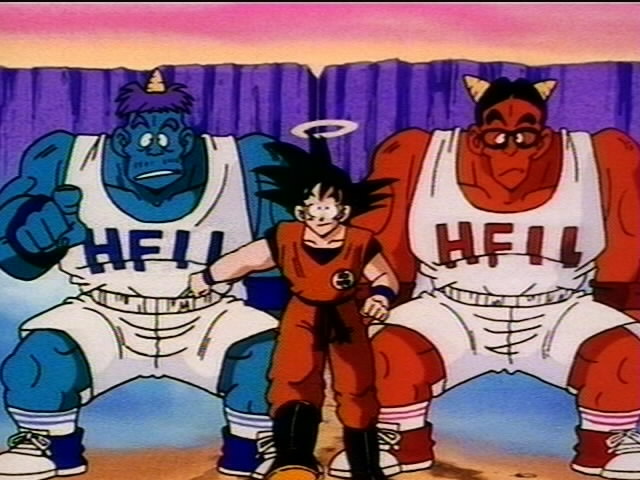
Samanosuke's patrons, the Oni, pictured with legendary monkey king, Son Wukong.

Samanosuke’s patrons, the Oni, pictured with legendary monkey king, Son Wukong.

From there, anyone who has played one of the early Resident Evil games can pretty much predict what happens. Samanosuke fights his way through a haunted house…er, castle…filled with hungry monsters, convoluted locking mechanisms that would only piss off any normal person who lived there, and random encounters with a small cast of characters wandering aimlessly around with no regard for the onslaught of things that want them dead. Onimusha de-emphasizes puzzle solving, which I appreciate even though I can’t think of anything more horrifying than slowing down the pacing of a good story in order to solve a riddle about which order to push a series of buttons. Like Resident Evil, play occasionally shifts to Kaede, Samanosuke’s kunoichi assistant who, again like Resident Evil, has less strength and health, but moves faster. Since she can’t seal souls, Kaede doesn’t have a lot of motivation for hanging around to stab things, so the player has to change tactics to more of a gauntlet run. Except she still has a knife and a belt full of kunai, so her sections of the game didn’t annoy me the way that playing as Ashley Graham did.

I bet you say that a lot while wearing that suit.

I bet you say that a lot while wearing that suit.

The game paces itself very well. Better than most modern games. While many games, RPGs especially, like to throw a challenge at you ten or twenty times to make sure you didn’t succeed those previous nineteen times on a fluke, Onimusha throws a challenge at you, then gives you something new to fight when you finish. Cut scenes and other story elements happen close enough together that you don’t need a libretto just to remind yourself why Samanosuke would rather let pig monsters bludgeon him to death rather than high-tailing it to Okinawa where he could kick back and enjoy the sunny, monster-free weather with a nice bowl of sake in one hand and a nice kunoichi or two in the other. In fact, even with side-questing and leveling up, I can finish the game in about three and a half hours. Because of its length, I can finish with the desire to actually play through it a second time to take advantage of all the unlockable items, and unlike Leon Kennedy and his tommy gun rampaging through Spain with infinite bullets and not enough monsters to put them into, I don’t get bored before the novelty of invincibility wears off. Plus…well…two words: panda costume. Who wouldn’t want to fight demons while wearing something both cute and vaguely unsettling?
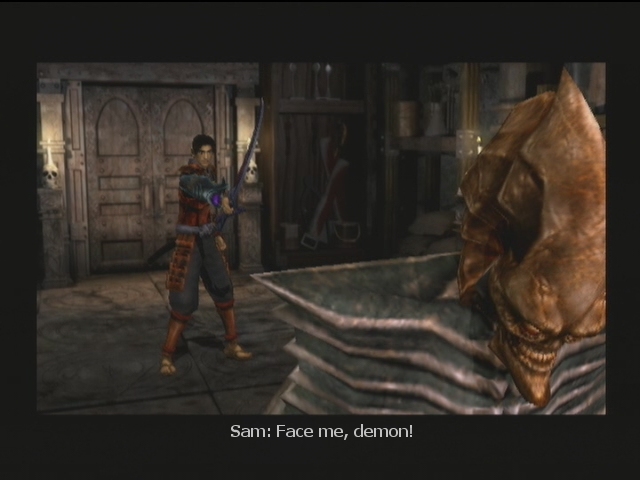
Not quite what Tom Stoppard had in mind.

Not quite what Tom Stoppard had in mind.

Onimusha really shines in the cultural department. I come from America, the culture that gave us Charlie Chan movies. If you don’t recognize the name, he came from a series of mystery novels and movies about a Chinese-born detective in Hawaii. When adapting the novels for film, they tried a few different actors, and the American viewing public watched the movies and said, “Yeah…we think the white guy made a more convincing Charlie Chan.” With racism like that, I understand why anything Japan wants to market in the U.S. has racially-neutral characters, that could belong to either Asian or Caucasian heritage, depending on how hard you squint and what you really want to see. Onimusha, however, delivers a cast entirely of unapologetically Japanese characters in a marvelously Japanese setting using traditional Japanese folklore. Er…mostly traditional. For some reason, all the demons bear names out of Shakespeare’s Hamlet, often referred to as “The greatest story ever written.” Hamlet represents the peak of Western literary culture. I’ll let you come up with your own interpretation for that. I, for one, appreciate the distinct cultural flavor of the game (much like visiting Kyoto tourist destinations…but with monsters). For added difficulty, set the game to Japanese audio with English subtitles. The voices sound a lot cooler, and the trick treasure box puzzles have a new twist when you don’t get Arabic numerals.
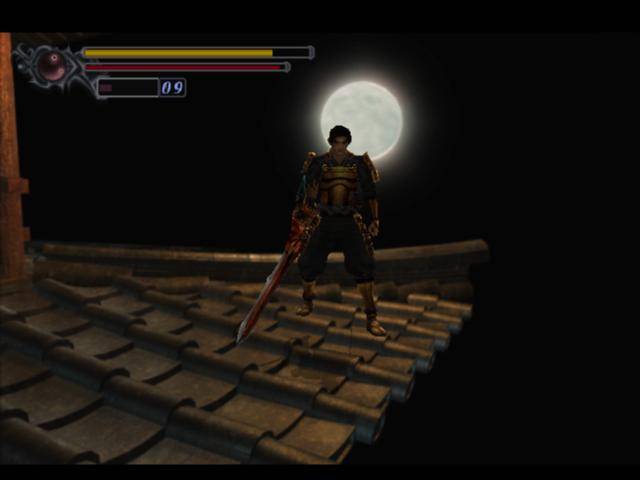
I hear the Castlevania production team let Onimusha use their set at night (but they had to share with Spanish Castlevania)

I hear the Castlevania production team let Onimusha use their set at night (but they had to share with Spanish Castlevania)

Once more like Resident Evil, the game gives you a report card at the end, one final smack in the face for anyone who thought they did well. Depending on your grade and how many useless rocks you found, the game will either reward you with unlockable goodies and a bonus mini-game (obviously designed with enough difficulty and repetition so as to wean you off of Onimusha and on to your next game), or it will send you to bed with no dinner and take away all video game privileges until your grade improves. Later games don’t quite live up to the quality of the first, which probably explains why the series effectively came to an end in 2006, but I give this first installment an A…even if it thinks I deserve a B.

Oh yeah. Magic. You can use magic. I guess I didn't find anything funny to say about that in the main entry.

Oh yeah. Magic. You can use magic. I guess I didn’t find anything funny to say about that in the main entry.

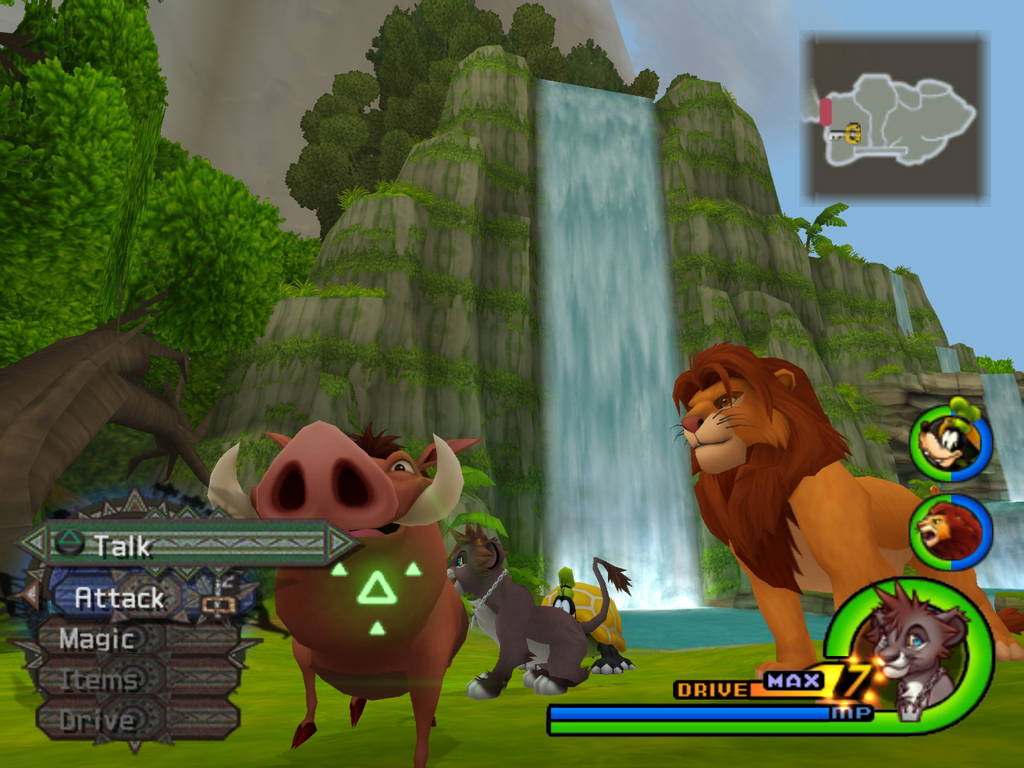
Kingdom Hearts II – PS2

Mickey Mouse: Bad Ass Warrior King

Mickey Mouse: Bad Ass Warrior King

The keen reader may notice by now that I did not begin my entry today with a twenty-page instructional guide on the cleaning, gutting, and harvesting of sperm whales. Odd as that may seem, I have a very solid justification for that decision; nobody wants to read boring irrelevant shit just to get to the interesting part of the article. Likewise, my primary criticism of Kingdom Hearts II stems from that same philosophy. Normally in a game that involved a substantial amount of story, I’d begin by describing a brief summary of the most relevant points of the plot. However, this game doesn’t really have any. The overarching plot once again focuses on Sora. Once again, the primary conflict involves the race of Heartless swarming through the ragtag amalgamation of worlds that any other game would have the decency to call a galaxy. Square-Disney introduces a mechanic in which a strong-willed person who becomes a Heartless actually separates into a Heartless and a “Nobody,” which as you can surmise from the name, also has no heart. The strongest of the Nobodies have formed an organization to protest that they have no right to exist, and Sora must stop them (yeah, I’ll get to that later). So slide your disc into your PS2, select the “New Game” option, and then prepare yourself for the non-stop thrill ride of watching some other kid spend his last week of summer vacation in the most average, mundane way possible…for three solid hours!

Hot tuna frittata?

Hot tuna frittata?

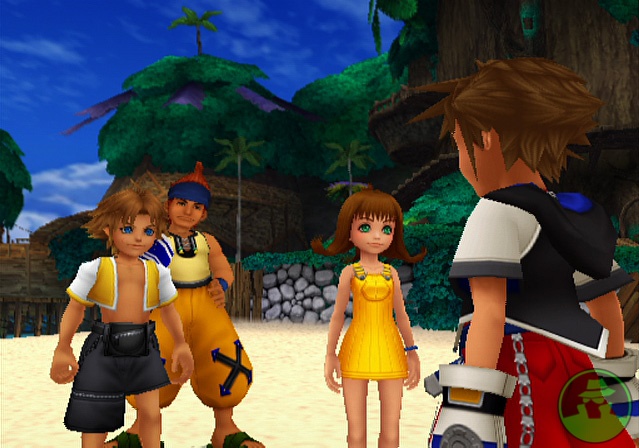
While I feel Kingdom Hearts II generally improves upon its predecessor, even in the area of storyline, the game needed plenty of editing. While the character Roxas needs an introduction, that introduction does not need to occupy the first three hours (two if you know the secret) of the game, and they definitely could have set either a faster pace or a less mundane story arc for us to follow. No one wants to whack a ball for a crowd endlessly in order to earn pennies toward a train ticket so Roxas can ride to the beach with his friends (which the game never bothers to tell you that you don’t actually need to do: your friends will make up the difference). See, unfortunately, once you pass that part, the game paces itself quite nicely, and since the first game appealed more to Final Fantasy fans more Disney, they instituted a darker, more adult storyline. However, in order to get that far, you almost need to have a fetish for the Lion King in order to summon up the patience to slog through this pointless hazing in order to get to the actual game.

And you'll stay there until you finish them all, young man!

And you’ll stay there until you finish them all, young man!

The game itself plays quite nicely. They sped up the irritating gummi ship sections and got rid of the gummi ship builder from the first game that worked with the learning curve and intuitiveness of ancient Sumerian cuneiform. The different worlds feel larger and more fun to go through, and you visit most of them twice for shorter episodes. This game pretty much only suffers from the writing skills of a burgeoning romance novelist who recently suffered a series of strokes rendering the language portion of their brain as useful as a lump of mashed potatoes. I loved the moment when Mickey showed up like Yoda and went all epic-warrior-king on the heartless, but while the darker story makes it better than the original, their tolerance for “dark” ends with well-tanned guys with beards. Don’t believe me; try to find a copy of “Song of the South” on DVD.

Already a short game to begin with, they could have shaved probably 40 minutes off the total play time if they hadn’t insisted on every single character chiming in at least once with a chorus that names the protagonists. “Sora. Donald. Goofy.” Because the player might forget, and the game can’t keep our interest in any better way than by constantly reminding us of this, seemingly to the exclusion of actually giving names to the members of Organization XIII. I understand that the Tron world has to sound computer-y, but I feel someone at some point during the editing process should have caught the potential double entendre in Tron repeatedly talking about his many “user friends.” And ending each episode with “we did it,” “way to go,” or just a raucous chorus of laughter from a gathering of characters reminded me of the cliches that resonate through the creative writing class assignments of the most inept writers our language has to offer.

They didn’t get rid of the Winnie the Pooh world, but they made it more tolerable by comparison to the Little Mermaid level. Rather than swimming through the sea fighting Heartless, they turned it into a music/rhythm game. Still, that could work, right? Alan Menken’s genius score for the film certainly…what, now? They introduce original songs? Songs that first-semester musical composition students use for toilet paper. Songs that challenge me to find as many interesting ways as possible to say “bad writer” in one entry. You get to do “Part of Your World” and “Under the Sea,” but they’ve cut and hacked them like a drunken lumberjack so they don’t sound good anymore. They even marvelously missed the point of rhythm games, as the triggers don’t line up with any discernible beat in the music.

The game gives Sora new duds for each world. This may not sell the game for them.

The game gives Sora new duds for each world. This may not sell the game for them.

The first game ran with the idea that Sora couldn’t “meddle” with the natural course of events in any world, and merely had to get in, lock the keyhole, and get out. Kingdom Hearts II on the other hand has an ankle-deep puddle from trying to flush that notion down the drain as fast as possible. Sora deposes Scar, bargains with Hades for the fates of the dead, single-handedly rescues China from the Mongol hoards, and deletes both Commander Sark and the Master Control Program. Near the end, Maleficent appears, willing to fight off a swarm of heartless and allow Sora to go on to defeat the final boss (presumably for her), and when Sora protests, Mickey says, “They’re doing what their hearts command. We can’t interfere.” Unless, of course, they do something antagonistic, in which case they can interfere liberally. The final boss has his own heart’s command (never mind that he allegedly has no heart) and Mickey and Sora fully intend to interfere with him. And that raises another issue: The Organization of nobodies, according to the exposition, has no right to exist. They have no hearts and no recognition as people, and only want the same shot at life that everyone else has. In order to accomplish this, they need to destroy the Heartless. But the game tells us to fight them, so we must stop their, uh…evil?

In case pressing X to attack strains your efforts, you also have the option of pressing triangle

In case pressing X to attack strains your efforts, you also have the option of pressing triangle

Munny has as much value in this game as in the last: absolutely none whatsoever. The synthesis requires so many rare items that trying to level up your synthesis moogle garners the same wasted-time feeling as the game’s prologue. In a miserably failed attempt to make the menus easier to navigate, they’ve added “reaction commands,” triggered at special moments with the triangle button. While they look impressive in battle, they pretty much amount to just a fancy name for quick-time events, or in the events that occur outside of battle, slow-time. (I can’t tell you the hours of enjoyment I get from, instead of talking to an NPC, “approaching” or “persuading” them with the not-necessarily-timely use of a single button press.)

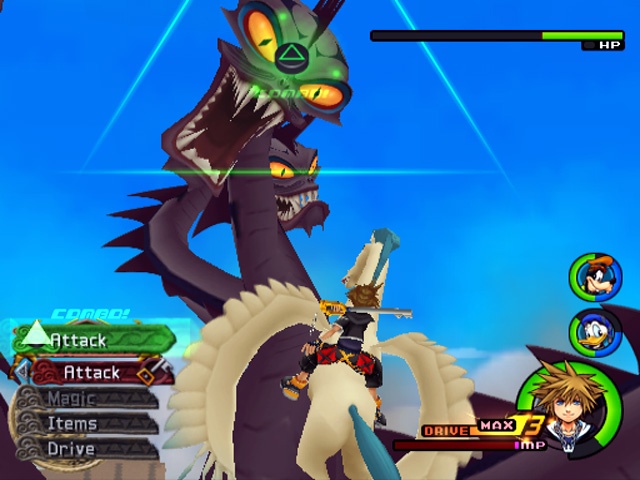
Magic has less relevancy than before, and I got to the end of the game before I realized I had never bothered to see what “magnet” magic did. Summon spells have a little more application than before, but still require navigation of convoluted menus in real-time, so Sora’s best option usually involves mashing the attack button and maybe hoping for a reaction command. They’ve added a “drive” feature, which allows Sora to briefly change form into…well, mostly himself, but usually much better at bashing enemies with his key club…I mean, “blade.” However, this relies on using Donald and Goofy’s power to make the transformation, and the game likes to remove them from your party on any pretense, making one of the most useful and interesting additions to the game completely inaccessible half the time.

It doesn't take much effort to see through Disney's attempt to capitalize on the popularity of a non-animated feature.

It doesn’t take much effort to see through Disney’s attempt to capitalize on the popularity of a non-animated feature.

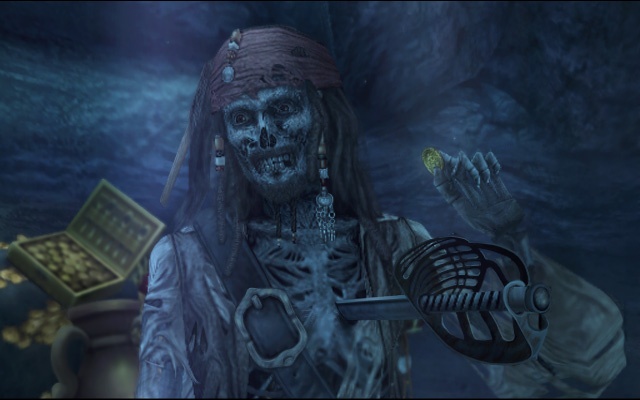
But keep in mind that I focus on the negative because it makes more interesting reviews. I actually do like this game, and quite a bit. It seems geared more toward the Final Fantasy crowd, as I mentioned, which means you can find easter eggs, like naming all the regular nobodies after Final Fantasy III/V/Tactics job classes (although the fact that they can make the nobody dancer grab me, flip me around, bash my head, and toss me halfway across the battlefield, but the FF Dancer class usually trips over their own feet so often for the most mediocre effects that I won’t use it even as a challenge kind of pisses me off) I like the darker tone and the faster pace, watching Riku go through the mother of all awkward adolescent body changes, and having Jack Sparrow as a playable character. The story, while not well-written–the Disney movie worlds all have some lame lesson about hearts and no connection with the plot of the Organization–feels complete enough that I don’t really feel they need to make a Kingdom Hearts III (especially as they won’t release it for anything except the PS4). And let’s not forget that no RPG would feel right without a gigantic final boss monster and a fight on a field with no visible ground.

Kingdom Hearts – PS2

You hated him as an adult; now loath him as a child! At least this game also implies that he dies.

You hated him as an adult; now loath him as a child! At least this game also implies that he dies.

When you walk away
You don’t hear me say
Please, oh baby, don’t go!
Simple and clean is the way that you’re making me feel tonight.
It’s hard to let it go.

Sounds sexy. This music opens up the Disney-Square-Enix joint production, Kingdom Hearts, and when the dark tones start playing, you know that only a sleek, sexy story could follow. If these lyrics mean anything, you’ll never encounter any teeny-bopper heroes, cutsey cartoon characters, or teen idol singers signed under the Disney label. But seriously; have you ever listened to the lyrics to “Simple and Clean”? No one could have written them but the Langston Hughes of blathering nonsense.

Anyway, the story behind the game goes that after Square lost about fifty million dollars on “The Spirits Within,” a movie whose failure any Final Fantasy player could have predicted on account of it resembling a Final Fantasy game as much as the World Wrestling Federation resembles the book of Deuteronomy, they risked going under and had to sell the rights to many of their most famous characters, such as Cloud, Squall, chocobos and moogles, to the only organization that could afford them: Disney.  Suddenly owning all these video game characters, Disney puzzled over what to do with them, and finally decided, “Let’s make a video game?” Then they had to find someone with the expertise to make an epic game using Final Fantasy–and Disney–characters, leading them straight back to Square.

Played by a Billy Zane pissed off that they cut him from Back to the Future III.

Played by a Billy Zane pissed off that they cut him from Back to the Future III.

This story never really happened. But still, the concept of a game where the main character travels through a universe full of worlds populated with a bizarre potpourri of animation contains a brilliance and innovation only matched by its convoluted, mind-numbing confusion. The story opens with Sora and his two friends, Riku and Kairi. They live on an island that gets devoured by cutesy black monsters called heartless. They somehow tumble through outer space to land on separate worlds. Sora discovers his destiny to wield the “Keyblade,” a stunning swing-and-miss attempt by Disney to reduce the image of violence in games while still letting the protagonist use a sword, and Disney’s own Donald and Goofy task him with traveling from world to world, using the keyblade (more of a key-club, really.) to lock each one away from the heartless who want to devour those worlds too. And on the way, Sora looks for Riku and Kairi.

Anyone who has ever visited one of their theme parks (Tokyo Disneyland, 2008!) will immediately realize that Disney has always liked to think of their characters as coexisting in the same universe, so while the story feels a bit like a flimsy excuse to parade cameos in front of our noses the way my grocery store tries to entice me into buying their day-old pastries by stacking them up on tables by the front entrance, Disney does that. They buy into all their talk of “magic,” and they don’t view Peter Pan or Maleficent as any less fresh than Elsa or Simba or the princess from that kinda racist movie set on the bayou. Rather than look at it that way, I considered this game like one of those “re-envisioning such-and-such as an anime” videos you find on youtube. (Look up the one for Miyazaki films)

Most of the gameplay occurs in a hack-and-slash RPG style in which Sora mercilessly gives the heartless (and occasional Disney villain) concussions, contusions, and other forms of blunt trauma with his “blade.” Sora can learn skills, techniques and magic like in a Final Fantasy game, but the fast-paced active combat style doesn’t fit well with the menu system, which demands simultaneous use of the left analog stick and d-pad, and disables any useful right-handed action while scrolling through. I guess since I get through battles all right, I can chalk this up as adding challenge, but I don’t really admire heroes with narcolepsy, who slip into brief comas in the middle of battle. As a result, while Sora can perform neat attacks and spells, I almost only ever use the basic attack and the three spells you can add to a quick-cast menu.

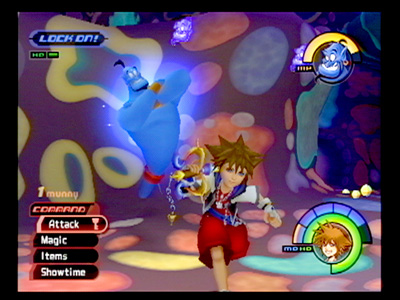
Genie fighting monsters in a psychadelic whale bowel. Because it makes sense.

Genie fighting monsters in a psychadelic whale bowel. Because it makes sense.

While traveling between worlds, the game becomes an over-the-shoulder perspective space shooter. This accomplishes very little except padding out the game for time and adding useless junk to find in each world.  These segments mostly consist of holding the X button for a steady stream of lasers and wiggling the analog stick ever so slightly to prevent impaling your ship on objects that will do as little damage as possible, then let you pass right through them. After finishing the first three worlds, you get a warp drive that lets you bypass this part, making it even less relevant to the game. You have the option of making custom ships by collecting blueprints, finding gummi blocks, and putting together or customizing existing models. However, the default ship provides as much challenge as deer hunting via carpet bombing with napalm, and at that point upgrading to an atom bomb really won’t cause any noticeable difference. Plus, I’ve conducted Korean-language ATM transactions more easily than using the gummi ship building interface, an extra-convoluted program that rival Adobe products for being non-intuitive.  While the player can mostly ignore these gummi-Galaga sections, it does intrude on the main quest by making gummi blocks the most common prize in hard-to-reach treasure chests. So when you finally have the proper skills and abilities, backtrack to old worlds, and get the platform-leaping aspects (honestly, why does anyone still make platformers?) right, the game rewards all your time and effort with an item as relevant as a Playboy magazine at a strip club.

Do I get the adult, powerful, many-antlered Bambi? Nope. I summon a baby deer to aid me in battle.

Do I get the adult, powerful, many-antlered Bambi? Nope. I summon a baby deer to aid me in battle.

I don’t want to mislead you into avoiding this game. It does have good qualities to outweigh the bad. You get to fly in Neverland and you turn into a mermaid…er, mer–Sora and swim through Atlantica. You can summon Mushu, the Genie and…for some reason, Bambi (and not the adult, mega-antlered, fearsome Bambi. The young, little Bambi).  I did enjoy the half-dozen Disney heroes as playable characters, especially the Beast, and major Disney villains like Jafar, Ursula, Maleficent and Hades carry a certain amount of weight.  Since playing a Disney character binds you to them for life, most original actors reprise their roles; however, one absence stands out, and without Robin Willaims’ manic ad-libbing, I feel a little awkward every time the Genie tries to crack a joke, even Sora tries not to make eye contact until the moment passes. Then act three arrives and Square says, “Fuck this Disney shit,” the plot turns dark, and the rest of the game riffs on themes of darkness, despair, and nihilism.

Pooh (n), winny the: Small yellow bear with honey fetish. See also pooh (v)

Pooh (n), winny the: Small yellow bear with honey fetish. See also pooh (v)

Oh, and don’t forget the absolute necessity for any action-adventure RPG where a heroic warrior fights his way through demons to conquor encroaching oblivion; Winnie the Pooh. No really, didn’t Aragorn have to defend Minas Tirith’s carrot gardens from bouncing orcs? I think Luke Skywalker’s biggest test on Dagobah required him to free Yoda’s head from a honey jar.  Okay, so the Hundred Acre Woods level doesn’t fit, and I can’t quite envision Pooh as belonging in an epic fantasy story. Sora doesn’t fight any heartless; instead he just plays the lamest mini-games since blitzball.
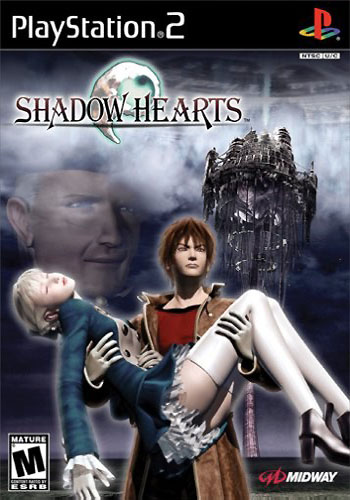
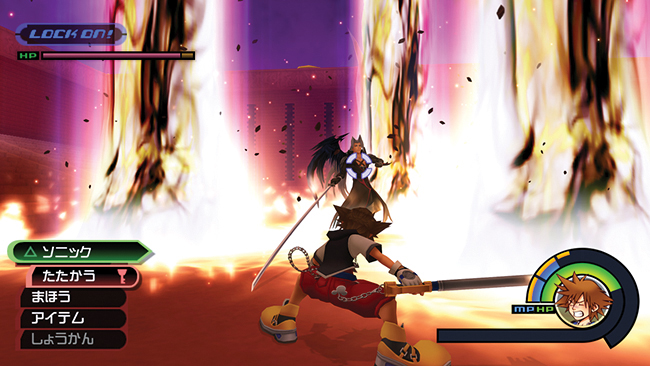
Played by Lance Bass. Because when I think "Sephiroth," I think soft pop music for pre-teen girls.

Played by Lance Bass. Because when I think “Sephiroth,” I think soft pop music for pre-teen girls.

On a final note, Kingdom hearts has some amazing optional bosses. I believe during my review of Final Fantasy VII, I described Sephiroth using the phrase “anemic guinea pig.” Well, this game finally does him some justice. To all those people on forums claiming Sephiroth’s difficulty compares to the final boss, well, no. Final boss fights need to display flashy effects and epic, cinematic moments. The final boss tells a story, but has to let the player through relatively easily. No one needs to fight Sephiroth. So by removing any and all requirements (seriously, you get nothing for beating him except bragging rights), Square finally made him hard as all fuck to beat. Oh, and they cast ‘N Sync’s Lance Bass to voice him. So I guess the anemic guinea pig still fits.

Fatal Frame II: Crimson Butterfly – PS2, XBox

Fatal-frame-II-screenshot-fatal-frame-ii-crimson-butterfly-11732067-640-480

I have to confess that this week’s entry has put me in a situation not unlike walking in on a room full of beautiful, lonely lesbians; I may have just discovered the best thing in existence, but I can’t praise it because of a single catch in the logic that renders it of absolutely no use to me. To give you an idea of how confused this game makes me, that previous sentence took approximately fifteen minutes to write.  Have you ever played a game so brilliantly designed that you wanted to erect a statue of it and place it at the top of the highest mountain so that everyone could see your rather weird graven image, but one thing about it just kept driving you insane until you decided you’d rather construct an effigy of the game and hang it, set it on fire, then pee on the ashes? Well, if not, I recommend Fatal Frame 2: Crimson Butterfly.

Fatal Frame 2 tells the story of twin girls Mio and Mayu, who after a shaky-cam montage that the player can only pray to the game to explain, find themselves in an abandoned traditional village after nightfall. After a bit of exploration, the girls start hearing noises and seeing glimpses of movement here and there.  Doors begin to unlock by themselves, and items appear in rooms when Mio and Mayu leave to search other rooms. Soon, they come across a camera with a note explaining, in terms only slightly more scientific than the average paranormal investigator uses to describe their own equipment, that it has the power to exorcise ghosts. And then Mayu displays the most astounding lack of survival skills in the history of horror, running off into the village full of angry spirits without her sister, who now holds the only means of defense against the supernatural menace.

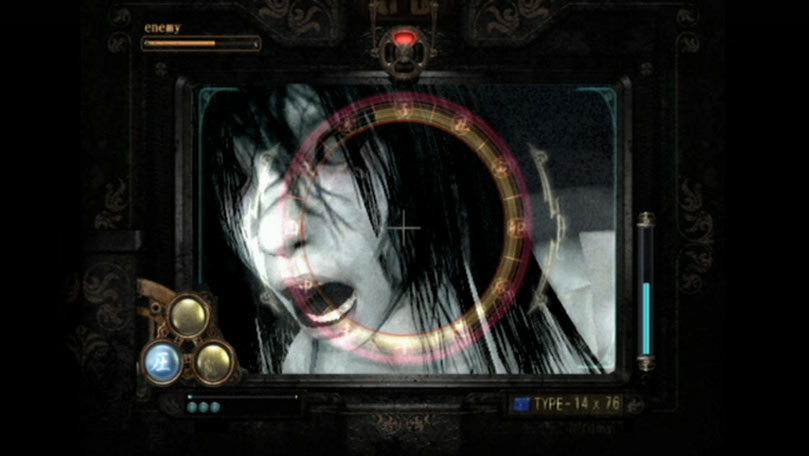
Most people believe they don't look good in pictures. Some people truly don't.

Most people believe they don’t look good in pictures. Some people truly don’t.

Fatal Frame 2 combines all the best aspects of successful survival horror games.  Like Resident Evil, the noises Mio makes as she traipses through the environment sometimes sound enough like ghost noises to keep you panicking.  Like Silent Hill, it creates an atmosphere of total isolation, garnished with introspection and the slight hint of a dark past.  The horror builds off of Japanese culture, especially the significance of twins and the mythology of butterflies, which many Western players will find unfamiliar enough to spook them (but relax; if you’ve seen “The Ring,” the game offers one scene of a ghost girl climbing out of a well). Furthermore, they took away the standard issue gun and replaced it with a camera, making the player feel completely helpless in the face of adversity–it even requires letting ghosts get close and attack in order to do any meaningful damage to them. Imagine a donut made out of birthday cake, filled with chocolate chip cookie dough ice cream, frosted with Oreo cream and topped with M&Ms; this game feels like that. (I’ve recently cut back on sweets…can you tell?)

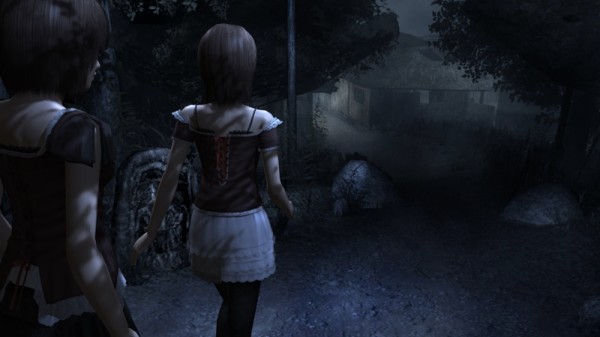
Now picture this without the edges of the screen, the girl following you, most of the girl leading, the house, the road, the trees and...well, see that lightly glowing spot at the center? I didn't see much more than that.

Now picture this without the edges of the screen, the girl following you, most of the girl leading, the house, the road, the trees and…well, see that lightly glowing spot at the center? I didn’t see much more than that.

However, Fatal Frame’s Fatal Flaw might just negate all of that.  Have you ever played a survival horror game that asked you at the beginning to “adjust the brightness until you can just barely see the gray line”? Well, this game doesn’t do that. It just assumes you like it dark. In fact, not only do you not want to see the gray line, but you don’t really care to see the text asking you the question, either.  What? You can’t see Mio? Well, you shouldn’t look at her anyway, given her young age. If you need to know what your environment looks like, you have a map. Use it! (I honestly spent less time following my GPS through downtown Minneapolis than I did checking the map screen for Fatal Frame).

If you manage to find a bright enough TV screen, you get to see an excellent rendering of a run-down, abandoned town.

If you manage to find a bright enough TV screen, you get to see an excellent rendering of a run-down, abandoned town.

While I understand what Tecmo intended by making the game darker than a chain smoker’s lung, and while I have to begrudgingly admit that certain scenes would not come across as terrifying in a lighter environment, I often needed to check the map to see what direction Mio faced, and due to the adoption of Resident Evil’s shifting camera angles, even that didn’t guarantee that I knew how to get her to move forward instead of back, slightly to the left, or directly into the nearby wall. Horror relies on senses, and the deprivation of one heightens the unknown, forcing you to interpret information more heavily with your other senses.  Good horror can overload those senses. However, video games lack texture.  You can drop a character into a pitch black room, but the player doesn’t entirely come along for the ride. A vibrating controller simply doesn’t substitute for placing your hand on something warm and gooey that you can’t see. One might as well climb into a sensory deprivation chamber and then have a friend dump a bucket of spiders on the outside. Yeah, it might scare you if you think about it hard enough, but you have a good layer of insulation protecting you.

It turns out that other people have had this problem as well, but no one could offer an infallible solution. Despite the game having the option to increase brightness, you can only increase it enough by finding a TV that naturally has a more vivid contrast. For the record, none of mine could do it. They both interpret an increase of brightness as watering down the picture with more white pixels. All in all, not very helpful.

See! This girl creeps me out more than any of the ghosts in the game

See! This girl creeps me out more than any of the ghosts in the game

I wish I could get past that because I did enjoy the game (at least what I could see of it). I can only describe the initial ghost encounters as “pants dampeningly scary,” and by the time the shock wears off, it feels as if some sort of character growth happened…somewhere. (I don’t know. They don’t really talk much.) Despite occasionally pairing up with Mayu, it doesn’t turn into a babysitting mission. Still, they managed to make her creepy enough that I started to feel safer without her around. True to the genre, the player learns Mio’s story as Mio in turn learns the story of the village. Also true to the genre, she does this by picking up scattered notebooks, letters, and other writings left around the village because apocalyptic horrors always result from a breakdown in private filing systems. If you ever notice disembodied pages from diaries lying around town, get out while you can; those places collect monsters like Gamestop collects used Madden games.

Because black and white scares people, reminding themof the dark days before Kodachrome and Technicolor

Because black and white scares people, reminding themof the dark days before Kodachrome and Technicolor

Unfortunately, not only did the lack of  vision and direction ruin the experience, but a plot full of dangling details never fully explained make the ending not quite satisfying (I played the PS2 version, but I heard they added endings for the XBox and Wii). Plus, while having doors unlock on their own adds to the creepy factor, it doesn’t give you that solid line on where to go next, like Resident Evil does when it hands you a specifically marked key.  And while the four houses in the village don’t really qualify it as sprawling, I’ve never enjoyed the “just walk around until something happens” mentality, which only pisses me off and sends me rifling through the internet for a walkthrough, a cardinal no-no in my book of game design flaws. Still, I have to give them credit for minimizing puzzles.

So I should probably lay out all the information to see my ultimate opinion of the game: creepy as hell, great atmosphere, nice departure from guns-n-ammo approach to horror, no stupid puzzle solving. On the con side: walking from room to room feels like solving a puzzle, shifting camera angles in the dark causes Mio to dance in little circles, and the ending falls just shy of explaining anything.  I can honestly say I have never played a better survival horror game, nor have I played a worse one.

Jurassic Park: Operation Genesis – PS2, XBox, PC

jurassicgene_003-large
If you follow my blog regularly, rather than flip through in disappointment after your search for “sex” and “video game” turns up nothing but a wall of text with a few irreverently captioned images, you’ve probably found more than one review complaining about game series that sold out by porting a downgraded version of their original to a same-generation console just to make a few bucks (or a few thousand yen). While I do love to put on my big, black sanctimonious robes and pound my gavel in condemnation for these cash-grab attempts, I would disgrace the dignity and sex appeal of my big, curly powdered wig if I didn’t admit I can’t really make a general rule out of that practice. Fortunately, another sell-out genre of video game lets me keep up the pretence of blanket hatred on a much more regular basis: movie-based games.

Because Spielberg thought people would prefer an obscure species of predator to the historical favorite for the third film. Yeah. Smart move there.

Because Spielberg thought people would prefer an obscure species of predator to the historical favorite for the third film. Yeah. Smart move there.

I loved Jurassic Park. It came out the summer before fifth grade, and I never remember a movie scaring me more than that.  Give me a chair moving very slightly in a ghost story and I’ll pucker my naval in boredom. On the other hand, give the shark from Jaws a pair of lungs, legs, the intelligence to open doors, and a plausible-sounding explanation of how scientists might make them a reality, and I’ll lie awake at night, terrified, unable to sleep until eighth grade. Granted, some of that stemmed from the fear that the sun would go supernova and incinerate me in my sleep, but still…raptors! So you can imagine that after years of games like the weird top-down/first-person SNES adaptation or the Sega version where you play as a raptor, when I found a copy of Jurassic Park: Operation Genesis for $3 at my local Savers, I reacted with an emphatic WTF (and not just because I found out later that the game sells for upwards of $80 on ebay).

As the game simulates an alternative reality where John Hammond succedes, capitalism seeps into every aspect of the game, including visitor deaths.

As the game simulates an alternative reality where John Hammond succedes, capitalism seeps into every aspect of the game, including visitor deaths.

Operation Genesis shows an odd sense of self-awareness, showing the main characters from the film selling out their principles to make piles of cash.  John Hammond apparently has made a full recovery from his lesson in human endangerment for the sake of capitalism (or if we follow the book’s plot, his death by compies) and puts himself to the task of opening another park and profiting off tourists, despite the occasional fatality. Rather than advising about ethical ramifications of cloning a long-extinct ecosystem, Dr. Grant now digs fossils for the explicit purpose of extracting DNA for use by the park (however, the fact that they manage to obtain DNA from solid rock, which has completely replaced any organic material, causes me to question the validity of the cloned animals).  Dr. Sattler has apparently renounced her paleobotanist ways and now works as a nurse for sick dinosaurs.  And John Arnold, no longer holding a grudge against the dinosaurs that dismembered and devoured him, returns as the park’s operations manager.

Gameplay resembles sim games, with construction mechanics similar to Sim City, but with tourists walking through the park, apparently completely incapable of finding things like restrooms, restaurants, and the dinosaurs standing right on the other side of viewing enclosures. Oh yeah, and the game also includes dinosaur cloning.  Although the game drops you right onto the island with no instructions after a paltry five-minute loading time, if you’ve ever played a sim game in your life, it doesn’t take too much effort to pick up the tasks. The park needs an entrance, fences, and at least one dinosaur before you can open, at which point park admissions becomes your primary source of revenue, along with charges for viewing, eating, and for the serious dick players, using the bathrooms. Restaurants, cleaning stations, ranger stations, and other buildings help tourists leave to spread the word about how satisfied they felt after wandering, eating, peeing, and not getting gored to death in your park, raising your rating and by extension, your potential to profit.

Most of the amenities and attractions require research before you can build them because apparently your staff simply can’t grasp how a gift shop might work without someone writing a dissertation on the subject first. I know why they include this mechanic in the game–it lets the player prioritize, adding variety to each play through, and insuring that the park could, theoretically, fail. It also adds some credibility to the scientific aspects of the game.  I just fail to see how developing a vaccine for previously unknown diseases that will work on species whose biology we’ve only ever known through rocks shaped like their bones takes the same amount of time to figure out as how to drive a jeep through a field of duck-billed hadrosaurs.

They call this building the hatchery. I think it looks suspiciously like a raptor pen.

They call this building the hatchery. I think it looks suspiciously like a raptor pen.

The process of cloning dinosaurs from DNA adds a layer of complexity to the game, requiring just about every step actually involved in real-life cloning except for the applications and approval from ethics boards. You start by digging fossils from a randomly selected dig site which, props for authenticity, coincides with real-life locations where each dinosaur species lived. You can purchase extra dig teams to make the excavation faster, but each team costs twice as much as the one before it and the process still feels like it takes sixty-five million years to get anything you can use. Also, sometimes they’ll dig up gold, silver, or opals, which have no use, but you can sell them. I usually use the money on store-bought fossils. You know why? Because I’d rather have fossils than gold, silver, or opals.  Once you have fossils, you have to extract DNA from them. Each sample gives you a small portion of DNA for a single species. You need 55% or more to clone a dinosaur. Yeah. It takes a while. And at 55%, they die off rather quickly. I like to imagine mixed characteristics of dinosaurs and frogs. Slimy, amphibious raptors hopping around their pens, or T-rexes trying to catch flies with their tongues. Anyway, once you have enough, and pay a hefty fee, your dinosaur hatchery (which you need to build) will start incubating and raising your park’s attractions: one animal at a time.

Allosaurus, a member of the Tyrannosaur family, struts for the camera. See, even T-Rex has relatives that embarass him at Thanksgiving.

Allosaurus, a member of the Tyrannosaur family, struts for the camera. See, even T-Rex has relatives that embarass him at Thanksgiving.

While at thirty years old, I still love the idea of dinosaur cloning and hope for the possibility to visit a real Jurassic Park one day, I don’t really know if the main focus of the game should force players to watch the research in real-time. While you start with enough material to produce at least one dinosaur species, it can take years of in-game time to get a second. Each dig site has only three species, and the fossils put up for sale only match the species of fossils you’ve found. Furthermore, out of the nine sites available, you can only access three per save file, so you can’t actually get all the dinosaurs in the game for your park. The game moves at the speed of fish climbing out of the ocean, but it only takes four or five hours of gameplay before you realize that, even though the game itself has other options, it won’t let you do anything to make your establishment more awesome.

Theoretically, disasters can add some panic into the game. Apparently tropical storms and disgruntled employees shutting off the power don’t quite match up with the excitement of the occasional twister (what, did you just copy and paste the coding from Sim City?), which can either add mild amusement in the need to follow along behind it immediately repairing fences, or it can game over you if it happens too early on.  Dinosaur rampages–supposedly–cause more trouble, but I’ve never had an animal break out of its fence, even when I had the T-rex in minimum security pens.

Nausea mode: where the camera jiggles, and the vomiting player simulates shooting dinosaurs on the ground below.

Nausea mode: where the camera jiggles, and the vomiting player simulates shooting dinosaurs on the ground below.

The game also offers a mission mode, with some alternative gameplay. The first mission asked me to drive a jeep around an island, photographing various species to prove to investors that the park really did clone dinosaurs–or knows how to use Photoshop. The second mission put me in a helicopter, gunning down rampaging carnivores.  The game lost me on that one–for a vehicle designed with the ability to hover, it handled like a gift shop balloon in a strong breeze.  Again, if they intended to nauseate their players, mission accomplished, but I just couldn’t live up to the task of operating a helicopter, machine gun, and vomit bucket at the same time. The reward for completing ten missions  lets you release all your dinosaurs onto an island without disease or people and just watch. No thank you.

You know what I’d rather do? Go read the damn book.

Valkyrie Profile 2: Silmeria – PS2

Our non-valkyrie protagonist, protagonisting

Our non-valkyrie protagonist, protagonisting

Imagine the worst thing a video game has ever done to you. What games did you invest time and money in only for them to pull some dick move on you, probably leaving you swearing at the top of your lungs at the TV screen? If you finish Jurassic Park for the SNES, you get a delightful little non-ending that consists of the loading screen playing in reverse, which after a team of friends and myself spent an entire night of caffeine, headaches and dial-up internet walkthroughs to do, left me with an empty feeling, much like waking up next to a prostitute hungover and broke, except without the exciting evening to balance it out. Or one of Anne’s favorites; spending hours early on in a game going through side-quests, leveling up to the ultimate attacks, finding the ultimate weapon, and then the game murdering the character and taking with it all the equipment, experience, and precious moments of your finite life span along with it. Final Fantasy, Legend of Dragoon, take your pick. This one happens often enough. How about forced stealth, babysitting missions, or quick time events?

Full disclosure: I might give away some integral plot points of Valkyrie Profile 2: Silmeria, but I refuse to call them spoilers. See, to spoil something implies that it began with a certain level of freshness, but this game holds the record for most rotten-to-the-very-center-of-its-being of any game I’ve ever played.  If Mother Teresa, Gandhi, Jesus and Buddha collaborated to breath life into this game to make it human, it would still back over your cat with a humvee and then try to console you by saying, “At least it wasn’t a dog.”

Release the Kraken! Because apparently Norsemyth doesn't have enough monsters to keep us interested?

Release the Kraken! Because apparently Norsemyth doesn’t have enough monsters to keep us interested?

The first time I played this game, I swore I’d never do so again. I lived in a studio apartment and had to apologize to my neighbors for regular disturbances as I screamed profanities that would offend sailors at the top of my lungs. Hours upon hours of my life spent leveling up to plow through impossible enemies would vanish into oblivion as a clunky game mechanic would have my party trip over a blade of grass, leaving the nearby monsters to drive them into the mud like lawn darts. After figuring out from Valkyrie Profile: Lenneth that the game innovated RPG combat to stress set-up and strategy over power-leveling and high stats, I realized I simply didn’t know how to play the game right before. As it turns out, I rather enjoy the games combat system and find it highly engaging, much like the system for The World Ends With You, which I’ve found amazing ever since hoisting myself to the top of the learning curve with a few crampons and a good length of dental floss to use for rope.

No, to get to the real, black, shriveled prune of a heart of why this game laughs in the face of all who dare to play it, you have to examine the things the game designers did intentionally. For starters, for a game that claims to profile a Valkyrie, it spends very little time doing so, in favor of constantly introducing new characters with no relevance on the plot in the least. I didn’t often appreciate the half-hour long snooze-fests that introduced einherjar in VP: Lenneth, but Silmeria swung the opposite direction, introducing dozens of playable einherjar with no backstory whatever except for an entry in the status screen. They have no effect on the plot, but the game expects you to play with them and level them up anyway for the sole purpose of transferring their souls…well, maybe not to Valhalla due to Silmeria’s war with Odin…but to somewhere not nearby your party. Yes, by transferring them you get an item that permanently increases any characters stats, but it seems like time spent leveling up useless characters would help more if you spent it on the main characters of the story.

Our titular valkyrie, not valkyrie-ing

Our titular valkyrie, not valkyrie-ing

Speaking of which, you only really get two. Well, maybe one and a half, since the protagonist spends half the game possessed by the spirit of Silmeria. See, at the critical act one climax, you lose all your main characters–permanently–except for two, except Silmeria’s spirit goes on to bigger and better things. So you better hope you have some einherjar left over, especially a mage, because you never get them back!  Sure, the plot gives them back to you, but the game has changed their stats and attack patterns enough that you can’t call them the same person once you get back into combat, sort of the games way of saying, “Sorry I ran over your cat with a humvee, but I’ll give you a coupon for a free pizza to make it up to you.” Without Silmeria, you have no power to call einherjar, so if you had set them all free–like I did the first time I played–you may find yourself drastically shorthanded for the rest of the game. Then, for whatever reason, the game gives you a slew of playable characters literally in the final dungeon. In fact, by the time you actually get to see and play as Silmeria, you’ve already explored 74% of that level.

But perhaps the worst offense of all, VP: Silmeria reunites you with your trusty mage, a major playable character, a powerful magic user, and a Harry Potter impersonator, for one dramatic battle with Odin…and then leaves your party permanently to become the game’s end boss. Also, his lust for Lenneth, a character mentioned only once before, motivates everything he does. So…really, I don’t entirely know what Silmeria has to do with anything.

Just a little cranky. Apparently he lost all purpose in life after killing Voldemort

Just a little cranky. Apparently he lost all purpose in life after killing Voldemort

But really, the story lacks the cohesiveness of a wet post-it note, surpassing its predecessor for scattered, irrelevant, and unexplained plot points. It seems like Enix intended to make this sequel as they wrote the original, and they do connect a number of plot points and locations together, even if they don’t feel compelled to include explanation or reasonable motivation for characters’ actions. I could have connected with and found interest in the villain, had they ever decided to explain his obsessive crush on Lenneth, but they don’t even give us as feeble a reason as “has a thing for platinum haired vixens.” Furthermore, it seems highly unlikely that anyone crazy enough that Hannibal Lecter, Jack Torrence and the Joker want to keep a healthy distance would have the wits to put up an intelligent, rational and friendly facade for the majority of the story. Several characters from VP: Lenneth make appearances here, but the game never bothers to explain how they exist in both the Ragnarok-era of Lenneth and the ancient past of Silmeria. Near the end of the game, they throw some very elegant prose at you that I may have found slightly more moving had they ever bothered to establish some sort of theme or direction for the story. Then they try to explain some stuff about an alternate history, how these events happen after Ragnarok for Lenneth and the villain who have traveled through time, but before Ragnarok for everyone else and…honestly, they lost me.

Even a major antagonist takes priority over Silmeria on the box art.

Even a major antagonist takes priority over Silmeria on the box art.

For all its flaws, I don’t want to condemn the game to the coldest, darkest region of Hel quite as much as I did the last time I played it.  As I mentioned before, I feel they revolutionized RPG combat–or would have, had anyone figured it out. Rather than focusing on fighting enemies, gaining experience, buying stronger weapons, and fighting more enemies, the monsters throw challenges at you. You have only a few menu options, and can’t use more than a single spell or item every so often, but it gives you choices to make that you don’t commonly find in these games; do you want to split up your party into two groups to distract an enemy? Would magic or physical attacks do more damage here? Do you need to take out smaller enemies, or can you go directly to killing the leader? While the main maps, oddly enough, give the player only two dimensions to work with, combat maps switch to a 3D perspective where monsters and players alike move across terrain, trying to avoid getting taking hits.

An insipid, directionless story, but beautifully rendered.

An insipid, directionless story, but beautifully rendered.

Furthermore, the care they neglected when writing the story obviously went into rendering the characters, cut scenes, and scenery. You’ll have plenty of eye candy for those moments your attention wanders off of the vapid plot.

And, thankfully, they got rid of the sushi bars. Influenced by Norse myth or not, that just didn’t make sense.

Shadow Hearts: Covenant – PS2

sh2

In tenth grade, my friend Albert (who today would probably be best known for his work on this) came to school with a hilarious bit of trivia. It seems he found a book in his pastor’s office that listed off pop culture icons that defied God. Most notable among the entries, it suggested we shun the Smurfs because a) Papa Smurf used magic to help his fellow smurfs instead of prayer, and b) Gargamel drew actual Satanic symbols when casting his own evil spells. While these aspersions seem about as productive as speculating on the sexual orientation of a teletubbie, Shadow Hearts: Covenant, the final instalment of my reviews on the game series, kinda, sorta, actually does this.

Legend states that King Solomon used a ring engraved with the Star of David to capture and enslave 72 demons. A book known as Goetia, The Lesser Key of Solomon, or sometimes Lemegeton, supposedly authored by Solomon himself, lists off all these demons, describes them, and shows the crests used to call them into service. Not only does Covenant base its magic system off this legend, sending the player across the world to find these demons and equip them, but when you summon them in-battle, the actual crest from the book appears on the battlefield. So just a warning, while I recommend this game, you may run the risk of actually calling monsters out of your television.

Yuri (as Amon) and Karin in homage to the box art to the original game

Yuri (as Amon) and Karin in homage to the box art to the original game

Now that I’ve issued my disclaimer, I can get on with describing the game…except I don’t really have much to say that differs from my articles on the original Shadow Hearts or From the New World.

The game follows Yuri Hyuga once again, continuing from the bad ending of the first game.  The Vatican sends Nikolai Conrad, who has a personal beef with Yuri for beating Albert Simon before he had the chance, to curse him.  Attacked with the “holy mistletoe” curse, Yuri loses all weapons, items, and fusion demons from the last game, as well as the ability to get any action from the game’s double-D female lead (which, not to ruin the game for you, probably works out in Yuri’s favor.)–probably the games greatest irony considering mistletoe’s reputation for inspiring sexual hedonism akin to playing Twister.  Once thusly cursed, Yuri and Company set off on a crusade to take down the secret society responsible for making the Vatican look like Dick Cheney’s personal assassination squad. Along the way he rediscovers demons and, you know, just might learn a little something about himself.

Like the original, Covenant emphasizes character development over action and plot. Unfortunately, players despise quick-time events that ask them to “press X to not die,” so I don’t think they’d readily accept “press X to introspectively examine your purpose in life after the death of your lover.” On the positive side, Nautilus did not actually include these events in the game, instead favoring flimsy excuses for geographical movement into a series of irrelevant dungeons.

Torture scenes exist in all three main series games...but only here do you get a BDSM dominatrix along with the pain.

Torture scenes exist in all three main series games…but only here do you get a BDSM dominatrix along with the pain.

And while the story masterfully outlines Yuri’s development, I wouldn’t go so far to say that each character adds something vital to the story.  Much like the dungeons, it feels like the guys at Nautilus sat around trying to think up caricatures to round out a battle party.  “We can’t get through the game with only two characters!” someone said. “Let’s throw in a super-hero….pro wrestling…vampire,” offered a staff writer, who probably just flipped through the nearest copy of Game Informer until he found three successful titles. Granted, when given the option of using a super-hero pro-wrestling vampire, few players will resist the call.  Shadow Hearts has always designed their characters people want to use in battle.

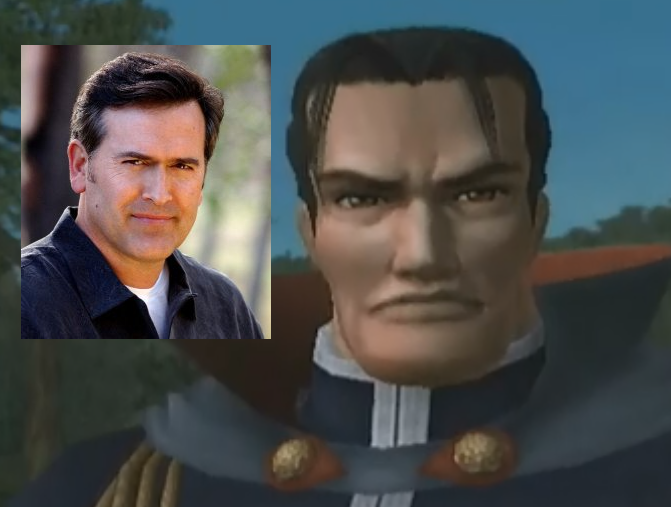
But hey, if you do one thing well, just do it ad nauseum, right? The game uses the alternate history genre to present a parade of cameos. Characters from the first game make appearances, including Kato, Albert Simon, Roger Bacon, Alice, Keith and Margarete–as well as historical figures like Lawrence of Arabia, the Great Gama, Gregori Rasputin…and Margarete.  Also, Kato looks more than a little bit like Bruce Campbell, so that should count for something, I think.

Summoning demons with a book, resurrected girlfriend, and chins bigger than China...coincidence?

Summoning demons with a book, resurrected girlfriend, and chins bigger than China…coincidence?

However, the carnival of characters and the dismissive plot tend to retcon parts of the game’s universe. Apparently, Albert Simon only wanted to destroy the world in the first game because he needed more power to fight one of the major villains in this game. I’d need a good long time with the latest edition of the DSM to count the psychological disorders required to make that logic work. Apparently Yuri only needed to sit down with him and have a chat about the problems of overkill to solve the conflict in SH1.  Whether he does or not, the change in motives takes the fangs out of previously enjoyable villainy.

Covenant improves on mechanics developed for the original.  Players have options for customizing the judgement ring, as well as equipping an item that slows it down to a reasonable speed.  In the first game, the ring fixed the traditional RPG mechanic of finishing battles by hitting X repeatedly–by making you hit X four times as often and at very precise moments.  Covenant offers their characters a reasonable amount of MP, making magic and special techniques a valid option. The game clearly had influences–if you ran a drug test, its urine would contain more than trace amounts of Final Fantasy–but in Covenant, it developed enough of its own flair to stand on its own…which of course made it branch off into obscurity, eventually leading to the cancellation of Shadow Hearts 4 and the downfall of the series, despite attaining a quality and ease of playability that other RPGs would envy.

Yes, the dog is sidling to avoid being seen.

Yes, the dog is sidling to avoid being seen.

Covenant exists to impress. This game introduced me to the series, and still stands as its strongest game.  A rare occurrence of RPG direct sequelage, it manages to inform the player of all relevant plot points from the first game in less than three cut scenes, seemingly animated by Yuri’s own hand-drawings of the events.  These scenes also illustrate the otherwise dark, gothic game’s aloof sense of humor, although the gay-sex-between-athletes innuendo remains a reward for the fervent side quester.

And on a final note, Shadow Hearts does side quests better than any any other game I’ve played.  If you’ve ever played an RPG, you’ve probably gone through dozens of quests for ultimate weapons, magic, or skills, only to find yourself at the end of the game with literally nothing left to use them for except the final boss who at that points fights back with all the rage and fury of a plastic cup filled with pudding.  Covenant, however, offers multiple side quests for every character, most of which include full-length dungeons and bosses.  Yes, eventually you’ll run out of options and have no choice but to end the game, but by then the game feels satisfying, if not just a little too easy.

So I should probably throw this in before wrapping this up: Solomon didn’t write the book.  Unless he knew German. And worshiped Jesus…thousands of years before his birth.  But as an element of the real world–as well as all the other real-world elements in Covenant–it immerses the player into the fantasy, and it does it well.  Well enough, obviously, to get me to play an entire series over the course of two months.  Although I don’t rate games, I feel this particular game merits some sort of quantitative praise, so I will bestow upon it my highest ranking: 10 stars out of two thumbs up multiplied by 100 tomatoes.

Why play the game? Here are two big reasons.

Why play the game? Here are two big reasons.

Sorry for the delays in updating. I’ll target some shorter games over the next few weeks to make up for it. Thanks for reading!

Shadow Hearts – PS2

Shadow Hearts holds the distinction of having the most kick-ass box art of all time.

Shadow Hearts holds the distinction of having the most kick-ass box art of all time.

Hehehe.  Let’s talk writing for a bit.  Hehehe.  Villains have made derisive laughter an art form. People love it.  I used to practice my evil laughter as a kid.  Hehehe. It even merited an Austin Powers gag. Hehehe.  Used correctly, it can create an air of menace by painting a game’s enemy as powerful and confident, a daunting task for the hero. Used incorrectly, it gives the impression that he may wander off in the middle of the battle looking for something to eat.

And sadly, Shadow Hearts leans in the direction of the latter, with villains and heroes alike floundering in the aftermath of a dentist-office gas explosion.  While I love the series, I can’t help but admit the flaws in the writing.

The first game in the Koudelka universe branded with the series’ title, Shadow Hearts introduces Yuri, the harmonixing youth with a heart of gold and a soul full of filthy, horrible monsters.  Hearing a voice in his head telling him to rescue Alice, the damsel in distress, from the Japanese Army who hold her prisoner on a train bound for Shanghai.  Finding the Japense soldiers dead, Yuri squares off against an English gentleman who goes by the name of Bacon, a moniker that, when shouted in a spirit of anger and vengeance, equates the game’s antagonist with clogged veins and heart disease.  After receiving a thorough trouncing, Yuri summons the strength to leap into the stratosphere while carrying Alice (because in video games, injuring people only makes them stronger) and the two land in the first of many episodic, horror-themed, RPG adventures.

I’ll spare the details of the rest of the plot because they simply don’t matter.  For a story with so many things going for it, the actual action of the story could have coalesced from the flotsam of sunken B-horror films. They don’t fit together well, but the game wants us to focus on them, even going so far as to devote major cut scenes to ghost-story backgrounds for minor bosses. At one point, Yuri and Alice stumble onto a village terrorized by a ghost who kills a new victim each night.  When the elder tells them about the ghost, she really hams it up.  Real people supposedly have died, and this monster has put Alice under the fatal curse, and this woman squeezes out onomatopoeia that would make five-year-old girls giggle.

Kinky! The second of four games, the female lead has gone up to about a B-cup. Future games will push those boundaries.

Kinky! The second of four games, the female lead has gone up to about a B-cup. Future games will push those boundaries.

But you don’t play Shadow Hearts for the plot, you play it for the premise.  Oddly enough, the character development and relationship between Yuri and Alice carry the story.  As a harmonixer, Yuri fuses with monsters to gain strength in battle, but the demons possessing him take their toll on his soul. The battle system furthers this aspect of the story; characters have sanity points they must maintain, and every time Yuri transforms, his sanity points drop drastically. Running out of points drives characters into a berserk state where they can’t distinguish friend from foe, and it counts towards a K.O., depriving them of exp at the end of battle.

In what I consider a fascinating treatment of a hero (even an anti-hero), Yuri can’t withstand the effect this has on him.  He succumbs to insanity and destroys Shanghai.  Later, after she brought him back to his senses, Alice tries to save Yuri’s soul by offering her own to the god of death.

Er…spoilers…

Torture...mini skirts...peg leg...there's so much going on in this scene I can't withstand the power.

Torture…mini skirts…peg leg…there’s so much going on in this scene I can’t withstand the power.

And in that aspect, one of my major beefs with the series emerges, because Alice’s fate changes depending on which ending you get, and while the player can work through some interesting challenges to get the good ending, the easy ending to achieve actually feels more satisfying.  Yuri struggles for peace in his soul during the whole game, and he owes much of that peace to his relationship with Alice.  The fact that his peace requires her death provides a darkly poetic irony to conclude the story, and also to propel him into a frustrated angst that moves him to action in the sequel.

On a technical aspect, the game doesn’t vary too much from its successors, Covenant and From the New World.  The judgement ring still stands between you and nearly every action you perform, including magic, physical attacks, items, and interacting with the non-combat environment.  While I’ve previously praised this idea (somewhat) for making the game more engaging, I sometimes feel that it doesn’t always make sense; I would think the whims of fate have very little to say in whether or not you can pick up kettle from a table.  That more often falls under the whims of degenerative neuromuscular disorders, which don’t seem to bother Yuri most of the time.

One staple of modern RPGs becomes extra annoying in this game; the three-character party.  Too many games feature multiple characters as a selling point, only to limit you to a three-member team.  Furthermore, they generally require you to stick with whatever twat they’ve decided to make protagonist (I’m looking at you, Legend of Dragoon!), which pretty much limits you to two characters.  Now, while I’d play with Yuri more often than other characters, I still enjoy all the others–in fact, Shadow Hearts has made a name for itself by introducing bizarre characters in every game, so I hate cutting anyone from the team.  Furthermore, I grew very fond of Zhuzhen, the Chinese wizard, but halfway through the game, the new characters eclipsed his power in a way that made him obsolete.  I liked the ol’ coot, and for some reason they paired up Yuri with a new old-guy friend in Covenant, so he sadly drops out of the story.  Margarete, the “alluring female spy” also intrigues me–mostly because if you google her name, pages about Mata Hari pop up.  Sadly, Mata Hari dies during World War I, so I guess they had a reason for keeping her out of the sequel.

First of many appearances by the judgement ring

First of many appearances by the judgement ring

The game has math issues as well. The bonus for hitting the judgement ring in the strike zone adds only a small boost to attacks, noticeable only at mid-game levels and not effective until end-game levels.  Every enemy has one of six different elemental affiliations, but using opposing-element attacks has all the effect as mounting a spatula to the end of a bayonet. Support spells grant similar half-hearted measures, akin to increasing your defensive capabilities with a fine, state-of-the-art sheet of newsprint, or increasing your speed by thinking about a Roadrunner cartoon you saw as a kid. Halfway through the game I realized I could take off all stat-increasing equipment and replace them with accessories that grant status immunity and still suffer no noticeable loss in power or defense.

The unwelcome house-guests of the soul take inspiration (mostly) from the suits of a tarot card deck.

The unwelcome house-guests of the soul take inspiration (mostly) from the suits of a tarot card deck.

Fortunately, the game knows it failed miserably, as evident by the fact that the sequels fix all of the complaints I just raised here.  Elements and status attacks have a noticeable impact in Covenant and FTNW, equipment offers helpful bonuses, and parties consist of four members.  Furthermore, the game recognizes that just because characters don’t enter battle, they also don’t vanish entirely, and the subsequent games let you switch out the main characters when you don’t feel like using them.  I always thought the convention of peek-a-boo style party forming didn’t make sense.  At one point during Shadow Hearts, in his quest for the ultimate weapon, one of my characters had to fight his brother one-on-one.  Unfortunately, little bro KO-ed my fighter, and even though five other playable characters witnessed this event and still had full control of their senses and perfect health, I found myself staring down the business end of a Game Over screen.

Maybe it wouldn’t bother me as much if I hadn’t saved over an hour earlier…

Sorry for the infrequent posting, but school demands more attention. I’ve been on a Shadow Hearts kick lately, so expect a review of Covenant next. Afterwards, Anne wants me to play The Last Story for Wii, and I’d like to go to a Sega or SNES RPG, so that should be interesting. Don’t touch that dial.

Shadow Hearts: From the New World – Playstation 2

Shadow.Hearts.full.787296
Playing video games regularly for over twenty years, I’ve absorbed them into my identity, and constructed an elaborate vision of the afterlife based on them.  Once I die, I’ll unlock the New Game + option and restart my life from birth with all the possessions and experience from my first life.  Using this advantage, I can explore the world in more detail and test out the alternatives to decisions I made the first time through.  Eventually, by discovering every available potential story line, I’ll unlock the “Good Ending.”

Think Buddhism, but without the discipline or commitment.

Still, this scenario relies heavily on the assumption that the “Bad Ending” comes more easily and that I actually desire the “Good Ending.”  Unfortunately, the Shadow Hearts series routinely flouts this concept, rewarding players for overcoming enticing challenges with good endings written with the appeal of an off-Broadway musical version of Twilight.  So I have to decide between extending my stay in a game with a colorfully dark atmosphere and impossibly well-conceived side quests or walking away from a deep contemplation of malice and monstrosity in the human soul with a positive, bubbly, can-do attitude toward the world.

Let me rewind, though, and start from the beginning–of the third game.  Shadow Hearts: From the New World rounds out the trilogy of games about a man with demons fused into his heart searching for love, acceptance and purpose in a Europe and Asia torn apart by the malice preceding World War I by creating an epilogue starring none of the same characters, demons, or setting as the first two games and taking place well over a decade after they ended.  But in spite of the awkward continuity break, the game actually turned out pretty good.

Quack, quack, quack!

Quack, quack, quack!

Nautilus has played with combining the irreverent with the dark, and by this game they managed to construct a world of Lovecraftian horrors that will leave you rolling in the aisles.  You play as Johnny Garland, sixteen-year-old boy detective and the least interesting character in the entire Shadow Hearts series.  As the game opens, the creepy Professor Gilbert, on sabbatical from his quest to become the kingpin gangster in Gotham City, hires Johnny to track down a missing person.  Unfortunately, his career in investigation comes to a dramatic end when a monster materializes and eats the guy he’s tracking.  But to prove the adage that every time God shuts a door, he opens a peep show, Shania, an Aryan Native American with breasts the size of all three pair owned by protagonists of the two previous Shadow Hearts games and Koudelka put together.

Seriously...I'd play it just for this guy.

Seriously…I’d play it just for this guy.

Now you may remember me praising Samus Aran for contributing her femininity to a story that doesn’t ask for or need her gender in the least.  Considering my stance there, I’d come off as incredibly hypocritical and misogynistic if I confessed to favoring Shania because I enjoyed watching her.  Well, yeah, she has the anatomical proportionals a Barbie Doll and kind of gives off the vibe that no one can focus a story around a Native American unless their standing ovation happens in the players’ pants, but to that I say one thing: Frank Goldfinger.  Very shortly after Shania joins your party, you encounter the middle-aged Frank hiding behind a cloth sheet as three monsters pound the snot out of him.  When he emerges bragging about how neither Johnny nor the monsters ever saw him, he claims to have studied the Brazilian Ninja Arts in order to protect the United States.  At that point, the game’s message rings through like an air raid siren in a library; don’t interpret anything seriously.  The irreverent, nonsensical characters count among the games strongest features.  If you partake in a certain side quest, you even realize that each one supposedly embodies one of the seven deadly sins, a very interesting bit of symbolism until you realize that Gilligan’s Island actually pulled it off much better.

Yeah, it LOOKS easy...

Yeah, it LOOKS easy…

Like previous instalments of the series, combat revolves around the Judgement Ring, a spinning dial that asks the player to activate it at very specific points in order to determine the success and effectiveness of attacks and spells.  While many RPGs suffer from excessively repetitive combat that often forces you to just hit “X” over and over until the battles end, the Judgement Ring offers a more engaging system that asks you to hit “X” more often and at very specific times than those games.  Oddly enough, it works. It encourages players to aim for minuscule strike zones to buff up their power, which increases the chances of missing altogether and screwing up the attack.  For a mechanic intended to represent the unpredictable whims of fate, it creates a sense of control over the battle that few other games can rival.

In addition to the characters and the combat system, the game design and atmosphere make the game worth playing.  I enjoy the works of H.P. Lovecraft, but holy hackney Batman, his stories sound like he threw the Oxford English Dictionary into a garbage disposal and dumped it onto a page covered in glue.  So what I really mean when I say I enjoy Lovecraft is that I enjoy Shadow Hearts and appreciate his influence on them.  Nautilus painted a dark world with vibrant colors.  The unorthodox monster design offers something more grotesque than the standard vampire, werewolf, zombie, or other human- and animal-based design.  I’d pay $50 for a Shadow Hearts 4 just for the artwork.

Shftnw_mon_038

Well, mostly non-humanoid

Well, mostly non-humanoid

Like the monsters, the game itself gives us something refreshingly unorthodox.  Most RPG developers work within the fantasy genre, with sci-fi as their backup.  The real-world, alternate-history setting of this series, and I understand the New World setting for all I mock it.  It didn’t make sense at the end of Covenant to continue with Yuri’s story, while the Americas provide an untapped source of history and landmarks to work with.  It provides enough background to qualify for the series; the judgement ring, lottery games, a wacky vampire from the Valentine family, Roger Bacon and his porn addiction, and the emigre manuscript.  While the plot doesn’t wow me with complexity, they use events and ideas from previous games to prevent the story from falling into formula.  The plot of From the New World springs primarily from Nikolai Conrad’s release of Malice in Covenant, along with the running theme that no one has ever successfully resurrected the dead using the emigre manuscript.

While many found it a weak follow-up to the games starring Yuri Hyuga, and the game itself didn’t make enough money to ensure continuation of the series, the game doesn’t disappoint.  This forgotten/hidden gem perfects the judgement ring combat system and adds an entertaining complexity to the magic system and combo attacks.  Also, I bought the soundtrack for this game (and for Covenant) because it created such a perfect mood.  Bottom line: don’t play From the New World expecting a strong story or a familiar protagonist (although enough characters make cameos to keep it entertaining); play the game because Nautilus perfected their art and won’t likely make any more instalments of a great, atmospheric series. And breasts. Large, but not quite comically large breasts.
shadownewworld393