Lego Star Wars II: The Original Trilogy – PS2, NDS

Lswii_pcfrontBy a show of hands, how many of you played with Legos? I did. I had birthdays where I wouldn’t get anything except Legos. I’d combine base plates with a friend of mine and we’d construct entire cities of little plastic bricks. My fascination with Legos shaped my career path, helping me decide that, for the safety of anyone who ever drove a car or went into a building, I should not go into architecture or engineering. But for all the failed mechanisms I’d contrive and all the magnificent buildings that collapsed under the weight of my genius–or the more likely culprit, physics–I still loved to build. And do you know what else I loved? Star Wars.

Who doesn’t, though, right? Well, besides my ex-girlfriend, but she has a soul cold enough to freeze over and dampen the spirits of even the great Boba Fett himself, so she doesn’t count. The popularity of Legos makes them the natural choice to compliment the epic space-fantasy masterpiece, so what could possibly go wrong with Lego Star Wars II: The Original Trilogy. It already has a leg up over the first Lego Star Wars insomuch as it does not demand you play through the prequel trilogy.

Note how Lego Men make perfect--and geographically customizable--Risk pieces. They already have horses and cannons. Also, notice how maps installed on the floors at UMD make perfect Risk boards.

Note how Lego Men make perfect–and geographically customizable–Risk pieces. They already have horses and cannons. Also, notice how maps installed on the floors at UMD make perfect Risk boards.

Like other licensed Lego games, you play through the plot of the film(s) as Lego versions of your favorite characters. By itself, that pays for the cost of the game. I spent $2 at my local Savers to buy this, and another $2 to get the prequel trilogy (after someone else had taken the prerequisite number of chunks out of the disc before passing on ownership). The combined $4 I spent could have covered a physical–and generic–Lego man at the same store. Granted, you can’t, for example, take the characters out of the game and use them as pieces in a giant game of Risk, but you can still play with them with even a little more control than the real things.

The novel idea that, in retrospect, seems obvious: Darth Vader as a playable character in the fight against Palpatine. Duh.

The novel idea that, in retrospect, seems obvious: Darth Vader as a playable character in the fight against Palpatine. Duh.

The game tasks Luke Skywalker and his friends not so much with getting through levels based on the films, but with collecting shit along their way, namely money. Each level hides a cache of red Lego bricks, “minikits,” and Lego studs of various colors which like poker, kids, denote different values. These studs serve as the game’s money, allowing you to buy characters, vehicles, hints, and other trinkets at the central hub, the Mos Eisley Cantina. Only by collecting enough studs in each level can you achieve the “True Jedi” status–and thus unlock more useless collectibles. This gives Lego Star Wars a feeling not unlike poker, asking you to build up more and more stuff merely for the purpose of using that stuff to collect even more stuff.

The stages don’t exactly innovate game design, nor do they really show a departure from typical Star Wars games. Characters progress in a mostly linear direction. In Story Mode, you take control of a small group of characters who might reasonably find themselves within the vicinity at whatever point in time, and in Free Play Mode, you get to choose two of your own, while the game assigns additional characters to make sure you have whatever individual skills you need to actually finish the level. To reach the goal, characters use the Force, grappling beams on blasters, and that little stick that R2-D2 uses as a Deus Literally Ex-Machina (or in the case of C-3PO on Endor, Literally Deus Ex-Machina). Furthermore, you have to build stuff. Lots of stuff. Sometimes you need to destroy something for parts, but it usually comes down to building. Characters can build by walking up to a twitching pile of parts and holding in the circle button. And waiting. Sometimes you have to fight off a hoard of enemies first, but then feel free to go up to that pile and hold in circle. Yes, ladies and gentlemen, play Lego Star Wars if you’ve always wanted to play with Legos, but without any of the actual fun of building things for yourself. Funny, though, how they managed to include the tedium of searching for parts.

Slave Leia! Nice! Although I didn't expect her to be quite so flat-chested...

Slave Leia! Nice! Although I didn’t expect her to be quite so flat-chested…

Anyone who has ever woken up in the middle of the night to pee and had to cross a minefield of Legos can attest to the damage they can inflict, but combat in the game feels a little clunky and awkward. Lightsaber swings pay off at low odds, most often striking a jaunty pose in an irrelevant direction, sometimes managing to deflect blaster bolts, and very rarely slicing through enemies. The design of the blasters seems inspired by Obi-Wan’s description of them as clumsy and random, as about 50% of the time I hit my own characters instead of stormtroopers. I found it far more effective to use Chewie, walk right up to the enemies, and use the melee attack to rip their arms out of their sockets. Like other Star Wars games, you also take control of vehicles on a regular basis. These vehicles control about as well as a drunken condor trying to land on a bicycle seat in a hurricane. Even by the end of the game I found myself flipping, spinning, doing somersaults, U-turns and barrel rolls at the drop of a Lego hat.

A quirk of the game that you might find interesting–no wait, the other thing…obnoxious–the credits, which you have to sit through three times–one at the end of each film adaptation. Not the glorious 45-second credits from NES games, or even the standard five- to eight-minute credits of standard PS2 games. No, Lego Star Wars goes full-on Arkham Asylum, making you sit through an extended credit sequence while they name off not just programmers and artistic designers, but their office staff, from the Assistant to the Vice President of Global Sales and Marketing to the Assistant to the Janitor of Mopping up Puke at the Lego Employee’s Day Care. At the risk of sounding offensive and preachy, credits should offer recognition, a chance for the skilled workers and artists to sign their work. Instead, these credits read like an Occupy Wall Street hit list.

This guy put in nearly 35 hours into collecting all that stuff. . . I hope he enjoyed the search.

This guy put in nearly 35 hours into collecting all that stuff. . . I hope he enjoyed the search.

But hey, you can go make a sandwich or play with your cat or something, right? The valuable part to you as a player comes after the credits, in the post game. Now you can finally play through the game on free play mode, using all those characters you unlocked along the way! I want Darth Vader and Obi-Wan Kenobi! Yeah! All right! Now what do I do in free play mode? Uh, go through the levels and collect more stuff…to unlock more characters…to use in free play mode…to collect more stuff… In all fairness, I never did collect all the mini-kits in any given level. Maybe something really cool happens when you do. I don’t know–the game didn’t really motivate me to seek them out. Even in the early stages, they tucked away these things so well that I rarely got more than two per level. If they made these things easier to get in even just the first level, I might know why I want to collect them everywhere else.
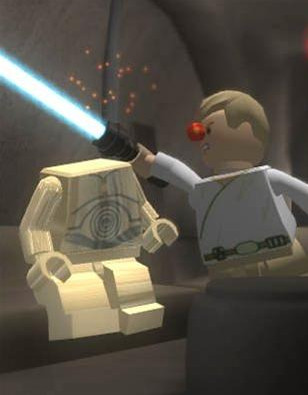
Come on...be honest...you wanted this to happen. We hate this guy just as much as Jar-Jar.

Come on…be honest…you wanted this to happen. We hate this guy just as much as Jar-Jar.

Honestly, though, I did have fun while it lasted, even in light of super-easy game play (you can’t actually die, you just spill your coin purse a little every time you lose a few hearts) and some obnoxiously obscure puzzles to solve. The games display a characteristic sense of humor, adding a delightful irreverence to a story that everyone–except for my ysalamir of an ex–already knows. Without additional dicking around in free play, the game runs under ten hours, which doesn’t exactly commit you to a Bethesda-level commitment. Speaking of which…I just got Oblivion for Christmas. Expect a week off here and there because in addition to working on RPG Maker for the last few months, I just took on a Bethesda-level commitment.

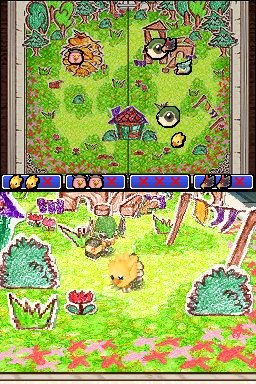
Final Fantasy Fables: Chocobo Tales – NDS

This Thanksgiving, enjoy a bird and a story that won't put you to sleep.

This Thanksgiving, enjoy a bird and a story that won’t put you to sleep.

Give any television show long enough and one of two things will happen. Either they’ll make a Rashomon-style episode where every character gives a different recounting of a certain event, or they’ll parody a famous story using their own characters in place of the original. The latter usually only happens with cartoons and almost exclusively with comedy, but apparently it doesn’t require anything more than a long-running series running out of ideas, because that basically sums up Square Enix’s Final Fantasy Fables: Chocobo Tales. And in their eternal struggle to out-epic everyone else on the planet, they have redone not just one story, but sixteen, rewriting classic fables and fairy tales around their main series summon monsters and recurring fauna.

After turning on the game, the title screen greets you with two eyes, a beak, and the questionably euphemistic command to “touch the chocobo,” without giving you a doll to show you where to touch it. Touching said chocobo launches it upward into the title, bringing you to the main menu. A new game opens on a small farm where the young priestess, Shirma, has gathered three or four of her favorite chocobos to read them a story, which they apparently appreciate more than when I perform Shakespeare for my cats. Soon the black mage, Croma, arrives with a wagon full of newly acquired tomes, including one special-looking one that locks with a tile sliding puzzle. Having dexterous, prehensile digits, the humans naturally request help opening the lock from one of the giant birds with only wings incapable of flight. Enter the player-character, a young, silent, yellow chocobo. You undo the book, naturally unleashing all hell upon the world because, after all…Final Fantasy. The book eats all your chocobo friends leaving you alone with the mammals, and the villainess, Irma, struts out with her chocobo lackeys to taunt everyone about restoring the book to its true form….yada yada.

Who needs a hungry, big bad wolf when you have an angry little tonberry with a knife and a grudge?

Who needs a hungry, big bad wolf when you have an angry little tonberry with a knife and a grudge?

None of that really matters. The real game lies in three areas: pop-up book mini-games, microgames, and of course, Square wouldn’t pass up the opportunity to design an addictive yet time-consuming card game that wouldn’t actually work if you played it outside of the game. The main story only carts you between these games like a rickshaw with plot. The chocobo enters pop-up storybooks scattered around a small world like a Raccoon City library. Each one consists of a story loosely based off a real-life fable or fairy tale. Depending on the difficulty setting, winning the mini-game based on the story will earn you either one of three epilogues, a card that rescues a chocobo from the book that ate it, or a summon card for the card game. The epilogues offer some of the most bizarre prizes in the game. In re-writing these classic stories, Square may have missed the point. While some still sound moralistic, other resolutions wander so far off from the original plots so quickly that I wonder if the game shouldn’t go out to refill its Ritalin prescription instead of telling me stories. Others yet just offer tragedy, such as tonberries who cut off, stomp, and burn the three little pigs’ tails, or how the ugliest chocoling left home to live with the blind mole people and never became a beautiful phoenix. Each epilogue effects one change in the natural world–in addition to effecting a depression in the player–which tends to progress the story, open access to a card, or give the player access to a microgame. Rescuing chocobos will usually open a microgame or the grateful bird will give you a card. Beating the microgames will always give you a card.

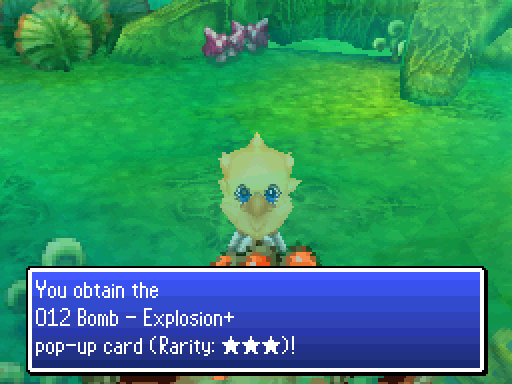
Three-star rarity! That would impress me more if every single card didn't have only one copy in the entire game.

Three-star rarity! That would impress me more if every single card didn’t have only one copy in the entire game.

So really, the game should come to a head at the card game, right? You’d expect plenty of clever card duels with clever designs and challenging deck building strategies, right? You’d also recognize the sarcastic tone and have figured out by now that you shouldn’t expect those things, right? The card game works depressingly simply, but not simple and brilliant like the card game in Final Fantasy VIII and IX. More just plain-old simple. Each card has four zones, each one representing one of the four elements, Fire, Water, Earth and Cobalt-Thorium G. Each zone might attack, defend, or just sit with a gaping opening hoping someone will impale it. During each round, each player selects a card, which summons a classic Final Fantasy monster, and the game compares zones. An attack zone needs to match with an empty zone of the same element to hit, a guard zone of the same element to miss, and an attack zone of the same element for half damage. For successful attacks or blocks, instructions on the card determine damage and effects. The first player to reach zero HP wins the shame of losing the duel.

Yeah, I've spent a lot of time on newer systems, but this one tries to look retro!

Yeah, I’ve spent a lot of time on newer systems, but this one tries to look retro!

While the card game has addicting qualities, the simplicity often means that several rounds will pass with no damage. Occasionally I suspect a video game at cheating. Here, it seems like your opponents know what cards you’ve selected and will adjust their selection accordingly, a luxury you don’t have. Add to that unskippable animations for summoning, attacking, guarding, counterattacking, and unsummoning, and you can sometimes spend twenty minutes or more in a duel you know you won’t win. Moments like that made me wonder why Square included a “quit game” feature for the pop-up books, but not the microgames or the card game. Also, one pop-up book offers the option to skip the opening animation, but not the other fifteen or the card game. So while the game takes about 16 hours to finish and complete, you can use a good chunk of that time for reading, homework, preparing dinner, and telling those people from the congressman’s office that no, you don’t want to help out his campaign by calling people and trying to persuade them. The card game, though, doesn’t actually head the game; Square just needed some seemingly useful prize to give for the mini- and micro-games, and they just happened to have a plentiful supply of cards.

Whack-a-Malboro. Easily the most addicting, and surprisingly the least likely to inspire violence.

Whack-a-Malboro. Easily the most addicting, and surprisingly the least likely to inspire violence.

I found that I enjoyed the micro-games more than pop-up games or the card games. These games work like flash games or iPhone games–simple objective, simple rules, fast-paced game play, and difficult enough that you should probably pad your walls with rubber so as not to smash your DS when you chuck it away in frustration. Fortunately, unlike flash games, they offer prizes–cards, of course–which may not benefit you at all, but at least provide a point at which you can say, “Fuck this! I never want to play this game again!” with at least a modicum of dignity still intact. Getting that prize puts a reasonable limit on your need to sit there for hours because you think you can do just a little bit better next time.

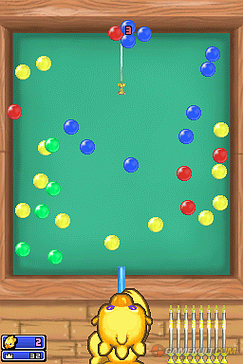
Some games make use of the DS microphone, like this one simulating a blow gun. When I regained consciousness, I found I had won the gold prize!

Some games make use of the DS microphone, like this one simulating a blow gun. When I regained consciousness, I found I had won the gold prize!

This light-hearted spinoff doesn’t take much time, and it doesn’t pile on heavy themes of death and sacrifice and identity that the main series does with enough melodrama to sicken even the most self-absorbed teenage girls. The plot never really twists or complicates, and only thickens like a mild curry sauce. It pretty much consists of the humans sending you to the front lines, while they hang back and work as dialogue-spewing machines every so often. Most of the game recycles main series music in a move done either to reminisce on familiar series elements or to capitalize off having a Nobuo Uematsu score years after he left Square-Enix for greener pastures and blacker mages. The chocobo fights card battles to either the FF1 battle music or the FFVI boss music. The boss fight plays “The Battle on the Big Bridge,” one of my all-time favorite battle themes…unfortunately the modified air-hockey game doesn’t quite live up to the music. Still though, the game works, works well, and feels like all those addicting minigames you play when you know you should read or prepare for class instead…except, with more of a point. Other than getting out of work….I have to go play Whack-a-Malboro now.

Age of Empires: Age of Kings – NDS

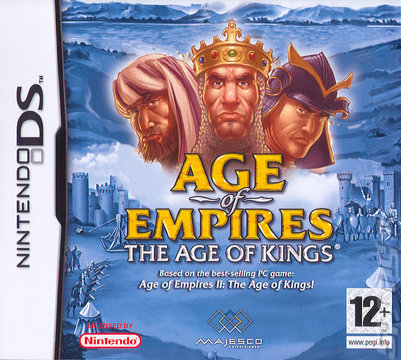
_-Age-of-Empires-The-Age-of-Kings-DS-DSi-_
If you’ve kept up with me for even a few months, you’ve probably noticed a pattern. I play a game, like it, and jump immediately to another game in the series. Or, perhaps, I hate the game and want to play something better. Either way, you can expect another Onimusha entry soon. Maybe another Castlevania, too. But not this week. This week I’ll jump back into the past and re-create historical battles without the need to tolerate people who truly believe the South will rise again. You may recall a few weeks ago when I wrote about Age of Empires: Age of Kings. I felt that between juggling the tasks of deforestation, trading resources like a gambling addict at the New York Stock Exchange, whipping lazy peasants like a plantation overseer, and constantly buffing out the hoof dents in and removing arrows from the skulls of my soldiers, I didn’t feel like I had any time to enjoy the game.  So when I finished–yes, and I also read all the way through Moby Dick. I abuse myself that way–I did what I could to rectify my frustration; I played through the turn-based Age of Kings on the Nintendo DS.

Yes, “turn-based.” The words reviewers always spit out like an angry dilophosaurus, meant to imply something infantile, unrealistic and boring, while still gives them an opening for lavishing praises on Mario, which really does play as infantile, unrealistic and boring.  Reviewers use the term “turn-based” to justify abandoning a Final Fantasy game after playing for thirty minutes and not getting a Call-of-Duty-esque rush of testosterone and a story premise they can sum up into ten words or less. If you haven’t yet picked up on the tone here, I don’t necessarily think games where the enemy patiently waits for you to bash in their teeth before they do unto you actually suffer directly because of that feature. Consider this retribution for panning Assassin’s Creed; now I have to defend something no one else likes. For starters, people who play chess and go take turns, and we commonly believe that geniuses play those games. Now think back to some of the real-time games you’ve played. Kingdom Hearts–do you ever use any strategy other than mashing the X button and occasionally healing? How about Smash Brothers or other fighting games. Do you actually know how to pull off the special moves, or do you just hit buttons and hope to get lucky?

Yup. Grid-based strategy. Like chess, but with trees and rivers.

Yup. Grid-based strategy. Like chess, but with trees and rivers.

See, players will usually do the simplest, easiest thing that accomplishes their goals. Real-time games usually give you a swift, basic attack that you can execute in a pinch. Think about it this way; a spider falls on you while taking a shower. Do you rationally think out a plan to improve the situation, or do you freak the hell out? Real-time games make players freak out. I don’t like that. I constantly have to explain to friends that button-mashing never works better than actually knowing how to play the game, and they never believe me, and then they play as Gannondorf and I play as Jigglypuff and I beat them into submission within moments. The PC version of Age of Kings employed the freak-out strategy, where building a proper economy, scoping out the terrain and developing a strategy often took a back seat to giving a sword to any man, woman, child, horse or hedgehog within sight and pushing them out one at a time to get slaughtered by the hoards of enemy Rohirrim Riding into my village, smashing and hacking and destroying everything in their path.

Wait...doesn't my advisor's name mean "Toilet" in Japanese?

Wait…doesn’t my advisor’s name mean “Toilet” in Japanese?

The DS game, however (to actually discuss today’s topic), gives you both the time to plan out a strategy and the need to do so. In addition to campaigns where you build towns and mine resources to support your army, this game gives you missions with a set number of non-renewable troops and tells you, “Go get ‘em, tiger!” And of course, attacking your enemy directly inevitably results in a wall of bodies–and not the useful kind, like in “300“–and a serious reflection as to your career choice of famous historical warlord. Different missions offer different objectives–destroy a town center, defeat an enemy hero, capture relics, build a tent for Genghis Kahn and make sure no one sets it on fire–and a number of ways to accomplish those tasks.

Hero units make the game. While in the PC version, you only ever took control of Joan of Arc, every mission in the DS game gives you control of a hero, and gives those heroes a number of special powers that effect game play. Joan of Arc can heal, Richard the Lionhearted can make his archers shoot farther, and Saladin will occasionally chip in a few coins to help you save up for that camel you’ve always wanted. Regular units, while only the monks and villagers have special commands, each have their own characteristics or abilities that tailor their uses to specific strategies. Archers can attack from a distance, preventing a counterattack, but if attacked at close range they have very low defense. Pikemen have less attack power than swordsmen, but deal more damage to cavalry. Cavalry deals a lot of damage to most things, but loses strength against buildings. This keeps the gameplay variable, and the bonuses and handicaps mostly feel intuitive, but sometimes come off a little weird. While I appreciate the challenges in ripping down a castle with your bare hands from the back of a camel, I find it difficult to understand how a rock hurled from a trebuchet can rip through that castle like tin foil, but an infantry unit can take the same blow and walk it off with only minor bleeding.

The game, of course, retains its titular feature, “Aging Up.” In campaigns that require economy building, your production lines turn out shabby, brand X fighters, and only by sinking money–and for some reason, food–into research each day can you expect to give them better weapons, stronger armor, or more efficient training. With enough research, a player can advance to the next “age,” beginning in the dark age, then progressing through the feudal, castle, and into the imperial age. With each new age, new buildings become available and new research opportunities along with them. In the feudal age, for example, you can build a blacksmith, which doesn’t create any units, but can improve weapons and armor for your existing soldiers. Likewise, by the time you reach the castle age, you can found–and underfund–your very own university, just like a real national governor.

Uhh...yep. More screenshots. Unfortunately, you don't often see much action.

Uhh…yep. More screenshots. Unfortunately, you don’t often see much action.

Age of Kings follows a historical path–sort of–for the five main heroes; Saladin, Minamoto Yoshitsune, Genghis Kahn, Joan of Arc, and Richard the Lionhearted. Occasionally it has to include a note here and there stating that Minamoto never actually fought the Mongols, that Richard never took Jerusalem, or that Joan of Arc didn’t really win all that many battles. I understand that not a lot of people out there nerd out over Medieval history, but I do, and as much as I appreciate science fiction and fantasy, game developers rarely realize that their products don’t have to fall into one of the two default categories. Unfortunately, it doesn’t include all that many historical re-creations, and the post-game falls short of expectations so hard I think I heard all its bones shatter. By accomplishing challenge goals in the main game, you can unlock extra maps and a few scenario battles to set up hypothetical and partially randomized campaigns to play through. However, all the heroes must have suffered a few too many blows to the head in the main game because even on the hardest settings, enemies often forget to build, research, age up, or attack. Not so much battles anymore, these campaigns have all the difficulty of erasing low-quality chalk off a chalkboard (you young ‘uns should think “dried up ink on a white board.” But then go find some chalk.) These additional campaigns serve only to wean me off the game while simultaneously looking toward Age of Empires: Mythologies, but in the interest of getting through this stack of games I bought by never played, you don’t have to worry for a while.

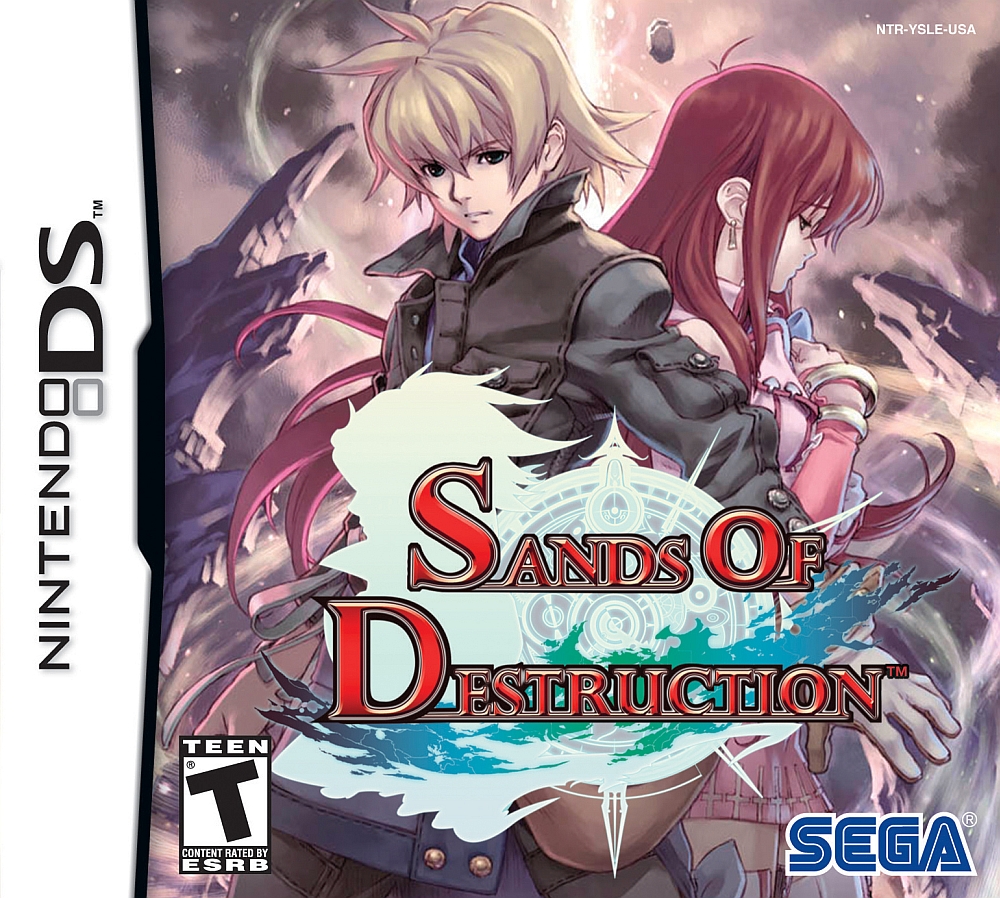
Sands of Destruction – NDS

Title

If I had to list off the best games ever made, of course Chrono Trigger and Final Fantasy VI would sit near the top. Every list of best RPGs or best SNES games and even a bunch of best-game-ever lists pick one or the other. Still, an often overlooked gem for the Playstation wins out over both of them: Xenogears. But I played it recently, and with 75 or so hours of game play, I doubt I’ll come back to it soon. Plus, while I can play Chrono Trigger over and over without getting bored with the story (and watch Back to the Future for days straight…must have something to do with time travel), overplaying a finely crafted drama like Xenogears tends to devalue the story. Fortunately, the list of people who love the game begins with the team who designed it, and thanks to their endless quest to make lightning strike as often as possible, they’ve hoisted the same battered rod used for Xenogears and Xenosaga, and enough metal remained that it channeled a trickle of electrons into an NDS game called “Sands of Destruction.”

The player can rotate the map like in Xenogears. Except in about half the areas. Because fuck that!

The player can rotate the map like in Xenogears. Except in about half the areas. Because fuck that!

From the beginning, the story clearly strives to lead the same life as big brother Xenogears; both games focus on the exploits of a twat with a personality often found only among the most noble and kind-hearted sacks of flour, who accidentally annihilates his entire village and everyone in it. Both protagonists learn they have the chosen power to do something that generally sounds like a bad idea; Xenogears’ Fei has the strength and technology to slay god, while in Sands of Destruction, a clutter of fliers reveals to Kyrie (Greek for “Lord”) that he has the power to destroy the world and should promptly join the World Annihilation Front and get on that. Then both Kyrie and Fei get taken prisoner on a sea of sand by a kind-hearted, whip-wielding pirate, et cetera, et cetera, then they kill god.

Unfortunately, Sands of Destruction doesn’t come close to the 75 hours that Xenogears had to develop their story. As much as I surrounded myself in rosaries and doused myself in holy water when I learned I had to slay god, by the end of Xenogears, I knew I needed to exterminate the sick bastard and started combing eBay for a cheap Ghostbuster proton pack. In Sands of Destruction, the WAF distributes orders like it desperately wants you to see its band perform, but for all the confetti you pick up by the end of the game, no one has given you a single reason why you need to put the world down. It certainly doesn’t feel like an impending apocalypse; no one points out frogs going extinct, polar bears balancing on ice floes, the dead rising from the grave and the virtuous ascending into heaven, or polar vortexes ruining an already cold Minnesota summer.

"In a game so bland they couldn't figure out what to do with the second screen half the time."

“In a game so bland they couldn’t figure out what to do with the second screen half the time.”

Rather than spending time developing character, conflict, or even asking the pretty young girl who rescues you from jail why the world sucks so much, the game sends you on one pointless task after another so that you run into the beast lords, twelve anthropomorphic rejects from Winnie the Pooh, mowing them down one after another without any real idea of what they’ve done to oppress the human population or ruin the world. In addition to the beast lords, Kyrie crosses paths with primal lords, titanic gods who appear to govern the whims of nature. These primal lords accept the inevitable apocalypse with a positive spirit and a chipper attitude, but still attempt to re-decorate their houses with his bowels to show the ungrateful brat a lesson about what happens to him if he ignores his chores to go gallivanting around not destroying the world. That’ll teach him! The story plays out entirely without any motivation for or investment in the quest at hand, and in the ending sequence after you kill god and find out that “creating your own world” means making everything exactly the same except for replacing all the sand with water, I couldn’t help but wonder why anyone really had to do anything. I mean, no one really seemed all that thirsty before, and the sand ships seemed to work just fine. Any mystique or meaningful interpretation behind the story becomes flimsy and transparent to anyone with a few weeks of Beginning Latin under their belt. Only one character kept my attention for any length of time, mostly out of the novelty of a teddy-bear bounty hunter with a gruff, middle-aged, man’s man voice. He joins the party because he wants to take in one of the characters for her bounty, then just sort of goes along with all their plans and quests without any real explanation. Also more of a novelty interest, one of the early villains speaks in the angriest, most self-absorbed gay lisp I have ever heard. I might suggest playing the game simply for the voice acting, except for the long, unskippable pauses between lines of dialogue.

The game really likes to make you wait. Much like in Xenosaga, characters get two attacks per turn, sometimes earning an extra attack through–as far as I can tell–pure fucking chance. Enemies, however, can chain together about as many attacks as they feel like, often not quitting until at least one character dies. Factor in useless animations where they spasm like a raver in the advanced stages of Parkinson’s, and enemy turns become useful moments to get stuff done around the house. Go make a sandwich. Vacuum the floor. Do your taxes. Eat that sandwich. Don’t worry. Your characters won’t take their turns any time soon. You won’t miss anything. The battles display a turn order like in Final Fantasy X or Xenosaga, but not with enough accuracy that it lets you plan out a strategy or anything. Nope. Enemies can cut their way into the sequence whenever they like, certain characters will forget about their turns entirely, and every so often they’ll even trade order, making the display more of an annoying distraction than useful information.

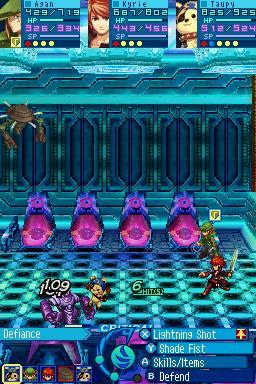
Taupy dealt about 10 times the damage as Kyrie. I used him often.

Taupy dealt about 10 times the damage as Kyrie. I used him often.

It feels like Sega developed and published this game at gun point; as if they pounded out a rough draft and never bothered fixing any of the problems with it. Kyrie attacks as if I equipped him with a pair of used chopsticks, while a few of the other characters can deal about 100x the damage that creatures can take. They try to balance this out by giving enemies obnoxiously high evade rates, which I’ve said before only turns battles into endless sessions of watching battle animations like you have to remember them for a test. Similar to Xenosaga and Xenogears, attacks correspond directly to buttons, with X delivering a single hard-hitting attack, and Y dealing a flurry of blows, each one dealing as much as a single X attack, and a system of magic attacks, fully powered up, allows characters to expend SP to almost deal as much damage as a single X attack. I advise you to tape down the Y button and open up a bag of chips to eat with the sandwich you made during the boss fight.

Teddy bear kicking the shit out of someone.

Teddy bear kicking the shit out of someone.

Character customization had potential, allowing the player to power up attacks at the expense of accuracy or accuracy at the expense of attacks. Magic attacks traded off power and SP cost. Still, only ever using the one attack, I didn’t feel any sense of urgency in strategizing how I’d level them up. I hit the attacks I used and then just dicked around with the rest of my customizing points to keep them from piling up. Furthermore, by the time I got to advanced magic spells, I started noticing that players simply can’t use certain attacks that they learn. At various points during the game, players learn “quips,” short phrases that they can repeat in battle. Unlike most useless battle cries, these have effects, usually support statuses, that can actually make a difference. Each character learns a total of five, and can equip…four. Again, the game doesn’t really press you to make the difficult choices.

Most dungeons consist of only a few screens, padded out with all the tedious puzzles they could think of and enemy encounters so frequent that the Toyko metro system during rush hour has more breathing room. And that serves as a good metaphor for this game. It has a lot of good things in it, but not enough elbow room to use it for anything constructive. Most of this game only exists to pad out a handful of interesting ideas into a full-length (about 20~25 hours), marketable product for the NDS, and tedious methods for making a game feel longer without actually giving us a reason to play it tend to amount to an Asian train ride; you may have gotten somewhere, but only at the expense of an unpleasant journey, and you get off feeling like someone either owes you an apology or dinner.

Final Fantasy IV – NDS

A beatifully animated, fully-rendered 3D opening sequence, the style of which you never see again. Why does Rosa look like she has swine flu?

A beatifully animated, fully-rendered 3D opening sequence, the style of which you never see again. Why does Rosa look like she has swine flu?

I you will permit me, I’d like to start on a serious note, preferably without discourse as to whether or not my usual candor qualifies as humorous. I just finished Final Fantasy IV, something I claim to have done no more than twenty or thirty times in the past, and suddenly I can put my finger on why I appreciate Japanese storytelling more than Western writing. That whole dichotomy between good and evil and the struggle there between, falls a little flat, and as people have a pesky habit of applying fiction to moral decisions (for which I recommend reading Kurt Vonnegut or Charles Dickens) rather than, you know, just treating people well, such a dichotomy tends to screw up society.

ffiv-infernoHow so? Start with Beowulf. The draugr Grendel came from the lineage of Cain. And if that doesn’t earn him his own private hell, he also killed people and ate them. Then Beowulf shows up and slays him to punish evil. Excellent, right? Well, let’s take a jaunt over to this week’s game and look at Kain, who came from a noble lineage of dragoons. Golbez manipulates him into committing evil acts on his behalf. Then Cecil shows up, decides not to kill him, and you get a wonderful exception to normal RPG party limits that lets you fight with a fifth member. Now skip on over to Star Wars where we find Darth Vader, the Father of all Incarnations of Pure Evil. Except George Lucas wanted to show him redeem himself at the end, atone for his crimes and bring balance to the Force. But no one took it that way and we all talk about Vader as a badass so evil that he makes Satan sith his pants in terror; this pisses off Lucas, so he makes us sit through a crappy prequel trilogy to show us how badly we misunderstood this character. Then in Final Fantasy, Golbez pulls the classic Vader twist, Cecil struggles with the news, but eventually forgives Golbez, who goes on to clear out the first form of the big bad Zemus for you, then goes into self-imposed exile out of remorse. And this trend runs throughout Asian religion and literature from Journey to the West to Dragonball; no one possesses absolute good or evil, and everyone can atone. Full disclosure: Cecil’s atonement on Mt. Ordeals *always* gives me chills, and I’ve played the game forty or fifty times.

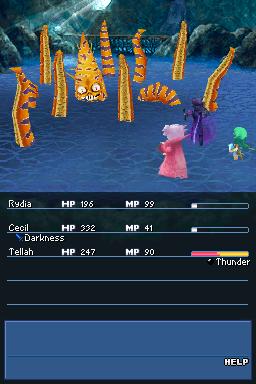
They put enough thought into the new translation so as to actually appear as though they put thought into the translation.

They put enough thought into the new translation so as to actually appear as though they put thought into the translation.

Despite everyone’s praise for FFVII, this installment changed the world of electronic RPGs more than anything else, having introduced novel ideas such as actually giving a character a personality and a conflict to resolve, and introducing thematic congruity throughout the story. Also, having a story. And dear god, music so good that Japanese schools instituted it as mandatory curriculum. I might even confess that I played the FF Main Theme, which played during Rosa and Cecil’s wedding, as the opening to my own wedding. While I have a special relationship with FFVI as the first RPG I ever played (and played and played…), I find myself playing FFIV about once per year, and only in part because they port and remake the game with a regularity that anyone over the age of 70 would envy. (Seriously…FFIV (Japan), FFII (USA), FFIV Easy Type, FF Chronicles, FFIV for the Wonderswan, the GBA, a few systems I probably missed, and then this version.) So when I found out that the game would receive such a drastic makeover as they gave FFIII, building it up in three dimensions with voice-acted cut scenes, I actually played the game in Japanese because I didn’t want to wait for the North American release (and thankfully, I lived in Korea at the time). Also I intend to argue that that qualifies me as bilingual and that I don’t have to pass a language proficiency test ever again.

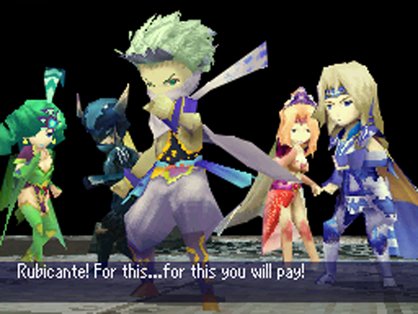
A more appropriate representation of in-game cut scenes, the character design obviously symbolises that neither Cecil nor Kain can see the path before them. Because of their helmets.

A more appropriate representation of in-game cut scenes, the character design obviously symbolises that neither Cecil nor Kain can see the path before them. Because of their helmets.

So other than the aesthetic makeover, why should I waste my time on yet another release of a game I’ve already played sixty or seventy times? Square decided that simply milking it for cash wouldn’t cut it in the long run, so they added some chocolate to that milk. Many enemies have different attack patterns, and certain attacks and spells function differently; for example, if you expect simply to bounce Bahamut’s megaflare back at him, you’ll soon discover the reflect spell has all the defensive capabilities of a burlap sack soaked in gasoline. These changes tailor the game to develop strategies, without which you will pass through the game with the ease of a golf-ball sized kidney stone. To help ease said passing, characters now can augment their abilities using items mostly looted from the corpses of their dead friends. As the name suggests, these augments will give characters extra commands to use in battle or enhance their qualities akin to the relics in FFVI. Unfortunately, the game explains this system with all the clarity of Sylvester Stallone explaining quantum physics while running a garbage disposal at 6:00 in the morning. It fails to tell anyone who’s played the game before that you won’t waste your augments by giving them to characters who won’t stay in your party. Instead, it’ll let you loot even more powerful abilities from them. Thanks, game. I could have used that information during the early game when I usually drudge through the road from Damcyan to Fabul, ruing Squaresoft for giving me a bard and wondering why anyone in their right mind would ever choose to play as a bard.

And while discussing the merits–or lack thereof–of things no one ever uses, they’ve added an entire garage sale full of assorted junk to the roster of items. You know those too-pointless-to-use magic items that Square seems to love handing out? The ones that cast low-level spells at a fraction of the stats that their black mage counterparts have available? And you usually get them when you’ve had their upgraded version in your regular magic menu for hours? Yeah, the game chucks them at you like a Double Dare physical challenge. And they’ve added a mapping feature to make use of the dual screens–any time you complete drawing a map of a dungeon floor, you get an item. Or five or ten. I’ve found uses for some of them; they’ve added items that permanently upgrade HP or MP, while helped keep Rydia and Rosa alive and not useless in battle. But usually you’ll get an antarctic wind or a bomb core or–my personal favorite–items that cast status spells that never work anyway. You no longer have to replenish arrows–each one gives you an infinite set, which takes a bit of the fear out of using Rosa, lest she run out of anything useful to do and end up tossing pebbles, but now Cecil can’t equip bows, making him all but a burden in the Lodestone Cavern.

ffiv_battleUnfortunately, for all the clever re-figuring that they did when assembling the DS version, even with augments and strategies and piles of crap looted from caves, eventually (and often) you will run into an enemy–not even necessarily bosses–that hits your entire party for more damage than you can take in a single blow, or that spams an attack faster than you can keep up with it, and you only have the option of leveling up in order to resist. Having played the game once before, I knew this and kept a steady pace of leveling up through the game. I did all right in most places, but the final dungeon clearly took offense at my presumption that I could fight through basic battles at a paltry level 65. So thank you, Square-Enix, for taking one of my favorite games of all time and adding just the right dose of tedium to turn it into a fucking level grinder.

FFIV DS group shot

I can only really recommend this game for the die-hard FFIV fans who have played the other versions eighty or ninety times, like me. I liked it. Mostly. The voice acting impressed me when I heard it in Japanese, and it only got better when I listened to it in English and actually understood it. Also, I appreciate the recognition that people still want to play certain games even twenty years after their first release. But it requires a certain level of patience and know-how to both grind and solve strategic puzzles (the only kind that actually belong in non-puzzle based video games!), and it might turn off first-time players (as well as some second-, third-, and tenth-time players). Still, the dramatic points in the game still awe me after a hundred times through the game, and finishing the game rewarded me with the realization that Yang, our blonde-mustachioed Asian Fabio, can attend a wedding bare-chested without the slightest sense of impropriety.

Resident Evil: Deadly Silence – NDS

You should take solace in the fact that the spiders still qualify both as "big" and "hairy."

You should take solace in the fact that the spiders still qualify both as “big” and “hairy.”

I might compare art to beautiful prostitutes; lovely, inspiring, everyone has seen them, and people everywhere feel an instinctual need to do them both, but no one wants to get caught giving them money.  Sadly, despite all our magnanimous feelings toward art, if it doesn’t turn a profit at the end of the day, it doesn’t happen, and as the $400 average price for a current generation system will attest, video games, while creative and artistic endeavors, still need to turn tricks to keep afloat. If you’ve read my recent entries, you’ve heard me rant about Nintendo’s efforts to package the portability of Game Boy games over any actual quality of games. Their breakthrough efforts with the DS gave us an onslaught of games, and statistically speaking we could expect many good ones in the pile of broken coding. However, that didn’t stop them from porting the 1996 classic, Resident Evil to yet another system to make a quick buck on making it portable.

...these guys. Still hate 'em.

…these guys. Still hate ’em.

To Capcom’s credit, they try to make this game more interesting every time they expect us to shell out more cash for their new edition. The major feature of Deadly Silence builds off the DS (I see what you did there!) hardware.  Although cheap and gimmicky in places, I can’t really lament REDS the way I would other game ports.  The game practically invented modern survival horror, and as such it works because it embraces horror elements such as fear and surprise. While essentially the same as the original PS1 version, I have to begrudgingly admit that they’ve altered it enough so as to keep it fresh and startling.  Since the game actually features two modes–classic and rebirth–and since they didn’t really do anything but a straight-up port for classic, I’ll concentrate on rebirth mode here.

Immediately I noticed they fixed the knife mechanics. I really enjoyed the knife in RE4, and found it quite satisfying to take down monsters by a quick jab to the knee caps and repeatedly plunging the blade into their parasite-ridden flesh like Dexter, reveling in the squishy noises until that last groan tells me to to look for a new victim. Unfortunately, the knives in earlier games don’t provide such a cathartic experience, and serve only to sacrifice the number of useful items you can carry in exchange for the ability to play “here comes the airplane” with zombies, thrusting what can only look like a juicy piece of meat directly into their all-too-willing jaws. Instead of offering yourself up as bait, the knife remains equipped like it does in RE4, under control of the left shoulder button, and it actually damages the zombies enough to make it a worthwhile weapon. And I know that people say it’s always worked against the spider, but do you know what works better? A fricken flame thrower.

...because he should really see a doctor if his blood has the color and consistency of the green ketchup.

…because he should really see a doctor if his blood has the color and consistency of the green ketchup.

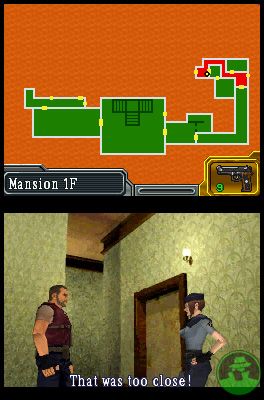
As another nice feature, which completes my list of any actual differences between the original and the remake/port, the top screen of the DS displays both a map of the mansion and the player’s current health status. While the flashing colors to display injuries doesn’t make it less cryptic, still leading to the inevitable question of whether or not it hurts enough to only take a few aspirin or to inject that case full of morphine directly into your brain, it at least removes the need to open a menu and give the character time to reflect on the nature of wounds and come to grips with their inevitable mortality.

Jill learned this in 'Nam.

Jill learned this in ‘Nam.

Some of the puzzles have different mechanisms for solving: use the microphone to blow out a candle, use the stylus to draw in wires or jiggle a sword out of a door. These really add nothing to the game other than the altered layout of items forces you to take a new route, which causes you to backtrack through areas that may or may not have new challenges. Keepin’ it fresh, eh, Capcom? The real addition involves a mini-game sequence activated semi-randomly as you enter a room. The player shifts to a first-person perspective and requires use of the stylus to hack and slash a rush of monsters. Specific attacks can stun monsters, otherwise they plow through to your tasty brains, oblivious to the holes opening up in their torsos. I enjoyed this, more or less, but during the more frustrating onslaughts I couldn’t help but ask, “If Jill had a fully loaded shotgun as she walked through that door, why did she feel the need to combat this 15-meter, venomous snake like a boyscout whittling a marshmallow-roasting stick?”

Yes. We get it. Jill Sandwich. Sounds funny. Now shut up and edit the script.

Yes. We get it. Now shut up and edit the script.

Beating the game once unlocks a more developed version of this, called “Master of Knifing,” which also suggests that Capcom decided to embrace, rather than repair, acting so bad that the actors refuse to list their full names on IMDB. Yes, we all know about the “Master of Unlocking” and the “Jill Sandwich” lines, but seriously, the actors read every line like a mommy reading to an infant that doesn’t speak English yet. And the mommy has never heard anyone speak English or use inflections or tone of voice. They had the decency to rethink the puzzles and the layout and to fix the knife and all that; did it never occur to them to wander over to the nearest high school, pull a handful of the extras out of an Our Town rehearsal and spend ten minutes with them to get a performance far superior to the original cast?  Did that take bit of energy cross the line, or did they just really enjoy a performance stitched together from the discarded audio of 1980s cleaning supply infomercials?  Just because the game sold well and people had a good laugh at the lousy actors doesn’t mean it should stay that way.  Resident Evil built its fame on setting tone and using creepy sounds to scare the shit out of both ends of the player; the acting not only breaks that tone, but reverses its effect.  Humor relieves stress, and in a game designed for tension, they can’t really relent on stress.  Just pack up the original recording as an unlockable feature if you love it so much.

For those times when using a shotgun just wouldn't give you the same rush. Thinking of these two as adrenaline junkies really changes the tone of the game.

For those times when using a shotgun just wouldn’t give you the same rush. Thinking of these two as adrenaline junkies really changes the tone of the game.

Mostly though, I can’t complain.  The puzzle redesign puts certain items in places where the unaltered story may not send you–but hey, I’ll tell you right now that you find the wolf medal in the guard house, but be prepared to knife the giant snake for it.  Otherwise, well, the game won’t surprise you too much.  Same thing, but different. But mostly the same.

____

Even though I thought I’d disappear for a while, I’ve managed to update weekly. This week should challenge me, though, as right now I have about 30% of Assassin’s Creed II and maybe 40% of Final Fantasy VII done.  I generally don’t like playing two games at once, but Anne’s never seen FFVII, and I need something to do when she goes to work. So look for reviews of those two games in the near future. Maybe I’ll throw in an Atari, arcade, or NES game just to have something quick to play and easy to write about.

As usual, thanks for reading!

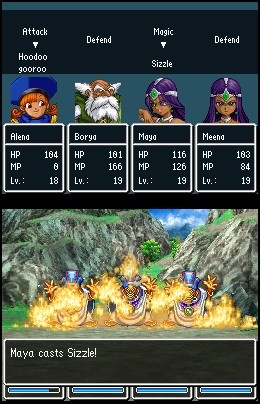
Dragon Quest IV: Chapters of the Chosen – NES, NDS

Stunning artwork by Akira Toriyama, which you will never see with the first-person battle system.

Stunning artwork by Akira Toriyama, which you will never see with the first-person battle system.

Sometimes I wonder if game designers ever play games themselves. When they go home from a hard day at Square-Enix or EA or wherever they work, do they sit down, pop in Goldeneye 64 and vent their aggressions on unsuspecting polygonal clones? Because half the time, the games I play suggest that the designers slapped together a few inebriated, late-night ideas together, hired some monkeys to make the code functional, then add required backtracking, level-grinding, or needlessly long menu dialogue to pad the game out to the optimal length for predicted financial success.

And so we arrive, weary and saddle-sore, at the beloved Dragon Quest series. In particular, Dragon Quest IV: Chapters of the Chosen stands out as the paradigm of wrong answers to good questions. “What part of the traditional JRPG do players consistently enjoy as the most stunning part of the experience? What makes them ignore the phone, neglect their schoolwork, household chores and personal hygiene, and refuse to develop a social life more than any other point in the game?”

DS Battle“Compelling characters and a complex, driving storyline?” shouts an up-and-coming young mind in the Enix meeting room.

“Fuck you!” responds the boss, who follows up by firing the up-and-coming mind.

“Hours and hours of monotonous grinding?” someone suggests.

“Technically, true. Put it in the game. But what do they love? Why do they love RPGs with the intensity of a rabbit overdosing on Viagra?”

“The first hour and a half where you have no money, no access to anything cool, and  no abilities other than attack and item?”

“I like it,” says the boss. “We’ll do it five times, and throw in some of that grinding to make it more like three hours.

And thus, the incipient Dragon Quest took form. Chapters of the Chosen focuses on…the idea of not focusing on anything. The story opens with the generic blank-hero, a character so bland compared to everyone else in the game that the lord of hell himself couldn’t drag my projection of myself into the game. “You want me to imagine myself as that guy?” I ask the game. “No thanks. You go on and play without me. I’ll just watch this one.” Feigning a fast-paced, exciting game, monsters invade the hero’s village, looking for you. After killing your neighbors, your adopted parents, and your love interest, the monsters decide they just don’t feel like putting the effort into eviscerating one more human and leave your cowering in a mixture of fear and bodily fluids.

And then the game, bored of the hero’s personality already, leaves you as well, and goes on to someone much more interesting. I’ve just described the prologue. Bear in mind, you don’t even get to battle the monsters. No fighting. Not with the protagonist. Not yet. C3PO and R2D2 make it to their hero at light-speed compared to this game. So the game shifts to Ragnar McRyan, whose king has sent him to find the hero–but before he does, we have to help Tsarevna Alena pull a Princess Jasmine. Alena eventually Alena joins a tournament that almost introduces the villain–

Thought I should include a screen shot of the NES version. Apparently they added the borderline-offensive gibberish for the DS version

Thought I should include a screen shot of the NES version. Apparently they added the borderline-offensive gibberish for the DS version

–but first cuts to the story of Torneko Taloon, Akira Toriyama’s answer to Nicholas Cage, and his aspirations to profit from mass slaughter more than anyone has ever profited off anyone else’s misfortune ever before. Torkneko deserves special attention, for taking role-playing to the extreme. Flash back to the execs meeting:

Just to mess with you, they included "night," which translates to "for half the game, you'll wait for the useful NPCs to wake up."

Just to mess with you, they included “night,” which translates to “for half the game, you’ll wait for the useful NPCs to wake up.”

“We need a role that will open up their eyes to the possibilities!”

“Why not a Samurai?”

“That’ll never work. Next idea!”

“What about a Cowboy?”

“What do I pay you losers for?”

“How about we put players in the role of a mindless clerk standing at a cash register all day long?”

“Fuckin’ genius!”

I should mention at this point that I haven’t exaggerated anything yet. During Torneko’s chapter, you literally spend huge chunks of time standing on the merchant’s side of the counter, waiting for people to come in and buy weapons. Torneko hopes to save up enough money to buy his own gear to set out on a money-making adventure, but he doesn’t even get to keep the cash the store rakes in–his boss pays chicken feed, amounting to less than a 10% commission on each item sold. But still, it gives you the option of refusing sales to each customer, and sometimes they won’t pony up enough cash and will walk out empty handed.

I spent a great deal of time wandering as the game felt I'd enjoy it more if I had no fucking clue about what I needed to do next.

I spent a great deal of time wandering as the game felt I’d enjoy it more if I had no fucking clue about what I needed to do next.

And then just for good measure, we get another chapter. And each new chapter opens up with flat-broke, level-1 characters who fight monsters with all the effectiveness of a paraplegic cub scout wielding a foam pool noodle. Grind away, ladies and gentlemen. Seriously, I haven’t exaggerated anything yet. By the time chapter five dragged itself in to let me play as the hero, my game timer read 12:56. Out of the total 30 hours I played the game, I spent 43% effectively at the beginning, grinding until the “attack” option did reasonable damage. And for the zinger: the story keeps going after the final boss! I beat the game and it offered me another chapter. Thanks, but I’ll pass.

One positive thing I’ll say for the game: it gave Torneko an ability to initiate a monster battle at any time, cutting out the need for useless walking between battles. I take this as clear evidence that Dragon Quest IV knows it only has value as a time-killing grinder, but even with this trick to speed things up, it still felt like I’d hit my mid-life crisis before the end of the game. Unfortunately, any time gained by not walking while grinding balances out with time wasted managing menus. For each option, you have to flip through three or four dialogue boxes that want to confirm in triplicate that yes, you indeed want to use that herb. Or save. Or anything. Yes. Given the choice I will always answer yes. Yes, I’ll sell the damned sword! Yes, I want to equip the armor! Yes, I’ll continue the game after I save! (who thought of this one? Do you need to go to a special screen to shut the power off? Did the original NES erase your data otherwise?)

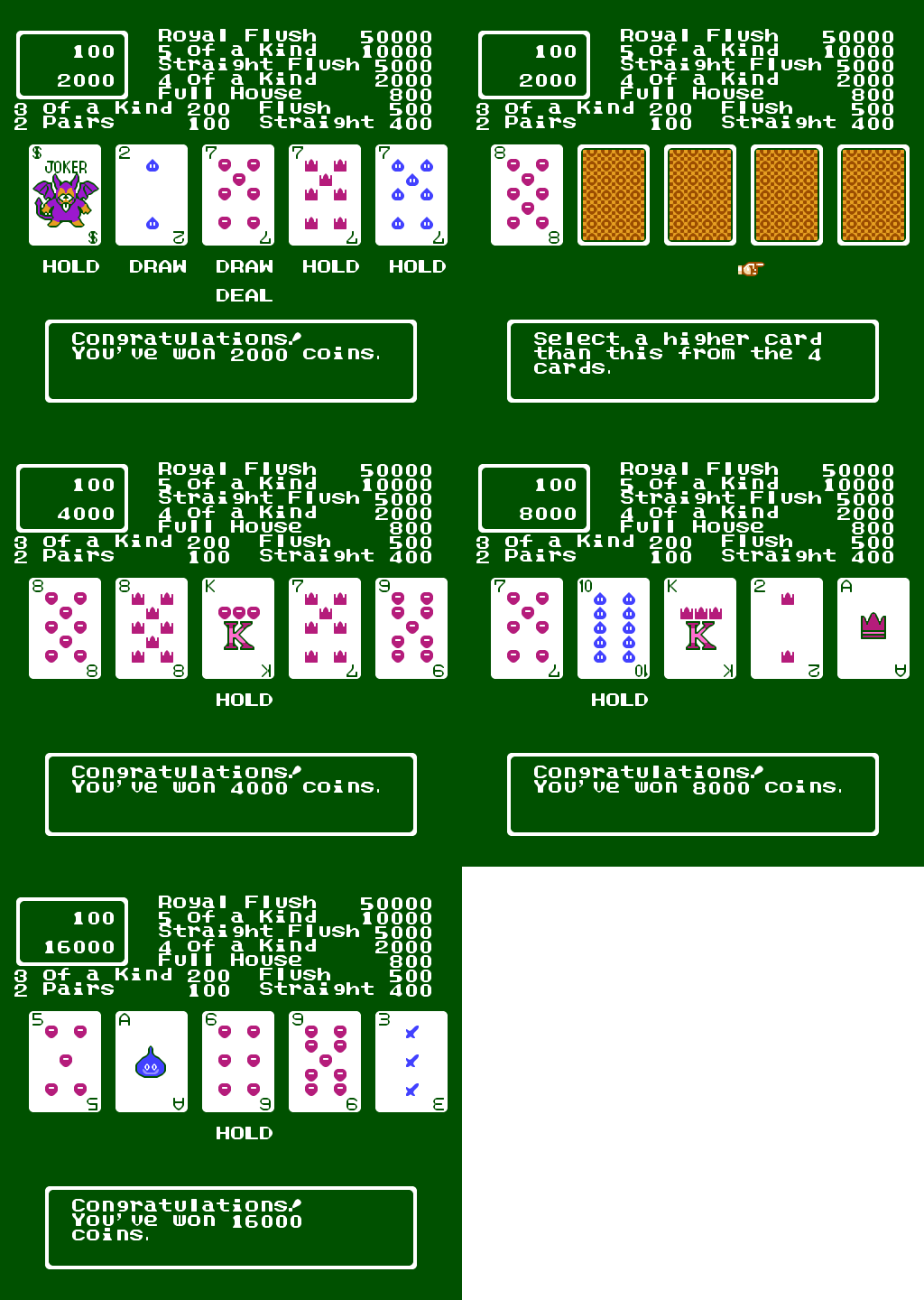
The game features a casino; If you want to waste more than time, why not waste money, too?

The game features a casino; If you want to waste more than time, why not waste money, too?

I think I can stick to the same assessment I gave the original; I’ll play the game as long as something else in the room can take my priority attention. Otherwise, I still don’t see the appeal in Dragon Quest, other than Akira Toriyama’s artwork, which I could download in much less than 30 hours. A game that centers on level-grinding and only includes a half-assed plot and characters doesn’t really offer much value, especially compared to most of the Final Fantasy installments. I don’t understand how these games rate so highly.  And yes, I’ve lived in Asia and I’ve seen Gaijin Goomba; I understand that different cultures think differently and have different needs. But I don’t think I need to spend thirty hours hitting the “confirm” button when I could have just as much fun pushing the buttons on my shirts.

Super Scribblenauts – NDS

Super-Scribblenauts-Coming-This-Fall

As an English writing and literature student, I had to deal with the following on a daily basis.  “English majors, we just love words! Don’t you just love words? I love words.”  Well, no actually.  If I cared at all about random sequences of molecular vibrations, I’d have studied music.  Ideas mean much more to me, and the idea I’d like to discuss here concerns the use of words in Super Scribblenauts.

Super Scribblenauts, a game that requires no scribbling or sailing skills and that I can describe as  just “pretty good” at best, focuses on solving simple puzzles of varying convoluted-ness by summoning physical objects from an arsenal of anything, literally ANYTHING…that the programmers had the foresight to program into it; just speak (er, type) the word and it shall appear! So long as it doesn’t involve profanity, racism or sexual innuendo.  Blood death and violence seem fine, though.  I created an “exotic dancer,” once, but since adjectives have about the same effect as labeling your leftovers with a sharpie and hoping that someone will recognize what it means, the game just gave me a ballerina. Sigh…I was really looking forward to the colony on Mars for a brief moment.

In each level, Maxwell, the extraneous protagonist who has apparently wrapped his head with an iPhone cover, needs to collect the game’s macguffins called Starites.  Often times, the player must meet certain conditions before the starite will appear, such as adjective levels that may ask to create something with the characteristics of both a dwarf and a giant.  While I tend to enjoy creative, free-flow problem solving, most players with an IQ high enough for self-awareness may tend to over think these problems, as I did when I didn’t immediately create a “small giant” or a “big dwarf.”

I have to admire a game that encourages weirdness.

I have to admire a game that encourages weirdness.

Most levels require Maxwell simply to get from point A to point B, navigating certain obstacles such as trees, spikes, lava pits and wedding guest lists.  The game encourages the use of new words to solve each puzzle, which keeps it interesting for a while.  Eventually, however, the problems become a little convoluted, and I found that using “wings” pretty much got me around any obstacle I needed.  I also became quite adept at using a combination of ropes, balloons and a fan to put things exactly where I wanted them. Certain levels require you to think up objects to fill a school or grocery store or something.  One level asked me to create a super hero, and to my utter, childish delight, I put in a “cape,” “dead parent” and “bat” and out popped a masked avenger!

Still, the entertainment value of summoning chupacabras, robotic dinosaurs, napalm, ninjas, demons from the pits of hell, and cats that eat spaghetti wears off after a while.  Since the game rewards use of new words with all of a pleasing, cash-register “ding,” I found myself questing for synonyms.  I found the thought of a game made by running a dictionary through a garbage disposal intriguing, but it disappointed me with its lack of words.  I’m sorry, but you took the time to program in Moby Dick, the Great Flood, the Necronomicon and nitrous oxide, but you missed “jewelery store?” Also, some items tend

Your tauntaun will . . . uh, freeze?

Your tauntaun will . . . uh, freeze?

And as I mentioned in my Phoneix Wright article, creative games usually fail when the player has to tell the game how to think. Many of the objects in the game exist, apparently, only for novelty value, as the programmers felt that not everything really needed to function. Maxwell can’t quite figure out that the acid may help more if he took it out of the container.  One level asked me to find a safe way for a man to jump off a cliff, so I attached a bungee cord to his waist and a rock and then watched the guy run in circles scratching his head, while waiting for a “ding” that never came.  Some puzzles seem to enjoy kicking me in the groin with convoluted answers, but hey, I should have just known that the janitor would clean a mess, but not dirt, the doctor would save someone from a snake, but not cyanide pills, and that a psychiatrist would only check on a patient if they’d seen a big hairy spider.

Even if you can summon the object you want, it may not come in a useful form.  A few times, I wanted to walk across a pit, so I asked for a plank, only to get something immovably vertical.  I could only create fans that pointed left, and ramps that sloped upward to the right. Adjectives don’t reliable alter items either, and while “gold bridge” did in fact summon a bridge made of gold, the system didn’t register any qualities that went with it, so I actually had to destroy it after it started floating away on a light breeze.

As puzzle games go, it played rather nicely.  The novelty lasted long enough and some problems did require a decent amount of thought.  The player has the option to play through most levels on advanced mode, which means they have to solve the puzzle three times without repeating any words.  I tried that for a while, but opted against it in the long run, to save my nerves.

Phoenix Wright: Ace Attorney – NDS

Objection

Phoenix Wright does for the legal profession what the Trauma Center games do for medicine, which happens to be pretty much the same thing McDonald’s does for fish; sliced it open and yanked out its guts until nothing remained except the few tasty remnants that everyone likes, then padded it out with a nice slice of cheese and a bun to make it appetizing. While my initial reaction may sound like I don’t like the game, keep in mind that Court TV and the Surgery channel really don’t rank as high in the ratings as such masterpieces as “The Bachelor” and “Jersey Shore.” I’d like to make a joke here about viewers’ preferences, but reading through the Wikipedia page on Jersey Shore doesn’t really give me any information on what the show actually is.  So as it stands, most people would rather watch 42 minutes of nothing than to learn anything–anything at all–about medicine or the legal process.

However!

…we’ve got endless hours of Scrubs, E.R. Chicago Hope, M*A*S*H, Doogie Howser, Grey’s Anatomy,  House, Ally McBeal, Night Court, the People’s Court, Judge Judy, Judge Joe Brown, JAG, Perry Mason, Law & Order, Law & Order: Criminal Intent, Law & Order: LA, Law & Order: Special Victims Unit, and Law & Order: Trial by Jury.  Just to name a few.

So while the Anime Kabuki Courtroom Melodrama that is Phoenix Wright may not prep us very well for the LSAT, we can sit back and enjoy it simply for being an Anime Kabuki Courtroom Melodrama.

largePhoenix Wright: Ace Attorney tells the story of a 24-year-old who clearly has not aced his profession and only barely qualifies as an attorney.  While the life of the NDS hasn’t entirely ended yet, this game holds a special distinction of “retro,” as gameplay derives from the standard point-and-click adventures of ages long past.  Playing as Phoenix, you explore crime scenes to collect data and evidence to help build a case in defense of your clients.  You can talk with witnesses and other key figures, present them with evidence you’ve found to initiate reactions which lead to more information, and use the DS touch screen to zero in on specific details of a scene you’d like to examine.  At regular intervals in the investigation, you enter the courtroom, where you listen to witness testimony and try to point out all their flaws either by presenting them with your evidence or by shouting out any obnoxious thought that pops into the game writers’ heads concerning key statements in their testimony.

While the game springs from the genre of murder-mystery, it also puts a new twist on the subject.  Most of the time, the player knows who dunnit from the beginning of the case, and in all five cases, you figure out the identity of the murderer well before the end of each episode.  The real genius of Phoenix Wright is not in guessing who the criminal is, but requiring the player to provide proof that pins them to the crime.  This eliminates the possibility for intuition, “cop instincts,” personal bias, “just knowing,” and all the other special-kind-of-stupid arguments that my students use every time I assign a researched persuasive essay.  A goal that aims for evidence instead of the verdict? Can I require video games on my syllabus?

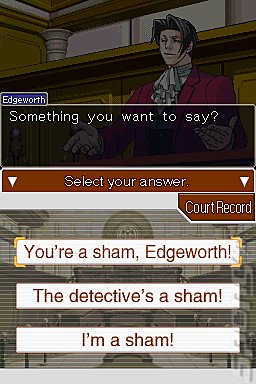
Still, no one has yet developed a video game that can communicate with its players fluidly, and when it demands logic and deduction skills, this can get rather frustrating.  You can’t gather evidence, then waltz into court and say “I’d like to suggest that the witness is trying to frame the defendant based on the grudge he bears from this old case file and the fact that not two, but three shots have been fired from this gun.”  Nope. You have to wait until just the right moment, when the judge demands you present a certain piece of evidence, or you have something that contradicts a witnesses’ statement.  And even that defies intuition at times:

_-Phoenix-Wright-Ace-Attorney-DS-_“Can you prove the defendant was not present on the crime scene at the time of the murder?”

“Well let’s see, I have a photo of the crime scene that he isn’t in, a photo of him halfway across town in a movie theatre, his movie ticket time stamped for the exact time of the murder, his car which is still broken down in front of the movie theatre, and I’m just now receiving a phone call from the defendant stating he’s been trapped in his car since the murder and would sincerely like for one of us to let him out before he starves to death.”

“I don’t see what you’re getting at, Mr. Wright.”

“Umm…well…here’s the janitor’s mop, which he said he cleaned the floor with when he found the body, but there are no traces of dirt on it. If the defendant had been present, he would have left traces of soil from the lawn behind with every foot step!”

“Brilliant, Mr. Wright!”

Murder mystery retains popularity from the satisfaction people get when the figure out the mystery.  People like to feel smart, but sometimes picking through evidence can feel like trial and error.  And you can’t really influence the story any other way, not being able to communicate with the game takes you out of the story.  I felt even worse when I figured it out, then presented my evidence, and they explained an entirely different course of events than those I suspected.  During the final case, the sheer amount of evidence and difficulty of the logic forced me to look up a walkthrough a few times, and at one point after looking up what I needed to present and hearing the explanation given in the story, I still didn’t understand how point A led to point B.

Compounding the frustration, Phoenix Wright: Ace Attorney relies on text more than most games.  While I’ll admit that every word did serve a purpose and they probably couldn’t have trimmed the story much more than they did, it does make the game, especially the later, more difficult trials, drag on much longer than I really enjoyed.  At the very least, they could have offered us the option to skip through text we’d already read, or maybe just changed the system to display all the text in each box at one time, rather than spelling it out for us letter-by-letter as though some tiny stenographer living in the cartridge were transcribing the dialog for us in real time on a sticky typewriter.

Also obnoxious: the game’s insistence on display any emotion other than bland disinterest by having the screen flash white and shaking the character sprites. By the end of major revelations an a-ha! moments, I felt like I needed aspirin and a break from the game to prevent myself from having a seizure.

As mentioned, the localization team seemed to drop all pretenses of courtroom verisimilitude, dropping ideas like “innocent until proven guilty beyond reasonable doubt,” confusing the fifth amendment right not to self-incriminate as a special right held by the police chief to refuse to give any sort of testimony, requiring the real murderer to be unmasked before a “Not Guilty Verdict” can be declared, and my personal favorite, implying that murder by accident or self-defense still qualified for prison sentences, which implies the characters follow the Divine Command Theory of morality, which the western world abandoned a thousand years ago (Look it up…it’s used in Beowulf) in favor of judging people by their intentions instead of just their actions.  But really, accurate courtroom procedure would prove even more tedious than reading through a novel of flashing text letter-by-letter.  Phoenix Wright keeps us entertained by forcing it’s players to think through the evidence to solve murders while amusing themselves by the dramatic kabuki poses made by the characters as they battle wits.  I’d like to look into the sequels, just maybe not right away.

(Notes: Also available for GBA in Japan and WiiWare in U.S.)

Radiant Historia – NDS

Image

I’ve done it!  After thirty-six hours of gameplay and a handful of short games to stall for time, I’ve finished Radiant Historia for the NDS!

Years ago, as a result of being forced to read Melville, Dickens, Dumas, and other people desperately in need of an editor, much of my fantasy intake shifted from Tolkien, Dragonlance novels and Terry Brooks (or as I call him, “Diet Tolkien”) to RPGs.  I tell you this not because I’ve made a habit of starting my posts with boring personal stories, but to let you know ahead of time that I like a lot of games that probably don’t deserve it, mostly based on the story or the setting.

If you’ve ever read a fantasy novel or slogged through any fantasy RPG, you’ll find Radiant Historia comfortingly familiar as it follows the genre’s traditional format of taking ideas used elsewhere and slapping them together like the last few leftovers in its fridge; it’s never eaten them together before, but going to the store before dinner would take too much effort.  As a result, fantasy always gives us something new and exciting that may not always smell right or look right, but damn it, it’s new!
Image
The story opens with your standard issue ongoing-war-between-two-nations and has your run-of-the-mill vaguely-supernatural-force-working-behind-the-scenes.  The main villain wants to annihilate existence, a motivating force brought to absurdity in Final Fantasy, and most of the plot twists were dragged kicking and screaming right out of Star Wars.  Also, following the current trend of modern games, the characters look as though the artist took the Sumo Diet approach to design, where they put the pencil on the paper and didn’t stop drawing until their jaw got tired.

Special Intelligence operative, Stocke, receives a book from his superior along with instructions to rendezvous with an informant.  On his mission, a battle breaks out and he has to get to safety with his two comrades.  The game forces him to choose between the escape route on the left and one on the right.  He immediately picks one that leads to a brutal slaughter at the hands of the executioner for the enemy kingdom.  However, the book warps him into an M.C. Escher painting which gives him the option of replaying portions of his life.  Already knowing the wrong answer, Stocke takes the right path, his comrades survive, the kingdom repels the invasion, and the very fabric of space and time accidentally splits open into two separate histories.  Teo and Lippiti, two children who guard the gates of history, give him the quest to set history back on its intended course. Image

Honestly, I could think of a hundred more useful applications for time travel than “setting the course of history right,” many that make me wonder if naming the protagonist “Stocke” was entirely coincidental, and the rest of which had previously been suggested by Scott Evil, only to be shot down as inconsequential paradoxes.

While people may complain about cliches and hackneyed writing, I might remind you that no one actually wants an original story.  Tolkien himself just blended images from Norse myth, Arthurian legend, Shakespeare and an ungodly knowledge of European languages.  And don’t forget Terry Brooks, who drew from a list of sources all the way from Fellowship of the Ring to Return of the King.  So I find that area of the story highly forgivable.

But the aspect of multiple histories sets it apart from other stories in the genre.  Promotional material compares the game to Chrono Trigger because of the ability to travel through time, but that doesn’t tell us anything other than Atlus wanted to boost sales by comparing their game to one of the most popular RPGs ever released.  Time travel in Chrono Trigger extends outside of the characters’ lifetimes and manipulates events important to the world, much like Back to the Future (and while I’m on the subject, look up your dates people before posting those ‘this is the date that they went to’ on your Facebook or Pinterest page).  Radiant Historia more closely resembles Groundhog Day, in which the protagonist relives events on a personal timeline with the opportunity to rectify poor decisions he made earlier in the game.  The tutorial at the beginning explains that these choices will branch off into alternate histories.

I’d like to pause here because this idea spices up the game with a mechanic that shouldn’t really be as original as it comes off.  RPGs and video games in general spring up from the excitement a player gets over influencing the course of events; however, most often they have no more choice than whether they’ll win this battle or pursue a new career as electronic carrion.  The availability of alternate histories means that the story no longer carts the player from battle to battle; it actually becomes part of the process of playing. I would play more games if they worked this into their concept.

Unfortunately, Radiant Historia falls short of using this expertly.  You make one decision early in the game that splits the universe into two different histories, but nearly every choice you make afterwards has two possible outcomes: continue along the path of history, or die suddenly and miserably, at which point the game warps you back to a point so far back that you’ll have to warp forward just to make the correct decision to move forward with the game.  It gives you the option to skip cut scenes, but if you fought any battles between where you are and where you need to be, you just have to suffer through them.  For most of the game, I actually felt as though I were playing through a poorly constructed choose-your-own-adventure book.

While the game does include some novel uses for time travel, it feels like the developers discovered what they could do with it as they went along.  Early on, you fall into a noticeable groove of moving ahead until you needed a skill or item that could only be obtained in the alternate history, switching over to that time line, then repeating that process.  I didn’t find it incredibly difficult to figure out how to progress when they began to deviate from that process, but on one or two occasions I felt more like I was playing Pong than an RPG, warping back and forth, fighting the same battles over and over while trying to figure out at which specific point in time the game wanted me to swipe the tools lying out on a table in a room I visited at during at least five different game events.

An hour or so into the game, I began to notice that I hadn’t had the chance to fight yet.  The game opens with a long expanse of plot, after which you have the opportunity to swing your sword once or twice in a tutorial, only to return to another stretch of story.  While I enjoyed Xenosaga, I managed to tolerate the endless hours of expository babble inserted between game events, but on the NDS, the amount of backlit text I need to read makes me acutely aware that my eyeballs are slowly melting back into my head.  Furthermore, like most RPGs, dialog has a tendency to repeat itself, adding Radiant Historia to the list I mentioned earlier of people who desperately need editing.
Image
But when the combat did pick up, the battle system really showed some ingenuity.  The game places enemies in random locations on a 3 x 3 grid.  The characters, lining up in a style only seen in classic RPGs and firing squads, concentrate special attacks that push or pull the enemies into specific locations, giving them the chance to employ other attacks that target specific shapes or areas, or just allowing a single attack to hit multiple enemies at once.  Effective manipulation of this system results in combo, with longer chains giving you a higher combo level.  For higher combo levels, the game awards greater experience at the end of battles.  At first, I enjoyed this system.  It gives the player options.  All too commonly, RPG battles get repetitive and boring since for all the special attacks available, “Attack” usually ends up being the best option, so you can win most fights by holding down the “enter” button.  Radiant Historia, however, forces the player to use special attacks, and the random placement of enemies requires a different strategy for each battle.  Furthermore, for the cost of a slight drop in defense, any character can exchange turns with any ally or enemy to change the order of attacks.

ImageI enjoyed having such a complex, yet easy-to-use system, so it disturbed me quite a bit when I found out that the battles still felt repetitive.  It took me a while before I realized why: this game is incredibly easy!  After I learned how to effectively manipulate the system, I became more of a photographer than a medieval warrior, making slight adjustments to line up the enemies, make sure they didn’t close their eyes, and then snap the picture to end the fight.  In fact, only the final boss gave me any trouble at all, and mostly because he occupied all nine spots on the grid.  See, while the player has an arsenal of choices for finishing a battle, the enemies can’t do much except fight.  As Valkyrie Profile 2 taught me, allowing either the enemies or the player to do something that the other can’t tends to make the game as balanced as someone who blows up abortion clinics to show how pro-life they are.

Still, by the time combat turned into a bad date that I somehow couldn’t ditch at the restaurant, the story had arrived with the meal that gave me the excuse to ignore it.  I always enjoyed something about the game, which I understand doesn’t ring praises to high heaven about it, but Radiant Historia deserves attention at the very least for pioneering concepts I hope to see more often in the future.  Or, perhaps, they could go back in time and introduce them into past games instead.