Sabriel – Garth Nix

“A book! WTF, Jake? How the hell does that relate to retro gaming?” I’ll admit, book reviews fit in with as well with retro gaming as Bernie Sanders fits in with the Wu Tang Clan. But I’ve been asked to write a few book reviews, and since most of them are sci-fi or fantasy, I thought your interests as a gamer might just imply a few things about your reading habits. If not, read on anyway. It should be entertaining, at the very least. And expect a few more of these in the months to come. I’m a little crunched for time, so I thought they’d be a good way to prevent slipping into the every-other-week pattern you may have noticed lately.
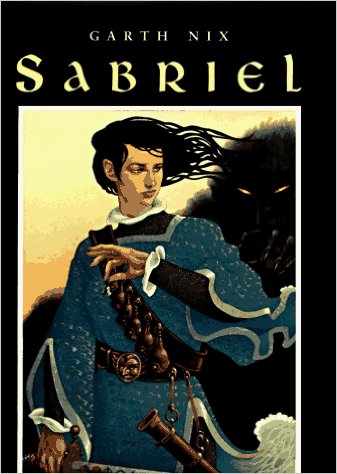
Sabriel.jpegIn the past twenty years, the name “Garth Nix” has begun to inspire awe and wonder among Fantasy readers, despite sounding like a Sith Lord who moonlights as a country music singer. Fantasy has, unfortunately, never been known for being an especially progressive genre, what with C.S. Lewis lacing his work with Christian Allegory and Tolkien ethnically cleansing the orcs off the face of Middle-Earth. Kings are good, emperors are bad, and no one has ever innovated a single piece of technology–it’s all just sort of always been there, unchanging, as though crossbows, saddles, and blacksmithing were residue left over from the Big Bang. Most of all, the only people who matter in Fantasy are heroes, powerful, intelligent young men armed only with their father’s sword and the blessings of God who undergo bloody combat to harden themselves in order to face the evil idolatrous sorcerer bent on ruling the world through global slaughter. Sabriel is…not actually any different than that. But the hero is a girl! That ought to count for something.

Nix’s novel begins with Sabriel on a long-term study abroad program in Ancelstierre, a country separated from her native “Old Kingdom” by an ancient wall, which, let’s be honest, does nothing to keep Mexicans from crossing into the Old Kingdom to look for work or White Walkers from coming south to haunt Ancelstierre. But the wall exists to give citizens of Ancelstierre peace of mind because they fear magic and want to deny it’s existence, much like comprehensive sexual education south of the Mason-Dixon line. And also like sex ed in the south, Sabriel’s school will only teach magic with the written request of a parent, and even that is rather discouraged. So our heroine finds herself confused about why her father, Abhorsen, sent her to this strange country for most of her life to receive a magical education. (Perhaps the next book in the series will send her to Texas for a Ph.D. on climate change.) One night, when Abhorsen doesn’t answer her mystical Skype call, she gets worried and heads into the Old Kingdom to search for what she somewhat presumptively assumes will be his bloody, mangled corpse lying in a ditch, bloated with maggots. She soon discovers first, that Abhorsen is a title, meaning she’s the kid with the weird father who insists that his children call him “President Dad,” and second, that upon his death, she will assume the duties of Abhorsen.

The Abhorsen, named for the executioner in Shakespeare’s Measure for Measure, is tasked with going around the Old Kingdom, knocking on graves and checking, “You still dead in there?” Death is depicted in the novel like a Justin Bieber concert or a theater playing an M. Night Shyamalan film, and once the dead realize how boring it is, they just want to step outside into Life for a little fresh air. As part of her inherent magical talent, Sabriel can travel freely between Life and Death as though she’s trying to get St. Peter to fill up her punch card for a free latte.

The unique addition to the standard Hero’s Journey trope, other than a hero who only makes 79% of the average hero’s salary, is the coming-of-age angle. The eighteen-year-old Sabriel leaves school, comes to terms with adopting a new identity, searches for a father she barely knows, discovers romance, and stands up to the pressures of professional responsibility. Just throw in one quirky, best-friend character and you’re one saccharine trope away from giving the reader diabetes. Fortunately, though, Nix’s handling of the situation uses more Splenda than sugar, and the best-friend character follows more of a Sabrina the Teenage Witch path, giving her a feline companion who houses the spirit of a great evil.

The story is entertaining, if not groundbreaking. Nix outlines the skeleton of the Old Kingdom, leaving it a little threadbare, and he leaves his system of “Charter Magic” and “Free Magic” frustratingly underexplained, dangling inferences for us to piece together, like trying to understand the plot of Star Wars by splicing together footage from the film trailers. Still, Sabriel behaves as a realistic and interesting character, and it’s a nice adventure that breaks from the tradition of meat head knight/swordsmen protagonists. Any fans of general Fantasy, especially those with an interest in magic, would enjoy it, but the feminine protagonist could also serve as an entry point for a lot of girls to enter a genre that has, until recent years, been a bit of a sausage fest.


Castlevania: Lords of Shadow 2 – PS3, XBox 360, PC

How-will-the-game-end-620x

Trevor and Alucard claim to be the same person, but I distinctly remember seeing them both in the same room together in Castlevania III.

As much as I love the Castlevania games, the series feels like developing a relationship with a teenage boy with an identity crisis. Is it an action game? A horror game? Does it want to try adventuring, or whatever Simon’s Quest was supposed to be. Will it feature classic horror monsters, mythological creatures, or make up my own? I actually rather liked when it started dressing in black, wearing heavy eyeliner, and presented itself as an emo/goth version of Metroid. But it’s also tried on RPG clothing as well. So although I can still fault them for this, I suppose I ought to have expected the new development team would ask “What game do Castlevania fans want to play?” and answered not “Castlevania,” but “God of War and Assassin’s Creed.”


church_lady_could_it_be_satan-1

If you’re old enough to get this reference, gently rap your cane against your walker.

In short, LoS2’s story puts you in control of Dracula, formerly Gabriel Belmont, the rebooted series’ patriarch (sorry, Leon) of a famous line of vampire hunters whose career objectives very much exclude “Become an undead demon prince and feed off the blood of the innocent.” However, suicidal games tend to send the wrong message (and really don’t put up much of a challenge), so the development team replaced the final boss with Satan, who apparently has spent the last few thousand years picking up every cliched, convoluted tantrum ever thrown by a Bond villain. Teaming up with his LoS1 enemy, Zobek, a monk who gives off an evil-Professor-Xavier vibe, Dracula wakes up in modern times and fights his way through a setting with very little Castle and practically zero Vania in order to bring down an evil pharmaceutical corporation, which I guess will lead him to the ultimate Evil.


Castlevania-Lords-of-Shadow-2-RealGamerNewz-9

Gabriel Belmont, meet your descendant, Ezio Belmont.

When Kratos–sorry, I mean Gabriel–doesn’t romp through stages filled with mythical monsters, tearing through anyone and everyone he meets and wearing their internal organs as costume jewelry, Ezio–sorry, I mean Gabriel again–plays itsy-bitsy-spider in extended climbing sections that derive player enjoyment from pushing the directional stick in the direction you want to go, then watching Gabriel swing over to the next conveniently placed handhold, completely forgetting that vampires–even in the Castlevania series–have the ability to turn into a bat and fly. Like Kratos and Ezio, Gabriel lumbers along in a hulking slouch, doubled over from the body suit of extraneous muscles he totes around. This sack-of-testosterone design seems to have taken over character design, presumably to appeal to the modern breed of misogynistic he-man wannabe gamers, but belonging to the old school breed of nerdy, sports-hating 1990s gamers, I find it hard to control someone like Ezio Auditore and not picture a guy in a big white hoodie trying to waddle around in Jncos.


castlevania_lords_of_shadow_2_prohozhdenie-1397378516

Play that funky music, Goat boy!

Out of all the game comparisons I could make, God of War and Assassin’s Creed aren’t exactly the equivalent of calling LoS2 “an overcooked casserole of coding leftovers baked from meats that were rancid the first time around.” For the game to deserve an insult like that, it would have to merit a special level of bad comparison. Like to the stealth sections of Legend of Zelda: Phantom Hourglass. While most players find gimmicks like quick time events as pretentious bribes to make people think they can interact with the game, forced stealth sections such as in Phantom Hourglass and LoS2 actually blow holes in the plot so wide you could actually build the next Castlevania game inside of it. The idea of an enemy that can’t be fought ever takes a lot of the luster out of Satan. If, by the end of the game, you can kill the King of Hell, the Prince of Lies, and the source of all wickedness and Temptation this side of Oz, but still can’t risk being seen by a low-level goon for fear of a flash-boiling from their flame throwers, why aren’t the goons in charge? Or at the very least, why wouldn’t Satan force you to fight them? Yes, it would ruin the game and render it unbeatable, but maybe the developers should consider that for a good long while. And I can’t even decide if that actually improves on the extended stealth section in a garden full of crunchy leaves, after which you do fight and destroy the boss who was hunting you. I guess Konami really loved its sadistic idea to put bells in the fight, like the Garradors in Resident Evil 4. I shot a projectile to ring a bell, darted the other direction, and had a brief vision of a giant hoof in my face before having to restart the level.


Projectile

It looks bad, but he actually just won the pie-eating contest from “Stand By Me.”

While I always wondered why Bowser didn’t simply dig an uncrossable pit of lava with no platforms, Castlevania places Dracula partly in his own castle, explaining how he can traverse some of the more convoluted architectural choices, such as every door, monument, mechanism, and hidden bonus requiring his personal blood sacrifice to activate. Once, however, I got turned around, and had to cross the same bridge three times in five minutes. As it required a blood sacrifice each time, I can’t help but think that even a vampire might get a little dizzy. I would have to imagine Dracula has a pretty dangerous morning routine, gnawing open his wrist to flush his toilet, then trying to make toast, but needing to squeeze out a few extra drops when the toast comes out black the first time. The fact that he could easily fall into a river of fire if he gets a little woozy makes me think there could have been a simpler design for his home. Still, it almost feels like a reasonable option in this world, since characters constantly projectile vomit enough blood to put out a burning building faster than the New York City Fire Department during a tsunami.

Alucard

Alucard, who reversed his father’s name in order to oppose all that Dracula does, turns out to be more helpful than a boy scout.

One thing I can say about Castlevania: Lords of Shadow 2 is that it has boss fights. Lots of boss fights. I can’t really say whether this improves the game or not. Some of them have a really inspired design to them, such as the obligatory end-game fight with Death. Others just feel like “press square until the monster dies.” During one fight, the boss encased herself in a hamster ball, which I had to pound mercilessly with a weapon slower than a tortoise with down syndrome, without pausing, while she and her two minions pressed their attacks. Even when I turned down the difficulty to “easy,” I could only beat this one by getting lucky. Early in the game, I spent over an hour fighting the gorgons, trying to figure out the convoluted button combinations required to throw an ice bomb. As a result, I have a few suggestions for any would-be game designers in my audience: the option to shut off the QTEs? Brilliant. Shutting off stealth sections would have been preferable. Even more so, not programming stealth sections in the first place. But one thing you really need to stop doing? Having bosses repeat phrases during battle like Dora the Explorer’s map.

TOYMAKER_610

Quack, quack, quack!

2415904-clos2_screen_08

Shortly after this, his father Darth Belmont comes to his aid.

Heroes of Mana – NDS

Heroes_of_ManaMy latest foray into addictive time-killers is Angry Birds: Fight, which has glued me to my phone every time I get two minutes not immediately filled with something stimulating and exciting. Like many free-to-play games, it offers me rewards and bonuses if I consent to watching ads that try to pitch more free-to-play games which will inevitably offer me more chances to watch videos pitching more free-to-play games until they’ve saturated my time so badly that we repeat the 1983 video game crash while everyone on earth stares at their phones in wonderment of games that could be way more awesome than the games they’re currently playing. Alas, as much as I’d love to bemoan the commercialized state of affairs of modern gaming, the game industry has historically been as all-about-the-art as Donald Trump’s hair stylist. (Low-hanging comedy fruit, I know.) If you don’t believe me, pick out your favorite franchise, and ask yourself how reasonable it is that the in-game world undergoes drastic geological cosmetic surgery from one installment to the next. Sadly, the evidence that developers slap franchise names on games to help them sell stacks up like a life-sized Jenga tower, ready to crumble under its own weight and concuss you with its logs of disappointment.


If I could brand any game as such a “log,” Heroes of Mana would be a prime candidate. The game brands itself as an RTS, and while I have no qualms with the “RT,” I have one or two suspicions about the accuracy of the “S.” Set in the Seiken Densetsu…category on amazon…Heroes of Mana uses monster design from Secret of Mana and themes from other Squenix failures in development at the same time. Otherwise, the game plays less like a Mana game and more like a (very) rough draft of Final Fantasy XII: Revenant Wings using Mana artwork.


Heroes 2The story…well, they say if you put a bunch of monkeys in a room hacking on typewriters, they’ll eventually produce the complete works of William Shakespeare. Assuming that’s true, the monkeys will produce the Heroes of Mana story long before they ever crank out something mildly resembling a sonnet. Roget, first mate of the Night Swan, his captain Yurchael, and an assortment of poorly written anime stock characters (including such favorites as eternally optimistic cutsey girl and grim mercenary with a conflicted past) crash in the wilderness after realizing their own leaders set them up. Why they villains fitted the Night Swan with a mafia-esque car bomb, the game never really explains, but that fear becomes a self-fulfilling prophecy as our intrepid heroes vow to halt the evil they suddenly assume must exist. Blah blah blah, plot lines in and out, a character who gets his ass creamed like chicken soup every time he shows up but somehow manages to inspire fear in the heroes, convolution at its finest, more characters than a story really needs to follow over the course of 27 battles…and one of the monkeys writing this thing must love cliches, because near the end they pull a Luke-I-am-your-father moment, which Roget (and the players) shrug off with a hearty disinterest. In the end, nothing is accomplished. Evil may have retreated, but no one knows or cares why, and the player moves on to story that makes more sense, like Moby Dick, or the United States Tax Code.

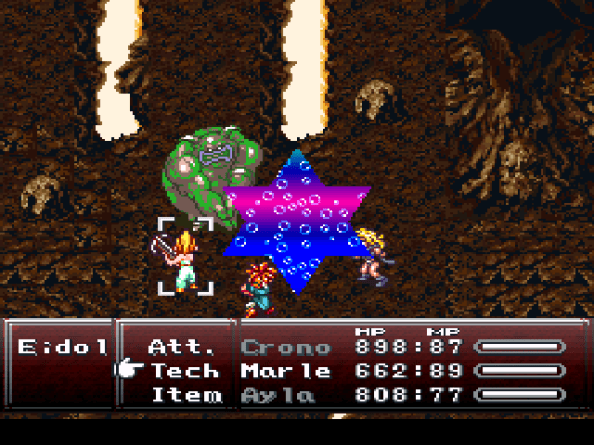
 

Heroes 5

This RTS game gives you multiple ways to strategically send all of the same type of monster at your enemies.

The gameplay follows a typical real-time strategy format, as long as that strategy is “select characters, attack enemy.” Units have a four-way rock-paper-scissors (rock-paper-scissors-lizard?) relationship going on, with a handful of units existing outside that structure. Ranged deals double damage to flying, flying deals double to heavy ground units which deal double to light ground units, and each time they introduce a new type of unit, the game puts you through the entire explanation again because when it comes to rock-paper-scissors, you have the brain of a goldfish, but when it comes to following the story, you are Albert Einstein performing a Vulcan mind-meld with Sherlock Holmes. Disregarding tutorials more repetitive than the ones from Dora the Explorer, I initially thought the four-way relationship sounded interesting. Unfortunately that all falls apart when trying to decide which units to purchase with your finite resources, as there’s no way of determining what type of unit your enemies are; just because they don’t stand on the ground doesn’t mean they’re flying units, and the fact that they can hit you from three squares away doesn’t qualify them as ranged. Heroes of Mana is just a dimmed DS screen away from being both literally and figuratively a stab in the dark.


Like Revenant Wings, you summon monsters to do your dirty work for you. The monsters don’t level up, but you get stronger ones as the game progresses. You also have a separate party of “leader” units, consisting of the fifteen characters seen in the story, all of which interact with Roget for a battle or two, then join your party and shut the hell up like a good subordinate tag-along. These characters don’t level up either, but you can win equipment in battle to boost their stats (naturally giving all of it to the same five characters who seem mildly more interesting than all the rest),  which makes as much difference in the long run as giving yourself a concussion to raise ALS awareness, because you’ll never take them anywhere near the fighting, since losing the main character results in an instant game over.


But even holding back characters like that is not a guarantee that they won’t charge headlong into the melee with their lone hit point ablazing. Of all the virtues of the NDS, screen size is not one of them, and trying to select characters, pathways or enemies to attack has all the finesse of a figure skater with the motor skills of an infant. Furthermore, since friendly characters refuse to step to one side of their square or to do that awkward thing people do in movie theatres and on airplanes where they try to make themselves as skinny and flat as possible to let people through, pathways get blocked easily, leaving the AI to take the scenic route around the battlefield, detouring right through the enemy camp. Even without clogged roadways, the AI has the IQ of George W. Bush with his head stuck in a plastic bag, often sending peaceful resource-gathering monsters on roundabout ways past hostile enemies, or telling dying characters to get three or four more parting shots in before retreating from the enemy currently making haggis out of your bowels.


Heroes 4

Precision tuned to let you follow all the action with only moderate permanent damage to your visual accuity.

There is one more feature to combat, summoning benevodons (the latest in asinine wordplay added to the World of Mana) to damage every enemy on the map. These are impressive attacks with exciting animated cutscenes that you will never use nor see (respectively) because they take up so much of your resources that in most battles you’ll never collect enough for the summoning. I pulled them off once or twice, mostly out of necessity rather than choice, and they all have pretty much the same effect, making them another nice attempt, but ultimately pointless addition to the game.


As usual, I like to include a “but the game’s not worthless!” section here. I did enjoy the game for all its flaws, and preferred in infinitely over Children of Mana, released at roughly the same time (and featuring the lame benevodon and malevodon wordplay…which mean “good tooth” and “bad tooth” respectively). As mentioned before, it reminded me of a draft version of Final Fantasy: Revenant Wings, so if you liked Revenant Wings…go replay that game instead of Heroes of Mana.

Chrono Trigger: Crimson Echoes – SNES ROM Hack

RetroArch-0729-020645

L’chaim!

One common lament I often hear wailing from the insincere lips of our species, Homo Obliviosa, criticizes books, literature, television, and within five years, I guarantee those game-show infomercials that play on the pumps at gas stations, for being too predictable and not having a shred of originality that they didn’t pick up at a yard sale somewhere. Still, if we’ve learned anything from seven Saw films, twelve Friday the 13th movies, The Land Before Time 14, the entire James Bond series, and 27 years of watching Debbie gyrating her aging pelvis across Texas until she files her bones into a fine powder, we’ve learned that Americans have a serious problem when it comes to sequels. And sequels don’t even do it for us anymore; our problem has spread like a raging yeast infection to cover things like adaptations, novelizations, novelizations of adaptations, and fan fiction. Personally, I’ve never finished a story and thought, “I need to fix this so Hermione marries Malfoy and Hagrid ends up with Dumbledore!” or felt that I couldn’t really judge Star Wars until I read about how some 35-year-old McDonald’s assistant shift manager would have destroyed the Sith, brought balance to the Force, and made passionate love to Queen Amidala. But a fan-made adaptation has come along once or twice (no wait…twice. Exactly twice) that makes me take note, and so with a heavy heart, I introduce you to Chrono Trigger: Crimson Echoes.


RetroArch-0729-074940

They were going to go with “Time Lord,” but the phone booth ruined the epic showdown feel.

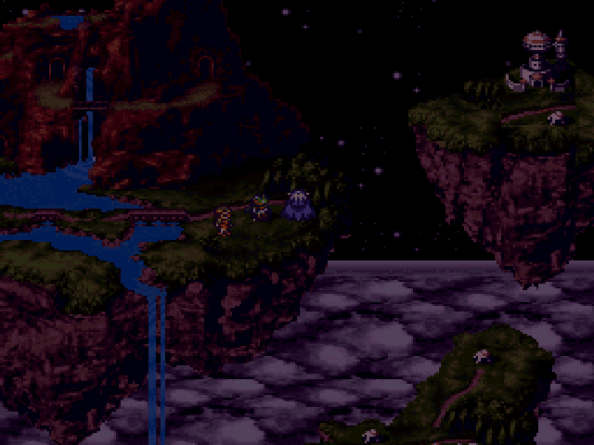
A team of devoted fans produced Crimson Echoes after compiling everything they knew about Chrono Trigger and Chrono Cross, hacking the SNES rom for six years, and presumably smoking so much weed that they felt implying a romance between Frog and Ayla wouldn’t come across as weird and out-of-character as Gollum shacking up with Galadriel. The story weaves together several plots, including a war between Porre and Guardia, Magus’ search for Schala, Dalton’s quest to find new and more creative ways of being a major douche while demonstrating all the power of crystal therapy after a viking raid, and some weird jazz about alternate timelines. King Zeal emerges from the shadows as the primary antagonist, who aims to resurrect the kingdom after his ex-wife gained custody of it and ran it into the ground (literally) in the first game.


RetroArch-0728-025243

Yet somehow I still have all of the other me’s memories and skills.

Chrono Trigger rocks, and I can understand wanting more of it, but a game with a setting that spans “all of history” leaves about as much room for more as a fat guy with a lifetime pass to Old Country Buffet. Writing a sequel to a time-travel game has to carefully weave in the events of the previous game–a la Back to the Future Part II–or it looks like the heroes spent the whole quest to fight the god of hedgehogs oblivious to all the other action going on. “Fuck you, fans of the first game,” it says. “You should have been paying attention!” For better or worse, though, it works, as the developers understand the literary mechanics of time travel about as well as a teenage boy with Asperger’s Syndrome understands a speed-dating event. “Marty!” I hear doc Brown’s voice saying, “You’re not thinking fourth-dimensionally!” They get points for trying new ideas, but their idea of extra timelines gives the impression that time flows normally, centered around Crono, and these other timelines are just tacked on in weird succession, like a video editor with ADHD (God, I’m being just brutal to people with disabilities in this paragraph.) Time Travel feels more geographical than fourth dimensional, as if 65,000,000 B.C. lies just past the Wisconsin border.


RetroArch-0729-072445

Apparently the guy designing backgrounds was sick that day.

I’ve played through Chrono Trigger probably fifty times in my life and seen the Back to the Future trilogy probably into the triple digits. The thing that gets me stuck in an ever-repeating loop of irony is this sense of how time stacks on itself, about how, like a good party, billions of years worth of events can happen in one place (and how as the guy who shows up the next morning to pick up his drunk friends, I seem to miss all the exciting parts.) Crimson Echoes doesn’t give me the feeling of the vastness of time, or how it connects with each other. Whereas Lavos was eternal, living his life content to move down time like a one-way street, meeting up with our heroes whenever they felt like visiting him, King Zeal pops up in random time-periods as Crono et al. do the same, in a cosmic game of whack-a-mole. Furthermore, the three gurus somehow watching all the changes Crono makes from some point in the distant future makes about as much sense as learning about the life span development of a chicken by studying an omelette mcmuffin. Near the end of the game, the gurus dish out a list of side quests, but while in the original game, these added to the enormity of time and centered on the seven playable characters, the Crimson Echoes sidequests have little to do with anyone or any-when. Most of them are damn near impossible to even find without help, and the ones I did felt so fetch-questy that the only way they’d develop character is if you happened to be a labrador retriever.


RetroArch-0728-064748

Travel twelve hours through time! Explore the mysterious “night.”

In adding to my swelling list of grievances, the designers cranked up the difficulty setting like crazy. For whatever reason, the general video game fan community interprets the quality of a game as directly proportional to how hard it is. God knows if you want to find a version of Castlevania that’s been hacked to remove life limits, you’ll inevitably stare down lists of hacks for people who thought the original NES game felt too simple, then another list of hacks for people who thought the first list of hacks didn’t successfully raise their blood pressure enough to burst from their veins like an anime blood-geyser. But when it comes to simple ideas to maintain challenge without tedious repetition of hours worth of gameplay, game hackers dry up like the Sahara desert as described by Henry David Thoreau and read by Al Gore. But even if challenge did implicitly make a game better, how exactly does one make an RPG harder? You can raise monster stats all you want, but the only thing a player can do in response is level grind which only challenges them to stay awake long enough to build up their stats. Most bosses don’t especially put a good fight, but rather wind up like a college drinking game, with the player slamming back as many potions and ethers as possible, hoping the other guy passes out first. For a while, I actually appreciated that the astronomically high enemy HP forced me to dig into my otherwise unused techniques, but by the end of the game, most enemies could absorb at least three of the four styles of magic (and Magus apparently has suffered a stroke in the intervening years, rendering him unable to cast anything but shadow magic), leaving me to tape down the A button and go scoop the cat box.


RetroArch-0728-064231

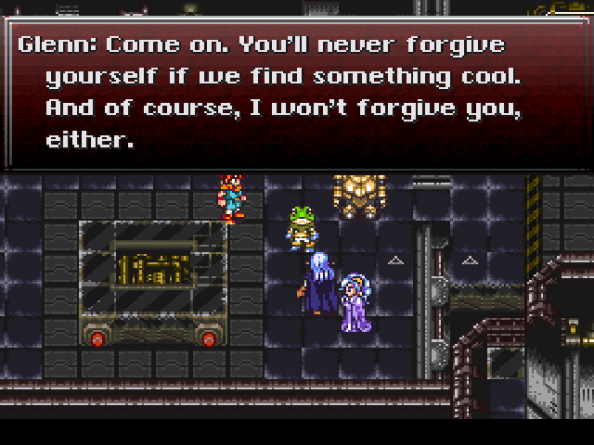
Forthwith anon! Thou shalt besmirch thy honor if we henceforth discover…uh…something cool.

This isn’t to say, of course, that the developers simply chewed up the ROM and spit it back out into whatever arrangement the physics of projectile vomiting so decided. They added some interplay between Magus and Frog (who they renamed Glenn and completely abandoned his formal, pseudo-Middle-English style of speech), and the residual animosity actually approached something feeling organic. None of the characters are hidden, although Ayla doesn’t join until nearly the final dungeon. In another bold and senseless act of violence against the original game, the designers re-imagined the artwork, replacing Akira Toriyama’s  character portraits with new, updated ones supposedly reflecting the five-year time difference. Sorry, guys, but if you want to infringe on copyright, at least keep the stuff worth infringing upon.

RetroArch-0728-013808

And saying this in no way alleviates any legal ramifications you may have faced.

Pixels – 2015 Film

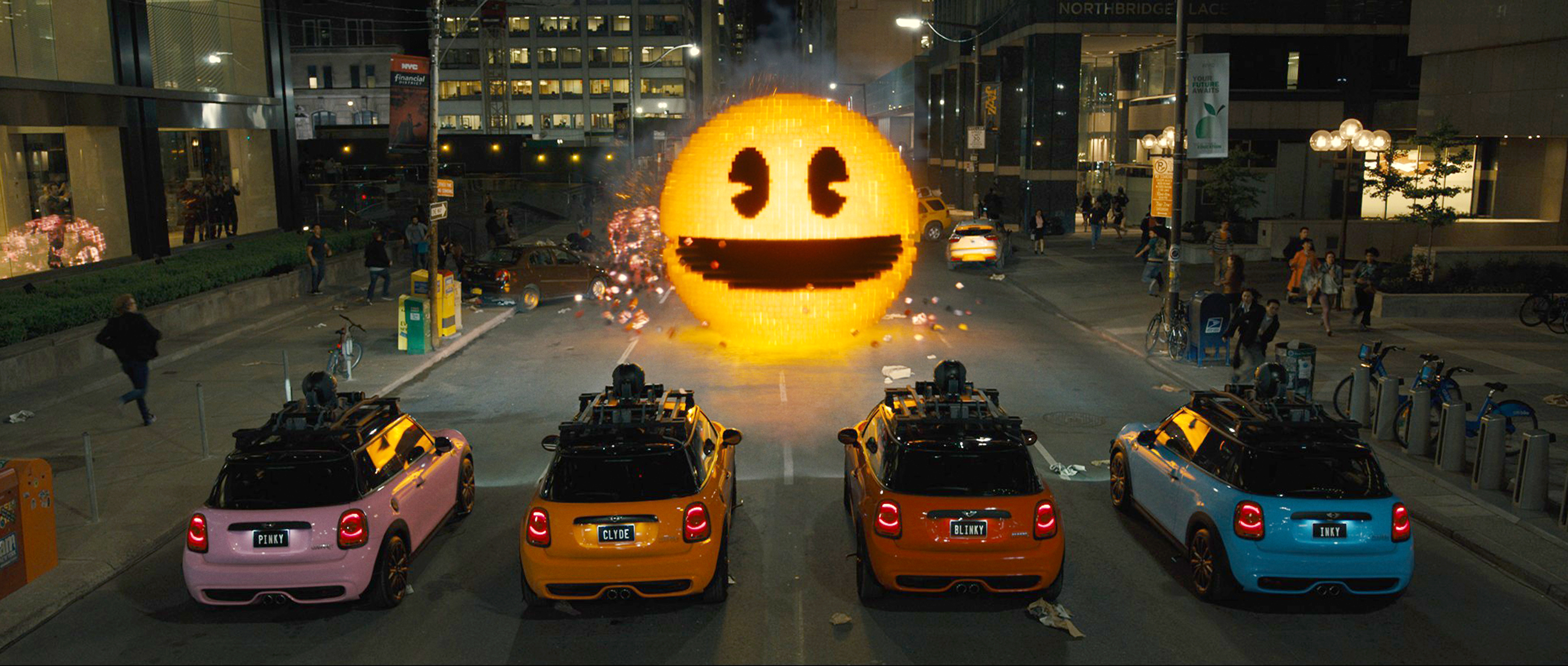
Pixels Pac Man Cars

Having a hobby that the world has villainized for over three decades, I can’t help but react to the slightest bit of recognition thrown at video games. Fortunately, Hollywood has given us exactly that: the slightest bit…that recognizes thirty-year-old games..with an Adam Sandler movie. This validation couldn’t get any smaller if they had hired a team of nuclear physicists to assemble it by smashing protons together in a particle accelerator. Actually, I kid, but having grown up in the nineties, I have a confession to make, which they tell me is the first step toward recovery; I actually like Adam Sandler. Billy Madison? Hilarious. Happy Gilmore? You couldn’t make a better sports movie if you recast the Mighty Ducks with the Playboy Bunnies. And honestly, after Wreck-it-Ralph decided fans of classic video games would love to watch the inbred love-child of Mario Kart and Candyland, I actually appreciated a movie that got the classics right.

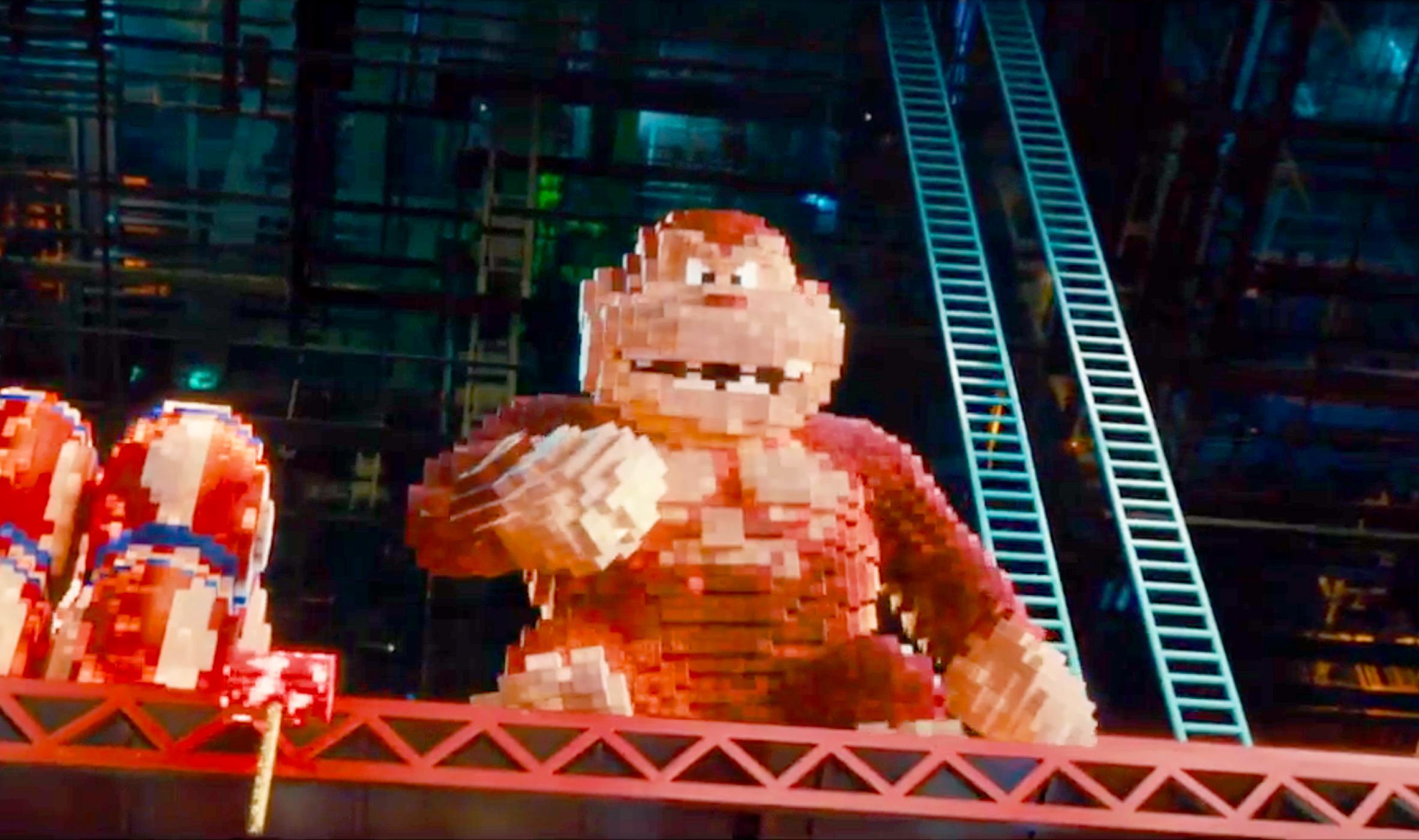
Mr. Sandler, this is Mr. Kong, and I believe he's not happy about spending $13 on Spanglish.

Mr. Sandler, this is Mr. Kong, and I believe he’s not happy about spending $13 on Spanglish.

The film follows an over-mature man child–no, not like Big Daddy. He’s a character who acts like a child–no, not like Billy Madison. He’s actually an unlikely prodigy–but not like Happy Gilmore. He’s kind of socially awkward–no, not like Little Nicky or Anger Management–and tries to win over a girl who is unbelievably hot–but not like 50 First Dates–and…you know what? Why don’t I just start over.

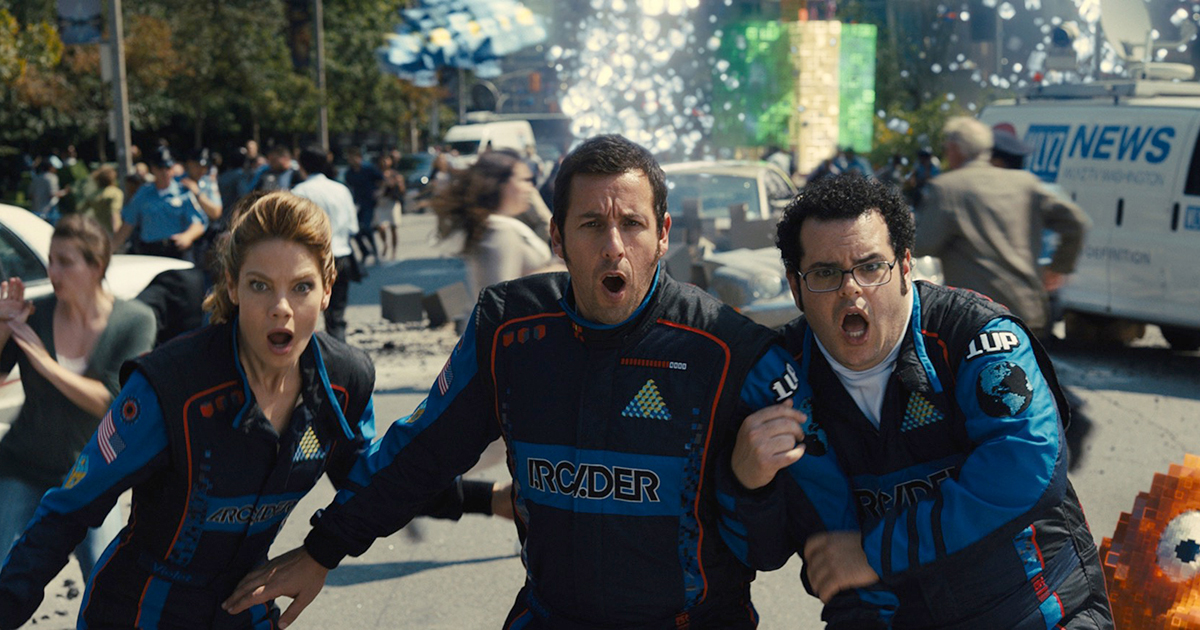
One of them built a career on a notoriously foul mouth, and the other on Happy Gilmore. I hear they do a great duet of "Ode to my Car."

One of them built a career on a notoriously foul mouth, and the other on Happy Gilmore. I hear they do a great duet of “Ode to my Car.”

Pixels follows four friends–Happy Gilmore, Paul Blart Mall Cop, Tyrion Lannister, and the snowman from Frozen–who won their fifteen minutes of fame by the age of twelve setting record high scores for Galaga, Pac Man, Donkey Kong, and other silver-screen era arcade games. Beldar Conehead took the footage from the competition and blasted it into space, whereupon aliens mistook it for a declaration of war, and they emulate the forms of the games they see in order to invade. Apparently nothing makes an invasion strategy look stronger than footage of adolescent boys systematically dismantling it with apparent ease. Fast forward thirty years, and United States President Blart Mall Cop has to pull the country together to stave off this invasion. Naturally he turns to his long time friend, who now installs home theatre systems in the D.C. area. Because the skills required to hit buttons while standing in front of an arcade cabinet easily translate to heavy weapons proficiency in a first-person, physical environment. In the end, Sandler hooks up with the insanely hot Lieutenant Colonel, which is not a spoiler for an Adam Sandler movie, and Olaf the Snowman fucks Q-Bert, which I unfortunately did not exaggerate in any way.

See, boys and girls? If you practice writing and get real good at it, you too can create parts for yourself that require making out with the most attractive people on the planet.

See, boys and girls? If you practice writing and get real good at it, you too can create parts for yourself that require making out with the most attractive people on the planet.

Generally, any audience will accept coincidence more readily at the beginning of a story, but Pixels asks us to take quite a bit on faith. When we see the president as a self-absorbed bastard with a flair for indulgence in sex, drugs, and partying, we get that. In fact, he surprisingly bridges the ideological differences between George W. Bush and Bill Clinton. But suggesting that he comes from a background that enables him to know any blue collar workers, let alone still associate with them, seems a bit of a stretch. And the fact that both of them had a personal hand in starting the invasion that they both personally help repel…well, a religion based on the sixty-five-year-old writings of a washed up sci-fi author who asks celebrities for exorbitant subscription fees starts sounding pretty reasonable by comparison. Then we have to follow that the insanely hot, Sandlerishly milfish (she has to have a kid because Sandler needs an early-adolescent boy in all his films to connect with on an intellectual level) Lieutenant Colonel just so happened to call President Mall Cop’s drinking buddy for her son’s PS4 installation, that people exist who both need help with that and who provide professional services for that, that her husband left her based on physical appearance, and that she gave birth to a son–presumably at the age of twelve, based on how old she looks–without any noticeable change in her figure.

Pixels creates a world about as realistic as an M.C. Escher drawing, but with an elegance more on par with a self-shot sex tape after knocking the camera off the nightstand. Sandler plays the same character as always: that kid who scored major cool points in middle school because he had older brothers who taught him dirty words and let him take their Playboys, and then graduated to high school and couldn’t understand why his eat-anything-on-a-dare routine didn’t impress people anymore. The dialogue has all the wit and humor of that thing your buddy said while drunk and you later posted to Facebook. But I don’t want to give the impression that the film is worthless.

A Lannister busy paying his debts.

A Lannister busy paying his debts.

First off, Peter Dinklage has been hailed by prophecy as the anti-Sandler, he who will be born unto the world every thousand years to blight other actors with the realization that acting means completely playing pretend, not just being a slightly different version of yourself in every movie. Dinklage created his character from the ground up, and it comes off as fully enjoyable to the point where you wish he had a bigger part…uh…no pun intended. It’s good to see him get roles based on his talent, rather than every other dwarf actor who shows up when a director needs a short character, and then gets stuffed back into a closet or a duffle bag, or an overhead compartment on a cessna.

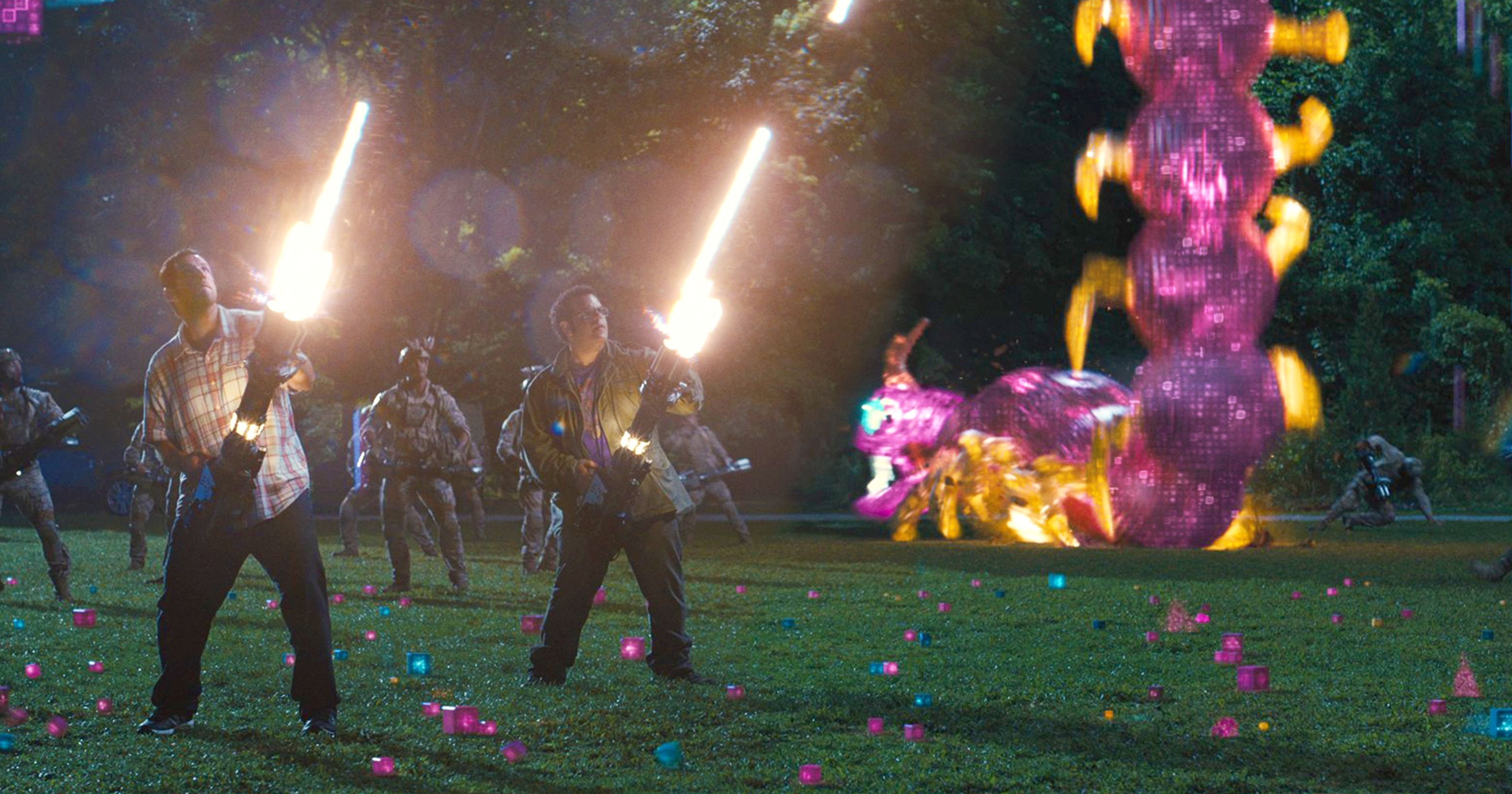
Second, this movie has figured out something–likely 100% accidentally–that no other video game movie to date seems to have realized: gameplay. Barring well-written stories in games like Final Fantasy or Silent Hill, people watch these movies because they like the way the game plays. Pixels doesn’t try to give an origin story to Pac Man, a tragic plot arc to Centipede, or some crazy MacGuffin to explain why the tetrominoes have such a beef against horizontal lines. None of that shit! Donkey Kong chucks a barrel at Sandler’s head? Sandler climbs up the scaffolding to kick his monkey ass! Big-ass centipede dropping out of the sky? Sandler grabs a gun and shoots for the head. Tetrominoes filling up the streets, making the buildings disappear? Sandler…well he doesn’t really do anything about that, but the point is that’s what happens in the game.

And before you harp on me about praising the film's details...yes I know they're supposed to use magic wands against the centipede.

And before you harp on me about praising the film’s details…yes I know they’re supposed to use magic wands against the centipede.

The film has details. Lots of details. Scenes where fans of arcade classics can scan the crowd and recognize the bloke riding an ostrich, the frog hopping in front of cars, or the bipedal fried egg running around as though it would actually be menacing in real life. And these aren’t any tongue-in-cheek references either. No ha-ha-they-call-him-Ralph-but-that-game-looks-like-Donkey-Kong attempts at satire. These are actually the games we played thirty years ago, come back to seek revenge for when we ran out of quarters to feed them. You could watch this half a dozen times and probably catch new details on each viewing.

If, you know, it wasn’t a generic disposable comedy, filmed to view once and then discard like a used condom: an awesome idea the first time, but after using it you don’t really want people to see it sitting on your shelf. Much like the condom, if you get the opportunity, I’d say go for it; it’ll be fun. I did say earlier that I like Adam Sandler (just not in that way), despite the common criticisms…some of which I’ve conveyed here, myself…and the movie has its moments. However, if you have trouble with staying power, good news; it turns out this film was based on a 2010 short film of the same name, and–much like your experiences with the condom–it’s over after two and a half minutes.

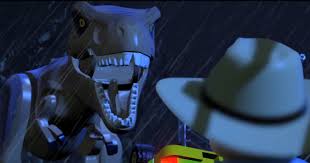
Lego Jurassic World – 3DS, PS3, PS4, XBox 360, XBox One, PC

Clever meme...

Clever meme…

We here at RetroCookie pride ourselves in our preservation of vintage games, which compels us to give credit to game makers who do the same (although don’t ask us what compels us to speak in the Royal We, as we still have much evidence to support the idea that we only have one body and very little control over household pets, let alone entire nations). To that end, I’ve covered modern 3DS games such as the Majora’s Mask remake, the Ulitmate NES remix, and even newer games based around the charm of the classics, such as the Legend of Zelda: A Link Between Worlds. With that spirit at heart, I’d like to introduce a new 3DS game to the notches on my belt, Lego Jurassic World, which falls under the retro gaming category for reasons I will expound upon now.

A needlessly huge cast of characters in which more than one person will routinely dive up to their ankles in shit deeper than Spielberg's first plan for Jurassic Park 4!

A needlessly huge cast of characters in which more than one person will routinely dive up to their ankles in shit deeper than Spielberg’s first plan for Jurassic Park 4!

(Don’t rush me! I’m still thinking!)

Okay, you caught me. I just don’t have a PS4 or a WiiU. But with games like Bravely Default and Link Between Worlds on the horizon, and all my other NDSs worn almost to the breaking point, I figured a 3DS would be a wise purchase. Plus it doesn’t have creepy, voyeuristic tendencies like the XBox One. So to tell the truth, I own that one modern game system, and I do occasionally play it, and I struggle to get through games quickly enough to write a weekly entry with enough time left over that I don’t have to give my students lessons on metaphor and character development in Bubble Bobble. So this week, I give you Lego Jurassic Park, a coincidentally perfect game for playing in the ten minute breaks between classes.

...whassaaaa!!

…whassaaaa!!

If you read my review on the Lego Star Wars games, you’ll know the series has one or two issues with originality in game play. Inevitably, the games degrade into a process of collecting studs to purchase unlockable characters which help you collect more studs, and I strain to think of anything that such a cyclical experience might augment other than a walk down a moebius strip or a finely tuned, professional relationship with a prostitute. However, like the prostitute, Lego games may need to offer something other than a sense of humor and playing fast and easy if they want to keep my interest and coax me out of 20 bucks for cab fare. (Ah, comparing Legos to professional sex workers. It’s times like this that I wish anyone actually read this blog.)

I want a good clean fight. No bites below the...uh...belt?

I want a good clean fight. No bites below the…uh…belt?

Don’t get me wrong, though, there is something very zen about the act of romping through tropical environments, smashing everything into a zillion tiny lego bricks at the slightest touch, especially considering that realistically your characters would spend five minutes prying each piece loose with a butter knife that won’t fit into the crack and walking away with sore hands. Lego Jurassic World takes this stud collection (and as I say that I resist the urge to continue making sex worker jokes) very seriously. Traveller’s Tales games has always treated combat in their Lego series as more of an irritating formality, like renewing your driver’s license, waiting for a waiter before eating at Old Country Buffet, or telling your friends that their newborn babies don’t look at all like someone dipped George W. Bush in a bathtub full of Nair. In Lego Jurassic World, though, they have almost eliminated combat entirely, save for a few levels in Jurassic Park II and III where you punch a few compies and trample a few InGen workers with a stegosaurus.

Goin' down to Nublar, gonna eat a lot of people.

Goin’ down to Nublar, gonna eat a lot of people.

That last bit, though, adds a much needed touch of originality to the series. In addition to wandering around as your choice of any of a million worthless characters (When the novelty of playing as Dino Handler Bob loses its lustre, spice it up by having an affair with Dino Handler Vic!) , the game also lets you control most of the movies’ animals. Furthermore, you can unlock access to the Hammond Creation Lab, where you can play with genetic coding to mix and match different features into custom dinosaurs, thus proving that Traveller’s Tales missed the point of all four movies about as much as those people who think Harry Potter promotes devil worship. Certain secrets actually require this genetic Frankensteinery, as do two bonus areas that allow players to take full control of hungry dinosaurs as they eat, trample, gore, or hawk poisonous loogies at unsuspecting park staff.

Must drive faster...must escape terrible addition to poorly adapted Michael Crichton novel...

Must drive faster…must escape terrible addition to poorly adapted Michael Crichton novel…

Lego Jurassic World has more of a puzzle-oriented design than other Lego games. Normally, puzzles would earn the game a black mark by its name, followed by a swift hammer blow to the cartridge and, if I feel especially generous that day, a steady stream of urine. However, puzzles in this game simply means picking the right character to activate whatever interactive element might block your path at any moment, more of a formality than a puzzle: “Hello, there, Jake. Do you have a character willing to dive head first into this steaming pile of triceratops shit? Oh, I’m sorry. Here, fill out these forms and pay a small fee to unlock a character with a severe hygiene deficiency, then come back on a later playthrough.” Now, my regular readers (almost typed that with a straight face) might remember my Twilight Princess review where I described such mechanics as needlessly enforcing a developer mandated sequence of events without actually giving the player anything fun to do. Well…okay, so I have a point, and that point still stands here.

LEGO-JURASSIC-WORLDHowever, I played this game through to completion, so it must have some strong points. Earlier, though, I mentioned that Traveller’s Tales previously treated (and other companies still do) combat as a requirement for games, as though making a game without some type of fighting would create a vacuum that would implode, sucking the console, player, and northern hemisphere into oblivion. And since there’s no combat in oblivion, they’d like to avoid that. But as it turns out, games don’t need violence (I know…crushing news to all those bloodthirsty Tetris fans.), and Lego Jurassic World seems to have figured out how to replace that. Stud collecting, for one–simple, yet fun, and for whatever reason human beings have brain signals that light up on hearing a pleasing sound and watching dozens of small objects transmogrify into a score total ratcheting ever upwards. The humor, of course, makes us wait for the next cheeky thing the game will do–I’d recommend the game entirely based on the talking raptor scene from JP3. Also, did I mention you get to rampage as dinosaurs? Those segments might feel short and underdeveloped, but it does include a minigame that lets you target-spit at Newman from Seinfeld.

Hello, Newman!

Hello, Newman!

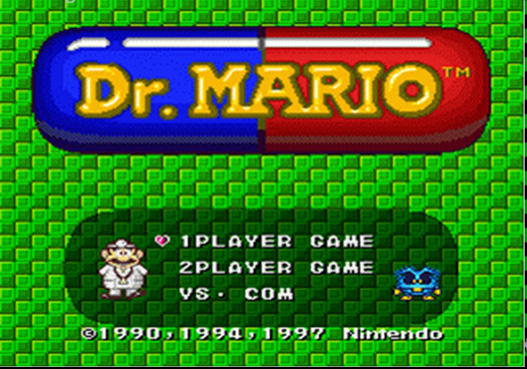
Dr. Mario – NES, Game Boy, Game Boy Advance, Arcade, SNES (with Tetris)…

Fdrtitle

I’ve spent my life trying to discover something I could do during my days to play nice with society, while still leaving plenty of free time to pursue things that make me not want to hurl myself into the blades of an industrial snowblower. So I decided to rank, from least time-consuming to the most, some positions I’ve held in the last ten years.

1. Substitute Teacher
2. Part-time undergraduate student
3. Public school teacher in Korea
4. Graduate student
5. University instructor (3 classes)
6. Full time Undergraduate student
578,903. Private school teacher in Korea during public school summer/winter vacations

Oddly enough, you’d expect stress levels to go down as amount of time went up, but no. It bottoms out around “Graduate Student” and hits a critical limit as “Private School: Korea” and “Substitute Teacher,” both of which exceed “hurl into snowblower” for things I wouldn’t want to do. Anyway, to get to the point of this rant, I’ve currently spent the last semester as #6 on this list, with two more of those hoops to jump through before I can legally hold a full-time job at a public school. Unless my novel suddenly takes off and becomes a best selling, direct-to-kindle, science-fiction…yeah that’s not happening. So video games, unfortunately, have to take a back seat for a while. And to that end, expect to see a lot of games I can finish in a few hours.

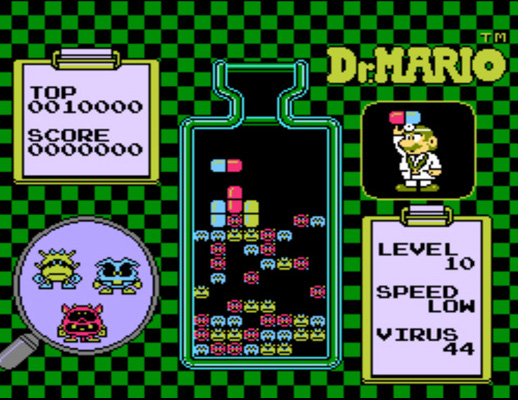
Despite a relatively minor infection, the patient suffers more from the side-effects of the treatment. How best to minimize these problems? Use more of the same drugs!

Despite a relatively minor infection, the patient suffers more from the side-effects of the treatment. How best to minimize these problems? Use more of the same drugs!

Doctor Mario! Because the only logical career path (as opposed to the career path outlined above) for a tradesman goes Carpenter → Plumber → Medical Practitioner. I guess rooting through all those pipes qualifies him for gynaecology. I don’t know, though. I’d really like to see his credentials, along with Dr. Dre and Dr. Pepper. Maybe ask Dr. Evil and Dr. Horrible to review the accreditation. But legally licensed or not, Dr. Mario solved one of Nintendo’s biggest problems: how they can make money off of Tetris when everyone and their pet wildebeest had cloned and/or ported the game to any device with a power cord or at least two batteries. So they took the idea of chucking blocks made up of smaller blocks into a jar for the purpose of reducing the amount of blocks in the jar, changed one or two things, and released Dr. Mario. Or, rather, Tetris with shorter line requirements that lets you build them vertically as well as horizontally.

For those of you who haven’t played the game and find your eyes spinning at my rant, imagine that the Tetris playing field got sick. The game starts with viruses of three different colors–red, yellow and blue–chilling in a jar. Mario, deciding to fight fire with fire, chucks in pills containing a combination of two types of medicine–red, yellow and blue, one block on each side of the pill. If you get four of the same color in a row of any combination of pill blocks and viruses–the whole row disappears. Let me point this out to you: one virus takes three doses of medicine to cure, while two viruses together only take two.

Pushed by Big Pharma to prescribe yellow drugs for a patient not even inflicted by yellow, Mario now faces a major malpractice lawsuit from the family of the survivor.

Pushed by Big Pharma to prescribe yellow drugs for a patient not even inflicted by yellow, Mario now faces a major malpractice lawsuit from the family of the survivor.

The major problem in the game revolves around Mario’s aforementioned medical training: namely, he doesn’t have any. So instead of carefully diagnosing the disease and measuring out the correct doses needed to properly treat the patient, he just lobs whatever he finds lying around the pharmacy like the patient were a carnival game who if Mario filled up with drugs faster than anyone else, he’d win a Sonic the Hedgehog keychain. No, strike that. Considering the fact that you can’t actually treat viruses with medicine, Mario works exactly like an E.R. doctor, prescribing whatever medicine won’t outright kill the patient, but will give them enough side effects for a good placebo effect to kick in, preventing a lawsuit from an angry patient upset that they couldn’t get “that drug that House takes” to treat the funny looking spot on their back shaped like a lemur.

Coming soon to an iPhone near you...

Coming soon to an iPhone near you…

However, other than the cheerful implication that every level failed means a dead patient, usually from overdosing on irrelevant medication rather than the actual viral infection, I’ve spent a lot of time with Dr. Mario. Tetris gets boring after having constant access to it on every game console, home computer, digital watch, graphing calculator, exercise bike, car dashboard, DVD menu, dehumidifier, wood chipper, coffee maker and pet iguana made since 1984. So what do you do when you don’t have the free time of a part-time undergrad, but more free time than a grad student? Do what I did: play Dr. Mario non-stop between classes in Korea.

Parasite Eve – PS1

Merry Christmas, Internet! For those loyal readers who have followed my work since…well, October, you know that I like to coordinate horror games with the Halloween season. In part, this works well because horror games sell well, whereas I have a more difficult time finding games with 4th of July themes (Assassin’s Creed 3, maybe), St. Patrick’s Day themes (uh…Leisure Suit Larry on the XBox likes to drink), Labor Day themes (Down with Shin-ra!) or Secretary’s Day (…I’ll leave this one to you). However, thanks to Square Enix and their own version of the war on Christmas–starting with the Santa Clause boss battle in Secret of Mana–I have a perfect specimen of a game for this Holiday season that I wouldn’t waste on any other time of year. So this week, I intend to celebrate Parasite Eve for a magical Christmas adventure, as it contains the birth of an incarnate god, bountiful freebies you don’t have to pay for, a festively dressed villain, rivers of slime, and the video game protagonist whose stocking I’d most like to stuff.

I should have a word with the fire marshal. Those curtains are supposed to be flame retardant.

I should have a word with the fire marshal. Those curtains are supposed to be flame retardant.

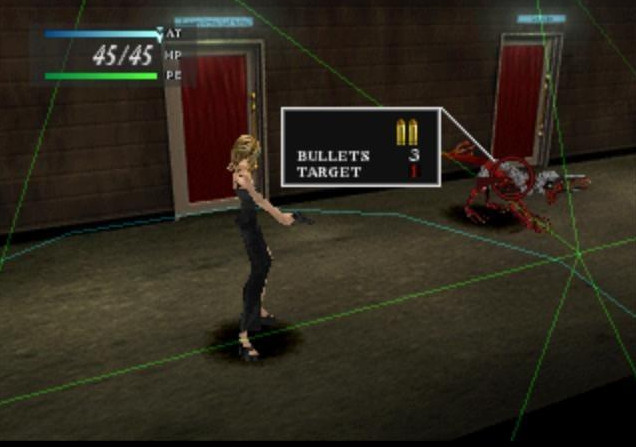
Beginning on Christmas Eve and spanning the course of nearly a week, Parasite Eve tells a heartwarming holiday story of spontaneous human combustion. Aya Brea, a young cop in New York City, attends spends the evening at the opera. The experience holds exactly what we’d expect your average night at the opera to contain: first the singing, then the panic, screaming, the audience running in terror trying to get out of the theatre. However, unlike most opera performances, everyone bursts into flames. Except, of course, for the lead actress, Aya, and Aya’s date for some reason they never explain. Aya confronts the actress, or rather Eve, the actress’s collective mitochondria, who claims to have overthrown the shackles of its bourgeois cell oppressors. They fight, Eve flees, and Aya pursues, but the villain escapes to plan the world’s greatest sperm bank heist.

From there, Aya goes on to discover a river of slime with a grudge against humanity in the sewers of New York. The slime heads toward a museum to protect the villain, but Aya draws her out, leading to an epic showdown against the backdrop of a slime-covered statue of liberty. But all along, the slime served as a womb, and ultimately it gives birth to Viggo the Carpathian! Er, wait…I might have confused Parasite Eve with Ghostbusters 2.

Uhh...I really don't know what I should be looking at.

Uhh…I really don’t know what I should be looking at.

Weird as all that sounds, the game actually plays very seriously with a complex, well-written storyline. For those of you who slacked off in anatomy, first of all your teacher dodged a bullet having to answer a thousand questions on spontaneous combustion, but more importantly, our cells contain organelles called mitochondria. These microscopic pseudo-organisms have their own fragmented DNA, so as the game’s title suggests, they use us as a host. However, what the title completely missed the boat on is that they’re symbiotic (friendly) instead of parasitic, producing the energy that, well, you know…keeps us from dying. This energy, theoretically, if the mitochondria all went into overdrive at the exact same time, might produce enough heat to…well, probably not. But the game uses that as a weapon for them to seize control of our bodies to have their tiny little ways with us.

One of the earliest 3D games (not done with vector graphics), Parasite Eve plays smoothly and has impressive visuals, even eighteen years (God, I’m old…) later. When introducing combat to the game, a fully animated CGI cutscene shows a rat’s mitochondria seizing control of its cells, transforming it into a hideous monster of nearly the same size and temperament of a real New York City rat. Although in all fairness, I thinking hanging out backstage at the opera would make me bleed out of my eyes as well. Naturally, though, the spectacle doesn’t end there; the dedicated player will also get to see people melt into a giant ball of Kaluha, a german shepherd transform into a four-legged vagina with teeth, and the main villain transform into several different forms that might be arousing if it didn’t look like someone had stuck a Barbie doll in a microwave.

Impressive cut scene, but don't think we didn't notice your RPG hero leveling up at the beginning of the game by fighting rats underground.

Impressive cut scene, but don’t think we didn’t notice your RPG hero leveling up at the beginning of the game by fighting rats underground.

Combat blends traditional RPG tropes–magic, weapons, items–with a free moving action system against a pre-rendered background. Aya can equip different types of guns, each with their own advantages and disadvantages in combat. Handguns sacrifice range for high speed and moderate power. Rifles increase power and range, but fire slowly. She can also find shotguns, grenade and rocket launchers, and tonfa clubs. Furthermore, each weapon comes with its own subset of abilities that the player can move around and customize through the use of special tools.

Generally I don't like it when pretty girls--even fictional ones--have boyfriends. But if the game doesn't feel he merits a name, I somehow don't mind him that much.

Generally I don’t like it when pretty girls–even fictional ones–have boyfriends. But if the game doesn’t feel he merits a name, I somehow don’t mind him that much.

And they fit all that, plus a bonus dungeon in the New Game + option, into a game less than 10 hours long. Replaying this after playing its sequel for Halloween, I remember why this game works so brilliantly. Its compact storyline doesn’t leave anything out. Out of the six or so major characters, each one of them feels human. We know more about each one of them besides whatever they need to drive the plot forward. Hell, the fucking German Shepherd has more character development than any of the characters from the sequel–including Aya. In retrospect, this game succeeds because it doesn’t play up Aya as some love-starved twit, ready to submit to the first hunky boy she runs across on the job. Because what scrawny video game nerd in the late 1990s wanted to see the lovely Goddess of RPG heroes wind up with the over-inflated douche of testosterone, Kyle Madigan? If anyone, she deserves to to wind up with the brilliant yet socially awkward scientist whose genius pulls her through dangerous situations time and time again.

Maeda finds one of many NYC cops who has attempted to culture himself by studying world languages.

Maeda finds one of many NYC cops who has attempted to culture himself by studying world languages.

Dr. Maeda, I’ll tell you exactly what the parents of a friend of mine told me after she went off and married the biggest douche in the country: “We’re sorry. We were pulling for you.”

On behalf of brilliant but socially awkward RPG fans everywhere, have a wonderful holiday season…but maybe stay out of Manhattan for a few days.

Mega Man: The Wily Wars – Sega Genesis

FIsh Mega Man Wily Wars
If we think about video games as a family, Mario acts like your workaholic dad, head of the family, but he does just a little bit more work than anyone really wants him to do. Your sister Metroid went off to college and came back for Thanksgiving after discovering feminism, and while she’s learned some fascinating things about science, she can’t talk about it without bemoaning the fact that she needs to hide her femininity for anyone to take her seriously. She brought home this guy, Resident Evil, who talks about surviving the apocalypse with nothing but a lighter, a broken shotgun, a medallion with a bird on it, and some herbs, but he obsesses over guns a little too much to make you comfortable. Your cousin Link has traveled the world, but half the family won’t talk to him because he gives off a strong gay vibe, and everyone else makes fun of him, calling him by girls’ names. Grandpa Chrono Trigger can’t tell you what day it is, Final Fantasy only wants to pay Magic the Gathering all the time, and even though no one really has much control over the dog, Yoshi, Mario insists he’ll take good care of the children.

"I totally scared you, didn't I?" "Fuck off."

“I totally scared you, didn’t I?”
“Fuck off.”

In all this, Uncle Mega Man sits in a corner with Uncle Madden (who started talking about next year’s football game the minute this year’s game ended). Mega Man has some cool stories about his younger days, but they all sort of sound the same after a while. He enjoys his routine, and reacts violently any time someone suggests he spice up his life a bit. His son, X, wants to think of himself as a rebel, but doesn’t realize his dad acted just as wild in his youth. Neither one of them shows much sign of changing, and after a few years they just stop coming to Thanksgiving altogether.

They did a wonderful job of updating the backgrounds and keeping everything else the same.

They did a wonderful job of updating the backgrounds and keeping everything else the same.

Now that I’ve taken the metaphor just a little too far, I should introduce Mega Man: The Wily Wars, a little-known release for the Sega Genesis. Released in North America only for the Sega Channel, The Wily Wars serves as Capcom’s own version of Mario All Stars for the Mega Man Series, bundling the first three games, updated with minimal (very minimal) 16-bit graphics and some new content.

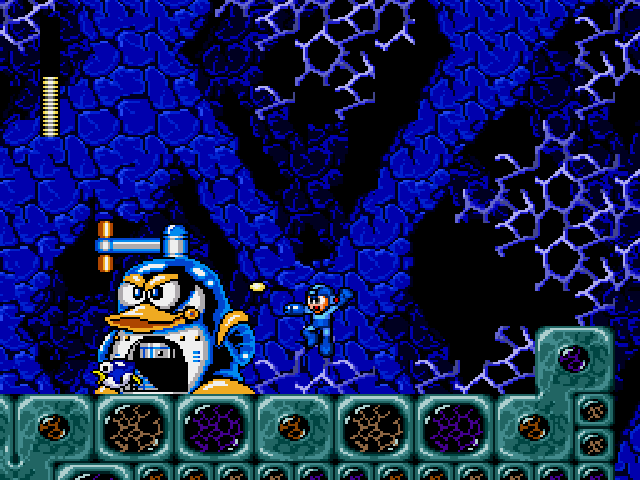
True story, the filename for this picture is Penguin.png

True story, the filename for this picture is Penguin.png

But here the wall I ran into when reviewing Lego Star Wars stands before me with not the slightest dent from the last time my head violently collided with it. What can I say about any Mega Man game that I didn’t cover the first time I reviewed any of them? Aside from a small list of minor alterations, most of them aesthetic, I only need say, “Mega Man still fights robots. Takes their weapons. Manages to let the villain escape for another day.” They updated his sprite, as well as a few of the robot masters’ sprites. Stage backgrounds received a makeover, but as the graphical upgrades peter out as you work upwards through the games, it comes off as a little insincere, as though Mega Man 3 subtly wanted to point out how much prettier she looked from the get-go.

Mega Man taking inspiration fPython and the Holy Grail. Ten to one odds he doesn't make it to that next block.

Mega Man taking inspiration from Monty Python and the Holy Grail. Ten to one odds he doesn’t make it to that next block.

But teenage drama aside, some of the changes actually make a difference, especially in Mega Man 2. Capcom eliminated easy mode and it felt like they ramped up the difficult mode in subtle yet obnoxious ways. For instance, the redesigned sprites for the wood shield make it nearly impossible to jump over Wood Man’s attacks without taking damage. Someone on the design team must have really missed the boat with Quick Man, as they toned down his speed to match the other robot masters’, turning him into Boomer Kuwanger with special needs. (He must have seriously let himself go after the series decided not to renew his contract for Mega Man 4. Depression can ruin a robot, let me tell you. No one will take him serious while crusted over in his own rust.) Probably the most obnoxious change involves the Mecha Dragon, which no longer takes damage from the crash bombs…making it the only boss in the game without a weakness. Plus you get to fight it over a giant bottomless pit. Yay. Since Mega Man games fell into the sweet spot (for me) of just the right amount of challenge, the minor increase in difficulty that these tweaks add works for the game play. Too much change, after all, might frighten Capcom.

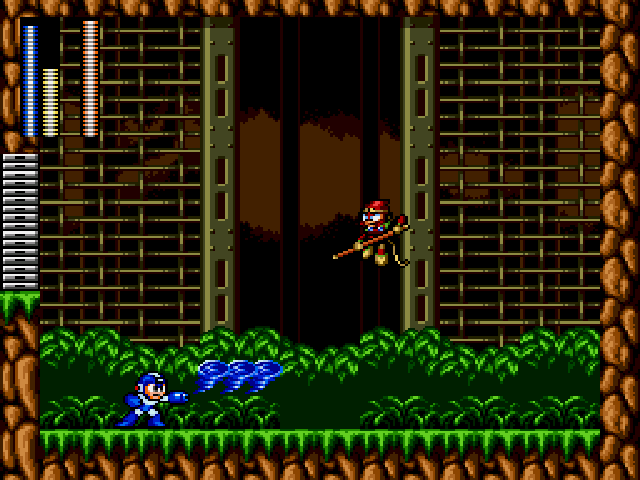
Yeah...I don't care how much danger threatens the earth. I don't want to set one foot in a part of the jungle made out of snakes.

Yeah…I don’t care how much danger threatens the earth. I don’t want to set one foot in a part of the jungle made out of snakes.

Then I beat all three games and something wondrous happened: original content! A Mega Man mini-game, complete with Dr. Wily’s skull tower and three unique robot master levels (none of which feel the urge to assert their machismo by adding “Man” to their moniker). Plus, this mini game did something I’ve always wanted to do with Mega Man: select from a set of weapons acquired in any of the games. What? You mean he doesn’t have to reformat his hard drive every time he beats up Dr. Wily? I would think after the first few times the old man threatened the world as revenge for not letting him threaten the world, Mega Man would at least keep a few of those outdated peripherals in a box in his closet–you know, just in case.

Realizing the limitations of the original game, Mega Man pioneered the idea of Rock-Paper-Scissors-Lizard-Spock

Realizing the limitations of the original game, Mega Man pioneered the idea of Rock-Paper-Scissors-Lizard-Spock

This adds an interesting spin to the game. Rather than a rock-paper-scissors relationship (or rather, because no one cares about Paper Man, rock-bomb-scissors), the three bosses have a small set of weaknesses, offset by weapons useful against their attack patterns, and the player has to decide what approach to take against them. Also, their design strongly resembles characters from the Ancient Chinese novel, Journey to the West. Like the characters in Dragonball. Because when Wu Cheng’en penned his satirical allegory of Buddhist enlightenment, he really just wanted to break into the anime and video game markets.

After defeating Son Wukong, Mega Man must take his place protecting Tripitaka so that they may travel to India to receive the eight energy crystals to rescue China from Dr. Wily. I think it goes something like that.

After defeating Son Wukong, Mega Man must take his place protecting Tripitaka so that they may travel to India to receive the eight energy crystals to rescue China from Dr. Wily. I think it goes something like that.

For a unique and fairly original Mega Man game, I’d only complain about the length–seven stages in total falls terribly short of what I’d actually want to play. It’s like ordering the unlimited soup at Olive Garden, enjoying your first bowl, and then for every bowl after that the waiter just rips open a packet of Maruchan Ramen. You had the good stuff! You knew what we wanted! Maybe changing the formula a little would do us all some good. Of course, eventually that waiter stopped delivering even the Ramen, evacuated the building, and left you sitting at your table in the dark, reminiscing about your meals of old.

Baby steps, Capcom. Baby steps.

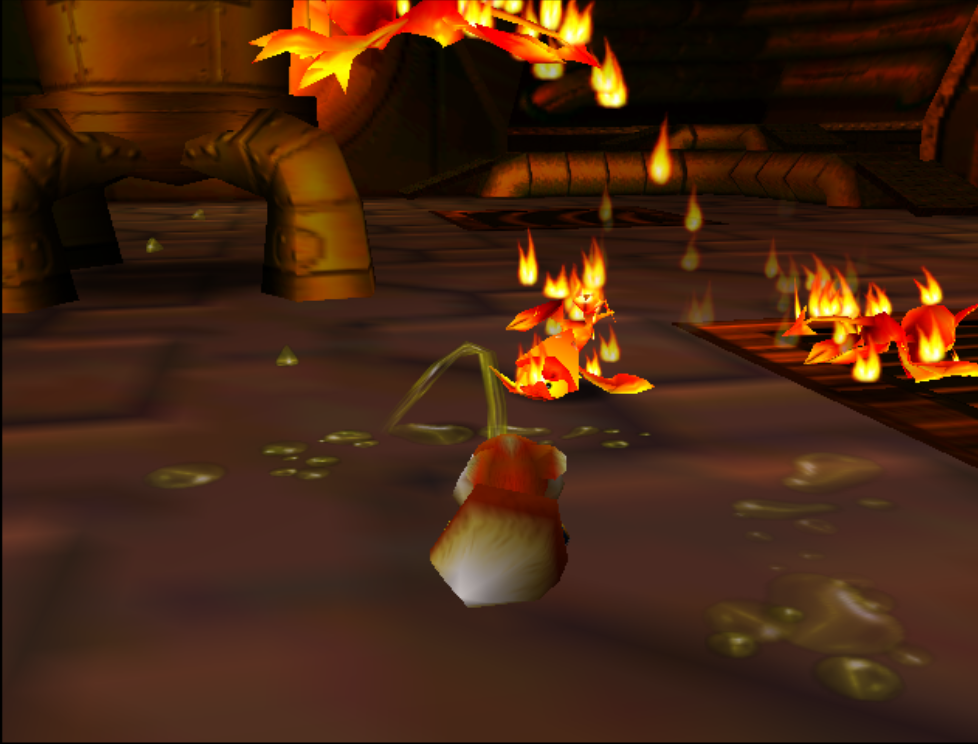
Conker’s Bad Fur Day – N64

The true impetus for getting Conker out the door. However, much like psycho, the money only acts as a macguffin.

The true impetus for getting Conker out the door. However, much like psycho, the money only acts as a macguffin.

While growing up, I always had this nagging awareness that the video game industry, much like fast food, big tobacco, and Fox News, designed their products for a target audience of children. That thought worried me, as I knew one day either my hobby would suddenly have no more relevance to me, or that I’d have to grow a peach fuzz mustache, don a dirty, faded, and malodorous My-Little-Pony T-shirt and start hanging out with boys 30 years younger than me if I still wanted to have interesting conversations. Although I nailed the prediction that grown-up conversation would be boring enough that I wish it would bore a hole in my head so I’d at least get to sit there, all content and lobotomized, I had little realization at the time that Rareware had already begun developing games for adults, and that it might have a little more polish than Custer’s Revenge.

What a mess they make.

What a mess they make.

I did have a vague understanding that Conker’s Bad Fur Day existed, but the commercial (below) tells surprisingly little about game play, and actually does quite a bit to frighten off all but the most disturbed teenage boys. So I didn’t pay much heed to the ads, and when I finally did see samples of gameplay, it just looked like another anthropomorphic version of some cute animal jumping through a cartoonish world picking up someone’s trash while trying to avoid falling into holes. And honestly, after Sonic, Yoshi, Banjo and Kazooie, Bubsy, Crash Bandicoot, Earthworm Jim and the rest of the damn zoo of stagnant ideas, Conker didn’t look that interesting, and I never put it together that I may actually want to play this game.

So this game flew under my radar until a few years ago when, indulging Anne in her youtube fetish, I saw it on an episode of The Completionist.  Finally, I began to take note of the humor involved, and resolved to play Conker myself. Except the cartridge costs a minimum of $70, and you can pretty much only find it on eBay. So I waited. And it searched. And the price stayed the same. Until, of course, the day came when I bought a new computer with the processing power to run an N64 emulator. (What? It’s not like Rare gets royalties from used games, anyway.) And trust me…I got my money’s worth out of Conker’s Bad Fur Day.

Conker Zombie SquirrelAt heart, Conker’s Bad Fur Day follows the same platforming formula used by all the games it.  Usually, I suspect that developers only release platformers when their lack of ingenuity and patience to design a good game conflicts with their desire to tear the cash directly out of our hands, but I figured for a game full of adult humor, video game satire, and at least one major musical number, I could sit through one game’s attempt to chuck me into holes for ten hours. The Completionist, however, could cover a raging fungal infection with enough saccharine to give the entire cast of Candy Land diabetes, and I probably should have heeded his subtle remarks that “the controls are a little difficult” with a red flag large enough to attract all the bulls in Pamplona.

But I should start with the story. If you’ve seen the Completionist’s review, you know that Conker spends a night out drinking, neglecting his poor girlfriend Berri at home. He stumbles out of the bar, takes a wrong turn at Albuquerque, and winds up in a wacky world of adventure! Meanwhile, the evil Panther King sends out his goons to kidnap Berri as bait for Conker, because Weasel Dr. Strangelove decided that nothing can balance out a wobbly table like a red squirrel. And there’s a giant poop monster.

Berri clearly exhibits inappropriate behavior for a kidnapped princess.

Berri clearly exhibits inappropriate behavior for a kidnapped princess.

In all fairness, I doubt I could come up with a more coherent interpretation. In reality, Berri never realizes that Conker ditched her, since her jazzercising covers up the sound of the phone, and while Conker claims he wants to get home, he actually romps through the countryside, performing favors for the animals (which often involves murdering other animals), and then extorting them for cash.  A giant rock monster knocks on Berri’s door, apparently kidnapping her, but the two apparently resolve their differences in a civil and diplomatic fashion as we next see her dancing in the rock monsters’ night club, and Conker reacts to seeing her with a characteristic lack of interest. None of the enemies seem in league with the Panther King, and I use the term “enemy” loosely; the game doesn’t so much have enemies as it has things that can harm you if you interact with them improperly. I have things like that around me, too, but I’ve never really considered my snow blower an enemy. (Rather, we form a reluctant alliance against the snow plow)

...nope. Not human enough. Just creepy.

…nope. Not human enough. Just creepy.

The initial scenes between the Panther King and his mad scientist set up a joke about duct tape that never gets to any sort of reveal or punch line, and most of the game’s third act involves a war between the squirrels and the tediz (Teddy Bear Nazis), a cause that Conker throws himself into wholeheartedly for no reason other than some steroidal army squirrel hitting him on the head and throwing him in a troop transport.  Through the whole game, Conker shows no interest in anything except monetary personal gain–and an opportunistic interest in breasts–but throw him into a Saving Private Ryan parody and he whips out a cigar and starts mowing down stuffed bears. Rare must have written the story by placing all the scenario writers in separate counties and forced them to communicate via smoke signal, then combining each one’s interpretation into one script, transcribed in Swahili and run through Babelfish.

And so we say goodbye to good old unforgettable what's-his-name, who we have known for an entirety of this half of the war level.

And so we say goodbye to good old unforgettable what’s-his-name, who we have known for an entirety of this half of the war level.

Much like the story, the game play of Conker’s Bad Fur day redefines itself as the game progresses. And while that fluidity may not spell out a cohesive narrative, it actually does quite a bit to keep the game interesting. Conker has no way of directly fighting back against dangers in his environment. He can swing a frying pan, but only to knock small things out briefly enough to pick them up. At first glance, the game actually takes cues from point-and-click adventures, requiring the players to use their wit in figuring out how objects in the environment alter each other. And true to point-and-click adventure fashion, these puzzles usually make about as much sense as a Texas public school science textbook. Later in the game, Conker picks up guns, which transforms the game into first a Resident-Evil-with-Squirrels zombie shooter, and then a modern warfare shooter.

I can't think of any way to describe this that won't sound like a euphemism. I'll just say it. It feels like trying to hang on to a weasel.

I can’t think of any way to describe this that won’t sound like a euphemism. I’ll just say it. It feels like trying to hang on to a weasel.

Conker has a fatal flaw that may just break the game for me–the controls. Platforming by design requires a certain level of coordination, but developers should still find a balance between clever, challenging world design and performing drunken brain surgery during an earthquake, and while Conker usually hits that mark, some segments felt so difficult to control they made me physically ill. As someone who has, in real life, attempted to safely guide drunks away from danger, making sure they pee in the right direction and at a proper intensity, I fail to see the appeal in simulating the experience for enjoyment. Yes, I understand that Conker gets witty super powers by guzzling booze from a cartoonishly large barrel. But when I have to force him to pee in a straight line while rock monsters want to pummel him, and he exercises the coordination of your average Friday night frat boy, well…let’s just say that asking me to help him crawl to the Alka-Selzter after he sobers up doesn’t make me laugh as much as you think it will.  And even when sober, Conker’s controls made me want to punch a hole in my screen. From a lava surf board with a seemingly magnetic pull towards rock walls to gun crosshairs that can’t sit even as steady as a three-year-old overdosing on caffeine pills, I honestly don’t believe I could have finished this game without the use of save states.

Conker NeoConker’s Bad Fur day, as far as platformers go, kept me entertained for the most part. Not great, but nice. I guess the biggest problem for me stems from Conker himself. Yeah, I enjoy mocking video games by using the most unlikely protagonist, but does he have anything else going for him? The indulgent lifestyle and self-centered opportunism effectively satirize our worn-out, cliched game heroes, but if we had to deal with Conker in real life, we’d hate the furry bastard. Who among you really wants to spend any amount of time with a crass drunk who always wants to swindle or mooch money off of you? The guy with a super-hot girlfriend who he barely notices and clearly doesn’t appreciate? The humor in Conker only goes so far. The character only has a superficial level of appeal, the outdated movie references will fly over the heads of anyone younger than 20 years old, and when you take those out, all you have left is a platform game covered in poop jokes. And as a rule, I generally like things less and less the more shit I find piled on top of it.

'nuff said.

’nuff said.