Dragon Quest IV: Chapters of the Chosen – NES, NDS

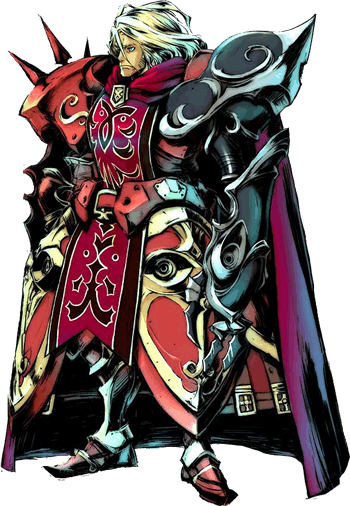
Stunning artwork by Akira Toriyama, which you will never see with the first-person battle system.

Stunning artwork by Akira Toriyama, which you will never see with the first-person battle system.

Sometimes I wonder if game designers ever play games themselves. When they go home from a hard day at Square-Enix or EA or wherever they work, do they sit down, pop in Goldeneye 64 and vent their aggressions on unsuspecting polygonal clones? Because half the time, the games I play suggest that the designers slapped together a few inebriated, late-night ideas together, hired some monkeys to make the code functional, then add required backtracking, level-grinding, or needlessly long menu dialogue to pad the game out to the optimal length for predicted financial success.

And so we arrive, weary and saddle-sore, at the beloved Dragon Quest series. In particular, Dragon Quest IV: Chapters of the Chosen stands out as the paradigm of wrong answers to good questions. “What part of the traditional JRPG do players consistently enjoy as the most stunning part of the experience? What makes them ignore the phone, neglect their schoolwork, household chores and personal hygiene, and refuse to develop a social life more than any other point in the game?”
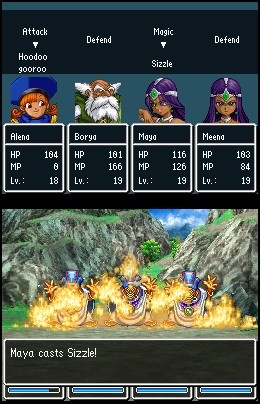
DS Battle“Compelling characters and a complex, driving storyline?” shouts an up-and-coming young mind in the Enix meeting room.

“Fuck you!” responds the boss, who follows up by firing the up-and-coming mind.

“Hours and hours of monotonous grinding?” someone suggests.

“Technically, true. Put it in the game. But what do they love? Why do they love RPGs with the intensity of a rabbit overdosing on Viagra?”

“The first hour and a half where you have no money, no access to anything cool, and  no abilities other than attack and item?”

“I like it,” says the boss. “We’ll do it five times, and throw in some of that grinding to make it more like three hours.

And thus, the incipient Dragon Quest took form. Chapters of the Chosen focuses on…the idea of not focusing on anything. The story opens with the generic blank-hero, a character so bland compared to everyone else in the game that the lord of hell himself couldn’t drag my projection of myself into the game. “You want me to imagine myself as that guy?” I ask the game. “No thanks. You go on and play without me. I’ll just watch this one.” Feigning a fast-paced, exciting game, monsters invade the hero’s village, looking for you. After killing your neighbors, your adopted parents, and your love interest, the monsters decide they just don’t feel like putting the effort into eviscerating one more human and leave your cowering in a mixture of fear and bodily fluids.

And then the game, bored of the hero’s personality already, leaves you as well, and goes on to someone much more interesting. I’ve just described the prologue. Bear in mind, you don’t even get to battle the monsters. No fighting. Not with the protagonist. Not yet. C3PO and R2D2 make it to their hero at light-speed compared to this game. So the game shifts to Ragnar McRyan, whose king has sent him to find the hero–but before he does, we have to help Tsarevna Alena pull a Princess Jasmine. Alena eventually Alena joins a tournament that almost introduces the villain–

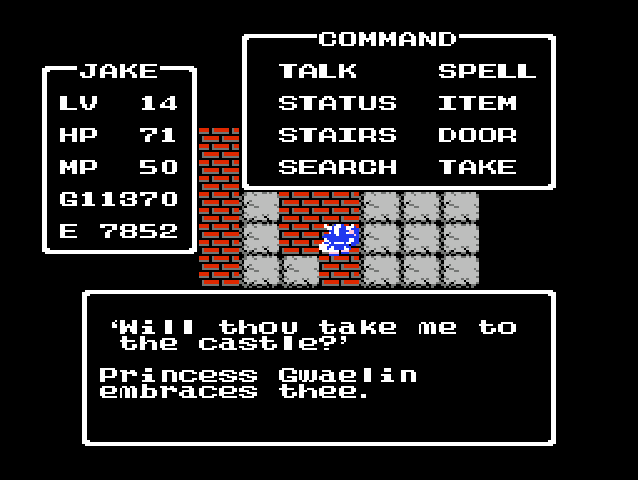
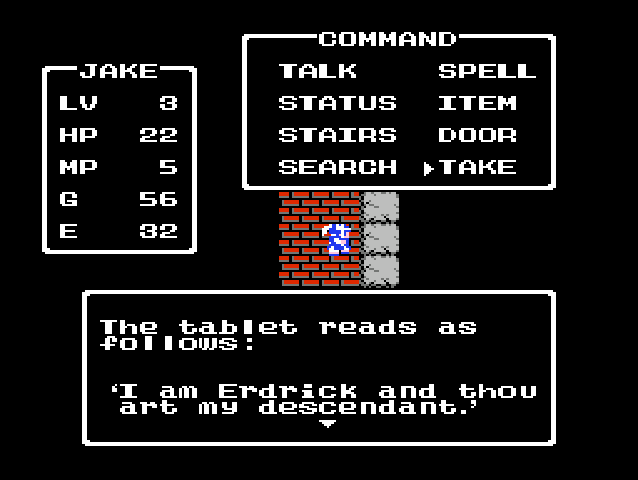
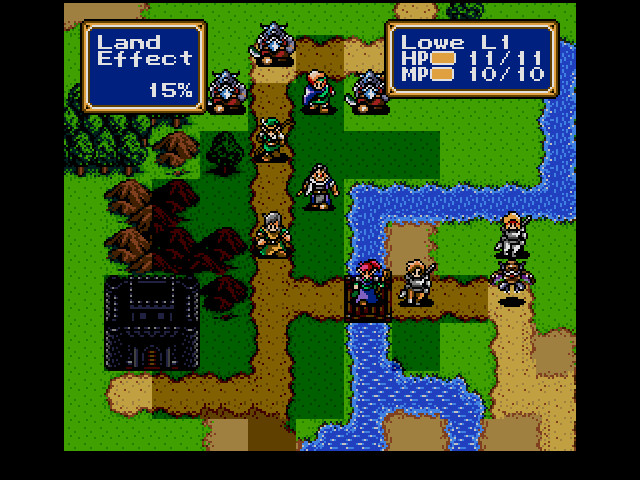
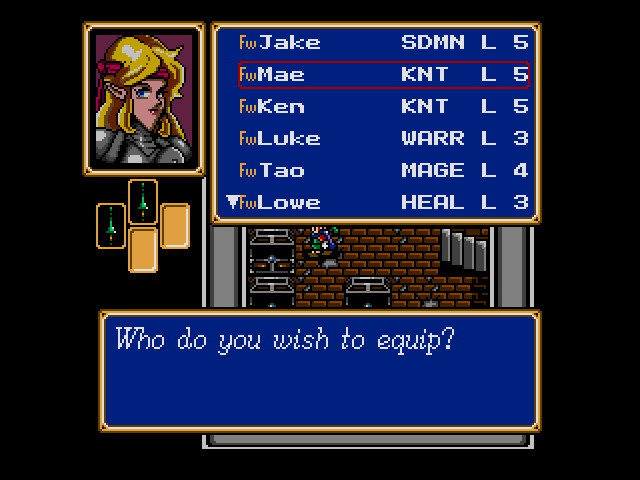
Thought I should include a screen shot of the NES version. Apparently they added the borderline-offensive gibberish for the DS version

Thought I should include a screen shot of the NES version. Apparently they added the borderline-offensive gibberish for the DS version

–but first cuts to the story of Torneko Taloon, Akira Toriyama’s answer to Nicholas Cage, and his aspirations to profit from mass slaughter more than anyone has ever profited off anyone else’s misfortune ever before. Torkneko deserves special attention, for taking role-playing to the extreme. Flash back to the execs meeting:

Just to mess with you, they included "night," which translates to "for half the game, you'll wait for the useful NPCs to wake up."

Just to mess with you, they included “night,” which translates to “for half the game, you’ll wait for the useful NPCs to wake up.”

“We need a role that will open up their eyes to the possibilities!”

“Why not a Samurai?”

“That’ll never work. Next idea!”

“What about a Cowboy?”

“What do I pay you losers for?”

“How about we put players in the role of a mindless clerk standing at a cash register all day long?”

“Fuckin’ genius!”

I should mention at this point that I haven’t exaggerated anything yet. During Torneko’s chapter, you literally spend huge chunks of time standing on the merchant’s side of the counter, waiting for people to come in and buy weapons. Torneko hopes to save up enough money to buy his own gear to set out on a money-making adventure, but he doesn’t even get to keep the cash the store rakes in–his boss pays chicken feed, amounting to less than a 10% commission on each item sold. But still, it gives you the option of refusing sales to each customer, and sometimes they won’t pony up enough cash and will walk out empty handed.

I spent a great deal of time wandering as the game felt I'd enjoy it more if I had no fucking clue about what I needed to do next.

I spent a great deal of time wandering as the game felt I’d enjoy it more if I had no fucking clue about what I needed to do next.

And then just for good measure, we get another chapter. And each new chapter opens up with flat-broke, level-1 characters who fight monsters with all the effectiveness of a paraplegic cub scout wielding a foam pool noodle. Grind away, ladies and gentlemen. Seriously, I haven’t exaggerated anything yet. By the time chapter five dragged itself in to let me play as the hero, my game timer read 12:56. Out of the total 30 hours I played the game, I spent 43% effectively at the beginning, grinding until the “attack” option did reasonable damage. And for the zinger: the story keeps going after the final boss! I beat the game and it offered me another chapter. Thanks, but I’ll pass.

One positive thing I’ll say for the game: it gave Torneko an ability to initiate a monster battle at any time, cutting out the need for useless walking between battles. I take this as clear evidence that Dragon Quest IV knows it only has value as a time-killing grinder, but even with this trick to speed things up, it still felt like I’d hit my mid-life crisis before the end of the game. Unfortunately, any time gained by not walking while grinding balances out with time wasted managing menus. For each option, you have to flip through three or four dialogue boxes that want to confirm in triplicate that yes, you indeed want to use that herb. Or save. Or anything. Yes. Given the choice I will always answer yes. Yes, I’ll sell the damned sword! Yes, I want to equip the armor! Yes, I’ll continue the game after I save! (who thought of this one? Do you need to go to a special screen to shut the power off? Did the original NES erase your data otherwise?)
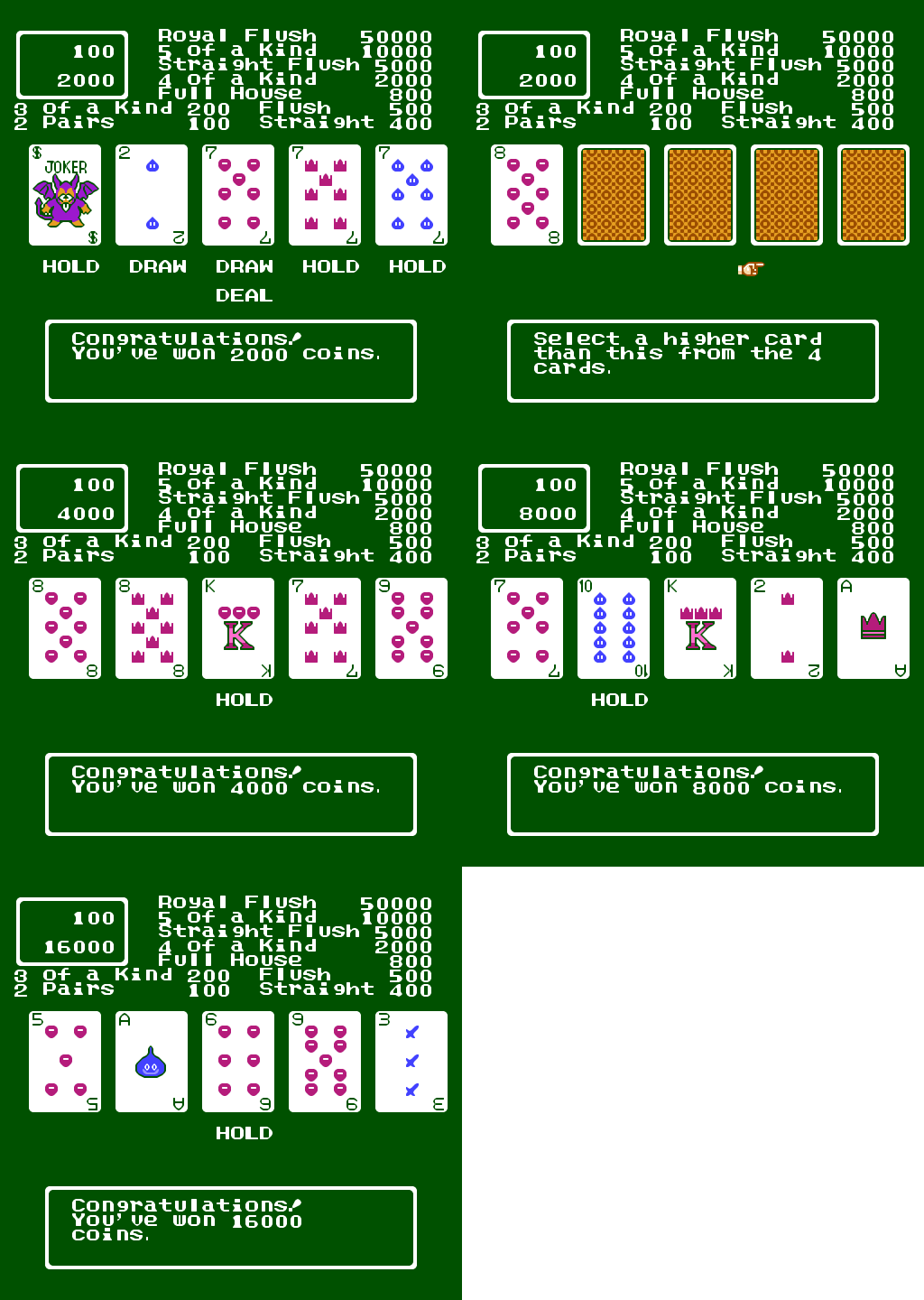
The game features a casino; If you want to waste more than time, why not waste money, too?

The game features a casino; If you want to waste more than time, why not waste money, too?

I think I can stick to the same assessment I gave the original; I’ll play the game as long as something else in the room can take my priority attention. Otherwise, I still don’t see the appeal in Dragon Quest, other than Akira Toriyama’s artwork, which I could download in much less than 30 hours. A game that centers on level-grinding and only includes a half-assed plot and characters doesn’t really offer much value, especially compared to most of the Final Fantasy installments. I don’t understand how these games rate so highly.  And yes, I’ve lived in Asia and I’ve seen Gaijin Goomba; I understand that different cultures think differently and have different needs. But I don’t think I need to spend thirty hours hitting the “confirm” button when I could have just as much fun pushing the buttons on my shirts.

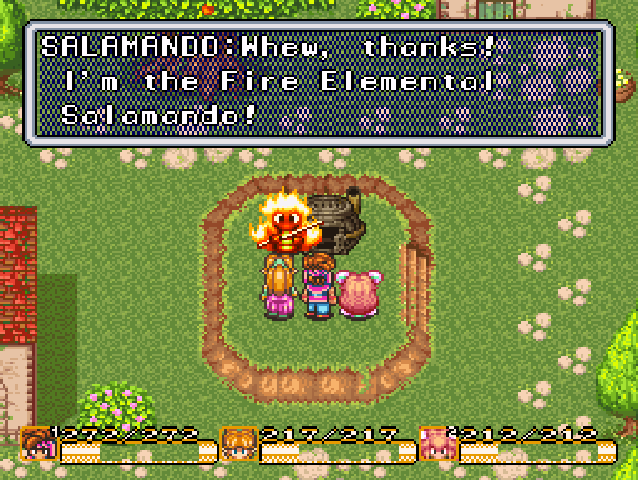
Secret of Mana – SNES

The game's elemental magic system lets you build snowmen! Out of the dying corpses of your foes, nonetheless.

The game’s elemental magic system lets you build snowmen! Out of the dying corpses of your foes, nonetheless.

Anyone between the ages of, say, 23 and 35 might understand the sheer disappointment of nostalgia, how delving deep into the caverns of your past usually only uncovers the noxious fumes that kill the canary of our fondest childhood treasures. Did any of you ever watch “The Real Adventures of Johnny Quest,” Hannah-Barbara’s update of their classic science-adventure series into the computer age? I loved it! I stayed up every night one summer to tape it. I wanted to dive into Quest World, to meet the Evil Stephen Hawking guy who only felt truly alive in virtual reality. I wanted to know what ran through the mind of the psycho religious fanatic. I wanted to travel the world, see exotic animals and mess with cool science gear. And a few years ago when I dug up some of those old episodes, I found I wanted to surreptitiously leave the room when the writers decided to let Hadji bust out a few “Sim Sim Sala-bims.” Yep. Despite possessing the ability to change with the times, “The Real Adventures of Johnny Quest” only succeeded in blandness. And racism.

After rescuing him from a plot to create a tropical resort...in the arctic.

After rescuing him from a plot to create a tropical resort…in the arctic.

And so, with heavy heart I have to confess I had a similar reaction to Secret of Mana, Squaresoft’s epic Final Fantasy Spin-off. Don’t worry, though, I don’t intend to condemn the entire game. Just one guy. Which guy? Guess. Which early 90s Squaresoft employee did everyone know simply by virtue of having the only Western name in the credits? The one whose translations dropped text into the game with the care and precision of a spastic colon? Ted. Fuckin’. Woolsey. Now, it appears that the internet uses people’s opinions of Woolsey as kindling for flame wars, I should give him the necessary credit he deserves: direct translations don’t work. People simply use languages differently, and certain words and phrases don’t translate at all.

Rather, I’d like to say (if I can ever learn to shorten my introductions) that one shouldn’t confuse the Japanese “R” and “L” sound when a) you speak English natively and b) The same name appears both in Final Fantasy (Gestahl) and Secret of Mana (Geshtar). And seriously…he honestly didn’t know Biggs and Wedge, Luke Skywalker’s trusty wingmen during the first Death Star Assault?

So while the old games, even with Woolsey’s translations, don’t fall to the level of Johnny Quest, re-playing Secret of Mana recently made me painfully aware of the jagged, incoherency of the story. The main character, who rarely has any direct interaction with the plot, comes off as a silent protagonist after the first few scenes, but occasionally mumbles just enough so that he comes off as a second-rate mime. Jema, the game’s Obi-Wan Kenobi figure, offers no more advice than “Go to the Water Palace” or “Go to Gaia’s navel,” and the Yoda figure literally tells you nothing more than your next random destination for a good chunk of the end-game. Furthermore, the game introduces a fascinating villain, Thanatos, who shares a name with the God of Death, and we sort of infer is manipulating the war between the Emperor and the Kingdoms (the standard stock war included free with every purchase of a fantasy plot), but we get very little dialogue from or about him and the other villains. These inconsistencies seem to reach a peak when you sneak into the Imperial Capital, leaving the world of medieval-style fantasy villages and plopping yourself down into the horrible, dreary, nightmarish…contemporary urban town with paved streets and cheerful music, where the sun shines down warmly and everyone walks around with a smile on their face.

Let me just flag down a cab here...

Let me just flag down a cab here…

…uhh, why again do we want to disembowel the emperor with such a passion? Oh right…something somewhere about a cliched metaphor for limited resources and global warming. I think.  See, I can’t ever tell, because according to wikipedia, they cut a massive amount of text from the game to get it to fit on an SNES cartridge. And rather than economize the language available, artfully revealing key plot points and character development in as few words as possible, Woolsey just let it go. So when the hero’s village becomes overrun with monsters, they banish the only villager with a sword. Now, I support enforced background checks for lances and a ten-bolt limit for crossbows, but I also fail to see the reasoning behind believing that every monster and demon on earth wants to attack you simply because you have a weapon.

But leave you must, and just as the hero becomes unimportant to the story once other characters join him, you pick up weapon after weapon on your journey until you forget all vital details behind the sword, and all towns in your wake remain utterly defenseless.

The characters fighting a monster...Playboy? Well, the nuns at my sunday school did warn about the dangers of pornography.

The characters fighting a monster…Playboy? Well, the nuns at my sunday school did warn about the dangers of pornography.

However much the story lacks, the gameplay makes up for. Rather than the standard consumer economy provided by most RPGs, Secret of Mana tackles weaponry in more of a Marxist fashion, providing you with a set of weapons, free of charge, at or near the beginning of the game, that level up as the proletariat works harder and harder. (Unfortunately, the inventory does not include “hammer” or “sickle”) Combat takes place in pseudo-real-time, with enemies directly on the map, completely free of jarring explosions sucking you into isometric perspectives where the enemy kindly lines up and waits as you pound them. Rather, you move freely about the map, attacking freely as in a Legend of Zelda game; however, with the added encumbrance of an ATB gauge that needs to charge before your characters can summon up enough strength to penetrate the enemies outer layer of…epidermis. The player opens up menus at any time, in battle or otherwise, to use items and cast magic. Magic comes in the form of elemental spirits gathered along the journey, and they can level up with use, same as the weapons. While I usually write my reviews to ridicule the more absurd aspects of the game, I find myself at a loss for good jokes. The combat system wraps things up pretty tightly. It works.

Well, mostly. Despite giving us a rich selection of weapons and magic and a smooth, sleek ring-menu system to navigate between them, Secret of Mana gives you three characters and about half a brain of AI to split between the two inactive ones.  While they’ll refrain from wasting your MP and will generally wait to attack until their ATB gauge fills completely, they do wonderfully smart things such as dart head first into enemies, attack during the invulnerable period after a monster has received a hit, or try to get closer to the lead character by running straight into a wall nonstop like a squirrel confused by a sheet of glass. While you can program basic attack/defense strategies, you can’t send commands to switch these during combat, so it amounts to either one worthwhile character at a time, or the player needs to constantly switch between party leaders.

Fortunately, Square included a crafty solution, allowing up to two other players to join in. If you want to play the game, I suggest hunting down friends, relatives, co-workers, homeless guys, or  prostitutes, since it does make a world of difference, having someone with a brain behind a character who would otherwise serve as much purpose as one of these.

A good way to see the world without getting probed by Airport security.

A good way to see the world without getting probed by Airport security.

On the unfortunate side, I don’t really have anything interesting or witty to say about Secret of Mana. Really, what can you add to a game that considers “shoot you out of a cannon” as a viable method of travel, and has a travelling anthropomorphic cat-merchant rip you off by jacking up prices on normal items? The game doesn’t have a lot of visible flaws and its own unique sense of humor, so I have to resort to picking on the poor translator, and since so many people have played it already, I don’t really feel the need to describe it in detail. So ask Santa for a copy this Christmas if you don’t already own one. And if he fails to deliver, buy the game and kick his ass.

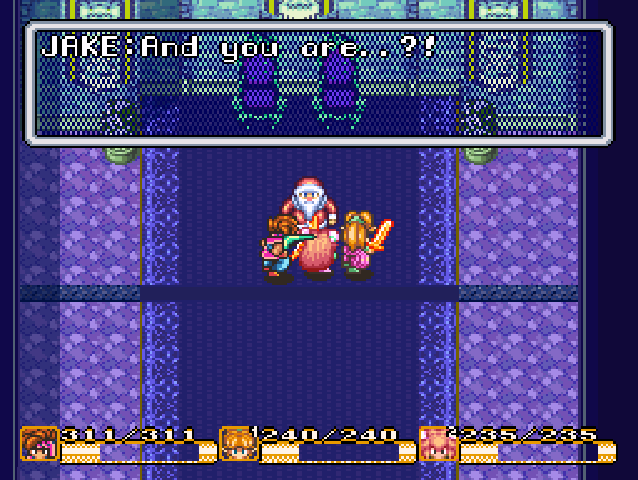
Because seriously…you fight Santa Clause about halfway through. Santa tries to kill you. Santa. An enemy. How can you improve on a fantasy death match with St. Nick?

RetroArch-0908-175043

The Last Story – Wii

Last Title

Between planning lessons for school and writing about every game I play, I’ve begun to suspect that I may not actually have something to say about certain things. Certainly the terrible games like Dr. Jekyll and Mr. Hyde let me spout elegant prose as rapidly as I spout an elegant stream of profanity while playing the game, and of course the excellent books, once again like Dr. Jekyll and Mr. Hyde, lend themselves to interesting discussions of the pointlessly abstract. But honestly, some things just don’t have much worth mentioning. I’ve always intended to write about Burger Time, for instance, but while concepts of a short order cook trampling food like a grape stamper running around in flagrant defiance of health codes conjures up a delicious opportunity for ringworm jokes, it doesn’t really have much substance to it to write any more than that.

Despite the hurdles, however, I now turn your attention to The Last Story, a game so generic that even its developers decided to fill it up halfway with as many fantasy RPG tropes as they could list off in an afternoon, at which point they called it good and went home before the rancid filth of blandness they created could swell up, devour any remnants of artistic integrity still sucking meager nutrients from their soul, and chain them up and whip them until they produced a line of unwanted sequels. They did, at least, learn to avoid the fate of the Final Fantasy XIII team.

You know, I find it amazing how this in no way resembles the octopus battle from Final Fantasy IV.

You know, I find it amazing how this in no way resembles the octopus battle from Final Fantasy IV.

The not-so-subtle Final Fantasy nods in the game indicate the developers intended to take the throne that the giant RPG Series sucked into the void with the last few attempts at reinventing themselves. Obviously the synonymous titles give off a familiar vibe, jabbing our eyes, demanding attention like a Twilight book cover slapped on Wuthering Heights. The game weaves personal, political, and worldwide existential crises together, has a similar art style and logo as Final Fantasy, and even shares a few minor similarities such as series creator Hironobu Sakaguchi and composer Nobuo Uematsu.
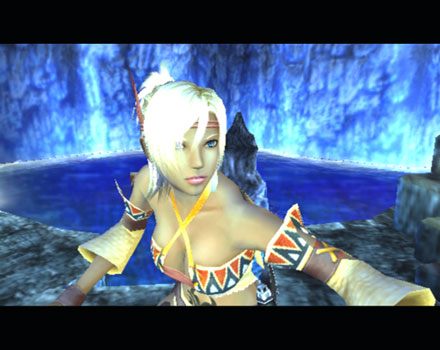
I find it amazing how this in no way resembles a fuzzy-headed Gannondorf

I find it amazing how this in no way resembles a fuzzy-headed Gannondorf

Unfortunately, the legendary developers and beloved Fantasy elements don’t seem to push this game forward so much as drag it with the oomph of a golf cart pulling a dead horse.  The game opens with the obligatory action scene. The player takes control of Dagran, a young mercenary who we very quickly learn will act only as a supporting character when, after one battle, control switches to the real protagonist, Zael. As Reptar-themed monsters pour out of the camera’s blind spots, Zael hacks endlessly at them with a Buster-Sword-sized weapon. After a few hours of spamming the A button, I realized that the game hacks automatically, with no need to input attack commands. This made sense in Final Fantasy XII; actually, it seems a bit embarrassing that it took Sakaguchi eleven main-series games before he realized how often we used it. But at least in Final Fantasy, we had the option of programming the characters’ behavior. Yeah, it took the need to thoughtlessly mash buttons–a technique perfect by Shadow Hearts–away from us, but we never lost control, nor did we sacrifice options for battle strategy. Zael, on the other hand, when he receives the “Supernatural Aid” portion of his hero’s journey, claims the Power of the Outsider, which allows him the ability…to do something else in battle besides hack with a sword.

This move requires you to target an area on the ground as you run up the side of a wall. Both actions use the joystick. I didn't use this often.

This move requires you to target an area on the ground as you run up the side of a wall. Both actions use the joystick. I didn’t use this often.

His first new skill allows him to resurrect fallen semi-playable characters while simultaneously tempting all the enemies to hunt him down as their main target. Now you may ask what good will come from drawing all the monsters toward the person you want to revive, but I can say with confidence that Zael’s uncontrollable need to relentlessly slash everything within a two meter radius will keep your companions safely dead until you finally wrestle with the controls enough to get away from the battle. Another skill, the ambush slash, only really works going into a battle, as it requires Zael to hide. A third ability lets him attack friendly magic spells for additional effects. I had some more abilities, but like many other RPGs, the basic attack option works best, and in the Last Story it has the added bonus of not demanding surgical dexterity to perform.

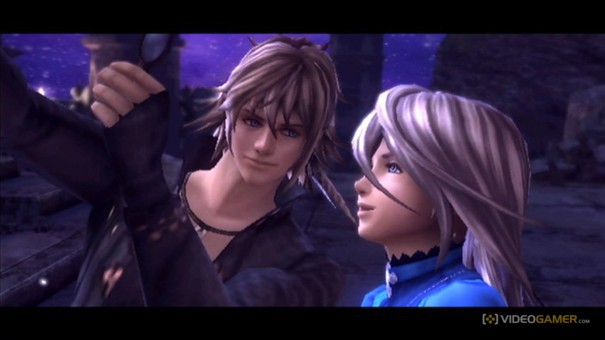
Zael putting the moves on Callista, showing her how to look at things like he can.

Zael putting the moves on Callista, showing her how to look at things like he can.

Zael lives to underwhelm. In addition to a handful of battle options, he can fire arrows from a crossbow that the enemies almost feel, and outside of battle he frequently assumes the task of… looking around the environment…for stuff. The game offers roughly 25 to 30 hours of play, which somehow still feels padded, despite its clear disdain for side quests. On an early mission Zael must go to the other side of town to get beer. And if he gets beer, he has to go get more beer. As it turns out, the game expects the player to notice things on the way and get distracted in order to further the story. The lack of direction given the player also serves no end except to pad out a short game to a minimum acceptable length. At regular intervals, the player takes control of Zael, usually as he sits in bed, and proceeds to walk around until something happens. The world doesn’t extend beyond a castle and a town, so chances are it won’t take long before you stumble into the area that triggers the cut scene, but I would appreciate maybe a hint or an arrow now and then.

The best suggested strategies in this game more often than not fall terribly short of the standard run-in-waving-your-sword-at-anything-that-moves technique.

The best suggested strategies in this game more often than not fall terribly short of the standard run-in-waving-your-sword-at-anything-that-moves technique.

I did enjoy the story. Tropes become tropes for a reason, and I saw a lot of what I like in the fantasy genre in this story. Unfortunately, the designers didn’t add any ideas to the story–except, apparently, a blues harmonica player–so I could predict twists and turns in the plot most of the time. They clearly intended the identity of the final boss to shock the player, but when the ally who had acted suspicious through the whole game suddenly failed to join the party during the final dungeon, I didn’t exactly lose my breath; I’d wager that more Superman fans would have trouble identifying Clark Kent. Also, while the length of the game makes it possible to play an RPG without asking time off from work, it also detracts from developing any of the characters enough to have their actions make sense.

From what I gather, they announced “The Last Story 2“ a while back, but only as an April Fool’s joke. I would have liked to see improvements on the game; it has potential, even if can’t deliver in the first instalment. Besides, I hated Final Fantasy XIII enough that I want other series to succeed, but I may have to wait a little longer.

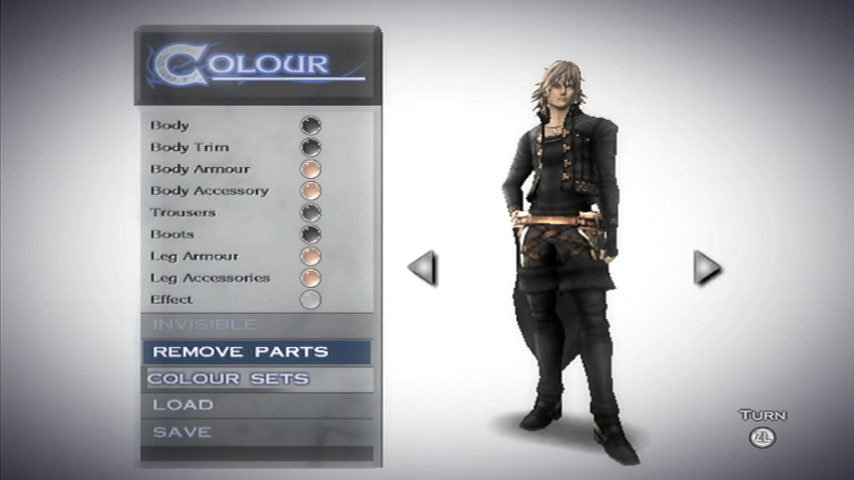
The game doesn't offer much in the way of armor variety, but it allows you to change the color. I usually went with the "invisible" dye.

The game doesn’t offer much in the way of armor variety, but it allows you to change the color. I usually went with the “invisible” dye.

Coming up soon: Minecraft, and Dragon Quest IV–if I can pry myself away from Minecraft long enough to play it.

Dragon Quest / Dragon Warrior – NES, GBC

Yep...she makes you carry her halfway around the world.

Yep…she makes you carry her halfway around the world.

In tenth grade, my school required me to buy a graphing calculator. My trusty TI-85 and I became inseparable when I realized it came with its own programming language. I spent days in my bedroom, hunched over my calculator with thumbs blitzing like epileptic clog dancers until I managed to program a simple, shoddy dungeon crawler with about 20 rooms and 4 or 5 monsters that could beat you into negative hit points. It filled the calculator’s entire memory, had more bugs than a gas station bathroom, and I only played it once, but I still loved it. The next year I upgraded to a TI-89 and shinier, newer games found their way to me, including Phoenix, a 4-level version of Mario, a version of Tetris where blocks fell all the way down when their supporting blocks vanished, and a four-screen-map sequel to Final Fantasy VII with two characters, one boss fight, not enough monsters to level-up, and an inconclusive ending.

Any of these math-class knock-offs released on a dedicated gaming console would have undoubtedly given the impression that the video game industry had replaced all their experienced developers with a team of lemurs who had a penchant for writing fanfiction. They glitched. They wasted memory. They ran poorly on systems not designed for games. I had a Playstation and an N-64 by this point.  I didn’t need these crummy games; yet I still played them. I mention this because my recent play-through of the 1986 RPG legend, Dragon Warrior, left me in a quandary, puzzled over how games with as much substance as a half-finished knock-knock joke written on a pizza box can gather a large enough fan following to inspire one of the most long-lived series in video game history.

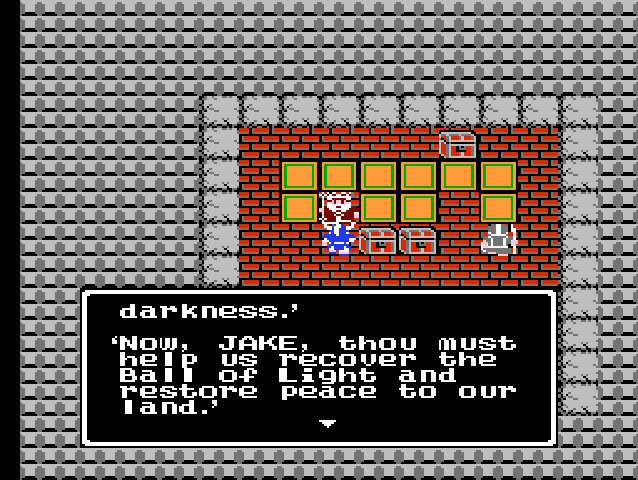
GwaelinDragon Warrior (known in Japan as “Dragon Quest”) hails from an age where RPG developers wanted to re-create the Dungeons and Dragons experience without the dice, paper, or need for that pesky socialization, but hadn’t yet figured out that interactive storytelling doesn’t exactly work the same way with pre-programmed computer characters.  As such, you play as _______, and up-and-coming warrior with the charm, charisma and personality of Edward Cullen after eating his weight in magic brownies. The King of Tantagel, in a display of straightforwardness that most video game mystics would find offensive, gives you a simple task: 1) Find the princess and 2) Kill the Dragonlord. After which, young ________ ambles through the world, slaughtering the indigenous fauna until he feels confident enough to carry out the assassination the king entrusted to him.

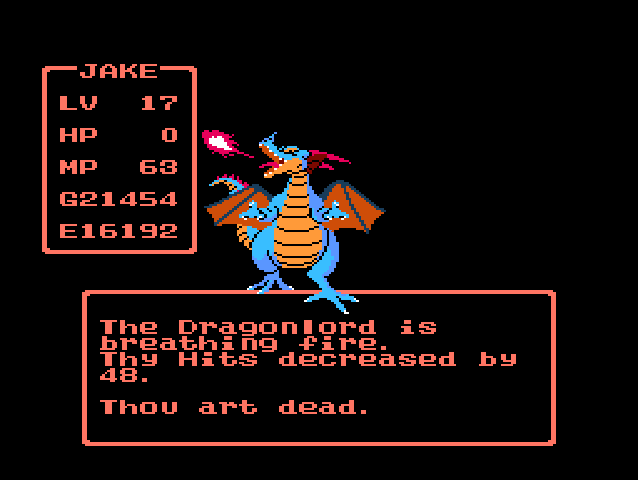
As much as the simplicity sounds like a breath of fresh air, however, we play games exactly for the roundabout nature of questing. In fact, if you’ve spent any length of time with literature professors, they’ll remind you that the world’s alleged greatest, most classic piece of literature focused entirely on Odysseus gallivanting around the Mediterranean for years, cavorting with nymphs while “guilt” over his marital fidelity “tortured” him, when it may have only taken him two or three weeks simply to walk home. I get that NES cartridges didn’t have the capacity to store complex stories, but like most RPGs from the 1980s, Dragon Warrior has a problem with math. Leveling up to the point where the Dragonlord won’t vaporize you like a bottle of  Zippo fluid requires over 20,000 experience. The most reasonable enemy to fight while level grinding gives you 54. With nothing to do in-game, I hope you have a second TV in your living room because you may want to put on a movie while you grind.

I humbly accept this quest my liege, and...did you just take my wallet?

I humbly accept this quest my liege, and…did you just take my wallet?

Furthermore, your gold supply creeps up with an impressive lack of urgency, while weapons and armor can run as high as 14800. To add to the tedium, every time ________ dies, he wakes up in front of the King of Tantagel, who admonishes you for having the gall to allow the overpowered monsters of the countryside maul you to death. The first time this happened, I didn’t realize that I kept all the experience earned since I last saved because my gold stock had dropped substantially from the moment of my death. But Eventually I realized that in addition to chewing you out for your audacious apathy toward life, the King takes half your gold every time he revives you.

Is it to late to reconsider your offer?

Is it to late to reconsider your offer?

After my initial outburst of anger at having to replenish larger and larger sums of money at each death, this got me thinking. One of the inconsistencies in the design, only certain buildings have roofs and entrances, while the rest simply appear as walled-off areas with a gap to pass through. The fact that some areas have inside maps suggests that the houses without them actually remain open to the elements. With a king who rifles through dead men’s pockets for loose change, I began to wonder if the Dragonlord might actually want to enact social change in the land of Alfgard. Perhaps instead of the black-and-white good-versus-evil trope of the fantasy genre, the villain’s crime doesn’t extend beyond threatening the provincial villagers with scary, scary change.  Unfortunately, while the game does offer the chance to team up with him, taking that option will end in a game-over after days and days of piling up monster corpses for the scraps of stat bonuses necessary to get that far.

First the old man asks me to find his balls, and now this guy?

First the old man asks me to find his balls, and now this guy?

Another factor that compounds the tedium stems from the cryptic hints and clues as to how to finish your quest, gleaned from random townsfolk throughout the game. The King shoves you out the door with absolutely zero direction, and every step you have to take you have to guess based on riddles thrown at you. They’ll point you in vague directions, or suggest items that you must infer you need to progress, or even tell you to visit certain people in certain towns, most of the time leaving you to guess the names of each town because the game won’t label them in any way. Rather than send myself into an angry rant, let me describe it this way; Any game that forces me to look up a walkthrough to progress automatically earns one strike against it. If upon figuring out what I need to know, I still feel like I couldn’t have figured it out on my own no matter how much time I gave it, the game earns another strike. Dragon Warrior forced me to create a third category; games where I look up the walkthrough and still can’t figure out the puzzles.

Dragon Warrior boasts its artwork, done by Akira Toriyama (Dragonball, Chrono Trigger), which could have saved this game…if I had seen any of his influence in it. Maybe the designers based the sprites off the interesting, colorful designs that probably looked something like Goku, but the 16×16 pixel designs couldn’t even hint that Toriyama had any hand in the game development. Someone else clearly did the box art, and I even downloaded the original instruction manual, hoping for more than the second-rate fan art that often graced the pages of NES games intended for 8-year-olds. But no. Even Toriyama couldn’t save this game.

RetroArch-0907-094525
But still, as the first NES-era RPG released in Japan, the series succeeded. People there love it. They perform Dragon Quest music at major symphonic performances. Video games hold an advantage over movies in that their sequels don’t have to recycle the rotting corpses of the original, so I do trust that the later games in the series surpass the first by far. I can only explain its success via my calculator story; the portability and disguise of an education tool allowed me to take games into places previously forbidden, places I couldn’t exactly lug my Playstation.  Having it with me gave me an option. I enjoyed it more for the novelty of its existence rather than the value of its games, and Dragon Warrior can certainly claim the same novelty for its era and console. Still, the painfully slow pace of the grinding, also seen in Final Fantasy (released the following year in both Japan and North America, while Dragon Quest waited three years to cross the pacific…I wonder if that has anything to do with the popularity of each series in each region.), along with the dangerously unstable battery-backed saves of the NES cartridges, tell me I should put my time into the SNES-era games instead.

Shadow Hearts: Covenant – PS2

sh2

In tenth grade, my friend Albert (who today would probably be best known for his work on this) came to school with a hilarious bit of trivia. It seems he found a book in his pastor’s office that listed off pop culture icons that defied God. Most notable among the entries, it suggested we shun the Smurfs because a) Papa Smurf used magic to help his fellow smurfs instead of prayer, and b) Gargamel drew actual Satanic symbols when casting his own evil spells. While these aspersions seem about as productive as speculating on the sexual orientation of a teletubbie, Shadow Hearts: Covenant, the final instalment of my reviews on the game series, kinda, sorta, actually does this.

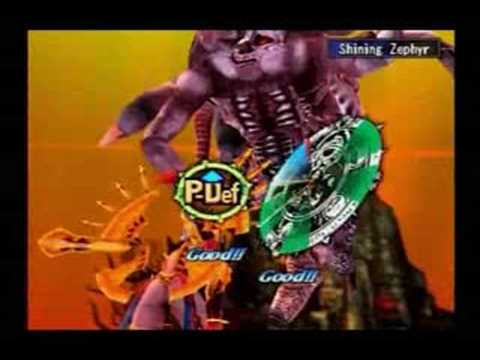
Legend states that King Solomon used a ring engraved with the Star of David to capture and enslave 72 demons. A book known as Goetia, The Lesser Key of Solomon, or sometimes Lemegeton, supposedly authored by Solomon himself, lists off all these demons, describes them, and shows the crests used to call them into service. Not only does Covenant base its magic system off this legend, sending the player across the world to find these demons and equip them, but when you summon them in-battle, the actual crest from the book appears on the battlefield. So just a warning, while I recommend this game, you may run the risk of actually calling monsters out of your television.

Yuri (as Amon) and Karin in homage to the box art to the original game

Yuri (as Amon) and Karin in homage to the box art to the original game

Now that I’ve issued my disclaimer, I can get on with describing the game…except I don’t really have much to say that differs from my articles on the original Shadow Hearts or From the New World.

The game follows Yuri Hyuga once again, continuing from the bad ending of the first game.  The Vatican sends Nikolai Conrad, who has a personal beef with Yuri for beating Albert Simon before he had the chance, to curse him.  Attacked with the “holy mistletoe” curse, Yuri loses all weapons, items, and fusion demons from the last game, as well as the ability to get any action from the game’s double-D female lead (which, not to ruin the game for you, probably works out in Yuri’s favor.)–probably the games greatest irony considering mistletoe’s reputation for inspiring sexual hedonism akin to playing Twister.  Once thusly cursed, Yuri and Company set off on a crusade to take down the secret society responsible for making the Vatican look like Dick Cheney’s personal assassination squad. Along the way he rediscovers demons and, you know, just might learn a little something about himself.

Like the original, Covenant emphasizes character development over action and plot. Unfortunately, players despise quick-time events that ask them to “press X to not die,” so I don’t think they’d readily accept “press X to introspectively examine your purpose in life after the death of your lover.” On the positive side, Nautilus did not actually include these events in the game, instead favoring flimsy excuses for geographical movement into a series of irrelevant dungeons.

Torture scenes exist in all three main series games...but only here do you get a BDSM dominatrix along with the pain.

Torture scenes exist in all three main series games…but only here do you get a BDSM dominatrix along with the pain.

And while the story masterfully outlines Yuri’s development, I wouldn’t go so far to say that each character adds something vital to the story.  Much like the dungeons, it feels like the guys at Nautilus sat around trying to think up caricatures to round out a battle party.  “We can’t get through the game with only two characters!” someone said. “Let’s throw in a super-hero….pro wrestling…vampire,” offered a staff writer, who probably just flipped through the nearest copy of Game Informer until he found three successful titles. Granted, when given the option of using a super-hero pro-wrestling vampire, few players will resist the call.  Shadow Hearts has always designed their characters people want to use in battle.

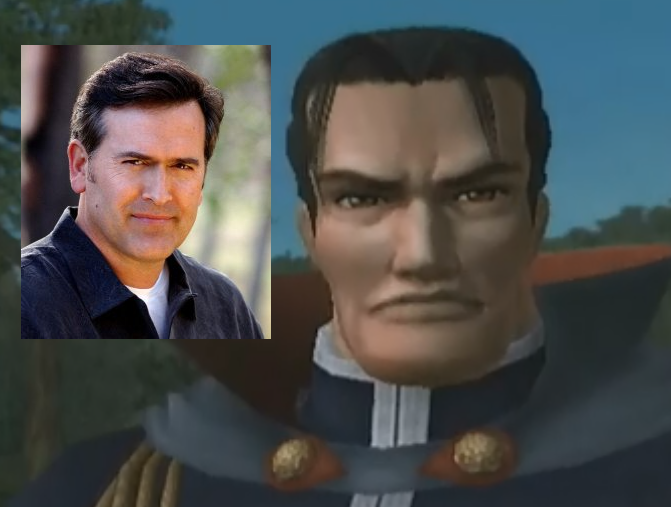
But hey, if you do one thing well, just do it ad nauseum, right? The game uses the alternate history genre to present a parade of cameos. Characters from the first game make appearances, including Kato, Albert Simon, Roger Bacon, Alice, Keith and Margarete–as well as historical figures like Lawrence of Arabia, the Great Gama, Gregori Rasputin…and Margarete.  Also, Kato looks more than a little bit like Bruce Campbell, so that should count for something, I think.

Summoning demons with a book, resurrected girlfriend, and chins bigger than China...coincidence?

Summoning demons with a book, resurrected girlfriend, and chins bigger than China…coincidence?

However, the carnival of characters and the dismissive plot tend to retcon parts of the game’s universe. Apparently, Albert Simon only wanted to destroy the world in the first game because he needed more power to fight one of the major villains in this game. I’d need a good long time with the latest edition of the DSM to count the psychological disorders required to make that logic work. Apparently Yuri only needed to sit down with him and have a chat about the problems of overkill to solve the conflict in SH1.  Whether he does or not, the change in motives takes the fangs out of previously enjoyable villainy.

Covenant improves on mechanics developed for the original.  Players have options for customizing the judgement ring, as well as equipping an item that slows it down to a reasonable speed.  In the first game, the ring fixed the traditional RPG mechanic of finishing battles by hitting X repeatedly–by making you hit X four times as often and at very precise moments.  Covenant offers their characters a reasonable amount of MP, making magic and special techniques a valid option. The game clearly had influences–if you ran a drug test, its urine would contain more than trace amounts of Final Fantasy–but in Covenant, it developed enough of its own flair to stand on its own…which of course made it branch off into obscurity, eventually leading to the cancellation of Shadow Hearts 4 and the downfall of the series, despite attaining a quality and ease of playability that other RPGs would envy.

Yes, the dog is sidling to avoid being seen.

Yes, the dog is sidling to avoid being seen.

Covenant exists to impress. This game introduced me to the series, and still stands as its strongest game.  A rare occurrence of RPG direct sequelage, it manages to inform the player of all relevant plot points from the first game in less than three cut scenes, seemingly animated by Yuri’s own hand-drawings of the events.  These scenes also illustrate the otherwise dark, gothic game’s aloof sense of humor, although the gay-sex-between-athletes innuendo remains a reward for the fervent side quester.

And on a final note, Shadow Hearts does side quests better than any any other game I’ve played.  If you’ve ever played an RPG, you’ve probably gone through dozens of quests for ultimate weapons, magic, or skills, only to find yourself at the end of the game with literally nothing left to use them for except the final boss who at that points fights back with all the rage and fury of a plastic cup filled with pudding.  Covenant, however, offers multiple side quests for every character, most of which include full-length dungeons and bosses.  Yes, eventually you’ll run out of options and have no choice but to end the game, but by then the game feels satisfying, if not just a little too easy.

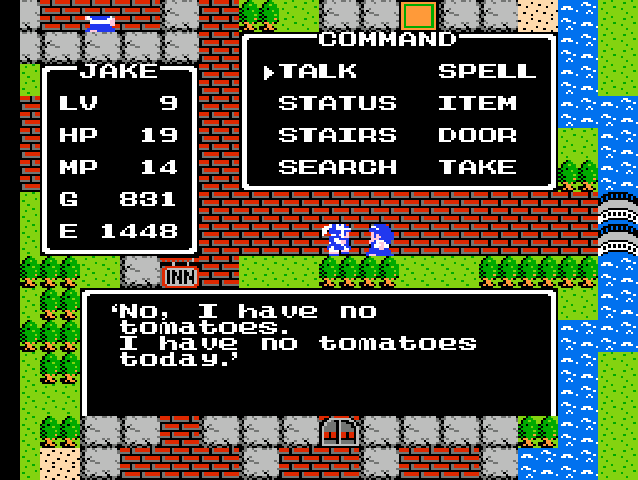
So I should probably throw this in before wrapping this up: Solomon didn’t write the book.  Unless he knew German. And worshiped Jesus…thousands of years before his birth.  But as an element of the real world–as well as all the other real-world elements in Covenant–it immerses the player into the fantasy, and it does it well.  Well enough, obviously, to get me to play an entire series over the course of two months.  Although I don’t rate games, I feel this particular game merits some sort of quantitative praise, so I will bestow upon it my highest ranking: 10 stars out of two thumbs up multiplied by 100 tomatoes.

Why play the game? Here are two big reasons.

Why play the game? Here are two big reasons.

Sorry for the delays in updating. I’ll target some shorter games over the next few weeks to make up for it. Thanks for reading!

Shadow Hearts – PS2

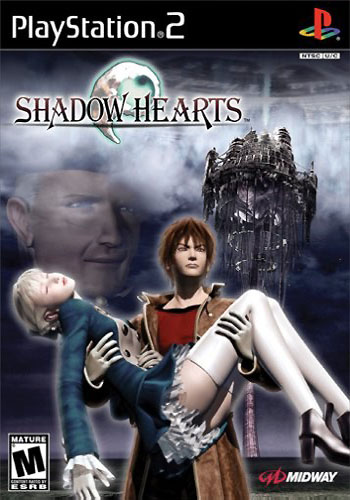
Shadow Hearts holds the distinction of having the most kick-ass box art of all time.

Shadow Hearts holds the distinction of having the most kick-ass box art of all time.

Hehehe.  Let’s talk writing for a bit.  Hehehe.  Villains have made derisive laughter an art form. People love it.  I used to practice my evil laughter as a kid.  Hehehe. It even merited an Austin Powers gag. Hehehe.  Used correctly, it can create an air of menace by painting a game’s enemy as powerful and confident, a daunting task for the hero. Used incorrectly, it gives the impression that he may wander off in the middle of the battle looking for something to eat.

And sadly, Shadow Hearts leans in the direction of the latter, with villains and heroes alike floundering in the aftermath of a dentist-office gas explosion.  While I love the series, I can’t help but admit the flaws in the writing.

The first game in the Koudelka universe branded with the series’ title, Shadow Hearts introduces Yuri, the harmonixing youth with a heart of gold and a soul full of filthy, horrible monsters.  Hearing a voice in his head telling him to rescue Alice, the damsel in distress, from the Japanese Army who hold her prisoner on a train bound for Shanghai.  Finding the Japense soldiers dead, Yuri squares off against an English gentleman who goes by the name of Bacon, a moniker that, when shouted in a spirit of anger and vengeance, equates the game’s antagonist with clogged veins and heart disease.  After receiving a thorough trouncing, Yuri summons the strength to leap into the stratosphere while carrying Alice (because in video games, injuring people only makes them stronger) and the two land in the first of many episodic, horror-themed, RPG adventures.

I’ll spare the details of the rest of the plot because they simply don’t matter.  For a story with so many things going for it, the actual action of the story could have coalesced from the flotsam of sunken B-horror films. They don’t fit together well, but the game wants us to focus on them, even going so far as to devote major cut scenes to ghost-story backgrounds for minor bosses. At one point, Yuri and Alice stumble onto a village terrorized by a ghost who kills a new victim each night.  When the elder tells them about the ghost, she really hams it up.  Real people supposedly have died, and this monster has put Alice under the fatal curse, and this woman squeezes out onomatopoeia that would make five-year-old girls giggle.

Kinky! The second of four games, the female lead has gone up to about a B-cup. Future games will push those boundaries.

Kinky! The second of four games, the female lead has gone up to about a B-cup. Future games will push those boundaries.

But you don’t play Shadow Hearts for the plot, you play it for the premise.  Oddly enough, the character development and relationship between Yuri and Alice carry the story.  As a harmonixer, Yuri fuses with monsters to gain strength in battle, but the demons possessing him take their toll on his soul. The battle system furthers this aspect of the story; characters have sanity points they must maintain, and every time Yuri transforms, his sanity points drop drastically. Running out of points drives characters into a berserk state where they can’t distinguish friend from foe, and it counts towards a K.O., depriving them of exp at the end of battle.

In what I consider a fascinating treatment of a hero (even an anti-hero), Yuri can’t withstand the effect this has on him.  He succumbs to insanity and destroys Shanghai.  Later, after she brought him back to his senses, Alice tries to save Yuri’s soul by offering her own to the god of death.

Er…spoilers…

Torture...mini skirts...peg leg...there's so much going on in this scene I can't withstand the power.

Torture…mini skirts…peg leg…there’s so much going on in this scene I can’t withstand the power.

And in that aspect, one of my major beefs with the series emerges, because Alice’s fate changes depending on which ending you get, and while the player can work through some interesting challenges to get the good ending, the easy ending to achieve actually feels more satisfying.  Yuri struggles for peace in his soul during the whole game, and he owes much of that peace to his relationship with Alice.  The fact that his peace requires her death provides a darkly poetic irony to conclude the story, and also to propel him into a frustrated angst that moves him to action in the sequel.

On a technical aspect, the game doesn’t vary too much from its successors, Covenant and From the New World.  The judgement ring still stands between you and nearly every action you perform, including magic, physical attacks, items, and interacting with the non-combat environment.  While I’ve previously praised this idea (somewhat) for making the game more engaging, I sometimes feel that it doesn’t always make sense; I would think the whims of fate have very little to say in whether or not you can pick up kettle from a table.  That more often falls under the whims of degenerative neuromuscular disorders, which don’t seem to bother Yuri most of the time.

One staple of modern RPGs becomes extra annoying in this game; the three-character party.  Too many games feature multiple characters as a selling point, only to limit you to a three-member team.  Furthermore, they generally require you to stick with whatever twat they’ve decided to make protagonist (I’m looking at you, Legend of Dragoon!), which pretty much limits you to two characters.  Now, while I’d play with Yuri more often than other characters, I still enjoy all the others–in fact, Shadow Hearts has made a name for itself by introducing bizarre characters in every game, so I hate cutting anyone from the team.  Furthermore, I grew very fond of Zhuzhen, the Chinese wizard, but halfway through the game, the new characters eclipsed his power in a way that made him obsolete.  I liked the ol’ coot, and for some reason they paired up Yuri with a new old-guy friend in Covenant, so he sadly drops out of the story.  Margarete, the “alluring female spy” also intrigues me–mostly because if you google her name, pages about Mata Hari pop up.  Sadly, Mata Hari dies during World War I, so I guess they had a reason for keeping her out of the sequel.

First of many appearances by the judgement ring

First of many appearances by the judgement ring

The game has math issues as well. The bonus for hitting the judgement ring in the strike zone adds only a small boost to attacks, noticeable only at mid-game levels and not effective until end-game levels.  Every enemy has one of six different elemental affiliations, but using opposing-element attacks has all the effect as mounting a spatula to the end of a bayonet. Support spells grant similar half-hearted measures, akin to increasing your defensive capabilities with a fine, state-of-the-art sheet of newsprint, or increasing your speed by thinking about a Roadrunner cartoon you saw as a kid. Halfway through the game I realized I could take off all stat-increasing equipment and replace them with accessories that grant status immunity and still suffer no noticeable loss in power or defense.

The unwelcome house-guests of the soul take inspiration (mostly) from the suits of a tarot card deck.

The unwelcome house-guests of the soul take inspiration (mostly) from the suits of a tarot card deck.

Fortunately, the game knows it failed miserably, as evident by the fact that the sequels fix all of the complaints I just raised here.  Elements and status attacks have a noticeable impact in Covenant and FTNW, equipment offers helpful bonuses, and parties consist of four members.  Furthermore, the game recognizes that just because characters don’t enter battle, they also don’t vanish entirely, and the subsequent games let you switch out the main characters when you don’t feel like using them.  I always thought the convention of peek-a-boo style party forming didn’t make sense.  At one point during Shadow Hearts, in his quest for the ultimate weapon, one of my characters had to fight his brother one-on-one.  Unfortunately, little bro KO-ed my fighter, and even though five other playable characters witnessed this event and still had full control of their senses and perfect health, I found myself staring down the business end of a Game Over screen.

Maybe it wouldn’t bother me as much if I hadn’t saved over an hour earlier…

Sorry for the infrequent posting, but school demands more attention. I’ve been on a Shadow Hearts kick lately, so expect a review of Covenant next. Afterwards, Anne wants me to play The Last Story for Wii, and I’d like to go to a Sega or SNES RPG, so that should be interesting. Don’t touch that dial.

Shadow Hearts: From the New World – Playstation 2

Shadow.Hearts.full.787296
Playing video games regularly for over twenty years, I’ve absorbed them into my identity, and constructed an elaborate vision of the afterlife based on them.  Once I die, I’ll unlock the New Game + option and restart my life from birth with all the possessions and experience from my first life.  Using this advantage, I can explore the world in more detail and test out the alternatives to decisions I made the first time through.  Eventually, by discovering every available potential story line, I’ll unlock the “Good Ending.”

Think Buddhism, but without the discipline or commitment.

Still, this scenario relies heavily on the assumption that the “Bad Ending” comes more easily and that I actually desire the “Good Ending.”  Unfortunately, the Shadow Hearts series routinely flouts this concept, rewarding players for overcoming enticing challenges with good endings written with the appeal of an off-Broadway musical version of Twilight.  So I have to decide between extending my stay in a game with a colorfully dark atmosphere and impossibly well-conceived side quests or walking away from a deep contemplation of malice and monstrosity in the human soul with a positive, bubbly, can-do attitude toward the world.

Let me rewind, though, and start from the beginning–of the third game.  Shadow Hearts: From the New World rounds out the trilogy of games about a man with demons fused into his heart searching for love, acceptance and purpose in a Europe and Asia torn apart by the malice preceding World War I by creating an epilogue starring none of the same characters, demons, or setting as the first two games and taking place well over a decade after they ended.  But in spite of the awkward continuity break, the game actually turned out pretty good.

Quack, quack, quack!

Quack, quack, quack!

Nautilus has played with combining the irreverent with the dark, and by this game they managed to construct a world of Lovecraftian horrors that will leave you rolling in the aisles.  You play as Johnny Garland, sixteen-year-old boy detective and the least interesting character in the entire Shadow Hearts series.  As the game opens, the creepy Professor Gilbert, on sabbatical from his quest to become the kingpin gangster in Gotham City, hires Johnny to track down a missing person.  Unfortunately, his career in investigation comes to a dramatic end when a monster materializes and eats the guy he’s tracking.  But to prove the adage that every time God shuts a door, he opens a peep show, Shania, an Aryan Native American with breasts the size of all three pair owned by protagonists of the two previous Shadow Hearts games and Koudelka put together.

Seriously...I'd play it just for this guy.

Seriously…I’d play it just for this guy.

Now you may remember me praising Samus Aran for contributing her femininity to a story that doesn’t ask for or need her gender in the least.  Considering my stance there, I’d come off as incredibly hypocritical and misogynistic if I confessed to favoring Shania because I enjoyed watching her.  Well, yeah, she has the anatomical proportionals a Barbie Doll and kind of gives off the vibe that no one can focus a story around a Native American unless their standing ovation happens in the players’ pants, but to that I say one thing: Frank Goldfinger.  Very shortly after Shania joins your party, you encounter the middle-aged Frank hiding behind a cloth sheet as three monsters pound the snot out of him.  When he emerges bragging about how neither Johnny nor the monsters ever saw him, he claims to have studied the Brazilian Ninja Arts in order to protect the United States.  At that point, the game’s message rings through like an air raid siren in a library; don’t interpret anything seriously.  The irreverent, nonsensical characters count among the games strongest features.  If you partake in a certain side quest, you even realize that each one supposedly embodies one of the seven deadly sins, a very interesting bit of symbolism until you realize that Gilligan’s Island actually pulled it off much better.

Yeah, it LOOKS easy...

Yeah, it LOOKS easy…

Like previous instalments of the series, combat revolves around the Judgement Ring, a spinning dial that asks the player to activate it at very specific points in order to determine the success and effectiveness of attacks and spells.  While many RPGs suffer from excessively repetitive combat that often forces you to just hit “X” over and over until the battles end, the Judgement Ring offers a more engaging system that asks you to hit “X” more often and at very specific times than those games.  Oddly enough, it works. It encourages players to aim for minuscule strike zones to buff up their power, which increases the chances of missing altogether and screwing up the attack.  For a mechanic intended to represent the unpredictable whims of fate, it creates a sense of control over the battle that few other games can rival.

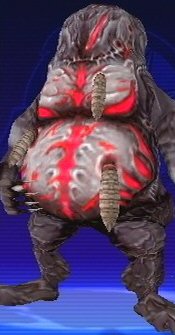
In addition to the characters and the combat system, the game design and atmosphere make the game worth playing.  I enjoy the works of H.P. Lovecraft, but holy hackney Batman, his stories sound like he threw the Oxford English Dictionary into a garbage disposal and dumped it onto a page covered in glue.  So what I really mean when I say I enjoy Lovecraft is that I enjoy Shadow Hearts and appreciate his influence on them.  Nautilus painted a dark world with vibrant colors.  The unorthodox monster design offers something more grotesque than the standard vampire, werewolf, zombie, or other human- and animal-based design.  I’d pay $50 for a Shadow Hearts 4 just for the artwork.

Shftnw_mon_038

Well, mostly non-humanoid

Well, mostly non-humanoid

Like the monsters, the game itself gives us something refreshingly unorthodox.  Most RPG developers work within the fantasy genre, with sci-fi as their backup.  The real-world, alternate-history setting of this series, and I understand the New World setting for all I mock it.  It didn’t make sense at the end of Covenant to continue with Yuri’s story, while the Americas provide an untapped source of history and landmarks to work with.  It provides enough background to qualify for the series; the judgement ring, lottery games, a wacky vampire from the Valentine family, Roger Bacon and his porn addiction, and the emigre manuscript.  While the plot doesn’t wow me with complexity, they use events and ideas from previous games to prevent the story from falling into formula.  The plot of From the New World springs primarily from Nikolai Conrad’s release of Malice in Covenant, along with the running theme that no one has ever successfully resurrected the dead using the emigre manuscript.

While many found it a weak follow-up to the games starring Yuri Hyuga, and the game itself didn’t make enough money to ensure continuation of the series, the game doesn’t disappoint.  This forgotten/hidden gem perfects the judgement ring combat system and adds an entertaining complexity to the magic system and combo attacks.  Also, I bought the soundtrack for this game (and for Covenant) because it created such a perfect mood.  Bottom line: don’t play From the New World expecting a strong story or a familiar protagonist (although enough characters make cameos to keep it entertaining); play the game because Nautilus perfected their art and won’t likely make any more instalments of a great, atmospheric series. And breasts. Large, but not quite comically large breasts.
shadownewworld393

Koudelka – PS1

Many Victorian women preferred to wear bondage corsets as tops.

Many Victorian women preferred to wear bondage corsets as tops.

When Hiroki Kikuta, composer for Secret of Mana, left Square to found his own game company, he wanted to produce something fast-paced, exciting and dark, citing Resident Evil as his inspiration.  The developers working for him at Sacnoth, however, wanted something more like Final Fantasy and other games being released by Squaresoft.  I enjoy cross-genre works.  They take bits of the familiar and twist it into something fun and new.  Sacnoth’s 1999 release, Koudelka, takes the best of both worlds, combining the fast, exciting combat of Resident Evil with a well-written, progressive storyline like an RPG.

Just kidding! It’s actually all the backtracking and item hunting of a survival horror game with the repetitive random-enemy encounters of an RPG! Congratulations to Sacnoth for totally missing the point of playing either of those genres.

The story opens in 1889 when a voice calls a young Gypsy girl, Koudelka, to the Nemeton Monastery in Wales.  Equipped with nothing but her traditional Victorian-Era hot pants, bondage corset, and a personality that would strip the skin off a crocodile and rust off a Buick, she climbs the wall into a Medieval torture dungeon full of fresh corpses and stale plot premises.

I punched a chair!

I punched a chair!

From the point where she meets up with the game’s two companions, the story kind of flows freely, like a soda that Sacnoth spilled in a lake and then tried to put it all back in the bottle.  The characters seem to want to investigate the bulk supply of mangled corpses stocked in the monastery, but kind of lose interest when the ghost of a little girl dumps them into a hole, and that plot kind of peters out in favor of a mystery surrounding the back story of one of the games lesser noticeable characters, who literally dies in the second scene he appears in, at which point the game drops even that plot.  Eventually, it settles on something somewhat interesting; as it turns out, a priest tried to resurrect his wife, who happens to be the former love interest of one of the playable characters.  However, messing with dark magics never ends well, something went horribly wrong, yada yada, and now we have to fight her soulless body.

Fin.

This guy! Dark...

This guy! Neat.

In a game that clearly attempts to build a Lovecraftian atmosphere, that part of the story rouses interest.  Still, the story stands on a foundation of apple sauce, jello, and the hopes and dreams of lousy game designers, and it falls somewhat flat.

Really? You can't figure this one out?

Really? You can’t figure this one out?

The semi-strategical combat system attempts for something interesting, but doesn’t work right.  The player can move characters around on a grid like most tactics games, but every battlefield consists of a flat, featureless floor.  Only one battle bothered to include any obstacles, and due to a weird quirk where the game refuses to let you step past the entire line containing the foremost enemy, it ended up looking like a bunch of people who couldn’t navigate themselves around an inanimate wooden box.  Furthermore, considering the small size of the battlefield, large move capabilities of the characters, and lack of limits on ranged and magic attacks, it ends up amounting to a system almost exactly like the SNES Final Fantasy games where players and enemies line up and face each other like colonial armies.  Actions in battle consist only of standard attacks, moving, and casting a handful of spells–four attack, two healing, and a smattering of support–that might level up by the end of the game if you cast them enough. The game lacks money and shops, so all items and equipment come from either picking up randomly placed items that blend in with the environment, or from random creature drops.  As a player, one strategy fits all, and with very few options to choose from, most battles in Koudelka–which, I remind you, calls itself a strategy game–end up playing out exactly the same as every other battle.

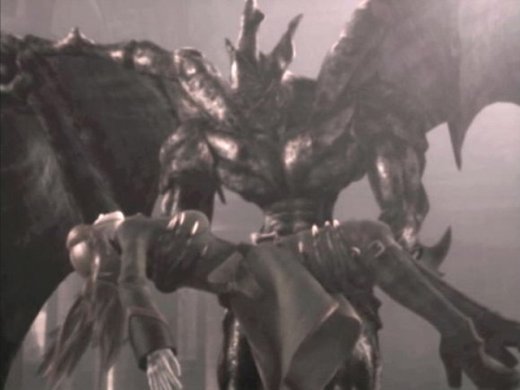
Roger Bacon

Roger Motherfuckin’ Bacon

Koudelka stands as a shining example of how unlike in Hollywood, games sequels can succeed even when the original holds itself up to standards I wouldn’t accept from a kindergarten school play.  Sacnoth apparently understood that the only interesting things about this game were the magic spell used to resurrect the dead and the creepy old monk, Roger Bacon, who wanders around the monastery like a madman.  They went on to develop a little-known but excellent series called Shadow Hearts, recycling very little from the Koudelka universe other than those things.

This might look neat...if it weren't made of polygons.

This might look neat…if it weren’t made of polygons.

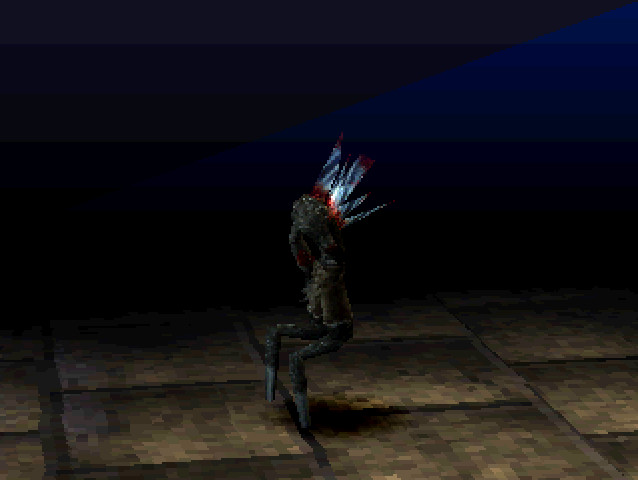
Still, I won’t say I hated Koudelka or that I had trouble rousing up interest in it.  It just feels like they needed to screw up before they figured out what would work in subsequent games.  I can tell they put some work into the Lovecraftian monster design, but on the rendered polygons of the PS1 they intimidated me about as much as a Lego Cthulu.  And while themes of dark magics and forbidden knowledge work well in Shadow Hearts, Koudelka had all the consistency of a story narrated by Leonard from Memento.

As I’ve mentioned before, I have a tendency to like games even when they don’t deserve it.  For the most part, I feel that way about Koudelka.  As a long-time fan of Shadow Hearts, I still consider this a must-play for series completionists.  Still, I’m not likely to  come back to it any time soon.

Shining Force – Sega Genesis, Game Boy Advance

When you wish upon a copyright infringement lawsuit...

When you wish upon a copyright infringement lawsuit…

Let’s have a quick word about how to increase endgame difficulty.  You want the game to feel more challenging near the end.  That way it works toward a climax, following a natural plot arc.  Some games do this better than others.  For instance, some bosses fight with status attacks.  Others will introduce bosses as random enemy encounters.  Valkyrie Profile II demanded I use the level 64 character they introduce for the final battle when even the easy enemies can vaporize all my level 90 characters like a meteor entering the earth’s atmosphere. Still, most games will bump up the level or stats of endgame enemies to give them a slight edge over the player.

However, raising the enemies’ evade rates doesn’t accomplish this as much as the Shining Force developers seemed to think it did.  Watching characters swipe the air like an epileptic in a dance club feels less exciting than, say, going outside and slashing bushes with foam pool noodles or watering your lawn with a water pistol.  This contributes to slowing the pace of a tactics game in which most battles start with bottlenecking your characters or putting them so far from the enemies that, if they worked together, they could measure the speed of light.

...have we met?

…have we met?

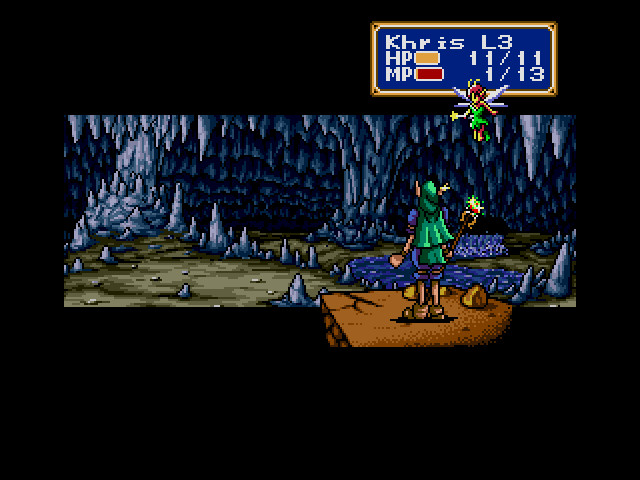
Not that they would do that, mind you, because like many mill-ground fantasy stories, Shining Force weighs itself down with themes like “Light is good” and “Dark is bad.”  The game opens with the formulaic war-between-two-countries-with-a-supernatural-threat-looming-vaguely-on-the-horizon.  The rival military general shows up looking like he dumped a life-size Wooly Willy set over his head and kills the king.  On his deathbed, the King gives you the order to form the Shining Force and defeat the darkness.  Light good.  Dark bad.  The enemy leader calls himself Darksol and he plans to resurrect the ancient Dark Dragon (who is neither dark, nor a dragon).

Would I be asking too much for a well-written fantasy story that doesn’t draw morally unconflicted characters in a black-and-white scenario?  I thought about rewriting that last sentence to get around using the phrase “black-and-white.”  Why do we have to associate black and white with evil and good?  I don’t know about anyone else, but I find a bit of darkness rather pleasant when I’m trying to sleep, or sneak up on a ninja or get dressed in a room full of people.  A little more subtle conflict might make a more interesting story.  In fact, for most of the game I turned off the music (which didn’t prevent it from echoing in my head like The Master’s drums) and listened to a Jim Butcher audiobook in order to get a good fantasy story. The bulk of the plot just involves moving from one excuse to start a battle to the next.  In fact, at one point, after fighting a hoard of monsters outside of a town, the man at the gate casually remarks, “Sorry about that.  We thought you were someone else,” at which point I just tip my hat, wish him good morning, and waltz on by as though I’m not headed to a priest to resurrect my comrades murdered as a casualty of mistaken identity.

Shining Force-000001While it seems like they wrote the story in as much time as it took to look up a formula and transcribe it into the game, Shining Force does have strong points.  The game centers on battles–and when I say “centers,” it also rights, lefts, ups and downs on it too.  Don’t expect side quests or even random enemy encounters–all battles are programmed and static–but the strategy aspect makes up for the minimalist approach to this RPG.  I enjoyed FF Tactics more than many of Final Fantasy’s main-series installments, and Shining Force feels like a somewhat simplified version of Tactics.  Battles take place on a grid map, characters have different classes that affect their stats and the range of attacks, and while they can’t switch between them like FFT’s job system allowed, they can receive a “promotion” to a slightly better class once they reach level 10.

I can also praise the game for allowing the player to keep any exp they earned in battles they lost.  I can’t tell you how many times I’ve taken an unexpected turn for the worst, then realized “I haven’t saved in an hour!”  Those moments make me acutely aware that time only moves in one direction, and that I’ve wasted hours careening toward death in front of the TV with nothing to show for it.  Shining Force, however, lets you stay at your new level, making the next round a little easier.  Although they probably included this to let players level-up in a game with no random encounters, I’d appreciate seeing this feature more often in RPGs.

New menu box . . . every time. . . can't stand it...but at least inventory management isn't as bad as in Skyrim.

New menu box . . . every time. . . can’t stand it…but at least inventory management isn’t as bad as in Skyrim.

While I appreciate the fast pace after playing some interminably slow Zelda games, I do have a complaint about the menu system, in which the player flips through single options box-by-box, resurrecting characters one at a time, transferring single items from character to character, purchasing and equipping items one-by-one, and needing to open a new menu and flip through all the options each time.  With Final Fantasy V already on the shelves for a full year, you’d think some of the programmers would figure out, “Wow! RPG menus don’t have to be complete shit!”

Like Final Fantasy Tactics, characters level up upon completing actions in battle, which again I mostly support.  However it leads to a common problem of healers never leveling up because they don’t act as much as any of the other characters.  Another option to gain experience might help.  At least in FF Tactics I could bounce rocks off my comrades’ heads until I had enough MP and JP to learn support spells.  Shining Force doesn’t give even that much.  I went into the final battle without effective cure spells because my healer was less than half the level of some of my other characters.

But don’t let the flaws get in the way of enjoying the game.  I made it through in about a week and a half, never feeling like the pacing dropped much, and only encountering minor frustration at whiffle battling enemies with high evade rates.  I finished the game feeling I enjoyed it very much, and look forward to the sequel.  Which I won’t play right away. Maybe some shorter games first.

Until this point in the game, they called him "Kane"

Until this point in the game, they called him “Kane”

A few notes before I leave, Shining Force has also been published for the Game Boy Advance, although it has a new subtitle, “Rise of the Dark Dragon.”  While I didn’t play that version, word on the net says they improved the translation massively and may have resolved some of the plot vacancies I mentioned earlier.

Radiant Historia – NDS

Image

I’ve done it!  After thirty-six hours of gameplay and a handful of short games to stall for time, I’ve finished Radiant Historia for the NDS!

Years ago, as a result of being forced to read Melville, Dickens, Dumas, and other people desperately in need of an editor, much of my fantasy intake shifted from Tolkien, Dragonlance novels and Terry Brooks (or as I call him, “Diet Tolkien”) to RPGs.  I tell you this not because I’ve made a habit of starting my posts with boring personal stories, but to let you know ahead of time that I like a lot of games that probably don’t deserve it, mostly based on the story or the setting.

If you’ve ever read a fantasy novel or slogged through any fantasy RPG, you’ll find Radiant Historia comfortingly familiar as it follows the genre’s traditional format of taking ideas used elsewhere and slapping them together like the last few leftovers in its fridge; it’s never eaten them together before, but going to the store before dinner would take too much effort.  As a result, fantasy always gives us something new and exciting that may not always smell right or look right, but damn it, it’s new!
Image
The story opens with your standard issue ongoing-war-between-two-nations and has your run-of-the-mill vaguely-supernatural-force-working-behind-the-scenes.  The main villain wants to annihilate existence, a motivating force brought to absurdity in Final Fantasy, and most of the plot twists were dragged kicking and screaming right out of Star Wars.  Also, following the current trend of modern games, the characters look as though the artist took the Sumo Diet approach to design, where they put the pencil on the paper and didn’t stop drawing until their jaw got tired.

Special Intelligence operative, Stocke, receives a book from his superior along with instructions to rendezvous with an informant.  On his mission, a battle breaks out and he has to get to safety with his two comrades.  The game forces him to choose between the escape route on the left and one on the right.  He immediately picks one that leads to a brutal slaughter at the hands of the executioner for the enemy kingdom.  However, the book warps him into an M.C. Escher painting which gives him the option of replaying portions of his life.  Already knowing the wrong answer, Stocke takes the right path, his comrades survive, the kingdom repels the invasion, and the very fabric of space and time accidentally splits open into two separate histories.  Teo and Lippiti, two children who guard the gates of history, give him the quest to set history back on its intended course. Image

Honestly, I could think of a hundred more useful applications for time travel than “setting the course of history right,” many that make me wonder if naming the protagonist “Stocke” was entirely coincidental, and the rest of which had previously been suggested by Scott Evil, only to be shot down as inconsequential paradoxes.

While people may complain about cliches and hackneyed writing, I might remind you that no one actually wants an original story.  Tolkien himself just blended images from Norse myth, Arthurian legend, Shakespeare and an ungodly knowledge of European languages.  And don’t forget Terry Brooks, who drew from a list of sources all the way from Fellowship of the Ring to Return of the King.  So I find that area of the story highly forgivable.

But the aspect of multiple histories sets it apart from other stories in the genre.  Promotional material compares the game to Chrono Trigger because of the ability to travel through time, but that doesn’t tell us anything other than Atlus wanted to boost sales by comparing their game to one of the most popular RPGs ever released.  Time travel in Chrono Trigger extends outside of the characters’ lifetimes and manipulates events important to the world, much like Back to the Future (and while I’m on the subject, look up your dates people before posting those ‘this is the date that they went to’ on your Facebook or Pinterest page).  Radiant Historia more closely resembles Groundhog Day, in which the protagonist relives events on a personal timeline with the opportunity to rectify poor decisions he made earlier in the game.  The tutorial at the beginning explains that these choices will branch off into alternate histories.

I’d like to pause here because this idea spices up the game with a mechanic that shouldn’t really be as original as it comes off.  RPGs and video games in general spring up from the excitement a player gets over influencing the course of events; however, most often they have no more choice than whether they’ll win this battle or pursue a new career as electronic carrion.  The availability of alternate histories means that the story no longer carts the player from battle to battle; it actually becomes part of the process of playing. I would play more games if they worked this into their concept.

Unfortunately, Radiant Historia falls short of using this expertly.  You make one decision early in the game that splits the universe into two different histories, but nearly every choice you make afterwards has two possible outcomes: continue along the path of history, or die suddenly and miserably, at which point the game warps you back to a point so far back that you’ll have to warp forward just to make the correct decision to move forward with the game.  It gives you the option to skip cut scenes, but if you fought any battles between where you are and where you need to be, you just have to suffer through them.  For most of the game, I actually felt as though I were playing through a poorly constructed choose-your-own-adventure book.

While the game does include some novel uses for time travel, it feels like the developers discovered what they could do with it as they went along.  Early on, you fall into a noticeable groove of moving ahead until you needed a skill or item that could only be obtained in the alternate history, switching over to that time line, then repeating that process.  I didn’t find it incredibly difficult to figure out how to progress when they began to deviate from that process, but on one or two occasions I felt more like I was playing Pong than an RPG, warping back and forth, fighting the same battles over and over while trying to figure out at which specific point in time the game wanted me to swipe the tools lying out on a table in a room I visited at during at least five different game events.

An hour or so into the game, I began to notice that I hadn’t had the chance to fight yet.  The game opens with a long expanse of plot, after which you have the opportunity to swing your sword once or twice in a tutorial, only to return to another stretch of story.  While I enjoyed Xenosaga, I managed to tolerate the endless hours of expository babble inserted between game events, but on the NDS, the amount of backlit text I need to read makes me acutely aware that my eyeballs are slowly melting back into my head.  Furthermore, like most RPGs, dialog has a tendency to repeat itself, adding Radiant Historia to the list I mentioned earlier of people who desperately need editing.
Image
But when the combat did pick up, the battle system really showed some ingenuity.  The game places enemies in random locations on a 3 x 3 grid.  The characters, lining up in a style only seen in classic RPGs and firing squads, concentrate special attacks that push or pull the enemies into specific locations, giving them the chance to employ other attacks that target specific shapes or areas, or just allowing a single attack to hit multiple enemies at once.  Effective manipulation of this system results in combo, with longer chains giving you a higher combo level.  For higher combo levels, the game awards greater experience at the end of battles.  At first, I enjoyed this system.  It gives the player options.  All too commonly, RPG battles get repetitive and boring since for all the special attacks available, “Attack” usually ends up being the best option, so you can win most fights by holding down the “enter” button.  Radiant Historia, however, forces the player to use special attacks, and the random placement of enemies requires a different strategy for each battle.  Furthermore, for the cost of a slight drop in defense, any character can exchange turns with any ally or enemy to change the order of attacks.

ImageI enjoyed having such a complex, yet easy-to-use system, so it disturbed me quite a bit when I found out that the battles still felt repetitive.  It took me a while before I realized why: this game is incredibly easy!  After I learned how to effectively manipulate the system, I became more of a photographer than a medieval warrior, making slight adjustments to line up the enemies, make sure they didn’t close their eyes, and then snap the picture to end the fight.  In fact, only the final boss gave me any trouble at all, and mostly because he occupied all nine spots on the grid.  See, while the player has an arsenal of choices for finishing a battle, the enemies can’t do much except fight.  As Valkyrie Profile 2 taught me, allowing either the enemies or the player to do something that the other can’t tends to make the game as balanced as someone who blows up abortion clinics to show how pro-life they are.

Still, by the time combat turned into a bad date that I somehow couldn’t ditch at the restaurant, the story had arrived with the meal that gave me the excuse to ignore it.  I always enjoyed something about the game, which I understand doesn’t ring praises to high heaven about it, but Radiant Historia deserves attention at the very least for pioneering concepts I hope to see more often in the future.  Or, perhaps, they could go back in time and introduce them into past games instead.