Shadow Hearts – PS2

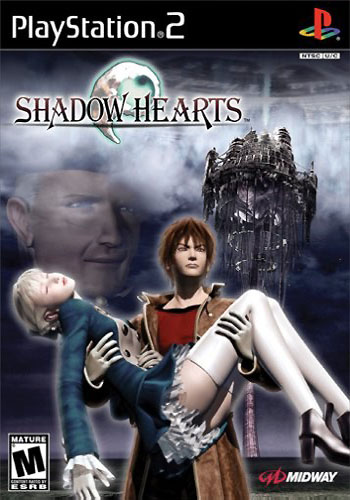
Shadow Hearts holds the distinction of having the most kick-ass box art of all time.

Shadow Hearts holds the distinction of having the most kick-ass box art of all time.

Hehehe.  Let’s talk writing for a bit.  Hehehe.  Villains have made derisive laughter an art form. People love it.  I used to practice my evil laughter as a kid.  Hehehe. It even merited an Austin Powers gag. Hehehe.  Used correctly, it can create an air of menace by painting a game’s enemy as powerful and confident, a daunting task for the hero. Used incorrectly, it gives the impression that he may wander off in the middle of the battle looking for something to eat.

And sadly, Shadow Hearts leans in the direction of the latter, with villains and heroes alike floundering in the aftermath of a dentist-office gas explosion.  While I love the series, I can’t help but admit the flaws in the writing.

The first game in the Koudelka universe branded with the series’ title, Shadow Hearts introduces Yuri, the harmonixing youth with a heart of gold and a soul full of filthy, horrible monsters.  Hearing a voice in his head telling him to rescue Alice, the damsel in distress, from the Japanese Army who hold her prisoner on a train bound for Shanghai.  Finding the Japense soldiers dead, Yuri squares off against an English gentleman who goes by the name of Bacon, a moniker that, when shouted in a spirit of anger and vengeance, equates the game’s antagonist with clogged veins and heart disease.  After receiving a thorough trouncing, Yuri summons the strength to leap into the stratosphere while carrying Alice (because in video games, injuring people only makes them stronger) and the two land in the first of many episodic, horror-themed, RPG adventures.

I’ll spare the details of the rest of the plot because they simply don’t matter.  For a story with so many things going for it, the actual action of the story could have coalesced from the flotsam of sunken B-horror films. They don’t fit together well, but the game wants us to focus on them, even going so far as to devote major cut scenes to ghost-story backgrounds for minor bosses. At one point, Yuri and Alice stumble onto a village terrorized by a ghost who kills a new victim each night.  When the elder tells them about the ghost, she really hams it up.  Real people supposedly have died, and this monster has put Alice under the fatal curse, and this woman squeezes out onomatopoeia that would make five-year-old girls giggle.

Kinky! The second of four games, the female lead has gone up to about a B-cup. Future games will push those boundaries.

Kinky! The second of four games, the female lead has gone up to about a B-cup. Future games will push those boundaries.

But you don’t play Shadow Hearts for the plot, you play it for the premise.  Oddly enough, the character development and relationship between Yuri and Alice carry the story.  As a harmonixer, Yuri fuses with monsters to gain strength in battle, but the demons possessing him take their toll on his soul. The battle system furthers this aspect of the story; characters have sanity points they must maintain, and every time Yuri transforms, his sanity points drop drastically. Running out of points drives characters into a berserk state where they can’t distinguish friend from foe, and it counts towards a K.O., depriving them of exp at the end of battle.

In what I consider a fascinating treatment of a hero (even an anti-hero), Yuri can’t withstand the effect this has on him.  He succumbs to insanity and destroys Shanghai.  Later, after she brought him back to his senses, Alice tries to save Yuri’s soul by offering her own to the god of death.

Er…spoilers…

Torture...mini skirts...peg leg...there's so much going on in this scene I can't withstand the power.

Torture…mini skirts…peg leg…there’s so much going on in this scene I can’t withstand the power.

And in that aspect, one of my major beefs with the series emerges, because Alice’s fate changes depending on which ending you get, and while the player can work through some interesting challenges to get the good ending, the easy ending to achieve actually feels more satisfying.  Yuri struggles for peace in his soul during the whole game, and he owes much of that peace to his relationship with Alice.  The fact that his peace requires her death provides a darkly poetic irony to conclude the story, and also to propel him into a frustrated angst that moves him to action in the sequel.

On a technical aspect, the game doesn’t vary too much from its successors, Covenant and From the New World.  The judgement ring still stands between you and nearly every action you perform, including magic, physical attacks, items, and interacting with the non-combat environment.  While I’ve previously praised this idea (somewhat) for making the game more engaging, I sometimes feel that it doesn’t always make sense; I would think the whims of fate have very little to say in whether or not you can pick up kettle from a table.  That more often falls under the whims of degenerative neuromuscular disorders, which don’t seem to bother Yuri most of the time.

One staple of modern RPGs becomes extra annoying in this game; the three-character party.  Too many games feature multiple characters as a selling point, only to limit you to a three-member team.  Furthermore, they generally require you to stick with whatever twat they’ve decided to make protagonist (I’m looking at you, Legend of Dragoon!), which pretty much limits you to two characters.  Now, while I’d play with Yuri more often than other characters, I still enjoy all the others–in fact, Shadow Hearts has made a name for itself by introducing bizarre characters in every game, so I hate cutting anyone from the team.  Furthermore, I grew very fond of Zhuzhen, the Chinese wizard, but halfway through the game, the new characters eclipsed his power in a way that made him obsolete.  I liked the ol’ coot, and for some reason they paired up Yuri with a new old-guy friend in Covenant, so he sadly drops out of the story.  Margarete, the “alluring female spy” also intrigues me–mostly because if you google her name, pages about Mata Hari pop up.  Sadly, Mata Hari dies during World War I, so I guess they had a reason for keeping her out of the sequel.

First of many appearances by the judgement ring

First of many appearances by the judgement ring

The game has math issues as well. The bonus for hitting the judgement ring in the strike zone adds only a small boost to attacks, noticeable only at mid-game levels and not effective until end-game levels.  Every enemy has one of six different elemental affiliations, but using opposing-element attacks has all the effect as mounting a spatula to the end of a bayonet. Support spells grant similar half-hearted measures, akin to increasing your defensive capabilities with a fine, state-of-the-art sheet of newsprint, or increasing your speed by thinking about a Roadrunner cartoon you saw as a kid. Halfway through the game I realized I could take off all stat-increasing equipment and replace them with accessories that grant status immunity and still suffer no noticeable loss in power or defense.

The unwelcome house-guests of the soul take inspiration (mostly) from the suits of a tarot card deck.

The unwelcome house-guests of the soul take inspiration (mostly) from the suits of a tarot card deck.

Fortunately, the game knows it failed miserably, as evident by the fact that the sequels fix all of the complaints I just raised here.  Elements and status attacks have a noticeable impact in Covenant and FTNW, equipment offers helpful bonuses, and parties consist of four members.  Furthermore, the game recognizes that just because characters don’t enter battle, they also don’t vanish entirely, and the subsequent games let you switch out the main characters when you don’t feel like using them.  I always thought the convention of peek-a-boo style party forming didn’t make sense.  At one point during Shadow Hearts, in his quest for the ultimate weapon, one of my characters had to fight his brother one-on-one.  Unfortunately, little bro KO-ed my fighter, and even though five other playable characters witnessed this event and still had full control of their senses and perfect health, I found myself staring down the business end of a Game Over screen.

Maybe it wouldn’t bother me as much if I hadn’t saved over an hour earlier…

Sorry for the infrequent posting, but school demands more attention. I’ve been on a Shadow Hearts kick lately, so expect a review of Covenant next. Afterwards, Anne wants me to play The Last Story for Wii, and I’d like to go to a Sega or SNES RPG, so that should be interesting. Don’t touch that dial.

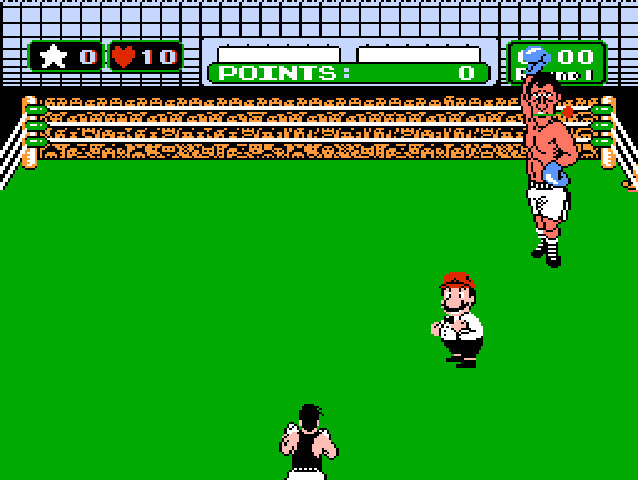
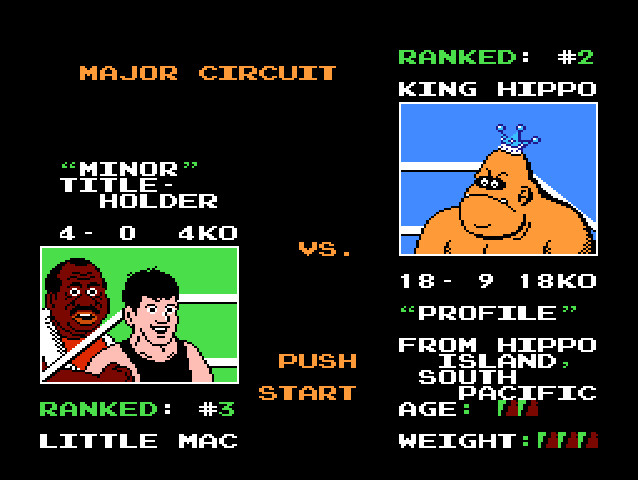
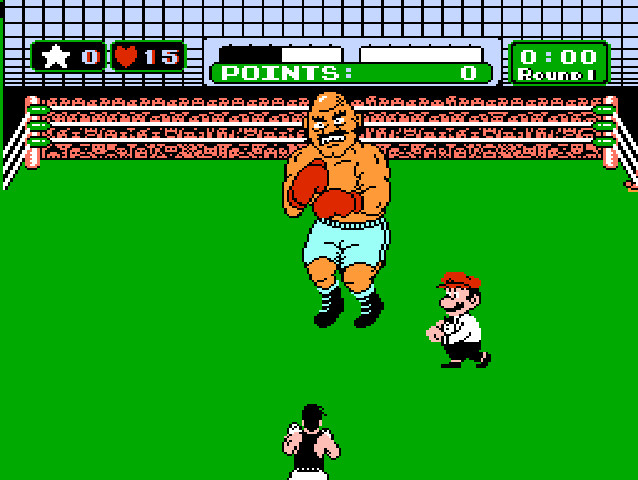
Mike Tyson’s Punch-Out – NES

11 Seconds and not dead. A personal best.

11 Seconds and not dead. A personal best.

This week, my Intro to College students turned in a paper on racial assumptions, proving that after drawing specific attention to a problem, a small minority of people will run to the nearest construction site and jam their head into the wet cement just for the extra layer of thickness it provides them. The pride they take in sticking to even the most backwards, offensive beliefs inspired me to write about my own favorite piece of unintentional racism: Mike Tyson’s Punch-Out.

A rose in his teeth. Because he's from Spain, see?

A rose in his teeth. Because he’s from Spain, see?

Now, when I say “unintentional racism,” understand that I may exaggerate that somewhat.  Sure, we can attribute the Spanish guy’s flamenco dance to a cultural flavor. And when the Indian fighter warps in and out of the ring like a fakir, I can even chalk that up to an accidental stereotype put in the game by people who probably don’t believe that all Indians charms snakes and breathe fire.  However, the French boxer goes down without a fight.  The French guy. Someone had to have thought that one through.  But hey, props for having the foresight to change the name “Vodka Drunkenski” to “Soda Popinski.”

Pseudo-Japanese Gibberish at its finest.

Pseudo-Japanese Gibberish at its finest.

But I can more effectively fight racism by ridiculing it than raging against it, so I can’t help but laugh at Punch-Out’s lack of political correctness.  So while I can enjoy its horribly offensive racial overtones, I can also admit that I actually really enjoy the game.  This NES remake of the 1984 arcade game tells the story of Little Mac (a pun on McDonald’s “Big Mac” and the fact that the character appears much smaller than his opponents due to the system’s graphical limitations) as he battles his way through the world of championship boxing.  Standing in his way, a host of caricatures riddled with tics, tells, and glaring debilitations gather from around the globe to brutally abuse a guy less than half their size.  Real-life boxer Mike Tyson appears as the final bout and major publicity stunt of the game.

Tyson graced the 8-bit ring for three years before his contract expired and Nintendo replaced him with the fictional “Mr. Dream.”  Unfortunately, while his name successfully sold this game to the public, his likeness takes the championship belt in the boring-personality division.  The rest of the game feels like playing through a cartoon (one of those old, 1930s cartoons that embarrass their creators so much that no one shows them on TV anymore).  Introducing a real-life figure just toned back the game for its final fight.

If you've ever played the game, this should offer some catharsis.

If you’ve ever played the game, this should offer some catharsis.

Now stop and think about what that means. Mike fricken’ Tyson made the game less absurd.  If you don’t understand how ridiculous that sounds, flip over to Wikipedia and read just the introduction for Tyson’s page.  Remember when he bit off Evander Holyfield’s ear?  The guy lost a boxing match for being too violent.  And if that doesn’t do it for you, go to youtube and look for a clip of him speaking.  The man practically sweats colored ink.  Still, in 1987 he hadn’t yet done any of the things that made him infamous (well…except speaking like a drawstring doll), so I guess I can forgive his lack of personality compared to the Convention of Racial Misunderstandings.

Nevertheless, I still rank him very high on the list of most challenging boss fights in any video game.   And yes, the NES-era difficulty surfaces in yet another one of my reviews. More on that later.

You might ask by this point, “Jake, why would someone like yourself, with an athletic aptitude to rival Stephen Hawking, want to play a game about boxing?” Easy; for the same reason I want to operate on tumor-ridden patients in Trauma Center.

To everyone of Pacific Island heritage...I'm sorry.

To everyone of Pacific Island heritage…I’m sorry.

It wouldn’t exactly take a call to your psychic friend’s network to realize that this year’s Madden, Fifa, MLB, and NBA games will wind up sitting in Gamestop next year at this time, not selling at an understandably exorbitant price of $0.99.  Sports games sell well, but don’t last.  They’ll never last as long as people can go outside and actually play the sport.  The games feed off the excitement of real-life changes to rosters reflected electronically, but the people who play them rarely feel possessed to archive their old games for scholarly research.

Not nearly as bad as his role in "Captain N: The Gamemaster"

Not nearly as bad as his role in “Captain N: The Gamemaster”

Punch-Out, on the other hand, only displays the skin of a sport game.  When you examine the gameplay mechanics, it actually forces the player to solve puzzles.  Each opponent has a handful of attacks, each with one or two weaknesses to exploit.  Discovering the trick to counterattacking takes repetition and thought, while actual sports rely on speed and perseverance.  You can’t beat a single one of these boxers with luck or button-mashing.  Repeatedly tackling fight after fight forces the player to try new combos, but with the simple moves available–left and right punches either low or high, dodge, and a special attack only available after pulling off a special combo move that the developers arbitrarily chose as worth awarding a star–it doesn’t take too long to figure these out.

The NES-era difficulty does detract from the game slightly. Most opponents have some sort of barrage attack they’ll eventually whip out like a flasher’s penis, and much like the case of the flasher it begins frantic attempt to get away and the shocking realization that I can’t dodge fast enough to save my ass.  Little Mac doesn’t have the freshly-loaded-vending-machine play control that made NES hero Simon Belmont so famous, but I feel that somewhere along the line, someone should have sat down with him, pointed out his diminished reaction time and tendency to move immediately back into the area currently swarming with giant fists, and suggest to him that a career in professional boxing might not actually suit him as well as he thinks it does.

One too many blows to the head, though.

Seriously...for years I thought this is what Turks looked like.

Seriously…for years I thought this is what Turks looked like.

Even using save states, the game took me days to finish, but I hold by my choice to cheat as I honestly wanted to experience full extent of the work people put into it.  I’d never even heard of “Sandman” or “Super Macho Man” as Punch-Out characters before (yet somehow everyone knew the code to warp straight to Tyson), but they added an oddly non-exploitative color and interesting puzzles to the game.  Granted, if I had played it the way they intended, I could fight for years and never get good enough to face off against them.  The game allows two free beat-downs from an opponent before it decides it made a mistake and sends you back to the previous fighter.  Well, good for Little Mac, but he already proved he could beat that guy. He needs to practice pounding the other racial stereotype for a while, but Punch-Out doesn’t give you such an option.

I rather enjoy it, though.  Yes, it makes me a terrible person to find humor in racism, but I do.  Punch-Out came out at a time when intercultural sensitivities hadn’t found their way into mainstream education yet, or maybe they did but no one thought to check something as fringe as a video game for political correctness.   Fortunately, no one would ever think to remake this for a modern system like the Wii.

Oh wait….

Shadow Hearts: From the New World – Playstation 2

Shadow.Hearts.full.787296
Playing video games regularly for over twenty years, I’ve absorbed them into my identity, and constructed an elaborate vision of the afterlife based on them.  Once I die, I’ll unlock the New Game + option and restart my life from birth with all the possessions and experience from my first life.  Using this advantage, I can explore the world in more detail and test out the alternatives to decisions I made the first time through.  Eventually, by discovering every available potential story line, I’ll unlock the “Good Ending.”

Think Buddhism, but without the discipline or commitment.

Still, this scenario relies heavily on the assumption that the “Bad Ending” comes more easily and that I actually desire the “Good Ending.”  Unfortunately, the Shadow Hearts series routinely flouts this concept, rewarding players for overcoming enticing challenges with good endings written with the appeal of an off-Broadway musical version of Twilight.  So I have to decide between extending my stay in a game with a colorfully dark atmosphere and impossibly well-conceived side quests or walking away from a deep contemplation of malice and monstrosity in the human soul with a positive, bubbly, can-do attitude toward the world.

Let me rewind, though, and start from the beginning–of the third game.  Shadow Hearts: From the New World rounds out the trilogy of games about a man with demons fused into his heart searching for love, acceptance and purpose in a Europe and Asia torn apart by the malice preceding World War I by creating an epilogue starring none of the same characters, demons, or setting as the first two games and taking place well over a decade after they ended.  But in spite of the awkward continuity break, the game actually turned out pretty good.

Quack, quack, quack!

Quack, quack, quack!

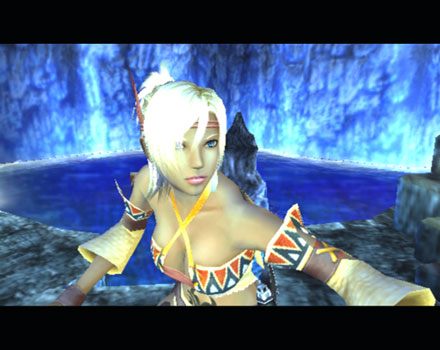
Nautilus has played with combining the irreverent with the dark, and by this game they managed to construct a world of Lovecraftian horrors that will leave you rolling in the aisles.  You play as Johnny Garland, sixteen-year-old boy detective and the least interesting character in the entire Shadow Hearts series.  As the game opens, the creepy Professor Gilbert, on sabbatical from his quest to become the kingpin gangster in Gotham City, hires Johnny to track down a missing person.  Unfortunately, his career in investigation comes to a dramatic end when a monster materializes and eats the guy he’s tracking.  But to prove the adage that every time God shuts a door, he opens a peep show, Shania, an Aryan Native American with breasts the size of all three pair owned by protagonists of the two previous Shadow Hearts games and Koudelka put together.

Seriously...I'd play it just for this guy.

Seriously…I’d play it just for this guy.

Now you may remember me praising Samus Aran for contributing her femininity to a story that doesn’t ask for or need her gender in the least.  Considering my stance there, I’d come off as incredibly hypocritical and misogynistic if I confessed to favoring Shania because I enjoyed watching her.  Well, yeah, she has the anatomical proportionals a Barbie Doll and kind of gives off the vibe that no one can focus a story around a Native American unless their standing ovation happens in the players’ pants, but to that I say one thing: Frank Goldfinger.  Very shortly after Shania joins your party, you encounter the middle-aged Frank hiding behind a cloth sheet as three monsters pound the snot out of him.  When he emerges bragging about how neither Johnny nor the monsters ever saw him, he claims to have studied the Brazilian Ninja Arts in order to protect the United States.  At that point, the game’s message rings through like an air raid siren in a library; don’t interpret anything seriously.  The irreverent, nonsensical characters count among the games strongest features.  If you partake in a certain side quest, you even realize that each one supposedly embodies one of the seven deadly sins, a very interesting bit of symbolism until you realize that Gilligan’s Island actually pulled it off much better.

Yeah, it LOOKS easy...

Yeah, it LOOKS easy…

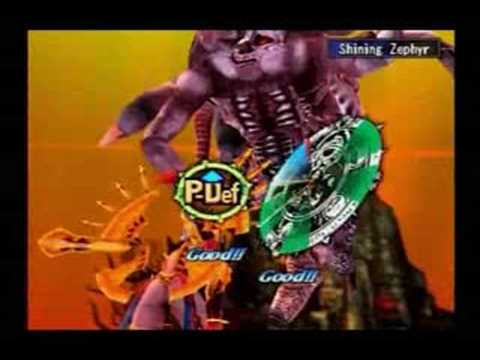
Like previous instalments of the series, combat revolves around the Judgement Ring, a spinning dial that asks the player to activate it at very specific points in order to determine the success and effectiveness of attacks and spells.  While many RPGs suffer from excessively repetitive combat that often forces you to just hit “X” over and over until the battles end, the Judgement Ring offers a more engaging system that asks you to hit “X” more often and at very specific times than those games.  Oddly enough, it works. It encourages players to aim for minuscule strike zones to buff up their power, which increases the chances of missing altogether and screwing up the attack.  For a mechanic intended to represent the unpredictable whims of fate, it creates a sense of control over the battle that few other games can rival.
In addition to the characters and the combat system, the game design and atmosphere make the game worth playing.  I enjoy the works of H.P. Lovecraft, but holy hackney Batman, his stories sound like he threw the Oxford English Dictionary into a garbage disposal and dumped it onto a page covered in glue.  So what I really mean when I say I enjoy Lovecraft is that I enjoy Shadow Hearts and appreciate his influence on them.  Nautilus painted a dark world with vibrant colors.  The unorthodox monster design offers something more grotesque than the standard vampire, werewolf, zombie, or other human- and animal-based design.  I’d pay $50 for a Shadow Hearts 4 just for the artwork.

Shftnw_mon_038

Well, mostly non-humanoid

Well, mostly non-humanoid

Like the monsters, the game itself gives us something refreshingly unorthodox.  Most RPG developers work within the fantasy genre, with sci-fi as their backup.  The real-world, alternate-history setting of this series, and I understand the New World setting for all I mock it.  It didn’t make sense at the end of Covenant to continue with Yuri’s story, while the Americas provide an untapped source of history and landmarks to work with.  It provides enough background to qualify for the series; the judgement ring, lottery games, a wacky vampire from the Valentine family, Roger Bacon and his porn addiction, and the emigre manuscript.  While the plot doesn’t wow me with complexity, they use events and ideas from previous games to prevent the story from falling into formula.  The plot of From the New World springs primarily from Nikolai Conrad’s release of Malice in Covenant, along with the running theme that no one has ever successfully resurrected the dead using the emigre manuscript.

While many found it a weak follow-up to the games starring Yuri Hyuga, and the game itself didn’t make enough money to ensure continuation of the series, the game doesn’t disappoint.  This forgotten/hidden gem perfects the judgement ring combat system and adds an entertaining complexity to the magic system and combo attacks.  Also, I bought the soundtrack for this game (and for Covenant) because it created such a perfect mood.  Bottom line: don’t play From the New World expecting a strong story or a familiar protagonist (although enough characters make cameos to keep it entertaining); play the game because Nautilus perfected their art and won’t likely make any more instalments of a great, atmospheric series. And breasts. Large, but not quite comically large breasts.
shadownewworld393

Link’s Awakening – Game Boy, Game Boy Color

Hey everyone, sorry again for the interminable gaps in posting.  I’m working through Shadow Hearts: From the New World at the moment, and only have a limited time to play. To make up for that, I’ll offer–when I can–reviews by guest writers. Anne recently finished an old Legend of Zelda Game (hey, I’m not playing this one), so she’s donated her time, and I’ve linked her name to her website. Enjoy!

Show of hands: who got stuck trying to figure out how to hurt this guy?

Show of hands: who got stuck trying to figure out how to hurt this guy?

Guest Writer: Anne Kendall

The character Link must be doing something right because everyone seems to think he’s trustworthy. It must be something in his face because, let’s face it, it isn’t his winning personality.  Unless I miss my mark there have been 16 original Zelda games and all use Link in some form or another (some weirder than others…Twilight Princess) as the endearing and trust engendering protagonist. Think back on any one of the games you might have played and you’ll notice that people turn to Link right and left with their problems from chasing down cuckoos, to saving Zelda…again, to spending countless hours slogging from watery ruin to firey cave in search of magical macguffins (and those are a bit of a Zelda trope all on their own). Now why does this matter you may ask? After all, he proves his worth every time he mops the floor with Gannon and gets the girl (oh wait, no he doesn’t). Well, here’s the thing, maybe we’ve all gotten it terribly wrong and I think the entire island of Koholint would agree with me. At the core of it, The Legend of Zelda – Link’s Awakening is the story of Link’s journey into mass genocide, as he knows full well that his quest to wake the Wind Fish will result in untimely oblivion for the island and all its residents.

It's a leopleuridon, Charley!

It’s a leopleuridon, Charley!

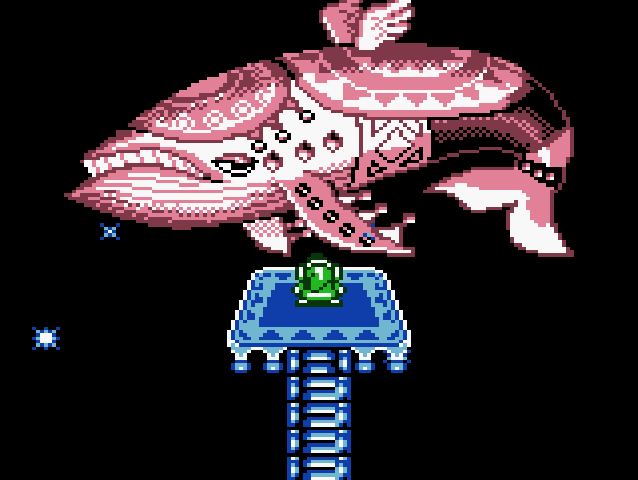
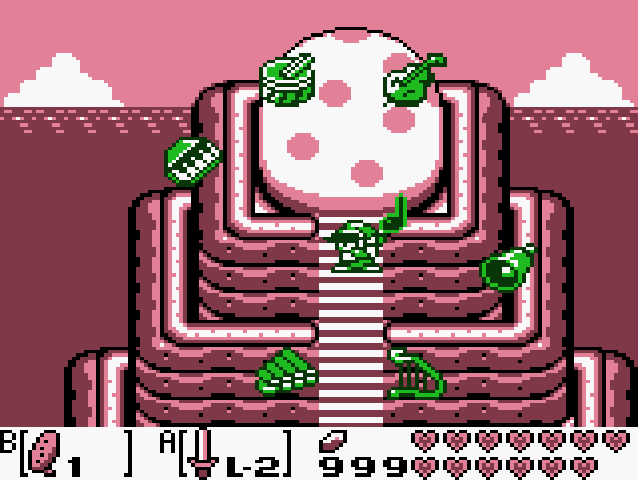
Since this game review is coming out 20 years after the game’s first release I feel I won’t be blowing anyone’s mind and feel that the statute of limitations on Spoilers! has long since passed. The game starts with Link washing ashore on the Island of Koholint where he is greeted by a young woman who will later star as a Resident Evil IV Ashley replacement as you go on a babysitting quest to take her to the talking animal village (cue rainbow effects and sparkles). Link quickly finds out that his room and board on this island won’t be free as they’ve decided that he is the legendary hero who will wake the Wind Fish from its slumber, thus making the isle of Koholint vanish with his dreams; although why this would be a good thing for anyone other than Link is never fully explained. Speed forward through eight atmospheric dungeons that can be won only by using that dungeon’s brand new item and a trading sequence so long that it has it’s own mathematical cross stitch proof out on the internet (search ‘link’s awakening trading sequence cross stitch’ on Google and it’s the first image you’ll see).  Oh and did I mention that music in these dungeons leaves something to be desired? Imagine being on the world’s longest elevator ride with a five year old who is singing you a song that she just now came up with…for five hours! Finally with all the magical macguffins, sorry ‘musical instruments’ as well as the requisite ocarina (apparently when they said you needed eight instruments they forgot that the ocarina is by definition an instrument) in hand Link goes off to wake the Wind Fish. Unfortunately, his (or perhaps her) egg turns out to be full of monsters that, for the most part, are shadow clones of previous dungeon and game bosses that you’ll easily recognize. Without giving the exact ending of the game away, let’s just say the survival rate for anyone not named Link is rather low.

It's no longer a cute cameo when you tell Link to fight like Mario.

It’s no longer a cute cameo when you tell Link to fight like Mario.

All genocidal tendencies aside the game turned out to be incredibly fun to play. The designers thought up a lot of interesting characters (several of whom are making appearances from other games) and regions that keep the game from getting too bogged down in the go to dungeon A, get item B, use key C to get in and defeat boss D and get macguffin E, repeat, formula. I will say that in the original version of the game for Game Boy there were far fewer owl statues than in consequent versions for the Game Boy Color or 3DS, which led to several sections that you might never think of on your own without a stealthy walkthrough peak. The Color and 3DS versions also introduced the upgrade Link uniform quest that could either increase defence or offence depending on the player choice.

Note that the only instrument he's actually playing is the one he wasn't specifically instructed to find.

Note that the only instrument he’s actually playing is the one he wasn’t specifically instructed to find.

So, the final overarching question for this revue: Is Zelda: Link’s Awakening a game worthy of our time? Yes. The game has enough entertaining points to offset any minor problems (or irritating music). The game is not my favorite Zelda (that position is held by Zelda: Ocarina of time) but it is a close second and is eons ahead of Majora’s Mask and Spirit Tracks. If you liked the style of the old Zelda games and are tired of the oddities of current generation Wii mote flailing consider giving this retro gem a spin.

Trauma Center: Second Opinion – Wii

banner

For years I’ve harbored a secret Snakes-on-a-Plane fantasy.  In it, I board a flight across the Pacific Ocean with Samuel L. Jackson, when bio-terrorists release a deadly toxin.  After hours of struggling with it, Jackson stands up and declares, “I’ve had it with these mother fuckin’ tumors on this mother fuckin’ plane! Is anyone here a doctor?”  At that point, like the guy from Goodburger, I timidly raise my hand. “I’ve logged ten thousand hours worth of Trauma Center games. I can operate.”  Then I break out my scalpel, laser, forceps, and my deus-ex-machina antibiotic goo, the timer starts, and I rescue four patients in ten minutes, saving the day.

Long before Phoenix Wright brought the legal world into the living room, I’ve enjoyed the melodramatic misrepresentation of the surgical profession.  It begs the question, which high-profile profession will they malign next?  I can already envision a Wii U game about an up-and-coming Irish Catholic Priest, charged with missions where he has to hold the baby under long enough to wash away its sins, but not enough to cause brain damage.  Or perhaps a text-adventure version where he has to select just the right advice to give during pre-marital counseling. Whatever they do, as long as they pump up the drama to a steroidal level and make the characters adopt kabuki poses, I’ll buy it.

Like other Trauma Center games, you play as Dr. Derek Stiles, fresh out of med school.  An awkward and bumbling person, he nevertheless has a great skill as a surgeon, mostly due to the magical power he discovers in himself that allows him to slow down time once during every surgery.  You know, like a real doctor.  After dealing with the usual tumors, polyps, and shards of glass to the lungs, a medical terrorist organization releases a series of diseases called GUILT on the population.  GUILT acts mainly through a combination of tumors and creepy crawly things skittering about your innards, making it fall under the jurisdiction of a surgeon for treatment.

Then you operate.  A lot.  Until the game ends.

Trauma Center technically falls under the classification of puzzle games, which brings up mixed feelings.  First, I usually don’t care for puzzle games, so the fact that I didn’t realize the genre until someone pointed it out speaks for the ingenuity of the concept.  However, I haven’t ruled out the fact that it may not seem like a puzzle because in every operation, they give you an assistant who constantly feeds instructions to you.  In an attempt to make each surgery unique, GUILT mutates, so each new strain has a slightly different treatment, but in order to actually complete the game, it has to give you constant tutorials on how to destroy each mutation.  I don’t think it makes the game less fun to play.  They find other ways to crank up the difficulty, and I suppose it eliminates the need to look up a walkthrough (which earns it a gold star in my book), but it makes me wonder why they insist on Derek operating, rather than his nurse who seems to know her way around entrails better than any of the surgeons in the game.

I'm the map! The triangle icon moves in true Indiana Jones style

I’m the map! The triangle icon moves in true Indiana Jones style

Second Opinion attempts to remake the original DS game, Trauma Center: Under the Knife, in the way that Renaissance fairs recreate the 1600s; they took what they liked, got rid of the dysentery, influenza, inbreeding, and rivers flowing with human excrement, added a few characters you suspect weren’t actually there before, and they slapped a happy, colorful new ending.  While I had a lot of fun with the DS version, some of the controls handled as well as a farming combine in a drag race through Tokyo. In fact, the in-game instructions to use the magnifying tool by drawing circles on the touch screen won’t actually work, and only through my faithful internet access did I discover you actually had to draw a C-shape. Second Opinion fixes nearly all those problems; the minimally-used magnification tool only requires point-and-click controls, you no longer has to manually slide fluids up the drain, and use of the nunchuck lets you flip between tools much faster than in the DS version.

You know, you're angry when you're beautiful.

You know, you’re angry when you’re beautiful.

Still, the Wii doesn’t have a reputation for perfection in controls, and the game does have some issues of its own.  Sometimes the nunchuck makes changing instruments easy to the point of accidental, and on several occasions I found myself trying to drain blood from a wound using thread or the laser.  The forceps don’t always activate, giving the impression that Derek believes he’s using them, but forgot to actually pick them up. I also found it more difficult to perform certain tasks, like suturing wounds or activating the Healing Touch, with the Wiimote as opposed to the DS touch screen.  However, I consider these fair trade-offs that make the game easier to play, and don’t hinder my efforts nearly as much as the problems on the handheld version.

Atlus cleared up some of the language issues for this release, so the game doesn’t ramble quite as much as before–it still yammers on from time-to-time, just not all the time.  They introduce a side character, Naomi Kimishima.  For every chapter you complete as Derek, one operation–usually lifted from Trauma Center 2 for the DS–opens up for Naomi.  It adds a few extra operations to the game, including some of the more interesting techniques they hadn’t included in the original, such as working with a pen light or piecing together bone fragments. While the game could use a few more operations, it didn’t fully make sense to add another surgeon, and to merge her story with Derek’s, they erased the entire final chapter from the DS game and replaced with a new one.

…You couldn’t have just added a seventh chapter? Really? The game doesn’t really take that much time to play, and we’d appreciate if you gave us back those final surgeries from the DS.

Before I go stamping this with my seal of approval, though, I ought to mention one serious flaw in the game that makes me hang my head in shame that any respectable developer could let this slip into a game.

Unskippable Cut Scenes.

Melodrama at its finest. But you're not on the DS now...how about a little more effort in the animation?

Melodrama at its finest. But you’re not on the DS now…how about a little more effort in the animation?

Capital letters.  As I mentioned, the Trauma Center series has a reputation for getting a little rambly.  While I’d disapprove of a story that didn’t try to put together a story at all, a lot of their rambling happens right before operations, and since the game does throw some hefty challenges your way, I found myself spending more time mashing the A button to get to the operation than I actually did operating.  Yes, sometimes I had a tendency to miss vital clues in the pre-op briefing, but once I pick those up, I’d appreciate it if I could go straight to the part of the game that wants me to, you know, play it.

Mostly, though, it does get my seal of approval.  The remake does improve on the flaws of the original game, and while they don’t throw many extra operations at you, they do give you at least a few.  If you haven’t played the Trauma Center series before, you actually may want to start with Second Opinion.

Stay tuned! Playing Koudelka inspired me to dig out a Shadow Hearts game, so expect that in about a week or two.  Since school has started, gaming has slowed down, but sign up to get email notification of my posts so you don’t miss any!

Koudelka – PS1

Many Victorian women preferred to wear bondage corsets as tops.

Many Victorian women preferred to wear bondage corsets as tops.

When Hiroki Kikuta, composer for Secret of Mana, left Square to found his own game company, he wanted to produce something fast-paced, exciting and dark, citing Resident Evil as his inspiration.  The developers working for him at Sacnoth, however, wanted something more like Final Fantasy and other games being released by Squaresoft.  I enjoy cross-genre works.  They take bits of the familiar and twist it into something fun and new.  Sacnoth’s 1999 release, Koudelka, takes the best of both worlds, combining the fast, exciting combat of Resident Evil with a well-written, progressive storyline like an RPG.

Just kidding! It’s actually all the backtracking and item hunting of a survival horror game with the repetitive random-enemy encounters of an RPG! Congratulations to Sacnoth for totally missing the point of playing either of those genres.

The story opens in 1889 when a voice calls a young Gypsy girl, Koudelka, to the Nemeton Monastery in Wales.  Equipped with nothing but her traditional Victorian-Era hot pants, bondage corset, and a personality that would strip the skin off a crocodile and rust off a Buick, she climbs the wall into a Medieval torture dungeon full of fresh corpses and stale plot premises.

I punched a chair!

I punched a chair!

From the point where she meets up with the game’s two companions, the story kind of flows freely, like a soda that Sacnoth spilled in a lake and then tried to put it all back in the bottle.  The characters seem to want to investigate the bulk supply of mangled corpses stocked in the monastery, but kind of lose interest when the ghost of a little girl dumps them into a hole, and that plot kind of peters out in favor of a mystery surrounding the back story of one of the games lesser noticeable characters, who literally dies in the second scene he appears in, at which point the game drops even that plot.  Eventually, it settles on something somewhat interesting; as it turns out, a priest tried to resurrect his wife, who happens to be the former love interest of one of the playable characters.  However, messing with dark magics never ends well, something went horribly wrong, yada yada, and now we have to fight her soulless body.

Fin.

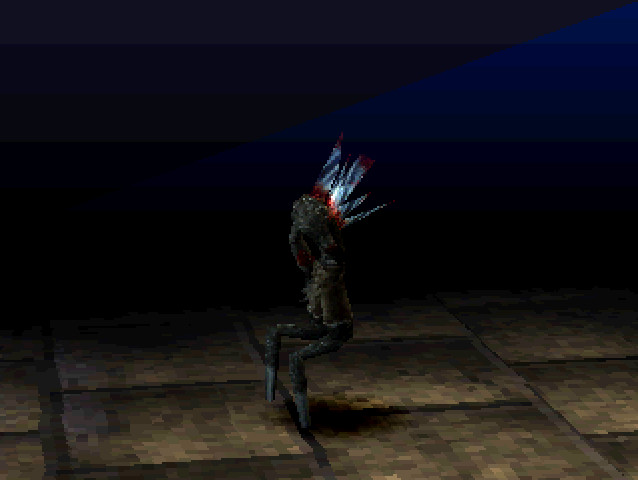
This guy! Dark...

This guy! Neat.

In a game that clearly attempts to build a Lovecraftian atmosphere, that part of the story rouses interest.  Still, the story stands on a foundation of apple sauce, jello, and the hopes and dreams of lousy game designers, and it falls somewhat flat.

Really? You can't figure this one out?

Really? You can’t figure this one out?

The semi-strategical combat system attempts for something interesting, but doesn’t work right.  The player can move characters around on a grid like most tactics games, but every battlefield consists of a flat, featureless floor.  Only one battle bothered to include any obstacles, and due to a weird quirk where the game refuses to let you step past the entire line containing the foremost enemy, it ended up looking like a bunch of people who couldn’t navigate themselves around an inanimate wooden box.  Furthermore, considering the small size of the battlefield, large move capabilities of the characters, and lack of limits on ranged and magic attacks, it ends up amounting to a system almost exactly like the SNES Final Fantasy games where players and enemies line up and face each other like colonial armies.  Actions in battle consist only of standard attacks, moving, and casting a handful of spells–four attack, two healing, and a smattering of support–that might level up by the end of the game if you cast them enough. The game lacks money and shops, so all items and equipment come from either picking up randomly placed items that blend in with the environment, or from random creature drops.  As a player, one strategy fits all, and with very few options to choose from, most battles in Koudelka–which, I remind you, calls itself a strategy game–end up playing out exactly the same as every other battle.

Roger Bacon

Roger Motherfuckin’ Bacon

Koudelka stands as a shining example of how unlike in Hollywood, games sequels can succeed even when the original holds itself up to standards I wouldn’t accept from a kindergarten school play.  Sacnoth apparently understood that the only interesting things about this game were the magic spell used to resurrect the dead and the creepy old monk, Roger Bacon, who wanders around the monastery like a madman.  They went on to develop a little-known but excellent series called Shadow Hearts, recycling very little from the Koudelka universe other than those things.

This might look neat...if it weren't made of polygons.

This might look neat…if it weren’t made of polygons.

Still, I won’t say I hated Koudelka or that I had trouble rousing up interest in it.  It just feels like they needed to screw up before they figured out what would work in subsequent games.  I can tell they put some work into the Lovecraftian monster design, but on the rendered polygons of the PS1 they intimidated me about as much as a Lego Cthulu.  And while themes of dark magics and forbidden knowledge work well in Shadow Hearts, Koudelka had all the consistency of a story narrated by Leonard from Memento.

As I’ve mentioned before, I have a tendency to like games even when they don’t deserve it.  For the most part, I feel that way about Koudelka.  As a long-time fan of Shadow Hearts, I still consider this a must-play for series completionists.  Still, I’m not likely to  come back to it any time soon.

Super Scribblenauts – NDS

Super-Scribblenauts-Coming-This-Fall

As an English writing and literature student, I had to deal with the following on a daily basis.  “English majors, we just love words! Don’t you just love words? I love words.”  Well, no actually.  If I cared at all about random sequences of molecular vibrations, I’d have studied music.  Ideas mean much more to me, and the idea I’d like to discuss here concerns the use of words in Super Scribblenauts.

Super Scribblenauts, a game that requires no scribbling or sailing skills and that I can describe as  just “pretty good” at best, focuses on solving simple puzzles of varying convoluted-ness by summoning physical objects from an arsenal of anything, literally ANYTHING…that the programmers had the foresight to program into it; just speak (er, type) the word and it shall appear! So long as it doesn’t involve profanity, racism or sexual innuendo.  Blood death and violence seem fine, though.  I created an “exotic dancer,” once, but since adjectives have about the same effect as labeling your leftovers with a sharpie and hoping that someone will recognize what it means, the game just gave me a ballerina. Sigh…I was really looking forward to the colony on Mars for a brief moment.

In each level, Maxwell, the extraneous protagonist who has apparently wrapped his head with an iPhone cover, needs to collect the game’s macguffins called Starites.  Often times, the player must meet certain conditions before the starite will appear, such as adjective levels that may ask to create something with the characteristics of both a dwarf and a giant.  While I tend to enjoy creative, free-flow problem solving, most players with an IQ high enough for self-awareness may tend to over think these problems, as I did when I didn’t immediately create a “small giant” or a “big dwarf.”

I have to admire a game that encourages weirdness.

I have to admire a game that encourages weirdness.

Most levels require Maxwell simply to get from point A to point B, navigating certain obstacles such as trees, spikes, lava pits and wedding guest lists.  The game encourages the use of new words to solve each puzzle, which keeps it interesting for a while.  Eventually, however, the problems become a little convoluted, and I found that using “wings” pretty much got me around any obstacle I needed.  I also became quite adept at using a combination of ropes, balloons and a fan to put things exactly where I wanted them. Certain levels require you to think up objects to fill a school or grocery store or something.  One level asked me to create a super hero, and to my utter, childish delight, I put in a “cape,” “dead parent” and “bat” and out popped a masked avenger!

Still, the entertainment value of summoning chupacabras, robotic dinosaurs, napalm, ninjas, demons from the pits of hell, and cats that eat spaghetti wears off after a while.  Since the game rewards use of new words with all of a pleasing, cash-register “ding,” I found myself questing for synonyms.  I found the thought of a game made by running a dictionary through a garbage disposal intriguing, but it disappointed me with its lack of words.  I’m sorry, but you took the time to program in Moby Dick, the Great Flood, the Necronomicon and nitrous oxide, but you missed “jewelery store?” Also, some items tend

Your tauntaun will . . . uh, freeze?

Your tauntaun will . . . uh, freeze?

And as I mentioned in my Phoneix Wright article, creative games usually fail when the player has to tell the game how to think. Many of the objects in the game exist, apparently, only for novelty value, as the programmers felt that not everything really needed to function. Maxwell can’t quite figure out that the acid may help more if he took it out of the container.  One level asked me to find a safe way for a man to jump off a cliff, so I attached a bungee cord to his waist and a rock and then watched the guy run in circles scratching his head, while waiting for a “ding” that never came.  Some puzzles seem to enjoy kicking me in the groin with convoluted answers, but hey, I should have just known that the janitor would clean a mess, but not dirt, the doctor would save someone from a snake, but not cyanide pills, and that a psychiatrist would only check on a patient if they’d seen a big hairy spider.

Even if you can summon the object you want, it may not come in a useful form.  A few times, I wanted to walk across a pit, so I asked for a plank, only to get something immovably vertical.  I could only create fans that pointed left, and ramps that sloped upward to the right. Adjectives don’t reliable alter items either, and while “gold bridge” did in fact summon a bridge made of gold, the system didn’t register any qualities that went with it, so I actually had to destroy it after it started floating away on a light breeze.

As puzzle games go, it played rather nicely.  The novelty lasted long enough and some problems did require a decent amount of thought.  The player has the option to play through most levels on advanced mode, which means they have to solve the puzzle three times without repeating any words.  I tried that for a while, but opted against it in the long run, to save my nerves.

Duck Tales – NES …(woo-ooh!)

Scrooge Moon Treasure

If I reach the ripe old age of 110, find myself immobile in a nursing home bed, unable to speak and peeing through a tube, and I’ve left a living will detailing that only one TV show play constantly in my room to let me reminisce about my youth in those last precious moments of existence, that one show would have to be…

…well, Rescue Rangers, to be honest. But if they could alternate between two programs, every other episode would be Duck Tales (then, I think, given the third option, I really enjoyed “Get Smart” around fourth grade or so).  Rescue Rangers and Duck Tales truly represented a time when Disney put forth an extreme effort into their afternoon programming.

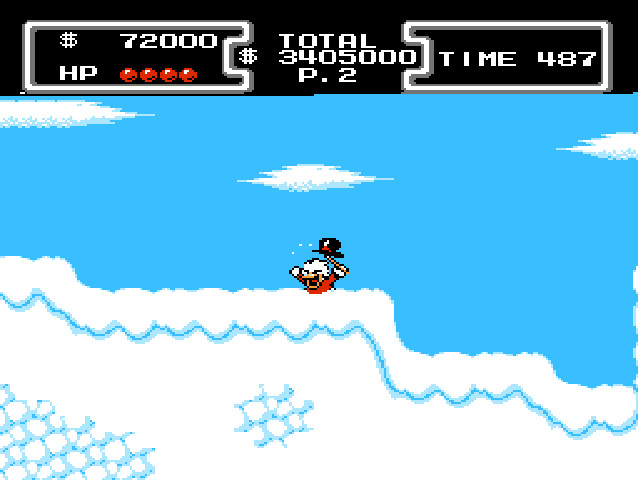
Stop complaining, Scrooge. I come from Northern Michigan. This is a light dusting for us.

Stop complaining, Scrooge. I come from Northern Michigan. This is a light dusting for us.

Now I can see all you wagging your heads in front of your screens thinking, Jake, Jake, Jake…everyone remembers their childhood as more wonderful and praiseworthy than everyone else’s.  But like Phoenix Wright, I make no claims without evidence (lest my conduct reflect badly on my client).  Prior to the 2012 Presidential Election, everything I understood about economics–and retained after graduating high school–I learned from Duck Tales.  Scrooge McDuck taught his nephews some fairly complex lessons about investment and saving.  He showed, through example, why keeping three cubic acres of cash sitting in a monolithic building marked with a dollar sign might demand ridiculously excessive security and a lot of sleepless nights.  Look up an episode called “The Land of Tra La La,” and you’ll see a hypothetical scenario illustrating the effects of inflation.  Even today, when politicians suggest to me that I only need to find more difficult work if I want to increase my income, (goodbye teaching college, hello digging ditches!) I hear Uncle Scrooge’s mantra, “Work smarter, not harder,” and I remember his admission that he succeeded as a result of determination, thought, risk, and luck (remember his lucky number one dime, so coveted by Magica DeSpell?), making me wonder why we elect people easily outwitted by a cartoon duck.

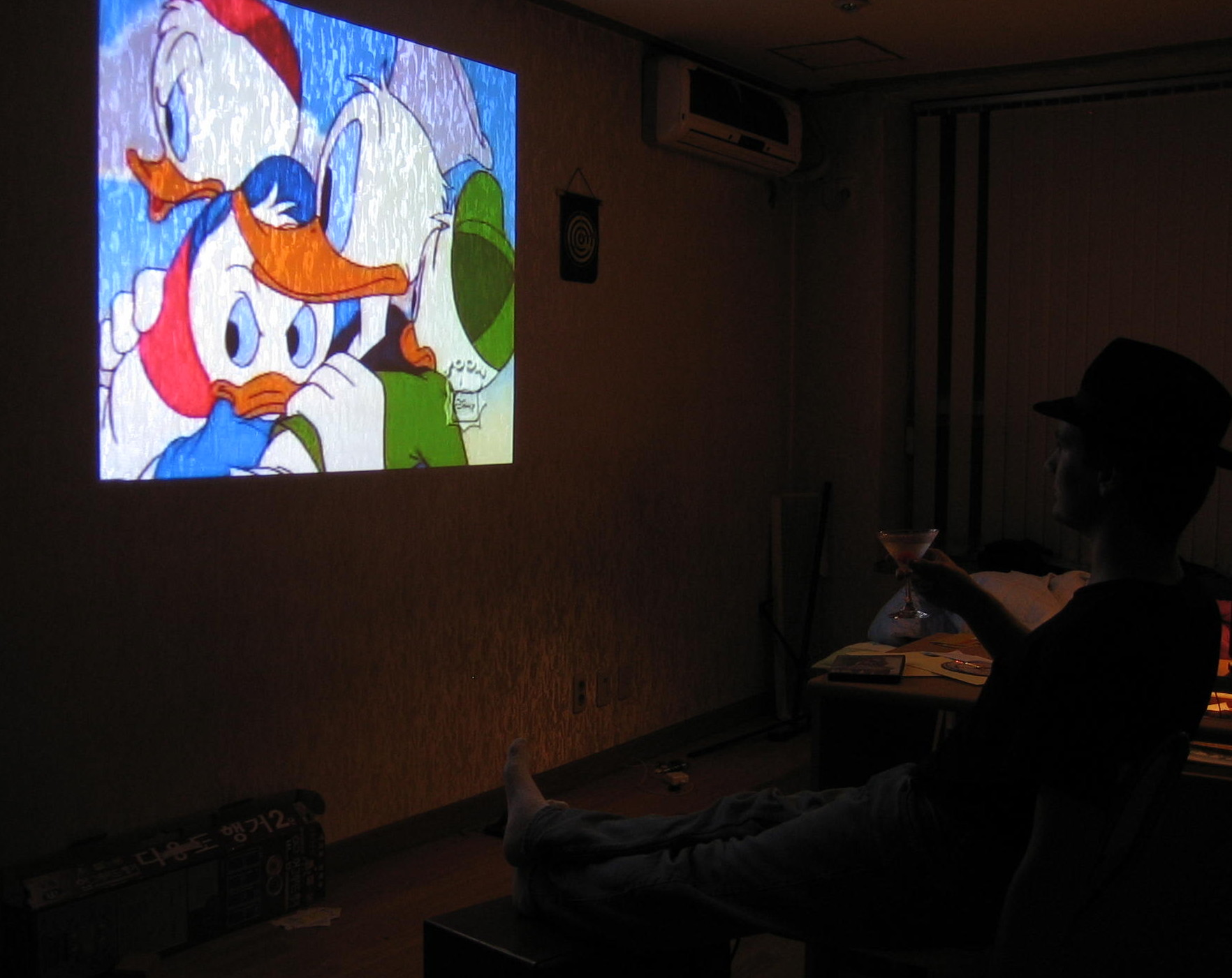
Doesn't everyone watch Duck Tales on their wall while drinking martinis in a fedora?

Doesn’t everyone watch Duck Tales on their wall while drinking martinis in a fedora?

Anyway, if your kilts are cursed enough that you missed out on being under ten years old from 1987 to 1990, go out and find the show.  Find some kids to show it to, or just watch it by yourself.  If your birth year does fall in the eighties, maybe you won’t necessarily remember the TV show, but you probably remember the NES game.  Capcom, it appears, has remastered the game and released an expanded version for Steam, PS3, Xbox 360, and the WiiU! Quackeroonies!

Except I promised I’d play through my giant stack of games before I bought any more, so I’ll write about the 8-bit version instead.

While that probably sounded a bit disappointing, the original Duck Tales game blessed a few bagpipes of its own when first released in 1989.  Congress hadn’t yet passed the law requiring the quality of games adapted from movies or TV to be equal to or less than that produced by unpaid interns who stay up until four in the morning because they can’t go home until they finished their other work.  A lot of the game’s features not only stayed true to the tone and design of the cartoon, it also put the player in adventure situations like Scrooge might actually encounter. (You may laugh at the fact that I bring that up, but have you ever tried playing the NES Back to the Future adaptation?)

Yep...even the duck is a better golfer than me.

Yep…even the duck is a better golfer than me.

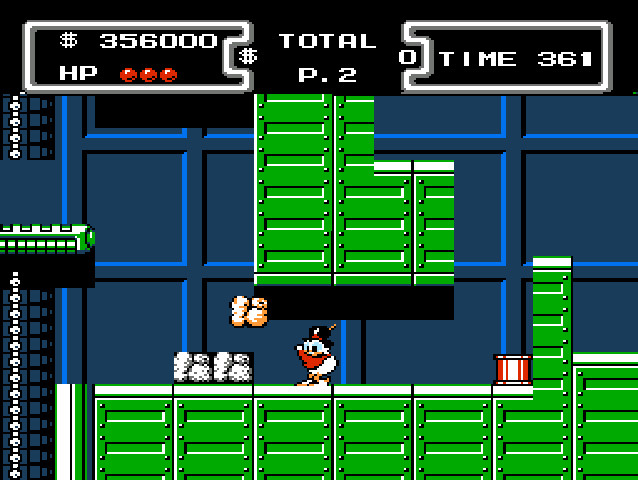
Scrooge McDuck, in a startling development of character that would make even the most hardcore fans shrug with astonishing indifference, wants to increase his fortune.  Rather than merge with other corporations, invest in stocks and savings, or buying up other businesses, firing all the employees, then liquidating all their assets right into his Money Bin, he feels that world travel would best suit his needs, as apparently we could find diamonds sprinkled everywhere from here to the moon if we just look hard enough.  In true Mega Man fashion, the player selects non-linearly from five stages, each which contain a treasure guarded by a boss and numerous diamonds found hiding in the stage or dropped by enemies.  Scrooge uses his cane–which doubles as a pogo stick and triples as a golf club–as his only defense.

This set up, I think, makes the game more about exploration than plowing through to the end.  Stages branch off, and each path contains diamonds, health upgrades, hidden treasures, key items, or extra lives.  Many items remain invisible until Scrooge crosses certain points in the area to reveal them.  So not only can we choose the order of levels, but we also can decide how long we want to spend in any one place.  And while the treasure value only serves as a score, which no one cared about after it ceased to mean “free game” or recognition by other upstanding arcade patrons, putting a dollar sign in front of it somehow makes it feel like a more worthy goal.

Hey guys....what'cha doing in there?

Hey guys….what’cha doing in there?

Other characters from the series appear to help you by offering advice, breaking through walls, or throwing baked goods at Scrooge, who gobbles them down like a diabetic with low blood-sugar.  Although the game keeps text to a minimum, they did try to retain certain speak mannerisms for most of the characters (although I don’t know if I can forgive Bubba’s lapse in not referring to the main character as ”Scooge”).

Despite being a platformer, I actually have a good time when playing this game. Something about bouncing around on a pogo-stick cane just mesmerizes me, and I can remember zoning out in third grade, imagining Scrooge hopping around the lines on the classroom walls.  My third grade teacher didn’t care for me much.  Of course, when I started subconsciously picking up economic theory in kindergarten, I set myself down a path where most of my teachers would accuse me of having an attitude problem. (Until I got to grad school. They liked me. I guess it evens out).

Moral of the story? Video games make you smarter. (No, really) So go play Duck Tales.

Metroid: Zero Mission – Game Boy Advance

Like the 80s never went away.

Like the 80s never went away.

As I’ve written before, I like Samus Aran.  She managed to break through gender assumptions after a programmer casually mentioned, “Hey, what if the person in the suit was a chick?” and everyone at Nintendo just went with it.  Unfortunately, every subsequent game turns her into some sort of space-floozy who rewards you with a striptease based on how fast you finish, and the animation in Metroid: Zero Mission makes her vaguely reminiscent of a Barbie doll, but hey, it takes a real woman of the 1980s to pull off shoulder pads the way she does.

The fact that the original game came out in 1986 does actually reflect on Samus as a character during Zero Mission.  She explains the game’s premise in the opening sequence: “Now I shall finally tell the tale of my first battle [on planet Zebes]…my so-called Zero Mission.”  Great! We’d love a remake of the original! Except that the 2004 “enhanced” remake actually plays like someone’s mom trying to tell a story about what happened nearly 20 years ago, and not getting it quite right.

I once caught a lizard THIIIIIIS big!

I once caught a lizard THIIIIIIS big!

“No mom, you didn’t get the speed booster until Super Metroid…sorry, I don’t remember you being stalked by a giant centipede….I swear Kraid gets bigger every time you tell the story.”  Furthermore, the bonus level tacked on to the end of the game, during which she loses her power suit, sounds like an aging beauty queen trying to remind the young folk how hot she used to be.

This guy would appear occasionally, take a few missiles to the eye, then leave. Never explained. Never beat him. I named him "Wikipede"

This guy would appear occasionally, take a few missiles to the eye, then leave. Never explained. Never beat him. I named him “Wikipede”

See, we played the 1986 game.  We know what happened.  Samus can’t fool us by adding exciting stuff to the story.  Calling Zero Mission a remake of the original is like calling a BLT sandwich a remake of a pig.

That brings up the questions as to how far developers need to go when doing a remake.  Honestly, the 1986 Metroid only really had two flaws with it: lack of an in-game map and the need to camp out in front of pipes for hours until enough monsters popped out to refill your energy tanks.  Except for these things slowing the game considerably, I wouldn’t change a thing about it.  According to Wikipedia, Nintendo “enhanced” the re-make to play more like Super Metroid.  Pardon me, but if we want a game to feel more Metroid-ey, shouldn’t we remake the later games to feel more like the original?

Still, Zero Mission improved upon the original gameplay in a number of ways.  For starters, they give you a map, and they designed each area to look distinct from the rest.  I always felt like navigating the 1986 planet Zebes had a difficulty curve akin to looking for a bathroom in the metro when all the signs are written in Chinese.  Furthermore, the extra items available do allow for more abilities, giving more control to the player, and video games mean very little without control.

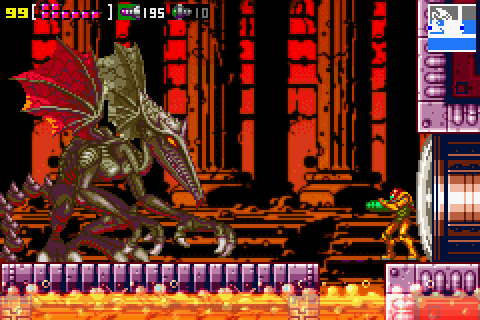
How did this...

How did this…

...turn into this?


It would almost help to think of Zero Mission as a reboot rather than a remake.  The game does resemble Super Metroid and Metroid Fusion, and while I did get occasionally get stuck expecting the same sequence of events as the 1986 game, it actually does a pretty good job of forcing and guiding the player in the right direction.  I also enjoyed the addition of the quasi-animated cut scenes.

I didn’t as much care for the bonus level, however.  After defeating Mother Brain, Samus escapes the obligatory time bomb (shout out to Mother Brain, the original number one Load-Bearing Boss) only to be shot down.  She crashes on Zebes, which somehow robs her of the large metal suit strapped to her body, and all the gizmos and gadgets that went with it.  She’s left with her skin-tight blue body suit and a pistol that will stun most enemies if you let it charge up between shots.  She somehow reasons that she should embark upon a forced stealth mission through the space pirates’ mothership to regain her suit and steal an enemy ship.

While forced stealth may have actually worked in Batman: Arkham Asylum, it detracts from the point of Metroid.  Batman lives for stealth.  Arkham Asylum gives the player neat ninja-like options for sneaking around and mixes it with a healthy amount of beating the shit out of bad guys.  Metroid, however, relies on action and tool using.  When you strip that away from Samus, all you have left is a metaphorical form-fitting blue body suit which leaves nothing in the gameplay to the imagination.  Sneak sneak sneak.  Don’t fight the badguys.  Did they see you?  Well, you can run away or die.  I know game makers feel obliged to deliver more hours of gameplay than they used to, but sometimes the padding just reaches the point of absurdity.  The map of the mothership, if you compare it to the map for the rest of the game, has about as much tunneling as half of the entire planet Zebes.  Since you get your suit back halfway through it, that means that you have to crawl, sneak, dodge, and flee your way through an area about one quarter the size of the rest of the game.

Then when you get the suit, it powers up to let you use the space jump, plasma beam, and you get power bombs shortly afterwards, and the rest of the level (again, about 1/4 of the size of the main planet) consists of powering through enemies who crumble like flies under your god-like might.  The game becomes too easy, and it stays too easy for too long.

I’d probably have no doubts about the game, but this final level throws me off.  I could easily suggest Zero Mission.  If you play with the mind frame that the game uses similar areas and items as the 1986 Metroid, but expands greatly on the world, then it becomes like Super Metroid; entirely new, but charmingly familiar.  However, the bonus level introduced boredom and tedium as a prerequisite for actually finishing the game.  While I may not condemn the game merely for that, I would like to end my post today with a letter to the Powers That Be:Dear Game Makers,
Forced stealth sucks.  No one likes it.  Stop using it.
Sincerely, Everyone