Lego Star Wars II: The Original Trilogy – PS2, NDS

Lswii_pcfrontBy a show of hands, how many of you played with Legos? I did. I had birthdays where I wouldn’t get anything except Legos. I’d combine base plates with a friend of mine and we’d construct entire cities of little plastic bricks. My fascination with Legos shaped my career path, helping me decide that, for the safety of anyone who ever drove a car or went into a building, I should not go into architecture or engineering. But for all the failed mechanisms I’d contrive and all the magnificent buildings that collapsed under the weight of my genius–or the more likely culprit, physics–I still loved to build. And do you know what else I loved? Star Wars.

Who doesn’t, though, right? Well, besides my ex-girlfriend, but she has a soul cold enough to freeze over and dampen the spirits of even the great Boba Fett himself, so she doesn’t count. The popularity of Legos makes them the natural choice to compliment the epic space-fantasy masterpiece, so what could possibly go wrong with Lego Star Wars II: The Original Trilogy. It already has a leg up over the first Lego Star Wars insomuch as it does not demand you play through the prequel trilogy.

Note how Lego Men make perfect--and geographically customizable--Risk pieces. They already have horses and cannons. Also, notice how maps installed on the floors at UMD make perfect Risk boards.

Note how Lego Men make perfect–and geographically customizable–Risk pieces. They already have horses and cannons. Also, notice how maps installed on the floors at UMD make perfect Risk boards.

Like other licensed Lego games, you play through the plot of the film(s) as Lego versions of your favorite characters. By itself, that pays for the cost of the game. I spent $2 at my local Savers to buy this, and another $2 to get the prequel trilogy (after someone else had taken the prerequisite number of chunks out of the disc before passing on ownership). The combined $4 I spent could have covered a physical–and generic–Lego man at the same store. Granted, you can’t, for example, take the characters out of the game and use them as pieces in a giant game of Risk, but you can still play with them with even a little more control than the real things.

The novel idea that, in retrospect, seems obvious: Darth Vader as a playable character in the fight against Palpatine. Duh.

The novel idea that, in retrospect, seems obvious: Darth Vader as a playable character in the fight against Palpatine. Duh.

The game tasks Luke Skywalker and his friends not so much with getting through levels based on the films, but with collecting shit along their way, namely money. Each level hides a cache of red Lego bricks, “minikits,” and Lego studs of various colors which like poker, kids, denote different values. These studs serve as the game’s money, allowing you to buy characters, vehicles, hints, and other trinkets at the central hub, the Mos Eisley Cantina. Only by collecting enough studs in each level can you achieve the “True Jedi” status–and thus unlock more useless collectibles. This gives Lego Star Wars a feeling not unlike poker, asking you to build up more and more stuff merely for the purpose of using that stuff to collect even more stuff.

The stages don’t exactly innovate game design, nor do they really show a departure from typical Star Wars games. Characters progress in a mostly linear direction. In Story Mode, you take control of a small group of characters who might reasonably find themselves within the vicinity at whatever point in time, and in Free Play Mode, you get to choose two of your own, while the game assigns additional characters to make sure you have whatever individual skills you need to actually finish the level. To reach the goal, characters use the Force, grappling beams on blasters, and that little stick that R2-D2 uses as a Deus Literally Ex-Machina (or in the case of C-3PO on Endor, Literally Deus Ex-Machina). Furthermore, you have to build stuff. Lots of stuff. Sometimes you need to destroy something for parts, but it usually comes down to building. Characters can build by walking up to a twitching pile of parts and holding in the circle button. And waiting. Sometimes you have to fight off a hoard of enemies first, but then feel free to go up to that pile and hold in circle. Yes, ladies and gentlemen, play Lego Star Wars if you’ve always wanted to play with Legos, but without any of the actual fun of building things for yourself. Funny, though, how they managed to include the tedium of searching for parts.

Slave Leia! Nice! Although I didn't expect her to be quite so flat-chested...

Slave Leia! Nice! Although I didn’t expect her to be quite so flat-chested…

Anyone who has ever woken up in the middle of the night to pee and had to cross a minefield of Legos can attest to the damage they can inflict, but combat in the game feels a little clunky and awkward. Lightsaber swings pay off at low odds, most often striking a jaunty pose in an irrelevant direction, sometimes managing to deflect blaster bolts, and very rarely slicing through enemies. The design of the blasters seems inspired by Obi-Wan’s description of them as clumsy and random, as about 50% of the time I hit my own characters instead of stormtroopers. I found it far more effective to use Chewie, walk right up to the enemies, and use the melee attack to rip their arms out of their sockets. Like other Star Wars games, you also take control of vehicles on a regular basis. These vehicles control about as well as a drunken condor trying to land on a bicycle seat in a hurricane. Even by the end of the game I found myself flipping, spinning, doing somersaults, U-turns and barrel rolls at the drop of a Lego hat.

A quirk of the game that you might find interesting–no wait, the other thing…obnoxious–the credits, which you have to sit through three times–one at the end of each film adaptation. Not the glorious 45-second credits from NES games, or even the standard five- to eight-minute credits of standard PS2 games. No, Lego Star Wars goes full-on Arkham Asylum, making you sit through an extended credit sequence while they name off not just programmers and artistic designers, but their office staff, from the Assistant to the Vice President of Global Sales and Marketing to the Assistant to the Janitor of Mopping up Puke at the Lego Employee’s Day Care. At the risk of sounding offensive and preachy, credits should offer recognition, a chance for the skilled workers and artists to sign their work. Instead, these credits read like an Occupy Wall Street hit list.

This guy put in nearly 35 hours into collecting all that stuff. . . I hope he enjoyed the search.

This guy put in nearly 35 hours into collecting all that stuff. . . I hope he enjoyed the search.

But hey, you can go make a sandwich or play with your cat or something, right? The valuable part to you as a player comes after the credits, in the post game. Now you can finally play through the game on free play mode, using all those characters you unlocked along the way! I want Darth Vader and Obi-Wan Kenobi! Yeah! All right! Now what do I do in free play mode? Uh, go through the levels and collect more stuff…to unlock more characters…to use in free play mode…to collect more stuff… In all fairness, I never did collect all the mini-kits in any given level. Maybe something really cool happens when you do. I don’t know–the game didn’t really motivate me to seek them out. Even in the early stages, they tucked away these things so well that I rarely got more than two per level. If they made these things easier to get in even just the first level, I might know why I want to collect them everywhere else.
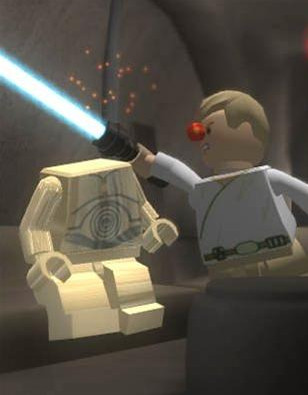
Come on...be honest...you wanted this to happen. We hate this guy just as much as Jar-Jar.

Come on…be honest…you wanted this to happen. We hate this guy just as much as Jar-Jar.

Honestly, though, I did have fun while it lasted, even in light of super-easy game play (you can’t actually die, you just spill your coin purse a little every time you lose a few hearts) and some obnoxiously obscure puzzles to solve. The games display a characteristic sense of humor, adding a delightful irreverence to a story that everyone–except for my ysalamir of an ex–already knows. Without additional dicking around in free play, the game runs under ten hours, which doesn’t exactly commit you to a Bethesda-level commitment. Speaking of which…I just got Oblivion for Christmas. Expect a week off here and there because in addition to working on RPG Maker for the last few months, I just took on a Bethesda-level commitment.
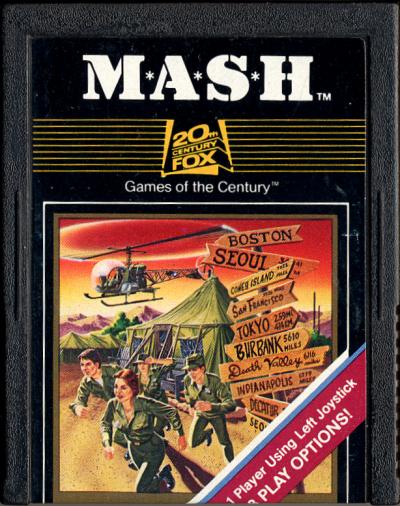

M*A*S*H – Atari 2600

When you plan on selling your game with the blurb "Two Whole Players!" ask yourself why you couldn't think of anything more exciting to say.

When you plan on selling your game with the blurb “Two Whole Players!” ask yourself why you couldn’t think of anything more exciting to say.

As a kid born in the early 1980s, I remember…well, not much. But how could I forget such wonderful programming for kids, such as Chip ‘n Dale Rescue Rangers, Duck Tales, Garfield and Friends, Thunder Cats, Smurfs and Gummi Bears. Of course, I didn’t get my first game console until the early nineties, so the kids five to ten years older than me–those playing Atari 2600 as their first console–must have had a different taste in television than I did. And if video game adaptations give any indication, then I can assume that 10-year-olds watched M*A*S*H. After all, what third-grade student wouldn’t appreciate dark comedy and biting satire about Vietnam, cleverly disguised as the Korean War, which itself bears a striking resemblance to the hills of southern California?

I find it amazing how a country eleven time zones away bears such a striking resemblence to Southern California! We have so much in common!

I find it amazing how a country eleven time zones away bears such a striking resemblence to Southern California! We have so much in common!

Actually, I love M*A*S*H. My parents have a picture of me in 1984 in my infant carrier, staring down Colonel Flagg. I played Trapper John in my high school’s theatrical production. I’m the only person I know who has watched every episode while actually in Korea. M*A*S*H presents us with an idealistic fantasy world, where bad things might happen, but the antisocial nutjobs always get a pile of garbage dumped on them in the end, the villains act like spoiled children / Tea Party patriots for easy identification, and hero doctors always grow a foot taller than common enlisted men. Why wouldn’t the youth of the eighties (or maybe Fox meant “youth in their eighties?) want to put themselves in the role of the legendary wise-cracking meatball surgeon?

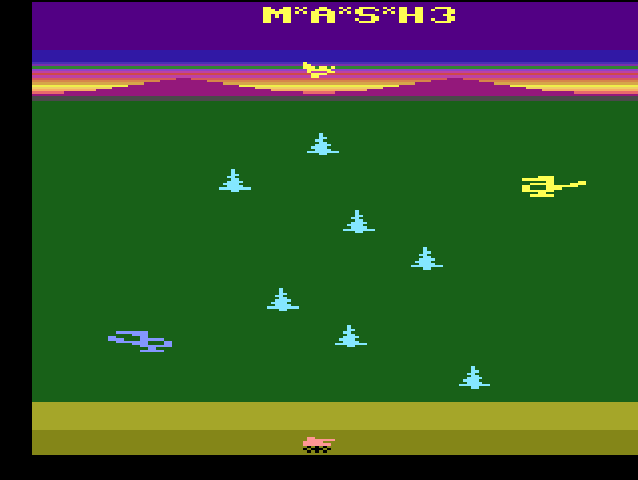
MASH Atari Mode 1Coming from the studio that once tried to turn Family Guy into an MMORPG, I think Fox has long had a problem understanding humor, specifically in how they can translate it into video game format, or in Fox’s terms, milking it for profit. See, the M*A*S*H tv show depended on witty responses to situations, satire on right-wing politics and war, and Catch-22-style double talk. The M*A*S*H Atari game did make me laugh, but more so at the premise that I need to catch Colonel Potter’s skydiving medics because they developed a fondness for leaping from their plane without parachutes. I like to point out the absurdity in games whenever I can, but sometimes they make it difficult, and I just don’t know if I can out-mock a game that asks me to accept that a platoon of soldiers devoted to saving lives has less survival instinct than the entire series of Lemmings games. At that point, the game mocks itself.

M*A*S*H offers four types of gameplay, with one- and two-player modes for each. In Modes 1 and 2, the player controls a helicopter, supposedly piloted by Hawkeye, picks up wounded soldiers, while flying low to avoid the lone North Korean tank. Thank you Fox! As embodied by your news network, you strive to offer us as many unintentional jokes as possible! For instance, “Putting a surgeon to work piloting a helicopter instead of a hospital shows that Fox objected to poor people receiving healthcare long before Obama.” Nah, even I didn’t like that one. How about “Military powerhouse North Korea sends one tank after enemy”? No, that didn’t work either. I know! I enjoy the wisdom of piloting a helicopter below the tree line to avoid enemy fire. At least, the idea of a chopper coming at me through the woods, hacking off branches and the heads of small animals sounds like solid, life-saving logic to me.

Excuse me, but if you have nothing more than a flap of arm pit skin connecting your upper torso to the rest of your body, I think the doctors should probably move on to someone a little less wounded.

Excuse me, but if you have nothing more than a flap of arm pit skin connecting your upper torso to the rest of your body, I think the doctors should probably move on to someone a little less wounded.

Periodically, the game stops to consider that doctors might serve their purpose better in the operating room, and so the scene shifts abruptly to the operating room. Wait, sorry, strike that…the scene shifts abruptly to the Milton Bradley “Operation” game. Surgery consists of removing a small dot–shrapnel, I assume–from a soldier with a physique to suggest that the army put him on the battlefield for the sole purpose of shielding others from bullets using his weeble-shaped hips (although with a body like that, how they got him to lay down on the table without immediately popping upright blows my mind). The player has a fondue fork, with which he must navigate the shrapnel through the soldiers’ bodies without touching the sides of hollow, maze-like tunnels whose presence, I would think, should cause slightly more concern than the dots within them. The player has about fifteen seconds to operate on as many patients as possible, unless you hit the sides, which prompts the game to call you “Ferret Face,” which wins an award for the only thing in the game actually referring to the TV show, despite targeting the wrong character, and sends you right back out to wreak havoc on the trees of South Korea.

In mere seconds, the bodies of trained medics will rain from the sky. Some may even impale themselves on those trees. Others, hacked by chopper blades. Too bad none will survive to tend to the wounded.

In mere seconds, the bodies of trained medics will rain from the sky. Some may even impale themselves on those trees. Others, hacked by chopper blades. Too bad none will survive to tend to the wounded.

Modes 3 and 4 pits Hawkeye’s helicopter against Colonel Potter’s madness (General Steele, anyone?). Bodies pour out of a plane like a fire hose and you get more points for picking them up just before they hit the ground than if you catch them right out of the plane. Apparently the army gets by on “thrilling climactic rescues” rather than “intelligent strategies.” Modes 5 and 6 work like easy versions of Modes 1 and 2, giving you a smaller helicopter–to shred denser forests, obviously–and a visual cue as to when you’ve loaded the maximum number of wounded on your ship. Modes 7 and 8 put you in the operating room for the entire game, sticking fondue forks into strings of pear-shaped personnel with no daring-yet-suicidal piloting skills required.

The player wins the game by reaching 1000 points before their opponent. The score counter only goes up to 999, though, so this may function less as an objective and more as a game-ending technical limitation. But as we learned from Fox News, the multi-conglomerate right-wing organization often views pushing a system until it breaks as synonymous with success, so I guess that makes sense. Presumably, the game pits one player against either the computer AI, presumably Frank Burns, or another player, B.J. Hunnicut or Trapper John. The game ends when one player reaches 1000 points. And it doesn’t take long. “I’ll play the game while watching my M*A*S*H DVDs!” I thought. “I’ll enjoy it!” The resonance of M*A*S*H will combine into an olive drab wave of comedy! Well, as it turns out, not only can you beat all four different game modes within the length of a single episode of the TV show, you can master the game before the second commercial break.

These Atari games really work like flash games or iPhone games, just with scaled-down graphics. They can still offer hours of fun game play, but they kind of have to follow the simple-to-learn-but-difficult-to-master philosophy. Unfortunately, this game disappointed all those bright-eyed kids waking up on Christmas morning 1983, hoping for a return to the glorious return to the days before their favorite prime-time program ended, earlier that year. Alas, the game couldn’t reproduce that feeling, and they’d have to suffer through AfterMash, Trapper John MD, and the pilot episode of W*A*L*T*E*R, a show even more obnoxious to type than M*A*S*H. My suggestion? Watch the TV show with a Nintendo DS and a copy of Trauma Center: Under the Knife. No one ever called Derek Styles “Ferret Face.”

Teenage Mutant Ninja Turtles II: The Arcade Game – Arcade, NES

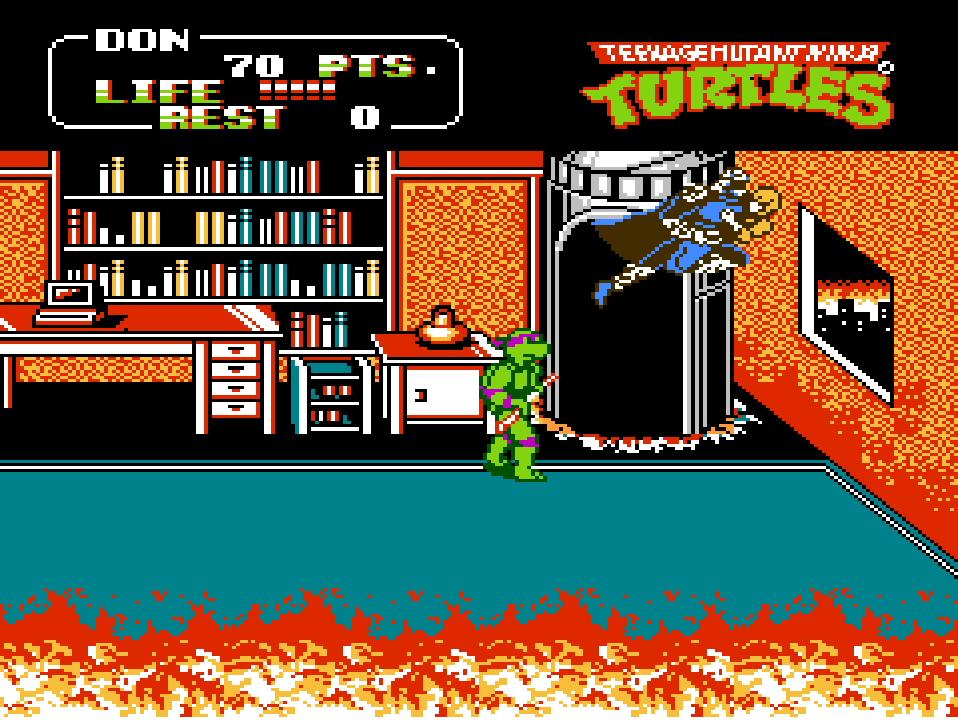
I have to run! I could never hope to defeat a lone ninja turtle severely weakened by a fight with Rocksteady! I'll have to wait until later!

I have to run! I could never hope to defeat a lone ninja turtle severely weakened by a fight with Rocksteady! I’ll have to wait until later!

Since I plan to write about Teenage Mutant Ninja Turtles II – The Arcade Game, I’d like to start in the most logical place: porn. See, I enjoy porn as much as the next guy, but sometimes it feels just a little superficial. And really, who among you can’t say you’ve ever longed for moving, well-written art with an insightful message…and naked people? Well, about a year ago I sat flipping through cosplay pictures when I encountered the blog of an attractive girl ready to burst out of her yellow jumpsuit at the slightest hint of a deep breath. She had some interesting posts, and clearly spent a lot of time at comic conventions seeking out others with well-built costumes. No pun intended. And after about two or three pages of this, she posted a picture of herself, sans costume. See, April O’Neil loves the Ninja Turtles so much that she adopted the cartoon reporter’s name for her own porn stage name. (Go ahead, before your eyes combust: NSFW Just come back and finish my article!) Oddly enough, I found I enjoy thinking, “Wow, some of these people I watch might actually share similar interests with me!” And now her videos somehow seem better.

And that, ladies and gentlemen, explains my stance on Teenage Mutant Ninja Turtles II – The Arcade Game. As I’ve written before, games in the beat-em-up genre really don’t have enough differences to really merit separate reviews for any of them. You choose a character, the game starts, enemies attack, you beat-em-up, then move to the next area of the stage, of which the game usually has five or six. Since developers design arcade games to gobble quarters like a bukkake actress, you usually face difficulty somewhere between “theoretical quantum physics” (on the low end) and “pulling the store sticker off the book/movie/game you just bought without leaving any residue” (on the high). Sure, some of them give you the option of a special attack button, or the novelty of mocking Michael Jackson’s pedophilia hobby, but basically–like porn–these games only offer you different appearances for the same thing. But also like porn, Ninja Turtles makes everything better.

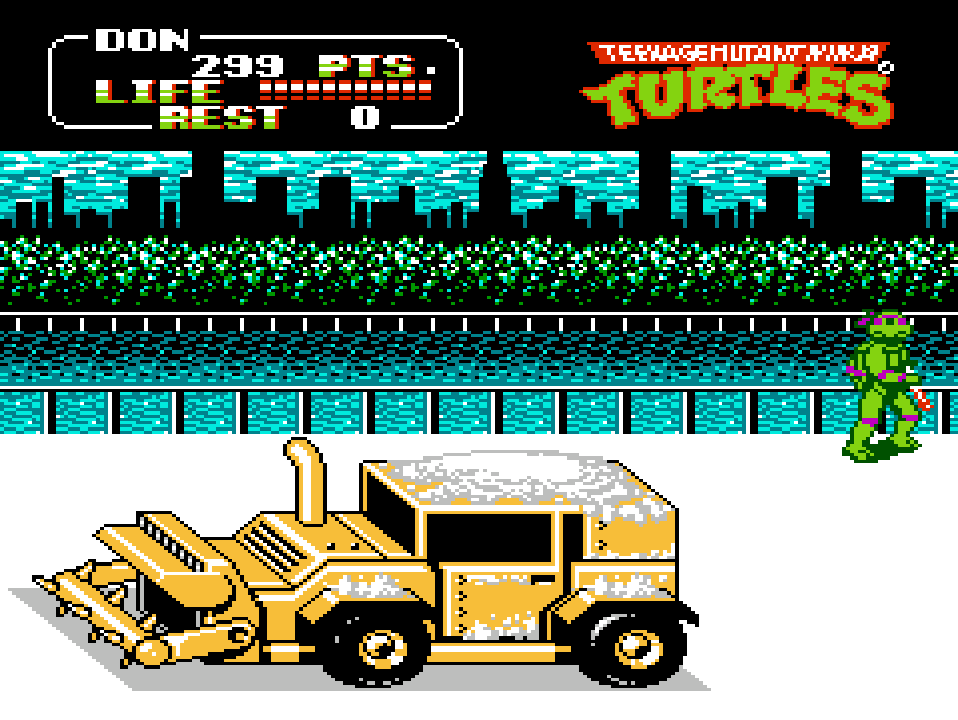
What practical application could this vehicle have? Even assuming NYC didn't purchase this with tax dollars, someone had to have built it and then marketed it to super villains.

What practical application could this vehicle have? Even assuming NYC didn’t purchase this with tax dollars, someone had to have built it and then marketed it to super villains.

In 1989, Konami published two Turtles games–one for the arcade and one for the NES. You might remember the NES game either from the box art that featured Raphael posing with three of his clones, or from the crushing disappointment everyone experienced when they brought the game home and found out they still had to save up their quarters to play the game they actually wanted. While this may have caused two or three…million…people to overlook an excellent–yet difficult–game, I’ve written about that elsewhere. Konami had the more noteworthy reaction to this, realizing people might actually want to play certain games under conditions other than standing up in crowded hovels of jet-engine level noise with a queue of angry kids behind you waiting to play and three beside you trying to mooch the remainders of your dwindling pile of quarters away from you. Roughly a year later, Konami presented Teenage Mutant Ninja Turtles II – The Arcade Game on store shelves as if they had planned on doing that all along.

Pizza Hut bought advertising space in video games long before Barack Obama made it cool.

Pizza Hut bought advertising space in video games long before Barack Obama made it cool.

While I have to hand it to Konami for faithfully adapting the Ninja Turtles cartoon, I also have to applaud them for scaling down an arcade game to an 8-bit system without Michael Bay-ing the quality (yes, you heard me. A coin-eating, side-scrolling beat-em-up game with virtually no plot has more class than any Michael Bay movie I’ve ever seen). I played through both the MAME and the NES editions before writing. Generally, playing an arcade game for free has all the thrill and excitement of shooting craps for sock lint and twigs, so I didn’t exactly expect to need an industrial solvent to unglue myself from MAME. However, I want to say that the NES game stands on its own as the finest gem that ever crawled from the sewers of New York City. Despite scaled-down graphics, most stages remain unchanged except for a few areas (including one complete additional stage), two or three boss battles, and shameless product placement on the part of Pizza Hut. Play control remains smooth, giving the player two whole attacks!–the characters’ weapon, plus a flying ninja kick harder to aim than a bucket of pachinko balls.

Raph needs to double-check his sights before his next jump.

Raph needs to double-check his sights before his next jump.

Character design, unfortunately, doesn’t distinguish between individual turtles, though. Although I understand this design for an arcade game. In the original NES game, I tended to use Leonardo and Donatello. Why wouldn’t I go for the turtle with the pair of sharpened blades, or the guy with a two-meter reach? I imagine late-comers to the arcade cabinet wouldn’t have appreciated the others saddling them with Raphael, the ninja trained in the art of hitting people with a blunt metal rod from a distance just far enough away that the enemy can uncross his eyes. So they shrunk down Don’s staff, blunted Leo’s blades, and added a good deal of oomph to Michaelangelo and Raphael. But if the turtles seem oddly underpowered, fear not. To a limited extent, the player can interact with the environment, hitting conspicuous objects into enemies. Granted, we may have preferred a Special Attack option, but with only two buttons, I guess we’ll take what they offer us–apparently a world where chucking a traffic cone at a trained warrior hurts twice as much as stabbing him with a sword.

...can you repay me like the porn star would?

…can you repay me like the porn star would?

What traces of a story I found roughly reprise the plot of the original NES game–perhaps because Konami developed the games along side each other. The turtles begin atop a building–where you may expect to find sewer-dwelling creatures–with Splinter. Splinter points at a burning building and astutely observes “Fire!” Our half-shelled heroes miraculously divine the correct interpretation from this–that Shredder has kidnapped April (the character, not the porn star) and that they need to chase Bebop and Rocksteady and some other villains from the cartoon to get her back. Halfway through the game you rescue her, but keep going (because…why not?) until you rescue Splinter.

Wow, you know what would really help right now? If someone with jonin ninja skills--or at least sharp teeth like a rat--could break free of that string holding him and give me a fucking hand!

Wow, you know what would really help right now? If someone with jonin ninja skills–or at least sharp teeth like a rat–could break free of that string holding him and give me a fucking hand!

Wait, Splinter? Didn’t we just see him on the rooftop? Did Shredder kidnap April and start that fire just to lure the turtles away from the rat sensei? And if the turtles didn’t need so much as a ransom note, they must have just assumed Shredder intended to…oh, just take my quarters already! I can forgive the lame plot. I can even forgive April for playing into the damsel-in-distress cliche. After all, a reporter doesn’t need ninja powers to do her job. She just has to act charming, know where to find interesting scenes, and look good on camera. Much like a porn star. But how in the hell does Splinter keep getting kidnapped? Every time the Foot Clan comes knocking, the legendary ninja master somehow doesn’t have so much as the skill to squeeze the last of the toothpaste from the tube, much less an ounce of stealth or offensive technique. Maybe, Splinter, you could put up slightly more resistance than Princess Peach? Just once in a while? Show us your moves? Meh. Whatever. National Geographic just told me that elephants can experience symptoms similar to PTSD. Maybe rats can get Stockholm Syndrome.

...help me?

…help me?

I fear I may have hit the bottom of the septic tank for things to say about this game. Pretty shallow for a beat-em-up game, but of course if you dig deeper and get to know your characters, maybe you’ll start seeing it as a master piece of Ninja Turtle Theatre. Unlike porn, people don’t really flock to these games because of their inherent value, so it pretty much demands that you and your game have common interests. So check it out if you like the Ninja Turtles.

Final Fantasy Legend (SaGa) II – Game Boy

1991: Discouraged from invading real countries, the Axis powers reunite to invade fantasy characters' digestive tracts.

1991: Discouraged from invading real countries, the Axis powers reunite to invade fantasy characters’ digestive tracts.

Let’s talk gun control. I don’t like living in a world full of guns and bombs and drones. I never had. Ever since…fourth grade, why not?…I’ve dreamed up method after method that humanity could adopt in order to rid the planet of high tech weaponry. And then replace them with swords, spears, and bows. As a kid, swords fascinated me. No one ever considered me angry, or aggressive, and I don’t think I ever once played soldier.  I didn’t even play pretend in the Middle Ages. I just liked the idea of a fantasy world with magic and dragons and heroes. Heroes, of course, who always wielded a legendary sword, enchanted by some wizard or possessed by the spirits of nature. I lusted for fantasy combat, adventures, traveling long distances and sleeping on the ground. I had a hero’s soul. I needed to live a hero’s life! Of course, two decades later I realize that yearning for a medieval lifestyle requires a fondness for poverty, war, plague, dysentery, and a government that hands out tortures and executions like speeding tickets, and I now consider myself a hero if I can leave a comment on Facebook without igniting a flame war.

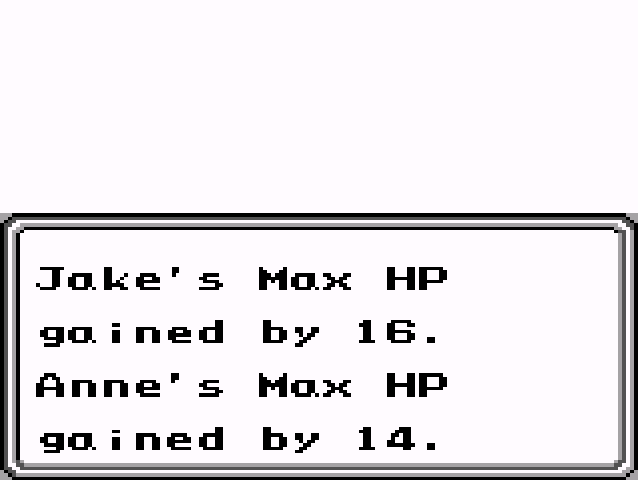
And their grammar grades lost by 20. Hopefully they won't receive too many damages.

And their grammar grades lost by 20. Hopefully they won’t receive too many damages.

But, of course, any excuse to pick up a sword and fight evil would do for childhood Jake, and I suspect that early video game RPGs owe their success to that phenomenon. In retrospect, Final Fantasy and Dragon Quest play as well as children suffering from polio and severe brain trauma, but with no other kids in town they must have seemed agile and imaginative by lack of comparison. But take the aforementioned kid, then add a raging hemophilia and an angry pet hedgehog, and you’ve got the perfect metaphor for Final Fantasy Legend II, a sluggish, bland, poorly translated, glitch-ridden little weevil for the game boy that somehow has garnered high reviews in the 20+ years since it came to the U.S.

"Any distinguishing features?"  "Well, he had a hat."

“Any distinguishing features?”
“Well, he had a hat.”

The second installment of the SaGa series–renamed to FF Legend as a marketing scheme–shares the same inbred genetics of other RPGs at the time. For starters, sometime in the late 1980s, Japan leased out the room full of monkeys trying to reproduce Shakespeare, and instead of waiting for the huge payoff, simply took the coherent shreds of text and built games around that. One particular monkey hammered out the word “magi,” which Squaresoft executives looked at and agreed it resembled the word “magic.” Thus, FF Legend II tells the story of a generic hero character with a human father no matter what race you choose, who has to collect magi from the nine worlds in order to kick evil’s ass. The game chucks a decent number of macguffins at you to keep you moving with little or no explanation–as any early RPG should–and any claims elsewhere that praise the game’s character development have clearly confused “dynamic character with a complex personality altered in a significant way by the events of the story” with “forceful, repetitive combat to simultaneous grind your level up and the buttons on your game boy down.”

Uh, as per California state law, I'll require positive verbal consent before this level.

Uh, as per California state law, I’ll require positive verbal consent before this level.

Final Fantasy Legend II doesn’t really have characters. They have text to tell you what to do next, but they really emphasize combat above all else. I would complain that the extremely high rate of random encounters sends me into battle on a single step away from my previous battle, but two or three times I finished fighting monsters, then without moving I hit the menu button, only to immediately get sucked into another battle. Again, as fits the style of the time, characters fall drastically short of effective combat stats, and the groups of monsters often more than 10 at a time regularly pose a risk of slaughtering your party. Upon death, Odin will appear and offer you the opportunity to repeat the fatal battle as often as necessary, but except for once or twice, but often the cause of my demise hinged on the size of the enemy hoard preventing any chance of victory, so I’d take up Odin on his offer only to run from the monsters when I could.

...can I politely decline to receive the Rhino's meat? That sounds painful.

…can I politely decline to receive the Rhino’s meat? That sounds painful.

As if wading through a world filled elbow-deep with enemies like a claw crane machine didn’t slow down the pacing enough, characters don’t earn experience or level up in a traditional sense. The best I can determine, the game awards stat bonuses based on actions in battle, like in Final Fantasy II (NES). However, you select your party from a list of humans, mutants, robots and monsters, and only the humans and mutants seem to get these stat bonuses. The robots improve states based on equipment–as one might expect a robot to do–and the monsters transform into other monsters by devouring the corpses of your fallen foes. So after hours of grinding, I had a human who could deal formidable damage at a reasonable speed, a mutant who could sometimes pick off a few enemies if he lasted long enough, and a robot and a monster who only contributed to the battle by presenting themselves as targets.

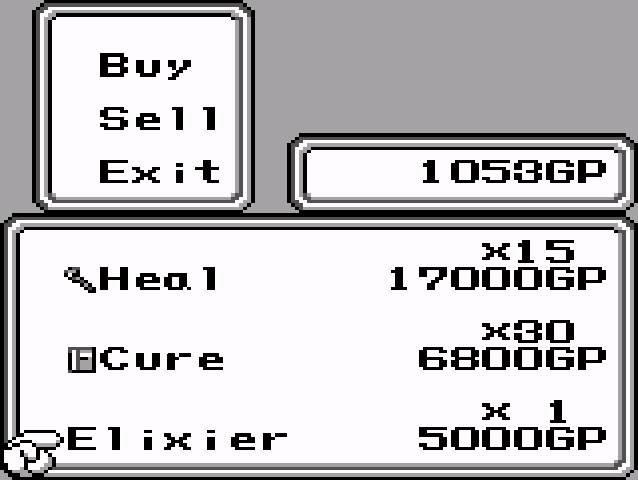
Each item even more elixier than the last!

Each item even more elixier than the last!

If you ever suspected yourself of having a trace of OCD, avoid this game for its menus. Characters can equip a set number of weapons, magic or items, but as many as they want of each. Except for armor. And certain spells which seem character specific. And a few abilities that don’t seem to do anything. Oh, and the monster can’t equip anything, which limits how much your party can carry. Once again as usual for this era of RPGs, the game treats healing items and spells like novelty trinkets, dropping them here and there when it thinks you might have some cash to spare, and kindly exiting the menu after a single use. How much did you heal, 30 HP? That should easily get you through the next dozen battles with 15 monsters apiece, each holding fully automatic rifles and a belt made from the thumbs of previously defeated players.  But apparently Square felt they needed to make the game just a little harder, so the equipment degrades with each use.

Now, I’ve seen equipment degradation done right. Well, maybe “well enough,” would more accurately describe it. I mostly worked in Fallout, although I did get tired of lugging around a half dozen suits of power armor as spare parts. Here, I can understand how combat might reduce the strength of a sword over time. I can even picture a shield, dented beyond use. However, when merely raising the shield in front of you reduces its life span, I have to wonder whether a material that degrades in a slight breeze would effectively block so much as an angry butterfly, let alone any potential enemy attacks.

After days of grinding, I finally have the stats to...what the hell? Five?

After days of grinding, I finally have the stats to…what the hell? Five?

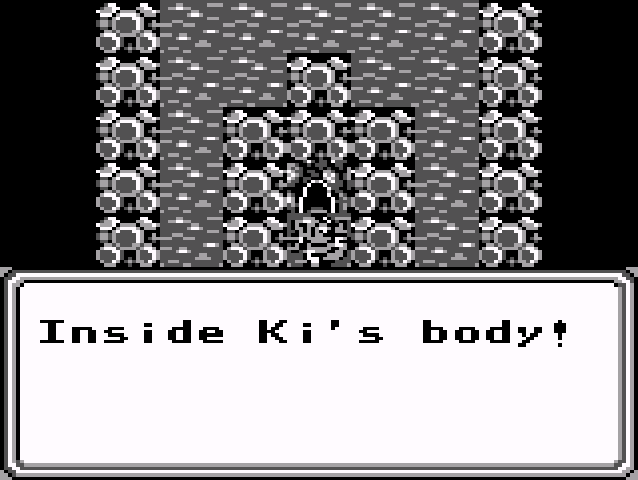
For all its faults, I would have slogged through this all the way. I did finish all the main-series Final Fantasy games, as well as both Dragon Quest games I’ve played. And I could see how a hand-held level grinder might have some value on a long car trip with a family you’d much rather ignore. However, the game has glitches. Fatal glitches. For instance, if a character runs out of viable options for use in battle, the other characters, apparently not wanting him to feel bad, will stop doing damage to enemies with their own attacks. I did pick up two items marked “power,” but can’t tell you what they do since using them freezes the game upon exiting the menu. However, most fun of all the glitches, somehow I triggered one that resets the game as you attempt to open a passage leading to the next area of the story. I’ve respectfully gone through games that I didn’t want to play after a little while, but I’ve never played a game so rude that it didn’t want me to play it. Maybe now I can find the FF game boy game that spawned the Seiken Densetsu (Secret of Mana) series.

(NOTE: A remastered edition of this game exists for the NDS. It probably has worked out the glitches; however to play it in English you’d have to find the fan-translated ROM hack, as they never released the game outside of Japan)

Soul Reaver 2 – PS2, PC

legacyofkainsoulreaver2-01
This link takes you to page one of Finnegan’s Wake, a 1939 work by James Joyce that demonstrates both the limits of beginning a story in media res, and a depressing vision of what literature looks like after it suffers a massive stroke. I hope by drawing a comparison between a book that uses the term “bababadalgharaghtakamminarronnkonnbronntonnerronntuonnthunntrovarrhounawnskawntoohoohoordenenthurnuk!” and Soul Reaver 2: Legacy of Kain, I will make it very clear how I felt about this game. “But Jake,” you ask, “Why play through Soul Reaver 2 when only a few weeks ago, you clearly did not like or finish the original?” I have a very complex response to that, involving the tendency of video games to improve upon their originals, but really, Anne gave me the game as a gift, so I had to play it. Kind of like inscribing “Homer” on the disc. She wanted to see it, but didn’t actually want to play it herself. Now I understand why.

So as I mentioned, you select “start new game” from the option menu and the game immediately expects you to understand the names of the characters, their back stories and motivations, game mechanics, the history of Nosgoth, macroeconomics, the depths of human psychology, the meaning of life and the true nature of the universe. Also I suspect a few lines of dialogue from the end of the first game would have helped out a little. I suppose, however, the game doesn’t quite deserve the comparison to James Joyce I previously made–the characters use English words with proper sentence structure and grammar, but the content of the text sticks together with all the cohesiveness of a thin film of pond scum. Characters–usually Raziel–tell the story through extensive internal monologues in an accent as authentically British as french fries. The writing carries a very refined sense of self-importance, sounding very lofty, as though an E. coli patient swallowed the King James Bible.

These things. They matter. Apparently. Also, watch Raziel float like a plastic action figure! No Deku leaf required!

These things. They matter. Apparently. Also, watch Raziel float like a plastic action figure! No Deku leaf required!

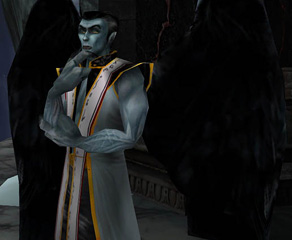
Customarily, I give you a synopsis of the story, but honestly, I have no idea. Soul Reaver 2 breathes life into the term “convoluted.” It opens with a verbal spat between Raziel and Kain. Then comes Moebius, who I assume we met in the last game, and whose name in no way indicates the cyclical nature of the plot twist or time travel. Themes of the sword–the Soul Reaver–seemed to spring up time and time again. I also picked up that Raziel somehow longs for his pre-vampire human form because of his former goodness and nobility, but–spoilers–he becomes disillusioned with himself after…witnessing his human self kill a vampire? Even evil Raziel mentions early in the game that vampirism “is a plague and had to be wiped out,” but somehow felt morally opposed to the persecution of vampires. Also they talk about some pillars. Apparently somehow these pillars broke and it bummed everyone out. No one ever bothered explaining why. Kain, the ultimate evil upon whom Raziel swore vengeance, skulks around like Smeagol, having pleasant chats with Raziel instead of fighting to the death. Also the Elder God, apparently Cthulu’s estranged cousin or something, appears every so often to have no bearing on the plot whatsoever.

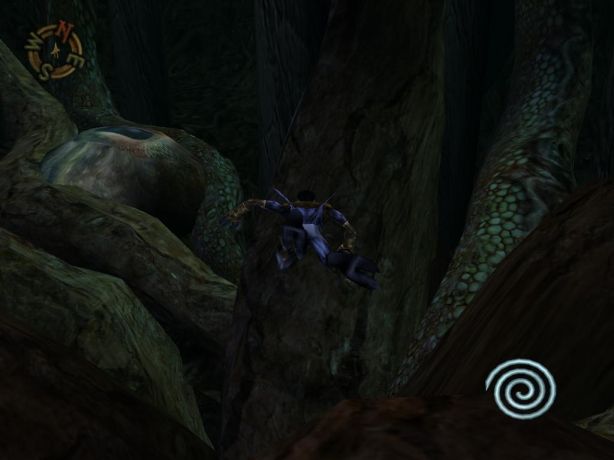
Gameplay involves Raziel running through the Nosgoth, a magical land where every location connects to exactly two other locations adjacent to it. Raziel runs from one end of this course to the other, backtracks, travels through time, then runs through Nosgoth again. Along the way he walks past enemies who would otherwise take too long to kill, recites bland, lengthy monologues, and occasionally pushes some blocks or flips some switches, all the while spending hours and hours lost. In pitch black environments. While people may enjoy video games with “dark atmosphere,” developer Crystal Dynamics may have taken that term a bit too literally. To quote writer Amy Henning’s wikipedia entry: “She also feels that focusing too much on graphics can inhibit a game, saying that once game writers focus on creative expression, video games will greatly improve.” I agree wholeheartedly. But could you at least focus enough on graphics to give us, say, a wall or a floor. Maybe a flashlight, at the very least? People don’t understand how to use darkness and light. In real life, darkness scares people. You don’t know what lurks in the shadows. You have to rely on other, lesser developed senses. However, darkness in a video game usually means tapping buttons unresponsively while staring at a black rectangle and wondering whether you should make ramen for dinner or order a pizza.

No did I just find a door, or the floor. Or the ceiling. Or did I visit the night side of Pluto? And get this--the section I described in the post, even darker than this one!

No did I just find a door, or the floor. Or the ceiling. Or did I visit the night side of Pluto? And get this–the section I described in the post, even darker than this one!

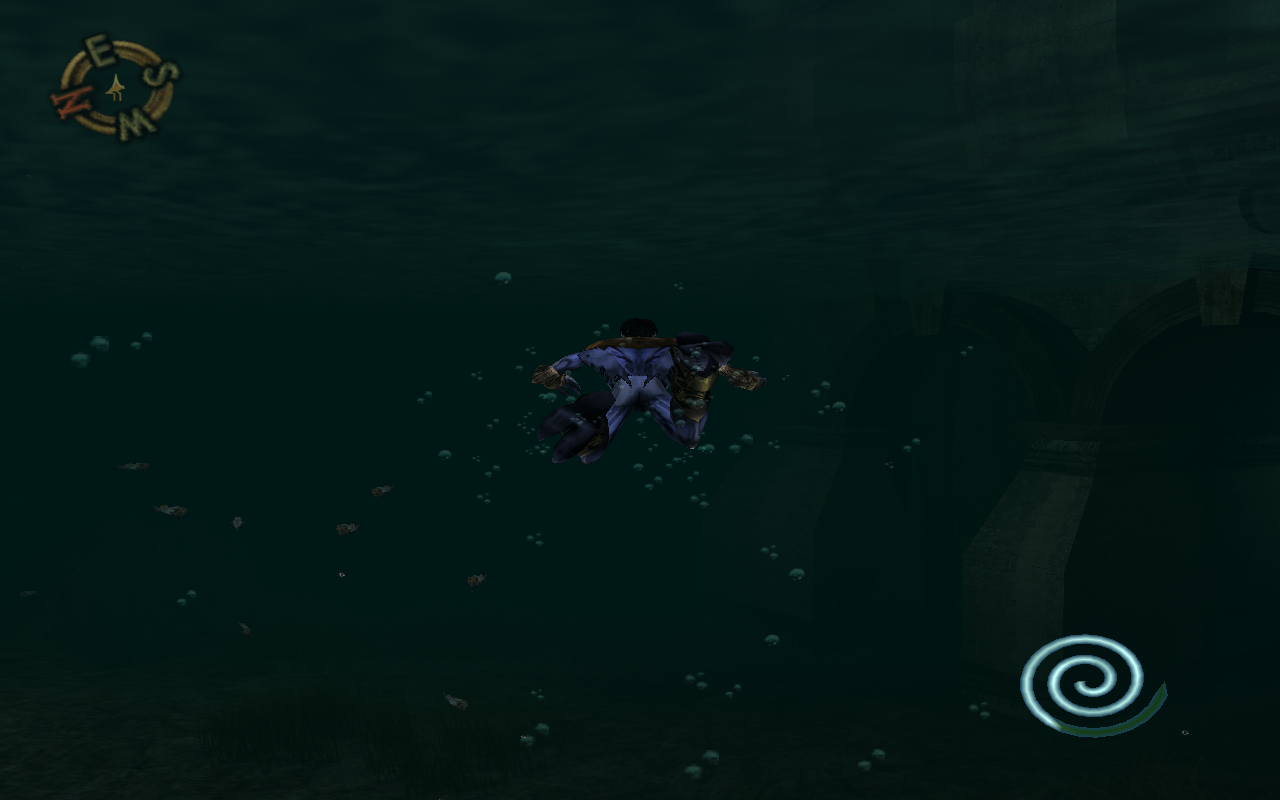
Even better, the game sends you through an underwater labyrinth of caves where the Elder God dwells, utilizing a swimming mechanic that works as well as folding laundry underwater. So in a pitch black environment (with a handful of glowing rocks every so often), you have to navigate through hidden tunnels with a “jump out of the water” button combination that will send you shooting downward (or sideways) if you nudge the control stick even a smidgen of its zeroed axis. And even better yet, the game makes you do this three damn times! I guess they really wanted you to talk to Squidworth. You know, some deep-sea creatures have bioluminescent qualities….

Who lives in a cesspool deep down in the ground? Who turned all the lights off and cannot be found?

Who lives in a cesspool deep down in the ground? Who turned all the lights off and cannot be found?

Crystal Dynamics deserves some credit for fixing a few of the more obnoxious features from the previous game. For instance, you can kill enemies on your own now, instead of hunting around for a boy scouts with some flint to finish them off. Puzzles have also improved, albeit only slightly. If the first game said, “We gave you some generic video game stuff. Do it,” Soul Reaver 2 says, “We finally figured out how other games use these generic video game things. Now do that.” Except do them right, because not only did we not focus on graphics, we also didn’t bother fixing glitches. The game has a number of them, usually the result of failing a puzzle. At one point, I had to float from one side of a cathedral to another without dousing a torch in the pool of blood filling the room. I made it across, but couldn’t figure out what to do with the torch in time. Then the blood rose so high that it covered up everything I needed for the puzzle. I finally figured out that the game had done something wrong–not me–when I swam from one room to the next and fell to the floor, looking back on a room full of blood polite enough to not cross the threshold unless invited.

A save point. The game generously gave you two or three of them. Don't start playing unless you definitely have three hours to kill at a time.

A save point. The game generously gave you two or three of them. Don’t start playing unless you definitely have three hours to kill at a time.

A further improvement, the soul reaver sword doesn’t vanish when you get hit–although that doesn’t exactly make combat smoother. If you kill an enemy who has a weapon, the reaver will automatically equip you with that weapon, which all invariably have far less strength than your reaver, and which Raziel can’t use quite as quickly as his opponents can. So combat often involved me dashing for cover, trying to put down weapons so I could use the useful attack again. The reaver does also inhale enemy souls before you can use them to refill your life, but considering the massive amounts of health I lost while whittling my enemies away with a weapon only slightly more powerful than a bronze toothpick, I never saw any reason to not use the reaver. Unlike in Onimusha, where souls come straight to you when you call, like a faithful and well-trained Labrador, when Raziel calls souls, they act like cats, fat and sluggish, interested in the treat you have, but kind of lazy after the big meal they just ate.

Unfortunately, small tweaks that bring the game up from “beginner’s effort” to “uninspired” don’t really make the game worth playing. I found it tedious and frustrating–like when I encountered enemies shorter than Raziel’s waist. He swings his sword in waist-high horizontal strokes. Only. So I’d always have to lure these monsters to a hill or incline because my character, named for the Hebrew Angel of All Knowledge, couldn’t figure out the first trick that Link learns in every game. Then by the end, approaching the nearest thing the game has to a boss fight, they hand me an upgraded soul reaver that makes Raziel invincible. Totally invulnerable to anything. For the rest of the game. Yeah, I suppose the plot twist after the final boss did entertain me for about ten seconds, but seriously…why even have a battle if you can’t die.

I spent a lot of time looking for this guy. Raziel felt very close to him during the three minutes of screentime he has. This is him wonder why.

I spent a lot of time looking for this guy. Raziel felt very close to him during the three minutes of screentime he has. This is him wonder why.

With writing full of cliches like “this opened my eyes!,” stupid puns like “feel the pull of history” as some mystical force drags me across the room, and human enemies lobbing taunts learned in a night-school course on one-liners for minor characters in fantasy games, I easily grew bored. The relentless monologues put me to sleep and the hoity-toity language just sounded like a sophomoric attempt to sound cultured. At one point Raziel shouts out the phrase, “Spare me your elaborate metaphors!” Please do, Soul Reaver 2. Please do.

Super Mario World – SNES, Game Boy Advance

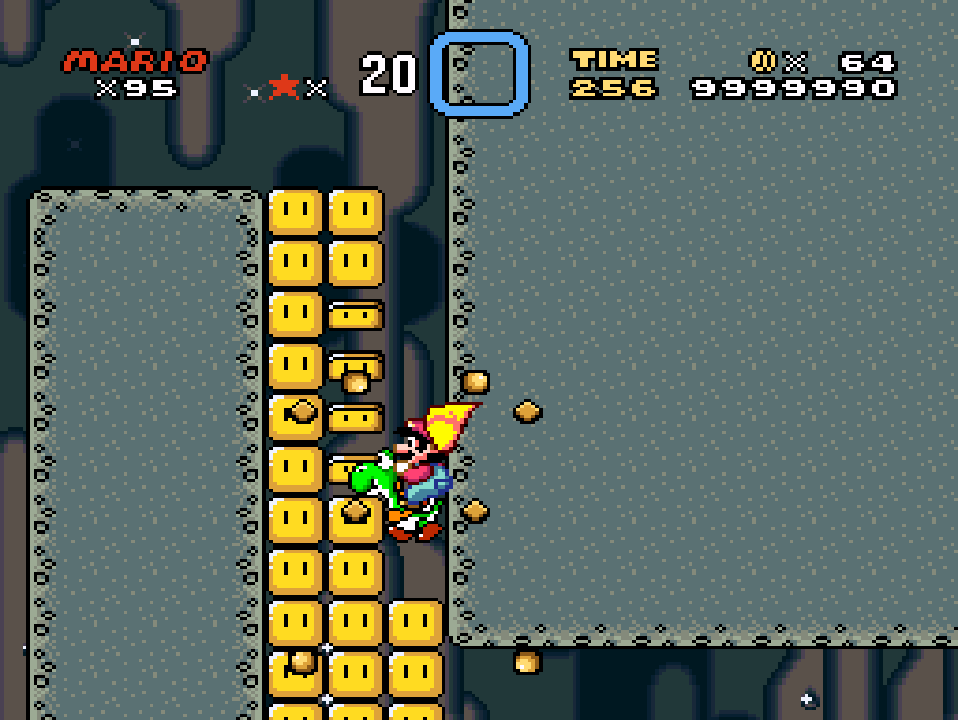
By the way, anyone who can surpass my score (without hacking) gets their own shrine set up on this blog. Good luck.

By the way, anyone who can surpass my score (without hacking) gets their own shrine set up on this blog. Good luck.

One night a while back, I finished a game rather early in the evening. Anne put on a movie, and I found myself with nothing to do. I needed something to keep my attention (and I didn’t feel like watching Paranormal Activity 4 for the twenty-seventh time), but without making too much noise or launching me immediately into another long-term game commitment (see, I just got out of a serious game and don’t feel ready yet…). So congratulations Mario! I finally found your strengths as a game! Now get in there and let me do some low-thought, mindless time-killing!

Disco ball and dancing ninja star reused from Nintendo's failed attempt at putting Mario into a DDR game.

Disco ball and dancing ninja star reused from Nintendo’s failed attempt at putting Mario into a DDR game.

I know I’ve railed on Mario in the past, but I suppose I should confess–I don’t actually hate Super Mario World. Before you picture me throwing myself to the ground in self-flagellation driven by my sorrow for having offended the mascot-god of video games, let me list a few other things I don’t hate: the Star Wars prequels, Pauly Shore, banjo music, China’s one-child policy, and ancient literature. While Mario did invent the primary plot device of Man vs Gravity, I shouldn’t draw and quarter him for the fact that every other game developer took platform jumping, avoiding holes and collecting hoards of coins and junk like a pack rat with ADHD as Aristotle’s Unities of Gaming. Of course, if so many industry professionals can look at Mario and miss the point as badly as a prostitute sucking on an elbow, what chance to I, a mere hobbyist, have of saying something profound? Well, remember that “industry professionals” have also brought us the controller with an “annoy Facebook” button and a camera that lets Microsoft watch you like Norman Bates.

Apparently, beating the special zone turns the island into mint chocolate.

Apparently, beating the special zone turns the island into mint chocolate.

I’ve previously compared platformers to religion. They appear simple on the surface, but require constant practice, which usually demands tedious repetition (apparently, society feels that I need to hear about Jesus’ torturous execution every single year, but that one time I eked out a C in differential calculus pretty much got the point across for my entire life). Furthermore, if you want to find any value in them, they have to hook you young, otherwise people won’t really understand why they should invest all their time into getting better at it. That last point explains why I can–occasionally–enjoy Mario, whereas that time Knuckles and Tails showed up at my door asking if I’ve accepted Sonic as my personal lord and savior of all woodland creatures, I slammed the door in their face. Mario games don’t really have an advantage over Sonic, but I never had a Genesis as a kid. Likewise, I can mumble through the Nicene Creed in a pinch, but don’t know anything in Hebrew and can only name one Sutra, albeit not for religious reasons.

What, you mean like the vacation they took to Dinosaur Land that got them into this whole mess?

What, you mean like the vacation they took to Dinosaur Land that got them into this whole mess?

So like the birth of Christ, what story requires such intense study that we need to repeat it in about 50 different games? Bowser kidnaps Princess Toadstool (Peach, to her friends). Okay, okay, so Super Mario World does have a bit more than that going on. Mario, Luigi and the Princess went on vacation to Dinosaur Land because they apparently thought Jurassic Park looked relaxing. Toadstool disappears. Mario and Luigi find a dinosaur, Yoshi, trapped in an egg who tells them about Bowser. Then they take turns punching Yoshi in the head, force-feeding it bullets, bombs and sentient creatures, and dropping him into pits. After they do this for a few hours, they beat bowser and rescue the princess. No innovations there. We always knew Mario had a sadistic side–which, I suspect, encourages the princess to run off with Bowser so often.

Get used to this screen. You'll spend more time going back and forth to this area than you'll spend playing each level.

Get used to this screen. You’ll spend more time going back and forth to this area than you’ll spend playing each level.

How about the game play? I could tell you about that. Let’s see…you collect coins, as usual, but now they’ve introduced another type of coin. Likewise, you need to find power-ups, but this time you find a feather that makes you fly instead of a leaf. You still go through pipes (because dinosaurs invented plumbing?), but sometimes the pipes will shoot you out like a cannonball. You break blocks, but…you know what? This game doesn’t really care about gameplay. You get to ride Yoshi. Everything else, they lifted straight out of the Mario formula. This game exists for the sole purpose of showing off the power of the Super Nintendo. In fact, has Nintendo sold a console since the SNES that came with a bundled game?

Genius! I would have posed for a lot more family portraits if I didn't actually have to pose with the rest of my family.

Genius! I would have posed for a lot more family portraits if I didn’t actually have to pose with the rest of my family.

Of the few noteworthy things to mention about the game itself, it has a now rare appearance by Bowser’s own litter of minions, the Koopa Kids–although, since the series never mentions any romantic interests for our reptilian antagonist, it forces me to question their maternity. What exactly does Toadstool do with Bowser? Does this mean that Rosaline shares some DNA with Lemmy? The koopalings all bear names suggesting famous musicians, as well as the new Fortress Mini-Boss, Reznor. Technically, this feature sprang from Super Mario Bros. 3, but I mention it here because it seems odd that in a game celebrating music, every last fucking level uses the same damn melody! Koji Kondo, well known for his musical variety on the Legend of Zelda series, decided to play it easy for Super Mario World, and just wrote variations on the same theme for each stage. Don’t get me wrong–he wrote them brilliantly. But that sort of repetition has an insidious tendency to take root in my brain and never leave.

Actually, that seems like a very good description for this game. You won’t get rid of it. Ever. In fact, you didn’t come here to decide whether or not you want to play this game. If you’d like it, you already know. If not, keep moving. And since I have so very little to actually say about Super Mario, I’ll give you some bonus screenshots. Enjoy.

Mario World's walk of fame. Clockwise from the top: Mario, Luigi, Yoshi, Bob Hoskins, Fox McCloud, with Zsa Zsa Gabor in the center.

Mario World’s walk of fame. Clockwise from the top: Mario, Luigi, Yoshi, Bob Hoskins, Fox McCloud, with Zsa Zsa Gabor in the center.

Try this, if you will...we know Mario will head straight toward the boss room, right? How about you take out the platform entirely and have Larry watch via CCTV from another room?

Try this, if you will…we know Mario will head straight toward the boss room, right? How about you take out the platform entirely and have Larry watch via CCTV from another room?

Note the look of shock on the adult Yoshis' faces. I can only assume they expected contained rubber gloves, IRS Forms and a healthy mixture of mud.

Note the look of shock on the adult Yoshis’ faces. I can only assume they expected contained rubber gloves, IRS Forms and a healthy mixture of mud.

Leisure Suit Larry: Land of the Lounge Lizards – DOS

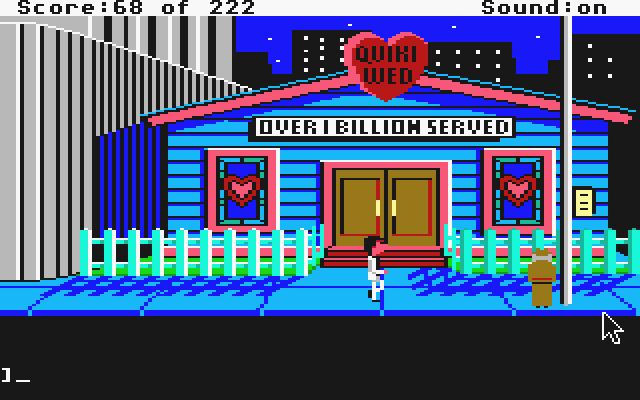
Ah, the beautiful sanctity of marriage. Such an auspicious and respected tradition.

Ah, the beautiful sanctity of marriage. Such an auspicious and respected tradition.

Sometime early in college, my great Uncle Harold upgraded his computer.  Essentially my grandfather, Uncle Harold has some impressive traits for a senior citizen. One, as an early adopter of technology, he always has the latest gadgets (usually photography-related) well before anyone else in my family. Two, although he doesn’t flaunt it like a lot of old men, he has a vibrant, private dirty side to him. And while I may not yet have found his alleged hoard of Playboys, I did receive a pleasant surprise when he gave me his old Windows 95 computer (in 2002) and a box full of unmarked 3.5 inch floppy disks. Let me stress the term “unmarked.” While most of them had nothing of note on them, two of them caught my attention. On one, what I can best describe as an extended animated .gif, a woman having sex demonstrated the technological capacity for photo-realistic breast-bouncing. To put it mildly. On another, I found that for all of Uncle Harold’s subtle disapproval of my reading fiction and playing video games, he had indulged in a lively, lighthearted little legend among electronic gaming, Leisure Suit Larry and the Land of the Lounge Lizards.

You couldn't call a game about the quest for anonymous sex complete without a good, moral lesson about public exposure.

You couldn’t call a game about the quest for anonymous sex complete without a good, moral lesson about public exposure.

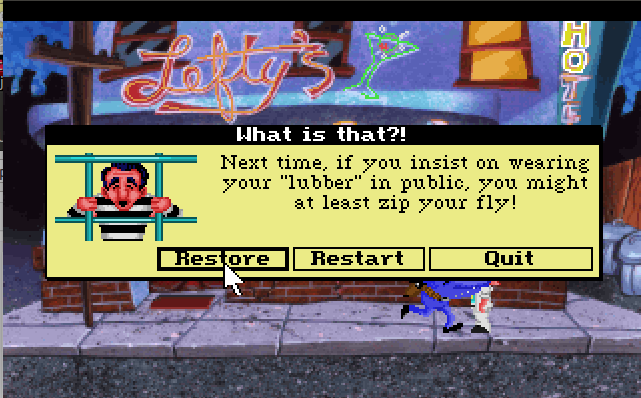
Sadly, for all my interest in classic SNES-era RPGs, I’ve found that entries with terms like breasts, penis, sex, bdsm, and any other of those erotic terms I can figure out how to squeeze into the text are really the entries that drive viewers to my blog. Since I’ve finished all the Mystique Swedish Erotica series, I had to look around for something new. Fortunately, I’ll have underground sex games aplenty should I ever need to up my viewership. For now, after spending about a week with Larry Laffer, I have, let’s say, “unlocked a new achievement”: Two in a row! I have just abandoned my second game in a row due to overpowering tedium!

Wait, let me get my calculator...sorry, I can't find the beer button.

Wait, let me get my calculator…sorry, I can’t find the beer button.

Let me get the background out of the way, first. Leisure Suit Larry tells the story of Larry Laffer, a 40-year-old version before Steve Carell made it cool, on a quest to get laid. I guess publisher Sierra had a different approach to the concept of “virtual reality.” I play games for something unusual and interesting! Not to relive ten years of frustration! Anyway, over the course of an evening in Las Vegas, Larry must go through all the proper steps of wooing women–boxes of candy, jewelery found in a men’s room, expensive wine, and other gestures that came off as hackneyed and cliched at a time when movie stars still rode off into sunsets and people wrote stories on papyrus. The game comes in two forms, the 1987 text parser adventure (type commands via keyboard) and the 1991 remake, which uses a point-and-click interface, and an upgraded resolution that can show more realistic looking anatomy, including shaded breasts and nipples–but chooses not to do so. Keepin’ it classy, eh, Larry? I hate to break it to you, Sierra, but your attempted humor has all the appeal of a Tuesday night strip club–a few drinks might make it interesting, but I’d still rather go home and sleep.

Because all adults can agree on the appropriate answer to this question, furthermore, without acting like children.

Because all adults can agree on the appropriate answer to this question, furthermore, without acting like children.

Stepping up to the plate for your first attempt at swinging, the game first pitches you a quiz. It asks you for your age, and if you answer in the range of 0-15 or over 100, the game automatically kicks you off.  Apparently seeing the hints of pixilated cleavage and a square representing an erect nipple through a dress might just cause centurions to have heart attacks, or send a 15-year-old boy spiraling into a den of sin from which he’ll never escape. No problem with 16-year-olds, though. Apparently, sex adventure games rate somewhere less than “R” and higher than “PG-13.“ Next problem I encountered, the game quizzed me to make sure I fell in the 21-39 range I claimed after I stopped trying to have fun by playing a game and fess up honestly. Apparently, Sierra has developed a crack formula for determining information that all adults know, but would mystify anyone younger than 16. Mainly that consists of knowing intimate details about the Nixon administration, including knowing all three vice-presidents from 1973-1974, the fact that Ford didn’t ever win a presidential election, and a running tab of U.S. attorney generals. Fortunately, I could guess the number of calories in a can of beer and look up the star of “Bedtime for Bonzo,” but I disagree vehemently with the game when it said that showing up to a party in your birthday suit would not “a: Help you make a lot of new friends.” I guess I could consider finding ways to age restrict what they perceived as a racy game as a noble attempt, but half that stuff I knew by the age of 12, and the other half I had to rev up my brain into GRE mode just to have a shot at answering. I’ll admit I don’t know what germ causes syphilis. I’ll wager a majority of the people with syphilis don’t even know the name of the germ, and the majority of them have a minimal knowledge of germs in general.

Losing all control when someone shows you porn seems like a bad quality in a man who sells naked women for a living.

Losing all control when someone shows you porn seems like a bad quality in a man who sells naked women for a living.

By the time I got to the actual game, I first took note of Larry, moving around the screen with all the vivacity of a sedated tortoise suffering from severe depression. After about an hour of playing, I noticed an option in the menu for increasing the game’s speed. It baffles me that anyone thought people would welcome this option. If you need five minutes to mentally adjust to the idea of crossing a room, you should avoid video games of any sort. Seriously, if you need to play LSL at anything less than the fastest setting, a rousing game of solitaire could trigger an epileptic fit, and something like Minesweeper could put you into anaphylactic shock. I also didn’t appreciate having to repeat commands, reading graffiti or flipping through TV channels ad infinitum just to read through every last pitch for a joke that went around the developer’s table. Comedy relies on speedy timing, and having jokes delivered on the backs of snails does tend to ruin the jokes. By the time I did figure out I needed to enter the command multiple times, I had enough time to notice that since the TV used a rabbit-ear antenna, I would not likely find the porn flick that eventually distracted the pimp on a broadcast station.

Finally, Larry, you've found some wholesome wife-material. Take this one home to meet mom!

Finally, Larry, you’ve found some wholesome wife-material. Take this one home to meet mom!

In addition to that, the game includes such interesting behavior as a) handing out booze like spare change, thus ensuring a speedy death via alcohol poisoning to any drunk who might have randomly useful shit in his pockets. b) A woman proposing to a complete stranger who gave her a diamond ring, then danced with her, because when it comes to the gray area of fucking a stranger, only marriage will somehow clear up any moral ambiguity. Because she shouldn’t worry at all about the syphilis germ. Or her potential death at the hands of a possible serial killer. And, of course, I have to mention the coup de grace, c) censored sex scenes. Yes, ladies and gentlemen, in a game preying on humans’ instinctive attraction to sex, a game involving a rigorous age filter, a game about a balding 38-year-old hobbit looking to score, every time the pants come off, the black “censored” bar goes on. Custer’s Revenge had more erotic moments than Leisure Suit Larry. Fuck it. Skip this game and just go to Red Tube.

What the fuck? Literally! Their parts may have the lowest resolution this side of the Atari 2600, but I think I deserve it for having slogged through the unintuitive muck of this game.

What the fuck? Literally! Their parts may have the lowest resolution this side of the Atari 2600, but I think I deserve it for having slogged through the unintuitive muck of this game.

Legacy of Kain: Soul Reaver – PS1, Dreamcast, PC

RetroArch-1101-224326

I knew it would come to this eventually. When I decided to play every game worth playing–and some not worth it, but nevertheless amusing–I made every effort to finish the game before I wrote about it. I couldn’t always keep that promise: some games have no real end, while games like Donkey Kong would require unemployment, a government grant, and ten years of having literally nothing better to do than jump over barrels in order to get to the kill screen. Also, Bubble Bobble kept crashing and Gauntlet just got boring after 64 virtually identical levels. But I knew eventually I’d find a game that would force me to quit just due to its sheer awfulness. A game with not only picture and sound, but a pungent aroma–probably of dead fish. As of tonight (and by “tonight” I mean November 5th when I actually wrote this), I have found that game. Ladies and gentlemen, if Satan himself handed me a clarinet carved from his own petrified shit using a reed soaked in Drano, I would rather play that then Legacy of Kain: Soul Reaver.

Yep...spectral realm here. Not too much going on. Nice and blue, though.

Yep…spectral realm here. Not too much going on. Nice and blue, though.

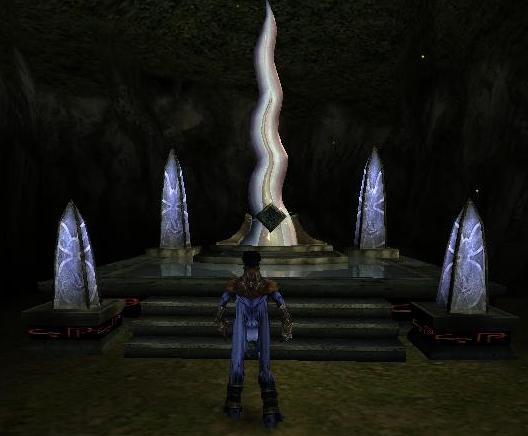
Soul Reaver draws inspiration from arcane Hebrew myth in a way that makes God of War look as canonically accurate as Bullfinch’s Mythology. You play as Raziel, named for the Jewish Angel of Knowledge, God’s own version of Astinus of Palanthas, who records all knowledge and delivered a book of magic to Adam and Eve with the instructions to help them return to Eden. Naturally, none of that interested the designers, so instead they give us an anthropomorphic hoover vacuum cleaner. A former servant of Kain, one day Raziel sprouts a pair of wings. Kain passes up the chance to found his own personal Luftwaffe, and interpreting these wings as an obvious threat to his manhood, rips them off with his bare hands, and to add more injury to injury, drops you into a swirling lake of fire to burn for eternity. Eventually, an Elder God revives Raziel and empowers him to take his vengeance upon Kain, entirely ignoring the fact that the past few thousand years has reduced the world to a post-apocalyptic shit hole with no one in it but a few monsters and nothing to do except writhe in the agony of boredom.

Here we see light. Not sure what it means, but it broke up the monotony.

Here we see light. Not sure what it means, but it broke up the monotony.

If we can describe games like Resident Evil 4, 5, and 6 as “action packed” and Metroid or the Legend of Zelda as “adventure packed,” then Soul Reaver proudly sports the label of “unpacked.” Critics in the late 90s may have praised the game for its dark, gloomy atmosphere. Perhaps they wouldn’t have focused on the atmosphere so much if the game didn’t had any other aspects to it. Raziel runs through a sparse, open world much like a hamster dropped into a brand new maze. Everything looks the same; kind of a dull brownish-green, a lot of rocks, stones, dark sky and murky water. Large portals connect various parts of the game, but labels each one with an complex symbol and no text, handing you about half a dozen of these things straight off with no context for why any of these locations matter. Raziel could pull out a GPS unit, input a location, and the thing would shoot back, “Sorry dude. Even I can’t find this one.” I spent most of the game just looking for the next important location, running through a big empty world, trying to avoid the random enemy the game so graciously bestows upon us every so often. And to make matters worse, upon loading a previously saved game, you get to start from the beginning! Of the entire game! Good luck finding where you left off! I’ve come to grips with the fact that even accomplished players often have to consult a walkthrough, but when my time playing versus time reading ratio reaches 1 to 9, I figure I might as well go all out on the walkthrough and save myself some money on the electric bill.

Use this portal to exchange the green filter for a blue one, but blue filters make you too weak to turn a door knob.

Use this portal to exchange the green filter for a blue one, but blue filters make you too weak to turn a door knob.

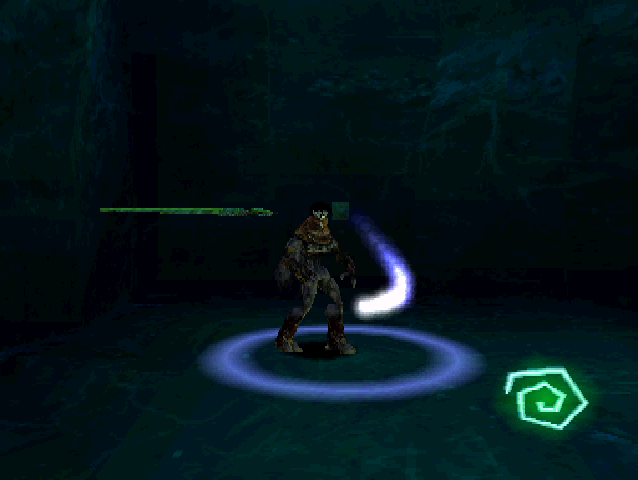
The game’s core feature lets players shift between two parallel realities, the spectral plane and the material plane, kind of like the light world and dark world from A Link to the Past, if you never picked up the moon pearl and had to play as the bunny while in the dark world. In the spectral realm, Raziel can’t alter or interact with anything physical. He can’t carry weapons, open doors, push blocks, but he can walk on rickety platforms and survive underwater. Don’t get too excited about that, though; they rarely do anything with this. I imagine Soul Reaver’s developers as the kind of people who could stumble upon a huge supply of gold and use it to weigh down a handful of papers in their office so they wouldn’t blow around when they chucked the rest of the gold into the alley behind the building.

As if sliding blocks didn't insult us enough, they actually managed to make it more infantile by putting it on a track.

As if sliding blocks didn’t insult us enough, they actually managed to make it more infantile by putting it on a track.

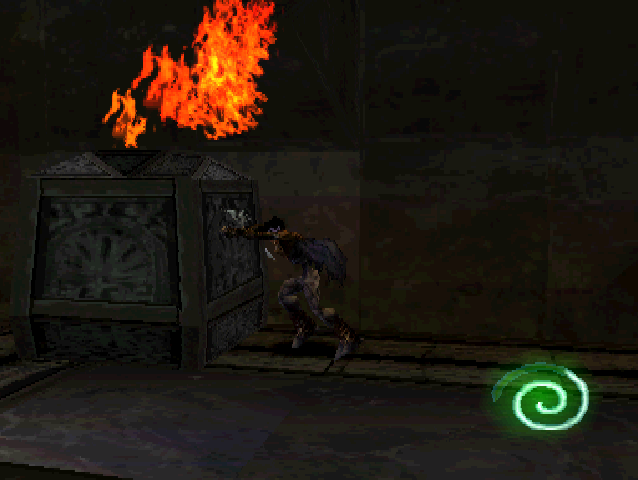
Rather than use this shifting-between-planes bit in a way that made the game creative and fun, you get to…wait for it…push blocks around rooms to solve puzzles! Yes, apparently the dark ancient god has resurrected Raziel in order to perform the most nonsensical overused cliche in all of gaming. He will extract his vengeance upon Kain by…slightly reorganizing all his stuff. “Ha ha,” says Raziel. “Now you will come through here at night and probably stub your toe because I put this block in a different place!” Gloomy atmosphere aside, the game sounds like an Eddie Izzard routine. I’ll put up with sliding block puzzles once in a while. The Legend of Zelda often uses them quite well, forcing you to think, “Now why did they put this sliding block here? What can I do with it?” In Soul Reaver, I’d often find a block, and way on the other side of the room you’ll see a block-shaped hole. “Oh no!” I say. “How ever will I slide this block all the way across the room!” Unique to Soul Reaver, Raziel has a mechanic that lets him flip blocks over, which as usual utterly disappointed me in its failure to incorporate this in any way that actually makes this fossilized corpse of an idea fun.

Because apparently the developers forgot to make the game fun. Usually in a game that installed the crap filter backwards, a modicum of fun will occasionally slip past the net to break up the time consuming tedium of wandering around lost and rearranging the furniture, but even Soul Reaver’s combat refuses to relent. Apparently on his checklist of “bad ideas for vengeance on Kain,” the elder god also included, “not giving my emissary the power to actually kill anything.” Sure, you can poke the monsters with your claws or occasionally whack them with junk you find lying about, but that only stuns them momentarily. You can’t reave their souls unless you happen to find a staff to impale them with or a handy campfire to chuck them into. And no, the game does not provide you with them; after all, such entitlement programming might make you dependent on killing enemies. You can’t even damage the first boss: you kill him by running away and luring him into places to drop gates on him Rancor-style.

I need to take vengeance upon this guy? He looks like he should be trying to gasp out the phrase, "Kill me, please!"

I need to take vengeance upon this guy? He looks like he should be trying to gasp out the phrase, “Kill me, please!”

After the second boss, Kain, you get a sword, coincidentally named Soul Reaver–which leads me to think the developers built the entire game around a really cool sounding name, and then spent most of the project bickering over whether it would describe the protagonist or the weapon. You can kill things with the sword, but unfortunately it only appears when you have full health. Eventually I found myself unable to attempt a sliding block puzzle because of two monsters tag-teaming me. With no fire or sticks about, I could only switch into the spectral plane, reave some energy to fill my life and charge my sword, then return to the physical plane just to get whacked before I could deliver my own whacking. After repeating this cycle about ten times, I finally stunned a single monster; however, Raziel prefers a wind-up to the finishing blow that could fill the plot of two solid Dragonball Z episodes, giving the other enemy ample time to knock my health down, or if I targeted that one, it the stunned enemy had plenty of time to recover. After another twenty or thirty rounds of this, I threw down my controller shouting, “Fuck it! I will not play this game!”

And I finished Dr. Jekyll and Mr. Hyde. So that should tell you something.

Final Fantasy X-2 – PS2, PS Vita

yuna gun

Yesterday I discovered RPG Maker, and now I have to use all my focus and concentration to not trash all my reading and lesson planning in order to fulfill a long-time dream of mine: make an RPG that accurately follows the events in the Iliad and the Odyssey. Stop looking at me like that. As a reader of a retro video game blog, you tell me: would you rather read the books or play through it in game format? Yeah. I thought so. Anyway, I bring this up because both the Iliad and the Odyssey not only find their way into literature classes, but also in pop culture, what with movies and TV miniseries, references in songs and stories and even in video games. An early example of a sequel, the Odyssey proves that continued storytelling doesn’t have to suck Donkey Kong Jr, so long as you do it right. Hollywood sequels have a tendency just to shove the original stories into an industrial blender, pour the contents into a plastic bag, mark it with a two (or if the original had a number in the title, increase that number by one like they invented clever) and demand your money: Austin Powers: Goldmember, Batman Forever, and any horror movie with a number on it will fall into this category.

A picture of Lulu...nine months pregnant. Seriously, did you guys even try?

A picture of Lulu…nine months pregnant. Seriously, did you guys even try?

However, Final Fantasy X-2, despite having a sequential numbering problem worse than the Metroid franchise, took the story in a worthwhile direction. They didn’t try to reveal a bigger evil than Sin, or someone who had secretly controlled Yu Yevon the whole time, or make a brand new threat somehow more threatening than a 1000-year-old sea monster. They didn’t retcon character deaths, bringing back Auron or Blitzy McThunderpants. They didn’t even need to send Yuna on some new kind of pseudo-pilgrimage. Instead, they did what the original–er, tenth installment–did. They focused on character. Final Fantasy X told the story of an obnoxious, extroverted, meat-headed jock, who Square somehow thought would appeal to the crowd playing console games in 2001. Highly literary nevertheless, the dipshit protagonist, referred to as Tidus in all material relating to the games and not at all throughout two entire games, served as a catalyst for changes in the story’s characters as well as the traditions of Spira, especially showing us themes of sacrifice. Final Fantasy X-2 starts with the most interesting thing about him–his girlfriend–and asks some heavy-hitting questions about peace, recovery, and trying to fit back into a generally happy world after dramatically rescuing it from death while contracting probably a pretty severe case of PTSD in the process. But while it doesn’t take a genius to pick up on the metaphor in the original–“Let’s go on a quest to defeat Sin and confront our issues with our fathers!”–you might need a master’s degree in literature to figure out the sequel.

The story opens with a flashy pop-dance number that literally has no bearing on the game and serves no purpose other than to start the show with a bang and establish the possibility that maybe Yuna can sing like a pop diva. Two years after Yuna sent Sin to the Farplane in a burst of pyreflies that looked coincidentally like a celebratory fireworks display, Spira has discovered an interest in history. No longer under the oppressive rule of old white men whose hearts have long stopped beating (no, not the GOP), citizens find the freedom to hunt spheres. *Looks around at sphere-themed world: “Another job well done!”* No, specifically they want old spheres with recorded scenes, with a quality much like a crappy VHS tape left on a car dashboard for a year. These spheres have the storage capacity somewhere between a vine film and a youtube video. But, apparently people will pay big bucks for the historical data on them, even though we follow a team of sphere hunters who never once sells a sphere for profit.

Line up, guys...each girl has her own unique set. Of costumes. A unique set of breasts. Costumes!

Line up, guys…each girl has her own unique set. Of costumes. A unique set of breasts. Costumes!

Enter Yuna and the Gullwings. Spira no longer needs summoners, as they don’t have to worry about Sin and apparently choose not to worry about the need to send their deceased to the farplane lest they turn into monsters, and Yuna has teamed up with Rikku to hunt spheres with the Gullwings. Led by Rikku’s brother, Brother, the team tools around Spira in an airship tricked out to resemble something of a cross between a low-rider, a muscle car, and a Freudian compensation for a small penis. Yuna and Rikku have tuned up their appearance as well. Rikku has stripped down to a bikini top and hot pants, and now sports a Jack Sparrow hairstyle (because nothing makes a 17-year-old girl more attractive than looking vaguely like Johnny Depp). Yuna’s costume, while it doesn’t scream “conservative apparel” any more than Rikku’s, hints at her character’s hang ups over losing Tidus Androgynous: she wears a hoodie, her warrior costume uses his sword, and the piece of bling holding the two halves of her top together look an awful lot like…uh…Jecht’s chest hair pattern. …Yuna, I love you, but you just ruined it. If you’ll excuse me, I have to go shave my eyes. The two of them picked up a new friend, Paine, a taciturn, gothic warrior with the personality of a girl Auron may have dated in high school. She has a mysterious history that would have made an interesting story, but with all the focus on Yuna and characterization, Square sort of forgot to develop a plot, so Paine and the new leaders of Spira fit into the story about as well as Sin would fit into Rikku’s hot pants.

Apparently people love the HD re-release on the PS-Vita. Go figure. Also, send me cash so I can buy one.

Apparently people love the HD re-release on the PS-Vita. Go figure. Also, send me cash so I can buy one.

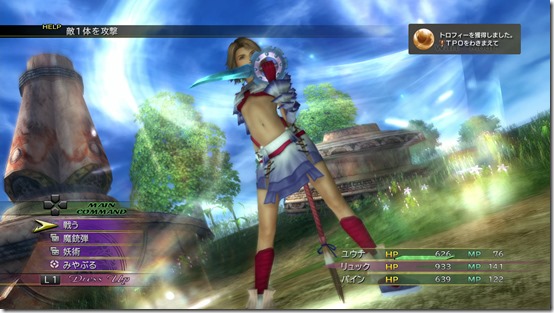
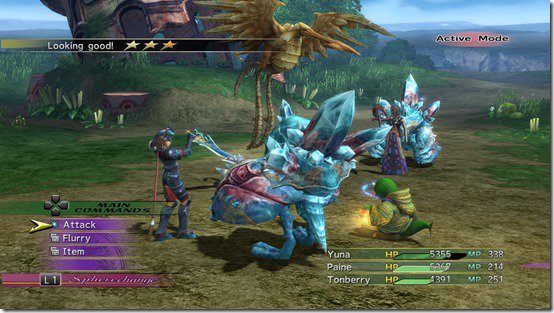
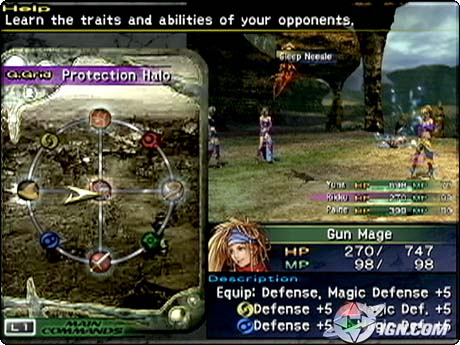
The battle system relies on dresspheres, special items that allow Yuna, Rikku and Paine to adopt job classes from classic Final Fantasy games. Jobs learn abilities, much in the same way as in Final Fantasy V or Tactics. For the most part, this works well. Abilities make characters stronger more than leveling up, which gives the player a more active control over the game. They even encourage job changing in battle, including some…tantalizing, let’s say…animations of the girls changing costumes. Battles adopt a faster pace than previous games, which almost makes up for a random enemy encounter rate higher than Willie Nelson. Unfortunately, as the game progresses, the job system fizzles out. You don’t find too many dresspheres, and the classes the game offers seem left over from the jobs no one used in other games–bard, blue mage, whatever “Lady Luck” does. I used white and black mages frequently. The physical classes–gunner, warrior, samurai, berserker, dark knight–all had slightly different stats for when, as usual for an RPG, I spammed the basic attack during regular battles.

Ripped off from IGN, but hey...I can't take screenshots on my PS2, and don't you feel better for having seen this?

Ripped off from IGN, but hey…I can’t take screenshots on my PS2, and don’t you feel better for having seen this?

Game play follows a non-linear pattern, in theory. You’ll still have to progress from chapter 1 to 5 in the usual order, but you can tackle any events in those chapters in whatever order you feel like. Really, I’d describe it as more of a rectangle than a line. Many of the missions–surprise!–find excuses to send Yuna through areas with random enemy encounters–because why wouldn’t your rival sphere hunter have wild, electric tigers roaming free in her booby-trapped home? I personally keep a few bears in my living room in case any upstart fantasy protagonists stumble through here (they have a weakness to fire…as does my living room in general). Some of the missions involve mini-games, like “Gunner’s Gauntlet,” which lets Yuna pop caps in fantasy monster asses (fucking tonberries!) to her little heart’s content. The game takes place during the blitzball off-season (praise Yevon!), so they’ve replaced it with a game called sphere break; what can give you more hours of fun than blitzball? A math game with an extremely long tutorial! Oh, how I wish I could say that with sarcasm!

I feel better for having seen this.

I feel better for having seen this.

The main events of the story when Yuna discovers one of her dresspheres has a 1000-year-old consciousness attached to it–yup, apparently dresspheres can do that, but only this one and only when Yuna uses it–belonging to a girl in love with a guy who looks like Loudmouth J. Ballkicker. And somehow that guy–Shuyin–has come to life on the farplane. And somehow the new leaders of Spira fit into that. I don’t know. The game has a lot of goofy moments, Charlie’s Angels poses, and a tall, slant-eyed Alan Rickman impersonator, but I like to tell myself that all this absurdity belies Yuna’s insecurities about her role in the new–yet still endangered–world she helped create. And then I google Rikku cosplayers and forget my school work, lesson planning, and RPG Maker for a good solid afternoon.

Really? People want to marginalize women who play video games? ...assholes! (ripped off from deviantart)

Really? People want to marginalize women who play video games? …assholes! (ripped off from deviantart)

Mega Man 3 – NES / PS2, XBox and Game Cube (as Mega Man Anniversary Collection)

The series employs many rooms shaped like this because you damn well better start from the far left side of the screen!

The series employs many rooms shaped like this because you damn well better start from the far left side of the screen!

So I’ve gone roughly twenty months on this project, but I’ve only written about one of my favorite franchises–Mega Man–once. But do you honestly need any more than that? Capcom released six main titles, each with a Game Boy spin-off, then moved on to the Mega Man X series, changing at most a handful of tools and the line-up of characters. If any series epitomized the “If it ain’t broke” philosophy more than any other…well, Madden, FIFA and all those sports games pretty much nailed it. But Capcom did it first. And as an added bonus, Mega Man has the advantage over Madden in that you can’t easily turn the game off and go fight a legion of evil robots, taking their weapons as trophies like an Assimovian serial killer. But as the first rule of robotics doesn’t preclude the murder of other robots, our favorite blue Dexterbot has free reign–even permission and justification–to slaughter all the bad people-bots in order to save humanity. And he does, but much like his human counterpart, Mega Man faces the challenge of killing over and over again without going stale. To that end, we get Dr. Albert Wily, mad scientist extraordinaire, modeled after Albert Einstein and inspiration for Albert Wesker. As a human, Mega Man can’t harm him, which gives him license to keep throwing robotic Batman-villain rejects our way until contentment dawns on our 8-bit faces or Capcom gets bored and suddenly stops producing the games in favor of Resident Evil.

Yep. You totally beat the final boss by dropping snakes into the cockpit with Dr. Wily.

Yep. You totally beat the final boss by dropping snakes into the cockpit with Dr. Wily.

The story behind Mega Man 3 tries to preemptively answer the question of why Dr. Light keeps pumping out deadly robots if Dr. Wily will only steal them and reprogram them for evil. Well, fortunately Dr. Wily has “found his sanity,” to quote the instruction book, and has teamed up with Dr. Light to work for world peace the only way they know how: by constructing the largest, deadliest, most powerful robot the world has ever seen. That’ll keep everyone safe. However, a new batch of robots has appeared on mining worlds, holding the 8 macguffins required to get the new peace keeper up and running.  Light believes some anonymous “lunatic guy” has ordered these robots to steal the energy crystals required to activate the peace keeping robot, Gamma. Jeez, Dr. Wily, didn’t you just find your sanity? Maybe you could lend to this situation your expert advice which we obviously know contains no trace of mental instability whatsoever.

As if the kooky concept of themed villains didn't scream "Batman" enough, Dr. Wily built a giant penguin.

As if the kooky concept of themed villains didn’t scream “Batman” enough, Dr. Wily built a giant penguin.

Fans have long considered Mega Man 2 the pinnacle of the series, and I really have to agree. The game introduced a number of features that fans had never seen before, but apparently would never reach the same quality again. Except Mega Man 3 improved upon everything. How does that work? Good question! Let’s start with the original Mega Man. For those of you who haven’t had the luxury of living in Asia, I should explain that Rock-Scissors-Paper games constitute an iron clad and legally binding contract between anyone under the age of 20. Drawing on this, the first Mega Man introduced this principle in the form of a guy who chucks scissors at you from his forehead, who goes down pretty easily if you’ve already beaten the guy who gives you the power to hurl rocks back at him. But since “Paper Man” sounded lame even on his own medium of attack, and a three-level game didn’t quite justify the $50 price tag, they had to beef it up a bit. So you might imagine Capcom designed themes for their robots, carefully crafted around well-balanced and clever real-world principles…just kidding! They went for the cliched trifecta of video game alchemy; lighting, fire and ice.

So in Mega Man 2, they went all-out with the alchemy, what with water dousing fire, fire burning wood (actually the combination of Earth and Water, but hey, who actually follows alchemy these days?), wood…I don’t know…filtering air? And then the other four robots. Except that metal guy looks like he’d do a number on wood man. And bubble lead somehow damages the time-stopping robot. So that game turned out a mess in the rock-scissors-paper department. Mega Man 3 tried to restore the feeling of one weakness per enemy. Except to keep it interesting, they made two separate circuits of weaknesses, ensuring you’d have to fight at least two bosses with just your mega buster.
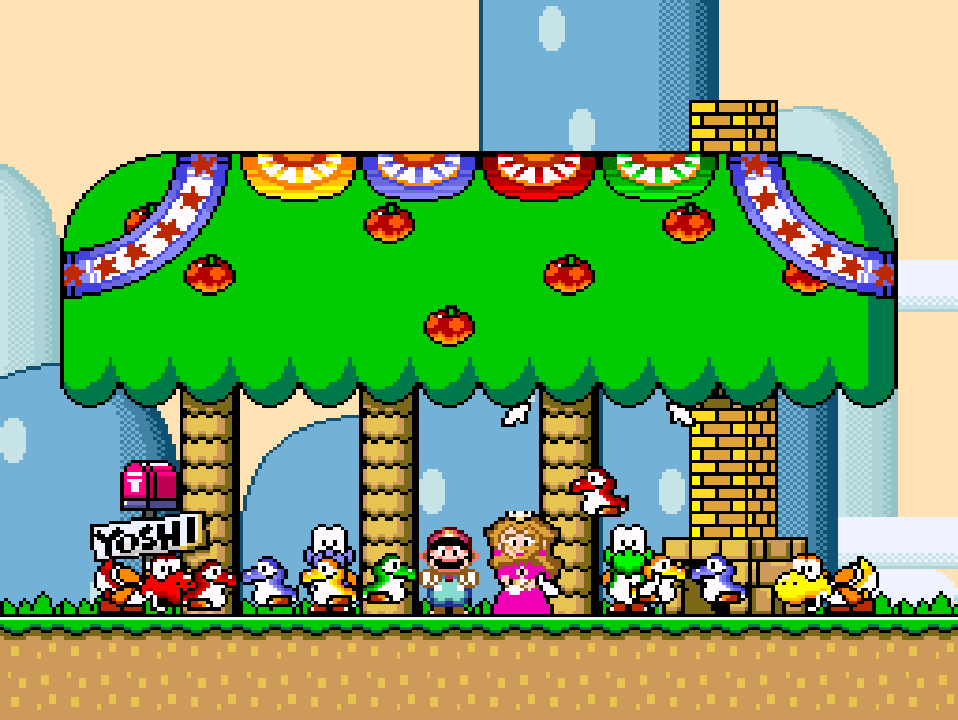
Capcom won an award for the design of Snake Man's stage. Then blew it by making the boss look like a green sperm with legs.

Capcom won an award for the design of Snake Man’s stage. Then blew it by making the boss look like a green sperm with legs.

Furthermore, this game marks Capcom’s foray away from the usual fire- and ice-themed levels. Instead, we get the dark, starry world of Gemini Man or the ninja-bot, Shadow Man.  One might question why anyone built robots around these ideas. The original six robot masters all had some constructive purpose to society. I can even think of some useful, productive ways to employ Mega Man 2 robot masters. But Gemini and Shadow Man don’t seem very helpful, and then…well…Top Man. Yes, this game introduces the Slippy Toad of Dr. Wily’s minions, Top Man. Who spins. And throws tops. After defeating him, you get the top spin, a weapon so difficult to use that I often deal more damage to myself than the enemy I hope to target. Seriously…I hate this guy so much I just want to punch him in the face! Wait, what? You defeat him by punching him in the face? Excellent! Who do I get that weapon from? …Hard Man? Did anyone at Capcom think these names through all the way? Seeing as how he appears in the same game as Snake Man, I’d say someone on the development team had just a little too much inspiration from bad porn.

Doc Robot gets wood. Really, did no one think this through?

Doc Robot gets wood. Really, did no one think this through?

The game also rectifies the too-awesome-to-use trope among games where you collect items. None of the weapons has a limited number of uses–you can always replenish them by camping out in front of a giant penguin or something. However, these weapons usually take too much effort, and simply blasting through levels with your arm cannon provides the quickest and easiest way to the end. In Mega Man 3, rather than going straight to Dr. Wily’s castle after fighting the robot masters, an enemy called Doc Robot appears. With as much bearing on the plot as Arwen in the Lord of the Rings films, Doc Robot merely gives you a chance to use your weapons more. He inhabits four previously conquered stages, although he alters them drastically. Facing you twice in each stage, he adopts the attack patterns of all the Mega Man 2 bosses. Because Mega Man hasn’t, apparently, proved that he can mop the floor with all of them. Meh.

Proto Man: Dick to friend and foe alike.

Proto Man: Dick to friend and foe alike.

Having a little more relevance to the story, Mega Man also faces off against the supposedly mysterious Proto Man. Of course, if you’ve ever heard the term “Proto” before, the figuring out his identity has all the challenge of pouring a glass of water. He appears in several stages, usually to fight a few rounds with Mega Man. Ostensibly, he does this as a test, but while certain things–such as practicing for the SAT–might help you out just before going in for the real thing, you may not want a practice bout against Mohammad Ali ten minutes before the fight. Unless, of course, you can move faster without all that cumbersome blood. And really, doesn’t having perfect vision only dull your other senses? Proto Man couldn’t come off as more of a dick if he had actually sided with Dr. Wily.

Man's best friend when lava pours into bottomless pits.

Man’s best friend when lava pours into bottomless pits.

Also noteworthy, Mega Man 3 introduces a new series staple, Rush. Taking the place of the items from the previous game, Dr. Light built Mega Man a dog that can morph into vehicles to increase your mobility. Rush makes a good companion; he does whatever you ask him to, never gets in the way, and he doesn’t poop so you never have to worry about where you step. Each of his three functions–two of which you obtain after beating certain bosses and the other you have from the get-go–increases your mobility, allowing you to spring to new heights, soar over dangerous ground, or swim through that one patch of water in Gemini Man’s level. So maybe the implementation could have used some more thought, but did I mention he doesn’t poop? That puts him ahead of a real dog in my book.

Otherwise, if you’ve played any game in the series, you should know what to expect. Run, jump. Enemy robots. Pew pew pew. Pretty standard stuff.