Grand Theft Auto III – PS2, XBox, PC

GTA3boxcoverBack in my undergraduate days, I worked at a Sam Goody. Never heard of it? Well, that just goes to show that charging $5 more per CD than anyone else selling music doesn’t constitute a particularly solid business strategy. But in trying to make up for dropping sales in overpriced music, they tried selling video games. Shortly after remodeling the store, adding the demo consoles, and gussying up the place all nice and pretty, I began to notice trending video games, two of which pop into mind as phenomenally stronger than anything else I sold to unsuspecting customers. One of these, Madden games, tricked people into buying the same shitty game year after year, only to disregard it as soon as the next installment came out. But even more popular than games doomed to life as a second-rate coaster, Grand Theft Auto III simply would not stay on our shelves.

Of course I took note. “Why does everyone want this game?” I asked. “Should I play it to find out?” Well, I didn’t. But I did hear about it. Open-world. Free-ranging. And prostitutes. Lots of prostitutes. Also, controversy. Controversy always makes for a good game, right? Well, I’d like to pose a question to any readers who may have played the game in the early 2000s–did you actually like Grand Theft Auto? Can you still pop in the disk and relive the good times? Or, like Goldeneye, do you look at it and puzzle over what the hell you ever saw in it?
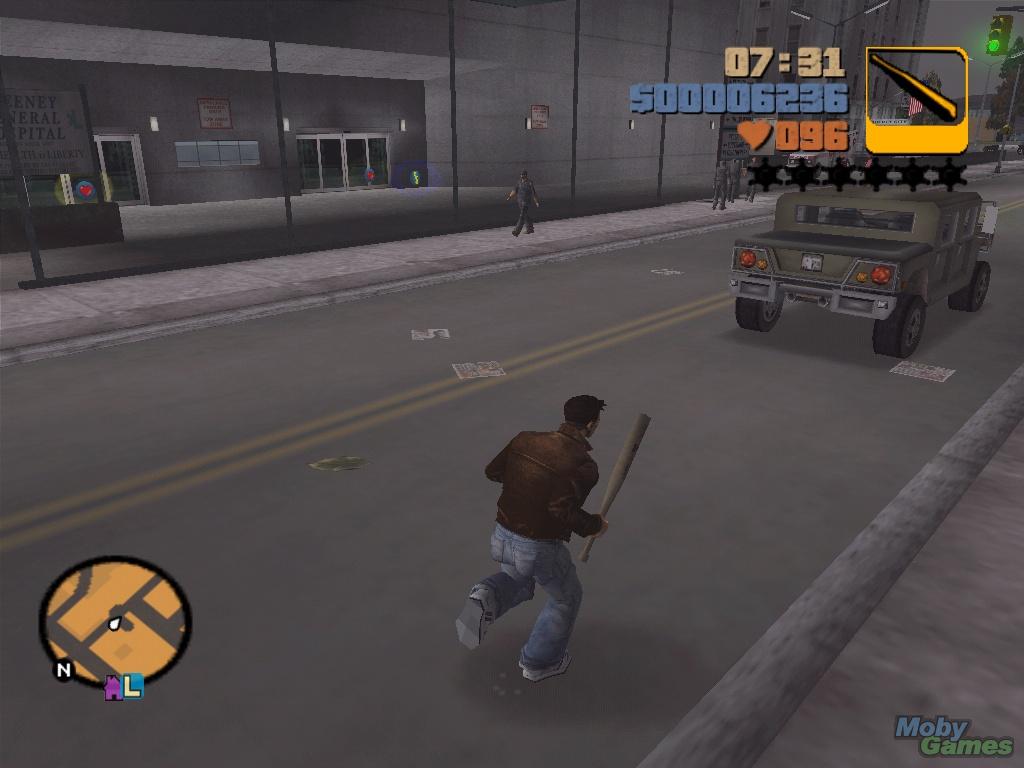
Naturally, in a game revolving around car theft, you can never find one when you need it. I spent about 25% of my time running after cars like a dog.

Naturally, in a game revolving around car theft, you can never find one when you need it. I spent about 25% of my time running after cars like a dog.

Reading reviews, wikipedia articles, and the like make GTA III sound like the messiah of sandbox games. Freedom! Non-linear gameplay! Wide-open world! You can do anything you want! To a certain extent, I see how they can make those claims. GTA III gives the player complete freedom to steal any car and drive around any street and hit anyone you want! Some examples of the variety of things you can do here include: Steal a taxi and get paid to drive people to their destinations, steal an ambulance and get paid to drive people to the hospital, steal a police car and get paid to drive around looking for criminals, or steal a fire truck and get paid to drive around looking for fires. I don’t want to describe this game as stupid, but what it lacks in imagination, variety, and any enjoyment whatsoever, it more than makes up for in tedium, repetition, and boredom.
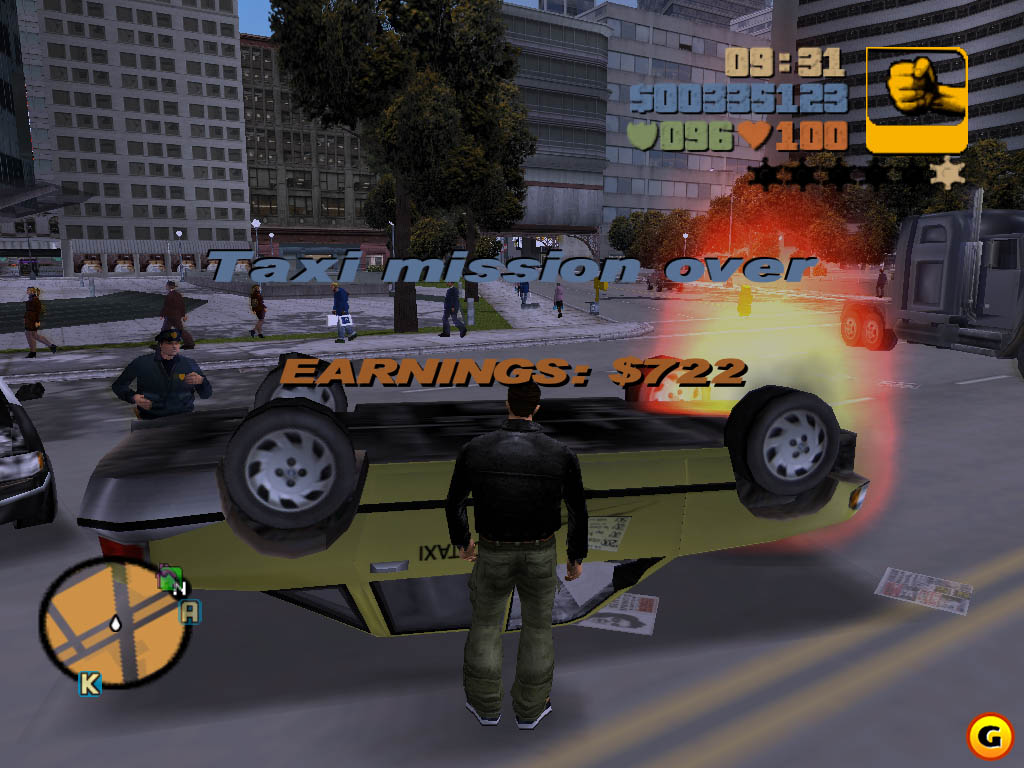
I know this looks bad...but this still turned out better than a lot of dates I went on in high school.

I know this looks bad…but this still turned out better than a lot of dates I went on in high school.

I went in expecting a crime spree game. Something like Scarface pointing Lock, Stock and Two Smoking Barrels at the Godfather while Mr. Pink runs off with the diamonds, some L.A. Confidential, Pulp Fiction type stuff. Instead I get Cars, without the cute CGI or Pixar wit. GTA III basically reinvents the driving/racing genre. Imagine Mario Kart, if every so often Mario pulled Toad out of his car and stomped on his face. The game also uses the exact same driving physics and controls as every driving game ever. The challenge in driving under this system lies somewhere between “playing a 3D platformer while blindfolded” and “trying to steer a hockey puck with a leaf blower during a hurricane.” Despite the amount of time the game puts you in the driver’s seat, it does occasionally let you get out of the car and engage in a rudimentary form of good, old-fashioned gang violence, but the awkward interface makes aiming feel like target shooting during a grand mal seizure. Despite the contract you took out to assassinate…apparently a ramen vendor…the game’s target selection program generally assumes that the innocent bystanders pose a greater threat than the thugs charging at you with automatic rifles.

Cars, in this game, like this one, only slightly improve on the quality of car I can afford to drive in real life.

Cars, in this game, like this one, only slightly improve on the quality of car I can afford to drive in real life.

Odd as this may sound, GTA III feels less like a video game and more like a board game. I didn’t see much of a story line going on, other than the main character robbing a bank, his girlfriend shooting him, and then his friends busting him out of prison. From there, you look for work, and you visit certain bosses over and over, taking missions in a pre-determined, very non-non-linear fashion, until that boss has no work for you anymore. You can lose these missions in a number of ways, such as running out of time, getting shot, your car exploding, or getting caught by the police. These don’t really pose a threat so much as a minor inconvenience. Getting killed just makes you start over at the hospital, and despite your recent jailbreak, the police seem to have more of a catch-and-release program going on, and a string of murder, reckless driving and grand theft auto merit no more punishment than having to go slightly out of your way while running errands.
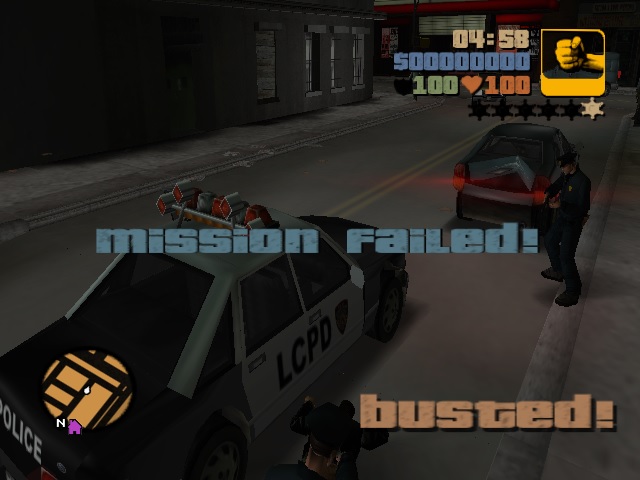
Yep...get used to this.

Yep…get used to this.

Also, veteran players may have noticed odd claims by now, so in full disclosure, I didn’t actually beat this game. In fact, I didn’t get very far in it at all, for a combination of two very good reasons. First of all, I didn’t find myself enjoying the game very much. Driving sims just don’t do it for me. I can barely stomach the thought of real driving. But I’ve finished boring games before. However, ramping up the difficulty to “harder than Charlie Sheen on a Viagra overdose” may not have endeared me to completion. After three days and roughly ten hours of gameplay, I had completed maybe seven or eight missions total. Maybe I just needed more practice, or more experience with driving games. Or maybe the damn game shouldn’t make you repeat absolutely everything every time something bad happens. Oh no! Ran out of time! Looks like I have to visit the boss again, watch the cut scene, go steal a car, look for the gun store, find a gun, look for the ramen stand, aim for the bad guys, shoot a few pedestrians by mistake, then get shot to death while the ramen noodle man hops in his car for a car chase that won’t happen. The sheer amount of time required for each individual mission, combined with the fact that I didn’t really enjoy the missions to begin with and the rage-inducing effect of the game’s shitty soundtrack of radio stations, indicated certain health benefits in walking away from this one.

And not even the good kind of wasted. Although both often require medical attention...

And not even the good kind of wasted. Although both often require medical attention…

Grand Theft Auto III which wins my coveted “Sarah Palin Award for Intelligence in Game Design,” cost me $2.99 at Savers. I think I paid too much. However, I also picked up a $2.99 copy of Grand Theft Auto: San Andreas. So…I at least have to make a perfunctory attempt at that one in order to clear off my shelf full of games I bought and haven’t yet played. Joy.

Mega Man 3 – NES / PS2, XBox and Game Cube (as Mega Man Anniversary Collection)

The series employs many rooms shaped like this because you damn well better start from the far left side of the screen!

The series employs many rooms shaped like this because you damn well better start from the far left side of the screen!

So I’ve gone roughly twenty months on this project, but I’ve only written about one of my favorite franchises–Mega Man–once. But do you honestly need any more than that? Capcom released six main titles, each with a Game Boy spin-off, then moved on to the Mega Man X series, changing at most a handful of tools and the line-up of characters. If any series epitomized the “If it ain’t broke” philosophy more than any other…well, Madden, FIFA and all those sports games pretty much nailed it. But Capcom did it first. And as an added bonus, Mega Man has the advantage over Madden in that you can’t easily turn the game off and go fight a legion of evil robots, taking their weapons as trophies like an Assimovian serial killer. But as the first rule of robotics doesn’t preclude the murder of other robots, our favorite blue Dexterbot has free reign–even permission and justification–to slaughter all the bad people-bots in order to save humanity. And he does, but much like his human counterpart, Mega Man faces the challenge of killing over and over again without going stale. To that end, we get Dr. Albert Wily, mad scientist extraordinaire, modeled after Albert Einstein and inspiration for Albert Wesker. As a human, Mega Man can’t harm him, which gives him license to keep throwing robotic Batman-villain rejects our way until contentment dawns on our 8-bit faces or Capcom gets bored and suddenly stops producing the games in favor of Resident Evil.

Yep. You totally beat the final boss by dropping snakes into the cockpit with Dr. Wily.

Yep. You totally beat the final boss by dropping snakes into the cockpit with Dr. Wily.

The story behind Mega Man 3 tries to preemptively answer the question of why Dr. Light keeps pumping out deadly robots if Dr. Wily will only steal them and reprogram them for evil. Well, fortunately Dr. Wily has “found his sanity,” to quote the instruction book, and has teamed up with Dr. Light to work for world peace the only way they know how: by constructing the largest, deadliest, most powerful robot the world has ever seen. That’ll keep everyone safe. However, a new batch of robots has appeared on mining worlds, holding the 8 macguffins required to get the new peace keeper up and running.  Light believes some anonymous “lunatic guy” has ordered these robots to steal the energy crystals required to activate the peace keeping robot, Gamma. Jeez, Dr. Wily, didn’t you just find your sanity? Maybe you could lend to this situation your expert advice which we obviously know contains no trace of mental instability whatsoever.

As if the kooky concept of themed villains didn't scream "Batman" enough, Dr. Wily built a giant penguin.

As if the kooky concept of themed villains didn’t scream “Batman” enough, Dr. Wily built a giant penguin.

Fans have long considered Mega Man 2 the pinnacle of the series, and I really have to agree. The game introduced a number of features that fans had never seen before, but apparently would never reach the same quality again. Except Mega Man 3 improved upon everything. How does that work? Good question! Let’s start with the original Mega Man. For those of you who haven’t had the luxury of living in Asia, I should explain that Rock-Scissors-Paper games constitute an iron clad and legally binding contract between anyone under the age of 20. Drawing on this, the first Mega Man introduced this principle in the form of a guy who chucks scissors at you from his forehead, who goes down pretty easily if you’ve already beaten the guy who gives you the power to hurl rocks back at him. But since “Paper Man” sounded lame even on his own medium of attack, and a three-level game didn’t quite justify the $50 price tag, they had to beef it up a bit. So you might imagine Capcom designed themes for their robots, carefully crafted around well-balanced and clever real-world principles…just kidding! They went for the cliched trifecta of video game alchemy; lighting, fire and ice.

So in Mega Man 2, they went all-out with the alchemy, what with water dousing fire, fire burning wood (actually the combination of Earth and Water, but hey, who actually follows alchemy these days?), wood…I don’t know…filtering air? And then the other four robots. Except that metal guy looks like he’d do a number on wood man. And bubble lead somehow damages the time-stopping robot. So that game turned out a mess in the rock-scissors-paper department. Mega Man 3 tried to restore the feeling of one weakness per enemy. Except to keep it interesting, they made two separate circuits of weaknesses, ensuring you’d have to fight at least two bosses with just your mega buster.

Capcom won an award for the design of Snake Man's stage. Then blew it by making the boss look like a green sperm with legs.

Capcom won an award for the design of Snake Man’s stage. Then blew it by making the boss look like a green sperm with legs.

Furthermore, this game marks Capcom’s foray away from the usual fire- and ice-themed levels. Instead, we get the dark, starry world of Gemini Man or the ninja-bot, Shadow Man.  One might question why anyone built robots around these ideas. The original six robot masters all had some constructive purpose to society. I can even think of some useful, productive ways to employ Mega Man 2 robot masters. But Gemini and Shadow Man don’t seem very helpful, and then…well…Top Man. Yes, this game introduces the Slippy Toad of Dr. Wily’s minions, Top Man. Who spins. And throws tops. After defeating him, you get the top spin, a weapon so difficult to use that I often deal more damage to myself than the enemy I hope to target. Seriously…I hate this guy so much I just want to punch him in the face! Wait, what? You defeat him by punching him in the face? Excellent! Who do I get that weapon from? …Hard Man? Did anyone at Capcom think these names through all the way? Seeing as how he appears in the same game as Snake Man, I’d say someone on the development team had just a little too much inspiration from bad porn.

Doc Robot gets wood. Really, did no one think this through?

Doc Robot gets wood. Really, did no one think this through?

The game also rectifies the too-awesome-to-use trope among games where you collect items. None of the weapons has a limited number of uses–you can always replenish them by camping out in front of a giant penguin or something. However, these weapons usually take too much effort, and simply blasting through levels with your arm cannon provides the quickest and easiest way to the end. In Mega Man 3, rather than going straight to Dr. Wily’s castle after fighting the robot masters, an enemy called Doc Robot appears. With as much bearing on the plot as Arwen in the Lord of the Rings films, Doc Robot merely gives you a chance to use your weapons more. He inhabits four previously conquered stages, although he alters them drastically. Facing you twice in each stage, he adopts the attack patterns of all the Mega Man 2 bosses. Because Mega Man hasn’t, apparently, proved that he can mop the floor with all of them. Meh.

Proto Man: Dick to friend and foe alike.

Proto Man: Dick to friend and foe alike.

Having a little more relevance to the story, Mega Man also faces off against the supposedly mysterious Proto Man. Of course, if you’ve ever heard the term “Proto” before, the figuring out his identity has all the challenge of pouring a glass of water. He appears in several stages, usually to fight a few rounds with Mega Man. Ostensibly, he does this as a test, but while certain things–such as practicing for the SAT–might help you out just before going in for the real thing, you may not want a practice bout against Mohammad Ali ten minutes before the fight. Unless, of course, you can move faster without all that cumbersome blood. And really, doesn’t having perfect vision only dull your other senses? Proto Man couldn’t come off as more of a dick if he had actually sided with Dr. Wily.

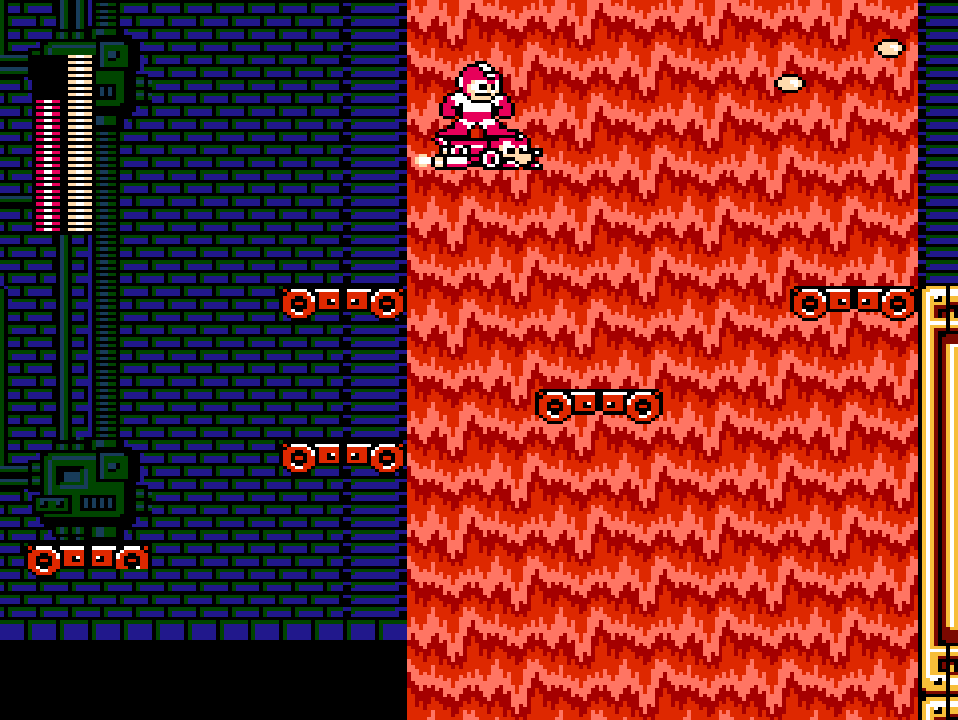
Man's best friend when lava pours into bottomless pits.

Man’s best friend when lava pours into bottomless pits.

Also noteworthy, Mega Man 3 introduces a new series staple, Rush. Taking the place of the items from the previous game, Dr. Light built Mega Man a dog that can morph into vehicles to increase your mobility. Rush makes a good companion; he does whatever you ask him to, never gets in the way, and he doesn’t poop so you never have to worry about where you step. Each of his three functions–two of which you obtain after beating certain bosses and the other you have from the get-go–increases your mobility, allowing you to spring to new heights, soar over dangerous ground, or swim through that one patch of water in Gemini Man’s level. So maybe the implementation could have used some more thought, but did I mention he doesn’t poop? That puts him ahead of a real dog in my book.

Otherwise, if you’ve played any game in the series, you should know what to expect. Run, jump. Enemy robots. Pew pew pew. Pretty standard stuff.

Onimusha Warlords / Genma Onimusha – PS2, Xbox, PC

Onimusha_-_Warlords_CoverartWhen I lived in Korea, I earned black belts in Haedong Kumdo (Korean Kendo) and Hapkido (Korean Aikido). They issued me licenses for each one; when someone makes some crack about registering their hands as deadly weapons, know that I actually did. The Kumdo license entitled me to legally buy a battle-ready katana, which ended up costing me half a month’s pay. I don’t mean to brag. In fact, rid yourself of the American notions of paranoia that the rebellion will begin any day now, the south will rise again, or that bad guys with guns exist in every store and restaurant, just waiting for a good guy with a gun to mow them down; Koreans practice martial arts mostly just to keep in good health. As such, any mugger who crossed paths with me in a dark alley would probably meet with the law-enforcement recommended protocol of me granting him easy and painless access to my debit card, naturally giving me the last laugh when he tries to find any money in the account. The Haedong Kumdo skill, unfortunately, has even less practical value in real life, as roving bands of samurai no longer wander the streets of Duluth, and have even refrained from menacing Korea for a good seventy or eighty years. Even so, the art claims to adapt the one-on-one sword fighting method for use on a battlefield full of guys with swords. It amounts to forms, really. Dancing with a sword. And honestly, I enjoyed it. Even more than polka. But it has limited uses, even on a field full of samurai. In fact, I can only think of one hoard of enemy it might fight effectively: zombies.

The kumdo license lists my birthday as September 9, 198. They obviously misprinted it. It should read "September 8."

The kumdo license lists my birthday as September 9, 198. They obviously misprinted it. It should read “September 8.”

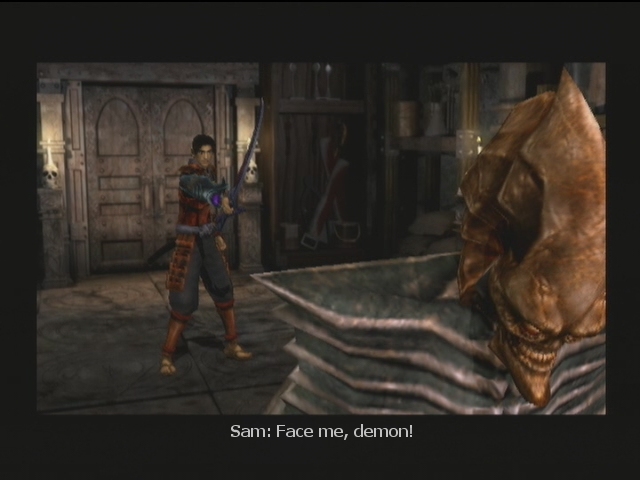
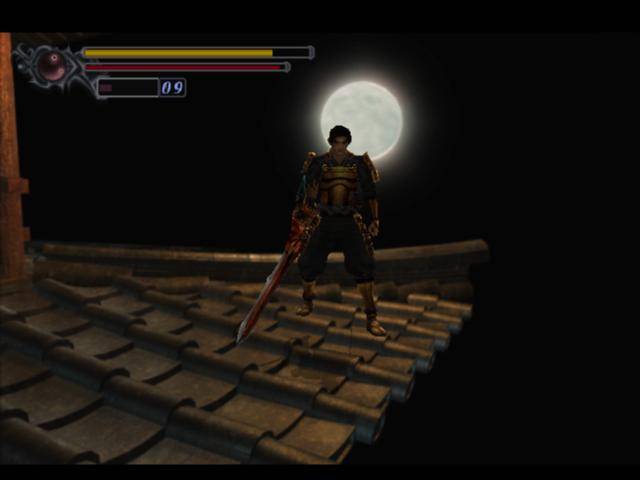
Fortunately, the idea of fighting monsters with a samurai sword doesn’t merely belong to Max Brooks and other brilliant authors; in 2001, Keiji Inafune of Mega Man fame released Onimusha Warlords for the PS2 (Genma Onimusha for the Xbox), which took the Resident Evil engine, set the story in feudal Japan, and replaced the zombies with the Genma tribe of demons. Although a horror game at heart, the concern over conserving ammo tends lose its emotional impact when armed with a sword, so the game strays from the survival horror design into more of an action genre. Which, I guess, makes it exactly like Resident Evil.  The game surrounds itself with real-life historical characters, much in the same way as Abraham Lincoln: Vampire Hunter. It has a profound respect for history in the same way that God of War has a respect for mythology and the League of Extraordinary Gentlemen has for classic literature, going even so far as to explain the fates of the surviving characters at the end of the game–Animal House style. The story follows the ronin samurai, Akechi Samanosuke, a character based on his supposed in-game uncle, Akechi Mitsuhide, who led a rebellion against the famous Shogun, Oda Nobunaga, a historical point rendered unnecessary when the game lodges an arrow in Nobunaga’s neck within three minutes. The need for rebellion neatly eliminated, Samanosuke turns his attention to his childhood friend, Saito Yuki-hime, and her concerns about the Genma demons stuffing her into a bento box with a dash of wasabi. Samanosuke arrives at the Saito castle to find Yuki missing and most of the Saito clan either dead or desperately trying to avoid becoming soylent sushi. The Oni clan whisks him away long enough to grant him a magical gauntlet that will inhale demon souls like a hoover, and let him inject them into his weapons to power them up.

Samanosuke's patrons, the Oni, pictured with legendary monkey king, Son Wukong.

Samanosuke’s patrons, the Oni, pictured with legendary monkey king, Son Wukong.

From there, anyone who has played one of the early Resident Evil games can pretty much predict what happens. Samanosuke fights his way through a haunted house…er, castle…filled with hungry monsters, convoluted locking mechanisms that would only piss off any normal person who lived there, and random encounters with a small cast of characters wandering aimlessly around with no regard for the onslaught of things that want them dead. Onimusha de-emphasizes puzzle solving, which I appreciate even though I can’t think of anything more horrifying than slowing down the pacing of a good story in order to solve a riddle about which order to push a series of buttons. Like Resident Evil, play occasionally shifts to Kaede, Samanosuke’s kunoichi assistant who, again like Resident Evil, has less strength and health, but moves faster. Since she can’t seal souls, Kaede doesn’t have a lot of motivation for hanging around to stab things, so the player has to change tactics to more of a gauntlet run. Except she still has a knife and a belt full of kunai, so her sections of the game didn’t annoy me the way that playing as Ashley Graham did.

I bet you say that a lot while wearing that suit.

I bet you say that a lot while wearing that suit.

The game paces itself very well. Better than most modern games. While many games, RPGs especially, like to throw a challenge at you ten or twenty times to make sure you didn’t succeed those previous nineteen times on a fluke, Onimusha throws a challenge at you, then gives you something new to fight when you finish. Cut scenes and other story elements happen close enough together that you don’t need a libretto just to remind yourself why Samanosuke would rather let pig monsters bludgeon him to death rather than high-tailing it to Okinawa where he could kick back and enjoy the sunny, monster-free weather with a nice bowl of sake in one hand and a nice kunoichi or two in the other. In fact, even with side-questing and leveling up, I can finish the game in about three and a half hours. Because of its length, I can finish with the desire to actually play through it a second time to take advantage of all the unlockable items, and unlike Leon Kennedy and his tommy gun rampaging through Spain with infinite bullets and not enough monsters to put them into, I don’t get bored before the novelty of invincibility wears off. Plus…well…two words: panda costume. Who wouldn’t want to fight demons while wearing something both cute and vaguely unsettling?

Not quite what Tom Stoppard had in mind.

Not quite what Tom Stoppard had in mind.

Onimusha really shines in the cultural department. I come from America, the culture that gave us Charlie Chan movies. If you don’t recognize the name, he came from a series of mystery novels and movies about a Chinese-born detective in Hawaii. When adapting the novels for film, they tried a few different actors, and the American viewing public watched the movies and said, “Yeah…we think the white guy made a more convincing Charlie Chan.” With racism like that, I understand why anything Japan wants to market in the U.S. has racially-neutral characters, that could belong to either Asian or Caucasian heritage, depending on how hard you squint and what you really want to see. Onimusha, however, delivers a cast entirely of unapologetically Japanese characters in a marvelously Japanese setting using traditional Japanese folklore. Er…mostly traditional. For some reason, all the demons bear names out of Shakespeare’s Hamlet, often referred to as “The greatest story ever written.” Hamlet represents the peak of Western literary culture. I’ll let you come up with your own interpretation for that. I, for one, appreciate the distinct cultural flavor of the game (much like visiting Kyoto tourist destinations…but with monsters). For added difficulty, set the game to Japanese audio with English subtitles. The voices sound a lot cooler, and the trick treasure box puzzles have a new twist when you don’t get Arabic numerals.

I hear the Castlevania production team let Onimusha use their set at night (but they had to share with Spanish Castlevania)

I hear the Castlevania production team let Onimusha use their set at night (but they had to share with Spanish Castlevania)

Once more like Resident Evil, the game gives you a report card at the end, one final smack in the face for anyone who thought they did well. Depending on your grade and how many useless rocks you found, the game will either reward you with unlockable goodies and a bonus mini-game (obviously designed with enough difficulty and repetition so as to wean you off of Onimusha and on to your next game), or it will send you to bed with no dinner and take away all video game privileges until your grade improves. Later games don’t quite live up to the quality of the first, which probably explains why the series effectively came to an end in 2006, but I give this first installment an A…even if it thinks I deserve a B.

Oh yeah. Magic. You can use magic. I guess I didn't find anything funny to say about that in the main entry.

Oh yeah. Magic. You can use magic. I guess I didn’t find anything funny to say about that in the main entry.

Fatal Frame II: Crimson Butterfly – PS2, XBox

Fatal-frame-II-screenshot-fatal-frame-ii-crimson-butterfly-11732067-640-480

I have to confess that this week’s entry has put me in a situation not unlike walking in on a room full of beautiful, lonely lesbians; I may have just discovered the best thing in existence, but I can’t praise it because of a single catch in the logic that renders it of absolutely no use to me. To give you an idea of how confused this game makes me, that previous sentence took approximately fifteen minutes to write.  Have you ever played a game so brilliantly designed that you wanted to erect a statue of it and place it at the top of the highest mountain so that everyone could see your rather weird graven image, but one thing about it just kept driving you insane until you decided you’d rather construct an effigy of the game and hang it, set it on fire, then pee on the ashes? Well, if not, I recommend Fatal Frame 2: Crimson Butterfly.

Fatal Frame 2 tells the story of twin girls Mio and Mayu, who after a shaky-cam montage that the player can only pray to the game to explain, find themselves in an abandoned traditional village after nightfall. After a bit of exploration, the girls start hearing noises and seeing glimpses of movement here and there.  Doors begin to unlock by themselves, and items appear in rooms when Mio and Mayu leave to search other rooms. Soon, they come across a camera with a note explaining, in terms only slightly more scientific than the average paranormal investigator uses to describe their own equipment, that it has the power to exorcise ghosts. And then Mayu displays the most astounding lack of survival skills in the history of horror, running off into the village full of angry spirits without her sister, who now holds the only means of defense against the supernatural menace.

Most people believe they don't look good in pictures. Some people truly don't.

Most people believe they don’t look good in pictures. Some people truly don’t.

Fatal Frame 2 combines all the best aspects of successful survival horror games.  Like Resident Evil, the noises Mio makes as she traipses through the environment sometimes sound enough like ghost noises to keep you panicking.  Like Silent Hill, it creates an atmosphere of total isolation, garnished with introspection and the slight hint of a dark past.  The horror builds off of Japanese culture, especially the significance of twins and the mythology of butterflies, which many Western players will find unfamiliar enough to spook them (but relax; if you’ve seen “The Ring,” the game offers one scene of a ghost girl climbing out of a well). Furthermore, they took away the standard issue gun and replaced it with a camera, making the player feel completely helpless in the face of adversity–it even requires letting ghosts get close and attack in order to do any meaningful damage to them. Imagine a donut made out of birthday cake, filled with chocolate chip cookie dough ice cream, frosted with Oreo cream and topped with M&Ms; this game feels like that. (I’ve recently cut back on sweets…can you tell?)

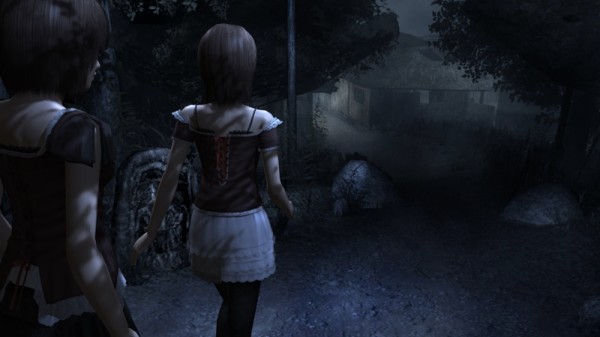
Now picture this without the edges of the screen, the girl following you, most of the girl leading, the house, the road, the trees and...well, see that lightly glowing spot at the center? I didn't see much more than that.

Now picture this without the edges of the screen, the girl following you, most of the girl leading, the house, the road, the trees and…well, see that lightly glowing spot at the center? I didn’t see much more than that.

However, Fatal Frame’s Fatal Flaw might just negate all of that.  Have you ever played a survival horror game that asked you at the beginning to “adjust the brightness until you can just barely see the gray line”? Well, this game doesn’t do that. It just assumes you like it dark. In fact, not only do you not want to see the gray line, but you don’t really care to see the text asking you the question, either.  What? You can’t see Mio? Well, you shouldn’t look at her anyway, given her young age. If you need to know what your environment looks like, you have a map. Use it! (I honestly spent less time following my GPS through downtown Minneapolis than I did checking the map screen for Fatal Frame).

If you manage to find a bright enough TV screen, you get to see an excellent rendering of a run-down, abandoned town.

If you manage to find a bright enough TV screen, you get to see an excellent rendering of a run-down, abandoned town.

While I understand what Tecmo intended by making the game darker than a chain smoker’s lung, and while I have to begrudgingly admit that certain scenes would not come across as terrifying in a lighter environment, I often needed to check the map to see what direction Mio faced, and due to the adoption of Resident Evil’s shifting camera angles, even that didn’t guarantee that I knew how to get her to move forward instead of back, slightly to the left, or directly into the nearby wall. Horror relies on senses, and the deprivation of one heightens the unknown, forcing you to interpret information more heavily with your other senses.  Good horror can overload those senses. However, video games lack texture.  You can drop a character into a pitch black room, but the player doesn’t entirely come along for the ride. A vibrating controller simply doesn’t substitute for placing your hand on something warm and gooey that you can’t see. One might as well climb into a sensory deprivation chamber and then have a friend dump a bucket of spiders on the outside. Yeah, it might scare you if you think about it hard enough, but you have a good layer of insulation protecting you.

It turns out that other people have had this problem as well, but no one could offer an infallible solution. Despite the game having the option to increase brightness, you can only increase it enough by finding a TV that naturally has a more vivid contrast. For the record, none of mine could do it. They both interpret an increase of brightness as watering down the picture with more white pixels. All in all, not very helpful.

See! This girl creeps me out more than any of the ghosts in the game

See! This girl creeps me out more than any of the ghosts in the game

I wish I could get past that because I did enjoy the game (at least what I could see of it). I can only describe the initial ghost encounters as “pants dampeningly scary,” and by the time the shock wears off, it feels as if some sort of character growth happened…somewhere. (I don’t know. They don’t really talk much.) Despite occasionally pairing up with Mayu, it doesn’t turn into a babysitting mission. Still, they managed to make her creepy enough that I started to feel safer without her around. True to the genre, the player learns Mio’s story as Mio in turn learns the story of the village. Also true to the genre, she does this by picking up scattered notebooks, letters, and other writings left around the village because apocalyptic horrors always result from a breakdown in private filing systems. If you ever notice disembodied pages from diaries lying around town, get out while you can; those places collect monsters like Gamestop collects used Madden games.

Because black and white scares people, reminding themof the dark days before Kodachrome and Technicolor

Because black and white scares people, reminding themof the dark days before Kodachrome and Technicolor

Unfortunately, not only did the lack of  vision and direction ruin the experience, but a plot full of dangling details never fully explained make the ending not quite satisfying (I played the PS2 version, but I heard they added endings for the XBox and Wii). Plus, while having doors unlock on their own adds to the creepy factor, it doesn’t give you that solid line on where to go next, like Resident Evil does when it hands you a specifically marked key.  And while the four houses in the village don’t really qualify it as sprawling, I’ve never enjoyed the “just walk around until something happens” mentality, which only pisses me off and sends me rifling through the internet for a walkthrough, a cardinal no-no in my book of game design flaws. Still, I have to give them credit for minimizing puzzles.

So I should probably lay out all the information to see my ultimate opinion of the game: creepy as hell, great atmosphere, nice departure from guns-n-ammo approach to horror, no stupid puzzle solving. On the con side: walking from room to room feels like solving a puzzle, shifting camera angles in the dark causes Mio to dance in little circles, and the ending falls just shy of explaining anything.  I can honestly say I have never played a better survival horror game, nor have I played a worse one.

Jurassic Park: Operation Genesis – PS2, XBox, PC

jurassicgene_003-large
If you follow my blog regularly, rather than flip through in disappointment after your search for “sex” and “video game” turns up nothing but a wall of text with a few irreverently captioned images, you’ve probably found more than one review complaining about game series that sold out by porting a downgraded version of their original to a same-generation console just to make a few bucks (or a few thousand yen). While I do love to put on my big, black sanctimonious robes and pound my gavel in condemnation for these cash-grab attempts, I would disgrace the dignity and sex appeal of my big, curly powdered wig if I didn’t admit I can’t really make a general rule out of that practice. Fortunately, another sell-out genre of video game lets me keep up the pretence of blanket hatred on a much more regular basis: movie-based games.

Because Spielberg thought people would prefer an obscure species of predator to the historical favorite for the third film. Yeah. Smart move there.

Because Spielberg thought people would prefer an obscure species of predator to the historical favorite for the third film. Yeah. Smart move there.

I loved Jurassic Park. It came out the summer before fifth grade, and I never remember a movie scaring me more than that.  Give me a chair moving very slightly in a ghost story and I’ll pucker my naval in boredom. On the other hand, give the shark from Jaws a pair of lungs, legs, the intelligence to open doors, and a plausible-sounding explanation of how scientists might make them a reality, and I’ll lie awake at night, terrified, unable to sleep until eighth grade. Granted, some of that stemmed from the fear that the sun would go supernova and incinerate me in my sleep, but still…raptors! So you can imagine that after years of games like the weird top-down/first-person SNES adaptation or the Sega version where you play as a raptor, when I found a copy of Jurassic Park: Operation Genesis for $3 at my local Savers, I reacted with an emphatic WTF (and not just because I found out later that the game sells for upwards of $80 on ebay).

As the game simulates an alternative reality where John Hammond succedes, capitalism seeps into every aspect of the game, including visitor deaths.

As the game simulates an alternative reality where John Hammond succedes, capitalism seeps into every aspect of the game, including visitor deaths.

Operation Genesis shows an odd sense of self-awareness, showing the main characters from the film selling out their principles to make piles of cash.  John Hammond apparently has made a full recovery from his lesson in human endangerment for the sake of capitalism (or if we follow the book’s plot, his death by compies) and puts himself to the task of opening another park and profiting off tourists, despite the occasional fatality. Rather than advising about ethical ramifications of cloning a long-extinct ecosystem, Dr. Grant now digs fossils for the explicit purpose of extracting DNA for use by the park (however, the fact that they manage to obtain DNA from solid rock, which has completely replaced any organic material, causes me to question the validity of the cloned animals).  Dr. Sattler has apparently renounced her paleobotanist ways and now works as a nurse for sick dinosaurs.  And John Arnold, no longer holding a grudge against the dinosaurs that dismembered and devoured him, returns as the park’s operations manager.

Gameplay resembles sim games, with construction mechanics similar to Sim City, but with tourists walking through the park, apparently completely incapable of finding things like restrooms, restaurants, and the dinosaurs standing right on the other side of viewing enclosures. Oh yeah, and the game also includes dinosaur cloning.  Although the game drops you right onto the island with no instructions after a paltry five-minute loading time, if you’ve ever played a sim game in your life, it doesn’t take too much effort to pick up the tasks. The park needs an entrance, fences, and at least one dinosaur before you can open, at which point park admissions becomes your primary source of revenue, along with charges for viewing, eating, and for the serious dick players, using the bathrooms. Restaurants, cleaning stations, ranger stations, and other buildings help tourists leave to spread the word about how satisfied they felt after wandering, eating, peeing, and not getting gored to death in your park, raising your rating and by extension, your potential to profit.

Most of the amenities and attractions require research before you can build them because apparently your staff simply can’t grasp how a gift shop might work without someone writing a dissertation on the subject first. I know why they include this mechanic in the game–it lets the player prioritize, adding variety to each play through, and insuring that the park could, theoretically, fail. It also adds some credibility to the scientific aspects of the game.  I just fail to see how developing a vaccine for previously unknown diseases that will work on species whose biology we’ve only ever known through rocks shaped like their bones takes the same amount of time to figure out as how to drive a jeep through a field of duck-billed hadrosaurs.

They call this building the hatchery. I think it looks suspiciously like a raptor pen.

They call this building the hatchery. I think it looks suspiciously like a raptor pen.

The process of cloning dinosaurs from DNA adds a layer of complexity to the game, requiring just about every step actually involved in real-life cloning except for the applications and approval from ethics boards. You start by digging fossils from a randomly selected dig site which, props for authenticity, coincides with real-life locations where each dinosaur species lived. You can purchase extra dig teams to make the excavation faster, but each team costs twice as much as the one before it and the process still feels like it takes sixty-five million years to get anything you can use. Also, sometimes they’ll dig up gold, silver, or opals, which have no use, but you can sell them. I usually use the money on store-bought fossils. You know why? Because I’d rather have fossils than gold, silver, or opals.  Once you have fossils, you have to extract DNA from them. Each sample gives you a small portion of DNA for a single species. You need 55% or more to clone a dinosaur. Yeah. It takes a while. And at 55%, they die off rather quickly. I like to imagine mixed characteristics of dinosaurs and frogs. Slimy, amphibious raptors hopping around their pens, or T-rexes trying to catch flies with their tongues. Anyway, once you have enough, and pay a hefty fee, your dinosaur hatchery (which you need to build) will start incubating and raising your park’s attractions: one animal at a time.

Allosaurus, a member of the Tyrannosaur family, struts for the camera. See, even T-Rex has relatives that embarass him at Thanksgiving.

Allosaurus, a member of the Tyrannosaur family, struts for the camera. See, even T-Rex has relatives that embarass him at Thanksgiving.

While at thirty years old, I still love the idea of dinosaur cloning and hope for the possibility to visit a real Jurassic Park one day, I don’t really know if the main focus of the game should force players to watch the research in real-time. While you start with enough material to produce at least one dinosaur species, it can take years of in-game time to get a second. Each dig site has only three species, and the fossils put up for sale only match the species of fossils you’ve found. Furthermore, out of the nine sites available, you can only access three per save file, so you can’t actually get all the dinosaurs in the game for your park. The game moves at the speed of fish climbing out of the ocean, but it only takes four or five hours of gameplay before you realize that, even though the game itself has other options, it won’t let you do anything to make your establishment more awesome.

Theoretically, disasters can add some panic into the game. Apparently tropical storms and disgruntled employees shutting off the power don’t quite match up with the excitement of the occasional twister (what, did you just copy and paste the coding from Sim City?), which can either add mild amusement in the need to follow along behind it immediately repairing fences, or it can game over you if it happens too early on.  Dinosaur rampages–supposedly–cause more trouble, but I’ve never had an animal break out of its fence, even when I had the T-rex in minimum security pens.

Nausea mode: where the camera jiggles, and the vomiting player simulates shooting dinosaurs on the ground below.

Nausea mode: where the camera jiggles, and the vomiting player simulates shooting dinosaurs on the ground below.

The game also offers a mission mode, with some alternative gameplay. The first mission asked me to drive a jeep around an island, photographing various species to prove to investors that the park really did clone dinosaurs–or knows how to use Photoshop. The second mission put me in a helicopter, gunning down rampaging carnivores.  The game lost me on that one–for a vehicle designed with the ability to hover, it handled like a gift shop balloon in a strong breeze.  Again, if they intended to nauseate their players, mission accomplished, but I just couldn’t live up to the task of operating a helicopter, machine gun, and vomit bucket at the same time. The reward for completing ten missions  lets you release all your dinosaurs onto an island without disease or people and just watch. No thank you.

You know what I’d rather do? Go read the damn book.