
Quit poking me.
Oh god, when does the Fire Emblem madness end?

What the hell, dude? I just asked if you could tell me how to get to Sesame Street!
Now. It ends now. I have Path of Radiance sitting on my shelf, ready to go, but like for firearms, it might be a good idea to impose a mandatory cool-down period, lest I totally flip my lid, fling the disc in the air, shoot it like skeet, then use its shards on a murderous rampage. But knowing Fire Emblem rules for weapon degradation, it’ll probably do enough damage to leave an unbleeding flap of skin on my first victim’s thumb before the disc completely disintegrates, leaving me defenseless against the inevitable counter-pummeling I’d then receive. Damn, I know Fire Emblem games have a reputation for being hard, but I’ve played six of them now, and the Binding Blade is easily the worst of them all. This game is more punishing than growing up with an ex-military hockey coach dad and a rampaging tiger mom (And trust me; growing up with just a hockey coach dad, we had our own gulag set up in the basement for bringing home any grade lower than a B.).

And I am conceited.
So first, some background on the Binding Blade—or “Fuin no Tsurugi,” or “The Sword of Seals” or “The Sealed Sword”–was never released in the U.S. Naturally, Fire Emblem was only released in the U.S. at all on account of Marth and Roy appearing in Smash Bros., so why Nintendo’s refusal to release Roy’s game is akin to a drug dealer lacing a joint with crack, and then selling you nothing but Xanax and Advil when you come back for more. So the Binding Blade is only available as a fan translation. Now, I’ve played some great fan translations before, but back when I was listing off the different titles, you may have noticed that “The Sealed Sword” doesn’t quite mean the same thing as “The Sword of Seals” and “The Binding Blade.” Personally, translators who can’t tell the difference between the genetive and a participle (which, for non-grammarians out there is like not knowing the difference between a 4th-grade Valentine card and a restraining order) probably should be kept far, far away from a Fire Emblem story. Even the well-translated games read like someone chucked Game of Thrones fan fiction through a wood chipper. The Binding Blade feels like after they did that, they threw it in a hot bath with a Risk board and some discount Anime figurines named after T.H. White characters.

Kage bunshin no jutsu!
Aside from writing that flows naturally as a story arc for Wheel of Fortune, the gameplay hits one of my battered, raw RPG nerve endings—low accuracy rate. Missing needs to be an option for video game combat. It adds a random bit of chance into battles, a little flavor on top of mathematically predictable fight scenes. So if missing is the spice to add flavor to battle, the accuracy rate in The Binding Blade is a full-on turmeric overdose. Rather than trading blows in a nice, even manner to progress the game, characters stand on opposite sides of a tornado and chuck Nerf darts at each other. Using save states, I actually began to manipulate the RNG just to get through the game, and it seems like some weapons are glitched to hit far less often than their accuracy rate, and there is little that can make a game more tedious than rushing into battle with Ray Charles, Helen Keller, and the entire pre-op ward of a cataract surgeon’s clinic.

Murdock has overcome great adversity, not having any arms sprouting from his giant shoulders.
Low cash flow, breakable weapons, and few chances for experience are staples of Fire Emblem games, but again, the Binding Blade expands this to the absurd. There are inner-city school districts with more funding than Roy’s army. So even though the game quite regularly springs for an extra hoard or two of enemies halfway through each battle, units have to lie on their resumes for experience. This is becoming a constant theme on my blog, but if I wanted to live surrounded by shoddy items, less financially solvent than most crows, fighting a futile battle to get more experience to change all that, I’d just shut off the goddamn game and write a few cover letters.

These are getting a little lazy. Rutger…filed his income tax. Marcus…had cake for breakfast. Roy…I don’t know. Went to bed early or something.
I feel at this point, it’s still not clear just what kind of a blinding rage this game threw me into, so let me make this point: in order to finish the game on a reasonable timeline—which still took probably more than 50 hours—I had to use over 280 save states. That’s right, the sheer number of save states I used to get through this Fire Emblem game would have caused binary overflow on an NES. Furthermore, as I mentioned earlier I had to learn how to manipulate the RNG. If I have to go into full research mode, read what people have written about the game mechanics, delve through the game’s coding, run controlled experiments with each unit on each turn and (optional) publish a dissertation on my findings, chances are this will be a difficult game to enjoy, to say the least.

I haven’t been this pissed off over a report card since I got a C in 8th Grade English.
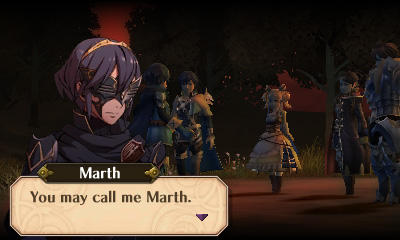


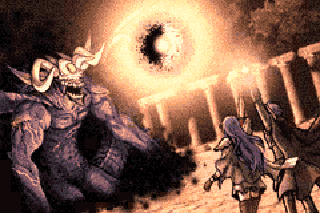


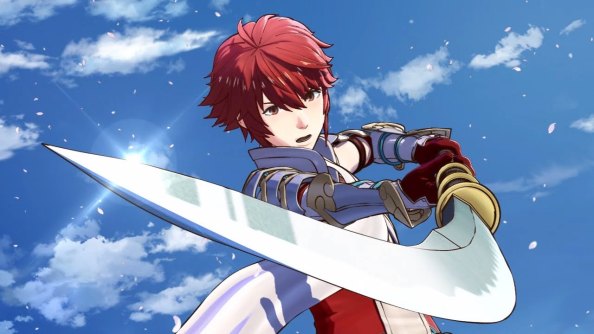

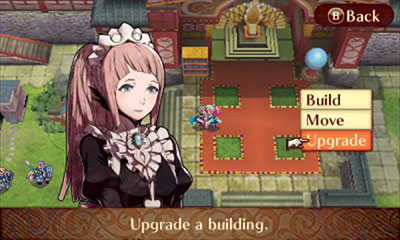
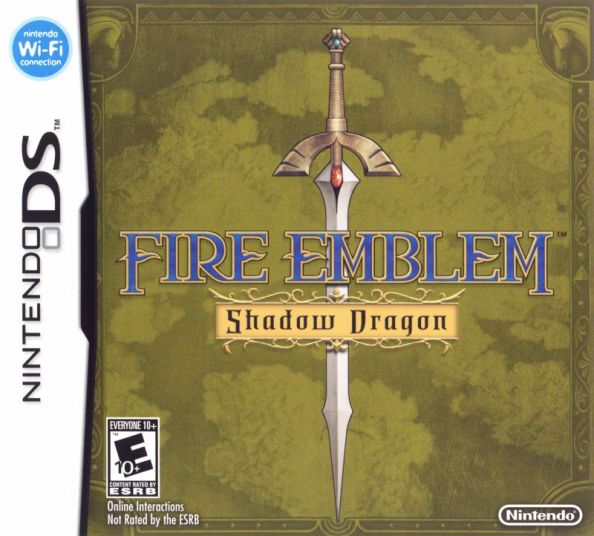
 Fire Emblem: Shadow Dragon tells the story of Marth, a young prince forced from his kingdom when an evil sorcerer, known as the Shadow Dragon, murders his father to steal his throne and his magical sword, Falchion. Fortunately, his pursuers allow him to bring one thing with him into exile: a well-equipped army of highly trained soldiers willing to stop at nothing to restore him to the throne. So Marth launches his campaign which consists of a series of macguffins and convoluted excuses for tactical medieval combat. After a handful of victories, Marth is awarded the titular Fire Emblem, which I assumed must have been pretty important to lend its name to the series. What could this be? Is it a supreme magical macguffin like the Triforce? Perhaps it grants Marth hero powers, such as in Age of Empires? Nope. It lets our hero open up treasure chests, thus allowing a single unit on the battlefield the ability to do what any standard RPG protagonist can do automatically and free of consequence in any dragon’s cave, king’s castle or stranger’s living room.
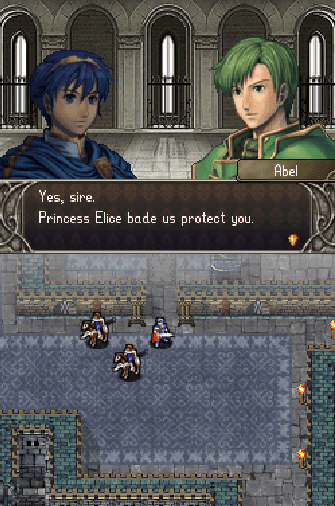 Bearing a strong Shining Force vibe, Fire Emblem presents a simple, no-frills strategy game with everything you’d expect to find and very little else. Noteworthy features include an insane difficulty and a perma-death system rivaled only by the real world. It is a video game, so it does include some healing magic after all, but there’s only one resurrection item. In the penultimate level. That can only be used by a single character. Once. (Which by the time this entry posts is likely to be the Republican healthcare policy) This is, I gather, supposed to make me more considerate of my actions, more mindful of the risks and more hesitant to throw away lives on crazy maneuvers like I was shooting craps with someone else’s money. However, in practice it only makes me frustrated that there’s no option to re-load save files from the battle menu. At least they had the consideration to give me two opportunities per battle to save progress, lest the dozen or so hours I wasted on resets blossom into two dozen.
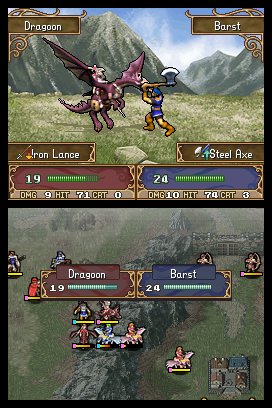 The problem with this, though, is that much like a buffet line, some characters tend to pull more weight than others, and they tend to get rather large, while your other combatants whither away by comparison. Early on, the units who dealt more damage began to gather more experience than the defensive units, and the gap between them grew until the endgame when I waged war with one seasoned soldier, a dozen accountants, and three nuclear bear robots with Ginsu claws and laser eyes. Later stages often became a handful of heroes pushing their way through a crowd of people milling about in the middle of a freeway. It got rather tiresome trying to stash characters in safe places, but the mages generally had the firepower of a toaster cranked up to 3, and as far as I could tell the archers were just lobbing plates of wet spaghetti at the enemies.
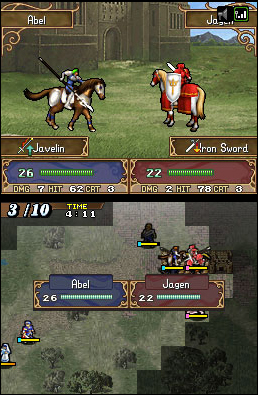 While mostly just a serving of vanilla strategy game, Fire Emblem has an interesting sugar cone underneath. All chests must be opened during battle, and of course those who are easily distracted by shiny objects while under assault will necessarily need to change their strategy. Furthermore, most characters must be obtained by fulfilling certain conditions in battle, such as rescuing them from death, schmoozing with villagers, or simply not killing key enemies. Unfortunately, if you’re anything like me, approaching people for conversation tends to be far more difficult than setting them on fire from a safe distance and hoping they die before expecting you to make small talk, so my ranks tended to grow slowly. Of course, there were also the moments when the game took pity on me as I stood shoulder deep in the corpses of my loyal followers, when it conveniently sent a ragtag group of scrappy fighters to help fill out my ranks without the least bit of concern for why Marth never bothered to learn their names.
 Video Game Underworld