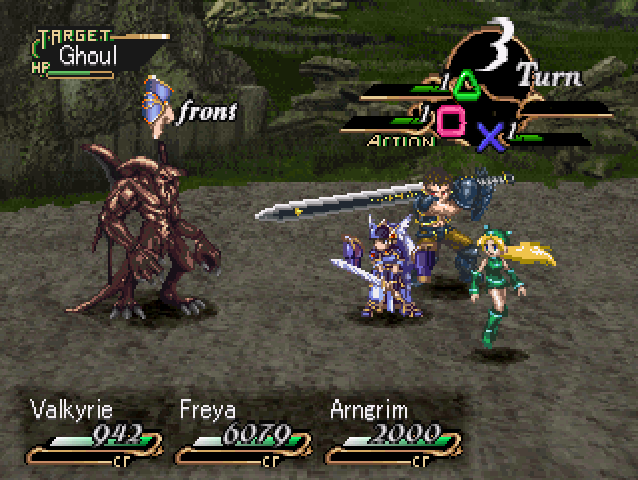
Valkyrie Profile 2: Silmeria – PS2

Our non-valkyrie protagonist, protagonisting

Our non-valkyrie protagonist, protagonisting

Imagine the worst thing a video game has ever done to you. What games did you invest time and money in only for them to pull some dick move on you, probably leaving you swearing at the top of your lungs at the TV screen? If you finish Jurassic Park for the SNES, you get a delightful little non-ending that consists of the loading screen playing in reverse, which after a team of friends and myself spent an entire night of caffeine, headaches and dial-up internet walkthroughs to do, left me with an empty feeling, much like waking up next to a prostitute hungover and broke, except without the exciting evening to balance it out. Or one of Anne’s favorites; spending hours early on in a game going through side-quests, leveling up to the ultimate attacks, finding the ultimate weapon, and then the game murdering the character and taking with it all the equipment, experience, and precious moments of your finite life span along with it. Final Fantasy, Legend of Dragoon, take your pick. This one happens often enough. How about forced stealth, babysitting missions, or quick time events?

Full disclosure: I might give away some integral plot points of Valkyrie Profile 2: Silmeria, but I refuse to call them spoilers. See, to spoil something implies that it began with a certain level of freshness, but this game holds the record for most rotten-to-the-very-center-of-its-being of any game I’ve ever played.  If Mother Teresa, Gandhi, Jesus and Buddha collaborated to breath life into this game to make it human, it would still back over your cat with a humvee and then try to console you by saying, “At least it wasn’t a dog.”

Release the Kraken! Because apparently Norsemyth doesn't have enough monsters to keep us interested?

Release the Kraken! Because apparently Norsemyth doesn’t have enough monsters to keep us interested?

The first time I played this game, I swore I’d never do so again. I lived in a studio apartment and had to apologize to my neighbors for regular disturbances as I screamed profanities that would offend sailors at the top of my lungs. Hours upon hours of my life spent leveling up to plow through impossible enemies would vanish into oblivion as a clunky game mechanic would have my party trip over a blade of grass, leaving the nearby monsters to drive them into the mud like lawn darts. After figuring out from Valkyrie Profile: Lenneth that the game innovated RPG combat to stress set-up and strategy over power-leveling and high stats, I realized I simply didn’t know how to play the game right before. As it turns out, I rather enjoy the games combat system and find it highly engaging, much like the system for The World Ends With You, which I’ve found amazing ever since hoisting myself to the top of the learning curve with a few crampons and a good length of dental floss to use for rope.

No, to get to the real, black, shriveled prune of a heart of why this game laughs in the face of all who dare to play it, you have to examine the things the game designers did intentionally. For starters, for a game that claims to profile a Valkyrie, it spends very little time doing so, in favor of constantly introducing new characters with no relevance on the plot in the least. I didn’t often appreciate the half-hour long snooze-fests that introduced einherjar in VP: Lenneth, but Silmeria swung the opposite direction, introducing dozens of playable einherjar with no backstory whatever except for an entry in the status screen. They have no effect on the plot, but the game expects you to play with them and level them up anyway for the sole purpose of transferring their souls…well, maybe not to Valhalla due to Silmeria’s war with Odin…but to somewhere not nearby your party. Yes, by transferring them you get an item that permanently increases any characters stats, but it seems like time spent leveling up useless characters would help more if you spent it on the main characters of the story.

Our titular valkyrie, not valkyrie-ing

Our titular valkyrie, not valkyrie-ing

Speaking of which, you only really get two. Well, maybe one and a half, since the protagonist spends half the game possessed by the spirit of Silmeria. See, at the critical act one climax, you lose all your main characters–permanently–except for two, except Silmeria’s spirit goes on to bigger and better things. So you better hope you have some einherjar left over, especially a mage, because you never get them back!  Sure, the plot gives them back to you, but the game has changed their stats and attack patterns enough that you can’t call them the same person once you get back into combat, sort of the games way of saying, “Sorry I ran over your cat with a humvee, but I’ll give you a coupon for a free pizza to make it up to you.” Without Silmeria, you have no power to call einherjar, so if you had set them all free–like I did the first time I played–you may find yourself drastically shorthanded for the rest of the game. Then, for whatever reason, the game gives you a slew of playable characters literally in the final dungeon. In fact, by the time you actually get to see and play as Silmeria, you’ve already explored 74% of that level.

But perhaps the worst offense of all, VP: Silmeria reunites you with your trusty mage, a major playable character, a powerful magic user, and a Harry Potter impersonator, for one dramatic battle with Odin…and then leaves your party permanently to become the game’s end boss. Also, his lust for Lenneth, a character mentioned only once before, motivates everything he does. So…really, I don’t entirely know what Silmeria has to do with anything.

Just a little cranky. Apparently he lost all purpose in life after killing Voldemort

Just a little cranky. Apparently he lost all purpose in life after killing Voldemort

But really, the story lacks the cohesiveness of a wet post-it note, surpassing its predecessor for scattered, irrelevant, and unexplained plot points. It seems like Enix intended to make this sequel as they wrote the original, and they do connect a number of plot points and locations together, even if they don’t feel compelled to include explanation or reasonable motivation for characters’ actions. I could have connected with and found interest in the villain, had they ever decided to explain his obsessive crush on Lenneth, but they don’t even give us as feeble a reason as “has a thing for platinum haired vixens.” Furthermore, it seems highly unlikely that anyone crazy enough that Hannibal Lecter, Jack Torrence and the Joker want to keep a healthy distance would have the wits to put up an intelligent, rational and friendly facade for the majority of the story. Several characters from VP: Lenneth make appearances here, but the game never bothers to explain how they exist in both the Ragnarok-era of Lenneth and the ancient past of Silmeria. Near the end of the game, they throw some very elegant prose at you that I may have found slightly more moving had they ever bothered to establish some sort of theme or direction for the story. Then they try to explain some stuff about an alternate history, how these events happen after Ragnarok for Lenneth and the villain who have traveled through time, but before Ragnarok for everyone else and…honestly, they lost me.

Even a major antagonist takes priority over Silmeria on the box art.

Even a major antagonist takes priority over Silmeria on the box art.

For all its flaws, I don’t want to condemn the game to the coldest, darkest region of Hel quite as much as I did the last time I played it.  As I mentioned before, I feel they revolutionized RPG combat–or would have, had anyone figured it out. Rather than focusing on fighting enemies, gaining experience, buying stronger weapons, and fighting more enemies, the monsters throw challenges at you. You have only a few menu options, and can’t use more than a single spell or item every so often, but it gives you choices to make that you don’t commonly find in these games; do you want to split up your party into two groups to distract an enemy? Would magic or physical attacks do more damage here? Do you need to take out smaller enemies, or can you go directly to killing the leader? While the main maps, oddly enough, give the player only two dimensions to work with, combat maps switch to a 3D perspective where monsters and players alike move across terrain, trying to avoid getting taking hits.

An insipid, directionless story, but beautifully rendered.

An insipid, directionless story, but beautifully rendered.

Furthermore, the care they neglected when writing the story obviously went into rendering the characters, cut scenes, and scenery. You’ll have plenty of eye candy for those moments your attention wanders off of the vapid plot.

And, thankfully, they got rid of the sushi bars. Influenced by Norse myth or not, that just didn’t make sense.

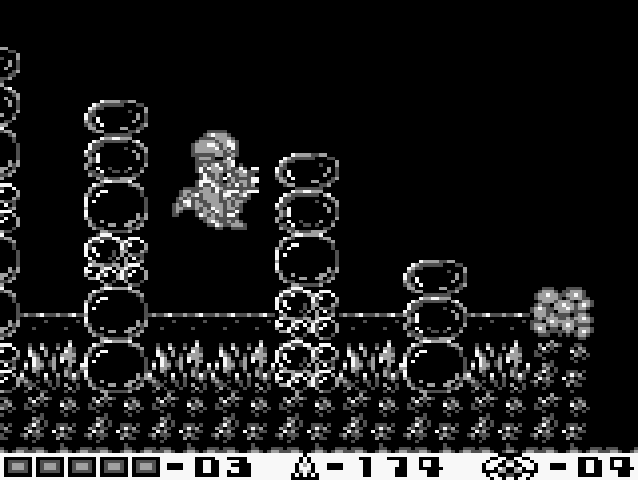
Metroid II: Return of Samus – Game Boy

RetroArch-0305-133132After the events of the original Metroid, the Galactic Federation decided the Space Pirates had gone too far! Perhaps they damaged relations by attacking galaxy cargo and transport ships.  They may have even ruffled a few feathers in wiping out the entire race of Chozo.  The galaxy may have thought about issuing a stern warning when they killed off Samus’ family. But damn it! Now they’ve gone too far. The Federation had no alternative but to…eliminate the entire species of metroids. I can see the activists lining up now–signs that read “Metroids don’t kill people: Space Pirates kill people!” Bribery and lobbying from “Big Metroid” must not have measured up against the prices offered by the Space Pirates. I may come off as cynical, but I can’t help but think that any government who would consider apprehending and prosecuting known criminals as a less-favorable alternative to wiping out the apex predator of an entire planet’s ecosystem must suffer from a fair amount of corruption.

Beats hunting them by their droppings

Beats hunting them by their droppings

The idea of writing about a Metroid game has me bashing my head against the same wall I bash against for Mega Man. What can I really say that doesn’t already apply to all the other games in the series? Samus rolls up like a hedgehog.  Samus finds items like Link and jumps around like Mario. Samus fights monsters. Freeze the metroids, then blast them with missiles. Metroid really doesn’t innovate too much. While the original frustrates me on account of having no map and exceedingly large rooms that all somehow look identical to each other, and Prime annoyed me on account of Samus’ power suit not including the feature to see your feet as you leap from rocky precipice to rocky precipice (I hear that feature cost extra, and she preferred to go with the cup holders), I really can’t point out any significant difference in quality from one game to another.

Well, they hired me to kill you, but...just this once.

Well, they hired me to kill you, but…just this once.

As other games in the series tend to roughly follow the plot of the Alien movies, Metroid II: Return of Samus calls upon a character to invade a planet and wipe out an entire species, a request by a group of people collectively too dumb to read a job description. As a bounty hunter, I imagine Samus’ passion and skills fall in the area of tracking space criminals who have skipped out on their space court dates, receiving their space bail money as payment for her services. Or by a more archaic definition, capturing runaway space slaves who have liberated themselves from oppressive space plantations where their space masters whip them if they don’t grow enough space tobacco or pick enough space cotton. Apparently, though, that profession only lies one step away from “Orkin Man,” as the galaxy seems to have contracted her as an exterminator. So tired from her last mission and grumbling about the nature of this one, Samus lands her ship on the dark side of SR-388 with an inaccurate list of metroids to kill.

Remember: they mostly come out at night. Mostly.

How did these guys get everywhere in the galaxy? Bad tourist policies? "Take only photographs. Leave only chozo statues."

How did these guys get everywhere in the galaxy? Bad tourist policies? “Take only photographs. Leave only chozo statues.”

While I don’t usually consider graphics vital for a good game experience, Metroid II makes them significant. On the tiny, dimly-lit game boy screen, the lack of color offsets the background design, meaning that I spent as much time wandering around SR-388 looking for a gas station to ask directions as I did in the original game.   Unlike Mega Man II, the Samus’ size-to-screen ration doesn’t leave her burrowing through the map like a ferret, leaving plenty of room for her to roll, space jump, or bounce like a rubber ball.  In fact, quite the opposite; sometimes the game encourages hefty upward climbs with nary a ledge to stand on, requiring long chains of space jumping.  Unfortunately since the controls demand the clockwork input of a hungry toddler, one slip-up can send Samus plummeting back to the start.  Sometimes the spider ball tool helps out, but sitting too close to a bomb, getting hit by a monster, or just nudging the wrong button at the wrong moment can likewise invalidate your efforts. Item management has taken a downgrade from the original, as beam weapons no longer stack effects, and with no menu system (as in Super Metroid), if you want to switch between weapons, you have to backtrack to the last place you found that particular item. Because the Game Boy only had four buttons and a D-pad to work with, some of the ways to activate tools come off as clunky and random as the tools themselves. The spider ball commits this offense more than anything, and it doesn’t help that in spider-ball form, Samus moves more like a lazy tarantula when I’d prefer her to move like the spiders I nearly step on in my bathtub, yet like bathtub spiders she seems to have no qualms about randomly dropping from the ceiling.

So if we watch them hatch and view them through every stage of their life...when do they turn into the jellyfish things?

So if we watch them hatch and view them through every stage of their life…when do they turn into the jellyfish things?

I mostly maintain a Mega Man-esque appreciation for Metroid; the original concept worked, more or less, and as long as the game doesn’t tweak that too much, I can enjoy running and rolling through 2-D subterranean tunnels, murdering local wildlife and opening doors with a gun. If I needed to raise serious complaints about the game, I’d have to express a mild frustration that they’ve traded off challenging, unique boss fights like Ridley and Kraid, for simple, straightforward metroid battles, and while they included a lot of them, it takes less firepower to kill each one than a Northern Michigan mosquito–about five missiles.

Beatiful scenery, well designed textures, a wonderful, distinct world and...oh shit. Spikes.

Beatiful scenery, well designed textures, a wonderful, distinct world and…oh shit. Spikes.

While not nearly off-the-wall enough to merit inclusion in my WTF category, the Metroid II map deserves honorable mention.  The original map infuriated me to no end, but at least they programmed it all on a single grid. So if you traveled in a circle, they at least had the decency to drop you back to where you started. Not so in Metroid II, as entire regions overlap–imagine finding that gas station I mentioned before, only to find that the cashier gives directions entirely in Shakespearean sonnets. It might get you from place to place, but you can’t help but wonder if a more direct approach would have worked better.

Still, fans of the series should invest some time into this game. You won’t miss any story if you don’t, since Nintendo still included the plot entirely in the instruction book and they give you all of it in the opening of Super Metroid, but you’ll at least get another subterranean gauntlet to run around, fight monsters and….wait, what? You don’t get to open doors with a gun? Well, forget it then.

I have a busy week, but look for upcoming articles on Resident Evil: Deadly Silence and Valkyrie Profile: Silmeria. Thanks to my regular readers for following me, and to those who just found your way here because of the BDSM tags in my Shadow Hearts and Custer’s Revenge articles, I offer my apologies.

Mega Man II – Game Boy

RetroArch-0305-044755

What can I say about Mega Man that no one has ever said before? “Mega Man accurately predicted the use of drone strikes against Pakistani citizens.” “Mega Man takes his roots from an Indo-European god who would absorb other deities’ attributes after conquering them in battle.”  “Mega Man sits in the tum-tum tree of life, burbling in the tulgy wood of post-modern philosophy, calling philosophical jabberwocks to examine the nature of his soul with their eyes of flame.” It turns out, I can say a lot of things.  If you want something valuable, something worth saying, that might take a little extra thought.

While clearly a beloved series, no one will accuse Capcom of great innovation.  Consider the minute differences between the core series and Mega Man X (i.e. new end boss, upgradeable armor, and different stage select screen layout): now realize that Capcom considers those different franchises. These games epitomize the “if it ain’t broke” philosophy.  With minor exceptions from game to game, if you’ve played one, you really have played them all.

While Capcom ran all their old games through a meat grinder, spitting back the same ground chuck in a new package, injected with colorful dyes to make it look fresher and tastier, they also silently spit out the intestines, giblets, and other dubious parts of their creativity, crammed it into a small cartridge and sold it to us for the Game Boy.

Did these guys creep out anyone else?

Did these guys creep out anyone else?

I don’t entirely know what to make of the Game Boy.  I didn’t enjoy it much when I owned one, but I only had three Mario games, Tetris, and Kirby’s Dream Land–not exactly USDA choice. On one hand, it seemed to offer an experimental system to figure out how to make better sequels, flush out series with side stories, or work more with less technical space.  On the other hand, they could also simply port games from the NES, package them as portable, and rake in the dough.  In the case of Mega Man, I’d put my money on the latter.

Capcom blew their budget for this game by hiring Salvador Dali

Capcom blew their budget for this game by hiring Salvador Dali

For the game boy Mega Man series, Capcom phoned it in.  Literally.  They called in other developers to take over their flagship franchise, the character they would love, adore, and pamper like a rich, young, trophy wife (at least until Resident Evil started making eyes at them, offering more money, a younger series, and more realistic breasts…sorry, Roll.).  So what exactly happens when they pimp out a favorite game? Not much, it turns out. Following the formula for the Game Boy franchise, Mega Man II takes four robot masters from the NES Mega Man II, followed by four from the NES Mega Man III.  For the most part, each enemy’s weakness remains the same, making boss battles about as fun as playing rock-paper-scissors with someone who believes that if he keeps picking scissors, you’ll eventually fall into his trap, pick paper, and he’ll emerge victorious (sorry, Cut Man).

Psst! Rock, can you step out of the picture? You make it look less like an imposing fortress and more like an ugly SUV.

Psst! Rock, can you step out of the picture? You make it look less like an imposing fortress and more like an ugly SUV.

After progressing through Dr. Wily’s castle…er….space station, you encounter Quint, the mysterious character who appears before you to challenge you, a la Protoman in Mega Man III.  According to the additional material for the game, in the future, Dr. Wily reprogrammed Mega Man, named him Quint, and set him back in time to fight you, here, in this game. Here, the half-life of logic drops to mere seconds, like the artificial elements scientists spend thousands of dollars to create, only for them to exist for an infinitesimally small fraction of a second.  Apparently, after years upon years of Mega Man pounding Dr. Wily and an army of robot masters armed with the deadliest weapons ever devised using nothing more than the blaster grafted onto his arm, Dr. Wily thought he could finally emerge victorious….by replacing the blaster with a jack hammer.  I guess in the future, Mega Man really let himself go.  Lost his job as defender of humanity.  Maybe threw out his back.  Eventually only a 2-bit road construction company would take him in, and every morning after downing a box of donuts, he throws his gut, swollen from drinking a six-pack of E-tanks every day, over the handles of the only tool he’s capable of picking up anymore, and starts ripping away at the road. I like to think Guts Man comes out of a nearby trailer every so often to supervise.

"Sakugarne? It's not in the dictionary!" "Just run it through Babel Fish!"

“Sakugarne? It’s not in the dictionary!” “Just run it through Babel Fish!”

Anyway, not only does the jack hammer feel slightly outclassed by an energy blaster, but after defeating Quint and adding his weapon to your stash like a serial killer claiming a trophy, you only fight one more enemy: Dr. Wily. Sorry, but even lazy, witless, beer-gut Mega Man won’t take too long to figure out what weapon to use on the final boss.  And that means that the one weapon Wily thought he could use against a weapon-adaptable super-robot…also deals the most damage to Wily himself.  When Capcom named him after Einstein, I didn’t realize they meant that in the sarcastic-colloquial sense.

You closed your eyes! Great, now I have to take the picture again.

You closed your eyes! Great, now I have to take the picture again.

Because the Game Boy doesn’t offer much in the way of Real Estate on such a tiny screen, levels feel claustrophobic.  Level designs seem simpler, character sprites appear larger than they do on the NES, and as a result, less stuff can happen.  A great deal of the challenge in the NES games required you to make snap decisions based on multiple threats attacking at once, requiring quick attacks, evasive action, or clever use of a weapon. Nope! Not here.  I shot through the game in less than forty minutes on my first play-through. The game didn’t label which teleporters took you to the last four robot masters…that kinda added some challenge.  Also, your weapons don’t refill between stages at that point.  But really, I think this game shows Dr. Wily’s age.  No longer full of fiery hatred towards Dr. Light and Mega Man, he steals robots and attacks humanity just to go through the motions because he doesn’t know what else to do.  Really, if you think about it that way, Mega Man II for the Game Boy, rather than presenting a fun and interesting challenge, merely provides a scathing indictment of our prison system and their failure to rehabilitate offenders.  And I bet that no one has ever said that about Mega Man before.

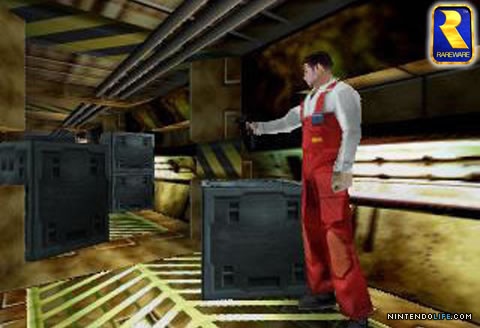
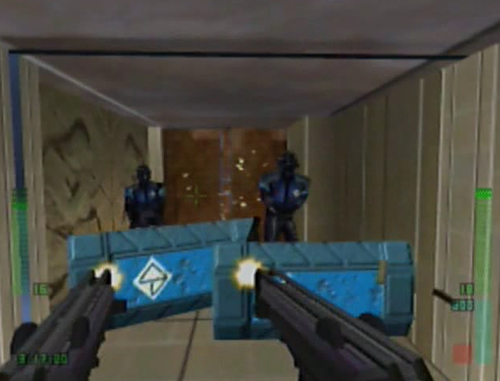
Perfect Dark – N64

perfectdarku
People remember the N64 very fondly.  Almost excessively so.  If you lived through that era with a decent enough memory, you may remember the burgeoning Sony, best known at the time for making VCRs and portable cassette and CD players, blossoming onto the console scene with a 32-bit system and a library of games such as Final Fantasy VII, Parasite Eve, Resident Evil, and more. I didn’t notice right away.  I bought the 64 because I had always owned Nintendo’s consoles.  And as I soon found out, the 64 sported a library of games that rivalled the great Library of Alexandria’s…collection of video games. Seriously, when I think of how difficult a time I had finding good games for that system, vultures will actually leave carcasses bleaching in the desert to come and circle over my head.  However, through a magnificent gift of fortune, a sign of massive favor from the gods, and the store selling out of Star Fox before I arrived to buy the system, I managed to pick up the undoubtedly shiniest gem of the 64-era: GoldenEye.

I, for one, really find it obnoxious that Mario shows up in the most random of games.

I, for one, really find it obnoxious that Mario shows up in the most random of games.

I have played few games as extensively as I did that one.  My cartridge currently has four 007 save slots.  I explored every level, experimented with every cheat, and shot every enemy in every extremity with every weapon just to see what would happen.  I became one with the multi-player mode like some kind of nerdy guru, and to this day, I have only ever lost a round on the day I first bought the game. I even tested this out about three or four years back, as a friend-of-a-friend wound up in my apartment, noticed I had the game, and needed with all his soul to break out this classic.

“Let’s do a deathmatch!” he said.  “I want to customize the weapons.”
“Actually,” I responded, “you have to choose from pre-determined sets.”
“Well, fine.  As long as we can make the bots difficult.”
“Actually, this game doesn’t have simulated players.”
“What? Eh. Whatever. Let’s just start. How do I jump?”
“Actually…”

As much as I love the game, I got bored with it, and it didn’t age well.  Fortunately, Rare developed Perfect Dark as a spiritual successor to the Bond classic.  Unfortunately, the N64 decided to experiment with accessorizing like the ditzy teenage daughter of the super-rich Nintendo.  Rumble packs, needless memory cards, disk drives, voice recognition, transfer packs: all of which worked for less than a handful of games, simultaneously draining your wallet and filling the plastic bin by the TV with more video game hardware that would eventually collect enough dust to make you feel guilty about owning it in the first place.  So while you may hear about Goldeneye outperforming Perfect Dark in sales, keep in mind that I didn’t feel like one game (Majora’s mask came out on the game cube and I never had any interest in Donkey Kong Country) justified buying the expansion pack until a few weeks ago.

Yes. He loves his new planet that much.

Yes. He loves his new planet that much.

Perfect Dark, though.  I should talk about it, at least before the halfway point of my article.  While James Bond games and movies have always courted science-fiction like a Republican congressman who picks up drag queens in truck stop restrooms, Perfect Dark openly embraces the genre, strutting about the sci-fi stage looking fabulous.  As such, the game can explore territories that traditional spy fiction, much like the aforementioned congressman, wouldn’t dare traverse openly.  Agent Joanna Dark infiltrates a corporation and picks up information about an alien war about to spill over onto earth.  She picks up a sassy alien sidekick named “Elvis” after rescuing him from Area 51, and with his help, she brings down the evil alien race, saving all of humanity.  Not exactly Pulitzer material, but simple, interesting, and it retains the noir tone of spy fiction while seasoning it with some inter-genre ideas and garnishing it with a sense of humor that, let’s face it, James Bond simply wouldn’t understand.

image10Agent Joanna Dark, (named after Joan of Arc (Jeanne D’arc) in a massive fit of historical amnesia, forgetting that other than breaking the siege of Orleans, she lost every battle she led) provides an excellent protagonist, on par with Samus Aran.  The hegemony of spy fiction dictates that the characters ooze sexuality.  Men charm, while women slink around and act sultry.  Dark however, shows us a competent professional who unlike Bond, doesn’t do her best work on her back.  Short hair, strong face, and average figure, she comes off as attractive, but based on character traits, not an exaggerated physique.  Until, of course, Microsoft got their hands on her and redesigned her in the image of Christina Hendricks. But even Samus’s developers shamed her into a tight blue bodysuit in later games.

Whether intentional or not, Rare actually figured out what people like in game sequels–more of the same, but improving things barely enough to notice.  Based on the GoldenEye engine, Perfect Dark feels exactly like playing through new levels of the same game.  However, they’ve added small features here an there: reloading animations, smoother polygon rendering, secondary functions for each weapon, and for the multiplayer, customizable weapons and sim-opponents.  But still no jump.  No addition to game play, however, deserves more note than the voice-acting.  While GoldenEye offered a handful of out-of-context paraphrased subtitles from the movie, Perfect Dark plays out like its own film with cut scenes and actors who don’t always always beg for their lives like a J-Pop rapper (that particular character even sways from side-to-side as though dancing while you hold the gun to his head).

Perfect Agent, yes, but in just a minute she'll get stuck trying to go around the barrier to pick up their ammo.

Perfect Agent, yes, but in just a minute she’ll get stuck trying to go around the barrier to pick up their ammo.

Still, the voice acting has a down side.  Anyone who’s played Final Fantasy Tactics knows the intense feeling of guilt when you dismiss a character from your roster, and they leave with a line about how sad they feel that they have to part ways with you.  Well, bring on the guilt and multiply it by ten, as each enemy you shoot feels perfectly fine letting you know what a horrible crime you’ve committed with such snappy comebacks as “Why me?” “You bitch!” and “I don’t wanna die!”  In an early stage, I even barged in on two guys lounging around in a break room.  Do security guards have to stop intruders if they’ve punched out for lunch?  Does their company require them to lay down their lives while on break?  It seems almost unfair to kill them when they just wanted to sit and scarf down a sandwich for a half hour.

I do enjoy the game.  Despite losing an interest in first-person shooters, I found the combination of a new game with the nostalgia of an old one invigorating, and the difficulty at the perfect level to keep me interested (at least until I decided to move on to another game) in the same way I loved GoldenEye.  But do you know what I hated about GoldenEye? Natalya.  My mother ran a daycare–out of our house–for 25 years.  I had a playpen in my bedroom until ninth grade.  Let me tell you, having witnessed babysitting that close, I can say with complete confidence that the job has never had any redeeming, let alone interesting, qualities to it.  Never.  At least in Resident Evil 4, you had the option of telling Ashley, “Wait here,” and “Follow me,” (even if she didn’t have the sense to move when a monster showed up to carry her off) but Natalya just stood there and let Sean Bean’s soldiers pump assault rifle rounds into her head.

This guy! Arrgh! I actually loaded a mission once because I just wanted to shoot him myself.

This guy! Arrgh! I actually loaded a mission once because I just wanted to shoot him myself.

So Rare asked themselves, “How can we improve this?”
“I know!” Someone said.  “How about they have to babysit inanimate objects!”
“Great! We’ll give them an explosive box to carry around to protect, even though they could easily use grenades to blow open the wall in that level! What else you got?”
“A flying laptop computer!”
“Not annoying enough.”
“Well, it deliberately flies into the crossfire as a helicopter shoots you relentlessly.”
“Getting there, but not quite.”
“You can’t tell it to stay behind, and when you push him out of the elevator, he insults you for forcing him not follow.”
“Genius! Let’s go!”

While they experimented with more complex mission objectives than “go here, don’t die, shoot this, don’t die, press the action button here, shoot this person, and don’t die,” some of their ideas end up a little infuriating, such as the flying computer guy, or mission briefing that only sort of hints at how you need to accomplish your tasks, or simply wandering around in labyrinthine maps where every area looks the same.  If explained more clearly, the rest of the game offers the perfect (and adjustable) levels of difficulty, not too easy, but also allowing you to finish the game (mostly) without forcing you through the impossibly difficult setting.  Still, wandering around in tunnels for a half hour while trying to figure out that apparently an X-ray scanner that you may or may not have noticed you had will tell you which four of eight switches you need to shutdown an outer defense…well, you get the picture. Boredom does not equal challenge.  Furthermore, the menu system does not play well with others.  There.  I said it.  It spreads out the games options and doesn’t explain them well.  You did much better in GoldenEye, Rare.

To emphasize the connection with Goldeneye, look at this bathroom.

To emphasize the connection with Goldeneye, look at this bathroom.

But after you finish the game once, the replay value goes into overdrive.  You can revisit each stage on higher difficulty levels and practice them, trying to earn the cheat codes, you can play through with the cheat codes, and of course the multiplayer option, which now no longer requires multiple players, offers a nice chance just to run around and shoot people.

Like I said, I’ve lost interest in most eff-pee-esses these days, but I’d still stamp this game with my seal of approval.

Valkyrie Profile (Lenneth) – PS1, PSP

Freya Odin Lenneth
Valkyrie Profile 2: Silmeria hit stores when I lived in Korea.  Square-Enix pulled off promotion after promotion advertising it, and this intrigued me–I hadn’t seen a video game advertised, really, since Nintendo wished to share exactly how “rad”; of a game it had produced. (After which, the world didn’t see a more egregious misunderstanding of rap until this.) The game looked wonderful, beautifully rendered, and epic.  I hadn’t heard of the original, but I knew I needed to play this game! So I bought it and played it, only to find out that Squenix had promoted the wonder, beauty, and epic-ness as a distraction from unrelenting difficulty due to bad gameplay mechanics, bugs, poor play control, and a storyline written by manatees.

“Have you played Valkyrie Profile 2?” I asked my friend Al later that year when I met him in Taiwan.
“Don’t,” he replied, several months too late to save me.

However, he did recommend the first game, so I immediately set out to find a copy.  And with equal expedience I placed it on permanent “wish list” status when I saw its price average at well over $100.  As you can imagine, although I hadn’t liked the sequel, I knew I needed to play this game!

A battle maiden limited by periods? Dear god, do they even think these things through before they translate?

A battle maiden limited by periods? Dear god, do they even think these things through before they translate?

Valkyrie Profile, which Square-Enix has re-released on the PSP as Valkyrie Profile: Lenneth, tells a story based on Norse Mythology.  Odin finds out about the impending battle of Ragnarok, and needs warriors.  He and Freya call upon Lenneth, one of three Valkyrie sisters to go scour the corpses of Midgard for bodies he can stick on the front lines.  From there, depending on whether you chose easy, normal or hard mode, you get a certain amount of time, called periods, to zoom and soar over an oddly diverse continent, looking for people on the verge of death and dungeons to crawl through to train them.

One of Wagner's less-popular operas. Onis don't tend to live quite so far north.

One of Wagner’s less-popular operas. Onis don’t tend to live quite so far north.

The game has a few issues I need to point out.  Valkyrie Profile develops a story based on Norse Mythology in the same way that God of War develops a story based on differential calculus, Thoreau’s “Walden” and the Japanese Stock Exchange.  Yes, they both have something called a Valkyrie, and all the gods have the right names, but after an early scene that takes place in an old Norse . . . sushi restaurant, any semblance of viking culture stands out as coincidental, something that makes you stop and ask, “Hmm, how did that get there?”  In your first battle, you face off against a harpy, as if someone handed the game writers a copy of the Prose Edda and said, “We need monsters to battle! Find some for us,” and the writers looked up from playing Pokemon long enough to see a really hard book, put off doing the work until the deadline, then struggled to remember anything at all from learning about mythology in grade school. In fact, except for a bunch of dragon-esque looking monsters, I didn’t encounter a fight with a recognizable Norse beast until literally just before the final boss.

And here we have...a mermaid?

And here we have…a mermaid?

Next, while I don’t generally demand insightful character development from a story, it might be nice when a game has a title like, say, “Valkyrie Profile.”  “Interesting,” I say to myself.  “What might a Valkyrie have to face in her daily life? What conflicts might she encounter?  Could she face difficult challenges in fating people to die in battle? Or does she have self-image doubts because of waiting tables in Valhalla for a bunch of drunken einherjar?” Unfortunately, we don’t really see anything nearly so interesting.  Tri-Ace gave her character just enough depth to hold its head under until that final bubble of personality popped out of existence.  She delivers a cliched pre-ultimate-battle speech indicating some sort of epiphany, but the game provides us with no build up to indicate why this apparent character trait matters.  Furthermore, even though Freya introduces the Valkyrie to us as “Lenneth,” the majority of characters and even the menus refer to her simply as “Valkyrie,” a point best illustrated by one scene where an einherjar party member states, “Lenneth is Valkyrie’s real name?”

Kinky

Kinky

The entire story comes off as disjointed, really.  The search for einherjar entails using Lenneth’s Spider-Senses on the world map, then flying to an indicated town to collect a soul.  Once entering the town, the player watches an extended cut scene involving the doomed character, seeing a snippet of their life and the conflict that led up to their death. Usually. They forgot to actually kill off one character before he joins your party, but hey, we can just fill in the blanks, right? Maybe he got drunk and fell off his horse or wandered to close to a rampaging myna bird. Anyway, sometimes these cut scenes take forever.  Other times, we see a few disjointed clips, and then a death.  Then the einherjar joins your party and never says another word.

Also, while games offer unique applications of music and put a lot of good soundtracks into the world, I feel the world map sections missed their chance to let players fly a Valkyrie around the world to this song.

Did I mention you only get to move in two dimensions? But hey, the design looks great!

Did I mention you only get to move in two dimensions? But hey, the design looks great!

Similar to Silmeria, Valkyrie Profile: Lenneth doesn’t feel satisfied with its difficulty level until it beats you until your characters have no internal support beyond a sack of bone meal and pated organs.  While at first I lamented the fact that Enix had seemingly duped me into grinding for yet one more game, I later realized the half-turn-based, half-real-time battle system actually innovated a non-level-focused brand of combat.  The game hands out experience like a disapproving politician, trying to punish you for your dependency on fighting monsters to level-up.  Instead, the player can win battles at a low level simply by preparing properly, using equipment and characters to their most efficient potential.  They didn’t accomplish this well, offering a muddled system for buying and selling (re: creating from and converting to divine energy) items, a menu that tells you nothing about what effects certain pieces of equipment will grant, and absolutely no indication that you should consider anything except grinding, but with some work, it might be a nice alternative to formulaic and repetitive RPG combat.

But believe me, it needs work. Badly.  Magic, while clearly overpowered, more than compensates for that by requiring excessive wait periods between casting spells.  Characters charging their magic can attack for a small amount of damage if they’ve learned the ability to summon a familiar, but can’t so much as use an item to heal in the interim. I found three mages in a party can make it pretty easy to plow through enemies, but you really need this many to use magic effectively.

The game found an interesting way to increase replay value.  Rather than shooting for ending A, B, or C and then looking up the other two on youtube when you finish, Valkyrie Profile actually sends you along alternate story paths based on the decisions you make, leading to more or less of Lenneth’s personal story, and the game culminates in alternate final dungeons with alternate final bosses which lead to the three alternate end-game cut scenes and credits.

RetroArch-0909-035901Oddly enough, despite the shallow story, sloppy menus and item system, broken battle mechanics, disjointed story, and complete lack of direction, I actually didn’t hate playing this game.  Yes, I know I forgive RPGs more easily than they deserve, but after finishing Valkyrie Profile: Lenneth, I feel tempted to play Silmeria again, and I know I didn’t enjoy that game.  It surprised me, because objectively I shouldn’t have enjoyed this game. But somehow I did, and I do acknowledge the value in playing this game.  I wouldn’t buy the game for $100, but it does have some value to it.

Coming soon, look for articles on Perfect Dark and Resident Evil: Deadly Silence.  I may actually play through Silmeria, in which case I’ll probably drop off the map for a while.  GRE coming up, plus long games equals I hope you’ll remember to check back every few weeks for an update. Thanks for reading!

Mystique Sex Games (Custer’s Revenge, Burning Desire, Knight on the Town) – Atari

RetroArch-0909-031923

After eight months of writing,  this entry will pop my cherry, sending my innocence–and any delusions I had of holding a “G” rating–cascading down the drain, through the earth and plummeting into the fiery hell of the planet’s core; I intend to enlighten you about the dreaded Mystique “pornographic” games for the Atari 2600! Yes, ladies and gentleman, by the end of this entry, a thick coat of soot, tar, and the shattered dreams of parents who expected their children to live an entirely asexual lifestyle will cling tightly to our hearts. Now, keep in mind that modern games frequently aim to re-create the feeling of real-life battle, and whether you want to watch it or not, the Fallout games will incessantly show you bullets ripping humans and animals alike into carrion and bone meal, but the games that disturb people involve an instinctual, consensual act of affection (or, at the very least, amusement) between two cartoons pixilated beyond any semblance of humanity? Really, world?

Which of these looks more realistic to you?

Which of these looks more realistic to you?

I generally oppose censorship. We could easily stop implicating video games as violence-inducing murder simulators if politicians and reporters could A) play a few of the thousands of games that don’t involve guns or B) look past the handful of school shooters to see the millions of people who play violent games without using educational facilities as target practice. I would like to say that studies show no difference in attitudes toward sex and women between men who watch porn and men who don’t, but I can’t, because those studies have failed since scientists can’t find men who don’t watch porn. Ubiquitous, natural, required for life, and generally all-around, good clean wholesome fun, sex shouldn’t really ruffle our feathers as much as it does. So I’d like to examine some of the games released by Mystique like I would any other game, and explain what they’ll actually do to you; make you bored, frustrated, and not the least bit aroused.

Custer’s Revenge / General Retreat

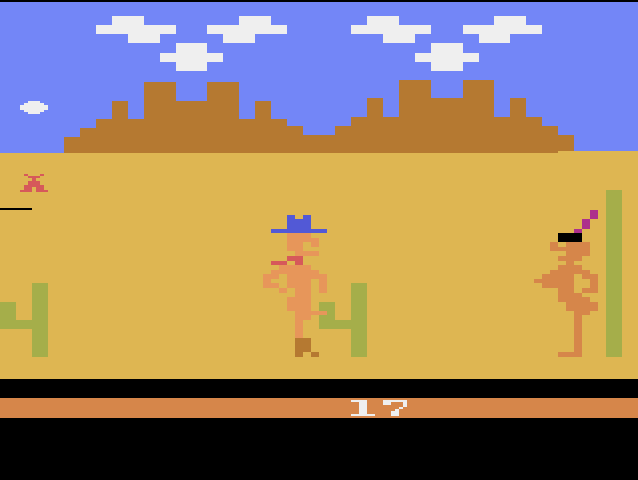
Probably more infamous than any other game on the list, “Custer’s Revenge” stars the reanimated corpse (or so we can only assume) of General George Armstrong Custer, trying to stick it to Sitting Bull and Crazy Horse by sticking it to…well, you get the picture. The game simply asks you to take control of Custer, decked-out in his Union Army hat, boots, and all the glory God gave him, and walk across the screen to an excited-looking Native American girl with scolioses, likely caused by a top-heavy physique. The catch? Much like the girl, Sitting Bull won’t take it lying down, and Custer must dodge a rain of arrows on his way to commit miscegenetic fornication. While…uh…engaging the young woman…against a cactus…Custer must occasionally…”withdraw from the battle”…as the arrows keep flying in, and the game wants you to keep pounding…uh, the action button until the deed is over.

After running into an invisible cactus.

After running into an invisible cactus.

Dear General Custer,

While I admire that, in spite of history recalling you as a proud, stubborn, and arrogant man, you’ve found a non-violent way to seek revenge for your painful murder, I might advise A) pants and B) that you take the girl somewhere a little more romantic than the brink of the afterlife. Mystique has granted you a second chance at life. Please use it well.

While the concept will probably keep me snickering for the rest of my life, the game itself displays less thought than its protagonist. The game offers a surprising challenge, but due to Custer’s slow movement, the tight spacing between arrows, and…well, expected difficulties in making a sufficient retreat…certain dodges can feel impossible. I eventually learned that arrows could safely hit the brim of his hat, which requires perfect timing to execute. By itself, I wouldn’t condemn the game for that. Higher difficulty levels, though, do some weird things, including placing an invisible cactus in the center of the screen, ready to skewer Custer’s reason for crossing the second half of the screen. I haven’t yet figured out how to dodge this.  And every time you die, the game plays an explosion sound, followed by a short excerpt from “Taps,” and restarting requires you to sit through a modal, Native-American-esque theme from “The Stars and Stripes Forever.” After spending a half hour on this game, 28 minutes of which involved waiting for these songs to end, I decided to just put on a Justin Bieber album so I could at least play a good game while I let music drive me insane.

Mystique games come in pairs, depending on which gender role you want to adopt (with “General Retreat” serving as the reverse of “Custer’s Revenge”); however, since they boast identical gameplay and each one revolves around a heterosexual orientation, the end result doesn’t change. Game winners get to watch pixel clusters and imagine it looks like a man and woman having sex. Of all the games I got working, only Custer’s Revenge suggested a non-consensual relationship, since the box art depicts the girl tied to a pole, but since General Retreat shows her free and going after Custer, I can only assume she enjoys that sort of thing.

Burning Desire / Jungle Fever

In Burning Desire and Jungle Fever, you play as a man or woman dangling from a helicopter, trying to rescue people from two pillars of flame, slowly closing in on their location, while two jungle monsters lob rocks (or something) at you. Yet for some reason, you flew out here au naturel, and don’t seem to have the wits to fight the fire with anything other than your least efficient bodily fluids. At least, the game’s material tells you the characters spray the flames with ejaculate and milk. One may want to tell Mystique that their depiction of the droplets coming from above the characters’ necks actually tames down the perversion of the game.

RetroArch-0909-032819Given the choice, I’ll take the necrophiliac Civil War vet over this game; at least it makes more sense. Burning Desire and Jungle Fever manage to leave gaping plot holes in a game that literally has no plot. Why not just lift the poor guy out of the fire? Why put it out first? Normally, that sort of thing wouldn’t bother me, but any time you stop spraying the fire, the flames immediately jump back to their original height, with a small chance of remaining extinguished for five or so seconds if you put it out completely. That means you have an almost certain chance of one fire reviving as you try to fight the other. Combined with the extra-finicky controls for allowing the rescued man/woman to latch onto…special bits…to let the helicopter lift him/her out of peril and into a position to thank the rescuer very affectionately, and I can say I only succeeded twice. By luck. I have no idea how to re-create what I did.

I think I'll have a word with these people about the graphic nature of their pixels.

I think I’ll have a word with these people about the graphic nature of their pixels.

Knight on the Town / Lady in Wading

While Mystique released several other games, I’d like to finish this list today with Knight on the Town and Lady in Wading. On this list, I can’t recommend any other game as even playable, while this game actually puts up a decent challenge. You play as either a knight or a lady, who has spent so much money on bridge-building supplies that you can’t afford a shred of protection against the sex-organ hungry alligator in the moat. The player must, brick by brick, build a bridge to cross the moat in order to…let’s say “secure an heir for your kingdom.” Meanwhile, an alligator leaps out of the water to indulge in select parts of you, a monster darts out of the bushes to devour you, and on higher difficulty settings, a…pterodactyl?…drops fireballs on you.

Seriously people. These games lampoon themselves. I really can’t add to the absurdity.

Once you’ve completed construction, one more challenge awaits you: intercourse. Here, you must successfully hit “up” and “down” on the joystick (hehe…”joystick”) in an alternating pattern until…well, you get the picture.
Apparently the monsters get to watch. I told you these games were kinky.

Apparently the monsters get to watch. I told you these games were kinky.

Honestly, I understand why people put out (hehe…”put out”) games like this. People like sex. But for some reason, it hasn’t caught on in the video game world. Yeah, we see it present in God of War, Mass Effect, and Leisure Suit Larry, but as sex, it doesn’t tend to evoke the same response in us that…well, anything else does. So even with the advent of the video game rating system, sex has only casually flirted with games. Maybe we can attribute that to the lack of quality in these early Atari games. Or maybe it had something to do with the fact that the price of an Atari plus a few games, when adjusted for inflation, cost over $500, and $500 buys a lot of porn.

I give these games my rating of “8 out of 10 WTFs.”

Dragon Quest IV: Chapters of the Chosen – NES, NDS

Stunning artwork by Akira Toriyama, which you will never see with the first-person battle system.

Stunning artwork by Akira Toriyama, which you will never see with the first-person battle system.

Sometimes I wonder if game designers ever play games themselves. When they go home from a hard day at Square-Enix or EA or wherever they work, do they sit down, pop in Goldeneye 64 and vent their aggressions on unsuspecting polygonal clones? Because half the time, the games I play suggest that the designers slapped together a few inebriated, late-night ideas together, hired some monkeys to make the code functional, then add required backtracking, level-grinding, or needlessly long menu dialogue to pad the game out to the optimal length for predicted financial success.

And so we arrive, weary and saddle-sore, at the beloved Dragon Quest series. In particular, Dragon Quest IV: Chapters of the Chosen stands out as the paradigm of wrong answers to good questions. “What part of the traditional JRPG do players consistently enjoy as the most stunning part of the experience? What makes them ignore the phone, neglect their schoolwork, household chores and personal hygiene, and refuse to develop a social life more than any other point in the game?”

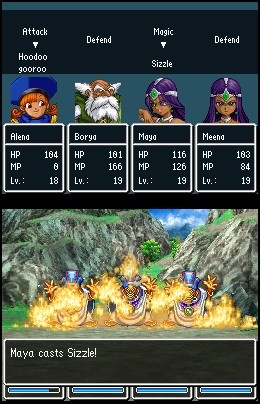
DS Battle“Compelling characters and a complex, driving storyline?” shouts an up-and-coming young mind in the Enix meeting room.

“Fuck you!” responds the boss, who follows up by firing the up-and-coming mind.

“Hours and hours of monotonous grinding?” someone suggests.

“Technically, true. Put it in the game. But what do they love? Why do they love RPGs with the intensity of a rabbit overdosing on Viagra?”

“The first hour and a half where you have no money, no access to anything cool, and  no abilities other than attack and item?”

“I like it,” says the boss. “We’ll do it five times, and throw in some of that grinding to make it more like three hours.

And thus, the incipient Dragon Quest took form. Chapters of the Chosen focuses on…the idea of not focusing on anything. The story opens with the generic blank-hero, a character so bland compared to everyone else in the game that the lord of hell himself couldn’t drag my projection of myself into the game. “You want me to imagine myself as that guy?” I ask the game. “No thanks. You go on and play without me. I’ll just watch this one.” Feigning a fast-paced, exciting game, monsters invade the hero’s village, looking for you. After killing your neighbors, your adopted parents, and your love interest, the monsters decide they just don’t feel like putting the effort into eviscerating one more human and leave your cowering in a mixture of fear and bodily fluids.

And then the game, bored of the hero’s personality already, leaves you as well, and goes on to someone much more interesting. I’ve just described the prologue. Bear in mind, you don’t even get to battle the monsters. No fighting. Not with the protagonist. Not yet. C3PO and R2D2 make it to their hero at light-speed compared to this game. So the game shifts to Ragnar McRyan, whose king has sent him to find the hero–but before he does, we have to help Tsarevna Alena pull a Princess Jasmine. Alena eventually Alena joins a tournament that almost introduces the villain–

Thought I should include a screen shot of the NES version. Apparently they added the borderline-offensive gibberish for the DS version

Thought I should include a screen shot of the NES version. Apparently they added the borderline-offensive gibberish for the DS version

–but first cuts to the story of Torneko Taloon, Akira Toriyama’s answer to Nicholas Cage, and his aspirations to profit from mass slaughter more than anyone has ever profited off anyone else’s misfortune ever before. Torkneko deserves special attention, for taking role-playing to the extreme. Flash back to the execs meeting:

Just to mess with you, they included "night," which translates to "for half the game, you'll wait for the useful NPCs to wake up."

Just to mess with you, they included “night,” which translates to “for half the game, you’ll wait for the useful NPCs to wake up.”

“We need a role that will open up their eyes to the possibilities!”

“Why not a Samurai?”

“That’ll never work. Next idea!”

“What about a Cowboy?”

“What do I pay you losers for?”

“How about we put players in the role of a mindless clerk standing at a cash register all day long?”

“Fuckin’ genius!”

I should mention at this point that I haven’t exaggerated anything yet. During Torneko’s chapter, you literally spend huge chunks of time standing on the merchant’s side of the counter, waiting for people to come in and buy weapons. Torneko hopes to save up enough money to buy his own gear to set out on a money-making adventure, but he doesn’t even get to keep the cash the store rakes in–his boss pays chicken feed, amounting to less than a 10% commission on each item sold. But still, it gives you the option of refusing sales to each customer, and sometimes they won’t pony up enough cash and will walk out empty handed.

I spent a great deal of time wandering as the game felt I'd enjoy it more if I had no fucking clue about what I needed to do next.

I spent a great deal of time wandering as the game felt I’d enjoy it more if I had no fucking clue about what I needed to do next.

And then just for good measure, we get another chapter. And each new chapter opens up with flat-broke, level-1 characters who fight monsters with all the effectiveness of a paraplegic cub scout wielding a foam pool noodle. Grind away, ladies and gentlemen. Seriously, I haven’t exaggerated anything yet. By the time chapter five dragged itself in to let me play as the hero, my game timer read 12:56. Out of the total 30 hours I played the game, I spent 43% effectively at the beginning, grinding until the “attack” option did reasonable damage. And for the zinger: the story keeps going after the final boss! I beat the game and it offered me another chapter. Thanks, but I’ll pass.

One positive thing I’ll say for the game: it gave Torneko an ability to initiate a monster battle at any time, cutting out the need for useless walking between battles. I take this as clear evidence that Dragon Quest IV knows it only has value as a time-killing grinder, but even with this trick to speed things up, it still felt like I’d hit my mid-life crisis before the end of the game. Unfortunately, any time gained by not walking while grinding balances out with time wasted managing menus. For each option, you have to flip through three or four dialogue boxes that want to confirm in triplicate that yes, you indeed want to use that herb. Or save. Or anything. Yes. Given the choice I will always answer yes. Yes, I’ll sell the damned sword! Yes, I want to equip the armor! Yes, I’ll continue the game after I save! (who thought of this one? Do you need to go to a special screen to shut the power off? Did the original NES erase your data otherwise?)

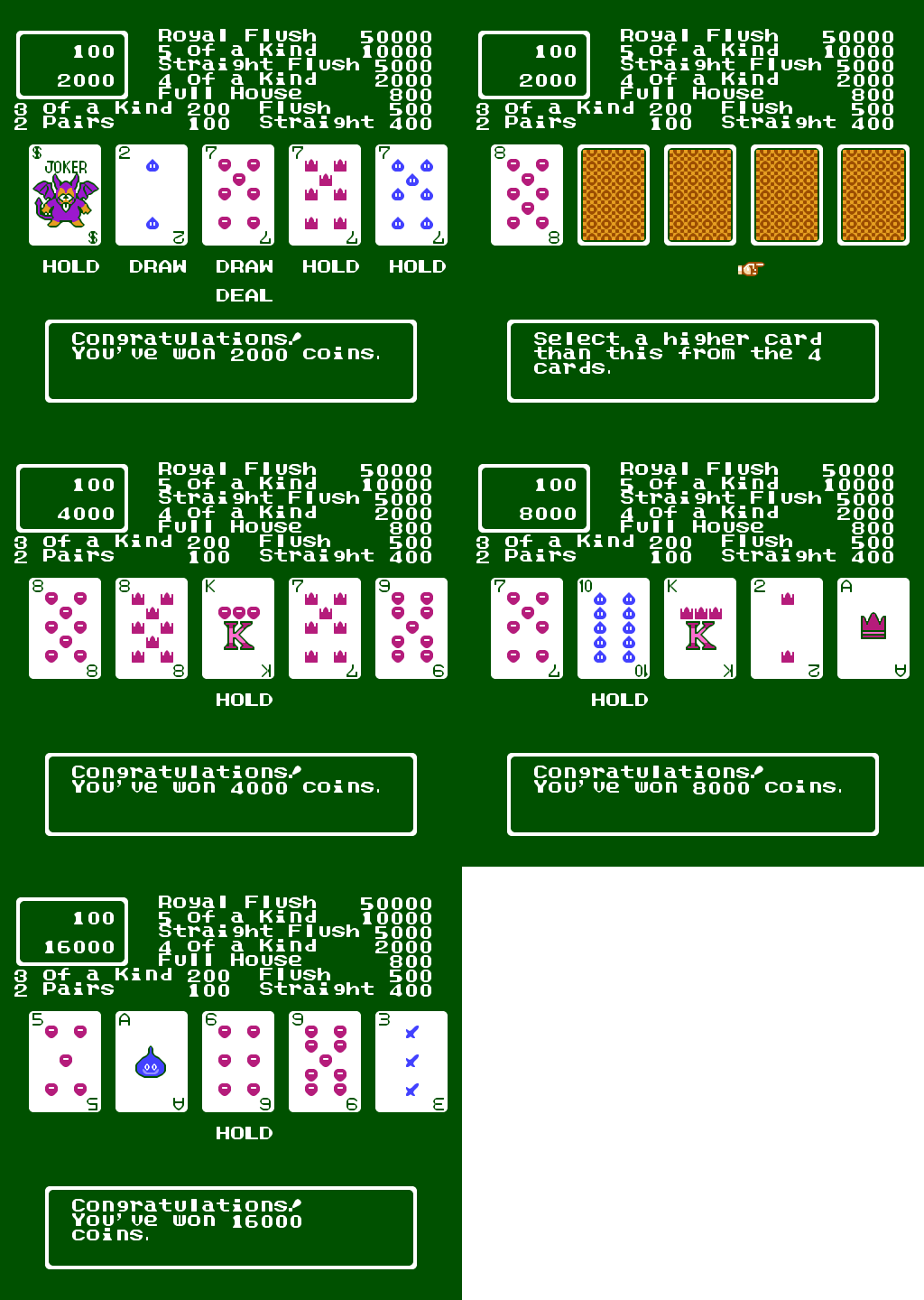
The game features a casino; If you want to waste more than time, why not waste money, too?

The game features a casino; If you want to waste more than time, why not waste money, too?

I think I can stick to the same assessment I gave the original; I’ll play the game as long as something else in the room can take my priority attention. Otherwise, I still don’t see the appeal in Dragon Quest, other than Akira Toriyama’s artwork, which I could download in much less than 30 hours. A game that centers on level-grinding and only includes a half-assed plot and characters doesn’t really offer much value, especially compared to most of the Final Fantasy installments. I don’t understand how these games rate so highly.  And yes, I’ve lived in Asia and I’ve seen Gaijin Goomba; I understand that different cultures think differently and have different needs. But I don’t think I need to spend thirty hours hitting the “confirm” button when I could have just as much fun pushing the buttons on my shirts.

Secret of Mana – SNES

The game's elemental magic system lets you build snowmen! Out of the dying corpses of your foes, nonetheless.

The game’s elemental magic system lets you build snowmen! Out of the dying corpses of your foes, nonetheless.

Anyone between the ages of, say, 23 and 35 might understand the sheer disappointment of nostalgia, how delving deep into the caverns of your past usually only uncovers the noxious fumes that kill the canary of our fondest childhood treasures. Did any of you ever watch “The Real Adventures of Johnny Quest,” Hannah-Barbara’s update of their classic science-adventure series into the computer age? I loved it! I stayed up every night one summer to tape it. I wanted to dive into Quest World, to meet the Evil Stephen Hawking guy who only felt truly alive in virtual reality. I wanted to know what ran through the mind of the psycho religious fanatic. I wanted to travel the world, see exotic animals and mess with cool science gear. And a few years ago when I dug up some of those old episodes, I found I wanted to surreptitiously leave the room when the writers decided to let Hadji bust out a few “Sim Sim Sala-bims.” Yep. Despite possessing the ability to change with the times, “The Real Adventures of Johnny Quest” only succeeded in blandness. And racism.

After rescuing him from a plot to create a tropical resort...in the arctic.

After rescuing him from a plot to create a tropical resort…in the arctic.

And so, with heavy heart I have to confess I had a similar reaction to Secret of Mana, Squaresoft’s epic Final Fantasy Spin-off. Don’t worry, though, I don’t intend to condemn the entire game. Just one guy. Which guy? Guess. Which early 90s Squaresoft employee did everyone know simply by virtue of having the only Western name in the credits? The one whose translations dropped text into the game with the care and precision of a spastic colon? Ted. Fuckin’. Woolsey. Now, it appears that the internet uses people’s opinions of Woolsey as kindling for flame wars, I should give him the necessary credit he deserves: direct translations don’t work. People simply use languages differently, and certain words and phrases don’t translate at all.

Rather, I’d like to say (if I can ever learn to shorten my introductions) that one shouldn’t confuse the Japanese “R” and “L” sound when a) you speak English natively and b) The same name appears both in Final Fantasy (Gestahl) and Secret of Mana (Geshtar). And seriously…he honestly didn’t know Biggs and Wedge, Luke Skywalker’s trusty wingmen during the first Death Star Assault?

So while the old games, even with Woolsey’s translations, don’t fall to the level of Johnny Quest, re-playing Secret of Mana recently made me painfully aware of the jagged, incoherency of the story. The main character, who rarely has any direct interaction with the plot, comes off as a silent protagonist after the first few scenes, but occasionally mumbles just enough so that he comes off as a second-rate mime. Jema, the game’s Obi-Wan Kenobi figure, offers no more advice than “Go to the Water Palace” or “Go to Gaia’s navel,” and the Yoda figure literally tells you nothing more than your next random destination for a good chunk of the end-game. Furthermore, the game introduces a fascinating villain, Thanatos, who shares a name with the God of Death, and we sort of infer is manipulating the war between the Emperor and the Kingdoms (the standard stock war included free with every purchase of a fantasy plot), but we get very little dialogue from or about him and the other villains. These inconsistencies seem to reach a peak when you sneak into the Imperial Capital, leaving the world of medieval-style fantasy villages and plopping yourself down into the horrible, dreary, nightmarish…contemporary urban town with paved streets and cheerful music, where the sun shines down warmly and everyone walks around with a smile on their face.

Let me just flag down a cab here...

Let me just flag down a cab here…

…uhh, why again do we want to disembowel the emperor with such a passion? Oh right…something somewhere about a cliched metaphor for limited resources and global warming. I think.  See, I can’t ever tell, because according to wikipedia, they cut a massive amount of text from the game to get it to fit on an SNES cartridge. And rather than economize the language available, artfully revealing key plot points and character development in as few words as possible, Woolsey just let it go. So when the hero’s village becomes overrun with monsters, they banish the only villager with a sword. Now, I support enforced background checks for lances and a ten-bolt limit for crossbows, but I also fail to see the reasoning behind believing that every monster and demon on earth wants to attack you simply because you have a weapon.

But leave you must, and just as the hero becomes unimportant to the story once other characters join him, you pick up weapon after weapon on your journey until you forget all vital details behind the sword, and all towns in your wake remain utterly defenseless.

The characters fighting a monster...Playboy? Well, the nuns at my sunday school did warn about the dangers of pornography.

The characters fighting a monster…Playboy? Well, the nuns at my sunday school did warn about the dangers of pornography.

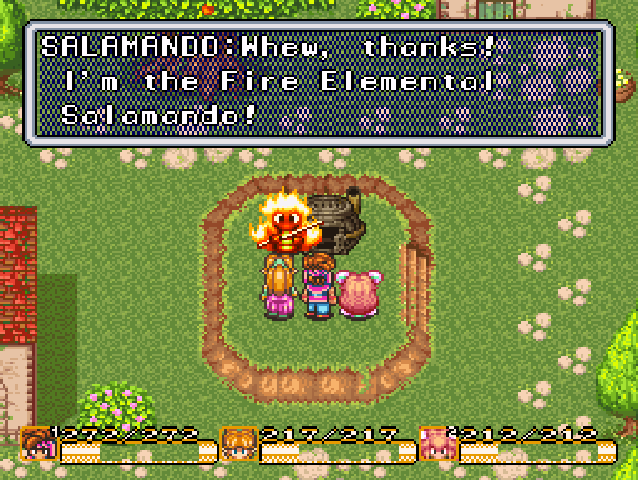
However much the story lacks, the gameplay makes up for. Rather than the standard consumer economy provided by most RPGs, Secret of Mana tackles weaponry in more of a Marxist fashion, providing you with a set of weapons, free of charge, at or near the beginning of the game, that level up as the proletariat works harder and harder. (Unfortunately, the inventory does not include “hammer” or “sickle”) Combat takes place in pseudo-real-time, with enemies directly on the map, completely free of jarring explosions sucking you into isometric perspectives where the enemy kindly lines up and waits as you pound them. Rather, you move freely about the map, attacking freely as in a Legend of Zelda game; however, with the added encumbrance of an ATB gauge that needs to charge before your characters can summon up enough strength to penetrate the enemies outer layer of…epidermis. The player opens up menus at any time, in battle or otherwise, to use items and cast magic. Magic comes in the form of elemental spirits gathered along the journey, and they can level up with use, same as the weapons. While I usually write my reviews to ridicule the more absurd aspects of the game, I find myself at a loss for good jokes. The combat system wraps things up pretty tightly. It works.

Well, mostly. Despite giving us a rich selection of weapons and magic and a smooth, sleek ring-menu system to navigate between them, Secret of Mana gives you three characters and about half a brain of AI to split between the two inactive ones.  While they’ll refrain from wasting your MP and will generally wait to attack until their ATB gauge fills completely, they do wonderfully smart things such as dart head first into enemies, attack during the invulnerable period after a monster has received a hit, or try to get closer to the lead character by running straight into a wall nonstop like a squirrel confused by a sheet of glass. While you can program basic attack/defense strategies, you can’t send commands to switch these during combat, so it amounts to either one worthwhile character at a time, or the player needs to constantly switch between party leaders.

Fortunately, Square included a crafty solution, allowing up to two other players to join in. If you want to play the game, I suggest hunting down friends, relatives, co-workers, homeless guys, or  prostitutes, since it does make a world of difference, having someone with a brain behind a character who would otherwise serve as much purpose as one of these.

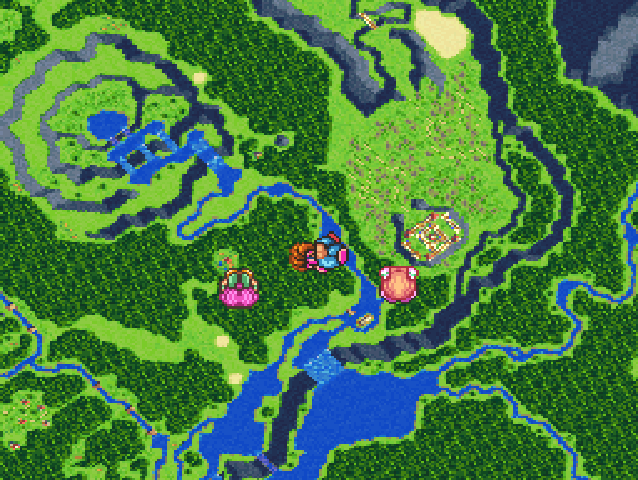
A good way to see the world without getting probed by Airport security.

A good way to see the world without getting probed by Airport security.

On the unfortunate side, I don’t really have anything interesting or witty to say about Secret of Mana. Really, what can you add to a game that considers “shoot you out of a cannon” as a viable method of travel, and has a travelling anthropomorphic cat-merchant rip you off by jacking up prices on normal items? The game doesn’t have a lot of visible flaws and its own unique sense of humor, so I have to resort to picking on the poor translator, and since so many people have played it already, I don’t really feel the need to describe it in detail. So ask Santa for a copy this Christmas if you don’t already own one. And if he fails to deliver, buy the game and kick his ass.

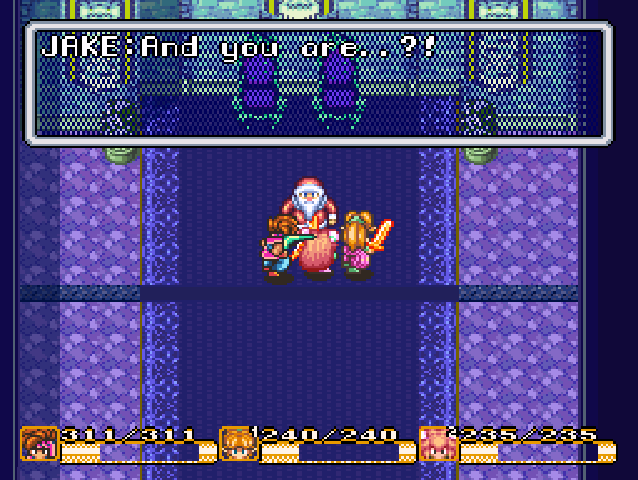
Because seriously…you fight Santa Clause about halfway through. Santa tries to kill you. Santa. An enemy. How can you improve on a fantasy death match with St. Nick?

RetroArch-0908-175043

Boss Monster – Table-top Card Game

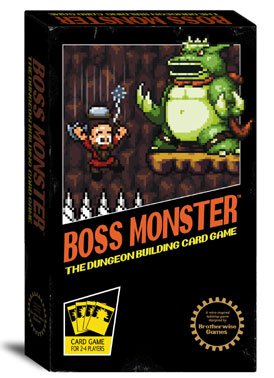
boss_monster_retail_box-smallWow!

So it appears I last wrote about three weeks ago. Awesome. Yeah, yeah, I know the rules. “You want to keep readers,” they say, “Update frequently! Daily if possible!”

Unfortunately, as much as I’d like to update daily, I find that playing through an entire Fantasy RPG and writing about it in a 24-hour period doesn’t tend to leave me with enough time to go to work, eat, sleep, use the bathroom, write about the game or finish a full Fantasy RPG. Furthermore, the fact that I’ve still spent a good number of evenings the last three weeks addicted to the random reorganization of pixilated blocks into ultimately meaningless re-creations of buildings I used to think were “neat.”

Ah, Minecraft. the heroine to Fallout’s morphine, you have no point, no direction, other than to keep me at your side.

Not to mention, the excessively long Dragon Quest IV has only exacerbated my problem of not finishing games in a timely manner. Also, soon I’ll write about the multiplayer mode in Secret of Mana, but Anne tends to get slightly narcoleptic after 8:00 at night, so progression there has slowed down from “Playing through a fun game” levels to “waiting until work lets out,” then down to “DMV Bureaucracy.” Thankfully, we haven’t yet hit “Congress,” so you can count on something productive sooner or later.

Anyway, to give you something to feed on for the interim, check out “Boss Monster.” Anne and I found it over the weekend, luring us closer with its NES-Box style art and seducing us further with subtle nods to classic 8-bit monsters, such as “Cerebellus: Father Brain” and artwork on “Brainsucker Hive” that hearkens back to Metroid. Each card offers an 8-bit style pixilated image, and many of them derive their theme from some pop-culture reference. Not limited to video games, you may also run into Futurama, Harry Potter jokes or others.

The players begin to create the most challenging dungeons for their heroes filled with the most expensive treasures—which will lure them to their untimely deaths. See, you play, as the title suggests, as the Boss Monster, vile, odious, and ever powerfully awesome. Let’s face it: no one has wanted to play the knight in shining armor since grade school. Why do you think they love Tyrion Lannister so much?

Games play quickly–usually less than fifteen minutes–and challenge each player to strategically build dungeon rooms to offer the best treasure (a.k.a. Hero Bait) while also dealing the most damage to the poor saps who wander in, fresh out of the archetype factory. Early in the game, however, heroes may overpower your dungeon, leading to the possibility that you’ll end up like most villains–just another hackneyed monster meant to indoctrinate young children into believing that if they misbehave, they’ll suffer through life until someone kills them. Sorry, but I defer to Johnny Dangerously here…at the end of the film, the ex-gangster finishes his moral proselytizing by declaring to the young shoplifter that, “Crime doesn’t pay!” Then he changes into a tuxedo and gets into a luxury car, declaring to the camera, “Well, it paid a little.” It just so happens that in “Boss Monster,” it pays you in souls of those you destroy in your dungeon.

“Boss Monster” apparently owes its origins to Kickstarter, which means it owes its existence to a partly democratic process of determining whether or not it looked “cool.” It does; I won’t argue that. However, once you strip away the aesthetics, you find a simplistic wiring system that might get the job done, but may also short itself out in the process. The game plays through three de facto phases: “heroes can get through your dungeons,” “heroes can’t get through your dungeons,” and “epic heroes may or may not get through, but probably won’t get through your dungeons.” This places much of the strategy simply on luring heroes to your dungeons at the right time. They have absolutely no interaction with the rooms you build other than to progress through them and kindly take a beating as though they had a fetish for undead S&M. The game might have played better if heroes put up some sort of fight, or had personalized abilities that affected the game in a way other than deciding which pile to drop their corpse into. Magic spells allow players to manipulate certain things, but once cast, you won’t come by new spells very easily.

Furthermore, while most of the cards seem to hint at some sci-fi, fantasy, or video game reference, many of them either don’t, or are obscure enough to make it difficult to understand, and others I suspect don’t make much of a connection other than “Well, I guess I can kinda see that in a video game.”

Still, I enjoyed the game. I hear that expansion packs might hit stores someday, but possibly only if the game sells well. I’ll leave you the link here and let you decide, while I have laundry to do and schoolwork to stop neglecting.

“Boss Monster,” Brotherwise games:

http://brotherwisegames.com/

Minecraft – Windows, OS X, Linux, Android, iOS, Xbox 360, Raspberry Pi, PlayStation 3, PlayStation Vita, etc

Minecraft-360

My list of things to do over winter break included reading and preparing for class next semester, getting through “Catch-22“ and a few other books for my own sake, taking the Jeopardy contestant test, studying for the GRE, and catch up on game reviews so I could post more frequently than once per week. What did I actually accomplish over the last six weeks? Minecraft. Often for four or more hours per night.

Now, nursing an addiction for a video game could easily sound like praise, but with that logic you might say that watching someone do heroin for ten years would offer a sparkling endorsement of opioids. Likewise, I don’t want to compare Minecraft to drug use, although it did have a tendency to leave me looking like I hadn’t eaten or slept in a week. Rather, picture a combination of Fallout, Final Fantasy XII and Legos. I’ll start with the obvious comparison.

Like many others my age, I spent an inordinate amount of time learning my ineptitude at engineering through these plastic Danish building blocks. My creations, subject to the terrors of my grand imagination, grew larger and more complex as the weeks went on until gravity popped her ugly head in to see my accomplishments as they shattered into pieces under their own weight. Minecraft offers the same sort of appeal as Legos without the nasty clean-up and inevitable three days of locating errant pieces with your feet. The world consists of an invisible cubic grid, and most objects found in the game can either fit into this grid or combine into other objects or mechanisms that you can build with. Gravitational force shows up every now and then like a know-it-all friend, offering horrible advice–“I think that pile of sand should come down here!”–or unexpectedly dropping a flow of lava on your head, then laughing hysterically as you lose your supply of rare diamonds, tools, and the blocks you spent the last three hours harvesting, but for the most part it stays out of your way so you can build your dream castle-slash-mansion-slash-dungeon-slash-pornatarium a hundred meters above the surface of the earth.

Each new game randomly generates a world full of specific geographical features–mountains, deserts, oceans, forests, etc–animals, monsters and other dangers, and minerals for you to mine. Beginning with nothing, I set myself immediately to the task of ripping down a nearby tree with my bare hands, then shredding the log into planks to build a crafting table, which let me work with some real tools. From then on, the game makes a little more sense, although not much. Different tools work best for different jobs; the axe cuts wood better than stone, while the shovel digs dirt, sand and gravel better than the pickaxe, etc. Unfortunately, after about three days of playing I realized I didn’t need anything except a strong pickaxe since the shovel and the axe managed to dig dirt and chop down trees only a little more effectively than a slice of watermelon (or any other random object found in the game). And since tools degrade over time until they shatter, the watermelon has thus far proven more effective.

The game offers a simple tutorial, but otherwise the player has to figure out their goals on their own. It doesn’t take long to figure out that you need to dig to find better minerals to make stronger tools that can mine the stronger minerals, all the while dumping the pile of stuff you pick up into whatever grandiose object you chose to blight the landscape with by making. It really amounts to an experience akin to building with Legos, except instead of searching through a giant tub of blocks, you search though the heavens and the earth, hoping to find whatever you need before something explodes behind you, emptying the contents of your pocket onto the ground and sending you to some random location to respawn in hopes of not getting too-lost before the time limit expires and your stuff vanishes from the game forever.

So after about two or three weeks of this, I realized I had found a smattering of most of the items in the game, built most of a castle, and splattered both my innards and several hours worth of progress all over the surface of the earth due to monsters sneaking up on me (more times than I care to admit), when as a character I had a mid-life crisis of sorts and seriously questioned my life’s path. I had a castle, diamonds, electricity…and planned to use it to mine more stone for castles, diamonds for pickaxe making, and electricity…so I could build more and mine more minerals…for the purpose of mining more…

You get the point.

As I enjoyed Final Fantasy XII more than most games, I played through it once with a completionist mindset. Once I had collected every trophy and found almost every item, I turned my sights toward the Wyrmhero blade…only to get an hour into the fishing minigame before I realized, “I have no reason to ever use this sword.” I had destroyed every challenge in the game. A super-sword would have no benefit other than a useless trophy. I went on to the final boss battle barehanded, hoping to salvage some shred of challenge.

I hadn’t experienced this feeling again until I realized the futility of Minecraft. Sure it kept me busy, and I sunk a lot of time into it, and yes, having my own flying castle satisfied me…much in the way that watching Indiana Jones satisfies my desire to travel…but I just couldn’t justify continuing in a game where I could accomplish all the major challenges within a few hours. Only the monsters and natural dangers offer any real degree of challenge, but since the game doesn’t focus on combat, they would fit in just as well in Sim City, Katamari, Trauma Center, or Wheel of Fortune.

Several platforms have versions of Minecraft, each one of them slightly different from the others. I played primarily on the PS3, but also checked out the Raspberry Pi edition, while Anne spent some time getting killed on the Mac version–that’s right, in addition to natural game dangers, online players have to worry about minor wars destroying all their accomplishments. We agreed that the PS3 played the easiest, since using a console controller limited the concentration we needed to devote to complex coordination tests–and also the Pi edition has no feature to save your progress…kind of a theme with the game, I’ve noticed–but you may have noticed this review lacking pictures.  Apparently the developers of this game, which fosters creativity, didn’t feel the need to include a function to take screenshots, so it won’t let you record in malleable form any progress you happen to make despite the game’s best efforts to ruin you. While I usually search for images online to insert in my posts, the only thing that pops up are the accomplishments of those who can take screenshots. Google it for yourself. I don’t need to root through their pictures for you.

Honestly, the game has the best of intentions and a unique concept (although the pathetic inclusion of combat aspect kind of ruins that concept), but one other aspect not only breaks the camel’s back, but crushes the camel and grinds its viscera into the sand beneath it: inventory management. With a limited number of inventory slots and a maximum of 64 items per slot (only if it lets you stack them), you quickly find yourself with half a planet’s worth of material in your pockets. Storage chests don’t offer a lot of relief, and pretty soon you notice yourself spending half the game just collecting, moving, sorting, and looking for all the items you’ve already collected. Just like in Fallout 3 and Fallout: New Vegas, the game offers over a hundred hours of play time, but less than half of that feels fun, while the other half makes me feel I would use my time better by cleaning my apartment.

The game does give a sort of unexplained sense of satisfaction, but has some issues to work out. For starters, the list of bugs and glitches–including the randomly corrupting data files for anyone who plays split-screen–don’t really belong on a console game, and shouldn’t have seen a PS3 release until they could iron those out (save the glitches for PC games, guys!). Other than that, yes, theoretically the game has an end boss, but without orienting itself toward combat, you really can’t claim any achievement other than that you’ve hollowed out an entire planet.