Resident Evil: The Mercenaries 3D – 3DS

resident_evil_3ds_mercs

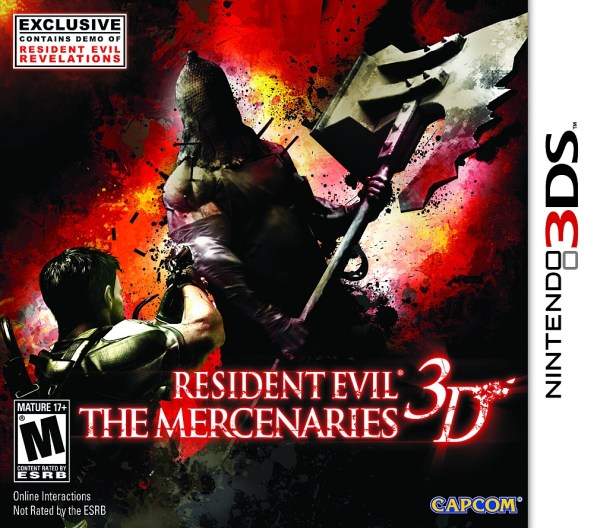
Well…as it appears that Anne has hijacked my 3DS to play Pokemon, so having not touched Resident Evil: The Mercenaries 3D in the better part of a month, I suppose that means I’ve finished it and ought to write about it. You’ll forgive me if, for once, I don’t have a snappy introduction, but it’s rather hard to find meaningful anecdotes to relate about a game designed entirely around the satisfying squish noise that happens every time you kill a monster. Don’t get me wrong—it’s not that I didn’t experience the epitome of bliss playing through main series games written by a team almost talented enough to devise a plot for a dog food commercial, or attain true inner-peace after playing hour after hour of briefcase feng-shui so I could pick up that chicken egg I found. It’s just that after a certain point, my “press X to not die” skills plateau and I start to feel like there are more enjoyable things I could be wasting my time on. Like shoveling goat shit out of a barn.

hunk_000200000_bmp_jpgcopy

Should we include popular protagonists like Leon and Ada? Nah. Let’s use the are-you-my-mummy guy!

Resident Evil: The Mercenaries 3D strips away all the unnecessary fluff from RE games except for the title. As they still insist on reading the entire title out to you every time you start the game, this gives you plenty of time to go make a sandwich while the drunken frat boy they got tries to read it in his scariest surfer voice. But past that, the only game play they give you is running around various RE4 and RE5 areas on an ammunition easter egg hunt—providing you occasionally have to stomp on someone’s head to get to the egg. Well, I take that back. They do force you to play through an insufferable number of tutorial levels with each of the eight playable characters, and then again with their alternate costumes, as though each one were recovering from a shattered spine and had to attend regular physical therapy sessions…with murderous monsters eying up their neck like a lumberjack ogles a sequoia.

If you’ve played the mini-games of the same name included in RE4, RE5 or RE6, you essentially know what you’re getting into. I say “essentially” because even though The Mercenaries was perfect as a mini-game, Capcom apparently felt the need to stuff it like a swollen, bloated turducken until it “felt” like a full game, apparently forgetting that Donkey Kong and Space Invaders were both full games—but like a cat in heat, I’ll wait and touch on that later. Each level starts you off with a unique set of weapons, two minutes on the clock, and a rag-tag band of scrappy fighters who just happen to be infected with a parasite that makes them want to trade recipes with Hannibal Lecter. You can pick up time extensions to encourage you to move around the map, and you get small bonuses for style if you wrassle your enemies like a gator and kill them with your bare hands.

screenshot-resident-evil-the-mercenaries-3d-800x480-2011-06-29-94

As far as I can tell, you get a double-S rating just for killing this guy.

At the height of popularity for arcades, games were much like life, relationships, bureaucracy and work—you couldn’t win, they just got harder and harder until you died. The Mercenaries employs this philosophy. Providing the enemies don’t tenderize you like a fillet mignon or coat you in a heavy layer of pre-digestive juices, the best you can hope for is to extend your time as long as possible. You get graded based on your score, which is primarily affected by the number of monster kills you can chain together, but also seems partly influenced by the amount of times you had to pound your own heart back into working order. (Once again proving that Resident Evil has about as fluent a medical knowledge as an Alabaman redneck with an iPhone. Took one too many bullets to the spine? Rub an herb on it! You’ll be fine! Smashed with a hammer the size of an SUV? Just give yourself CPR and you’ll be good to go until the next monster grabs you by the shoulders and spits on you!) Higher scores unlock more stages, characters and costumes. Rinse and repeat.

re_mercenaries_3ds_screen_01

Ultimate matrix-y super villain Wesker–now with all the strength of a maxi-pad.

The game has a sort of simplistic beauty in that way, like a graceful ballerina performing an elegant, well-choreographed dance on the back of a monster truck belching out smoke like a forest fire. See, in their attempt to release the Mercenaries as a stand-alone title, Capcom stuffed a little too much into it. Capcom is the guy who goes to Old Country Buffet and insists on getting their money’s worth, so they stack up the food on their tray like devil’s tower, goes back for more twelve times, and spends the rest of the evening in the ER with a tube down their throat. The perfection of the Mercenaries as a mini-game was that there were only four levels and five characters. The point wasn’t to race through as fast as possible to complete everything you can like you had a bag of cocaine, a life of regrets and a week left to live. Instead, you practiced, learned each level, and tried to best your own scores. Human psychology awards us a much higher level of satisfaction when competing against ourselves than it does for competing against a computer program or even another human. That’s why the mini-game and a lot of those old arcade games worked so well. If we worked hard to best our past skills, the feeling of self-worth we get completely negates the realization that we could have written a novel or mastered the French horn in the time it took us to reach level 4 of Donkey Kong. Meanwhile, when the focus is on completion and moving on to the next level, we tend to get frustrated when we’ve mastered a level for fifteen minutes and then die instantly because we were playing with the sound off and didn’t notice the one-hit-kill boss sneak up behind us with a chainsaw and cut off our heads for the forty-seventh time that day. But on the plus side, I started kicking out enough BTUs in anger that my heating bill dropped by about five bucks that month.

chainsaw

Most likely the last thing you’ll see. He’s like a ninja.

Not only do they have so many stages and characters that you might mistake The Mercenaries for a real estate firm, but the primary focus has shifted off of chaining monster kills and onto defeating bosses. Except for most of the tutorial levels, each stage has at least one boss enemy. That isn’t new. Each stage in the mini-game had them too. Except there, they were thrown in every now and then as a check on your power. They provided a hiccup in the difficulty to make sure you didn’t keep mowing down monsters like a field full of daisies. In the Mercenaries: 3D, the bosses take center stage, wresting it away from everything else and demanding all your attention like a narcissistic drag queen. The difference is that in the 3D game, the bosses constantly leer over you, breathing down your neck like the guy on the bus who smells like pee. You never get a moment to rest and go back to what you love—squishing monster heads. It seems like each level has either a never-ending parade of bosses to fight, or they give the bosses so much health that even the Republican party wants to take them down.

As I mentioned before, Anne had to take the game away from me. Whether I was playing it because I enjoyed it or because I felt obligated to unlock all the costumes…let’s say it’s about 50/50. The game definitely appeals to me as a fan of the mini-game, but it does so in the way that frozen yogurt appeals to me as a fan of ice cream—it fills the need, but you walk away feeling like something was wrong with it. Now if only Anne will get done with Pokemon, I’ve got a flaming meat tenderizer guy I need to kill…
The Legend of Zelda – NES

retroarch-0802-084508

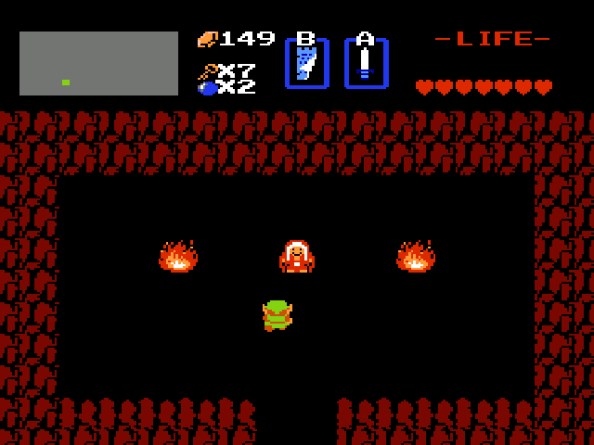
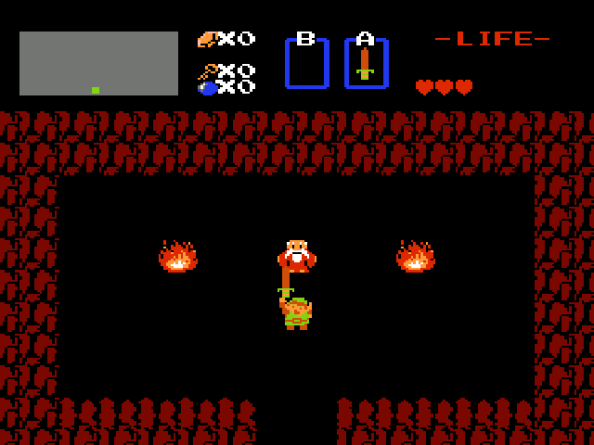
Let me hold it up to the light here…what, did you make this yourself? You really want to send me off to rescue your wrinkly ass with…what is this? Balsa wood? Yeah, some great hero of Hyrule I’ll be. “He could have saved everyone if it weren’t for that nest of termites.”

“Is he actually going to do it?” you ask. “Is he going to take pot shots at the Legend of Zelda?”

Yes, fictional reader who asked a question no one was thinking so that I could begin this entry the way I wanted. Yes I am.

But let’s face it, while the game is the orgasm in the orgy of fantasy, adventure, catchy music, and 8-bit eye candy, but to pretend that Nintendo ironed out all the flaws and created the paradigm of video games with only a 64kb cartridge is like saying a four-year-old scribbling out the alphabet has a literary prowess to rival Tolkien.

retroarch-0802-084151

Whoah, Ganon, dude…you gotta get out more. Lift a few weights. Cut back on the like-like steaks. I almost feel bad fighting you in that shape.

As usual, though, let’s start with the story. The Kingdom of Hyrule keeps a powerful source of magic, the Triforce of the Gods (or the Triforce of the Nintendo of America Secular Censorship Authority, depending on whether you’re American or Japanese). However, this is like eating in bed, and the crumbs of magic tend to attract vicious monsters, evil wizards, giant pig demons, and republicans to the kingdom. Currently, the demon king Ganon has seized command of the kingdom (despite losing the popular vote), the Triforce of Power, and in true villain fashion, Princess Zelda (we’ll not ask how he seized her). However, before her capture, Zelda decided to desecrate a sacred artifact—for its own good, mind you—and scatter the pieces of the Triforce of Wisdom around Hyrule. Furthermore, she put out a hit on Ganon and sent her servant, Impa, to track down the perfect assassin.

retroarch-0802-075031

Tink? Is that you? Come a little closer…there’s something really interesting in this bottle…

But Impa, being old enough to remember when the alphabet first came out, had a bit of a senior moment and came back with Link, an unarmed, prepubescent elf dressed like Peter Pan. Link, who apparently thinks he’s going to fight like Goofy from Kingdom Hearts, sets out with naught but his shield. His quest: wrest the hidden Triforce pieces away from Ganon’s goons and take them to the demon king himself to do battle. Wow. Where do I begin with that one? First, Zelda darling, your heart’s in the right place, but next time consider burying them in unmarked locations rather than hiding them in your enemy’s living room. Second, Ganon, I know you authoritarian types generally regard education with as much fondness as the scent of a burning skunk, but if it never occurred to you or your underlings to, you know, put the Triforce back together on your own, you may want to raise the standards on your help wanted ads. After all, it takes more than a few extra chromosomes to think that the hero would assemble it for you and waltz right into your office with it.

retroarch-0802-092228

What kind of fantasy world is this where I still need a prescription and a part-time job as an exterminator just to get medicine? I’m going to rescue Zelda, not roofie her!

So Link isn’t the sharpest edge on the sword (or judging by those tights, the straightest arrow in the quiver), but he gets the job done, much to the chagrin of the Hylian populace who, despite being forced to live in caves while packs of wild octopi devour people just beyond their threshold, seem to take every action possible to bolster the status quo of their predicament. They lure him into their casinos to take his cash, outright extort repair fees from him to maintain their shoddy housing, gouge prices on vital necessities, force him to obtain a reference letter before providing him with emergency healthcare, and refuse to give him the means to defend himself until he jumps through pointless hoops. But on the plus side, at least there are no background checks or five-day waiting periods. I guess, though, that dealing with an uneducated, right-wing group of victims is what separates true heroes from people applying for Canadian visas.

retroarch-0802-091020

…let me guess, the Democrats are in charge again. Don’t you know that the only thing that stops a bad guy with a sword is a good guy with a sword?

So by now, those of you who haven’t actually played the game are probably either confused about what I’m talking about or pissed off that I’ve just forced you to read three paragraphs of political satire veiled so thin that it could be sent home from school for violating the dress code. I promise that one of these days (preferably when national diplomacy no longer resembles poorly-scripted WWE smack-talk) I’ll go back and write a straight entry on this game. But for now, let’s talk about early sandbox games.

Most fans probably know the series through either Ocarina of Time or games that came out afterwards. These games and I have quite a bit in common—completely straight, even though no one seems to know just by looking at it. The original game is notably different in that right from the opening, the player has access to most dungeons and all but two of the grid squares on the map. In addition, you can collect items in whatever order you’d like, providing you can collect the cash to buy them or that you have the prerequisite items to obtain others. The result of this is a remarkable freedom as to how you play the game. We’re talking the type of freedom that makes Mel Gibson characters get teary-eyed. The type of freedom that George Bush wishes he could force upon the Middle East (sorry, but just try making a joke about freedom that doesn’t involve one or the other!)

retroarch-0802-090620

No, dude, this’ll totally work. I saw a cartoon rabbit do it on TV.

Like every other Zelda game, Link collects tools to help him, except instead of following the using-the-tool-to-beat-the-dungeon-it’s-found-in routine, most items just make regular tasks a little easier. Items range from the vital (swords, shield and bombs) to the mostly useless (raft, bow and arrows) to the completely worthless (red candle, wand, skeleton key), and the more difficult the dungeon is, the more likely you are to put the item you found there in a $1 bin at your next yard sale. So while the 1 to 2 hour game gives you several paths to choose from, those paths tend to lead to your choice of Detroit, Rio de Janeiro, Pyongyang, or Disney World.

Fortunately, for those of us who can’t quite strut around AGDQ with a girl on each arm like we’re the Jackie Chan of Zelda, there’s an intermediate option. For any player who finishes the game—or more likely had a friend on the playground who told them to name their save file ZELDA—the cartridge holds a second quest, with entirely new dungeons, a partly rearranged overworld map, new obstacles, more challenging bosses, and a red bubble enemy that might only be defeated by a prescription for sedatives and blood pressure medication. Oddly enough, I never played the second quest much when I was younger, so I found it more challenging than juggling hedgehogs. Dungeon layouts are confusing in part due to invisible doors, some of which work only one way, so between the doors and the onslaught of monsters I usually wound up feeling my way through the dungeon like a drunken roomba with an inner ear infection.

retroarch-0802-085127

It’s a good thing that Hylians don’t speak in cryptic riddles or this might be really hard to figure out.

Unfortunately I don’t have a playground full of kids to help me figure out the secrets of the second quest, but I do have the Internet, and I’m not ashamed to use it. Not only because Shigeru Miyamoto specifically wanted players to share information, but because otherwise the only way to find anything is to play the game like a Verizon commercial with bombs.

New Super Mario Bros Wii – Wii

new-super-mario

I know you’re probably reading this in February, but you have to understand that I’m writing in November. As it stands, we’ve just elected a new president who A) Lives in a tower, B) Enjoys grabbing maidens, C) Has legions of robed followers who call themselves wizards and D) Wants to rule the world for his own personal profit. As interesting as it might be to live under the rule of a dark sorcerer, no chosen one has come forth to end his reign, so life has been a little stressful. On top of trying to get Obamacare to pay for a four-to-eight year supply of Xanax before it’s repealed, I’ve also had to spend the semester student teaching, which basically means I’m spending all my time learning how to do a job I’ve had for ten years, and paying for the privilege of teaching someone else’s classes for free. But under Trump’s new education secretary, that may become the new norm. So in short, I haven’t had a lot of time for games lately. Here’s a Mario review.

The plot of New Super Mario Bros Wii opens with Bowser publicly denouncing his criminal ways. To offer restitution for the harm he’s committed in the past, he turns toward philanthropy, building up infrastructure in the Mushroom Kingdom and starting a foundation for the survivors of the Toad army to go to college. Mario embraces this new Koopa King, but Luigi can’t shake thirty years of dogged bullying, and secretly investigates Bowser’s sudden change of heart. Meanwhile, a dark and mysterious force moves in, trying to tempt a seemingly tranquil Bowser back to his old ways and…

…I’m just fucking with you. Bowser kidnaps the princess. Mario chases after him. This plot is Nintendo’s sugar daddy, and they’re going to stick to it like they were walking through Mirkwood and deviating from the path even slightly meant they’d be devoured by spiders the size of SUVs. (Although, they may want to consider a change in formula. I can see how the orange-haired monster grabbing the girl and taking her back to his tower while his magikoopa wizard tries to help him conquer the world might start inducing PTSD flashbacks like Pokemon induces seizures.) Fans are desperate enough for narrative consistency that Nintendo published a Zelda timeline that looks like it belongs in the office of an FBI agent hunting a serial killer. But Mario gets to remain frozen at one point in 1986, basically getting the same free pass as your racist, sexist grandfather. “He’s from a different time.”

hub

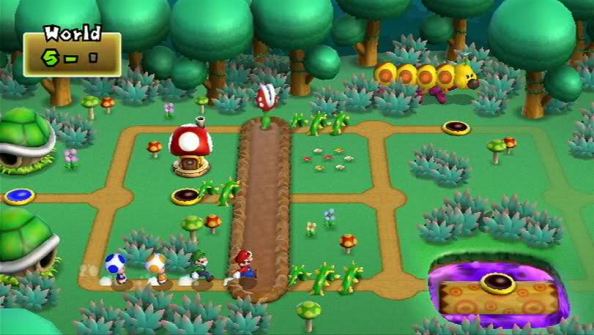
Like the hub world from SMB3, but with the added benefit of not having to make as many decisions!

So how does the game actually play? Well, pretty much like Mario 3, with a few cameos thrown in for fan service. You go through the same desert, ocean, ice world, etc, as you did on the NES. You fight the same koopa kids who haven’t bothered to take so much as a beginner’s judo lesson since Super Mario World and can still be taken out by three quick stomps to the head. You still follow a hub map from course to course as though you’ve got a bus pass for the Mushroom Kingdom and will be damned if you don’t get your money’s worth before you walk around the spinning lava-filled battlefield of murderous turtles. The game dishes out free lives and power-ups like Chick tracts, all of which have the stopping power of a broken condom when compared to the fire flower. In fact, they’ve paired up the fire flower with an ice flower that can freeze certain enemies for short periods of time. While it’s more useful than not for stopping your typical fire-proof enemies, and while it’s kind of fun to encase fish in a block of ice and make them float upwards to “sleep with the humans,” it generally slows enemies down about as much as stepping on a wad of chewing gum.

penguin

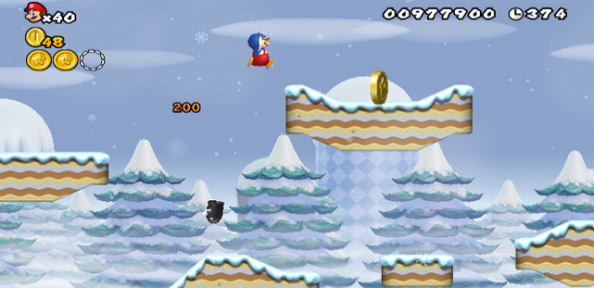
Penguin Suit. Because nothing says “Take to the skies!” like a chubby flightless bird with a strict black tie-dress code.

It’s a 2D platformer, and although I play platformers with much the same enthusiasm as renewing the license plates on my car every year, I’m glad they made the game. Too often, I think, developers confuse “what’s technologically possible” with “what’s mandatory for a game to include.” It’s the same sort of logic that leads people to confuse “abortion is legal” with “here’s some Vaseline and a plunger. Now get on the exam table or go to prison.”

The Elfstones of Shannara – Terry Brooks

elfstones-of-shannaraNow that our president has the motivations of a Bond villain and the brain of a kumquat, I think there’s one question on all of our minds: What post-nuclear-apocalyptic world would I most like to live in? McCarthy’s The Road? Bethesda’s Fallout? While selecting your favorite hypothetical misery, let’s not forget that science fiction doesn’t have the monopoly on the nuclear apocalypse (at least not under American business practices, where at least a half dozen corporations are vying for that monopoly themselves), and that there’s one apocalyptic landscape that actually doesn’t sound too damn bad: Shannara.
Well, technically the landscape is call “The Four Lands,” which I think perfectly encapsulates author Terry Brooks’ descriptive style of writing. Forget the clever names and fantastical languages of Tolkien! Just call everything what it is! Valley in the forest? That’s the shady vale! Ultimate lord of evil and practitioner of magic? He’s the Warlock Lord! Poultry slathered in enough grease to give half of North America heart attacks? Kentucky Fried Chicken! I didn’t even mind so much that the plot of The Sword of Shannara read like the draft had been turned in on tracing paper with The Lord of the Rings still attached; it was that Brooks simplified the adventure to the point where his nuclear landscape about elves, dwarves, and gnomes with magical swords and monsters just didn’t feel real enough. When Gandalf told Frodo he had to venture out with the One Ring, Frodo understood, “This is dangerous. I might end up being skewered by a nazgul, tortured, then dropped into a pit of lava…and that’s a best case scenario!” When Allanon told Shea Ohmsford he had to find the Sword of Shannara to defeat the Warlock Lord, he sat there smiling like a stoner listening to someone waxing on about the health benefits of blacklights. And his father, upon hearing of this quest, decided it was about time his boy leave home, go out into the world, and probably wind up in some situation where the terms “entrails,” “troll” and “chamber pot” would likely be used in conjunction. And while Frodo comes home battered and weary with a deep respect for the horrors of war and a clear case of PTSD, Shea returns from his adventure a little worse for the wear, but with a smile on his face and a sack of magic rocks.

The Elfstones of Shannara marks the point where Tolkien stopped, but Terry Brooks kept going. It’s no coincidence that the MTV series chose to start here (to avoid a lawsuit by Peter Jackson…it’s also no coincidence that they filmed in New Zealand and cast John Rhys Davies), as the reader first gets to hear plot ideas that hadn’t been abducted, beaten into submission and been forced to dance in some dive bar for 20% of all the singles stuffed into their g-strings at the end of the night. The book shifts the action to the elven kingdom of the Four Lands, where thousands of years ago, the elves rounded up a bunch of demons that were running around shredding the curtains and making a mess of the carpet, shoved them all into a magical closet called The Forbidding, and planted a tree in front of the door. At the beginning of the story, the tree is dying, and Allanon sets out to find Amberle, the elven girl charged with watering the tree, to make her do her job and fix up the tree. But rather than go himself, he decides to locate Wil Ohmsford, Shea’s grandson, who is studying with the gnomes to become a male nurse. Apparently, Allanon has fallen off the wagon because he thinks Wil would be an excellent bodyguard for Amberle because he inherited his grandpa’s sack…of rocks.

While Gandalf was a mysterious character whose actions all fell into place at the end of the story, I still wonder about Allanon’s judgment. Not only is Wil about as witty and charming as a box of cat litter, he does little to nothing through the whole story, influencing the plot about as effectively as the power of positive thinking in the cancer ward. Yet while he could often be mistaken for a potato in the middle of a conversation, he somehow has two beautiful women pursue him throughout the book (which, based on some of the guys I knew in high school, might be the most fucking realistic thing about this fantasy novel…either that or it has something to do with Wil being a doctor.). Amberle is the only character with a real inner conflict, and Eretria, from a band of Rovers who are probably still racial stereotypes even if they’re not outright called Gypsies, is the only one with an intriguing back story. There’s a fairly interesting side plot involving the younger elven prince who unexpectedly becomes king while fighting back the demons, but other than that characters come and go like the story takes place in a public restroom, and they all have less development and characterization than the Taco Bell cashier who always tells me my change in pennies.

Unfortunately, the book suffers from the Johnny Quest syndrome (where something nostalgic turns out to be bland, poorly written and just a little bit racist), but even so it wasn’t painful to read. I know that’s like saying, “Eat at Chipotle! It won’t give you a lot of gas!” But the main draw of fantasy stories comes from magic and adventure rather than meaningful character development, and at the very least the adventure is there. There’s no shortage of demons to stalk, shriek and shred their way through minor heroes until the Elfstones light them up like someone dropped a Zippo onto an oil spill. Brooks’ books have always been rather hit or miss, and I still prefer this one to any of the others I’ve read. There’s a blurb for the next edition, “Elfstones of Shannara: Not bad for Brooks!”

MAME Roulette #2

amigo

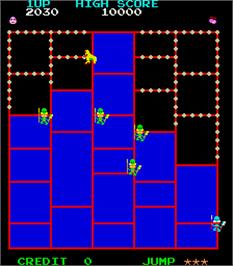
A yellow gorilla collects pellets to paint the town blue against the wishes of green tribal stereotypes. It’s so obvious, I’m ashamed it took so long for them to make the game!

Amigo

Amigo is the Spanish word for friend, which, in addition to opening up Mexican Moria, might make you think this game has a Hispanic flair to it. And it does, assuming that instead of running with the bulls, you run with…I don’t know…zookeepers? Pigs? Angry stereotypes of African villagers? It’s a Pac Man clone. During the 80s there was no shortage of enterprising video game characters out collecting dots, presumably to sell either to an episode of Pee-Wee’s Playhouse or to angry Reagan supporters who will use them to stone the gays for creating aids (assuming they can’t find any welfare queens first). This character is a chicken. Or a gorilla. Or a paintbrush. Fuck it…this review would be easier to write if I were on an acid trip. Despite the fact that it’s essentially Pac Man, it’s not incredibly intuitive. It’s like saying, “I developed a new smartphone! It works like Android, except it only runs on hydroelectric power and you turn it on by sacrificing your neighbor’s pomeranian to the elder god Cthulu.” Still, it’s pretty novel to have an attack that makes all your enemies jump over you like you upended the trampoline they were all standing on.

azurian

Gives a whole new meaning to the term “Spaceballs”

Azurian Attack

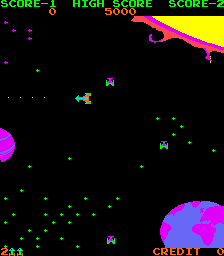
Also abundant during the 80s were space invasions. Disheartened from constant failures in 1950s sci-fi movies, 80s video game aliens didn’t even bother getting out of their spaceships. Opting instead for a McDonald’s drive-through invasion of earth, they pulled their saucers up to the atmosphere and interacted with earth heroes through their spaceship intercoms. In Azurian Attack, they ramp down the invasion even more. Or maybe Earth put a sign on the moon saying, “Only three invaders allowed into planet at a time,” and the aliens were dumb enough to queue up by Mars. Unlike Galaga or Space Invaders, your ship in Azurian Attack can fly anywhere on the screen and make turns. Of course it handles like shooting golf balls off a snowmobile driven by a monkey over a frozen lake. Maybe the game ups the stakes later on with four or even five enemies at a time, but after the first time I died, the crash sound effect refused to stop playing, so I refused to keep playing. Also the spaceship looks like a dick and balls.

blades

Lining up for the face off was the one thing I knew how to do in real life.

Blades of Steel

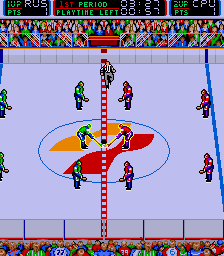
Way back ‘round 1990, I bought my first Nintendo off of one of my father’s students. Long before the first Madden game came out, sports nuts had to get their fix of buyers remorse some other way, and this kid bought all the big-name NES sports titles, including Blades of Steel. Despite my disappointment that it wasn’t a swashbuckling adventure about the end of the bronze age, it came with the NES, and having no money, I played it. The arcade version, naturally, is a little fancier. One quarter gets you a minute of playtime, (A standard hockey game lasts 60 minutes of play, and fifteen dollars falls in that weird range where it’s too much to pay for hockey admission and too little to pay for a prostitute.) but the game adds and removes time based on how many goals you score and how many you let in. (A policy that could add some excitement to an evening with a prostitute).

blades_of_steel_arc_fight

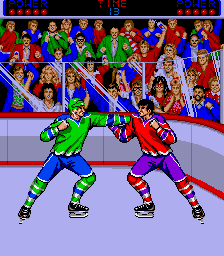
Why do hockey players insist on punching each other all the time? Don’t they know they’ve got razors attached to their feet? It’s in the title of the game for god’s sake!

Having more teammates than buttons makes controlling your players feel like a few dozen laps around a pool filled with Jello. Within the first five seconds of the game, I won the face off, lost a fight, let in a goal, and lost 10 seconds. There doesn’t seem to be an option to aim, so passing the puck is like handing a switchblade to a toddler—the result might be unpredictable, but there’s a good chance you’re going to wind up covered in blood and regretting your decision. I ended up playing for about fifteen minutes, though, and actually won the game 11-9. Much like real hockey, I spent most of my time offsides, the refs didn’t care about the spontaneous boxing matches, it felt like it took forever, and I’m pretty sure that playing the game the way that I did probably would have disappointed my father. Unlike real hockey, I actually got better at it, and I didn’t have to spend all my time with a team full of assholes.

fast-freddie

Sadly, Freddie got caught in his safety harness and ended up dangling like an old west outlaw.

Fast Freddie

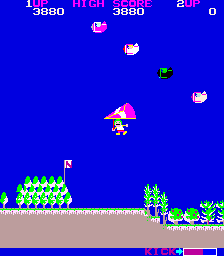
Contrary to what the title may imply, Fast Freddie is not the pickup artist who shows Leisure Suit Larry how the job is done right. Freddie is, rather, a cousin of the Hawaiian punch guy with a hang glider and a penchant for mugging the camera. Your job is to leap off a cliff and not fall to your untimely death as a mangled sack of broken bones floating in what used to be your organs. You will, of course, have to contend with a pro-meat-sack agenda, as you dodge some sort of murderous air show of pilots who desperately want to run you through their propellers like a witless sea gull. Freddie wins, I assume, if you make it to the end of each course without being hosed off a fuselage. The game encourages you to be a dick and buzz low over trees and houses, picking up the letters to spell “bonus.” I never did this. Nor did I finish the first course. There’s a helicopter who, I’m sure, has violated quite a few FAA regulations in his quest to replace the casket at your funeral with a series of Tupperware containers.

knock-out

Easily discernible from Amigo because instead of painting squares blue, you paint them teal.

Knock Out!

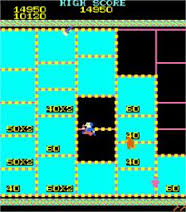
Here’s an example of a wasted name. Knock Out! would make a perfect name for a Punch Out! Clone. But instead of boxing, I got an Amigo clone. That’s right…a clone of a clone. And much like Jurassic Park filled in the holes in their clones with frog DNA (which would probably look less like a dinosaur and more like a pokemon with down syndrome), Knock Out! mixes their Amigo-ness with Donkey Kong. All this cloning makes it look like a tired effort. Even the characters are tired. Mario won’t jump, and Donkey Kong has grabbed the hammer since throwing barrels would take too much effort.

mania

Afterwards they go to the gym to lift their huge triangular iron weights.

Mania Challenge

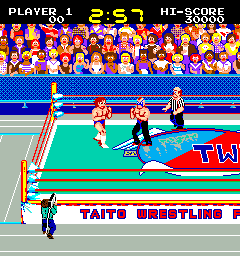
My Mame Roulette skills finally granted me a reprieve from clones by hitting on a knock off. I’m guessing “Wrestle Mania” is copyrighted because that’s about the only thing keeping this game from getting hit with a steel folding lawsuit—being put in a “lawsuitplex,” if you will. (What? You won’t? Screw you.) You play as Dynamite Tommy, fighting against some luchador who simply goes by “Insane Warrior.” The game contains all your standard pro-wrestling moves: the suplex, the clothesline, the rope-bouncy run, the vaguely sexual vertical 69, and my personal favorite, the stop-and-wonder-if-any-of-this-is-real. The game might have gone better for me if I didn’t just mash buttons like I had an itch at the tip of my thumb, but as it is, my opponent and I set some sort of record for number of double-knock-outs.

Legends of the Dark Crystal – Barbara Kesel

legendsJanuary 25th, 2017

Day 5

President Goldfinger has been in office for five days. He’s already hacked apart healthcare, fired all U.S. Ambassadors, waged personal war against the CIA and the media, forced poor people to pay more for housing, ordered an oil pipeline through a Native American water source, started redecorating the White House to look like Scrooge’s money bin, enacted Orwellian language with his “Alternative Facts,” created jobs by refusing to hire people for anything ever, took the first steps to crashing the economy with his own version of the Great Wall of Gyna, cut funding for arts, and threatened to invade Chicago. And it’s only 9:30 on Wednesday. Assuming that in the last two months, he hasn’t resigned, been impeached and/or committed, or drowned after seeing his reflection in the D.C. reflecting pool and falling in when he tried to grab it by the pussy, I’m sure we all need something to take our minds off of the horrible atrocities. So here’s a story about an evil race of greedy, conniving, narcissistic monsters who destroy an entire planet in their lust for power and declare war on an entire race of people who they want to lock up for no reason other than draining their essence and feeding it to their emperor (which, if there hasn’t been a White House executive order yet…just wait).

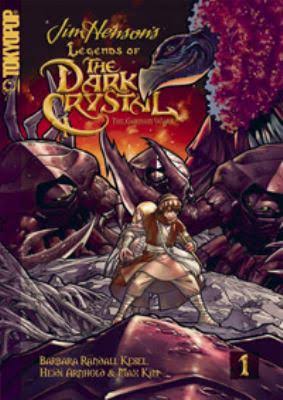
Legends of the Dark Crystal, a two-volume manga released in 2010, takes everyone back into the world of Thra in order to give us more of what we wanted from the movie…gelflings, apparently. Lots and lots of gelflings (You know, just once I’d like to see one of these things grow into an adult gelf). The story focuses on Lahr and Neffi, who both sound like they’re on Thra as part of a Scandinavian gelfling exchange program. Neffi is a weaver and Larh herds mounders (giant cattle that look like someone runs a christmas tree farm on top of a muppet). Both of them begin the story away from their respective tribes when their villages come down with a serious case of crabs. The Skeksis have sent their garthim—the monsters from the movie that look like someone cross bred a lobster and a kabuto beetle in a pile of radioactive goo—to harvest gelfings for their essence. Skeksis have no brains for sustainability. Rather than start a gelfling breeding program (which, I’ll concede, might not exactly attract the same target audience as the movie), they just round them up and drink them all like mountain dew at an all-night LAN party. And the rest of the story is about Lahr and Neffi warning other gelflings about the raids and trying to rescue their villages.

To be fair, the book does focus on the Skeksis about as much as the movie does, which is probably the perfect dose. Much like drunks, republicans and small children, their antics are entertaining, but if we see too much of them the novelty wears off and we start eying up the exits. There’s a major subplot following the Chamberlain trying to manipulate his way into favor with the emperor. In one scene, he employs the castle vermin as spies, which gives him a weird sort of Stewie Griffin vibe, briefing his toys before battle. But barring that one scene that strikes fear in the hearts of Smurfs, Care Bears and plastic army men, the Skeksis feel like they could school George Martin characters on how to connive and plot and ruin a country.

The sole problem I found with the Skeksis is their design. Henson’s studios did an excellent job of making each monster look like it withered out of its own, unique reptile-fruit hybrid. But in a black-and-white manga, it’s a little harder to discern one from another. The Chamberlain gives of his characteristic whimper like he’s standing around in an art museum trying to look thoughtful and deep to the people passing by, but when that’s not there to clue you in, each Skeksis’ beak changes in length, they’re all the same height, equally cranky, and dressed like they’re trying to shoplift lawnmowers out of Sears. I’ve had less trouble discerning individual squirrels from each other than figuring out which Skeksis was which.

The gelfling plot is enough to carry the story, but will be damned if it’s lifting it up one more flight of stairs! Lahr and Neffi are a bit bland, but if you remember the movie, Jen wasn’t even vanilla enough to flavor a bucket of ice cream. That story was carried entirely by the Skeksis, Augrah, the confusingly hot gelfling girl, and her rabid dust bunny, Fizzgig. So ultimately, the tone is about the same, except for the fact that it’s no longer as sombre as a documentary about starving orphans. The story, though, while not being quite up to the movie quality, flushes out the world of Thra some more, adding history and variety to the landscape.

Family Guy Video Game! – PS2, PSP, XBox

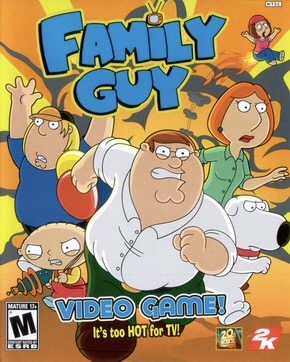
fg-coverIf you’re the type of person who likes to be more aware of your surroundings than your average rutabaga, you may have noticed I’m reviewing the Family Guy video game this week. “Great!” you’re thinking. “Now he’s going to lecture us on the evils of licensed games before telling us how much he likes this one, like some sort of congressman who rails on the importance of family values before being found with a dead Vietnamese transvestite hooker in the trunk of his car. The only thing more formulaic than his entries on licensed games are episodes of Family Guy!”
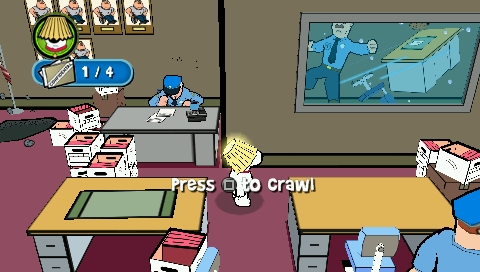
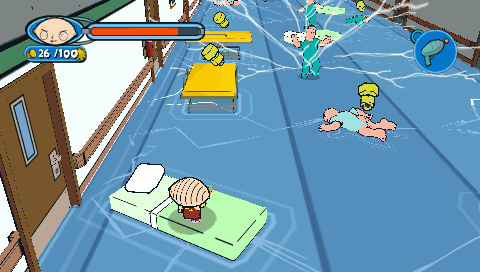
Family Guy and I have a very special history together. It’s like a supportive grandparent who helped me get through the tough times in life—reliable, always there to make me laugh and make me think, and kind of painful to watch now that its getting older and starting to have trouble putting a coherent thought together. It seems only natural, then, that they’d want to put together something to remember the good times, to recall all those fond interactions. And that’s just what they made. The game, while fun to play, has less the wit and unexpected humor of Seth MacFarlane and more the air of me and my friends mindlessly quoting episodes in lieu of conversation.

fg-brian

Brian disguised as a lamp. His sections were clever and entertaining, mostly because I didn’t play long enough to remember why I hate stealth games.

We’ve seen that the Family Guy writers, at their peak, couldn’t produce a plot longer than about 17 minutes (a number that’s declined as a function of time) unless George Lucas wrote it for them. As such, Family Guy Video Game! Follows not one, but three storylines. Stewie squares off against Bertram, Peter’s sperm from Emission Impossible, now born to the lesbian gym teacher and reigning supreme over the neighborhood babies (which, I hear, is a common origin story for the world-domination types. Look up baby photos of Genghis Kahn. And Trump? His hair is simply hiding the fact that his head is shaped like a deflated football.). Brian, once more accused of impregnating Seabreeze (from the episode Screwed the Pooch), goes on a stealth mission to discover the real father in a Metal Gear Solid meets Jerry Springer sort of way. And Peter, in the only plotline that doesn’t hearken back to a wad of ejaculated semen from 2001, randomly decides that tv’s Mr. Belvedere has kidnapped his family, and the only way to rescue them is to kick the teeth out of every man woman and child (mostly child) in Quahog, and to knock the dentures out of anyone over the age of 65.

fg-electrocuteGameplay is simple, stemming from the TV show’s method of humor. Rather than reinvent video games, jokes are thrown in as nods to games from the 80s and 90s, such as the Simpsons arcade game or Galaga. Peter and Brian both control naturally and intuitively, and for the most part Stewie does, too, although aiming at enemies is a bit like being strapped to a tilt-a-whirl. Stewie’s levels are partly platforming, though, which has felt like blindfolded beer pong ever since the shift into three dimensions, but one particular section of extended vertical platforming escalates that to feel more like lobbing live chickens into oncoming go-karts…after a rousing match of beer pong.
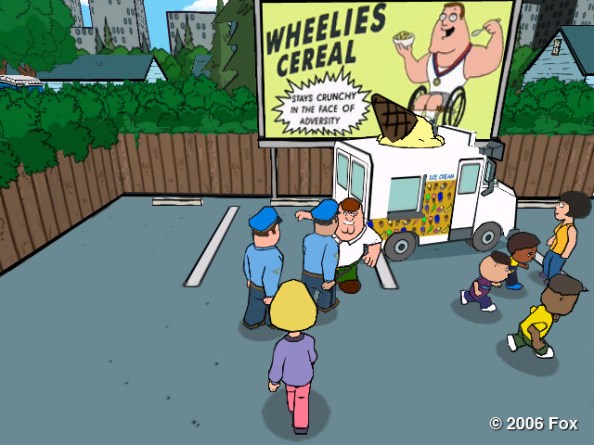
fg-glitch2

Most cut-away gags are played out as minigames and have about as much bearing on the plot as they do in the TV show. The manatees must have been having an off day.

But playing Family Guy Video Game! For a well-crafted interactive experience is like watching porn for dynamic and intricate characters. What really matters is the humor, and whether or not it matches the quality of the show. In a way, it does…and that way is that they clearly only got Seth MacFarlane and one or two other actors to reprise their roles, so most of the quips and one-liners are lifted verbatim from the TV show. So on one hand, it’s exactly the same as the TV show, and yet it somehow translates about as well as if someone ran it through two dozen different languages on Google Translate. Wait, actually, that could be pretty funny…

fg-glitch

Picture of Joe in the back to remind you how this glitch will cripple you permanently.

So far, this has been a particularly difficult review for me to write. In part it’s because my attention is split between job hunting, a perpetually hungry cat, a polar vortex that’s freezing Duluth to the point where my car won’t start and every time I try the key shatters in the ignition, and the trauma and disbelief over the fact that a few paragraphs ago I used the phrase “Metal Gear Solid meets Jerry Springer.” However, the biggest challenge in reviewing the game is that apparently in Peter’s second level, if you are killed by one of two policemen after the midway checkpoint, they do what policemen do best after shooting a black man (Peter Griffin: Husband, Father…Brother?): they move on with their lives. They don’t come back after you respawn. And since, in true beat-em-up fashion, you can’t move on with the level until you kill all the enemies, so you end up wallowing in an existential crisis between a porta-potty and an ice cream truck, left with nothing to do but kick the shit out of some kids and their moms. After their corpses are dead and rotting, you might amuse yourself by head-butting the truck, but eventually all you are left with is a headache, a pile of useless iron, and a few square meters of Quahog where you can do nothing but wander in circles, contemplating the inevitable need to end it all and wonder if there’s a new game in your future.

fg-too-bad

This section looks like fun. Too bad I can’t play it.

So I suggest turning auto-save off right before you go into the porta-potty, or you might be stuck with the constant reminder that the game is shit. Otherwise, it’s not bad.

Nightfire – PS2, XBox, Game Cube

dominique
I’m currently having a bit of a Jonny Quest crisis when it comes to James Bond. In eighth grade, The Real Adventures of Jonny Quest was the standard by which I set my life up for disappointment. My yard wasn’t big enough, my life wasn’t adventurous enough, my friends weren’t close enough, and instead of making daily trips to Gibson-esque cyber worlds, the most technical, scientific thing I could do was set people’s VCR clocks for them. However, about ten years back, untreated depression, a vicious break-up, career uncertainty, and the entire Bush administration had given me new standards for disappointment, so when I dug up some old episodes of Jonny Quest, I could finally watch them objectively. Even if I ignore the fact that I’ve seen McDonald’s wrappers with more entertaining writing and character development less natural than breast implants, the first time they busted out a “Sim-sim-sala-bim,” I began to edge cautiously away from the series like it was a family member who always refers to Asians as “those little yellow people.”

japan

Visit exotic locales. Meet the local population. Then shoot them.

Likewise, James Bond always held a certain allure for me throughout high school and early college, allowing me to vicariously experience the frustration of not living a life of exotic travel classy parties, and the luxury of not being rejected by girls who would prefer I sequester myself in a hole somewhere because I wasn’t exotic or classy enough for them. Fortunately, Goldeneye gave me something to do while cloistered like a frustrated adolescent monk, thus fueling my frustrated fantasies—kind of like putting out a kitchen fire with a bottle of bacon grease simply because you like the way it smells afterward. I wrote about that last week, though, about how the Wii remake was a disappointing, linear, first-person-shooter without any elements of the spy-thriller genre. It was only after playing Nightfire and watching Tomorrow Never Dies that I came to the realization, “Oh yeah. They’re all kind of bad.”

But if judged by 007 standards, Nighfire blew me away on its release. It had a story as original and strong as any of the films (even if the films are formulaic and convoluted), it’s own opening sequence (even if the song sounded like a monkey trying to crush a termite running across a piano) and an overall look and feel that completely outdid the previous game, Agent Under Fire (even if that game was only a mediocre effort at best). The story has Bond investigating the theft of a missile guidance chip as it is turned over in secret to Raphael Drake, a man who heads the Phoenix Corporation that specializes in decommission of nuclear weapons. Sounds to me like they’re throwing Bond softball missions in his old age. A man with dead nuclear weapons who runs a company named after a bird that comes back from the dead in a fiery blaze wants control of nuclear weapons? I’ve seen episodes of Blue’s Clues that were harder to crack. Mix in your standard cocktail of Bond villain motivations (Part Hugo Drax from both the Moonraker film and Novel with a spritz of Blofeld’s New World Order) and you have a pretty good story that almost certainly doesn’t sound completely ripped off from the main series.

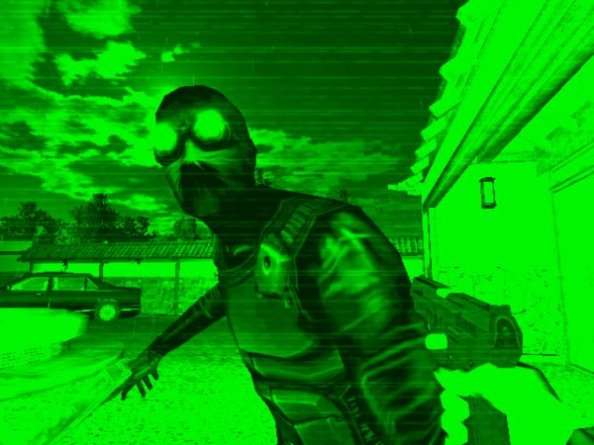
nightvision

The game gives you constant access to night and heat vision, which you will probably only remember when you search for screen shots for your blog post.

If you read my Goldeneye Reloaded review from last week, I lamented the fact that modern Bond games are practically indistinguishable from your average Call of Duty. Nightfire, fortunately, had not yet fallen into that trap, and thus has objectives a little more complex than “Go that way. Don’t get shot.” Stages have some areas that, if you squint just right, might be forcing you into it’s own predetermined Macarena of fantasy espionage, but mostly, they’re free-roaming and engineered like real world locations: buildings naturally have hallways with doors and rooms off of them, outdoor locations are reasonably open and non-constricting, and roads, like always, are long corridors with very few forks which all link back up to the main road and have boxes of missiles and body armor lying around on the pavement. This gives the game an aspect of exploration absent from the hallway-of-bullets style games. The player can find extra body armor, ammunition caches, or even weapons stronger than the ones Bond loots off corpses. This creates one of my favorite scenarios for video games—options for the player. Each weapon has an alternate method of fire for when you want to be accurate with your shot or just hit everything in front of you, when you want to be silent and stealthy or if you don’t care who knows where you are, or when you think an enemy is best brought down with a hail of bullets or a grenade launched into their face. Also unlike modern games, you can carry as many weapons as you find. Yes, it might take Medieval torture equipment to stretch my imagination far enough to picture Bond lugging around enough firepower to be legally classified as either a small-scale civil war or an NRA gun show, but this is one case where verisimilitude takes a back seat to being fun to play, and I’d rather have a steady choice of weapons than leave a trail of deadly breadcrumbs behind me for my enemies to follow every time I stumble across a new gun.

driving

Wait, this isn’t a screenshot from Nightfire…this is a photograph from my driving test.

The other benefit to the exploration is that the player can potentially change how the level plays. An early stage tasked me with skirting a castle’s security system. Halfway through I stumbled across a panel that controlled the spot lights. There’s something about zapping a single wire with a watch laser and then waltzing right in through the front gates that makes me feel like…well, like James Bond, to be honest. The player can discover moves like this several times throughout each level, and each one jacks up their score (towards unlocking multiplayer features). The game calls these “Bond Moves,” described in the manual as “Moves that only Bond would think of.” Disregarding the fact that any action taken by the player is, by definition, no longer a Bond move, some of these are a little disappointing. Sure, it takes some skill to launch a car through a diner to evade enemies, but I’m pretty sure that’s in the standard Blues Brothers playbook as well. And maybe it takes the keen eyesight of a super-spy to spot a weak support beam that would bring down a bridge on top of a troop of soldiers, but it takes less wit to realize that an explosive barrel makes a better target than the enemy huddling for cover behind it. And if it doesn’t, well, I’m assuming the NSA is monitoring this post, so please consider this my application.

alura-mccall

The game forges emotional connections with the characters by killing you constantly so you have to stare at Alura McCall for a combined total of three hours.

And, of course, what Bond game would be complete without his legendary charm, beautiful women, and we can only assume the unholy stench every time he unzips his pants that derives from the conglomeration of sex diseases he’s accumulated over the years? Nightfire views women less like Bond’s companions and more like dialysis machines, which he can’t be separated from for more than an hour at a time. In addition to having three named women and at least two random girls lining up to perpetuate his addiction to carnal spelunking, one later stage murders a love interest at the top of Drake’s Tokyo tower and gives him a fresh girl by the time he makes it to the ground, as though he got them in a buy-two-get-one free sale and just had the third one laying around unopened in his glove box. I know Bond has become so flat and formulaic he looks like a Loony Toons algebra book, but we are still talking about the character who went on an angry, vengeful killing spree when his wife was murdered, so it might have been nice to give him more time to grieve than it takes to acquire PTSD.

While I realize my reviews have gotten progressively cloudier and can only really be called reviews in the sense that I’m looking at stuff again, I’d like to state clearly that I liked this game. It has the classic Bond feel. The gadgets are actual spyware (not the stuff that the Internet installs on your computer)–the day you can download a grapple beam from Google Play is the day the spy thriller genre dies. The difficulty curve works well, although it’s a little depressing to watch your scores progressively drop off until the game stops giving you gold medals and unlocked items and handing out participation awards instead. At the end of the game, especially, you notice that checkpoints are rarer than nuns in a brothel, but with unskippable cut scenes, I can probably recite Drake’s final monologue the next time I audition for a play.

Xenoblade Chronicles – Wii, 3DS

xenobladeFrom Monolith Soft, the team that brought us Xenogears and Xenosaga, we get Xenoblade Chronicles, yet one more story about human beings questioning the rights of gods and breaking free from the shackles of predestined fate. Generally, I like this idea. Xenogears is my favorite game of all time, and I put Xenosaga high on my list even if Episode I plays like a ten-season anime series that periodically gives you quizzes to make sure you’re paying attention. Still, the theme of rising up to challenge the will of God might ring a bit more inspiring if we weren’t constantly given characters with superhuman qualities who are powerful enough to be gods in their own right. Yes, I know this is a game and it has to be engaging and challenging without being impossible, but there’s still an element of fantasy in playing as characters who can shrug off a napalm shower by chugging a few bottles of Mr. Pibb and recover from mortal wounds with a good night’s sleep and have no lasting effects. As much as I want to identify with game protagonists, I know it’s because I have as many heroic qualities as a bald hedgehog with lymphoma. My personality isn’t quite forceful enough to let me confidently stroll into the Vatican with a buster sword and demand to “speak with the manager.”
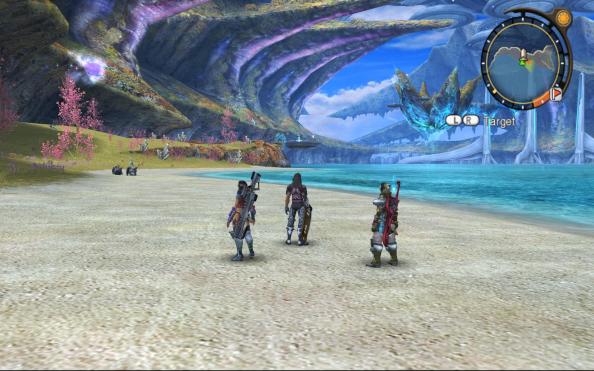
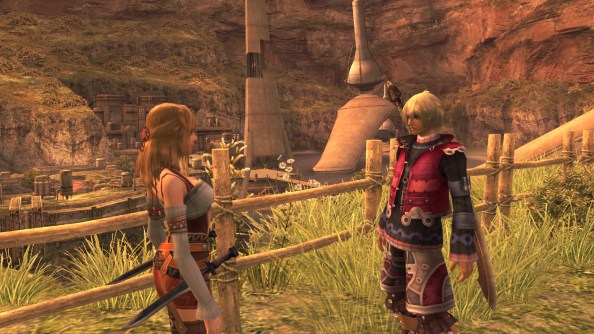
Xenoblade Chronicles sets up a scenario in which two ancient gods fought a battle in an endless ocean and just sort of simultaneously zoned out long enough for entire species to evolve and develop civilizations on their bodies. The flesh and blood inhabitants of the Bionis are locked in an eternal struggle with the Mechon, the residents of the other titan, Mechonis. As such we set up an interesting and unique Man versus Machine scenario that has never been done before. Except in the Matrix, Terminator, Blade Runner, I Robot, the Paul Bunyan myth, the John Henry folk song and about six thousand other things over the last thousand years. In a Mechon attack early in the game, protagonist Shulk sees his will-they-won’t-they girlfriend, Fiora, murdered by a machine, setting the pace for what ends up a 70-hour string of cliches (Including, “The girl is at the fortress. Come and get her,” a villain with the courtesy to get himself killed right after the protagonist takes the high road by sparing his life, and a system of quests wherein everyone in the world only wants things that require combat with monsters to obtain). Shulk vows revenge, and fortunately discovers he’s the Chosen One who can control the legendary sword of the Bionis, the https://en.wikipedia.org/wiki/Monad_(philosophy)”>Monado, because what Xeno game would be complete without a dense basis in graduate-level philosophy that will sail over the heads of nearly everyone who plays?

So other than the unique perspective of titanic bodily parasites, what does Xenoblade have to offer? At first, it doesn’t seem like much. The first two or three hours of gameplay give the impression that the writers intended the story to be verbal diarrhea of cliches, tropes, and characters with no apparent ability to engage in inner monologue, all acted out with the pacing of Speed Racer dialogue by voice actors who sound like refugees from a Monty Python sketch. I thought the game had topped itself when the characters stumbled across an ATV spewing black smoke like it was trying to provoke a Prius into a fistfight, and Shulk said, “Who would abandon a buggy in such good condition?” Fortunately, that served as more of a turning point than a sign of things to come. The dialogue slowed down, edited itself—mostly—for redundancy, and while the story still meandered lazily, following around its older brother’s and sister’s shadow, the recycled ideas from Xenogears and Xenosaga still kind of work.
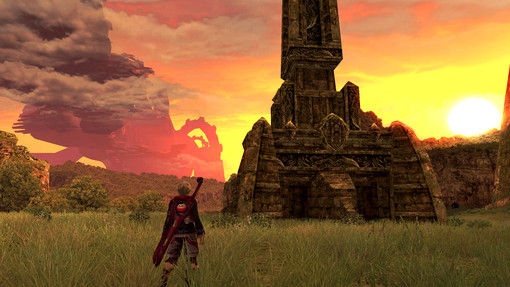
xenoblade-chronicles-eyrth-sea-screenshot
Combat suffers from the same standard RPG combat issues: long repetitive battles, a cast of seven playable characters of which you can only use three at a time, and such a painful awareness that most of the time we’re just going to use the basic attack that they’ve taken away the option and just make your characters attack if they’re not doing anything else. Plus the game throws junk at you like it’s in the middle of a fierce domestic dispute, so 99% of the items, weapons, and armor you receive have less of an impact on your stats than bringing an angry duck into battle to bite your enemies. At the beginning of the game, I thought it was amusing that even the level 1 grasshoppers lugged around 18th century style wooden treasure chests filled with junk, but by the end of the game I understood that anyone living in this universe is, by default, a chronic hoarder who would need several shipping crates to store there crap were it not for the miracle of hammerspace. There’s also a weird quirk I’ve noticed on the few good modern RPGs I’ve played wherein the emphasis is shifted to an action format, thereby sacrificing control of all but one player. Based on some of the character’s unique fighting styles, certain combinations of characters can’t be used because whichever one you aren’t controlling will stand around like an idiot doing whatever will most likely destroy themselves and everyone around them.
xenoblade-fiora

But it isn’t terrible. Characters have a selection of skills that take focus over auto-attacking, and each one has a unique set, and with that comes strategy. Shulk is the only one regularly capable of attacking mechon. One characters has defensive stats and the ability to draw enemy attention, contrasting with another who has high HP, but stealth attacks and minor healing skills. Since you can only control a single character, battle strategies mostly rely on the characters you choose to use, and different monsters call for different combinations.

Suffering from another RPG trope, most characters remain relevant to the story just long enough to prove their worth and be handed a membership card into the Rag-tag Band of Adventurer’s Club. Afterwards, they fade into the background except to call out the occasional platitude of inspiration about teamwork and/or friendship during a particularly emotional cut scene. Xenoblade takes this one step farther, creating battle music out of the wall of sound emanating from characters slurring out battle cries and announcing their attacks like three marching bands placed back-to-back in the same parade. This leads to some amusing mispronunciations, such as Thunder Buddy, Aflack!, Jail Slash and my personal favorite, Electric Dustbuster.

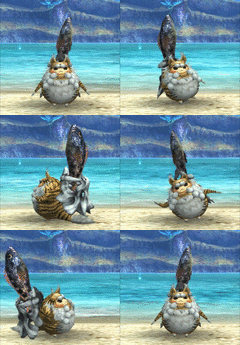
riki_swagBut for all the tropes and sins it commits, one character steals the show. As soon as you get control of Heropon Riki, the bureaucratically appointed hero of the Nopon tribe, all the focus shifts onto this obese chinchilla with the appetite of a garbage disposal. It’s worth playing the game just for him.
Shadows of the Dark Crystal – J.M. Lee

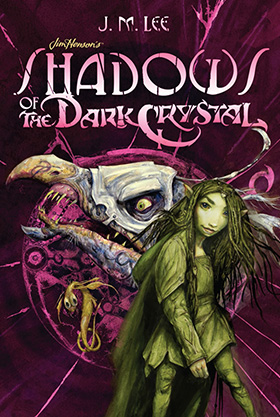
shadowsIf books were children, the treatment I’ve given them lately may not land me in jail, but I might get a stern talking-to by Social Services. Oh, the ironies of teaching literature, spending all day long with books and coming home without enough energy to charge a cell phone while it’s still on. If I had book shelves beneath my stairs, I could compare myself to the Dursleys, literally keeping Harry Potter in the pantry all the time. As such, I feel that the last few books I’ve read, I’ve been about as fair and balanced as a rusted-out bathroom scale shoved in a closet in a Fox News studio. Fortunately, I’ve found one I can get through and enjoy without the regret of wasted time and money you get when the high class escort girl you hired isn’t the one from the picture on the website. What’s more, the book stems from the world of the 80-minute Jim Henson production, The Dark Crystal. Managing to make a movie-based book that expands the lore and, what’s more, manages to capture the Jim Henson feel without the muppets, is a task that ranks up there with slaying the Nemean lion, destroying the One Ring, and reading a presidential ballot when you want to vote for the guy who hates words. But somehow, author J.M. Lee managed to bring skeksis back with his book, Shadows of the Dark Crystal.

skeksisThe book serves as a distant prequel to the Dark Crystal film, set way back in a time when gelflings weren’t harder to find than a Mormon strip club. In fact, the skeksis employed them as guards in their palace, and the gelflings served with a sense of pride, patriotism, and Stockholm syndrome that would rival that of even Hispanic and female Trump voters. (Preemptive apology for any political tone in today’s post, but I’m writing less than a week after the election, and we in the U.S. are currently a little worried that our hallowed democracy and electoral college will soon be replaced with “Trial By Stone!”) Naia, a swamp gelfling, receives word that her brother, one of the aforementioned guards self-flagellating themselves in service to Trump’s Satan’s Parakeets, is on trial for treason. The only thing preventing the skeksis from beating him over the head with a lead bucket of propaganda for an hour—mostly to tenderize the meat for later—and using the remaining pulp to thicken their soup is that they can’t find him. But since punishment is always entertaining whether or not there’s a legitimate crime to go with it (as per standard Republican philosophy), the skeksis insist that someone stand trail in his place, and call for a member of his family (dear God, I’m glad Trump can’t read. This book would give him too many ideas.). From there, Naia begins her journey to discover a horrible, dark, and twisted secret that anyone who’s seen the movie kind of already sort of knew.

For starters, she discovers the Crystal is no longer pure and white, but dark and corrupted (which finally breaks the trend of Republican comparisons, as the GOP is somehow all four of those at once). I thought about marking that as a spoiler, but again like the Republicans, anyone who’s paying attention has known that since 1982. Furthermore, the dark secret Naia needs to tell the world is that the skeksis have been eating the gelflings, draining their essence and turning them into empty husks to use as slaves, much like…okay, do I even have to keep saying this? [sigh] Sadly, we’ve been promised that the federal minimum wage is going the way of the gelfling.

Enough political stuff. Let’s return to a cheerier subject: a world ruled by the iron fists of a group of bloated, decomposing lizards with a wardrobe that looks like a drag queen who’s been run through a wood chipper.

Author J.M. Lee does a marvelous job showing us things we’ve known about for 35 years. And while that sounds like my normal humor rhetoric, I’m actually serious. Jim Henson, the Rembrandt of Muppetry, does such an amazing job of creature design and world building that the finer aspects of his own story fly by like a heavy dose of gamma radiation—it may be invisible, but it’s still there, and it affects us deeply, way down inside, in a way that changes us forever. Before reading Shadows of the Dark Crystal, I had always looked at the essence-draining like any other ticking clock in an adventure movie. But the treatment Lee gives it in his book would send chills down Stephen King’s spine (although considering he’s responsible for a book with a climactic showdown with flying clams who devour an airport, that may be a low bar to jump).

Naturally, no book would be fun to write about if it were flawless enough to be the child of Mother Theresa and Jesus. The pacing, especially in the early-middle part of the book, drops with a lot of introspection and a burgeoning love plot with a gelfling singer-songwriter one-hit-wonder that thankfully pays off like a Wells Fargo savings account. Ultimately they don’t shoehorn the romance in, but like the Wells Fargo account, it makes me wonder if there were a better way I could have invested my resources. I mentioned Jim Henson’s world building and creature creation before, which admittedly is responsible for much of the film’s success and everyone’s fascination with mangy vultures dressed like Elton John if he were in the Thriller video. Lee, on the other hand, could start a game of Minecraft with the goal of making a birch tree. Almost none of the creatures he creates are unique or expand the world in any way. Granted, if he had done something stupid like create a race of Big Bird monsters, I’d probably be even angrier, but the reason I read novels like this is because trying to get my fix of an excellent movie that’s only 80 minutes long is like trying to enjoy a box of porn that contains nothing but a DVD with the sex scene from Terminator, a screenshot of Jennifer Connelly from Career Opportunities, and a Medieval manuscript illustrated by a monk who lived in an entirely male community for sixty years.

the_skeksis-yearbook

And I thought my yearbook photo was bad…

Fortunately, despite the flaws, the novel delivers. Now if you’ll excuse me, I’m assuming Trump was inaugurated about a week ago, which means I have to find a gelfling before the Great Conjunction or he’ll live forever. In which case, I’m moving to New Zealand.