Super Mario RPG: The Legend of the Seven Stars – SNES

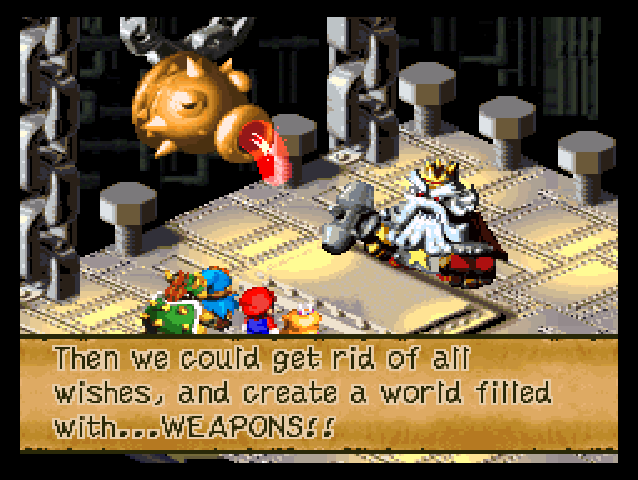
Here we see Smithy at his forge, creating the Republican Party platform.

Here we see Smithy at his forge, creating the Republican Party platform.

Square must have cornered the market on awesome with Final Fantasy. Yes, I can say “I love those games!” emphatically as though someone had offered a roomful of people a potion that would make orgasms last fifteen minutes each, and they will only give the potion to the loudest, most excited person in the room, but I still might understate the effect of those games. See, people keep going to Square and handing over the rights to their personal characters, requesting they scan them, digitize them, and build a game around them. And this doesn’t mean any yahoo on deviantart with a thrice-yearly web comic about a stick figure super hero who beats up all the people who called him names in high school. No, Square has people handing them Batman. And Disney (which means we’ll likely see Darth Vader team up with Sora in Kingdom Hearts 4). And, of course, Nintendo’s own Super Mario. Apparently, Shigeru Miyamoto felt his favorite character still wallowed in obscurity after his debut fifteen years ago, and thought that redesigning his game into an RPG might help Mario find his niche.

Obviously "Mushroom Retainer" doesn't refer to a feudal warrior bodyguard. Perhaps it means the Princess regularly pays Toad for legal council?

Obviously “Mushroom Retainer” doesn’t refer to a feudal warrior bodyguard. Perhaps it means the Princess regularly pays Toad for legal council?

The game opens with the Super Mario Super Cliche. Bowser kidnapped Princess Toadstool. Mario goes to the castle to rescue her. Pretty standard stuff, and thankfully, Square only subjected us to that torturous redundancy for the first ten minutes of the game. In the middle of Mario’s duel with Bowser, a sword big enough to loosen even Crocodile Dundee’s bowels falls from the sky and embeds itself in Bowser’s keep, presumably until a titanic-sized King Arthur comes along to declare his rule over an entire solar system. But in absence of giant boy kings, the sword declares the glory of the Smithy Gang, and claims the Mushroom Kingdom in the name of Smithy. The force of the colossal impalement sends Bowser, Mario and Peach flying to various assorted parts of the game. Mario assumes a quest has begun, although no one ever really states whether he wants to rescue the princess or defeat Smithy, but both those points become irrelevant about five or six hours into the game when he meets up with Geno, a spirit from the Star Road, searching for seven star pieces destroyed in Smithy’s latest giant knife-throwing circus routine. Without the star pieces, the world will have no more wishes. And go.
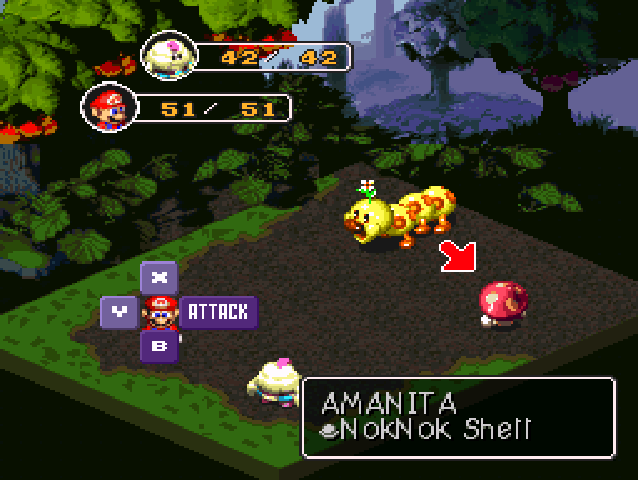
You can't ignore fan theories as crazy anymore. Mario officially lives in a world with psychadelic amanita mushrooms.

You can’t ignore fan theories as crazy anymore. Mario officially lives in a world with psychadelic amanita mushrooms.

The design team attempted to create an RPG that still had the feel of a Mario game. As such, Mario retains his signature special abilities. Namely, he can jump, and subjects of the Mushroom Kingdom constantly request demonstrations and/or autographs from him. In fact, other than his basic attack, Mario can only either jump on or shoot fire at enemies in battle, and leveling-up only teaches him upgraded versions of those two attacks. Jumping in battle consumes three flower points, the game’s version of MP, except the party shares one communal total of FP rather than giving each character their own. So if Geno shoots off his beam too much, Mario simply won’t have the energy in him to jump, and will have to resort to blunt trauma instead. Until the battle ends. Then he can jump until his shins shatter without even stopping to catch his breath. While the game functions perfectly from a technical and mathematical standpoint, that inconsistency really marks the game as confusing, to say the least.

After jumping over these things since 1981, do you think you could help me out a bit, Princess?

After jumping over these things since 1981, do you think you could help me out a bit, Princess?

For instance, the first half of the game sees Mario hunting down Princess Toadstool and rescuing her from a bizarre man-child with the most severe case of Asperger’s syndrome I’ve ever seen. The game relegates her to the role of Damsel in Distress because, let’s face it, if she didn’t enjoy the thrill of a good kidnapping, she would probably have upgraded her security after SMB 3–if not after the original SMB. For contrast, the introduction to the title screen shows her sitting alone in the middle of a field staring at flowers when Bowser swoops in–on the same clown-duck thing he used to kidnap her in Super Mario World–and carries her off. After you rescue her, though, she joins your party and, despite fighting with stereotypical glove slaps and healing spells, actually shows a remarkable competency in battle. So, uh, Princess…how about rescuing yourself for once? Sound like an idea? Give Mario a day off and bust out of Bowser’s dungeon yourself.
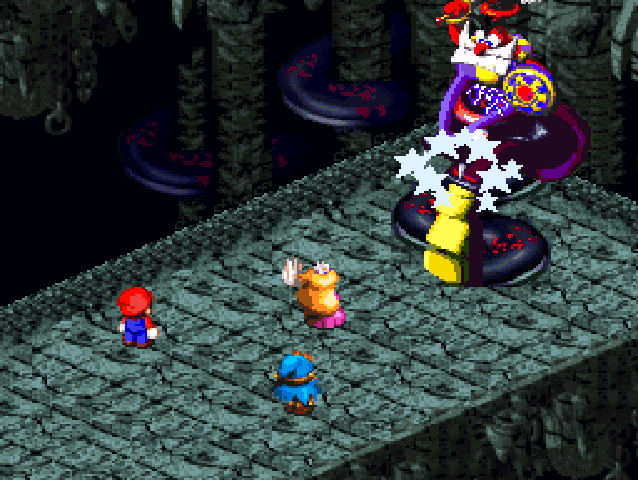
Peach slaps the snake. Should we interpret that as a euphamism?

Peach slaps the snake. Should we interpret that as a euphamism?

Beyond that, Mario displays quite a few skills that would have come in handy in some of his other games. For example, touching monsters without throwing himself to the ground, screaming in pain. Maybe taking more than one hit, or having the ability to block? He apparently can shape shift, which he uses in lieu of language, but not for anything practical like a stealthy disguise or a hilarious mistaken-identity comedy-of-errors. Maybe, though, these abilities mean to offset his nasty habit of standing around in silence watching various major enemies escape. I mean, yeah, he catches up with them later, but why not make the game a little shorter and fight them now? At least the weapons he can equip show some consistency. Mario can use hammers, alluding to his days fighting Donkey Kong; a turtle shell, an obvious reference to his side-scrolling, koopa-stomping adventures; and uh…gloves, which hearken back to his ability to break blocks with his fist? Maybe? Or referencing his time as a referee in punch out? Super Mario RPG really excels at these nods to Mario’s history, which players of the older games may appreciate more than those just coming into the series in the last fifteen or twenty years (god, I feel old…they released this game eighteen years ago!). One room in the penultimate dungeon even requires you to leap over barrels thrown by an ape.

I don't know what bothers me more; that I only had a 10% success rate with three choices, or that they put "Yoshi" in quotation marks.

I don’t know what bothers me more; that I only had a 10% success rate with three choices, or that they put “Yoshi” in quotation marks.

So I’ve put this off long enough–I know everyone loves this game, but yes, I found issues with it. Three-dimensional platforming didn’t work well in Super Mario 64, which felt like playing skeeball blindfolded. The attempts at action-platforming on the Super Nintendo upgrades that analogy to…let’s say, playing piano blindfolded while wearing hockey gloves over numb hands. Also you can’t hear the piano. For most, but not all, attacks, special abilities and items, you can tap the command button at a certain time during the animation in order to receive an upgraded effect; however, counting for the difference in animations, the uncertainty of whether or not the attack has an upgrade, and the lack of a clear point to double-tap the button makes this…uh, let’s say like playing banjo in hockey gloves? (Hey, I don’t have a limitless supply of analogies and I just have to make them up based on what I see in the room!) Geno’s special “charge” attacks almost never worked for me, but honestly, regular attacks outclass special attacks by so much in this game that I rarely used flower points for anything but healing. Square included these elements in order to give the game a more action-oriented feel. Thank you, Square, for interpreting the challenge in turning Mario into an RPG as “How to make it feel less like an RPG.”
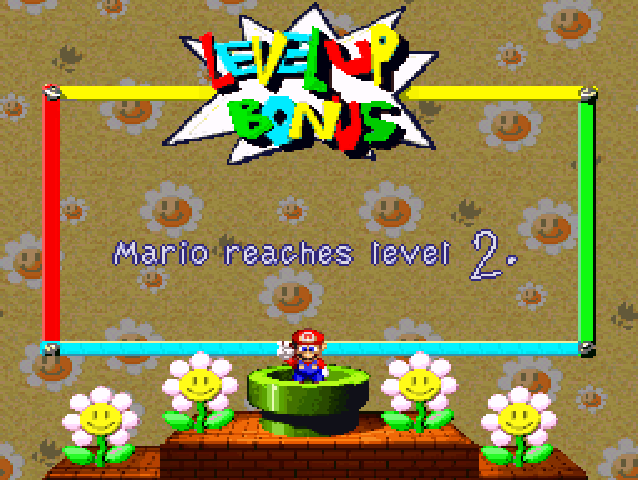
Yes! Level 2! Now to just finish off the final boss...

Yes! Level 2! Now to just finish off the final boss…

Also, Square populated the Mushroom Kingdom with enough enemies to rival a plague of locusts or an invasion of army worms. In a genre where people criticizes most games for repetitive, time-consuming battles, “adding more enemies” really doesn’t make up for a short game length. And no, the solution employed–handing out exp with the generosity of a Republican in a soup kitchen–doesn’t really fix the issue. In fact, if I spend twenty-some odd hours in battle alone, I’d appreciate it if I could finish the game a little higher than level 25. Character growth, for the most part, remains static, so no matter who you use in battle, they all level up at the same speed, and learn their predetermined skills at a predetermined time, allowing for no more customization than adding one or two points to your choice of stat at each new level. Because fighting Smithy with an attack power of 225 made a world of difference compared with 200. (And before you ask, I dumped all of Geno’s bonuses into his special attack, and even at level 25 his physical attack did more damage.)

...yo, is this racist?

…yo, is this racist?

I know everyone loves this game and it makes top-ten lists all the time. And in all fairness, I liked the cartoonish feel to it as well as traveling through a Mushroom Kingdom filled for the first time with people and villages and things other than jutting ends of pipes, piles of bricks and other mostly unfinished attempts at improving infrastructure. But the game feels more like a novelty than a masterpiece. Worth playing, maybe, but not often. Also, Mole Village gives off a vaguely racist vibe.
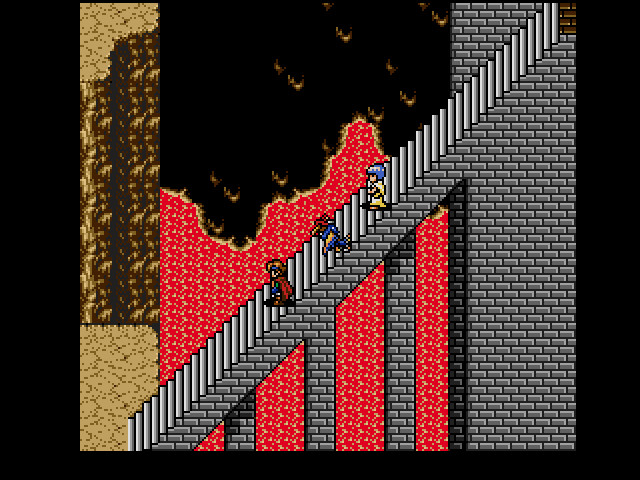
Shining Force II – Sega Genesis

You cannot pass!

You cannot pass!

Last year around this time I decided to indulge in a bucket list game of mine: Shining Force. Given the choice between all the options released for the Sega Genesis, I randomly decided to begin with the first title that bore the name, all the while hearing over and over from sources online that the sequel blew that game out of the water. So in the mood for an old-school RPG, I pulled out Shining Force II and prepared for it to impress me with…a game almost completely indistinguishable from the first. Don’t misunderstand me, the first Shining Force more than justifies the cost of a Sega Genesis. But I had hoped that the improvements touted across the internet might include a story not ground from the same petrified chunk of mammoth shit, or a menu system a little cleaner than a congressman’s after-hours activities. Sadly, the game fails to deliver on both counts.

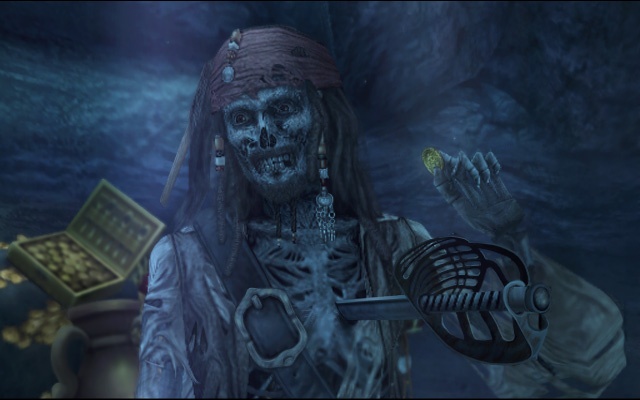
Davey Jones?

Davey Jones?

Shining Force II centers around tactical role-playing. As the leader of the force, the hero, dubbed “Bowie” in all media except for the game itself, commands a cast of characters with rudimentary job classes, mostly determined by species. Centaurs come equipped with all the important parts of the horse, so they make good cavalry. Dwarves make good, stout, infantry, while elves tend to work best with ranged weapons. Still, so as the king can cite examples in opposition to passing any civil rights legislation, you’ll occasionally get magic-using elves or humans, a centaur with a bow, or some other such crossover. For the most part, classes only determine what type of weapon the character will use, or in the case of magic-users, their spells and MP. The game’s primary difference involves a cast of hidden characters, each with special requirements to fulfill before they’ll join you. Furthermore, while all your characters should receive a promotion at level 20, you can promote some (apparently) to alternative classes. On both counts, I can’t say for sure whether or not I unlocked any of these, since even the main story often fails to clarify the steps you need to take to advance.

But we don't have the courtesy to do this during battle, of course.

But we don’t have the courtesy to do this during battle, of course.

The story begins with a careless thief (but one with a good heart!) unsealing an ancient Devil on Granseal island. This demon unleashes his hosts upon the world. They possess one king, try to kill another, suck the princess into an alternate dimension, and somehow embed two jewels into Bowie’s neck. Shaking off this pretty intense body modification as no more than modest bling, Bowie sails with the other survivors to the continent in order to found a new Granseal. He meets a phoenix named Peter who somehow becomes an important character, they travel around, do…stuff…and somehow they find the Peruvian Nazca drawings in this fantasy world otherwise unrelated to Earth, fly back to the island, and face off against a host of devils, demons, cliches, and WTFs.

Ah, yes, a translation to rival the works of Hemmingway, Milton, and Chaucer

Ah, yes, a translation to rival the works of Hemmingway, Milton, and Chaucer

Much like the previous game, the plot serves as an engine (albeit a badly tuned engine with a few pistons not firing and the “check” light constantly blinking on the dash) to get players from one battle to the other as fast as possible. While many games of this era can defend themselves with the “poorly translated” argument, Shining Force II has a special kind of bad writing that you only see when both the writer and the translator habitually abuse strong narcotics. The kind of writing that, while not overtly suggestive, makes dialog such as “They took my jewels” and “Don’t touch it! I’ll shake you off” sound like they lifted it right out of Leisure Suit Larry. One of the primary cliches–I mean, antagonist with a heart of gold who joins you after a major epiphany–suffers from one of the worst mistransliterations I have ever seen; rather than squaring off against the valiant Baron Ramon, the game expects you to take seriously repeated encounters with a villain named Lemon. However, I think I’ll grant my coveted Drunken Developer award to the end of the game where they can only break the curse on the sleeping princess with yet another cliche, and the characters hold a meeting to choose which one can deliver the true love’s kiss. While I never doubted for an instant that Bowie would get all the action here, they actually disappointed me by suggesting your healer–the blue-haired, sparkly-eyed elven priestess–could have possibly broken the curse, and then didn’t follow through on that.

Honestly, until that point, I didn’t think any of the characters had an inkling of personality behind them. They join your party out of the blue and fade into obscurity almost as quickly. To save space (presumably) on the cartridge, battle menus display character classes as four-letter abbreviations, such as RNGR, PGNT, RDBN, and SDMN, which I can only assume stand for Ringer, Pageant, Robber Barron and Sadomasochist, respectively.

Squid!!

Squid!!


The battle system helps this game stand on its own. Battles occur on the map, but like the first game they switch to an isometric animated environment whenever a character acts. Like any other tactics game, characters have a certain distance they can move per turn, each attack has its own range and effect areas, and different attacks seem to affect enemies differently. The limited number of attacks and the inability to customize characters make it a very rudimentary strategy game, but it plays well and forces you to think about your actions (even at one point dropping you onto a chess board and making you fight the pieces). Unlike the first game, you can freely explore the map and return to areas previously visited. Rather than having a set number of battles, they’ve introduced random encounters, which always seem to follow the same presets–kind of a nice gesture, I guess, but since you retain any experience when you die, it really makes level grinding unnecessary unless you really need some quick cash.

The system for awarding exp, though, leaves a lot to the imagination. The amount you earn after each attack seems about 10% dependent on whether the attack connected or missed, 10% on whether it defeated the enemy, and 80% on whether the game feels like giving you only 1 exp. Also on my list of criticisms, I’d like to add that I enjoyed the opportunity to explore the map (on account of having that option in every RPG released since the 1980s.), but the game didn’t always clarify where to go or what to do. At all. I felt good when I got a cannon and read that it could destroy rocks while also remembering a rock from halfway back to the beginning of the game that blocked my path. However, when I got there: nothing. Only by looking up a walkthrough did I learn it wanted me to backtrack to New Granseal and talk to a random guy outside the weapon shop in order to get ammunition. And while the game should take the blame for not giving me so much as a hint, I end up looking like a dumbass who tried to shoot a gun with no bullets.

Should I mock the mass of amalgamated hair, or the softball stuffed down her dress?

Should I mock the mass of amalgamated hair, or the softball stuffed down her dress?

But I have to look really hard for those flaws; while I appreciate a strong story, I can look past that to see the strong gameplay. I can’t comment on the music since I turned the sound off and played the game while watching seasons 3-5 of Dexter–all the while, of course, not missing out on storyline for Shining Force. Looking back at last year’s entry on the original game, I did the same thing with the sound. Losing track of how many times I compared the two games, I can say confidently that Shining Force II really stands out as an excellent jewel (hehe) of a game; I just disagree with the assessment that it surpasses the first.

Kingdom Hearts II – PS2

Mickey Mouse: Bad Ass Warrior King

Mickey Mouse: Bad Ass Warrior King

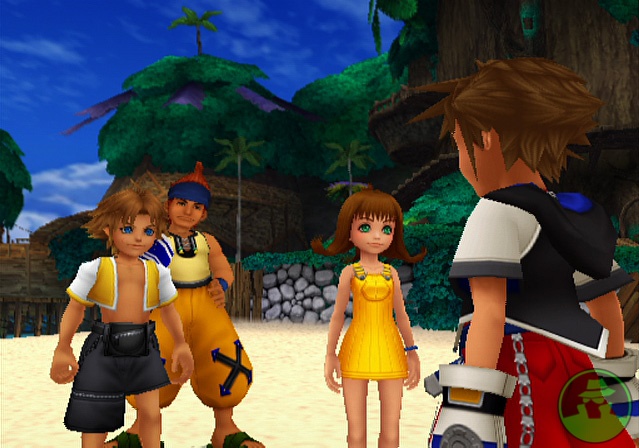
The keen reader may notice by now that I did not begin my entry today with a twenty-page instructional guide on the cleaning, gutting, and harvesting of sperm whales. Odd as that may seem, I have a very solid justification for that decision; nobody wants to read boring irrelevant shit just to get to the interesting part of the article. Likewise, my primary criticism of Kingdom Hearts II stems from that same philosophy. Normally in a game that involved a substantial amount of story, I’d begin by describing a brief summary of the most relevant points of the plot. However, this game doesn’t really have any. The overarching plot once again focuses on Sora. Once again, the primary conflict involves the race of Heartless swarming through the ragtag amalgamation of worlds that any other game would have the decency to call a galaxy. Square-Disney introduces a mechanic in which a strong-willed person who becomes a Heartless actually separates into a Heartless and a “Nobody,” which as you can surmise from the name, also has no heart. The strongest of the Nobodies have formed an organization to protest that they have no right to exist, and Sora must stop them (yeah, I’ll get to that later). So slide your disc into your PS2, select the “New Game” option, and then prepare yourself for the non-stop thrill ride of watching some other kid spend his last week of summer vacation in the most average, mundane way possible…for three solid hours!

Hot tuna frittata?

Hot tuna frittata?

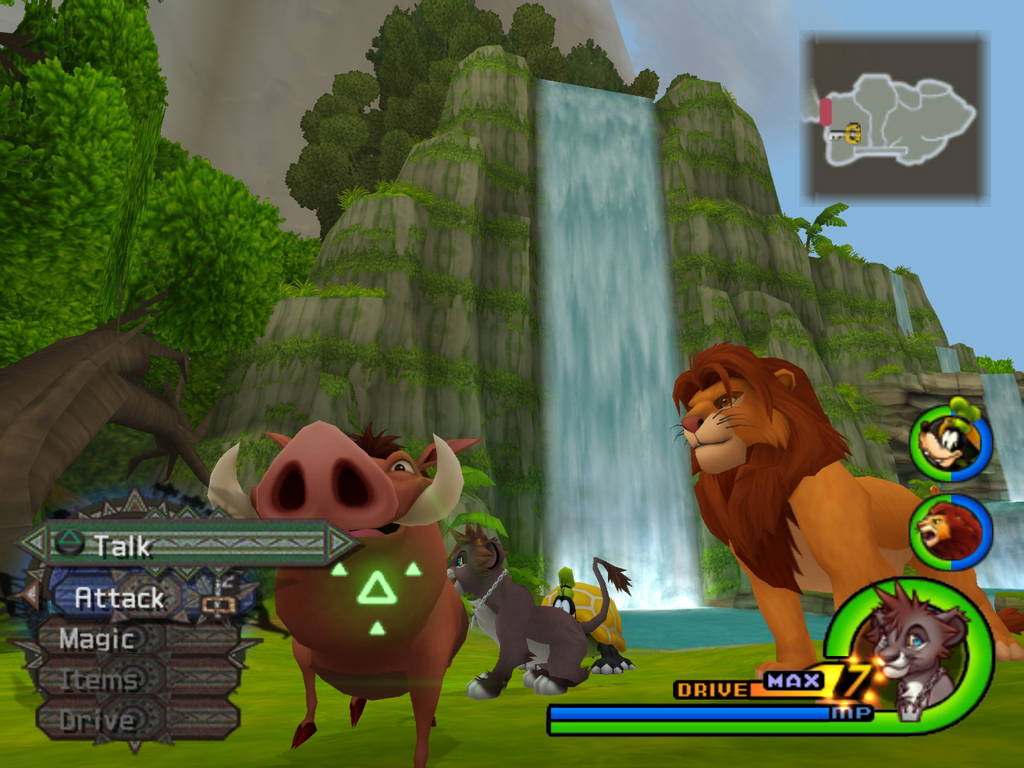
While I feel Kingdom Hearts II generally improves upon its predecessor, even in the area of storyline, the game needed plenty of editing. While the character Roxas needs an introduction, that introduction does not need to occupy the first three hours (two if you know the secret) of the game, and they definitely could have set either a faster pace or a less mundane story arc for us to follow. No one wants to whack a ball for a crowd endlessly in order to earn pennies toward a train ticket so Roxas can ride to the beach with his friends (which the game never bothers to tell you that you don’t actually need to do: your friends will make up the difference). See, unfortunately, once you pass that part, the game paces itself quite nicely, and since the first game appealed more to Final Fantasy fans more Disney, they instituted a darker, more adult storyline. However, in order to get that far, you almost need to have a fetish for the Lion King in order to summon up the patience to slog through this pointless hazing in order to get to the actual game.

And you'll stay there until you finish them all, young man!

And you’ll stay there until you finish them all, young man!

The game itself plays quite nicely. They sped up the irritating gummi ship sections and got rid of the gummi ship builder from the first game that worked with the learning curve and intuitiveness of ancient Sumerian cuneiform. The different worlds feel larger and more fun to go through, and you visit most of them twice for shorter episodes. This game pretty much only suffers from the writing skills of a burgeoning romance novelist who recently suffered a series of strokes rendering the language portion of their brain as useful as a lump of mashed potatoes. I loved the moment when Mickey showed up like Yoda and went all epic-warrior-king on the heartless, but while the darker story makes it better than the original, their tolerance for “dark” ends with well-tanned guys with beards. Don’t believe me; try to find a copy of “Song of the South” on DVD.

Already a short game to begin with, they could have shaved probably 40 minutes off the total play time if they hadn’t insisted on every single character chiming in at least once with a chorus that names the protagonists. “Sora. Donald. Goofy.” Because the player might forget, and the game can’t keep our interest in any better way than by constantly reminding us of this, seemingly to the exclusion of actually giving names to the members of Organization XIII. I understand that the Tron world has to sound computer-y, but I feel someone at some point during the editing process should have caught the potential double entendre in Tron repeatedly talking about his many “user friends.” And ending each episode with “we did it,” “way to go,” or just a raucous chorus of laughter from a gathering of characters reminded me of the cliches that resonate through the creative writing class assignments of the most inept writers our language has to offer.

They didn’t get rid of the Winnie the Pooh world, but they made it more tolerable by comparison to the Little Mermaid level. Rather than swimming through the sea fighting Heartless, they turned it into a music/rhythm game. Still, that could work, right? Alan Menken’s genius score for the film certainly…what, now? They introduce original songs? Songs that first-semester musical composition students use for toilet paper. Songs that challenge me to find as many interesting ways as possible to say “bad writer” in one entry. You get to do “Part of Your World” and “Under the Sea,” but they’ve cut and hacked them like a drunken lumberjack so they don’t sound good anymore. They even marvelously missed the point of rhythm games, as the triggers don’t line up with any discernible beat in the music.

The game gives Sora new duds for each world. This may not sell the game for them.

The game gives Sora new duds for each world. This may not sell the game for them.

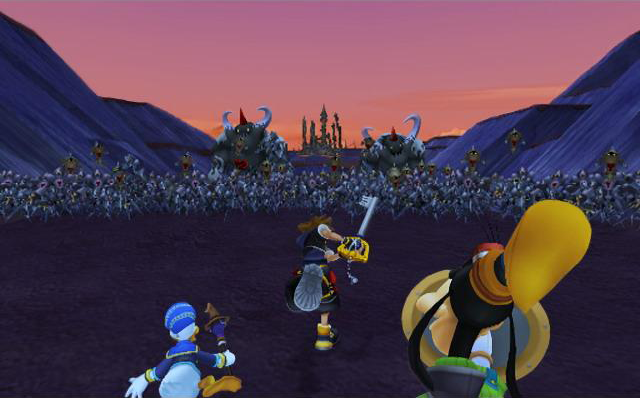
The first game ran with the idea that Sora couldn’t “meddle” with the natural course of events in any world, and merely had to get in, lock the keyhole, and get out. Kingdom Hearts II on the other hand has an ankle-deep puddle from trying to flush that notion down the drain as fast as possible. Sora deposes Scar, bargains with Hades for the fates of the dead, single-handedly rescues China from the Mongol hoards, and deletes both Commander Sark and the Master Control Program. Near the end, Maleficent appears, willing to fight off a swarm of heartless and allow Sora to go on to defeat the final boss (presumably for her), and when Sora protests, Mickey says, “They’re doing what their hearts command. We can’t interfere.” Unless, of course, they do something antagonistic, in which case they can interfere liberally. The final boss has his own heart’s command (never mind that he allegedly has no heart) and Mickey and Sora fully intend to interfere with him. And that raises another issue: The Organization of nobodies, according to the exposition, has no right to exist. They have no hearts and no recognition as people, and only want the same shot at life that everyone else has. In order to accomplish this, they need to destroy the Heartless. But the game tells us to fight them, so we must stop their, uh…evil?

In case pressing X to attack strains your efforts, you also have the option of pressing triangle

In case pressing X to attack strains your efforts, you also have the option of pressing triangle

Munny has as much value in this game as in the last: absolutely none whatsoever. The synthesis requires so many rare items that trying to level up your synthesis moogle garners the same wasted-time feeling as the game’s prologue. In a miserably failed attempt to make the menus easier to navigate, they’ve added “reaction commands,” triggered at special moments with the triangle button. While they look impressive in battle, they pretty much amount to just a fancy name for quick-time events, or in the events that occur outside of battle, slow-time. (I can’t tell you the hours of enjoyment I get from, instead of talking to an NPC, “approaching” or “persuading” them with the not-necessarily-timely use of a single button press.)

Magic has less relevancy than before, and I got to the end of the game before I realized I had never bothered to see what “magnet” magic did. Summon spells have a little more application than before, but still require navigation of convoluted menus in real-time, so Sora’s best option usually involves mashing the attack button and maybe hoping for a reaction command. They’ve added a “drive” feature, which allows Sora to briefly change form into…well, mostly himself, but usually much better at bashing enemies with his key club…I mean, “blade.” However, this relies on using Donald and Goofy’s power to make the transformation, and the game likes to remove them from your party on any pretense, making one of the most useful and interesting additions to the game completely inaccessible half the time.

It doesn't take much effort to see through Disney's attempt to capitalize on the popularity of a non-animated feature.

It doesn’t take much effort to see through Disney’s attempt to capitalize on the popularity of a non-animated feature.

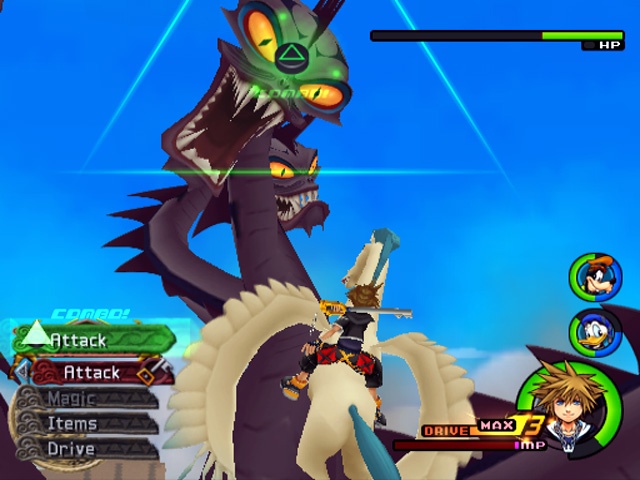
But keep in mind that I focus on the negative because it makes more interesting reviews. I actually do like this game, and quite a bit. It seems geared more toward the Final Fantasy crowd, as I mentioned, which means you can find easter eggs, like naming all the regular nobodies after Final Fantasy III/V/Tactics job classes (although the fact that they can make the nobody dancer grab me, flip me around, bash my head, and toss me halfway across the battlefield, but the FF Dancer class usually trips over their own feet so often for the most mediocre effects that I won’t use it even as a challenge kind of pisses me off) I like the darker tone and the faster pace, watching Riku go through the mother of all awkward adolescent body changes, and having Jack Sparrow as a playable character. The story, while not well-written–the Disney movie worlds all have some lame lesson about hearts and no connection with the plot of the Organization–feels complete enough that I don’t really feel they need to make a Kingdom Hearts III (especially as they won’t release it for anything except the PS4). And let’s not forget that no RPG would feel right without a gigantic final boss monster and a fight on a field with no visible ground.

Kingdom Hearts – PS2

You hated him as an adult; now loath him as a child! At least this game also implies that he dies.

You hated him as an adult; now loath him as a child! At least this game also implies that he dies.

When you walk away
You don’t hear me say
Please, oh baby, don’t go!
Simple and clean is the way that you’re making me feel tonight.
It’s hard to let it go.

Sounds sexy. This music opens up the Disney-Square-Enix joint production, Kingdom Hearts, and when the dark tones start playing, you know that only a sleek, sexy story could follow. If these lyrics mean anything, you’ll never encounter any teeny-bopper heroes, cutsey cartoon characters, or teen idol singers signed under the Disney label. But seriously; have you ever listened to the lyrics to “Simple and Clean”? No one could have written them but the Langston Hughes of blathering nonsense.

Anyway, the story behind the game goes that after Square lost about fifty million dollars on “The Spirits Within,” a movie whose failure any Final Fantasy player could have predicted on account of it resembling a Final Fantasy game as much as the World Wrestling Federation resembles the book of Deuteronomy, they risked going under and had to sell the rights to many of their most famous characters, such as Cloud, Squall, chocobos and moogles, to the only organization that could afford them: Disney.  Suddenly owning all these video game characters, Disney puzzled over what to do with them, and finally decided, “Let’s make a video game?” Then they had to find someone with the expertise to make an epic game using Final Fantasy–and Disney–characters, leading them straight back to Square.

Played by a Billy Zane pissed off that they cut him from Back to the Future III.

Played by a Billy Zane pissed off that they cut him from Back to the Future III.

This story never really happened. But still, the concept of a game where the main character travels through a universe full of worlds populated with a bizarre potpourri of animation contains a brilliance and innovation only matched by its convoluted, mind-numbing confusion. The story opens with Sora and his two friends, Riku and Kairi. They live on an island that gets devoured by cutesy black monsters called heartless. They somehow tumble through outer space to land on separate worlds. Sora discovers his destiny to wield the “Keyblade,” a stunning swing-and-miss attempt by Disney to reduce the image of violence in games while still letting the protagonist use a sword, and Disney’s own Donald and Goofy task him with traveling from world to world, using the keyblade (more of a key-club, really.) to lock each one away from the heartless who want to devour those worlds too. And on the way, Sora looks for Riku and Kairi.

Anyone who has ever visited one of their theme parks (Tokyo Disneyland, 2008!) will immediately realize that Disney has always liked to think of their characters as coexisting in the same universe, so while the story feels a bit like a flimsy excuse to parade cameos in front of our noses the way my grocery store tries to entice me into buying their day-old pastries by stacking them up on tables by the front entrance, Disney does that. They buy into all their talk of “magic,” and they don’t view Peter Pan or Maleficent as any less fresh than Elsa or Simba or the princess from that kinda racist movie set on the bayou. Rather than look at it that way, I considered this game like one of those “re-envisioning such-and-such as an anime” videos you find on youtube. (Look up the one for Miyazaki films)

Most of the gameplay occurs in a hack-and-slash RPG style in which Sora mercilessly gives the heartless (and occasional Disney villain) concussions, contusions, and other forms of blunt trauma with his “blade.” Sora can learn skills, techniques and magic like in a Final Fantasy game, but the fast-paced active combat style doesn’t fit well with the menu system, which demands simultaneous use of the left analog stick and d-pad, and disables any useful right-handed action while scrolling through. I guess since I get through battles all right, I can chalk this up as adding challenge, but I don’t really admire heroes with narcolepsy, who slip into brief comas in the middle of battle. As a result, while Sora can perform neat attacks and spells, I almost only ever use the basic attack and the three spells you can add to a quick-cast menu.
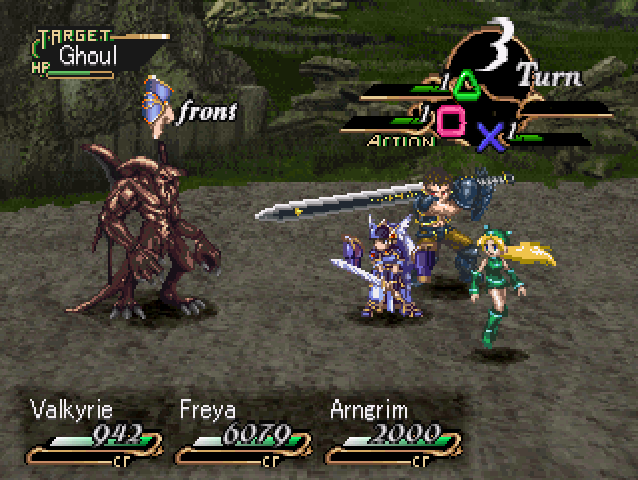
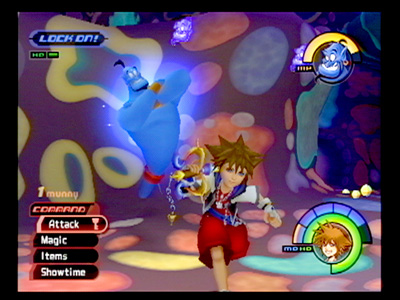
Genie fighting monsters in a psychadelic whale bowel. Because it makes sense.

Genie fighting monsters in a psychadelic whale bowel. Because it makes sense.

While traveling between worlds, the game becomes an over-the-shoulder perspective space shooter. This accomplishes very little except padding out the game for time and adding useless junk to find in each world.  These segments mostly consist of holding the X button for a steady stream of lasers and wiggling the analog stick ever so slightly to prevent impaling your ship on objects that will do as little damage as possible, then let you pass right through them. After finishing the first three worlds, you get a warp drive that lets you bypass this part, making it even less relevant to the game. You have the option of making custom ships by collecting blueprints, finding gummi blocks, and putting together or customizing existing models. However, the default ship provides as much challenge as deer hunting via carpet bombing with napalm, and at that point upgrading to an atom bomb really won’t cause any noticeable difference. Plus, I’ve conducted Korean-language ATM transactions more easily than using the gummi ship building interface, an extra-convoluted program that rival Adobe products for being non-intuitive.  While the player can mostly ignore these gummi-Galaga sections, it does intrude on the main quest by making gummi blocks the most common prize in hard-to-reach treasure chests. So when you finally have the proper skills and abilities, backtrack to old worlds, and get the platform-leaping aspects (honestly, why does anyone still make platformers?) right, the game rewards all your time and effort with an item as relevant as a Playboy magazine at a strip club.

Do I get the adult, powerful, many-antlered Bambi? Nope. I summon a baby deer to aid me in battle.

Do I get the adult, powerful, many-antlered Bambi? Nope. I summon a baby deer to aid me in battle.

I don’t want to mislead you into avoiding this game. It does have good qualities to outweigh the bad. You get to fly in Neverland and you turn into a mermaid…er, mer–Sora and swim through Atlantica. You can summon Mushu, the Genie and…for some reason, Bambi (and not the adult, mega-antlered, fearsome Bambi. The young, little Bambi).  I did enjoy the half-dozen Disney heroes as playable characters, especially the Beast, and major Disney villains like Jafar, Ursula, Maleficent and Hades carry a certain amount of weight.  Since playing a Disney character binds you to them for life, most original actors reprise their roles; however, one absence stands out, and without Robin Willaims’ manic ad-libbing, I feel a little awkward every time the Genie tries to crack a joke, even Sora tries not to make eye contact until the moment passes. Then act three arrives and Square says, “Fuck this Disney shit,” the plot turns dark, and the rest of the game riffs on themes of darkness, despair, and nihilism.

Pooh (n), winny the: Small yellow bear with honey fetish. See also pooh (v)

Pooh (n), winny the: Small yellow bear with honey fetish. See also pooh (v)

Oh, and don’t forget the absolute necessity for any action-adventure RPG where a heroic warrior fights his way through demons to conquor encroaching oblivion; Winnie the Pooh. No really, didn’t Aragorn have to defend Minas Tirith’s carrot gardens from bouncing orcs? I think Luke Skywalker’s biggest test on Dagobah required him to free Yoda’s head from a honey jar.  Okay, so the Hundred Acre Woods level doesn’t fit, and I can’t quite envision Pooh as belonging in an epic fantasy story. Sora doesn’t fight any heartless; instead he just plays the lamest mini-games since blitzball.

Played by Lance Bass. Because when I think "Sephiroth," I think soft pop music for pre-teen girls.

Played by Lance Bass. Because when I think “Sephiroth,” I think soft pop music for pre-teen girls.

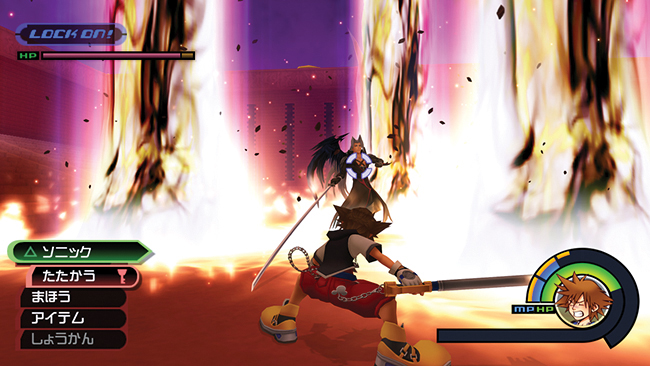
On a final note, Kingdom hearts has some amazing optional bosses. I believe during my review of Final Fantasy VII, I described Sephiroth using the phrase “anemic guinea pig.” Well, this game finally does him some justice. To all those people on forums claiming Sephiroth’s difficulty compares to the final boss, well, no. Final boss fights need to display flashy effects and epic, cinematic moments. The final boss tells a story, but has to let the player through relatively easily. No one needs to fight Sephiroth. So by removing any and all requirements (seriously, you get nothing for beating him except bragging rights), Square finally made him hard as all fuck to beat. Oh, and they cast ‘N Sync’s Lance Bass to voice him. So I guess the anemic guinea pig still fits.

Final Fantasy VII – Playstation, PC

Title

Thank god they fixed this! Why, I could almost hear the fabric of society bunching up around my nethers!

Thank god they fixed this! Why, I could almost hear the fabric of society bunching up around my nethers!

“They say words like ‘hell’ and ‘damn’ in it,” my friend John told me about Final Fantasy VII in ninth grade. This sums up the major features of the game quite nicely. Sure, at the time it came out, people hailed it as a demonstration of the cinematic powers of CD-based game consoles, but anyone who played it knew that it really demonstrated Tifa’s enormous rack as it jiggled like two shopping bags full of Jello when the explosion at the northern crater shook the Highwind–the game also demonstrated what Squaresoft could do when not oppressed by Nintendo of America’s horribly oppressive censorship requirements.

...Cloud, on the other hand, looks like he'd prefer some private time.

…Cloud, on the other hand, looks like he’d prefer some private time.

Final Fantasy VII almost needs no summary. Everyone knows about it by now. It changed the video game scene; believe me, I took weeks to decide whether I’d say that or not. People have made that claim about FFVII all over the internet–as they have about FFIV, FFVI, FFX and just about any new piece of technology that comes out. If you locked me in a room with ten dozen donuts, you wouldn’t especially look at the first one I ate and credit it with having special sprinkles with the power to break my will; it would have happened eventually.  However, the events surrounding the game’s release did successfully allow a number of things to happen.  Well, mostly it only took Square getting royally pissed at Nintendo for not giving them a CD-based console to work with, so that let them make the switch to Sony, which propped up Playstation as a major competitor in the market, leaving Nintendo wallowing in the dust trying to figure out how to entice their customers back without actually offering any good games.

"Must look intimidating...can't let them see...hair burning..."

“Must look intimidating…can’t let them see…hair burning…”

Still, I’ll concede that not everyone reading this has played the game, so I’ll sum it up: The multi-conglomerate Orwellian corporation known as Shinra, or in short, “Big Mako” have discovered an energy source even better than the sludge left over from decomposed corpses–the souls that used to inhabit those corpses.  Pulling the spirits of the dead out of the planet, they compress them and convert them into electricity so people can play video games (among other things), which naturally pisses off the local hippies.  Except rather than a skinny little white guy with a guitar and bloodshot eyes, a seven-foot tall powerhouse of a black man with a machine gun grafted onto his arm leads them, along with his double-D companion, Tifa, and her brooding, stormy, anti-social childhood friend, Cloud. Their game of cat-and-also-cat ends when one of Shinra’s old mistakes–a genetically engineered super-soldier with the DNA of an ancient monster sent to destroy the planet–arrives and plants a Nodachi two meters long into the President. Yada yada. Sephiroth burned down Cloud’s and Tifa’s hometown and now plans to destroy the planet, Cloud and his friends stop him.  The game ends, and the player looks up pictures of Tifa’s breasts on the internet.

So what do you think...they look fake, don't they?

So what do you think…they look fake, don’t they?

Although I joke about Tifa and her apparent fan following of CGI Animators on redtube, I truly believe in the necessity of adding a character with a large amount of sex appeal.  And not just her, but also Barret, his constant stream of profane tough-guy talk, his place as the only black guy in the entire fantasy genre except for that one dude from the Neverending Story, and the subtle gay vibe between him and Cloud.  Also, the comical string of obscenities that Cid spews forth could scour the rust off a car.  These things indicated that Squaresoft wanted to treat their audience like adults.  Games have aged since Donkey Kong, and so have their players; gone are the days of staring at Celes’s 16-bit pixilated sprite and trying to imagine something a little more photo-realistic.  I love the whimsical nature of those early games, but people actually seem to live in this world. Characters have speech patterns and dialects and everything.

Furthermore, in designing the combat system, Squaresoft took this notion of well-developed, distinct characters…and chucked it right into Ifrit’s hellfire. Custom characters have long attracted players to the Final Fantasy series. Games like Final Fantasy IV gave us special abilities like Kain’s jump or Rosa’s pray. Three and five (and later Tactics) allowed characters to learn skills permanently to equip in specialized combinations. Six mixed that, with character-specific skills and the ability to permanently use magic and raise stats. So naturally, we would expect something brilliant and revolutionary, now that we have 32-bits to utilize, right?

Same old ATB, stand-in-a-straight-line combat system, but with runaway summon animations lasting over two minutes!

Same old ATB, stand-in-a-straight-line combat system, but with runaway summon animations lasting over two minutes!

Nope! Forget all that–it all boils down to materia.  From the beginning of the game, any character can equip any materia–crystalized mako energy containing the knowledge of the ancients–which can let them cast magic, summon monsters, perform special abilities, augment other materia, or raise stats. The game only limits you by how much materia you can afford/find and how many slots your weapons and armor has to put them in. Characters can’t retain any of this once unequipped, so only limit breaks–powerful attacks only available once a character has received an amount of damage proportional to the power of the attack–and physical appearance in battle differentiate one character from another. And the game chucks characters at you like it wants you to sign up for its online dating service; with nine characters, parties of three or less, plus the old-school restriction of requiring the protagonist to lead your party at all times, I always have two or three who sit on the sidelines for the whole game, just to save money equipping them and to focus on building up the limit breaks for the more interesting characters. Which, yes, I usually choose based on physical appearance, in light of anything else. Which means the dog and the toy cat usually get bumped in favor of Tifa and Yuffie. And quite possibly Barret.

Anyone who's ever raced a chocobo knows the triumph every time you defeat Teioh...and the pathetic reward that usually follows.

Anyone who’s ever raced a chocobo knows the triumph every time you defeat Teioh…and the pathetic reward that usually follows.

Fortunately, though, Squaresoft packed more into this game than a hackneyed combat system and a questionable set of feelings for an electronically generated configuration of polygons.  In fact, I usual enjoy playing this game to completion.  Likely in attempt to show off the Playstation’s capabilities, FFVII includes a plethora of mini-games including a submarine battle, motorcycle chase, and a snowboard sequence so obnoxiously difficult that it only proves Cloud can run into more walls than Wile E. Coyote.  Furthermore, at the end of the game you open up the option to breed generations upon generations of chocobos–obviously the best hobby to take up with only seven days left to global annihilation.  You can raise chocobos to race, or try to raise special colors to help find all those hard-to-reach areas of the world map.  Again, I enjoy this, but sometime the task takes way too long, and the games variables don’t really feel truly random–while each race offers a 1 in 6 chance of winning the good prize, I seldom actually walk away with anything I couldn’t buy in any one of the hundreds of identical shops in the game, and quite often when trying to breed chocobos that can mate with each other, you’ll end up getting the wrong gender or the wrong color several dozen times in a row.

Final Fantasy VII also offers two bonus bosses, similar to the hidden bosses from FFV and the original Final Fantasy.  The Emerald and Ruby weapons make up for the plateau of difficulty toward the end of the game.  This presents a conundrum though because even though these bosses exist to add challenge to the game, in order to take them down you have to level up far more than necessary for anything else in the game, and it takes the punch out of anything else you’d do.  And while Sephiroth stands as one of the most iconic, impressive villains in any fantasy storyline, it generally disappoints me when I get to that final battle and he fights back with all the strength of an anemic guinea pig.

He's too sexy for his shirt, so sexy it hurts! He's too sexy for that sword...

He’s too sexy for his shirt, so sexy it hurts! He’s too sexy for that sword…

However, despite the overpowered characters in act three, frustrating random number generator, and a protagonist with forearms like Popeye, the storyline makes this game well worth playing. The save-the-planet eco themes offer, well…actual themes in a game’s storyline.  Sephiroth captivated so much attention by defying the obnoxious tradition that fantasy has of presenting magic-using villains, and the final scene with him carrying two meters of solid steel and dressed like a Chippendale dance only cements the fact that for once, just once, the villain earned his role in the story by acting like a dick to the protagonist, rather than because we all need to learn about how idolatry will lead us straight to Hell (thank you, C.S. Lewis, for welding Christianity into fantasy literature for all time…can we please talk about something else?). And, of course, spoiler alert, while FF characters have died before, nothing tops the moment when we lose Aerith forever. As I explained to my class the other day while doing the video-games-as-literature lecture, “When this happened, I cried like a baby!…no, you don’t understand, this happened like, two weeks ago.”

So to all those people who “debate” whether FFVII or FFVIII leads the series as the best game…WTF? You totally can’t compare the two.

Valkyrie Profile 2: Silmeria – PS2

Our non-valkyrie protagonist, protagonisting

Our non-valkyrie protagonist, protagonisting

Imagine the worst thing a video game has ever done to you. What games did you invest time and money in only for them to pull some dick move on you, probably leaving you swearing at the top of your lungs at the TV screen? If you finish Jurassic Park for the SNES, you get a delightful little non-ending that consists of the loading screen playing in reverse, which after a team of friends and myself spent an entire night of caffeine, headaches and dial-up internet walkthroughs to do, left me with an empty feeling, much like waking up next to a prostitute hungover and broke, except without the exciting evening to balance it out. Or one of Anne’s favorites; spending hours early on in a game going through side-quests, leveling up to the ultimate attacks, finding the ultimate weapon, and then the game murdering the character and taking with it all the equipment, experience, and precious moments of your finite life span along with it. Final Fantasy, Legend of Dragoon, take your pick. This one happens often enough. How about forced stealth, babysitting missions, or quick time events?

Full disclosure: I might give away some integral plot points of Valkyrie Profile 2: Silmeria, but I refuse to call them spoilers. See, to spoil something implies that it began with a certain level of freshness, but this game holds the record for most rotten-to-the-very-center-of-its-being of any game I’ve ever played.  If Mother Teresa, Gandhi, Jesus and Buddha collaborated to breath life into this game to make it human, it would still back over your cat with a humvee and then try to console you by saying, “At least it wasn’t a dog.”

Release the Kraken! Because apparently Norsemyth doesn't have enough monsters to keep us interested?

Release the Kraken! Because apparently Norsemyth doesn’t have enough monsters to keep us interested?

The first time I played this game, I swore I’d never do so again. I lived in a studio apartment and had to apologize to my neighbors for regular disturbances as I screamed profanities that would offend sailors at the top of my lungs. Hours upon hours of my life spent leveling up to plow through impossible enemies would vanish into oblivion as a clunky game mechanic would have my party trip over a blade of grass, leaving the nearby monsters to drive them into the mud like lawn darts. After figuring out from Valkyrie Profile: Lenneth that the game innovated RPG combat to stress set-up and strategy over power-leveling and high stats, I realized I simply didn’t know how to play the game right before. As it turns out, I rather enjoy the games combat system and find it highly engaging, much like the system for The World Ends With You, which I’ve found amazing ever since hoisting myself to the top of the learning curve with a few crampons and a good length of dental floss to use for rope.

No, to get to the real, black, shriveled prune of a heart of why this game laughs in the face of all who dare to play it, you have to examine the things the game designers did intentionally. For starters, for a game that claims to profile a Valkyrie, it spends very little time doing so, in favor of constantly introducing new characters with no relevance on the plot in the least. I didn’t often appreciate the half-hour long snooze-fests that introduced einherjar in VP: Lenneth, but Silmeria swung the opposite direction, introducing dozens of playable einherjar with no backstory whatever except for an entry in the status screen. They have no effect on the plot, but the game expects you to play with them and level them up anyway for the sole purpose of transferring their souls…well, maybe not to Valhalla due to Silmeria’s war with Odin…but to somewhere not nearby your party. Yes, by transferring them you get an item that permanently increases any characters stats, but it seems like time spent leveling up useless characters would help more if you spent it on the main characters of the story.

Our titular valkyrie, not valkyrie-ing

Our titular valkyrie, not valkyrie-ing

Speaking of which, you only really get two. Well, maybe one and a half, since the protagonist spends half the game possessed by the spirit of Silmeria. See, at the critical act one climax, you lose all your main characters–permanently–except for two, except Silmeria’s spirit goes on to bigger and better things. So you better hope you have some einherjar left over, especially a mage, because you never get them back!  Sure, the plot gives them back to you, but the game has changed their stats and attack patterns enough that you can’t call them the same person once you get back into combat, sort of the games way of saying, “Sorry I ran over your cat with a humvee, but I’ll give you a coupon for a free pizza to make it up to you.” Without Silmeria, you have no power to call einherjar, so if you had set them all free–like I did the first time I played–you may find yourself drastically shorthanded for the rest of the game. Then, for whatever reason, the game gives you a slew of playable characters literally in the final dungeon. In fact, by the time you actually get to see and play as Silmeria, you’ve already explored 74% of that level.

But perhaps the worst offense of all, VP: Silmeria reunites you with your trusty mage, a major playable character, a powerful magic user, and a Harry Potter impersonator, for one dramatic battle with Odin…and then leaves your party permanently to become the game’s end boss. Also, his lust for Lenneth, a character mentioned only once before, motivates everything he does. So…really, I don’t entirely know what Silmeria has to do with anything.

Just a little cranky. Apparently he lost all purpose in life after killing Voldemort

Just a little cranky. Apparently he lost all purpose in life after killing Voldemort

But really, the story lacks the cohesiveness of a wet post-it note, surpassing its predecessor for scattered, irrelevant, and unexplained plot points. It seems like Enix intended to make this sequel as they wrote the original, and they do connect a number of plot points and locations together, even if they don’t feel compelled to include explanation or reasonable motivation for characters’ actions. I could have connected with and found interest in the villain, had they ever decided to explain his obsessive crush on Lenneth, but they don’t even give us as feeble a reason as “has a thing for platinum haired vixens.” Furthermore, it seems highly unlikely that anyone crazy enough that Hannibal Lecter, Jack Torrence and the Joker want to keep a healthy distance would have the wits to put up an intelligent, rational and friendly facade for the majority of the story. Several characters from VP: Lenneth make appearances here, but the game never bothers to explain how they exist in both the Ragnarok-era of Lenneth and the ancient past of Silmeria. Near the end of the game, they throw some very elegant prose at you that I may have found slightly more moving had they ever bothered to establish some sort of theme or direction for the story. Then they try to explain some stuff about an alternate history, how these events happen after Ragnarok for Lenneth and the villain who have traveled through time, but before Ragnarok for everyone else and…honestly, they lost me.

Even a major antagonist takes priority over Silmeria on the box art.

Even a major antagonist takes priority over Silmeria on the box art.

For all its flaws, I don’t want to condemn the game to the coldest, darkest region of Hel quite as much as I did the last time I played it.  As I mentioned before, I feel they revolutionized RPG combat–or would have, had anyone figured it out. Rather than focusing on fighting enemies, gaining experience, buying stronger weapons, and fighting more enemies, the monsters throw challenges at you. You have only a few menu options, and can’t use more than a single spell or item every so often, but it gives you choices to make that you don’t commonly find in these games; do you want to split up your party into two groups to distract an enemy? Would magic or physical attacks do more damage here? Do you need to take out smaller enemies, or can you go directly to killing the leader? While the main maps, oddly enough, give the player only two dimensions to work with, combat maps switch to a 3D perspective where monsters and players alike move across terrain, trying to avoid getting taking hits.

An insipid, directionless story, but beautifully rendered.

An insipid, directionless story, but beautifully rendered.

Furthermore, the care they neglected when writing the story obviously went into rendering the characters, cut scenes, and scenery. You’ll have plenty of eye candy for those moments your attention wanders off of the vapid plot.

And, thankfully, they got rid of the sushi bars. Influenced by Norse myth or not, that just didn’t make sense.

Valkyrie Profile (Lenneth) – PS1, PSP

Freya Odin Lenneth
Valkyrie Profile 2: Silmeria hit stores when I lived in Korea.  Square-Enix pulled off promotion after promotion advertising it, and this intrigued me–I hadn’t seen a video game advertised, really, since Nintendo wished to share exactly how “rad”; of a game it had produced. (After which, the world didn’t see a more egregious misunderstanding of rap until this.) The game looked wonderful, beautifully rendered, and epic.  I hadn’t heard of the original, but I knew I needed to play this game! So I bought it and played it, only to find out that Squenix had promoted the wonder, beauty, and epic-ness as a distraction from unrelenting difficulty due to bad gameplay mechanics, bugs, poor play control, and a storyline written by manatees.

“Have you played Valkyrie Profile 2?” I asked my friend Al later that year when I met him in Taiwan.
“Don’t,” he replied, several months too late to save me.

However, he did recommend the first game, so I immediately set out to find a copy.  And with equal expedience I placed it on permanent “wish list” status when I saw its price average at well over $100.  As you can imagine, although I hadn’t liked the sequel, I knew I needed to play this game!

A battle maiden limited by periods? Dear god, do they even think these things through before they translate?

A battle maiden limited by periods? Dear god, do they even think these things through before they translate?

Valkyrie Profile, which Square-Enix has re-released on the PSP as Valkyrie Profile: Lenneth, tells a story based on Norse Mythology.  Odin finds out about the impending battle of Ragnarok, and needs warriors.  He and Freya call upon Lenneth, one of three Valkyrie sisters to go scour the corpses of Midgard for bodies he can stick on the front lines.  From there, depending on whether you chose easy, normal or hard mode, you get a certain amount of time, called periods, to zoom and soar over an oddly diverse continent, looking for people on the verge of death and dungeons to crawl through to train them.

One of Wagner's less-popular operas. Onis don't tend to live quite so far north.

One of Wagner’s less-popular operas. Onis don’t tend to live quite so far north.

The game has a few issues I need to point out.  Valkyrie Profile develops a story based on Norse Mythology in the same way that God of War develops a story based on differential calculus, Thoreau’s “Walden” and the Japanese Stock Exchange.  Yes, they both have something called a Valkyrie, and all the gods have the right names, but after an early scene that takes place in an old Norse . . . sushi restaurant, any semblance of viking culture stands out as coincidental, something that makes you stop and ask, “Hmm, how did that get there?”  In your first battle, you face off against a harpy, as if someone handed the game writers a copy of the Prose Edda and said, “We need monsters to battle! Find some for us,” and the writers looked up from playing Pokemon long enough to see a really hard book, put off doing the work until the deadline, then struggled to remember anything at all from learning about mythology in grade school. In fact, except for a bunch of dragon-esque looking monsters, I didn’t encounter a fight with a recognizable Norse beast until literally just before the final boss.

And here we have...a mermaid?

And here we have…a mermaid?

Next, while I don’t generally demand insightful character development from a story, it might be nice when a game has a title like, say, “Valkyrie Profile.”  “Interesting,” I say to myself.  “What might a Valkyrie have to face in her daily life? What conflicts might she encounter?  Could she face difficult challenges in fating people to die in battle? Or does she have self-image doubts because of waiting tables in Valhalla for a bunch of drunken einherjar?” Unfortunately, we don’t really see anything nearly so interesting.  Tri-Ace gave her character just enough depth to hold its head under until that final bubble of personality popped out of existence.  She delivers a cliched pre-ultimate-battle speech indicating some sort of epiphany, but the game provides us with no build up to indicate why this apparent character trait matters.  Furthermore, even though Freya introduces the Valkyrie to us as “Lenneth,” the majority of characters and even the menus refer to her simply as “Valkyrie,” a point best illustrated by one scene where an einherjar party member states, “Lenneth is Valkyrie’s real name?”

Kinky

Kinky

The entire story comes off as disjointed, really.  The search for einherjar entails using Lenneth’s Spider-Senses on the world map, then flying to an indicated town to collect a soul.  Once entering the town, the player watches an extended cut scene involving the doomed character, seeing a snippet of their life and the conflict that led up to their death. Usually. They forgot to actually kill off one character before he joins your party, but hey, we can just fill in the blanks, right? Maybe he got drunk and fell off his horse or wandered to close to a rampaging myna bird. Anyway, sometimes these cut scenes take forever.  Other times, we see a few disjointed clips, and then a death.  Then the einherjar joins your party and never says another word.

Also, while games offer unique applications of music and put a lot of good soundtracks into the world, I feel the world map sections missed their chance to let players fly a Valkyrie around the world to this song.

Did I mention you only get to move in two dimensions? But hey, the design looks great!

Did I mention you only get to move in two dimensions? But hey, the design looks great!

Similar to Silmeria, Valkyrie Profile: Lenneth doesn’t feel satisfied with its difficulty level until it beats you until your characters have no internal support beyond a sack of bone meal and pated organs.  While at first I lamented the fact that Enix had seemingly duped me into grinding for yet one more game, I later realized the half-turn-based, half-real-time battle system actually innovated a non-level-focused brand of combat.  The game hands out experience like a disapproving politician, trying to punish you for your dependency on fighting monsters to level-up.  Instead, the player can win battles at a low level simply by preparing properly, using equipment and characters to their most efficient potential.  They didn’t accomplish this well, offering a muddled system for buying and selling (re: creating from and converting to divine energy) items, a menu that tells you nothing about what effects certain pieces of equipment will grant, and absolutely no indication that you should consider anything except grinding, but with some work, it might be a nice alternative to formulaic and repetitive RPG combat.

But believe me, it needs work. Badly.  Magic, while clearly overpowered, more than compensates for that by requiring excessive wait periods between casting spells.  Characters charging their magic can attack for a small amount of damage if they’ve learned the ability to summon a familiar, but can’t so much as use an item to heal in the interim. I found three mages in a party can make it pretty easy to plow through enemies, but you really need this many to use magic effectively.

The game found an interesting way to increase replay value.  Rather than shooting for ending A, B, or C and then looking up the other two on youtube when you finish, Valkyrie Profile actually sends you along alternate story paths based on the decisions you make, leading to more or less of Lenneth’s personal story, and the game culminates in alternate final dungeons with alternate final bosses which lead to the three alternate end-game cut scenes and credits.

RetroArch-0909-035901Oddly enough, despite the shallow story, sloppy menus and item system, broken battle mechanics, disjointed story, and complete lack of direction, I actually didn’t hate playing this game.  Yes, I know I forgive RPGs more easily than they deserve, but after finishing Valkyrie Profile: Lenneth, I feel tempted to play Silmeria again, and I know I didn’t enjoy that game.  It surprised me, because objectively I shouldn’t have enjoyed this game. But somehow I did, and I do acknowledge the value in playing this game.  I wouldn’t buy the game for $100, but it does have some value to it.

Coming soon, look for articles on Perfect Dark and Resident Evil: Deadly Silence.  I may actually play through Silmeria, in which case I’ll probably drop off the map for a while.  GRE coming up, plus long games equals I hope you’ll remember to check back every few weeks for an update. Thanks for reading!

Secret of Mana – SNES

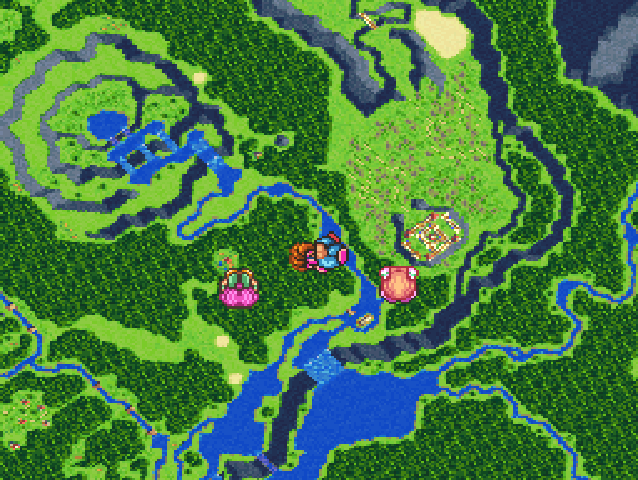
The game's elemental magic system lets you build snowmen! Out of the dying corpses of your foes, nonetheless.

The game’s elemental magic system lets you build snowmen! Out of the dying corpses of your foes, nonetheless.

Anyone between the ages of, say, 23 and 35 might understand the sheer disappointment of nostalgia, how delving deep into the caverns of your past usually only uncovers the noxious fumes that kill the canary of our fondest childhood treasures. Did any of you ever watch “The Real Adventures of Johnny Quest,” Hannah-Barbara’s update of their classic science-adventure series into the computer age? I loved it! I stayed up every night one summer to tape it. I wanted to dive into Quest World, to meet the Evil Stephen Hawking guy who only felt truly alive in virtual reality. I wanted to know what ran through the mind of the psycho religious fanatic. I wanted to travel the world, see exotic animals and mess with cool science gear. And a few years ago when I dug up some of those old episodes, I found I wanted to surreptitiously leave the room when the writers decided to let Hadji bust out a few “Sim Sim Sala-bims.” Yep. Despite possessing the ability to change with the times, “The Real Adventures of Johnny Quest” only succeeded in blandness. And racism.

After rescuing him from a plot to create a tropical resort...in the arctic.

After rescuing him from a plot to create a tropical resort…in the arctic.

And so, with heavy heart I have to confess I had a similar reaction to Secret of Mana, Squaresoft’s epic Final Fantasy Spin-off. Don’t worry, though, I don’t intend to condemn the entire game. Just one guy. Which guy? Guess. Which early 90s Squaresoft employee did everyone know simply by virtue of having the only Western name in the credits? The one whose translations dropped text into the game with the care and precision of a spastic colon? Ted. Fuckin’. Woolsey. Now, it appears that the internet uses people’s opinions of Woolsey as kindling for flame wars, I should give him the necessary credit he deserves: direct translations don’t work. People simply use languages differently, and certain words and phrases don’t translate at all.

Rather, I’d like to say (if I can ever learn to shorten my introductions) that one shouldn’t confuse the Japanese “R” and “L” sound when a) you speak English natively and b) The same name appears both in Final Fantasy (Gestahl) and Secret of Mana (Geshtar). And seriously…he honestly didn’t know Biggs and Wedge, Luke Skywalker’s trusty wingmen during the first Death Star Assault?

So while the old games, even with Woolsey’s translations, don’t fall to the level of Johnny Quest, re-playing Secret of Mana recently made me painfully aware of the jagged, incoherency of the story. The main character, who rarely has any direct interaction with the plot, comes off as a silent protagonist after the first few scenes, but occasionally mumbles just enough so that he comes off as a second-rate mime. Jema, the game’s Obi-Wan Kenobi figure, offers no more advice than “Go to the Water Palace” or “Go to Gaia’s navel,” and the Yoda figure literally tells you nothing more than your next random destination for a good chunk of the end-game. Furthermore, the game introduces a fascinating villain, Thanatos, who shares a name with the God of Death, and we sort of infer is manipulating the war between the Emperor and the Kingdoms (the standard stock war included free with every purchase of a fantasy plot), but we get very little dialogue from or about him and the other villains. These inconsistencies seem to reach a peak when you sneak into the Imperial Capital, leaving the world of medieval-style fantasy villages and plopping yourself down into the horrible, dreary, nightmarish…contemporary urban town with paved streets and cheerful music, where the sun shines down warmly and everyone walks around with a smile on their face.

Let me just flag down a cab here...

Let me just flag down a cab here…

…uhh, why again do we want to disembowel the emperor with such a passion? Oh right…something somewhere about a cliched metaphor for limited resources and global warming. I think.  See, I can’t ever tell, because according to wikipedia, they cut a massive amount of text from the game to get it to fit on an SNES cartridge. And rather than economize the language available, artfully revealing key plot points and character development in as few words as possible, Woolsey just let it go. So when the hero’s village becomes overrun with monsters, they banish the only villager with a sword. Now, I support enforced background checks for lances and a ten-bolt limit for crossbows, but I also fail to see the reasoning behind believing that every monster and demon on earth wants to attack you simply because you have a weapon.

But leave you must, and just as the hero becomes unimportant to the story once other characters join him, you pick up weapon after weapon on your journey until you forget all vital details behind the sword, and all towns in your wake remain utterly defenseless.

The characters fighting a monster...Playboy? Well, the nuns at my sunday school did warn about the dangers of pornography.

The characters fighting a monster…Playboy? Well, the nuns at my sunday school did warn about the dangers of pornography.

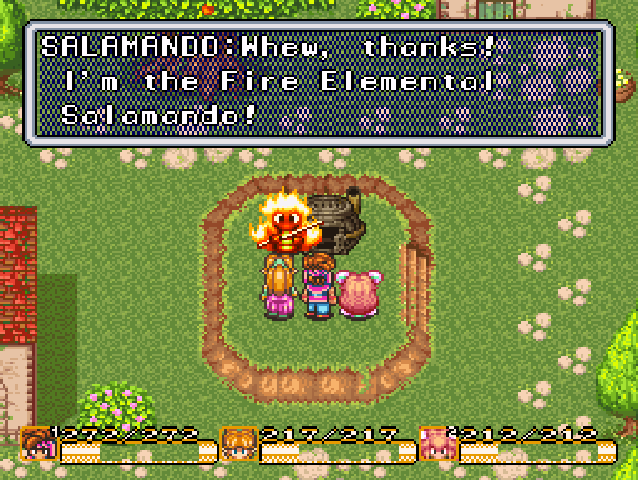
However much the story lacks, the gameplay makes up for. Rather than the standard consumer economy provided by most RPGs, Secret of Mana tackles weaponry in more of a Marxist fashion, providing you with a set of weapons, free of charge, at or near the beginning of the game, that level up as the proletariat works harder and harder. (Unfortunately, the inventory does not include “hammer” or “sickle”) Combat takes place in pseudo-real-time, with enemies directly on the map, completely free of jarring explosions sucking you into isometric perspectives where the enemy kindly lines up and waits as you pound them. Rather, you move freely about the map, attacking freely as in a Legend of Zelda game; however, with the added encumbrance of an ATB gauge that needs to charge before your characters can summon up enough strength to penetrate the enemies outer layer of…epidermis. The player opens up menus at any time, in battle or otherwise, to use items and cast magic. Magic comes in the form of elemental spirits gathered along the journey, and they can level up with use, same as the weapons. While I usually write my reviews to ridicule the more absurd aspects of the game, I find myself at a loss for good jokes. The combat system wraps things up pretty tightly. It works.

Well, mostly. Despite giving us a rich selection of weapons and magic and a smooth, sleek ring-menu system to navigate between them, Secret of Mana gives you three characters and about half a brain of AI to split between the two inactive ones.  While they’ll refrain from wasting your MP and will generally wait to attack until their ATB gauge fills completely, they do wonderfully smart things such as dart head first into enemies, attack during the invulnerable period after a monster has received a hit, or try to get closer to the lead character by running straight into a wall nonstop like a squirrel confused by a sheet of glass. While you can program basic attack/defense strategies, you can’t send commands to switch these during combat, so it amounts to either one worthwhile character at a time, or the player needs to constantly switch between party leaders.

Fortunately, Square included a crafty solution, allowing up to two other players to join in. If you want to play the game, I suggest hunting down friends, relatives, co-workers, homeless guys, or  prostitutes, since it does make a world of difference, having someone with a brain behind a character who would otherwise serve as much purpose as one of these.

A good way to see the world without getting probed by Airport security.

A good way to see the world without getting probed by Airport security.

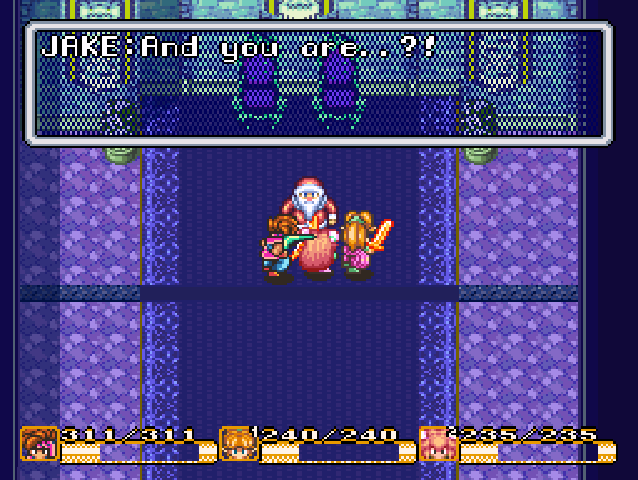
On the unfortunate side, I don’t really have anything interesting or witty to say about Secret of Mana. Really, what can you add to a game that considers “shoot you out of a cannon” as a viable method of travel, and has a travelling anthropomorphic cat-merchant rip you off by jacking up prices on normal items? The game doesn’t have a lot of visible flaws and its own unique sense of humor, so I have to resort to picking on the poor translator, and since so many people have played it already, I don’t really feel the need to describe it in detail. So ask Santa for a copy this Christmas if you don’t already own one. And if he fails to deliver, buy the game and kick his ass.

Because seriously…you fight Santa Clause about halfway through. Santa tries to kill you. Santa. An enemy. How can you improve on a fantasy death match with St. Nick?

RetroArch-0908-175043

Dragon Quest / Dragon Warrior – NES, GBC

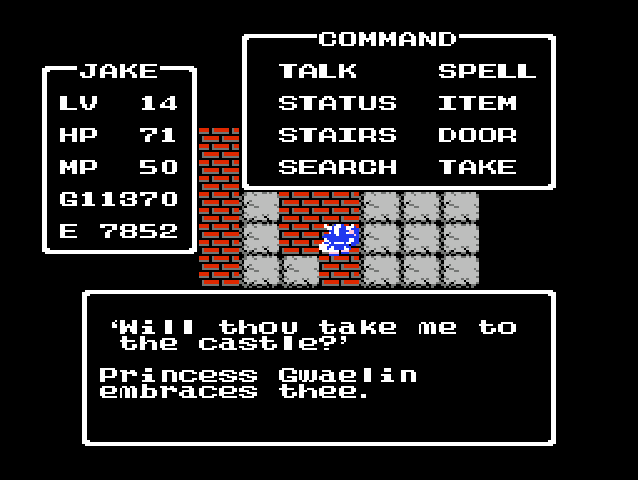
Yep...she makes you carry her halfway around the world.

Yep…she makes you carry her halfway around the world.

In tenth grade, my school required me to buy a graphing calculator. My trusty TI-85 and I became inseparable when I realized it came with its own programming language. I spent days in my bedroom, hunched over my calculator with thumbs blitzing like epileptic clog dancers until I managed to program a simple, shoddy dungeon crawler with about 20 rooms and 4 or 5 monsters that could beat you into negative hit points. It filled the calculator’s entire memory, had more bugs than a gas station bathroom, and I only played it once, but I still loved it. The next year I upgraded to a TI-89 and shinier, newer games found their way to me, including Phoenix, a 4-level version of Mario, a version of Tetris where blocks fell all the way down when their supporting blocks vanished, and a four-screen-map sequel to Final Fantasy VII with two characters, one boss fight, not enough monsters to level-up, and an inconclusive ending.

Any of these math-class knock-offs released on a dedicated gaming console would have undoubtedly given the impression that the video game industry had replaced all their experienced developers with a team of lemurs who had a penchant for writing fanfiction. They glitched. They wasted memory. They ran poorly on systems not designed for games. I had a Playstation and an N-64 by this point.  I didn’t need these crummy games; yet I still played them. I mention this because my recent play-through of the 1986 RPG legend, Dragon Warrior, left me in a quandary, puzzled over how games with as much substance as a half-finished knock-knock joke written on a pizza box can gather a large enough fan following to inspire one of the most long-lived series in video game history.

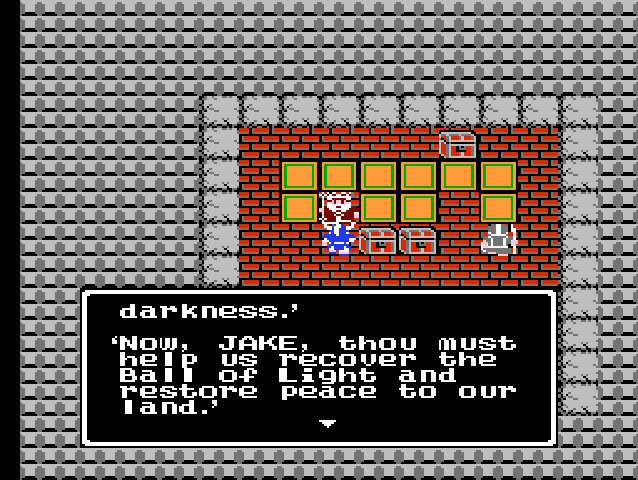
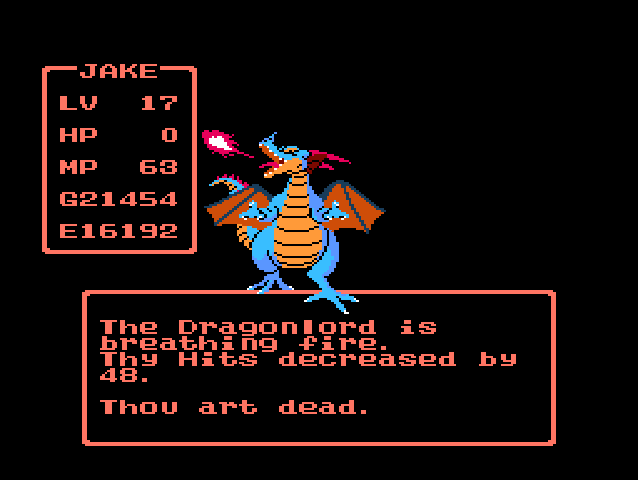
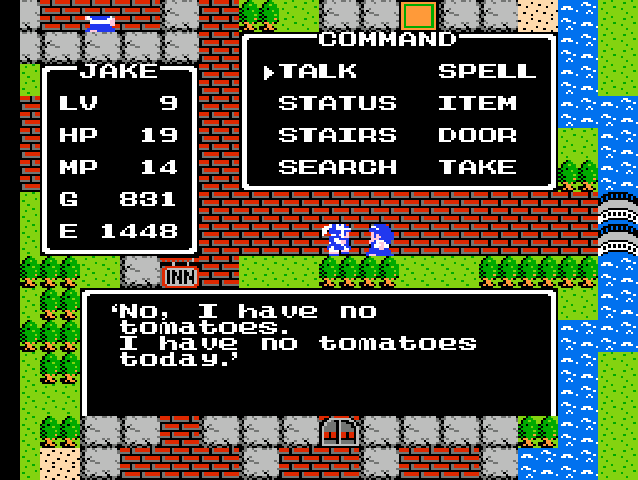
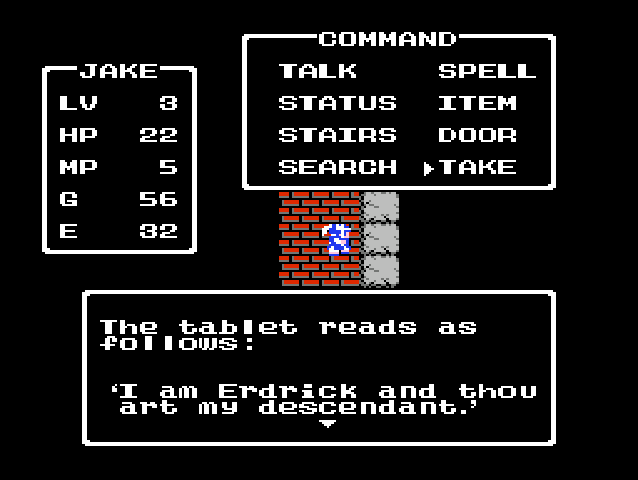
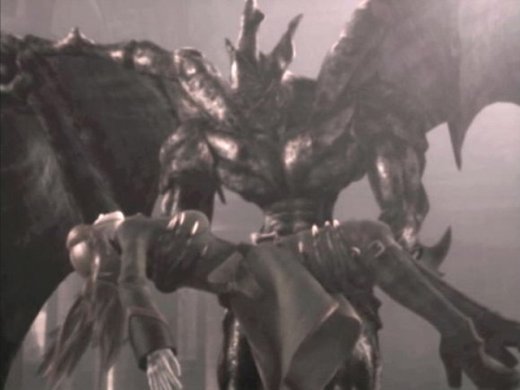
GwaelinDragon Warrior (known in Japan as “Dragon Quest”) hails from an age where RPG developers wanted to re-create the Dungeons and Dragons experience without the dice, paper, or need for that pesky socialization, but hadn’t yet figured out that interactive storytelling doesn’t exactly work the same way with pre-programmed computer characters.  As such, you play as _______, and up-and-coming warrior with the charm, charisma and personality of Edward Cullen after eating his weight in magic brownies. The King of Tantagel, in a display of straightforwardness that most video game mystics would find offensive, gives you a simple task: 1) Find the princess and 2) Kill the Dragonlord. After which, young ________ ambles through the world, slaughtering the indigenous fauna until he feels confident enough to carry out the assassination the king entrusted to him.

As much as the simplicity sounds like a breath of fresh air, however, we play games exactly for the roundabout nature of questing. In fact, if you’ve spent any length of time with literature professors, they’ll remind you that the world’s alleged greatest, most classic piece of literature focused entirely on Odysseus gallivanting around the Mediterranean for years, cavorting with nymphs while “guilt” over his marital fidelity “tortured” him, when it may have only taken him two or three weeks simply to walk home. I get that NES cartridges didn’t have the capacity to store complex stories, but like most RPGs from the 1980s, Dragon Warrior has a problem with math. Leveling up to the point where the Dragonlord won’t vaporize you like a bottle of  Zippo fluid requires over 20,000 experience. The most reasonable enemy to fight while level grinding gives you 54. With nothing to do in-game, I hope you have a second TV in your living room because you may want to put on a movie while you grind.

I humbly accept this quest my liege, and...did you just take my wallet?

I humbly accept this quest my liege, and…did you just take my wallet?

Furthermore, your gold supply creeps up with an impressive lack of urgency, while weapons and armor can run as high as 14800. To add to the tedium, every time ________ dies, he wakes up in front of the King of Tantagel, who admonishes you for having the gall to allow the overpowered monsters of the countryside maul you to death. The first time this happened, I didn’t realize that I kept all the experience earned since I last saved because my gold stock had dropped substantially from the moment of my death. But Eventually I realized that in addition to chewing you out for your audacious apathy toward life, the King takes half your gold every time he revives you.

Is it to late to reconsider your offer?

Is it to late to reconsider your offer?

After my initial outburst of anger at having to replenish larger and larger sums of money at each death, this got me thinking. One of the inconsistencies in the design, only certain buildings have roofs and entrances, while the rest simply appear as walled-off areas with a gap to pass through. The fact that some areas have inside maps suggests that the houses without them actually remain open to the elements. With a king who rifles through dead men’s pockets for loose change, I began to wonder if the Dragonlord might actually want to enact social change in the land of Alfgard. Perhaps instead of the black-and-white good-versus-evil trope of the fantasy genre, the villain’s crime doesn’t extend beyond threatening the provincial villagers with scary, scary change.  Unfortunately, while the game does offer the chance to team up with him, taking that option will end in a game-over after days and days of piling up monster corpses for the scraps of stat bonuses necessary to get that far.

First the old man asks me to find his balls, and now this guy?

First the old man asks me to find his balls, and now this guy?

Another factor that compounds the tedium stems from the cryptic hints and clues as to how to finish your quest, gleaned from random townsfolk throughout the game. The King shoves you out the door with absolutely zero direction, and every step you have to take you have to guess based on riddles thrown at you. They’ll point you in vague directions, or suggest items that you must infer you need to progress, or even tell you to visit certain people in certain towns, most of the time leaving you to guess the names of each town because the game won’t label them in any way. Rather than send myself into an angry rant, let me describe it this way; Any game that forces me to look up a walkthrough to progress automatically earns one strike against it. If upon figuring out what I need to know, I still feel like I couldn’t have figured it out on my own no matter how much time I gave it, the game earns another strike. Dragon Warrior forced me to create a third category; games where I look up the walkthrough and still can’t figure out the puzzles.

Dragon Warrior boasts its artwork, done by Akira Toriyama (Dragonball, Chrono Trigger), which could have saved this game…if I had seen any of his influence in it. Maybe the designers based the sprites off the interesting, colorful designs that probably looked something like Goku, but the 16×16 pixel designs couldn’t even hint that Toriyama had any hand in the game development. Someone else clearly did the box art, and I even downloaded the original instruction manual, hoping for more than the second-rate fan art that often graced the pages of NES games intended for 8-year-olds. But no. Even Toriyama couldn’t save this game.

RetroArch-0907-094525
But still, as the first NES-era RPG released in Japan, the series succeeded. People there love it. They perform Dragon Quest music at major symphonic performances. Video games hold an advantage over movies in that their sequels don’t have to recycle the rotting corpses of the original, so I do trust that the later games in the series surpass the first by far. I can only explain its success via my calculator story; the portability and disguise of an education tool allowed me to take games into places previously forbidden, places I couldn’t exactly lug my Playstation.  Having it with me gave me an option. I enjoyed it more for the novelty of its existence rather than the value of its games, and Dragon Warrior can certainly claim the same novelty for its era and console. Still, the painfully slow pace of the grinding, also seen in Final Fantasy (released the following year in both Japan and North America, while Dragon Quest waited three years to cross the pacific…I wonder if that has anything to do with the popularity of each series in each region.), along with the dangerously unstable battery-backed saves of the NES cartridges, tell me I should put my time into the SNES-era games instead.

Shadow Hearts: Covenant – PS2

sh2

In tenth grade, my friend Albert (who today would probably be best known for his work on this) came to school with a hilarious bit of trivia. It seems he found a book in his pastor’s office that listed off pop culture icons that defied God. Most notable among the entries, it suggested we shun the Smurfs because a) Papa Smurf used magic to help his fellow smurfs instead of prayer, and b) Gargamel drew actual Satanic symbols when casting his own evil spells. While these aspersions seem about as productive as speculating on the sexual orientation of a teletubbie, Shadow Hearts: Covenant, the final instalment of my reviews on the game series, kinda, sorta, actually does this.

Legend states that King Solomon used a ring engraved with the Star of David to capture and enslave 72 demons. A book known as Goetia, The Lesser Key of Solomon, or sometimes Lemegeton, supposedly authored by Solomon himself, lists off all these demons, describes them, and shows the crests used to call them into service. Not only does Covenant base its magic system off this legend, sending the player across the world to find these demons and equip them, but when you summon them in-battle, the actual crest from the book appears on the battlefield. So just a warning, while I recommend this game, you may run the risk of actually calling monsters out of your television.

Yuri (as Amon) and Karin in homage to the box art to the original game

Yuri (as Amon) and Karin in homage to the box art to the original game

Now that I’ve issued my disclaimer, I can get on with describing the game…except I don’t really have much to say that differs from my articles on the original Shadow Hearts or From the New World.

The game follows Yuri Hyuga once again, continuing from the bad ending of the first game.  The Vatican sends Nikolai Conrad, who has a personal beef with Yuri for beating Albert Simon before he had the chance, to curse him.  Attacked with the “holy mistletoe” curse, Yuri loses all weapons, items, and fusion demons from the last game, as well as the ability to get any action from the game’s double-D female lead (which, not to ruin the game for you, probably works out in Yuri’s favor.)–probably the games greatest irony considering mistletoe’s reputation for inspiring sexual hedonism akin to playing Twister.  Once thusly cursed, Yuri and Company set off on a crusade to take down the secret society responsible for making the Vatican look like Dick Cheney’s personal assassination squad. Along the way he rediscovers demons and, you know, just might learn a little something about himself.

Like the original, Covenant emphasizes character development over action and plot. Unfortunately, players despise quick-time events that ask them to “press X to not die,” so I don’t think they’d readily accept “press X to introspectively examine your purpose in life after the death of your lover.” On the positive side, Nautilus did not actually include these events in the game, instead favoring flimsy excuses for geographical movement into a series of irrelevant dungeons.

Torture scenes exist in all three main series games...but only here do you get a BDSM dominatrix along with the pain.

Torture scenes exist in all three main series games…but only here do you get a BDSM dominatrix along with the pain.

And while the story masterfully outlines Yuri’s development, I wouldn’t go so far to say that each character adds something vital to the story.  Much like the dungeons, it feels like the guys at Nautilus sat around trying to think up caricatures to round out a battle party.  “We can’t get through the game with only two characters!” someone said. “Let’s throw in a super-hero….pro wrestling…vampire,” offered a staff writer, who probably just flipped through the nearest copy of Game Informer until he found three successful titles. Granted, when given the option of using a super-hero pro-wrestling vampire, few players will resist the call.  Shadow Hearts has always designed their characters people want to use in battle.

But hey, if you do one thing well, just do it ad nauseum, right? The game uses the alternate history genre to present a parade of cameos. Characters from the first game make appearances, including Kato, Albert Simon, Roger Bacon, Alice, Keith and Margarete–as well as historical figures like Lawrence of Arabia, the Great Gama, Gregori Rasputin…and Margarete.  Also, Kato looks more than a little bit like Bruce Campbell, so that should count for something, I think.

Summoning demons with a book, resurrected girlfriend, and chins bigger than China...coincidence?

Summoning demons with a book, resurrected girlfriend, and chins bigger than China…coincidence?

However, the carnival of characters and the dismissive plot tend to retcon parts of the game’s universe. Apparently, Albert Simon only wanted to destroy the world in the first game because he needed more power to fight one of the major villains in this game. I’d need a good long time with the latest edition of the DSM to count the psychological disorders required to make that logic work. Apparently Yuri only needed to sit down with him and have a chat about the problems of overkill to solve the conflict in SH1.  Whether he does or not, the change in motives takes the fangs out of previously enjoyable villainy.

Covenant improves on mechanics developed for the original.  Players have options for customizing the judgement ring, as well as equipping an item that slows it down to a reasonable speed.  In the first game, the ring fixed the traditional RPG mechanic of finishing battles by hitting X repeatedly–by making you hit X four times as often and at very precise moments.  Covenant offers their characters a reasonable amount of MP, making magic and special techniques a valid option. The game clearly had influences–if you ran a drug test, its urine would contain more than trace amounts of Final Fantasy–but in Covenant, it developed enough of its own flair to stand on its own…which of course made it branch off into obscurity, eventually leading to the cancellation of Shadow Hearts 4 and the downfall of the series, despite attaining a quality and ease of playability that other RPGs would envy.

Yes, the dog is sidling to avoid being seen.

Yes, the dog is sidling to avoid being seen.

Covenant exists to impress. This game introduced me to the series, and still stands as its strongest game.  A rare occurrence of RPG direct sequelage, it manages to inform the player of all relevant plot points from the first game in less than three cut scenes, seemingly animated by Yuri’s own hand-drawings of the events.  These scenes also illustrate the otherwise dark, gothic game’s aloof sense of humor, although the gay-sex-between-athletes innuendo remains a reward for the fervent side quester.

And on a final note, Shadow Hearts does side quests better than any any other game I’ve played.  If you’ve ever played an RPG, you’ve probably gone through dozens of quests for ultimate weapons, magic, or skills, only to find yourself at the end of the game with literally nothing left to use them for except the final boss who at that points fights back with all the rage and fury of a plastic cup filled with pudding.  Covenant, however, offers multiple side quests for every character, most of which include full-length dungeons and bosses.  Yes, eventually you’ll run out of options and have no choice but to end the game, but by then the game feels satisfying, if not just a little too easy.

So I should probably throw this in before wrapping this up: Solomon didn’t write the book.  Unless he knew German. And worshiped Jesus…thousands of years before his birth.  But as an element of the real world–as well as all the other real-world elements in Covenant–it immerses the player into the fantasy, and it does it well.  Well enough, obviously, to get me to play an entire series over the course of two months.  Although I don’t rate games, I feel this particular game merits some sort of quantitative praise, so I will bestow upon it my highest ranking: 10 stars out of two thumbs up multiplied by 100 tomatoes.

Why play the game? Here are two big reasons.

Why play the game? Here are two big reasons.

Sorry for the delays in updating. I’ll target some shorter games over the next few weeks to make up for it. Thanks for reading!