Star Wars: Episode II: Revenge of the Sith – PS2, XBox

episode3_043005_ps2_orgThe Duluth/Superior region has a Facebook group dedicated to letting people sell their old junk. I like to keep tabs on this, theoretically, because people occasionally post video games or even consoles. Unfortunately, the people who tend to sell these things generally have no understanding of the difference between good and bad games. If they paid $50 for it, then damn it, everyone will claw each others eyes out to get to the $49 used Madden game that they so generously offered to take a financial hit on. Oh, how will you ever feed your starving children otherwise? Word of advice, people, no one wants your shitty sports games. Not even people who buy shitty sports games. Used game stores might charge a token 50 cents for them, but honestly if you needed to assign a realistic value to them, don’t forget to include the negative sign! Also, your 25-year-old front-loading NES won’t fetch the $300 you think it will. Look these things up on eBay before demanding people stop not-buying your shit. Anyway, these people generally mix in a few licensed games based on movies or TV shows, which brings me to this week’s topic.

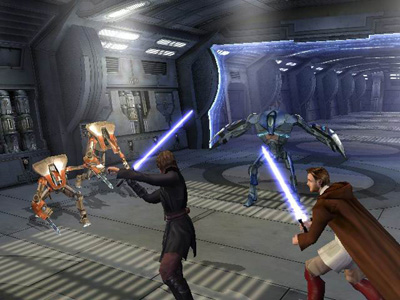
Despite my unfeeling metal body and legion of droids with heavy artillery, I will fight you with your weapon of choice, because having only two sith lords reduces the opportunity for lightsaber combat.

Despite my unfeeling metal body and legion of droids with heavy artillery, I will fight you with your weapon of choice, because having only two sith lords reduces the opportunity for lightsaber combat.

My regular readers will know by now that I’d rather crawl through a tunnel of razor wire towards a cliff dropping into the Dead Sea than play a licensed game. However, in the past I’ve admitted that Star Wars games fall into the golden territory of, and I quote myself here, “Meh. Not so bad.” And with that philosophy and a masochistic spirit worthy of homosexuals, women, and racial minorities who vote republican, I picked up Star Wars Episode III: Revenge of the Sith at Savers, expecting a mediocre gameplay at best–and the game wowed me…with how much it still managed to disappoint me with bland, uninspired and glitchy gameplay, and some identity confusion as to whether or not it wanted to fulfill its duty to its father and join the run-and-gun action genre, or whether or not it wanted to hang out with its rebel friends in more of a fighting game format.

I’ve definitely played worse, though. In fact, two minutes into the game, it almost felt just like watching the movie…mostly because they had actually inserted footage from the film as a cut scene, albeit with noticeably lower quality. And since anyone with a laptop less than ten years old can easily rip DVD footage and convert it to a format the PS2 can read, I can only assume the developer–some obscure company called “LucasArts”–had trouble getting their hands on a high quality copy of the game, perhaps developing the game as a bootleg edition. Either that or something went horribly wrong in the middle of George Lucas’ attempt to digitally replace all the lightsabers with walkie talkies, resulting in an explosion that gave him abnormal powers and turned him into a galactic super villain. Also, except for a brief quip in the middle of the final battle, they cut out any mention of Natalie Portman. Assholes. I swear, if you turned her into a walkie talkie, you’ll rue the day you ever….
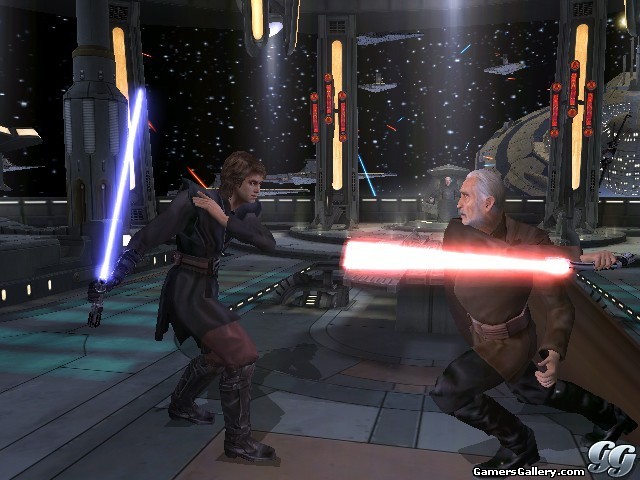
Tell me 'friend,' when did Anakin the wise abandon reason for madness?

Tell me ‘friend,’ when did Anakin the wise abandon reason for madness?

…sorry. I don’t usually develop crushes on celebrities, but as a nerd, I hold Star Wars near and dear to my heart, and Carrie Fisher predates my time by just a little too much.  Anyway, much like I do with soft porn, the game skips over absolutely everything part of the plot without any action. It begins with the assault on General Grievous’ fleet, the duel with Count Dooku, and the Chancellor’s rescue, and then except for a short mission with Obi-Wan, I immediately found myself battling Mace Windu and bowing before the Emperor. But even though the plot seems to have taken a lightsaber to the head, even the Super Star Wars series took gratuitous license to shove violence and action into every orifice not already occupied by a lightsaber battle, light-speed space chase, or baby Ewok.
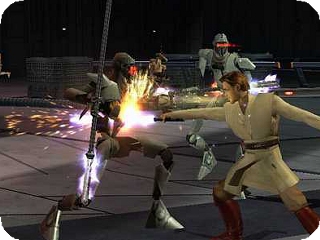
...damn it, Ben. I swear to god, if you say that one more time, I will telepathically call Jar Jar and tell him how much you miss him.

…damn it, Ben. I swear to god, if you say that one more time, I will telepathically call Jar Jar and tell him how much you miss him.

As a nameless run-and-gun, it provides a few hours of mild amusement. However, it doesn’t take long before the signs of a quick cash grab start popping up like a whack-a-womprat game. Characters glitch out occasionally, performing cirque du soleil Jedi contortions, enemies tend to get stuck off screen where you can’t kill them, and occasionally cut scenes will just forget to play, forcing you to restart the game to make any progress. Furthermore, for all their supposed strength with the Force, Anakin and Obi-Wan show as much intuition as a gay vegan publicly coming out of the closet at an NRA convention. The game’s targeting system seems to deliberately point me either at the farthest enemy from me or the one holding cattle prod while a nearby spaceship wants to make me a million pieces with the Force. I may have found it in my heart to forgive all this, but the developers also felt the urge to subject me to battle quips that might have worked better as a mild laxative, but even at the end of the game Obi-Wan feels so smugly witty about turning murdered droids into “another one for the scrap pile” that I miss the 3rd-grade joke book humor of James Bond.
8413187107675176The films tried to capitalize on Boba Fett’s cult following by literally cloning him a few hundred thousand times and setting up the elaborate back story of the clones as the Republic’s army, so in the context of the story it makes sense that they’d fight side-by-side with the Jedi. However, you can’t give me a lifetime full of Star Wars games that declare open season on anything wearing a white mask and then expect me not to spend half of every battle trying to slice off their heads. Sorry, but if they look like stormtroopers, my Jedi intuition will assess them as a threat, and meanwhile the inept droid will sneak up behind me and sodomize me with my lightsaber.

While switching play between Anakin and Obi-Wan may have sounded cool on paper, the developers seemed to overlook the fact that the two characters had a pretty epic throw down at the end of the film, as in, Obi-Wan threw down Anakin’s legs into a fiery pit of molten metal. To rectify this, players have the option of playing through the final duel with either character. By playing as Obi-Wan, you can unlock the regular ending of the film. Otherwise, you can play as Anakin and watch a scenario pulled off the dregs of the worst fan fiction the internet has to offer, while simultaneously unlocking a bonus mission from Episode IV that would make no sense considering the new ending.  Either way, you get an extended duel demonstrating that while lightsaber parries make awesome noises and flashes in the movies, they just drag out the games, dealing no damage to anything except your free time before bed.

007 Everything or Nothing – PS2, Game Cube, XBox

Jaws had some awkward first dates, much like I, myself, did.

Jaws had some awkward first dates, much like I, myself, did.

99? You don't look a day over 86!

99? You don’t look a day over 86!

While growing up, I never really cared much for super heroes. Something about the black-and-white morality of Superman made me think hero worship would send me down the path of joining the boy scouts or becoming an altar boy, and I had this policy of actively avoiding people who wanted to molest me. So barring a slight interest in Batman (fueled by more than a passing interest in my own mental stability), I had to look elsewhere for impressive super-humans. As much as I’d like to say my interest in spies came from picking up Goldeneye 007 for the N64, but honestly, ever since 4th grade I’ve held Get Smart as the pinnacle of television programming. To this day, 99% of the women I’ve fallen for have held more than a passing resemblance to Barbara Feldon. But since this blog focuses on video games….Goldeneye 007, N64, yada yada, cute story about my past, segue into James Bond games.

I love James Bond, from his Batman-like gadgets to his Laffy-Taffy-style wit, his flashy theme songs and cadre of beautiful women. I even bought the July 1973 issue of Playboy on eBay, hoping to see a different side of Dr. Quinn, Medicine Woman and Bond Girl (Come on, Barbara, you still have time to make an appearance!) So the fact that they only make new movies once every two or three (sometimes up to six) years, really gets under my skin. Damn it! I need regular doses of Cold War inspired action thrillers! Fortunately, I managed to find a copy of Nightfire….somewhere; I forget where…and I realized that original electronic Bond stories didn’t all have to end up as disappointing as Agent Under Fire. So let me tell you about Everything or Nothing instead.

Curse you, Spider-man!

Curse you, Spider-man!

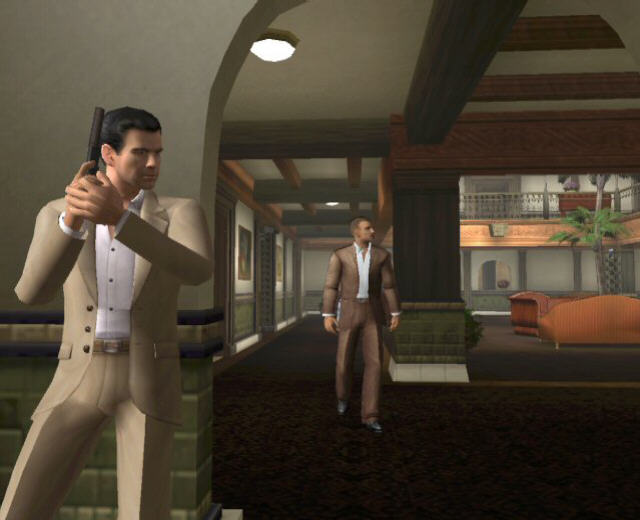
Everything or Nothing marks Pierce Brosnan’s final and from what I can tell only video game appearance as James Bond. The story follows our super-spy tracking down a load of nano-macguffins from the Green Goblin. If Willem Defoe–whose name literally means “of the enemy”–didn’t particularly look like his entire raison d’etre amounted to playing a Bond villain, they named his character after Satan and gave him a chip on his shoulder because Bond killed Christopher Walken–the only human on earth voted “Most Likely to Play a Bond Villain” by his high school graduating class”–in A View to a Kill. Some girls show up. Bond travels the world. Richard Kiel reprises his role as Jaws, lending his voice to the infamously mute character. Things explode. Bond makes puns that would make Gallagher turn in his grave.

This mission employs Bond's talent for plummeting.

This mission employs Bond’s talent for plummeting.

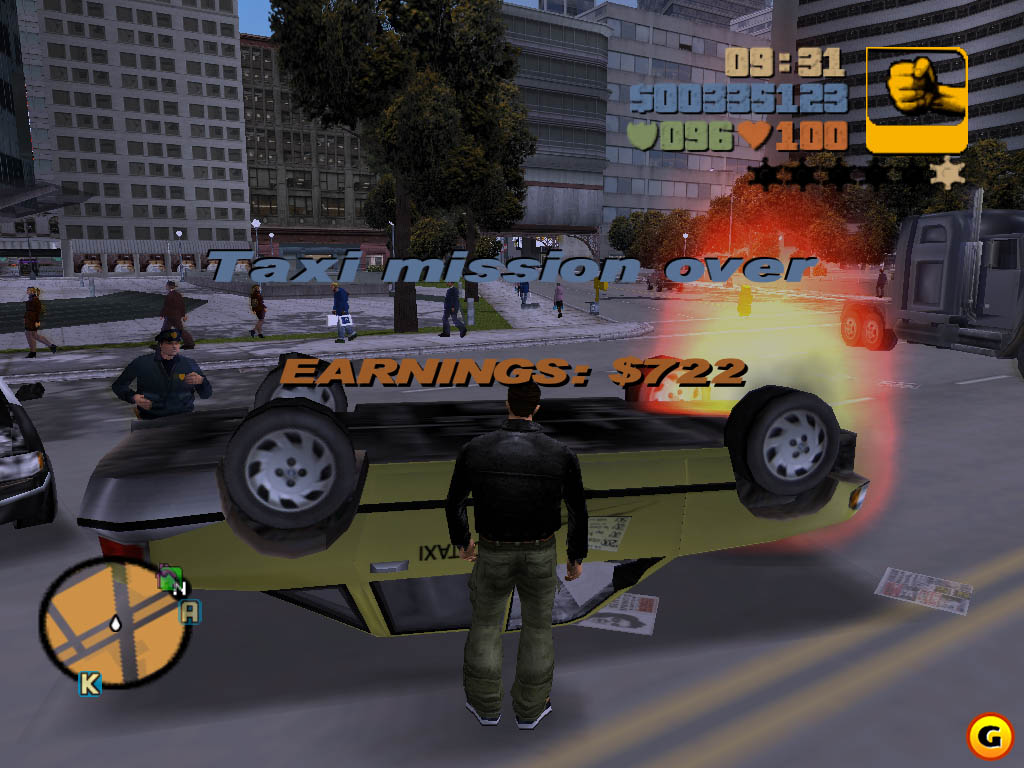
The back of the box tries to sell the game on the merits of having “an unprecedented variety of missions,” which raises some interesting questions. For one, what precedents on mission variety have we already established? Will Everything or Nothing contain action shooter levels, a quick round of Tetris in Moscow, three levels of Bubble Bobble, followed by ten minutes of Goat Simulator? Unfortunately for those of us who always felt James Bond needed a goat sidekick, the purported variety means that in addition to the regular third-person shooter levels, you get to play levels where you drive along a road, drive around a map, drive around a track, drive a tank around a map, and drive along a road in your choice of vehicles.  Of course, since I had just finished playing–sorry, attempting to play–Grand Theft Auto III, I couldn’t help but notice some strong similarities, especially on one map where the game literally asked me to steal a car and use it to break into a factory. Naturally, the GTA driving controls in place, this mission–along with several timed segments–turned into a game of Ted Kennedy bumper cars, with Bond’s Aston Martin flopping around the road as though someone had entered a live tuna in the Indy 500.

Take that, old bean! Yes, very good. Indeed.

Take that, old bean! Yes, very good. Indeed.

The character combat…works? I guess. I did rather appreciate the full body view of the character, rather than floating through the game as a disembodied gun with severely impaired peripheral vision. The camera controls work with all the finesse and grace of Ted Kennedy’s Bumper Cars, and I didn’t find any option for auto tracking or even a Z-targeting method like in Zelda. Since no one seems to have told the aiming feature they scrapped the first-person perspective, it will only lock on to enemies if Bond faces the same direction of the camera and the enemy falls within a zone of sight that doesn’t include his immediate peripheral vision; after all, nothing says “international super spy” like unloading six rounds into a house plant because it looks more threatening than the man holding a glass bottle, eying up your head like a recycling bin. Granted, taking control of Bond gives players the chance to immerse themselves in the world of espionage, but can’t we give the character just a little credit for intuition? I mean, Bond may excel at hand-to-hand combat, but when someone shoves the barrel of an AK-47 in your face, you just might have a few more effective tricks up your sleeve than pistol whipping him with your very much loaded shotgun.

How many games did it take you to figure out how to not stand out in the open, trying to stop bullets with your lungs?

How many games did it take you to figure out how to not stand out in the open, trying to stop bullets with your lungs?

Rather than a traditional menu, Everything or Nothing gives you “Bond Senses,” which I guess attempts to make up for the otherwise oblivious senses he displays in combat. By pressing left on the d-pad (Gamecube version), time will slow down, you can cycle through your weapons, and anything in the environment you can interact with will radiate small red rings that you can target to tell you exactly how to interact with them. I found this a refreshing alternative to the standard flipping-through-google-for-a-walkthrough method, and rarely got stuck. I say rarely because I did spend the better part of a half an hour running through an abandoned hotel looking for a fuse box, only to find out later that I had to target a non-accessible area of the map to find it. Also notice I said “slow time down” rather than “stop time.” Note: bullets travel fast. Best to stay on your guard even in Bond Sense Mode if you don’t have a pressing need to aerate your spleen. I found that one out the hard way.

EA retained the idea of Bond moves from previous games. Any time you do something especially clever, witty, or otherwise on the lines of what James Bond would have done himself, the game awards you bonus points. These can include useful tricks like jumping a fence on your motorcycle, or shooting a ceiling connection to drop a catwalk onto a group of enemies. However, I think EA may have run out of creative mojo (crikey!) to think up new Bond moves, as occasionally they awarded me points for things like “hitting the badguy with your rocket launcher” or “touch the girl.” And while, yes, this might fall under the umbrella of “in-character,” it generally doesn’t take super intelligence to go massage the girl when she asks you to.

Look....I, uh, hope I wasn't out of line with the crack about the big ape.

Look….I, uh, hope I wasn’t out of line with the crack about the big ape.

Generally, I liked the game. The lame accent Willem Defoe adopted made me think he didn’t exactly put his heart into this performance, and while I thought the game challenged me just enough to keep me interested without chucking my controller across the room, the final stage spiked horribly, so that I probably spent a good 10% of my total play time dying over and over again until giving up and dropping the game to easy mode–at which point it still took me three attempts. Everything or Nothing feels a little light in the story department, and even the girls only seem to make appearance out of perfunctory need to follow a formula, but as a game it held together without seeming like the usual movie-licensed cash grab that these games often degrade into. Plus, the game also features Judi Dench and John Cleese (or as I call him, Funny Q), and who doesn’t love to take mission suggestions from Monty Python?

God of War 2 – PS2, PS3, PS Vita

Big things count for extra murder! Plenty of murder to go around, boys!

Big things count for extra murder! Plenty of murder to go around, boys!

As a guy who drives a bright yellow beetle, cooks his own bread, watches Sailor Moon, performs in musical theatre, and enjoys a rousing game of Magic: the Gathering, I sometimes find myself curious as to what manliness feels like. Fortunately, I can indulge that curiosity from a safe, hair-growth-free distance with the God of War series, which features Kratos, a character overdosing on testosterone so badly that he makes steroid addicts back away timidly. Not all that long ago, most video game enthusiasts belonged to a class of people that would shyly wander school playgrounds alone, or sit quietly apart from high school cliques for fear that their interests would bring them mockery and bullying. Having a video game star grouchy old Kratos feels like Derek from American History X burst in on a Dungeons and Dragons game, dropped a box of guns on the table and said, “Okay you pansies, let’s do this right. Combat to the death, and we play for keeps.” The sheer amount of rage that goes into God of War games matches the emotional level of filling out job applications while standing in line at the DMV listening to death metal as a nearby television plays a news report about politicians pulling education funding for the orphans of homeless veterans so they can pay for tax cuts for millionaires.

Does this series seem to have an obsessive preoccupation with size?

Does this series seem to have an obsessive preoccupation with size?

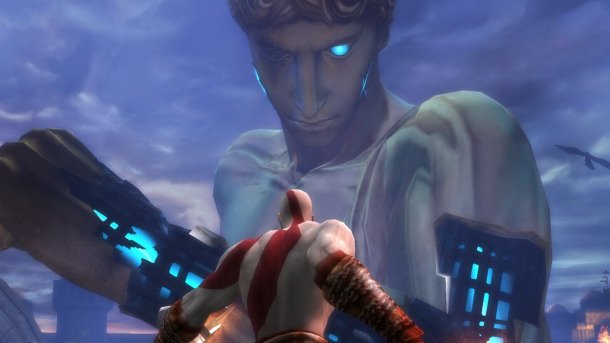
God of War II continues the story of Kratos, after defeating Ares and taking his place as the god of war. His first day on the job, the Colossus of Rhodes comes to life and embarks on a Godzilla-style quest to destroy Greece. Having not murdered anything for the better part of an hour, Kratos gleefully adopts the task of obliterating the Sixth Wonder of the World. Alas, though, it turns out Zeus, who likes Kratos apparently even less than Ares, didn’t approve of Olympus’ most recent hire, and apparently felt the best way to remove Kratos’ godhood involved a convoluted plot that required an action sequence convenient for the opening stage of a video game. Kratos, who includes both the Hydra and Ares on his resume of “things murdered without use of god powers,” finds himself utterly powerless against a hunk of metal, but Zeus offers him an out. By channeling all his power into a sword, Kratos can somehow defeat the statue that proved invulnerable to those exact same powers only moments ago. Then, when Kratos has sufficiently humanified himself and killed the statue, Zeus (Played by the voice of Dale from Chip ‘n Dale’s Rescue Rangers) shows up, grabs the sword, and uses it to poke a hole in Kratos’ gut. While in the previous game, his escape from Hades required an extensive, tedious stage of platforming, this time he gets out through the sheer force of his angriness. Now properly reduced to a level-one character, Kratos then begins the quest to find the fates, which somehow will help him get revenge against Zeus. I don’t know.

Although I can’t understand why developers thought this cute little bundle of murderous rampage would appeal to the average video game connoisseur, I have to admit that it doesn’t entirely turn me off, either.  As a mythology teacher, I do enjoy the concept, and now that I’ve played all three of the main series games, I can say I prefer God of War II to the original or III, mainly because a three-minute cut scene explaining the story of Zeus defeating Cronus marks the longest uninterrupted period of accurate mythology in the series. Naturally, after a beautiful rendition of Zeus’ war with the Titans, they chucked all semblance of literary value into the fiery pits of Tartarus in favor of over-simplified scenarios that give Kratos an excuse to murder mythological figures. In an early stage, Kratos comes upon Prometheus–who shortly thereafter will beg Kratos to murder him–and asks “Prometheus! Who did this to you?” If that didn’t immediately make you shift in your seat and avert your eyes awkwardly, read this. Uh, Kratos…you did. In fact, the play makes you out as some kind of rage-filled dick. At least that qualifies as accurate.

kratos giantBeyond a vague influence from Greek mythology–much in the way that the dinosaur asteroid influenced the game Asteroids–the game really doesn’t offer much beyond an overdose of violence. Initially, making Kratos spin his chains holds a type of graceful enjoyment, but I quickly noticed that it dealt damage to enemies roughly equitable with the damage chopsticks would do to cast iron, and sitting in mandatory battles against hoards of monsters that require you to beat on them like you want to drill a hole through a glacier just makes it feel padded. I do enjoy playing a game, but I prefer stuff to actually happen, rather than fifteen minutes of cyclops murder only to get creamed by two more cyclopses using their combined power of depth perception to send you back to the beginning of the fight.

If you press square by mistake, Kratos pulls out a banjo and starts singing "Ain't Misbehavin'" And then the minotaur kills him.

If you press square by mistake, Kratos pulls out a banjo and starts singing “Ain’t Misbehavin'” And then the minotaur kills him.

And quick time events! Dear, Zeus, you have answered my prayers! I remember playing Resident Evil 4, just wishing I could mash X to run from even more boulders, or press L1 and R1 to dodge even more monster tentacles. Well, God of War uses quick time events for everything. Trouble with a cyclops? They’ll give you buttons to press instead of something more involved and fun! Want to kill that gorgon? Simply wiggle the analog stick in the indicated patterns! Have you always wanted to wear down the life of your controller simply by opening doors? Forget pressing circle; try mashing it fifty times per second! (I miss the good old days of pressing “up.”) Did I miss anything? Kratos looks like a guy with a high-meat, low-fiber diet; should we maybe add a bathroom scene, with Kratos on the toilet, mashing the circle button to empty his bowels?   Hera almighty!   Have people ever liked ignoring the actual action in favor of concentrating on the upcoming buttons to press? Ever? Well, maybe in the bathroom…

FIghting the Kraken in his natural habitat...the sky! Because Greek myth doesn't have flying monsters?

FIghting the Kraken in his natural habitat…the sky! Because Greek myth doesn’t have flying monsters?

For that matter, what about puzzles? God of War seems to hit (hard) some of the biggest cliches available, including the sliding-blocks-into-place puzzle, the dropping-something-heavy-on-a-switch puzzle, and my personal favorite source of aneurysms, the pull a lever and beat the clock. Unfortunately, to overcome the challenges of using such a worn-out and hated method, God of War keeps it fresh and exciting by making it unintuitive and convoluted. How should I know if I have to race against the clock or find something to block the gate? Or which bosses I can actually damage and which ones require puzzle solutions? I don’t know if the game expects me to just *know* that the kraken’s tentacle hides a switch that I need to load down with a corpse when he lifts it slightly, or if it honestly thinks people still buy strategy guides rather than pop up Google and see what the Internet has to say.

The game works, I guess, as a time killer or a space filler. It has flaws, with convoluted puzzles, extended fight scenes, and a weapon upgrade system that has as much effect on combat as using a magnifying glass for shade on a hot day. But I played all three of them now (buying the collection used, apparently, does not give you access to the downloadable handheld games. Cheapskate jerks!). I’ve traveled to Hades and back three times, and carried several heads in my pockets. God of War has at least a novelty value to it. I just suggest playing it in small doses, and not during any stressful life events, such as, lets say, grading student papers while trying to buy a house and simultaneously waiting to hear back about acceptance into a phd program and alternatives. Adding God of War to that mix just focuses rage, down into one tiny bullet point of hate until it all bursts out of your forehead in a gory explosion of blood and brains. Fun and delicious!

Grand Theft Auto III – PS2, XBox, PC

GTA3boxcoverBack in my undergraduate days, I worked at a Sam Goody. Never heard of it? Well, that just goes to show that charging $5 more per CD than anyone else selling music doesn’t constitute a particularly solid business strategy. But in trying to make up for dropping sales in overpriced music, they tried selling video games. Shortly after remodeling the store, adding the demo consoles, and gussying up the place all nice and pretty, I began to notice trending video games, two of which pop into mind as phenomenally stronger than anything else I sold to unsuspecting customers. One of these, Madden games, tricked people into buying the same shitty game year after year, only to disregard it as soon as the next installment came out. But even more popular than games doomed to life as a second-rate coaster, Grand Theft Auto III simply would not stay on our shelves.

Of course I took note. “Why does everyone want this game?” I asked. “Should I play it to find out?” Well, I didn’t. But I did hear about it. Open-world. Free-ranging. And prostitutes. Lots of prostitutes. Also, controversy. Controversy always makes for a good game, right? Well, I’d like to pose a question to any readers who may have played the game in the early 2000s–did you actually like Grand Theft Auto? Can you still pop in the disk and relive the good times? Or, like Goldeneye, do you look at it and puzzle over what the hell you ever saw in it?

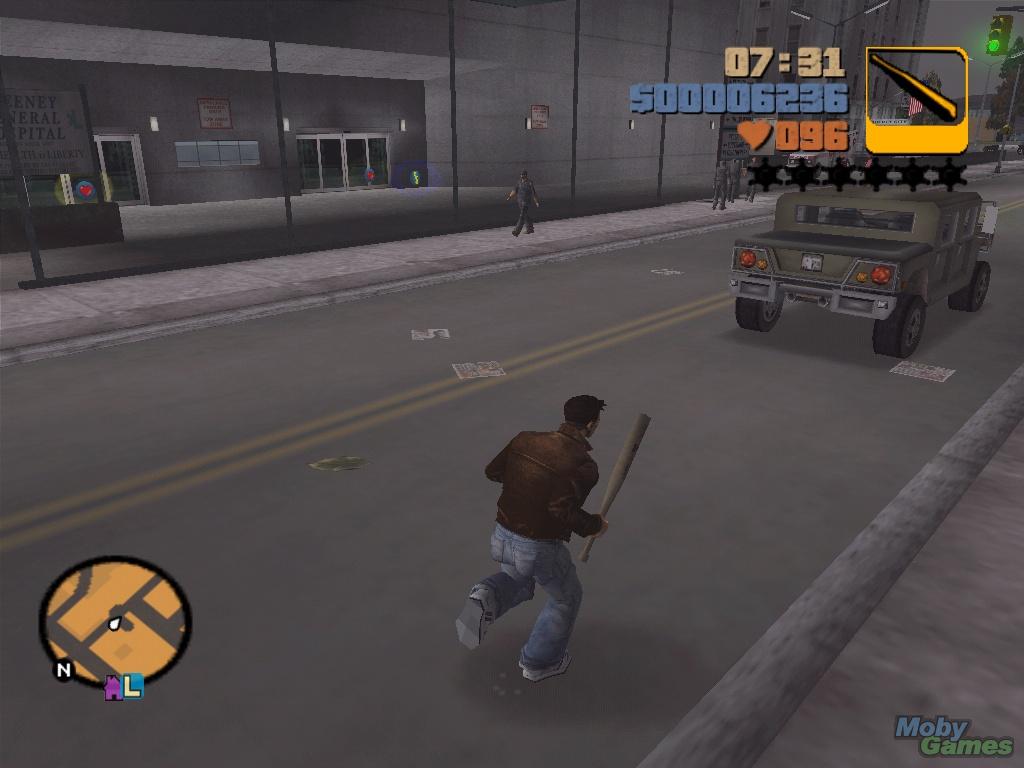
Naturally, in a game revolving around car theft, you can never find one when you need it. I spent about 25% of my time running after cars like a dog.

Naturally, in a game revolving around car theft, you can never find one when you need it. I spent about 25% of my time running after cars like a dog.

Reading reviews, wikipedia articles, and the like make GTA III sound like the messiah of sandbox games. Freedom! Non-linear gameplay! Wide-open world! You can do anything you want! To a certain extent, I see how they can make those claims. GTA III gives the player complete freedom to steal any car and drive around any street and hit anyone you want! Some examples of the variety of things you can do here include: Steal a taxi and get paid to drive people to their destinations, steal an ambulance and get paid to drive people to the hospital, steal a police car and get paid to drive around looking for criminals, or steal a fire truck and get paid to drive around looking for fires. I don’t want to describe this game as stupid, but what it lacks in imagination, variety, and any enjoyment whatsoever, it more than makes up for in tedium, repetition, and boredom.

I know this looks bad...but this still turned out better than a lot of dates I went on in high school.

I know this looks bad…but this still turned out better than a lot of dates I went on in high school.

I went in expecting a crime spree game. Something like Scarface pointing Lock, Stock and Two Smoking Barrels at the Godfather while Mr. Pink runs off with the diamonds, some L.A. Confidential, Pulp Fiction type stuff. Instead I get Cars, without the cute CGI or Pixar wit. GTA III basically reinvents the driving/racing genre. Imagine Mario Kart, if every so often Mario pulled Toad out of his car and stomped on his face. The game also uses the exact same driving physics and controls as every driving game ever. The challenge in driving under this system lies somewhere between “playing a 3D platformer while blindfolded” and “trying to steer a hockey puck with a leaf blower during a hurricane.” Despite the amount of time the game puts you in the driver’s seat, it does occasionally let you get out of the car and engage in a rudimentary form of good, old-fashioned gang violence, but the awkward interface makes aiming feel like target shooting during a grand mal seizure. Despite the contract you took out to assassinate…apparently a ramen vendor…the game’s target selection program generally assumes that the innocent bystanders pose a greater threat than the thugs charging at you with automatic rifles.

Cars, in this game, like this one, only slightly improve on the quality of car I can afford to drive in real life.

Cars, in this game, like this one, only slightly improve on the quality of car I can afford to drive in real life.

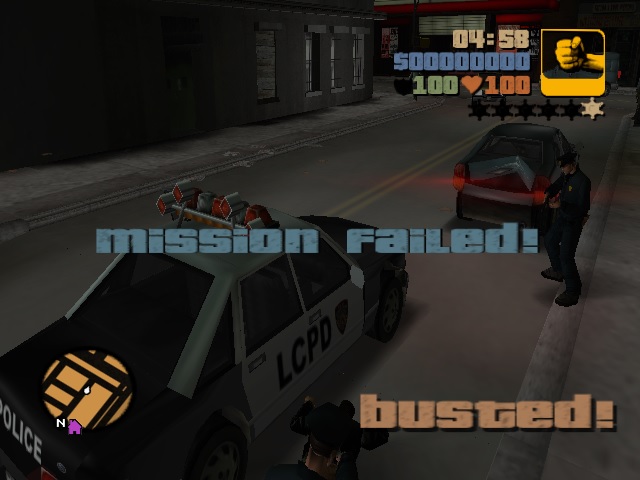
Odd as this may sound, GTA III feels less like a video game and more like a board game. I didn’t see much of a story line going on, other than the main character robbing a bank, his girlfriend shooting him, and then his friends busting him out of prison. From there, you look for work, and you visit certain bosses over and over, taking missions in a pre-determined, very non-non-linear fashion, until that boss has no work for you anymore. You can lose these missions in a number of ways, such as running out of time, getting shot, your car exploding, or getting caught by the police. These don’t really pose a threat so much as a minor inconvenience. Getting killed just makes you start over at the hospital, and despite your recent jailbreak, the police seem to have more of a catch-and-release program going on, and a string of murder, reckless driving and grand theft auto merit no more punishment than having to go slightly out of your way while running errands.

Yep...get used to this.

Yep…get used to this.

Also, veteran players may have noticed odd claims by now, so in full disclosure, I didn’t actually beat this game. In fact, I didn’t get very far in it at all, for a combination of two very good reasons. First of all, I didn’t find myself enjoying the game very much. Driving sims just don’t do it for me. I can barely stomach the thought of real driving. But I’ve finished boring games before. However, ramping up the difficulty to “harder than Charlie Sheen on a Viagra overdose” may not have endeared me to completion. After three days and roughly ten hours of gameplay, I had completed maybe seven or eight missions total. Maybe I just needed more practice, or more experience with driving games. Or maybe the damn game shouldn’t make you repeat absolutely everything every time something bad happens. Oh no! Ran out of time! Looks like I have to visit the boss again, watch the cut scene, go steal a car, look for the gun store, find a gun, look for the ramen stand, aim for the bad guys, shoot a few pedestrians by mistake, then get shot to death while the ramen noodle man hops in his car for a car chase that won’t happen. The sheer amount of time required for each individual mission, combined with the fact that I didn’t really enjoy the missions to begin with and the rage-inducing effect of the game’s shitty soundtrack of radio stations, indicated certain health benefits in walking away from this one.

And not even the good kind of wasted. Although both often require medical attention...

And not even the good kind of wasted. Although both often require medical attention…

Grand Theft Auto III which wins my coveted “Sarah Palin Award for Intelligence in Game Design,” cost me $2.99 at Savers. I think I paid too much. However, I also picked up a $2.99 copy of Grand Theft Auto: San Andreas. So…I at least have to make a perfunctory attempt at that one in order to clear off my shelf full of games I bought and haven’t yet played. Joy.

Lego Star Wars II: The Original Trilogy – PS2, NDS

Lswii_pcfrontBy a show of hands, how many of you played with Legos? I did. I had birthdays where I wouldn’t get anything except Legos. I’d combine base plates with a friend of mine and we’d construct entire cities of little plastic bricks. My fascination with Legos shaped my career path, helping me decide that, for the safety of anyone who ever drove a car or went into a building, I should not go into architecture or engineering. But for all the failed mechanisms I’d contrive and all the magnificent buildings that collapsed under the weight of my genius–or the more likely culprit, physics–I still loved to build. And do you know what else I loved? Star Wars.

Who doesn’t, though, right? Well, besides my ex-girlfriend, but she has a soul cold enough to freeze over and dampen the spirits of even the great Boba Fett himself, so she doesn’t count. The popularity of Legos makes them the natural choice to compliment the epic space-fantasy masterpiece, so what could possibly go wrong with Lego Star Wars II: The Original Trilogy. It already has a leg up over the first Lego Star Wars insomuch as it does not demand you play through the prequel trilogy.

Note how Lego Men make perfect--and geographically customizable--Risk pieces. They already have horses and cannons. Also, notice how maps installed on the floors at UMD make perfect Risk boards.

Note how Lego Men make perfect–and geographically customizable–Risk pieces. They already have horses and cannons. Also, notice how maps installed on the floors at UMD make perfect Risk boards.

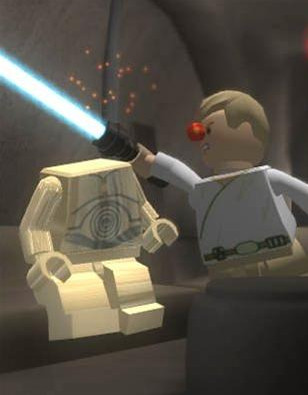
Like other licensed Lego games, you play through the plot of the film(s) as Lego versions of your favorite characters. By itself, that pays for the cost of the game. I spent $2 at my local Savers to buy this, and another $2 to get the prequel trilogy (after someone else had taken the prerequisite number of chunks out of the disc before passing on ownership). The combined $4 I spent could have covered a physical–and generic–Lego man at the same store. Granted, you can’t, for example, take the characters out of the game and use them as pieces in a giant game of Risk, but you can still play with them with even a little more control than the real things.

The novel idea that, in retrospect, seems obvious: Darth Vader as a playable character in the fight against Palpatine. Duh.

The novel idea that, in retrospect, seems obvious: Darth Vader as a playable character in the fight against Palpatine. Duh.

The game tasks Luke Skywalker and his friends not so much with getting through levels based on the films, but with collecting shit along their way, namely money. Each level hides a cache of red Lego bricks, “minikits,” and Lego studs of various colors which like poker, kids, denote different values. These studs serve as the game’s money, allowing you to buy characters, vehicles, hints, and other trinkets at the central hub, the Mos Eisley Cantina. Only by collecting enough studs in each level can you achieve the “True Jedi” status–and thus unlock more useless collectibles. This gives Lego Star Wars a feeling not unlike poker, asking you to build up more and more stuff merely for the purpose of using that stuff to collect even more stuff.

The stages don’t exactly innovate game design, nor do they really show a departure from typical Star Wars games. Characters progress in a mostly linear direction. In Story Mode, you take control of a small group of characters who might reasonably find themselves within the vicinity at whatever point in time, and in Free Play Mode, you get to choose two of your own, while the game assigns additional characters to make sure you have whatever individual skills you need to actually finish the level. To reach the goal, characters use the Force, grappling beams on blasters, and that little stick that R2-D2 uses as a Deus Literally Ex-Machina (or in the case of C-3PO on Endor, Literally Deus Ex-Machina). Furthermore, you have to build stuff. Lots of stuff. Sometimes you need to destroy something for parts, but it usually comes down to building. Characters can build by walking up to a twitching pile of parts and holding in the circle button. And waiting. Sometimes you have to fight off a hoard of enemies first, but then feel free to go up to that pile and hold in circle. Yes, ladies and gentlemen, play Lego Star Wars if you’ve always wanted to play with Legos, but without any of the actual fun of building things for yourself. Funny, though, how they managed to include the tedium of searching for parts.

Slave Leia! Nice! Although I didn't expect her to be quite so flat-chested...

Slave Leia! Nice! Although I didn’t expect her to be quite so flat-chested…

Anyone who has ever woken up in the middle of the night to pee and had to cross a minefield of Legos can attest to the damage they can inflict, but combat in the game feels a little clunky and awkward. Lightsaber swings pay off at low odds, most often striking a jaunty pose in an irrelevant direction, sometimes managing to deflect blaster bolts, and very rarely slicing through enemies. The design of the blasters seems inspired by Obi-Wan’s description of them as clumsy and random, as about 50% of the time I hit my own characters instead of stormtroopers. I found it far more effective to use Chewie, walk right up to the enemies, and use the melee attack to rip their arms out of their sockets. Like other Star Wars games, you also take control of vehicles on a regular basis. These vehicles control about as well as a drunken condor trying to land on a bicycle seat in a hurricane. Even by the end of the game I found myself flipping, spinning, doing somersaults, U-turns and barrel rolls at the drop of a Lego hat.

A quirk of the game that you might find interesting–no wait, the other thing…obnoxious–the credits, which you have to sit through three times–one at the end of each film adaptation. Not the glorious 45-second credits from NES games, or even the standard five- to eight-minute credits of standard PS2 games. No, Lego Star Wars goes full-on Arkham Asylum, making you sit through an extended credit sequence while they name off not just programmers and artistic designers, but their office staff, from the Assistant to the Vice President of Global Sales and Marketing to the Assistant to the Janitor of Mopping up Puke at the Lego Employee’s Day Care. At the risk of sounding offensive and preachy, credits should offer recognition, a chance for the skilled workers and artists to sign their work. Instead, these credits read like an Occupy Wall Street hit list.

This guy put in nearly 35 hours into collecting all that stuff. . . I hope he enjoyed the search.

This guy put in nearly 35 hours into collecting all that stuff. . . I hope he enjoyed the search.

But hey, you can go make a sandwich or play with your cat or something, right? The valuable part to you as a player comes after the credits, in the post game. Now you can finally play through the game on free play mode, using all those characters you unlocked along the way! I want Darth Vader and Obi-Wan Kenobi! Yeah! All right! Now what do I do in free play mode? Uh, go through the levels and collect more stuff…to unlock more characters…to use in free play mode…to collect more stuff… In all fairness, I never did collect all the mini-kits in any given level. Maybe something really cool happens when you do. I don’t know–the game didn’t really motivate me to seek them out. Even in the early stages, they tucked away these things so well that I rarely got more than two per level. If they made these things easier to get in even just the first level, I might know why I want to collect them everywhere else.

Come on...be honest...you wanted this to happen. We hate this guy just as much as Jar-Jar.

Come on…be honest…you wanted this to happen. We hate this guy just as much as Jar-Jar.

Honestly, though, I did have fun while it lasted, even in light of super-easy game play (you can’t actually die, you just spill your coin purse a little every time you lose a few hearts) and some obnoxiously obscure puzzles to solve. The games display a characteristic sense of humor, adding a delightful irreverence to a story that everyone–except for my ysalamir of an ex–already knows. Without additional dicking around in free play, the game runs under ten hours, which doesn’t exactly commit you to a Bethesda-level commitment. Speaking of which…I just got Oblivion for Christmas. Expect a week off here and there because in addition to working on RPG Maker for the last few months, I just took on a Bethesda-level commitment.

Soul Reaver 2 – PS2, PC

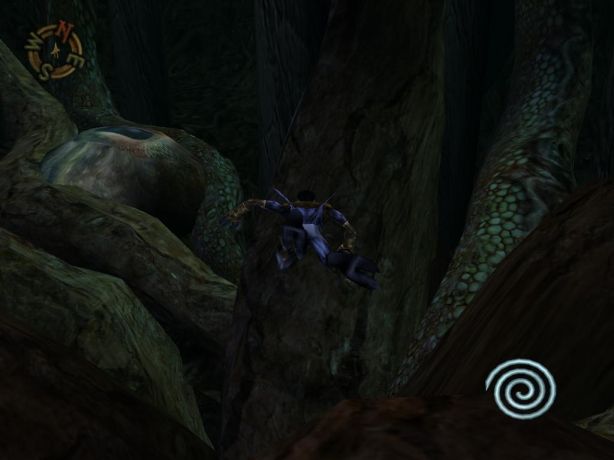
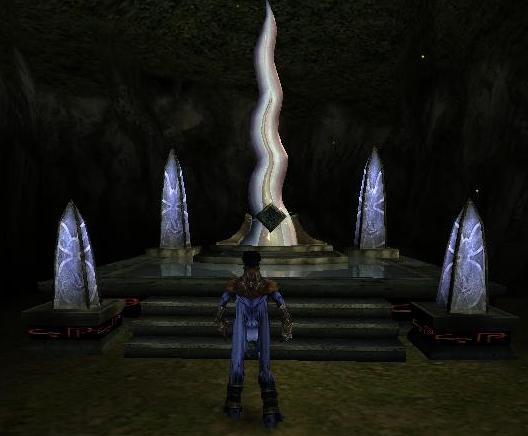
legacyofkainsoulreaver2-01
This link takes you to page one of Finnegan’s Wake, a 1939 work by James Joyce that demonstrates both the limits of beginning a story in media res, and a depressing vision of what literature looks like after it suffers a massive stroke. I hope by drawing a comparison between a book that uses the term “bababadalgharaghtakamminarronnkonnbronntonnerronntuonnthunntrovarrhounawnskawntoohoohoordenenthurnuk!” and Soul Reaver 2: Legacy of Kain, I will make it very clear how I felt about this game. “But Jake,” you ask, “Why play through Soul Reaver 2 when only a few weeks ago, you clearly did not like or finish the original?” I have a very complex response to that, involving the tendency of video games to improve upon their originals, but really, Anne gave me the game as a gift, so I had to play it. Kind of like inscribing “Homer” on the disc. She wanted to see it, but didn’t actually want to play it herself. Now I understand why.

So as I mentioned, you select “start new game” from the option menu and the game immediately expects you to understand the names of the characters, their back stories and motivations, game mechanics, the history of Nosgoth, macroeconomics, the depths of human psychology, the meaning of life and the true nature of the universe. Also I suspect a few lines of dialogue from the end of the first game would have helped out a little. I suppose, however, the game doesn’t quite deserve the comparison to James Joyce I previously made–the characters use English words with proper sentence structure and grammar, but the content of the text sticks together with all the cohesiveness of a thin film of pond scum. Characters–usually Raziel–tell the story through extensive internal monologues in an accent as authentically British as french fries. The writing carries a very refined sense of self-importance, sounding very lofty, as though an E. coli patient swallowed the King James Bible.

These things. They matter. Apparently. Also, watch Raziel float like a plastic action figure! No Deku leaf required!

These things. They matter. Apparently. Also, watch Raziel float like a plastic action figure! No Deku leaf required!

Customarily, I give you a synopsis of the story, but honestly, I have no idea. Soul Reaver 2 breathes life into the term “convoluted.” It opens with a verbal spat between Raziel and Kain. Then comes Moebius, who I assume we met in the last game, and whose name in no way indicates the cyclical nature of the plot twist or time travel. Themes of the sword–the Soul Reaver–seemed to spring up time and time again. I also picked up that Raziel somehow longs for his pre-vampire human form because of his former goodness and nobility, but–spoilers–he becomes disillusioned with himself after…witnessing his human self kill a vampire? Even evil Raziel mentions early in the game that vampirism “is a plague and had to be wiped out,” but somehow felt morally opposed to the persecution of vampires. Also they talk about some pillars. Apparently somehow these pillars broke and it bummed everyone out. No one ever bothered explaining why. Kain, the ultimate evil upon whom Raziel swore vengeance, skulks around like Smeagol, having pleasant chats with Raziel instead of fighting to the death. Also the Elder God, apparently Cthulu’s estranged cousin or something, appears every so often to have no bearing on the plot whatsoever.

Gameplay involves Raziel running through the Nosgoth, a magical land where every location connects to exactly two other locations adjacent to it. Raziel runs from one end of this course to the other, backtracks, travels through time, then runs through Nosgoth again. Along the way he walks past enemies who would otherwise take too long to kill, recites bland, lengthy monologues, and occasionally pushes some blocks or flips some switches, all the while spending hours and hours lost. In pitch black environments. While people may enjoy video games with “dark atmosphere,” developer Crystal Dynamics may have taken that term a bit too literally. To quote writer Amy Henning’s wikipedia entry: “She also feels that focusing too much on graphics can inhibit a game, saying that once game writers focus on creative expression, video games will greatly improve.” I agree wholeheartedly. But could you at least focus enough on graphics to give us, say, a wall or a floor. Maybe a flashlight, at the very least? People don’t understand how to use darkness and light. In real life, darkness scares people. You don’t know what lurks in the shadows. You have to rely on other, lesser developed senses. However, darkness in a video game usually means tapping buttons unresponsively while staring at a black rectangle and wondering whether you should make ramen for dinner or order a pizza.

No did I just find a door, or the floor. Or the ceiling. Or did I visit the night side of Pluto? And get this--the section I described in the post, even darker than this one!

No did I just find a door, or the floor. Or the ceiling. Or did I visit the night side of Pluto? And get this–the section I described in the post, even darker than this one!

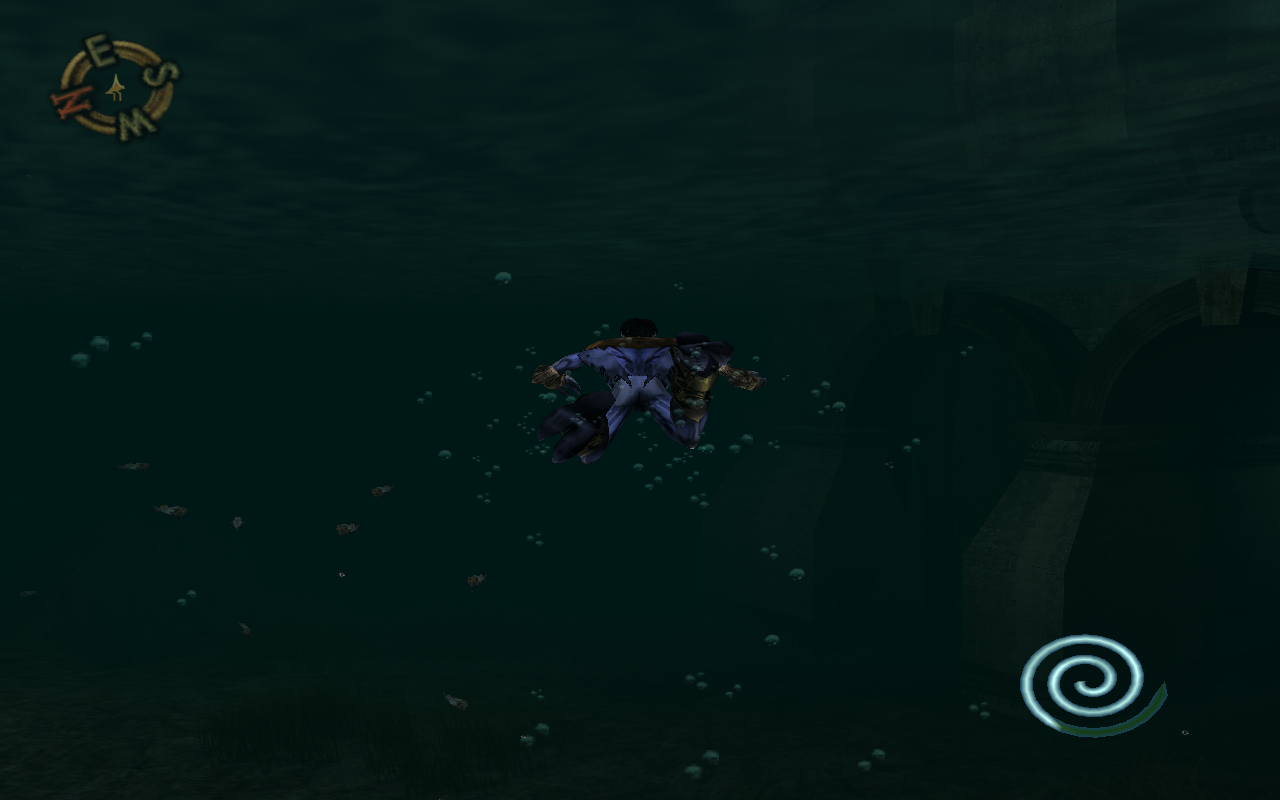
Even better, the game sends you through an underwater labyrinth of caves where the Elder God dwells, utilizing a swimming mechanic that works as well as folding laundry underwater. So in a pitch black environment (with a handful of glowing rocks every so often), you have to navigate through hidden tunnels with a “jump out of the water” button combination that will send you shooting downward (or sideways) if you nudge the control stick even a smidgen of its zeroed axis. And even better yet, the game makes you do this three damn times! I guess they really wanted you to talk to Squidworth. You know, some deep-sea creatures have bioluminescent qualities….

Who lives in a cesspool deep down in the ground? Who turned all the lights off and cannot be found?

Who lives in a cesspool deep down in the ground? Who turned all the lights off and cannot be found?

Crystal Dynamics deserves some credit for fixing a few of the more obnoxious features from the previous game. For instance, you can kill enemies on your own now, instead of hunting around for a boy scouts with some flint to finish them off. Puzzles have also improved, albeit only slightly. If the first game said, “We gave you some generic video game stuff. Do it,” Soul Reaver 2 says, “We finally figured out how other games use these generic video game things. Now do that.” Except do them right, because not only did we not focus on graphics, we also didn’t bother fixing glitches. The game has a number of them, usually the result of failing a puzzle. At one point, I had to float from one side of a cathedral to another without dousing a torch in the pool of blood filling the room. I made it across, but couldn’t figure out what to do with the torch in time. Then the blood rose so high that it covered up everything I needed for the puzzle. I finally figured out that the game had done something wrong–not me–when I swam from one room to the next and fell to the floor, looking back on a room full of blood polite enough to not cross the threshold unless invited.

A save point. The game generously gave you two or three of them. Don't start playing unless you definitely have three hours to kill at a time.

A save point. The game generously gave you two or three of them. Don’t start playing unless you definitely have three hours to kill at a time.

A further improvement, the soul reaver sword doesn’t vanish when you get hit–although that doesn’t exactly make combat smoother. If you kill an enemy who has a weapon, the reaver will automatically equip you with that weapon, which all invariably have far less strength than your reaver, and which Raziel can’t use quite as quickly as his opponents can. So combat often involved me dashing for cover, trying to put down weapons so I could use the useful attack again. The reaver does also inhale enemy souls before you can use them to refill your life, but considering the massive amounts of health I lost while whittling my enemies away with a weapon only slightly more powerful than a bronze toothpick, I never saw any reason to not use the reaver. Unlike in Onimusha, where souls come straight to you when you call, like a faithful and well-trained Labrador, when Raziel calls souls, they act like cats, fat and sluggish, interested in the treat you have, but kind of lazy after the big meal they just ate.

Unfortunately, small tweaks that bring the game up from “beginner’s effort” to “uninspired” don’t really make the game worth playing. I found it tedious and frustrating–like when I encountered enemies shorter than Raziel’s waist. He swings his sword in waist-high horizontal strokes. Only. So I’d always have to lure these monsters to a hill or incline because my character, named for the Hebrew Angel of All Knowledge, couldn’t figure out the first trick that Link learns in every game. Then by the end, approaching the nearest thing the game has to a boss fight, they hand me an upgraded soul reaver that makes Raziel invincible. Totally invulnerable to anything. For the rest of the game. Yeah, I suppose the plot twist after the final boss did entertain me for about ten seconds, but seriously…why even have a battle if you can’t die.

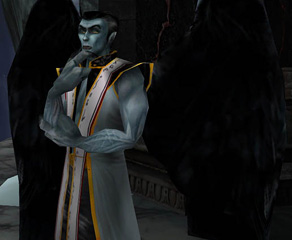
I spent a lot of time looking for this guy. Raziel felt very close to him during the three minutes of screentime he has. This is him wonder why.

I spent a lot of time looking for this guy. Raziel felt very close to him during the three minutes of screentime he has. This is him wonder why.

With writing full of cliches like “this opened my eyes!,” stupid puns like “feel the pull of history” as some mystical force drags me across the room, and human enemies lobbing taunts learned in a night-school course on one-liners for minor characters in fantasy games, I easily grew bored. The relentless monologues put me to sleep and the hoity-toity language just sounded like a sophomoric attempt to sound cultured. At one point Raziel shouts out the phrase, “Spare me your elaborate metaphors!” Please do, Soul Reaver 2. Please do.

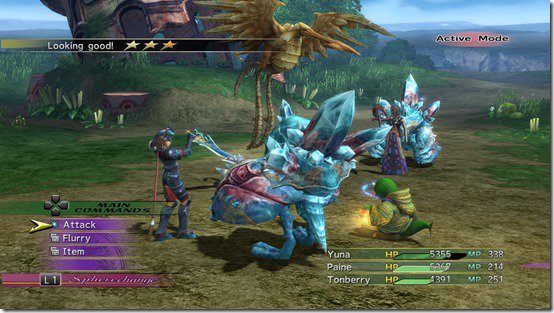
Final Fantasy X-2 – PS2, PS Vita

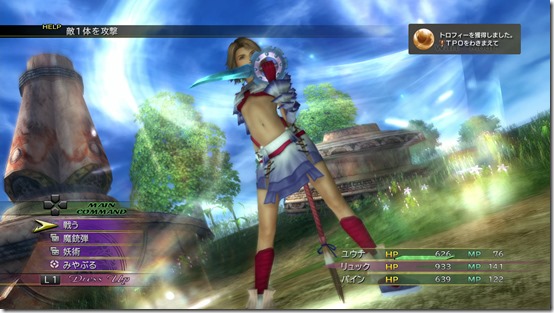
yuna gun

Yesterday I discovered RPG Maker, and now I have to use all my focus and concentration to not trash all my reading and lesson planning in order to fulfill a long-time dream of mine: make an RPG that accurately follows the events in the Iliad and the Odyssey. Stop looking at me like that. As a reader of a retro video game blog, you tell me: would you rather read the books or play through it in game format? Yeah. I thought so. Anyway, I bring this up because both the Iliad and the Odyssey not only find their way into literature classes, but also in pop culture, what with movies and TV miniseries, references in songs and stories and even in video games. An early example of a sequel, the Odyssey proves that continued storytelling doesn’t have to suck Donkey Kong Jr, so long as you do it right. Hollywood sequels have a tendency just to shove the original stories into an industrial blender, pour the contents into a plastic bag, mark it with a two (or if the original had a number in the title, increase that number by one like they invented clever) and demand your money: Austin Powers: Goldmember, Batman Forever, and any horror movie with a number on it will fall into this category.

A picture of Lulu...nine months pregnant. Seriously, did you guys even try?

A picture of Lulu…nine months pregnant. Seriously, did you guys even try?

However, Final Fantasy X-2, despite having a sequential numbering problem worse than the Metroid franchise, took the story in a worthwhile direction. They didn’t try to reveal a bigger evil than Sin, or someone who had secretly controlled Yu Yevon the whole time, or make a brand new threat somehow more threatening than a 1000-year-old sea monster. They didn’t retcon character deaths, bringing back Auron or Blitzy McThunderpants. They didn’t even need to send Yuna on some new kind of pseudo-pilgrimage. Instead, they did what the original–er, tenth installment–did. They focused on character. Final Fantasy X told the story of an obnoxious, extroverted, meat-headed jock, who Square somehow thought would appeal to the crowd playing console games in 2001. Highly literary nevertheless, the dipshit protagonist, referred to as Tidus in all material relating to the games and not at all throughout two entire games, served as a catalyst for changes in the story’s characters as well as the traditions of Spira, especially showing us themes of sacrifice. Final Fantasy X-2 starts with the most interesting thing about him–his girlfriend–and asks some heavy-hitting questions about peace, recovery, and trying to fit back into a generally happy world after dramatically rescuing it from death while contracting probably a pretty severe case of PTSD in the process. But while it doesn’t take a genius to pick up on the metaphor in the original–“Let’s go on a quest to defeat Sin and confront our issues with our fathers!”–you might need a master’s degree in literature to figure out the sequel.

The story opens with a flashy pop-dance number that literally has no bearing on the game and serves no purpose other than to start the show with a bang and establish the possibility that maybe Yuna can sing like a pop diva. Two years after Yuna sent Sin to the Farplane in a burst of pyreflies that looked coincidentally like a celebratory fireworks display, Spira has discovered an interest in history. No longer under the oppressive rule of old white men whose hearts have long stopped beating (no, not the GOP), citizens find the freedom to hunt spheres. *Looks around at sphere-themed world: “Another job well done!”* No, specifically they want old spheres with recorded scenes, with a quality much like a crappy VHS tape left on a car dashboard for a year. These spheres have the storage capacity somewhere between a vine film and a youtube video. But, apparently people will pay big bucks for the historical data on them, even though we follow a team of sphere hunters who never once sells a sphere for profit.

Line up, guys...each girl has her own unique set. Of costumes. A unique set of breasts. Costumes!

Line up, guys…each girl has her own unique set. Of costumes. A unique set of breasts. Costumes!

Enter Yuna and the Gullwings. Spira no longer needs summoners, as they don’t have to worry about Sin and apparently choose not to worry about the need to send their deceased to the farplane lest they turn into monsters, and Yuna has teamed up with Rikku to hunt spheres with the Gullwings. Led by Rikku’s brother, Brother, the team tools around Spira in an airship tricked out to resemble something of a cross between a low-rider, a muscle car, and a Freudian compensation for a small penis. Yuna and Rikku have tuned up their appearance as well. Rikku has stripped down to a bikini top and hot pants, and now sports a Jack Sparrow hairstyle (because nothing makes a 17-year-old girl more attractive than looking vaguely like Johnny Depp). Yuna’s costume, while it doesn’t scream “conservative apparel” any more than Rikku’s, hints at her character’s hang ups over losing Tidus Androgynous: she wears a hoodie, her warrior costume uses his sword, and the piece of bling holding the two halves of her top together look an awful lot like…uh…Jecht’s chest hair pattern. …Yuna, I love you, but you just ruined it. If you’ll excuse me, I have to go shave my eyes. The two of them picked up a new friend, Paine, a taciturn, gothic warrior with the personality of a girl Auron may have dated in high school. She has a mysterious history that would have made an interesting story, but with all the focus on Yuna and characterization, Square sort of forgot to develop a plot, so Paine and the new leaders of Spira fit into the story about as well as Sin would fit into Rikku’s hot pants.

Apparently people love the HD re-release on the PS-Vita. Go figure. Also, send me cash so I can buy one.

Apparently people love the HD re-release on the PS-Vita. Go figure. Also, send me cash so I can buy one.

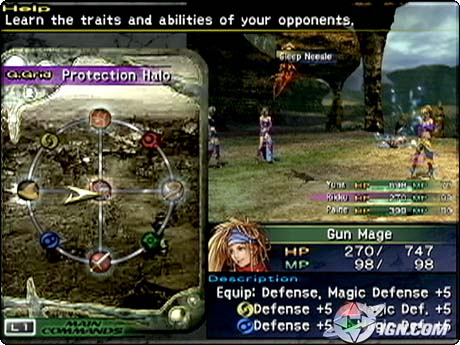
The battle system relies on dresspheres, special items that allow Yuna, Rikku and Paine to adopt job classes from classic Final Fantasy games. Jobs learn abilities, much in the same way as in Final Fantasy V or Tactics. For the most part, this works well. Abilities make characters stronger more than leveling up, which gives the player a more active control over the game. They even encourage job changing in battle, including some…tantalizing, let’s say…animations of the girls changing costumes. Battles adopt a faster pace than previous games, which almost makes up for a random enemy encounter rate higher than Willie Nelson. Unfortunately, as the game progresses, the job system fizzles out. You don’t find too many dresspheres, and the classes the game offers seem left over from the jobs no one used in other games–bard, blue mage, whatever “Lady Luck” does. I used white and black mages frequently. The physical classes–gunner, warrior, samurai, berserker, dark knight–all had slightly different stats for when, as usual for an RPG, I spammed the basic attack during regular battles.

Ripped off from IGN, but hey...I can't take screenshots on my PS2, and don't you feel better for having seen this?

Ripped off from IGN, but hey…I can’t take screenshots on my PS2, and don’t you feel better for having seen this?

Game play follows a non-linear pattern, in theory. You’ll still have to progress from chapter 1 to 5 in the usual order, but you can tackle any events in those chapters in whatever order you feel like. Really, I’d describe it as more of a rectangle than a line. Many of the missions–surprise!–find excuses to send Yuna through areas with random enemy encounters–because why wouldn’t your rival sphere hunter have wild, electric tigers roaming free in her booby-trapped home? I personally keep a few bears in my living room in case any upstart fantasy protagonists stumble through here (they have a weakness to fire…as does my living room in general). Some of the missions involve mini-games, like “Gunner’s Gauntlet,” which lets Yuna pop caps in fantasy monster asses (fucking tonberries!) to her little heart’s content. The game takes place during the blitzball off-season (praise Yevon!), so they’ve replaced it with a game called sphere break; what can give you more hours of fun than blitzball? A math game with an extremely long tutorial! Oh, how I wish I could say that with sarcasm!

I feel better for having seen this.

I feel better for having seen this.

The main events of the story when Yuna discovers one of her dresspheres has a 1000-year-old consciousness attached to it–yup, apparently dresspheres can do that, but only this one and only when Yuna uses it–belonging to a girl in love with a guy who looks like Loudmouth J. Ballkicker. And somehow that guy–Shuyin–has come to life on the farplane. And somehow the new leaders of Spira fit into that. I don’t know. The game has a lot of goofy moments, Charlie’s Angels poses, and a tall, slant-eyed Alan Rickman impersonator, but I like to tell myself that all this absurdity belies Yuna’s insecurities about her role in the new–yet still endangered–world she helped create. And then I google Rikku cosplayers and forget my school work, lesson planning, and RPG Maker for a good solid afternoon.

Really? People want to marginalize women who play video games? ...assholes! (ripped off from deviantart)

Really? People want to marginalize women who play video games? …assholes! (ripped off from deviantart)

Mega Man 3 – NES / PS2, XBox and Game Cube (as Mega Man Anniversary Collection)

The series employs many rooms shaped like this because you damn well better start from the far left side of the screen!

The series employs many rooms shaped like this because you damn well better start from the far left side of the screen!

So I’ve gone roughly twenty months on this project, but I’ve only written about one of my favorite franchises–Mega Man–once. But do you honestly need any more than that? Capcom released six main titles, each with a Game Boy spin-off, then moved on to the Mega Man X series, changing at most a handful of tools and the line-up of characters. If any series epitomized the “If it ain’t broke” philosophy more than any other…well, Madden, FIFA and all those sports games pretty much nailed it. But Capcom did it first. And as an added bonus, Mega Man has the advantage over Madden in that you can’t easily turn the game off and go fight a legion of evil robots, taking their weapons as trophies like an Assimovian serial killer. But as the first rule of robotics doesn’t preclude the murder of other robots, our favorite blue Dexterbot has free reign–even permission and justification–to slaughter all the bad people-bots in order to save humanity. And he does, but much like his human counterpart, Mega Man faces the challenge of killing over and over again without going stale. To that end, we get Dr. Albert Wily, mad scientist extraordinaire, modeled after Albert Einstein and inspiration for Albert Wesker. As a human, Mega Man can’t harm him, which gives him license to keep throwing robotic Batman-villain rejects our way until contentment dawns on our 8-bit faces or Capcom gets bored and suddenly stops producing the games in favor of Resident Evil.

Yep. You totally beat the final boss by dropping snakes into the cockpit with Dr. Wily.

Yep. You totally beat the final boss by dropping snakes into the cockpit with Dr. Wily.

The story behind Mega Man 3 tries to preemptively answer the question of why Dr. Light keeps pumping out deadly robots if Dr. Wily will only steal them and reprogram them for evil. Well, fortunately Dr. Wily has “found his sanity,” to quote the instruction book, and has teamed up with Dr. Light to work for world peace the only way they know how: by constructing the largest, deadliest, most powerful robot the world has ever seen. That’ll keep everyone safe. However, a new batch of robots has appeared on mining worlds, holding the 8 macguffins required to get the new peace keeper up and running.  Light believes some anonymous “lunatic guy” has ordered these robots to steal the energy crystals required to activate the peace keeping robot, Gamma. Jeez, Dr. Wily, didn’t you just find your sanity? Maybe you could lend to this situation your expert advice which we obviously know contains no trace of mental instability whatsoever.

As if the kooky concept of themed villains didn't scream "Batman" enough, Dr. Wily built a giant penguin.

As if the kooky concept of themed villains didn’t scream “Batman” enough, Dr. Wily built a giant penguin.

Fans have long considered Mega Man 2 the pinnacle of the series, and I really have to agree. The game introduced a number of features that fans had never seen before, but apparently would never reach the same quality again. Except Mega Man 3 improved upon everything. How does that work? Good question! Let’s start with the original Mega Man. For those of you who haven’t had the luxury of living in Asia, I should explain that Rock-Scissors-Paper games constitute an iron clad and legally binding contract between anyone under the age of 20. Drawing on this, the first Mega Man introduced this principle in the form of a guy who chucks scissors at you from his forehead, who goes down pretty easily if you’ve already beaten the guy who gives you the power to hurl rocks back at him. But since “Paper Man” sounded lame even on his own medium of attack, and a three-level game didn’t quite justify the $50 price tag, they had to beef it up a bit. So you might imagine Capcom designed themes for their robots, carefully crafted around well-balanced and clever real-world principles…just kidding! They went for the cliched trifecta of video game alchemy; lighting, fire and ice.

So in Mega Man 2, they went all-out with the alchemy, what with water dousing fire, fire burning wood (actually the combination of Earth and Water, but hey, who actually follows alchemy these days?), wood…I don’t know…filtering air? And then the other four robots. Except that metal guy looks like he’d do a number on wood man. And bubble lead somehow damages the time-stopping robot. So that game turned out a mess in the rock-scissors-paper department. Mega Man 3 tried to restore the feeling of one weakness per enemy. Except to keep it interesting, they made two separate circuits of weaknesses, ensuring you’d have to fight at least two bosses with just your mega buster.

Capcom won an award for the design of Snake Man's stage. Then blew it by making the boss look like a green sperm with legs.

Capcom won an award for the design of Snake Man’s stage. Then blew it by making the boss look like a green sperm with legs.

Furthermore, this game marks Capcom’s foray away from the usual fire- and ice-themed levels. Instead, we get the dark, starry world of Gemini Man or the ninja-bot, Shadow Man.  One might question why anyone built robots around these ideas. The original six robot masters all had some constructive purpose to society. I can even think of some useful, productive ways to employ Mega Man 2 robot masters. But Gemini and Shadow Man don’t seem very helpful, and then…well…Top Man. Yes, this game introduces the Slippy Toad of Dr. Wily’s minions, Top Man. Who spins. And throws tops. After defeating him, you get the top spin, a weapon so difficult to use that I often deal more damage to myself than the enemy I hope to target. Seriously…I hate this guy so much I just want to punch him in the face! Wait, what? You defeat him by punching him in the face? Excellent! Who do I get that weapon from? …Hard Man? Did anyone at Capcom think these names through all the way? Seeing as how he appears in the same game as Snake Man, I’d say someone on the development team had just a little too much inspiration from bad porn.

Doc Robot gets wood. Really, did no one think this through?

Doc Robot gets wood. Really, did no one think this through?

The game also rectifies the too-awesome-to-use trope among games where you collect items. None of the weapons has a limited number of uses–you can always replenish them by camping out in front of a giant penguin or something. However, these weapons usually take too much effort, and simply blasting through levels with your arm cannon provides the quickest and easiest way to the end. In Mega Man 3, rather than going straight to Dr. Wily’s castle after fighting the robot masters, an enemy called Doc Robot appears. With as much bearing on the plot as Arwen in the Lord of the Rings films, Doc Robot merely gives you a chance to use your weapons more. He inhabits four previously conquered stages, although he alters them drastically. Facing you twice in each stage, he adopts the attack patterns of all the Mega Man 2 bosses. Because Mega Man hasn’t, apparently, proved that he can mop the floor with all of them. Meh.

Proto Man: Dick to friend and foe alike.

Proto Man: Dick to friend and foe alike.

Having a little more relevance to the story, Mega Man also faces off against the supposedly mysterious Proto Man. Of course, if you’ve ever heard the term “Proto” before, the figuring out his identity has all the challenge of pouring a glass of water. He appears in several stages, usually to fight a few rounds with Mega Man. Ostensibly, he does this as a test, but while certain things–such as practicing for the SAT–might help you out just before going in for the real thing, you may not want a practice bout against Mohammad Ali ten minutes before the fight. Unless, of course, you can move faster without all that cumbersome blood. And really, doesn’t having perfect vision only dull your other senses? Proto Man couldn’t come off as more of a dick if he had actually sided with Dr. Wily.

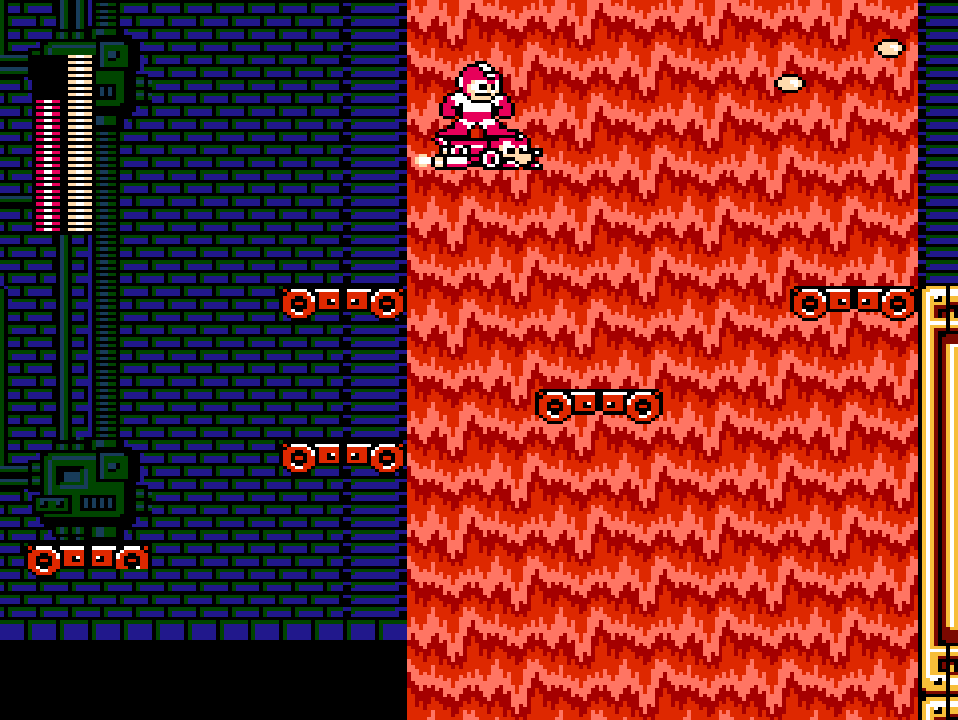
Man's best friend when lava pours into bottomless pits.

Man’s best friend when lava pours into bottomless pits.

Also noteworthy, Mega Man 3 introduces a new series staple, Rush. Taking the place of the items from the previous game, Dr. Light built Mega Man a dog that can morph into vehicles to increase your mobility. Rush makes a good companion; he does whatever you ask him to, never gets in the way, and he doesn’t poop so you never have to worry about where you step. Each of his three functions–two of which you obtain after beating certain bosses and the other you have from the get-go–increases your mobility, allowing you to spring to new heights, soar over dangerous ground, or swim through that one patch of water in Gemini Man’s level. So maybe the implementation could have used some more thought, but did I mention he doesn’t poop? That puts him ahead of a real dog in my book.

Otherwise, if you’ve played any game in the series, you should know what to expect. Run, jump. Enemy robots. Pew pew pew. Pretty standard stuff.

Castlevania: Lament of Innocence – PS2

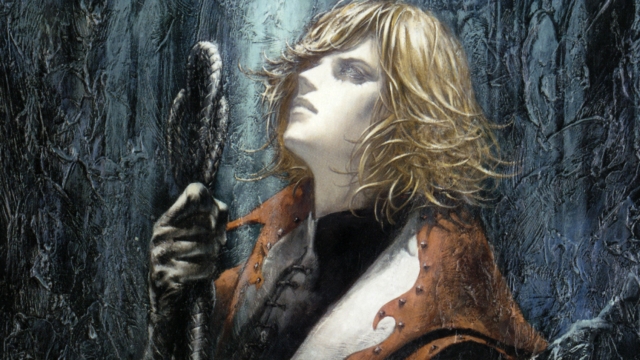
Here Leon Belmont laments his boy band hair style.

Here Leon Belmont laments his boy band hair style.

A word of advice for any game developers in my reading audience: if you make a game with the potential to give the players a stroke from the sheer force of disappointment, don’t use the term “Lament” in the title. People use the word to express negative emotions. “I lament the fact that my girlfriend dumped me for a homeless transsexual,” or “I lament the fact that my foot fell off and I went blind because I didn’t manage my diabetes,” or in this case, “I lament that an extremely promising origin story from a beloved childhood game franchise turned out mildly less interesting than the stuff that comes out of my cat.” Released in 2003 for the PS2, Castlevania: Lament of Innocence, offers players a backstory on the Belmont clan and there eternal struggle against Count Dracula and his light fixtures, as well as showing us the birth of a vampire, a glimpse into the terror and horror of a story so sub-par that a 100% historically accurate account would have entertained me far more.

Only a Belmont dares to stare down a gorgon. Seriously...eye contact. You can't do it. Don't these people ever read?

Only a Belmont dares to stare down a gorgon. Seriously…eye contact. You can’t do it. Don’t these people ever read?

I had the misfortune of seeing Dracula Untold the day after I began playing Lament of Innocence. Even that pales in comparison with the real Vlad Tepes; seriously, did we really need the vampire angle to make him interesting? The guy’s friends nicknamed him “The Impaler.” In real life! Want to know what they call the primary antagonist throughout most of Lament of Innocence? Walter. And nothing gets me shaking in my boots more than the dread of a confrontation with the villainous Walter the Vampire. Bram Stoker’s novel works because it took a real life legend and added horrors on top of that. In fact, the early Castlevania games did the same thing. Can’t write a story for an 8-bit console? Why not use creatures that already have one. We didn’t need cut scenes or text because when we saw Dracula, we already know him and his reputation. We presume he has a pike waiting in the closet, just for us. But an origin story that goes in a completely different direction actually ruins that for us. Imagine getting to the Blair Witch’s house only to find a 17-year-old girl dancing naked at the solstice, or if the gun in Saw fired a nerf dart, and Jigsaw jumped up, smiled, and yelled, “Gotcha!” It takes the fangs out of biting horror, and a monster trying to gum you to death feels more annoying than terrifying.
Lament of Innocence opens with the protagonist, Leon, running. Apparently Konami attributed the success of Symphony of the Night to its opening scene, rather than clever RPG combat system and Metroid Style exploration. Nope. Players don’t want that. Get rid of them. We only need to see someone running. That’ll set up sufficient premise and conflict. Unlike Alucard’s mad dash for the castle gates, though, Leon comes to a halt when a man steps out of the woods. He introduces himself as Rinaldo Gandolfini, a name indicating his role in the story only slightly less than if Konami had called him “Merlin-wan Kenobi” or “Yoda Dumbledore.” Leon reveals that the vampire master of the castle has abducted his betrothed, Sara (*cringe* Really? Running to the castle to save a girl? Can’t we think of anything original anymore? Why not make him collect coins and jump on a flagpole at the end?). Rinaldo, in turn, explains that Walter the Vampire runs a most-dangerous-game sort of operation, and wants Gandolfini to sell equipment to potential victims. He gives Leon a whip. A whip made with alchemy–I know my high school chemistry teacher often wound up with Medieval weaponry as byproducts of chemical reactions.

I don't know about violence against women, but I feel the sudden need to abuse myself.

I don’t know about violence against women, but I feel the sudden need to abuse myself.

The game, feeling guilty for killing your interest with a painfully long cut scene, proceeds to make up for its sins by giving you a five hour interlude of gameplay before the next bit of story.  Keep in mind I use that term loosely. In one of her videos, Anita Sarkeesian specifically mentions this game as a cliched example of violence against women used as a poor replacement for male character development. Here, I have to disagree with her, not because I think anyone can justify the violence in any way, but because Konami had zero pretenses that they wanted to develop anything in this story, least of all character! Leon expresses the personality of a sack of flour. None of the bosses stick around long enough to say or do anything interesting. You don’t encounter Walter the Vampire until the end, at which point the real villain reveals himself as–spoilers!–some guy they mentioned once offhandedly! The girl amounts to nothing but a pretty face covering a sack of cliches. Rinaldo has a little bit of history that makes him mildly interesting, but honestly the whip had more charm and charisma than any of the animate characters in this game.

...and they'll probably find it. Every day. Between 4:30 and 10:00 depending on lattitude and time of year.

…and they’ll probably find it. Every day. Between 4:30 and 10:00 depending on lattitude and time of year.

While the original Castlevania told a rich story with no words at all, Lament of Innocence showed us that Konami should, indeed, not use words to tell stories. With one-liner gems such as “Carve their suffering onto your body!” or “The force of your grief can only make me stronger,” the game succeeds as an unintentional comedy, while simultaneously working to undermine any interesting, meaningful interaction between characters. Close to the end of the game, after Sara asks Leon to kill her and infuse her soul into the Vampire Killer whip, and Leon laments her death and his role in it, Rinaldo offers sage advice and motivation by saying, “Hang in there.”

hang in thereBut I’ve lamented the story long enough. I should lament the game for a while. As I mentioned, the game departs from the RPG-style leveling up and the Metroid/Zelda style exploration and item hunting. Leon enters the castle and immediately begins to wage murderous war on torches and other light fixtures in what would soon become the traditional Belmont fashion. He can tackle five stages immediately in any order, each stage completely independent from the others (a few locked doors require keys located in other stages, but no level has more than one of these, and they only lead to optional relics with benefits on the same level as alternative medicine). Each level pretty much involves running a gauntlet of monsters, most of which you can just skip past by skirting the edges of the room, trying to avoid eye contact like an acquaintance you see in public but really don’t feel like talking to. Most levels require access to hidden areas, which poses the only true challenge, as the dearth of secret areas generally shuts off your brain to creative ways to access them. (How should I have known the game wanted me to jump on the plant monster to reach a ledge too high to see normally?)

Bad controls plague the game. The brief tutorial gives you profound advice such as “Do a double jump” or “latch on to stuff with your whip,” without really bothering to explain how any of this works. I mostly figured it out after a few hours of play, but still didn’t always know which ledges I could grab on to, or what fixtures I could whip. Games that involve 3D platforming usually execute moves with all the grace of a one-legged, drunk elephant with vertigo, but poor jump mechanics on top of that means that sometimes it took me six or seven attempts to jump onto a knee-high ledge right in front of me.

When a bad guy comes along, you must whip it. If his shield is very strong, you must whip it.

When a bad guy comes along, you must whip it. If his shield is very strong, you must whip it.

I can’t say I entirely hated the game. For a hack-and-slash, it kept my attention long enough, providing a decent amount of challenge as well as a recurring issue where bosses would kill me just as I reduced them to one hit point left–and one case when Walter and I both killed each other at the same time. The game doesn’t last too long, which helps prevent me from getting bored. I might even play it again, if I got into the right mood. However, I lament the fact that I got through the game without the threat of impalement, and I may refuse to accept the game as cannon, just so it doesn’t ruin the traditional horror atmosphere of the rest of the series.

Onimusha: Dawn of Dreams – PS2

onimusha-dawn-of-dreams

I’ve encountered a fair share of people in my time who scoff whenever I mention video games. “Well, I certainly would never consider that a worthwhile pursuit!” they say. Yeah. Fuck you, too. I don’t think the medium in question automatically elevates Desperate Housewives and Jersey Shore to a higher level of art than Xenogears or Final Fantasy. In fact, developers usually put enough care into each game that if you liked one, you can reasonably expect to enjoy the sequel. Film and book sequels usually have no value unless the weight of your wallet threatens to collapse your spine and you just feel like killing a little bit of time while waiting to die. But game sequels tend to grow and evolve out of their originals, building better ideas upon good ones, rather than slapping on lipstick and a wig in hopes of us shelling out the cash up front before taking them to a nice, private room somewhere, then turning them on only to realize we’ve already seen everything they have to offer. Also in this metaphor, let’s say you picked up a transvestite. Just for fun.

Thus cementing the already obvious comparison to Resident Evil 4.

Thus cementing the already obvious comparison to Resident Evil 4.

Still, that means game series change and evolve, sometimes into something significantly different than the original. Case in point, look at Resident Evil. The original sent you through an eerie, quiet, labyrinthine mansion, sending just enough monsters at you for your brain to send false alarms shooting through your nervous system every time you opened a door, turned a corner, or paused the game to pee. Resident Evil 4, on the other hand, gave you enough ammunition and ethnically Hispanic monsters to shoot that both Arizona and Texas nominated Leon Kennedy to run for governor. Likewise, the Onimusha series claims subtle origins. Samanosuke stumbles on a castle with all the quotidian feel of Hannibal Lecter’s kitchen, and on his own he must fight to keep his finger in the dike from hell. In Onimusha: Dawn of Dreams, both finger and dike have vanished out of existence, and the Genma demons roam through Japan with all the timid subtlety of an army of Jehova’s Witnesses (except, of course, for the fact that Toyotomi Hideyoshi, the Shogun during Dawn of Dreams’ time period and one of the primary antagonists of the game, sort of outlawed all forms of Christianity and executed practicing Christians. But hey, you gotta fill the void with something? Why not Genma demons?).

Nobody knows...the monsters I've seen. Nobody knows, but oni.

Nobody knows…the monsters I’ve seen. Nobody knows, but oni.

I should explain here that after the death of Oda Nobunaga in Onimusha 3…and, I guess, in real life…Toyotomi Hideyoshi rose to power in Japan. After making a deal with the Genma, who he believes will help him conquer the world, Hideyoshi perverts cherry trees with Genma insects so that they either turn people into trees or into more Genma or something. I don’t know. The trees kind of act like a MacGuffin, and for all their significance to the plot, the protagonist, Soki never so much as chops one with his sword, rips off a few leaves, or even takes a leak on them during the entire game. This part, by the way, not so much true in real history.

If I could take my own PS2 screenshots, you can bet I'd take a few that would show you something other than flashy lights.

If I could take my own PS2 screenshots, you can bet I’d take a few that would show you something other than flashy lights.

A further departure from the original games and their Resident Evil inspiration, Soki accumulates his own rag-tag band of plucky companions, who can fight along side him nearly every step of the way. It does provide a nice game play element, allowing characters to switch off, with one having the option to either attack or to guard and regenerate health. But it definitely detracts from the creepy vibes from the early games and hypes up action like a four-year-old on his third can of Red Bull. Each partner has a special ability; one can talk to the dead, another can grapple like Ada Wong, one can fit through tight spaces and cross delicate beams, and the other can punch heavy objects Chris-Redfield-Style. Naturally, Capcom designed these skills with no other trope in mind than to let Soki access new areas, however, they don’t do this very effectively. You can switch partners at most save points, but you can only have one at a time. Rather than forcing him to backtrack once a certain character becomes available, or constructing clever tricks requiring creative use of this mechanic, you often encounter several different obstacles in short succession, requiring Soki to stand there, flipping through allies like he has a big ring of keys and just needs to find the right one.

Each ally comes paired with a major villain, if for no other reason than to have them dramatically split up for cliched one-on-one battles, buying Soki time to rush toward the final boss. Naturally, you have to win all four battles to get back to Soki, even if the game never forced you to use the crappy boxing Spaniard for any extended length of time and I had forgotten to level up his stats. Yeah, I still won. Maybe that says something awesome about my skills, but I think it speaks more powerfully about how little a difference your stats make in the long run. Leveling up feels like an eye exam, trying to tell the doctor which of the lenses make the letters less blurry–maybe one of them makes a difference, but you can’t tell just by looking. The relationships between enemies and characters provide minor subplots to spice up the story, even if they didn’t feel like finishing the details. Jubei, a twelve-year-old ninja girl, seeks revenge on her Uncle, Yagyu Munenori, a villain who steals most of his dialogue from Ed the Hyena. The game explains just enough of her reasons to make the player feel like they’ve intruded on an awkward family moment, like eating dinner with a friend when a fight breaks out with their parents.

So cute you just want to squeeze him. Squeeze until his jar breaks and his eyes pop out of his oversized head.

So cute you just want to squeeze him. Squeeze until his jar breaks and his eyes pop out of his oversized head.

Dawn of Dreams also gives you a cute, chibi companion whose loyalty and character will grow on you like athlete’s foot. He hangs upside-down in a jar suspended from a vine, and in no subtle terms does the game relate him to the creepy bat-guy who takes you to the Dark Realm in the first game. If you don’t immediately understand why this infuriates me, understand that it retcons one of the most subtle, yet unnerving, details of video game storytelling ever. Samanosuke encounters the upside-down bat-guy fairly early in the game, but he just stares at you. He only speaks to you after you’ve picked up the relic that allows you to communicate with the dead (uh…spoilers, I guess, if you’ve paid attention). Obviously, Capcom meant to imply that this man had died, presumably in some horrible way that left him wrapped up and strung up by his feet. Well, Dawn of Dreams introduces the idea of the Mino tribe, where everyone hangs upside down. Coupled with the comic suggestions of how he travels from place to place, often with no clear support for his vine, and I welcome Minokichi into a horror-action franchise with all the enthusiasm of Star Wars fans when Lucas introduced Jar Jar Binks.

Japanese mythology commonly depicts oni as monsters weilding iron clubs. This game has a bizarre sense of humor. Like look at a wall with a slightly crooked picture that you can't straighten.

Japanese mythology commonly depicts oni as monsters weilding iron clubs. This game has a bizarre sense of humor. Like look at a wall with a slightly crooked picture that you can’t straighten.

I realize I’ve spent the greater part of this article complaining about the game, but honestly, most of the Onimusha appeal remains the same. If you enjoyed the earlier games for any reason…other than the ones listed here…you’ll want to play Dawn of Dreams. You still fight demons and absorb their souls. You have a variety of weapons–more options than the four or five the other Onimushas got, but you still can fight with katanas, spears, ninja swords, matchlocks and…lasers? Really? I guess Capcom plays it fast and loose with the whole historical accuracy thing. You can still fight your way through the Dark Realm–which they’ve made about ten times more difficult, and I have to confess, I only got to level 50. Out of 100. And I struggled to get that far. They’ve organized the game into stages (I guess nothing feels as “new” and “fresh” as the layout from 1980s arcade games), but Minokichi lets you revisit old stages. Despite sporting a second disc, Capcom apparently felt the characters didn’t need speaking animations, so to make up for that, everyone speaks in hand gestures. Big hand gestures. Well, body gestures. Actually, it very closely resembles interpretive dance. Also, since I’ve slipped back into criticizing, some of the controls didn’t work, and I couldn’t switch into Onimusha mode or do a few other moves. So…that holds the game back; generally, I hold the opinion that video games should, you know, work. But despite this installment taking hits in quality, I found it a very good action game with more length than previous games–but fun enough that I wanted to play through it all–and a moderately interesting story line. I give it a C+. It probably deserves a B+, but I object to games that grade your progress, and I refuse to give it anything higher than it gave me.