Boss Monster – Table-top Card Game

boss_monster_retail_box-smallWow!

So it appears I last wrote about three weeks ago. Awesome. Yeah, yeah, I know the rules. “You want to keep readers,” they say, “Update frequently! Daily if possible!”

Unfortunately, as much as I’d like to update daily, I find that playing through an entire Fantasy RPG and writing about it in a 24-hour period doesn’t tend to leave me with enough time to go to work, eat, sleep, use the bathroom, write about the game or finish a full Fantasy RPG. Furthermore, the fact that I’ve still spent a good number of evenings the last three weeks addicted to the random reorganization of pixilated blocks into ultimately meaningless re-creations of buildings I used to think were “neat.”

Ah, Minecraft. the heroine to Fallout’s morphine, you have no point, no direction, other than to keep me at your side.

Not to mention, the excessively long Dragon Quest IV has only exacerbated my problem of not finishing games in a timely manner. Also, soon I’ll write about the multiplayer mode in Secret of Mana, but Anne tends to get slightly narcoleptic after 8:00 at night, so progression there has slowed down from “Playing through a fun game” levels to “waiting until work lets out,” then down to “DMV Bureaucracy.” Thankfully, we haven’t yet hit “Congress,” so you can count on something productive sooner or later.

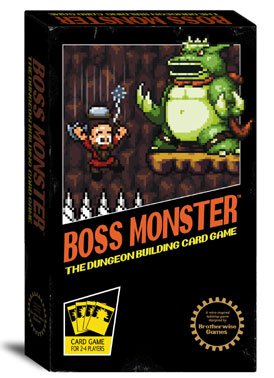
Anyway, to give you something to feed on for the interim, check out “Boss Monster.” Anne and I found it over the weekend, luring us closer with its NES-Box style art and seducing us further with subtle nods to classic 8-bit monsters, such as “Cerebellus: Father Brain” and artwork on “Brainsucker Hive” that hearkens back to Metroid. Each card offers an 8-bit style pixilated image, and many of them derive their theme from some pop-culture reference. Not limited to video games, you may also run into Futurama, Harry Potter jokes or others.

The players begin to create the most challenging dungeons for their heroes filled with the most expensive treasures—which will lure them to their untimely deaths. See, you play, as the title suggests, as the Boss Monster, vile, odious, and ever powerfully awesome. Let’s face it: no one has wanted to play the knight in shining armor since grade school. Why do you think they love Tyrion Lannister so much?

Games play quickly–usually less than fifteen minutes–and challenge each player to strategically build dungeon rooms to offer the best treasure (a.k.a. Hero Bait) while also dealing the most damage to the poor saps who wander in, fresh out of the archetype factory. Early in the game, however, heroes may overpower your dungeon, leading to the possibility that you’ll end up like most villains–just another hackneyed monster meant to indoctrinate young children into believing that if they misbehave, they’ll suffer through life until someone kills them. Sorry, but I defer to Johnny Dangerously here…at the end of the film, the ex-gangster finishes his moral proselytizing by declaring to the young shoplifter that, “Crime doesn’t pay!” Then he changes into a tuxedo and gets into a luxury car, declaring to the camera, “Well, it paid a little.” It just so happens that in “Boss Monster,” it pays you in souls of those you destroy in your dungeon.

“Boss Monster” apparently owes its origins to Kickstarter, which means it owes its existence to a partly democratic process of determining whether or not it looked “cool.” It does; I won’t argue that. However, once you strip away the aesthetics, you find a simplistic wiring system that might get the job done, but may also short itself out in the process. The game plays through three de facto phases: “heroes can get through your dungeons,” “heroes can’t get through your dungeons,” and “epic heroes may or may not get through, but probably won’t get through your dungeons.” This places much of the strategy simply on luring heroes to your dungeons at the right time. They have absolutely no interaction with the rooms you build other than to progress through them and kindly take a beating as though they had a fetish for undead S&M. The game might have played better if heroes put up some sort of fight, or had personalized abilities that affected the game in a way other than deciding which pile to drop their corpse into. Magic spells allow players to manipulate certain things, but once cast, you won’t come by new spells very easily.

Furthermore, while most of the cards seem to hint at some sci-fi, fantasy, or video game reference, many of them either don’t, or are obscure enough to make it difficult to understand, and others I suspect don’t make much of a connection other than “Well, I guess I can kinda see that in a video game.”

Still, I enjoyed the game. I hear that expansion packs might hit stores someday, but possibly only if the game sells well. I’ll leave you the link here and let you decide, while I have laundry to do and schoolwork to stop neglecting.

“Boss Monster,” Brotherwise games:

http://brotherwisegames.com/

Dr. Jekyll and Mr. Hyde – NES

RetroArch-0906-151611

Covering The Strange Case of Dr. Jekyll and Mr. Hyde in class this week, my students couldn’t have shocked me more if they had all ambushed me with cattle prods; they actually liked the book. But why not? It actually makes a good story, reads easily, and only lasts about eighty pages. However, the reason they gave was the suspense of not knowing what would happen next and the twist ending. Yes, my students hadn’t even heard of the story before, and jaws dropped faster than a cartoon wolf in an Asian strip club when they figured out that Dr. Jekyll and Mr. Hyde were, in fact, the same person!

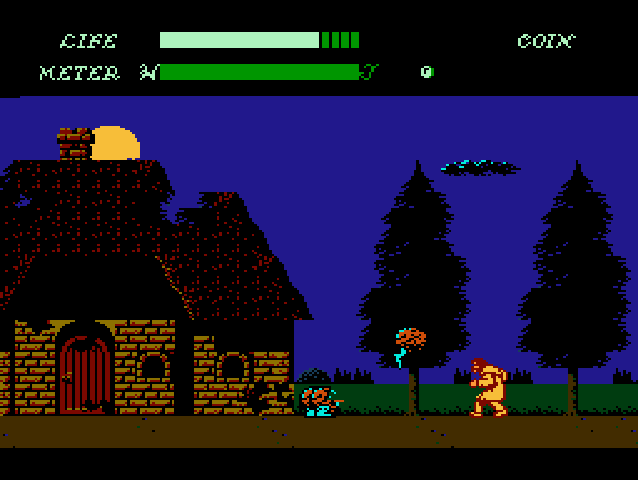
Hopefully I didn’t ruin the story for any of you, but I insist that spoilers have a statute of limitations, and I have no obligation to keep secret a plot devised in 1886.  Unfortunately, while I couldn’t believe how many of my students hadn’t heard of Dr. Jekyll and Mr. Hyde, I have no shred of doubt that the developers at Toho and Bandai hadn’t heard of the book either.  While the book comments quite adeptly about the duality of human nature, clandestine desires, and the forced separation of public and private lives, the NES game has the literary value of a bird shitting on pedestrians. I didn’t intend to employ sarcastic wit in that last sentence; the game literally forces the player to dodge steaming piles of bird crap, lest it kindle the rage within Dr. Jekyll, transforming him into the incredible, hulking figure of Mr. Hyde. Covered in feces.

I wonder why it comes out pre-piled...

I wonder why it comes out pre-piled…

NES games didn’t sell themselves on strong stories; most games had a premise, at best a scenario to follow, but they didn’t consider gameplay as the venue for developing plot.  However, with a timeless tale of horror already fabricated, making the game interesting should pose no problem at all. Right?  Unfortunately, while the book focuses on Jekyll’s close friend investigating the bad crowd the doctor has fallen in with, while giving us glimpses of Jekyll losing control of his personality, the game has the good doctor on his way to the church to get married.  Apparently harboring a criminal rage that indulged in dark pleasures didn’t excite Toho quite as much as the conflict of not being somewhere else. Along the way, the common rabble of London work their magic to piss Dr. J. off as much as possible.

Robert Louis Stevenson when they pitched the bird shit idea to him.

Robert Louis Stevenson when they pitched the bird shit idea to him.

While I’ve played games with pretty far-fetched elements (including the murder of frogs by force-feeding turnips), I find the scenario downright implausible.  Everything becomes an obstacle. Vicious dogs make sense, as do ruffian orphans.  Yeah, we’ve all watched the skies with guarded eyes for the rogue seagull with dysentery, and I can even stretch to say some people may freeze in their tracks if a spider dropped out of a tree.  However, I can’t quite see why every full-grown adult in the London streets feels the need to body check Dr. Jekyll like they only have one shot at the Stanley Cup, and the dozens of mild-mannered citizens dropping bombs at his feet give me reason to wonder why the police feel the need to make Mr. Hyde a priority arrest. By the final level, the game starts chucking barrels like it always wanted a career in Donkey Konging and its father forced him into a career murdering classical literature, and in addition to the suspension of suspension of disbelief, it becomes virtually unplayable, even with save states.

As Mr. Hyde, beating up on brains makes you feel warm and fuzzy.

As Mr. Hyde, beating up on brains makes you feel warm and fuzzy.

The game did experiment with a few novel concepts for its time.  The player has not only a life meter, but a mood bar as well.  When the life bar enemies, the player dies–no surprise there. However, when the mood gauge empties, the player transforms into Mr. Hyde, day becomes night, side-scrolling moves right-to-left, dogs and cats living together…mass hysteria.  Apparently Mr. Hyde needs some down time to vent his frustration, and wailing on monsters and demons rampaging through London (which again gives pause over the danger Hyde poses) makes him feel better. Successfully not dying as Hyde returns Dr. Jekyll to his quest of…going to church…and refills some of his life bar.  Also as Hyde, enemies drop coins, which Jekyll can use to pay off singers who spout out music notes like shrapnel, and to much of the same effect.  Dropping the pretense of music causing physical harm, this amounts to a man putting off his own marriage because he feels the need to stop and comment on how much he doesn’t like street performers. And again, Hyde is the jerk?

Normally when a game frustrates me, I remind myself that developers plan gameplay and test their games to make sure players can, theoretically, get through them.  However, Dr. Jekyll and Mr. Hyde ruined challenging games for me by shattering that axiom.  I could barely finish the game using save states.  Some scenes threw so many enemies at me that I had no choice but to replay them and hope for a fortunate random behavior to give me an opening to get through, a task made infinitely more difficult by the fact that Jekyll handles like a Winnebago with four flat tires and no engine trying to pull itself free from a swamp using a broken winch and fifty centimeters of dental floss. The B button controls a walking stick, which the player can wave around to feel more like a Victorian gentleman, but it doesn’t actually effect the game in any way.  I chalk that up to a glitch, considering the number of bombs that followed me as I jumped over them, and how the game inverted its colors during the final level.

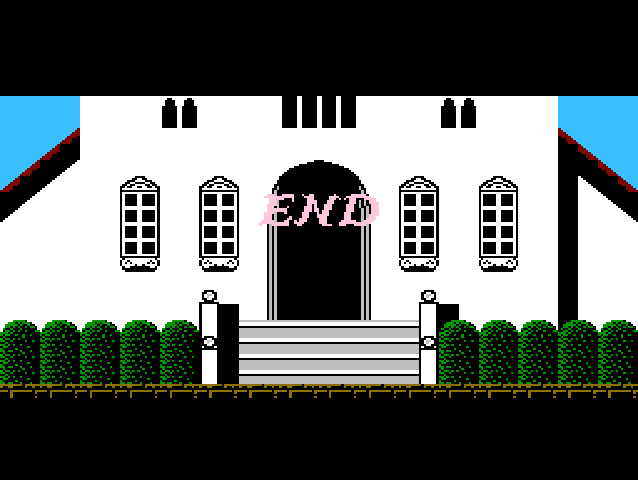
This is what happens when you finish. Literally. You see this screen.

This is what happens when you finish. Literally. You see this screen.

Honestly, I wonder how people thought games like this would sell.  I’ve finished some difficult games in my time, but I’ve always felt someone could finish them without save states if they had enough free time on their hands, but I don’t think Dr. J. and Mr. H. falls into that category. The end of the game offers less satisfaction than even the SNES Jurassic Park adaptation, but at the very least I won the right to complain about how terrible this bird crap of an idea turned out.

Working my way through Shadow Hearts: Covenant. Slow going, but I’ll try to update when I can. Thanks for reading!