Castlevania – NES

Image

Honestly, I swear I’m going to get around to Radiant Historia and Twilight Princess one of these days!

I have a problem, which you’ll soon recognize, of gravitating toward longer games–Final Fantasy, Xenosaga, Fallout, etc–which all have the ability to keep me entertained for hours on end, but don’t exactly provide reams of reading material to those of you kind enough to listen to me ramble like an old man telling stories of “the war” and “kids these days” and other cliches of the sort. So to appease the hungry beast that is the internet, I’ve shot through a few quicker games for some material.

So here’s Castlevania! A horror/adventure/semi-platformer for the Nintendo Entertainment System. You play as Simon Belmont, intrepid vampire slayer on a merry romp through Dracula’s castle armed with only your trusty whip–one of the kinkier, yet lesser known methods of destroying vampires.  Yet business must be good for everyone’s favorite impaler since his ventures apparently merged with every other horror movie from 1920 to 1960, and other famous denizens of the genre appear to be doing Vlad’s dirty work for him while Simon works his way up the corporate ladder.

Yet I still have a problem since I want to review Castlevania, but I’ve never managed to power through to the end before.  NES-era gameplay relied on extreme difficulty to promote replay value.  While Nintendo managed to create a regiment of games with a 20+ year fan base, more than a few fans would have appreciated the chance to play through more than the first three levels.  Once or twice.  After all, I did shell out 50 bucks a piece for these things at a time when my allowance was 50 cents a week if I kept my bedroom clean and did all my chores, and let me remind you that the front-loading design of the NES meant that the games I could pay for wouldn’t always work.

All things are possible, though, through practice, so now that my system reliability allows me to play whenever I want, I hunkered down and did what any self-respecting player who wanted bragging rights would do.  That’s right, I cheated my ass off and used save states.

No, I don’t actual claim to have legitimately beaten the game. Yes, I’d still like to do it the old-fashioned way.  However, considering how often I had to reset my fight with Death in the penultimate stage, it would have taken me days to get good enough to beat him–only if I never shut off the machine. Continuing after a game over means you have to plow through parts of the game you know you can finish only for a meagre shot of honing your skill on an enemy who will, in all likely hood, present you with instant death (both literally and metaphorically, in my case). Image

Despite the cleverness and creativity NES developers put into their games, if I had to rate their bag of tricks to up replay value on a scale from “Hand Purse” to “Mary Poppins,” it wouldn’t even hit the scale.  They didn’t have a bag. They had a sheet of fabric, torn, threadbare, and vaguely malodorous from being passed around by so many games.  I can imagine the meetings they had at work. “We’ve got an idea for a game!  We’ll build a tone reminiscent of classic horror films, using well-known monsters as the stage bosses!”  “Great, but what reason will they have to play it again? Should we rely on detailed level design and dark, catchy music?” “No! Let’s just up the difficulty so they’ll only be able to play the first three levels!”

Brilliant idea. See, I like Castlevania. I liked it enough to play those first three levels over and over again, and the game does have a lot going for it. But as I mentioned, NES games cost $50 a shot, which means the game ran me over $15 a level. Not particularly a wise investment.  Between that and the fact that Simon handles like a combination of a refrigerator and a lemming add a level of frustration that I commonly despise in more modern games.

Seriously, though, I don’t exactly feel inclined to cooperate with a protagonist who hurls himself meters backward, often off the nearest ledge, every time he gets a paper cut.  Watch the speed runs on youtube–players manipulate the distance you launch yourself when hit to add distance and height to jumps.

Yet we still play this game–I still play this game–years later, and Konami finds the series profitable enough to have made well over forty installments since this game appeared in 1986.  For all its faults, something must more than make up for it to give it such a reputation.  I believe it relies heavily on the tone.  The game opens as Simon approaches the gates of a crumbling, Gothic castle in the middle of night.  From there, background design only gets more detailed, giving the player a sense of placing themselves in a classic horror setting using only the 8-bit technology of the NES. Image

Pitting Simon against well-known baddies, such as Frankenstein’s monster, the Mummy, Death, and Dracula, gives players a sense of familiarity with the game.  NES games relied on the instruction book to provide the premise of a story, so employing characters that already had stories built a solid texture into the experience.  Furthermore, the power-up tools–holy water, crosses, daggers–are also staples of the horror genre, which furthers immersion.  In a system limited to 8-bit processing, Konami employed a string of techniques to expand Castlevania beyond what the NES could actually accomplish by itself.  This contributes to the long-lasting value of the game and makes it still worth playing today.Image

Also, not to backpedal too much, but while the difficulty exceeds reason, the fact that the game poses such a strong challenge does make me want to return.  It becomes a goal, rather than just a game.  Sure, it induces wrathful symptoms–shaking hands, throat sore from screaming, frothing at the mouth–but at its heart, the difficulty shows that the game cares enough to make you want to come back. I’ve heard the sequels surpass the original in difficulty, but I still look forward to summiting K2 after climbing this Everest.

Michael Jackson’s Moonwalker – Arcade

Image

Around my twelfth or thirteenth birthday, the local ice rink where my father taught at a summer hockey camp had a few arcade cabinets in rotation.  Considering how athletic, extroverted and interested in following in my dad’s footsteps I was, I had absolutely no interest in sports, but I did have about two bucks in quarters.  I resolved that one evening, I was going to take my hard-scrounged change on a quest to beat one of the games.  As soon as I got to the rink, I laid out seven quarters on the dashboard and dropped the last one in the slot.

Time passed and some of the other kids noticed.  I had progressed fairly strongly, and after a stage or two, some of them joined in.  Pretty soon they were coming in and out of the game, depending on availability of their own change, my trusty-yet-expendable wingmen, the Biggses and Wedges to my Luke Skywalker.

A dollar-twenty-five into the game, I’m almost at the end, and another kid asks if he can “borrow” a quarter from me.  In a mix of cockiness and generosity, I tell him to go ahead.  He whips a quarter from the dash and drops it in, only to die off immediately.  Shortly thereafter, I reach the boss of the game and begin to struggle.  I deal a fair amount of damage, but just before delivering the coup-de-grace, I run out of health.  Hyped up on near-victory, I reach for another quarter, only to discover that I’ve run out. While I still encourage generosity and try to practice it when I can, I still blame it for the reason I didn’t finish Michael Jackson’s Moonwalker that day.

Moonwalker falls into the realm of arcade Beat-Em-Up, a classification that puts the “generic” in “genre.” Ninja Turtles, X-Men, Sailor Moon, the Simpsons–these games and others like them came to life with only a little more effort than slapping new artwork on each cabinet as it rolled off the assembly.  Each one consisted of characters progressing through a stage, the game periodically forcing them to a stop and assailing them with dozens of goons who may have seen what you did to the hundreds before them, but still feel they have a shot of taking you down. When you dash their hopes–and organs–the stage begins to move again. Murder, rinse, repeat.  One button performs a standard attack.  The other offers a limited special attack. One the surface, Moonwalker doesn’t bring anything to the table except an angled top-down perspective instead of the usual limited-3D side-scrolling.  However, some interesting quirks and some unintentionally hilarious details make the game stand out from the rest.

Video game music hadn’t garnered much respect at that point, but I supposed it really hadn’t earned any yet. Moonwalker, on the other hand, boasted a soundtrack entirely composed by Michael Jackson himself, including hits such as “Bad,” “Billie Jean,” “Smooth Criminal,” and of course the most obviously fitting song to underscore a graveyard stage, “Another Part of Me.”   Now watch me turn my praise into a big ball of wibbly-wobbly uncertainty as I point out that if you decide to play a game because you want to hear synth-instrumental midi versions of Michael Jackson, you probably need to reevaluate your priorities.  However, it stands that when facing down an army of clone games, any unusual feature might sway you to play that one against all the rest, putting aside that playing Jackson’s CDs might be the way to go.

Image
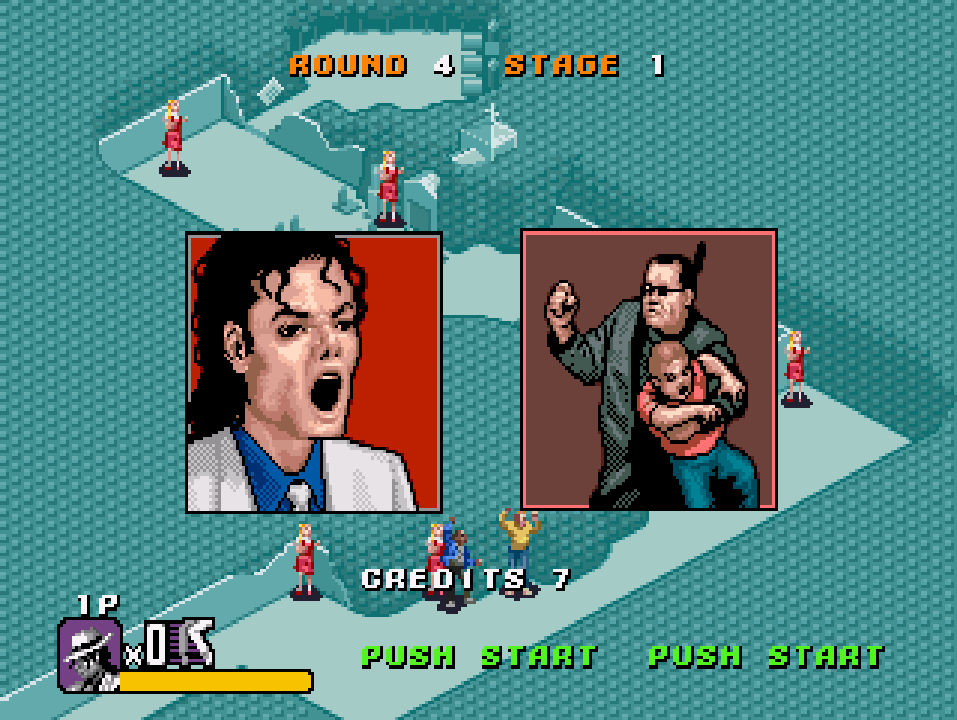
The game follows the plot of part of the Moonwalker film, where Michael sets off to rescue a bunch of children from a drug dealer. Comic-book-style panels flash before each stage, each time showing the villain struggling to restrain a kid, shaking his fist in unintentional mockery of every cartoon bad guy ever created.  Michael responds with his characteristic scream, “Ow!” Then after a brief moment of WTF and a snort of laughter, you begin!

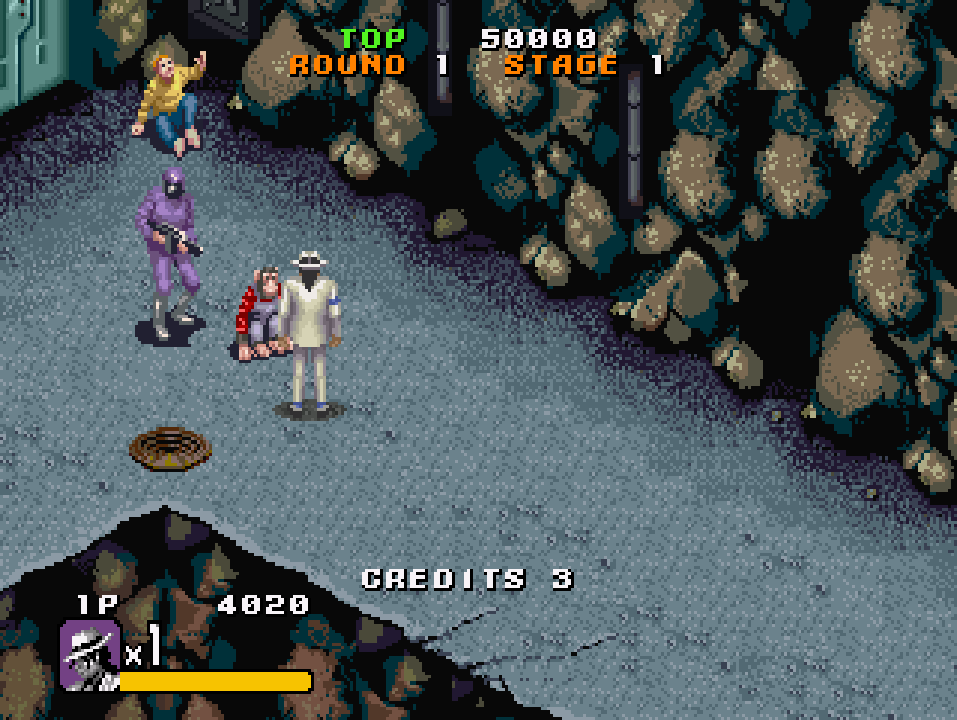
ImageAttacks come in a form of dance moves and sparkles that could flay the hide off Edward Cullen.  The special move puts the spotlight on Michael–literally–and alternates through three or four different moves, which involve the enemies dancing to death, bursting apart in pyrotechnics, or getting hit by meteors.
As you go through the stage, the goal is to collect–er, rescue the children, who will periodically refill your health or amount of special attacks.  Near the end, Bubbles the Chimp will dash out and turn you into Robo-Michael, allowing you to finish off the boss in a spray of lasers.

Image

Sadly, I’m not sure whether Jackson thought these ideas would portray him as a Superman figure or if he just took all this from his day-to-day life.  While allegations of child molesting might make the developers at Sega look back and cringe about the giant red flag they put into the world, I have no doubt that this is how Jackson viewed himself, or at the very least how he wanted people to see him.  Anecdotally, a friend of mine (who now works as a game developer. You should check out his game here; to support him. told me in high school that Jackson enjoyed Ready-To-Rumble Boxing so much, he called the developers and asked to be put in the sequel, requesting that they “Make [his] character really cool so the children will want to play with [him].”

Pause to let that sink in.

While I can’t confirm most of that story, I do know that shortly thereafter they released Ready-to-Rumble boxing with a special character.

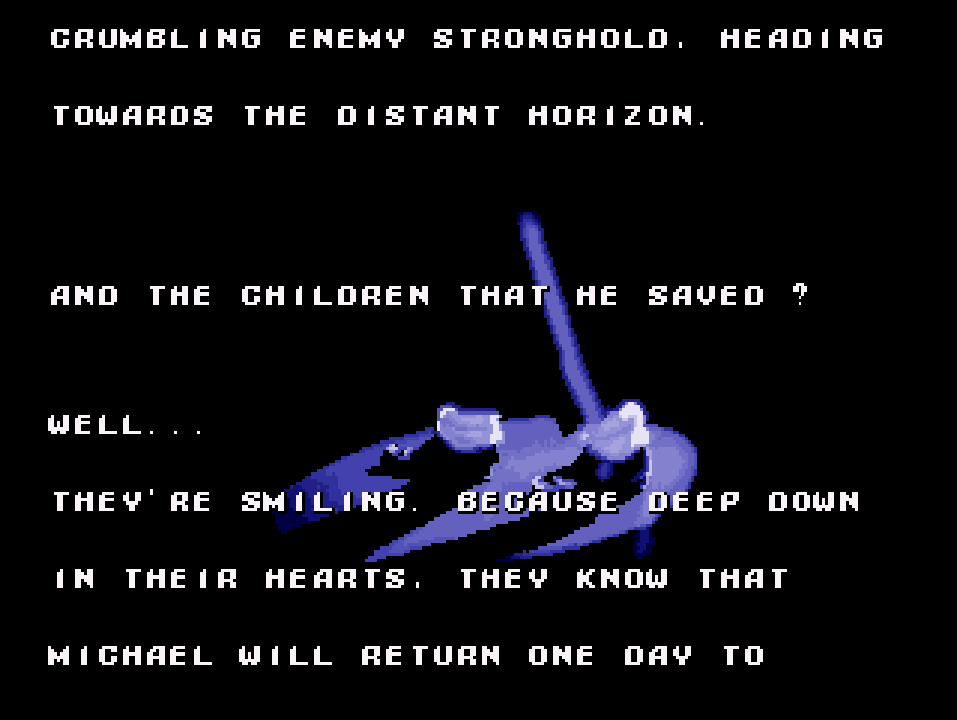
The game takes its super-hero message seriously, which I, for one, find amusing.  However, while collecting children and grabbing the monkey provide a good laugh, the main drawback of the game centers on the genre.  Combat in Beat-Em-Ups is nothing if not repetitive, and it makes me vaguely conscious that Sega programmed the game at an optimal length to pry as many quarters as possibly from pre-adolescent fingers.

I did, however, finally finish it.
Image

Resident Evil 6 – PS3, XBox 360, PC

Image

So technically I guess Resident Evil 6 isn’t retro, but by the time I get any readers, people will either have moved on cluttering up my facebook feed at the push of a button with the PS4, or living with the X-Box One sitting around like a roommate with boundary issues, not quite sure that his website of pictures of you sleeping on the couch might make us all feel just a little uncomfortable.

These gimmicks and features don’t really enhance the games at all, they just aim to make games more social.   I don’t know when anyone decided that video games needed to or even could be a social experience. You want to socialize?  Don’t play a video game!  With the possible exception of Journey, which requires natural intelligence to figure out gameplay aspects with minimal communication, I’ve never played a game and thought, “Yep! This is just as good as human contact!”  I always looked at games as something to do when you couldn’t find anyone to do anything else with (which in my life, has been all too often).

Thankfully, Capcom seems to have heard the voices of all of us angry peasants who hated being forcibly paired up with Sheva in RE5.  For those of us living the hermit lifestyle, this presented the player with the dire decision of playing through the game solo and relying on the inept AI, or finding a second player and dealing with something even worse. The latter option forced people to scrounge up little sisters, mothers, or hobos from the bus station in attempt to avoid the terrible decisions made by the AI (or as we referred to it in the day, “The Computer”).

While you have the option of joining another player online, the AI Partner mechanics give you a player who will always drop everything they’re doing to try to save you, and who won’t die themselves, so any self-respecting player will shut-off the network connection immediately as to prevent the game from turning into a babysitting mission. (I’m looking at you, Ashley.) It’s highly possible that when you’re on the verge of death, enemies can reach you before your partner, so it keeps an element of challenge, but you can still play through the game with the feeling that you can do what you want to do, instead of walking through a crowd of zombies with one hand on a gun and the other holding a baby monitor to your ear with the other.

Although the AI mechanics show promise for continuation of the series, whether or not RE6 lives up to expectations depends entirely on what you might expect from a Resident Evil game. That question becomes muddled when you take into account the fact that the series made a dramatic shift from Survival Horror to Action between Nemesis and RE4. Still, we can tally off some common aspects we enjoyed from previous games, right?

One: It’s not a first person shooter or a rail shooter. It’s not like anyone would think that’s a good idea anyway, right?

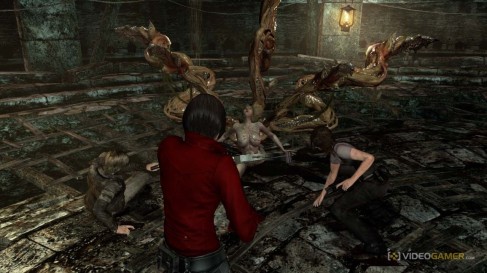
Two: More than one playable character, likely in response to the criticism that RE5 didn’t last long enough. The game stars Leon and Chris. And Ada. And a grown-up Sherry Birkin. And the son of Albert Wesker, some random army guy, and a woman who follows Leon around for some reason I’m sure they explained at some point. While having multiple characters with intersecting scenarios has long defined the replay value of Resident Evil games, the story does feel like a Racoon Class of ‘98 Reunion.  Fortunately, since they’re paired up, the story doesn’t become extraneously convoluted, and we know, as always, that only the characters from the first two games matter.  Unfortunately, working through a survival horror game in pairs takes away one of the most frightening aspects of the genre: being completely and utterly ALONE!

There does seem to be a level of predictability in the stars. I even remember thinking back in 2008, “You know what would be neat? An RE Game starring the grown-up Sherry Birkin.” Ten-to-one odds they bring back Claire (and probably Jill) in the next game.

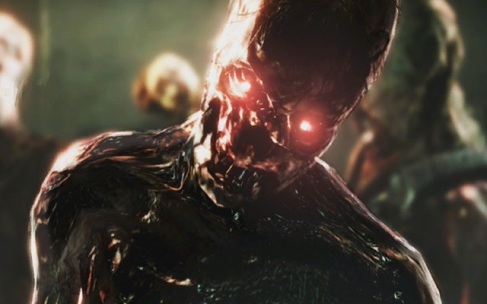
Three: Monsters. As with the massive split on characters, it feels like they’re trying to draw back to anything anyone may have ever liked about the game. Leon’s scenario involves handling a zombie outbreak, a la RE2 and RE3, while Sherry and Chris deal with J’avo, who are much like the Ganados from RE4 and the Majini from RE5.
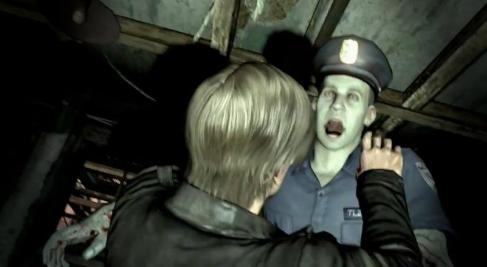
Image Image

Four: Uh…guns? Puzzles? Poorly written story line? A convoluted element that puts the “Resident” in Resident Evil?

Honestly, I can’t think of a whole lot more that the games have going for them. I played through this game slightly miffed and disappointed at the poorly-written scenarios until I remembered that  Capcom always manufactured their RE plots from beat up sci-fi cliches they found rotting in a dumpster outside a 1950s drive-in movie theatre. So what if we don’t fully understand what’s going on, or what makes the characters move forward, or why Leon stops and tries to reason with a zombie? That isn’t the point.

But that does lead to the major problem with the game. RE4 drew so many new fans to the series that every game since has tried to re-create that success, and as is so common in game development, they’ve done that without the slightest inkling of why people enjoyed it so much.

See, even after the genre switch, players loved the games because Resident Evil built atmosphere so well.  Right from the beginning, they rely on environmental sounds, dissonant tones in place of music, and sudden starts to scare the wits out of players. Enemies didn’t respawn. Ammo ran out. As a result, some zombies had to be ignored, the player running past them every time they backtrack through an area. Other areas could be cleared out, traveled through a dozen times, and then suddenly a new monster would dive through the window to snatch you up like a donut in those plexiglass cases at the grocery store. People mock the older games because it sounds like Leon Kennedy frequents cobbler shops, but the echoing footsteps play a vital role as well; different floors have different textures, and the crunching of glass underfoot sounds exactly like a feasting zombie. I can’t tell you how many times I froze solid only to realize I was standing alone in a room covered with junk on the floor.

This series–including RE4–relies on silences and downtime for effect. There must be the possibility of being alone along with the chance of being attacked. Scares in the horror genre never come from monsters; they come from the stress of suspense. RE6 abandons this idea completely. Gameplay is unrelenting. Monsters respawn as though someone were in the back running them off on a Xerox, and the player rarely has any downtime. To add to this, the macho-military theme for Chris Redfield’s scenario feels like it belongs in a Call of Duty game rather than Resident Evil.

Despite the lack of atmosphere, I did enjoy playing. The Mercenaries mini-game probably captures the feel of what’s fun about RE6 better than anything–running a gauntlet of monsters for a high score. Some of the other features gave me a laugh as well; you have the option of hopping on the network to play as a monster in someone else’s game. Although this makes for great novelty, the mechanics have to be worked out since the human characters can pulp you into cottage cheese within moments, and spawning points are distant and take time to load.

Although I’m not likely to be quoted on the packaging if I say, “It’s okay, considering,” the game is okay, considering it drops the key defining feature of survival horror. As always, the squish of a zombie’s exploding head satisfies me to no end.
Image

Bubble Bobble Sequels – Initial Reactions

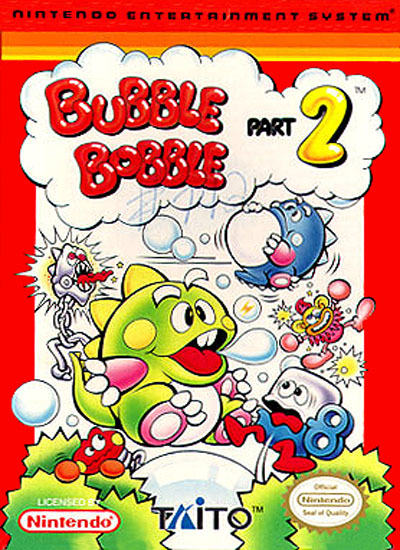
Yesterday’s review on Bubble Bobble piqued my curiosity to look into the series, so I read up on the sequel games and played a bit of Bubble Bobble 2. Image

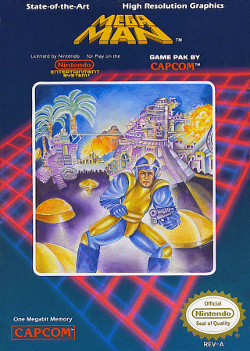
Image I’ll include a formal review later, but I felt inclined to share my thoughts. See, I usually laud the video game industry as the one area of storytelling that understands how to improve on the original instalment of a series.  If Hollywood had produced the first Mega Man game, one look at the promotional art would have sent him to rust on the scrap heap. Don’t believe me? Just look at what they did to the Star Wars prequels, the Jaws movies, and thank the higher deity of your choice they never made any sequels to The Matrix (No they didn’t! Shut up!) Meanwhile, Final Fantasy, the Legend of Zelda, Metroid, Resident Evil, and a plethora of other games all succeeded right from the beginning, but it’s hard to argue that their sequels didn’t show them up at every chance.

Image

Bubble Bobble, however, missed the boat entirely, and only survived onto sequels because the shark from the Jaws sequels was too stupid to eat it. The games all have very nice graphics, some even updating to 16-big home systems such as the Sega Genesis, and have much smoother mechanics and presentation, but as the whole philosophy of my blog states, better technology does not automatically ensure a better game!

Bubble Bobble 2–officially titled “The Story of Bubble Bobble 2” features a similar gameplay to the first. As sequels go, it’s not as bad as the rest. You’re still playing as Bub and Bob, the Bubble Dragons from the first game. Rather than 100 stages played through in order, the game grants you some degree of control over which path you take. The game even introduces boss fights, where you drink a potion that allows you to spit rainbow bubbles, and pop them to cause damage. Image

I’m glad to see Bub and Bob came out of the closet on that one. To add further innuendo, one of the bosses appears to be a female tanuki (sorry…you’ll have to find your own image there). Don’t even ask me how that one works.

Unfortunately, the two player mode, one of the better aspects of the first game, goes so far as to damage the mechanics of the sequel. Play is parallel, like the original Mario Bros, and it doesn’t run cooperatively, like Mario 3, where players clear levels to help the other advance. In fact, while on single player mode, you can resume play mid-stage when you get hit, but two-player mode ends the turn to alternate to the next player.

My initial reaction is that the game is worth playing, but not for more than one player.  And since the multiplayer option gives most of the value to the first game, that adds up to a big strike against Bubble Bobble 2. The following sequels don’t even sound interesting, as they’ve turned the loveable cartoonish bubble dragons into … wait for it … regular people. I’m sorry, Taito. You’ve lost me.

Yet, as I mentioned earlier, I write this after a ten-minute session of playing the game and a late-night boredom-induced scouring of the internet for images of bubble dragons. When I get a chance, I’ll focus on writing a more formal review.

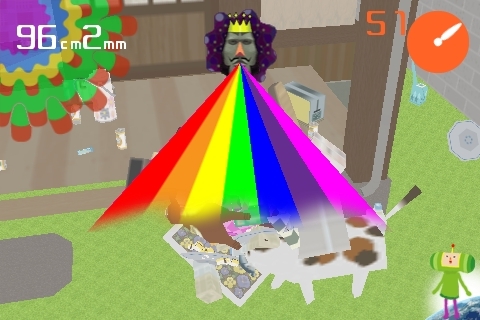
Coming up soon: Radiant Historia for the NDS. I’m working my way through Twilight Princess since I felt the beating I gave it in my Oracle of Ages/Seasons review may have been done with a outdated stick, so don’t pick up the crap raining from the fairy pinata just yet. Anne wants to watch that one, though, so it may be a few weeks before I get that one posted.

Bubble Bobble – Nes, Arcade

Image

Having crawled out of the womb and into the era of Donkey Kong, I’ve spent my entire conscious life watching the evolution of modern gaming.  Unfortunately, as Forrest Gumpy as it feels to have witnessed something historical that I take a deep interest in, I’ve had to face the onslaught of humorless dicks who have never played a game in their life calling me an anti-social, violence-crazed, killer-in-the-works.  But while I’m tallying up the number of football injuries versus the collective maimings incurred in the last twelve months of high school football, I have to concede with these people on one point; the sheer mass of games like Halo, Call of Duty, Modern Warfare, and all the other testosterone-dripping, military propaganda scenarios being released now do kind of point to a preoccupation with violence. But hey, when the amazon reviews for Game of Thrones complain about too much sex without a word on all the appendages lost in the series, I think our societies obsession with bludgeoning one another goes a little beyond the monkey-see-monkey-do argument against video games.

What these people fail to see is the plentiful cornucopia of games that don’t wallow in their own wrath.  Yes, it’s very nice of Jenova Chen to develop a game that gets away from the shoot-kill-win mentality, but it would be nice if people could remember that games like this already do exist.  Let’s go back to, say, 1986 and examine a little gem called Bubble Bobble.
Image
As a reviewer, there’s really not much to describe. You play as Bub and Bob, two Bubble Dragons that resemble Godzilla chibis. Instead of shooting a gun, you breath bubbles.  Instead of killing enemies, you trap them in said bubbles, then pop the bubbles to turn them into food.  Yes, I suppose you could go all Mufasa on me and imply that that’s a metaphor for the Circle of Life, but I say, “Screw you! It’s fun!”  As always, the ultimate test of a game’s value is how much you enjoy it, and while it’s less violent than your standard cartoon, Bubble Bobble manages to radiate enough bright colors and simple-yet-addicting gameplay to have kept my interest over the last several decades.

The game has a simple learning curve.  Hit start.  Three monsters?  Try blowing a bubble.  Easy enough. Pop them and sit back for 99 more levels of this!  But Bubble Bobble manages to avoid a repetitive feel for the most part.  The shape of the levels forces the player to change tactics to solve puzzles in gameplay.  How do you pop the bubble when you can’t reach it?  How do you get to a monster trapped inside a shape?  Certain levels change game physics and make bubble float or sink differently (and in one case, much more quickly) than usual.
Image
I don’t mean to give the impression the game is perfect, though.  As much variety as it introduces, a hundred levels can become a little repetitive from time to time.  Furthermore, the level designs sometimes get too fun and wind up with pits or nooks that your bubble dragon can get stuck in.  When that happens, you’d better hope the monsters can still kill you (which causes you to respawn in your starting position) or that you recruited another player who’s savvy enough not to get stuck.  

Another minor point, while the large variety of fruit, veggies, snack food, and other bonus items does add to the ability to get excited over cartoonish details, it does sometimes work against the player.  With dozens of items that do no more than grant point, sometimes it’s hard to realize that some times increase your speed, let you stream bubbles faster, or even warp ahead several stages. Perhaps, though, part of the challenge is to recognize which items to prioritize before they time out and vanish.

Difficulty, as to be expected from NES-era games, resembles breaking a pine log with your fist; you know it’s impossible, but it looks like fun so you’ll gladly pulp your hand into a maraca trying to do it.  The game does offer continue options.  On the NES, restarting after a game over gives the option to begin at any stage you previously cleared since turning the machine on, while the arcade system, with a spirit of capitalism that would make games that require DLC bow down in reverence, only asks for another coin to keep Charon from ferrying you back out of the building.

Differences between the arcade and home versions don’t amount to much beyond that.  The cabinet systems allow for better detail on enemies, fruits, and the tiles that make up the levels, but the NES version includes background music.  Granted, after 99 levels of the same song, it’ll start to echo through your living room long after you’ve shut the game off, but I still say it was kind enough for the game developers to include one.  

Fun, simple, and non-time-consuming, Bubble Bobble doesn’t have much to offend anyone.  I’m sure a handful of gamers view themselves as “serious” and wouldn’t be caught dead playing anything doesn’t involve trying to imagine how fun it would be to get shot in battle, but chances are most people will find something about this game to like, no matter what their taste in games.

Upcoming Reviews: July 11, 2013

Hey! I know a blog with one entry generates about as much excitement as a broken spatula on the side of the road, so I wanted to let you all know what to look forward to in the upcoming weeks. I’m working through a few games right now, so expect reviews of:

Radiant Historia (NDS)

Bubble Bobble (NES and Arcade)

Resident Evil 6 (I know the PS3 is still technically current gen, but it’ll be yesterday’s news soon enough)

And my wife is playing through O’Kage: The Shadow King (PS2) and Silent Hill (PS1).

Thanks for reading!

Legend of Zelda: Oracle of Seasons / Oracle of Ages

Bringing back fond memories of old friends...er, enemies.

I’d like to kick off my new blog with a review an often overlooked installment of a classic series; The Legend Of Zelda, Oracle of Ages/Oracle of Seasons.

So it’s actually two games. Kinda.

The games star Link (surprise surprise), journeying for some untold reason through the land of Labrynna in Ages and Holodrum in Seasons. The goddesses Nayru and Din appear as the oracles in each land, and are very soon after beginning the game are kidnapped by their respective baddies. Someone spots the Triforce symbol burned onto Link’s hand. They send him to talk to a tree, who tells him to find eight underworlds to find the eight macguffins to advance the story. In said dungeons he finds eight useful trinkets, he uses them, he solves puzzles, and fights bosses. It’s not exactly an innovative story line.

These games were released at the end of the life span of the Game Boy Color, which, please note, is a system that had only gone minor technical and aesthetic changes since it was released in 1989. Yes, the Game Boy Advance was released the same year, but it’s easy to see how Link’s adoring fans may have overlooked this game in favor of bigger and better systems. Even Nintendo didn’t want to give it much attention, as evident by the fact that they farmed the game out to Capcom for development.

Usually I’d shake my head in shame over an artist relinquishing control over their series–prime example would be how by casting George Clooney as Batman, Joel Shumacher effectively killed the franchise until they could reboot it into something that wasn’t embarrassed to call itself “Batman.” (And do you remember the Adam West TV series?)

Capcom, though, chose a different approach. The Oracle games play from a top-down perspective, Gannon is a pig again, bosses from the original game return en masse…I can’t help but think that they’re trying to make a statement. This is, after all, the company that created Megaman, where the most creative changes were eight new themes for robots which were cleverly named “insert-that-theme-here”-Man. This is why I think Capcom may actually understand the Zelda series more than other potential third-party developers. Change and innovation can spice up old series, well enough, but if players enjoyed a game, chances are they’ll enjoy more of the same in the sequel. No the Oracle games done push the envelope of storytelling, but I still go back and play the original NES game about once a year, and the only story that had was the paragraph or two you read out of the instruction book before your kid brother tears it to shreds and slobbers on the pieces. Even Ocarina of Time didn’t change all that much beyond the over-the-shoulder perspective and a more highly developed Hyrule than previous games. They certainly didn’t need to contrive some stupid gimmick to please fans, like, for example, turning Link into a werewolf.

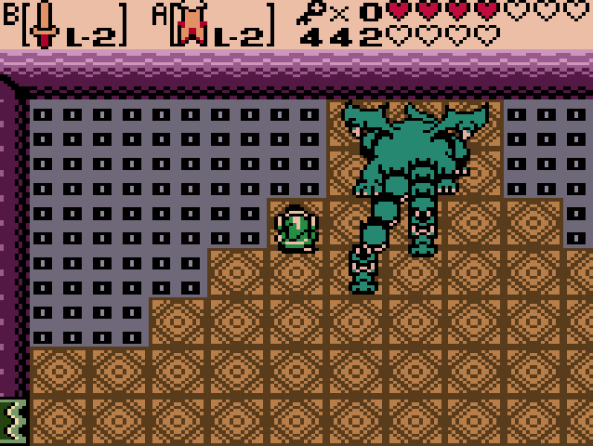
As much as these games give off a more-of-the-same vibe, they’re generally fun to play. Capcom added their own flair, allowing you to play through the games sequentially a la Resident Evil 2, with a Link To the Past style fight with Gannon (who often avoids handheld games, probably out of fear of making them seem too much like a Legend of Zelda game) for those who complete both games. As I mentioned, they bring back all the bosses from the first game like Manhandla, Gleeok, and Dodongo (among others) that those of us who have had nothing better to do since the 1980s will remember fondly. Boss fights are constructed simply, yet cleverly, and having two of them in each dungeon actually improved the game. Even the retro bosses have new–or at least variations of old–attack patterns that Link can exploit using the dungeon’s item.

The game offers the usual trinkets: a boomerang, bombs, an upgradeable sword. And some of the new items–such as the magnet glove–are inventive enough that I’d like to see it return in the main series.

The roc’s feather, however, returning from the first handheld installment, Link’s Awakening, probably deserves to be locked up in a dungeon guarded by a ferocious beast. Yes, it’s a very interesting way to access new locations, but the game relies too much on complex use of it, jumping over pits, spikes, and onto moving ledges that are often placed over lava. Part of the appeal of the Zelda series has always been that it’s NOT A PLATFORMER. If I want to simulate the feeling of waterskiing through a hurricane wearing nothing but a broken skii and a live ferret, I have a copy of Super Mario 64 collecting dust. I don’t want experience points in Resident Evil, complex puzzles in RPGs, and I don’t want platforming in Zelda. Furthermore, the upgraded version has some serious mechanical issues, especially in the games’ side scrolling sections, which often end up with Link making a beautiful 9.0 entry into a pool of lava.

The concept of traveling between two different maps separated by time travel, dimensional shift, or what have you, has long been a defining element of the series. While the ability to interact with the environment–literally–by changing seasons provides the opportunity for new puzzles, the time travel in Oracle of Ages feels like a clunky mash-up of Ocarina of Time and Link to the Past, not to mention each transition requires Link to play a five to ten second little ditty, followed by a sequence of wavy lines and warpy noises. This can tend to be obnoxious when accidentally triggering use of the harps, and ate up more of my time than I care to admit as I tried to place myself in the right age.

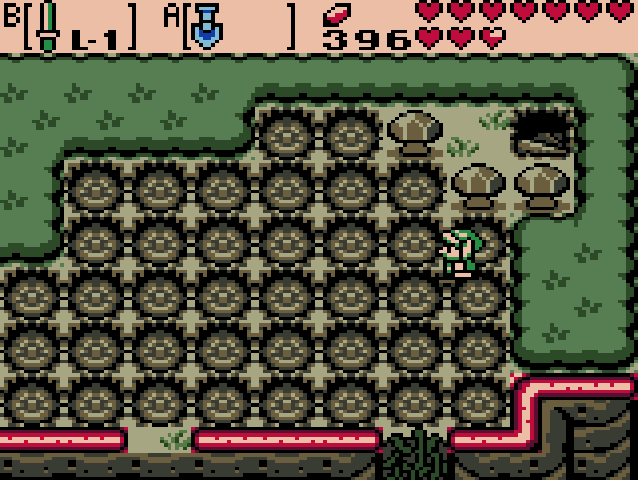
Capcom did try to shore up a frequent annoyance of the Zelda series, which earns them brownie–er, fairie–points. All too commonly, the player finds themselves just nearing the end of the dungeon when all their hearts runs out, and they’ve used up all their bottled deus-ex-machinas. Introduced to the game over screen, they find themselves whisked back to the continue point, only to find themselves with three hearts, ill-equipped to actually continue the game. The Oracle games make an attempt to fix this by giving you a percentage of your total life upon continuing, which certainly reduces tedium, however, when all you have to do is grab a shovel and start digging until you kick up enough hearts to keep going, it makes the attempt fall flat. There’s no reason not to start off the player with full life at that point, and partial life doesn’t add to challenge; it just sends them off on pointless errands they have to accomplish before getting back to the part of the game they really want to play.
In the next game, I hear Link gets a metal detector to solve puzzles that require him to look like a dork at the beach.

For the most part, the game is challenging, but not beyond hope of solving problems yourself. A few sections, mostly near the end of the games, demanded a walkthrough, which earns a big red mark on their report card, That and the odd mechanic that Link has to equip and use his shield like an item pretty much wrap up my list of annoyances with the games. Other than that, they’re worth playing through.

Games in the Zelda series have always been fairly simplistic, and the Oracle games definitely embrace that simplicity. While I like to encourage pushing the envelope, I also enjoy games like this. The value that you’ll find in these games depends on exactly how much you like to stick with an unchanged idea versus how much innovation you demand.