The Scoop – DOS

Inspector Smart

While I strive to generate an interest in games long forgotten, this week’s entry schools all my other entries in obscurity. While apparently listed as abandonware and therefore legally available for download, I don’t actually expect anyone to dig it out of the mothballs of the internet.  Still, like a serial killer claiming trophies from his victim, I may as well write about it to proudly display my conquest. Even if it did require a walkthrough.

My family got its first computer, a snazzy, sleek state-of-the-art 386, probably around 1992 or 1993–right before everyone else started discovering Windows. Already cultivating a healthy addiction to Nintendo, I found this new, clunky electrical contraption absolutely adorable, even if I spent most of the time playing solitaire, Tetris, and drawing pseudo-impressionistic geometric figures using the paint program. Still, every so often a new game would appear, presumably brought home by my dad who got a lot of cheap, secondhand software from the computer teacher he worked with. Of these games which I played endlessly–prefacing that as a 10-year-old, I probably remember 10-minute chunks of time as endless–only one of them didn’t try to teach me how to read words I could spell for five years, math skills mastered in first grade, or extremely outdated geopolitical trivia on the vague pretext that one day I could capture Carmen Sandiego. Curiously enough, this one game–the one that didn’t try to teach me anything–required more brainpower than any of the rest. One that, even today, I couldn’t quite figure out.

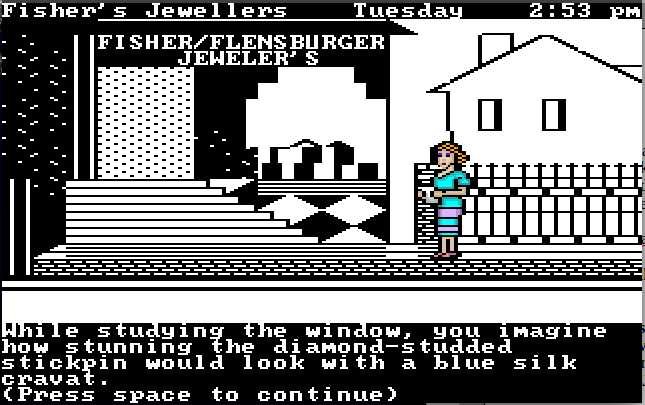
Not altogether an unreasonable time to slink around a jewlery store--not that it matters. You can barge in at one in the morning for routine looting and no one bats an eye. Hey, I don't have to go to trial, after all.

Not altogether an unreasonable time to slink around a jewlery store–not that it matters. You can barge in at one in the morning for routine looting and no one bats an eye. Hey, I don’t have to go to trial, after all.

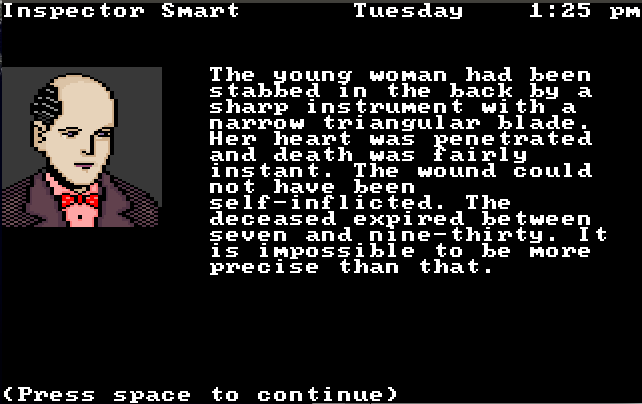
See, The Scoop, a precursor to point-and-click adventure games released for Apple in 1986 and DOS in 1989, takes its plot from a novella written (in part) by Agatha Christie. It tells the story of either a male or female reporter at a down-on-its-luck newspaper that spies an opportunity to increase readership by capitalizing on a recent murder. Which, very shortly after the game begins, becomes two murders. The reporter travels to various locations in England, talking to people, spying on people, searching for physical evidence, and showing said evidence to said people in order to evoke interesting and insightful responses. The player has five in-game days to pilfer as much junk from the scenery as possible and locate the people who may find it interesting. If the player can show the proper items to the proper people, they’ll all converge on a single spot on Saturday afternoon to reveal the murderer’s identity. Oh, and presumably in order to accomplish this you have to solve the mystery.
I think I found a clue. Does it look like a clue? I think I found a clue. (Whips out handy-dandy notebook)

I think I found a clue. Does it look like a clue? I think I found a clue. (Whips out handy-dandy notebook)

However, before you figured out who went around England last weekend increasing the corpse population, you have to solve the mystery of how the game wants you to think. You can’t travel to all locations immediately; some of them open up naturally as you progress, others when an NPC talks about it, and for some you just have to wait until divine inspiration hits you and locations come to you in your dreams. Literally. Some locations open up only after you dream about them; adding to your time constraints, the game makes sure you get a nice, healthy…uh, seven hours of sleep each day. Should you fail at going to sleep (no earlier than your 12:00 am bedtime) a fit of narcolepsy will overcome you, and your current activity will screech to a halt.  Nap attacks notwithstanding, you have to figure out which characters do what when and where in order to follow them for observation, interrogation, or just clearing out of their house so you can pilfer whatever seemingly random shit the game tells you to take.  Since certain clues and items only become available after showing other items to specific characters, which the player must first locate, this could take several play-throughs.

(Because I realize not everyone grew up on Garfield)

(Because I realize not everyone grew up on Garfield)

And with the logic the game expects, you might play through the game hundreds of times. How else would you figure out that you need to show the picture of the murder victim’s former housekeeper’s former employer to said housekeeper in order to get her to point out the identity of the murder victim’s husband? Therein lies the problem with murder mysteries; the solutions rely on clues that the sadistic bastard of an author expects us to pick up and understand. And they write fictional characters. Characters who all seem like they have a motive for offing any other character within a 5-meter radius. Characters who appear like people and act like people, but could very easily have the predictability of a highly caffeinated squirrel. Not an issue in a book, really. You get to the end, find out some clue the author withheld or a new character she never wrote about, or you’d just see how the author wanted you to fit the clues together; murderer revealed, reader becomes angry or just feels a little stupid, then zip on down to the used book store to trade it in for another carbon-copy formula mystery. Or if you want to get really wild, one of those steamy books with flowing garments and half-naked men on the cover.
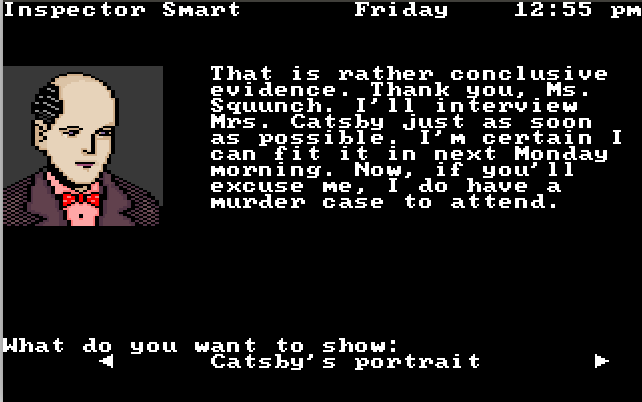
Yes...I often find portraits of irrelevant figures can prove guilt beyond reasonable doubt. Now excuse me, for I, too, must attend a murder case.

Yes…I often find portraits of irrelevant figures can prove guilt beyond reasonable doubt. Now excuse me, for I, too, must attend a murder case.

But in a game, the murder mystery format doesn’t work. Some times the clues simply don’t flow together logically and the player can only solve the mystery by trial-and-error. So while most games should have replay value, The Scoop forces you to replay it. Or, if you’ve solved the mystery, you don’t really have any reason to play it again. So with a bigger brain than my 10-year-old self and a finer understanding of mysteries (thanks to an amazing Neil Simon film, “Murder by Death.” Go watch it. Now. I’ll wait…) I zeroed in on the details I missed before, followed the people with the most likely motive, figured out that two of the characters conspired to murder over a bag of jewels…and then followed the walkthrough until a character with almost nothing to do with the story leaped off a building to avoid going to jail.
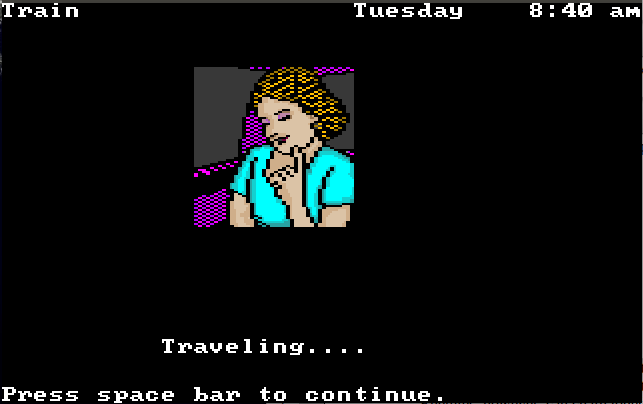
The hell with Mona Lisa; somebody tell me what this lady has running through her mind.

The hell with Mona Lisa; somebody tell me what this lady has running through her mind.

I give up. I can’t even think of anything worthwhile to say about the game. Play it if you want to learn urban English geography. Play it if you want to see artwork that makes riding on the train look like… like I don’t know what but people shouldn’t make that face when traveling! Otherwise, just take the reverse strategy of your high school English class–save time and effort and read the book instead.

Assassin’s Creed: Brotherhood – PS3, Xbox 360, PC, Mac

title

I didn’t care much for Assassin’s Creed II. Blasphemy, I know. I felt the developers had an interesting premise and concept to build a game around…and immediately burned it into a disc, slapped a label on it and charged $50 a pop. Apparently shooting for a sandbox game style, the bland tasks combined with the ad nauseum approach to…well, everything…made it a perfect game for ignoring in favor of chain-smoking episodes of Scrubs. And I watched every season. Even the last one about medical school; and if I found the rich med school tool character more engaging than murdering my way through 15th century Italy, you can imagine how little interest I had in playing Brotherhood. But I bought both games at the same time, so as long as I have no classes to teach and no real burning call to play anything else, I figured I might as well plow through it.
Naturally, the story opens up with Desmond Miles, still undergoing virtual reality training to fight Abstergo, a corporation we don’t really see which supposedly came from the Knights Templar crusaders who somehow connect with the Borgia in Ezio’s time period by virtue of developers wanting their stories to connect really bad, but not exactly giving a damn if they do it effectively. So the player learns that Templars equal Borgia equal Abstergo, and pretty much has to just understand that with no more evidence than the game telling us that once in the opening sequence. Still on the run from the last game, Desmond, his slightly less cross-eyed love interest Princess Anna, and their team of wacky, zany characters, drive into Monteriggioni where they set up the Animus machine and continue his training. At the end of the opening sequence, Desmond stands tall, crosses his arms triumphantly smiling, and declares proudly, “My name is Desmond Miles, and this is my story!”

At which point the game promptly switches to Ezio’s time period with absolutely no sense of irony or awareness either at how badly they misjudged their own story or how little Desmond actually matters. Fortunately, you only have to deal with the obnoxious sap for an extended sequence early on where you wander through a darkened, non-interactive environment trying to locate power boxes and one doubly obnoxious segment of seemingly endless platforming just before the closing credits. I did receive notification part way through that I could leave the animus at any time so Desmond could check his email. I did this once, finding two absurdly pointless messages in an inbox that had no bearing on the game in any way. Thank you, Assassin’s Creed, for you have designed a video game that successfully simulates the experience of playing a video game.

You pretty much have to get this close for accuracy in Renaissance firearms.

You pretty much have to get this close for accuracy in Renaissance firearms.

But very early on we get to leave the twenty first century and go back to Renaissance Italy. At this point, I started looking for differences; improvements they may have made from one game to the next. Brotherhood, however, appeared exactly the same as ACII. Even to the point where I had to ask, “Why does Ezio’s robe have the custom dye job I gave it in the last game? And how does he have the same inventory and cash supply?” I thought I might enjoy playing a game that built directly from the last game, allowing me to keep weapons, armor, cash, etc, and didn’t feel creeped out in the least that Brotherhood had NSA-ed its way through my hard drive to import my ACII configuration. However, after a side trip to his Villa, a surprise Borgia attack destroys his clothing, weapons and armor, forces him to leave behind his cash, and somehow makes him forget how to jump-grab ledges while climbing. (Yeah…that didn’t make too much sense)

New to the running and jumping, Ezio can swing 90 degrees, reaching new heights of "hold down X" gameplay.

New to the running and jumping, Ezio can swing 90 degrees, reaching new heights of “hold down X” gameplay.

On the plus side, the game didn’t force me to play through a tutorial stage where I had to wiggle my toes or race anyone up a building. I don’t know if they just didn’t include it or if I owe that to the ACII save file, but I liked the pacing. In no time at all, I found myself merrily romping through the rooftops of Rome, stabbing and murdering willy-nilly and care free, leaping off great heights into stacks of hay conveniently placed around town, on castle ramparts, inside the pope’s house, and later on at a 21st century construction site. From here, I did begin to notice differences between games. They streamlined the combat ever so slightly, so rather than clanging your sword against an enemy’s armor for five minutes at a time, you only have to wail on him for about four and a half. Later I discovered the kick feature, which immediately dropped their guard, which I liked, but still didn’t find half as useful as walking up to people and stabbing them without a fight. Missions feel less like playing tag with a map icon. One of the big parts of Brotherhood involves liberating areas of Rome from Borgia control. This involves sneaking into a heavily fortified area, killing a captain, then climbing a tower and setting it on fire. Yes, you have to do this about a dozen times and they don’t really vary the mission formula that much, but enough can happen to make them feel like different jobs that require different tactics and responses that I didn’t mind the repetition.

Son, one day all the light touches will be yours...providing you invest public funds into infrastructure.

Son, one day all the light touches will be yours…providing you invest public funds into infrastructure.

Once you’ve liberated an area, you can put money into renovating shops in that district. Much like the Monteriggioni renovations in ACII, this opens up new options for Ezio as well as increasing Rome’s income, which despite Borgia’s influence, apparently gets deposited directly into an account for Ezio. But he seems to understand how to spend tax money better than the Borgia, so I’ll forgive Rome this indiscretion. Not that Ezio could really skim off the top, though. While cash doesn’t flow like booze at a strip club anymore, you can’t buy a whole lot of useful things. Shops have an even more limited supply than before (excepting “shop quests,” which open up new items and of which I managed to complete a grand total of one), so a handful of renovations and a little patience could get you all the cash you need rather early on. At that point, you can only use income for further renovations, which usually serve little practical purpose other than to increase income. But screw all that: I bought the Coliseum. Why? So I could say I owned the Coliseum. Still, it seems a redundant system of busywork, and I still don’t quite understand how setting up a neighborhood thieves’ guild manages to increase the city’s value.

Ezio communicates with his lackeys by giving information to a little bird to tell them.

Ezio communicates with his lackeys by giving information to a little bird to tell them.

Also on the redundant side, Ezio can recruit assassins for his cause. Once you rescue citizens from Borgia guards, they’ll join you and you can send them across Europe on missions to earn a few florins and experience points toward–you guessed it–sending them on bigger and better missions. You can call them to bail you out of tight situations, which makes certain battles significantly less daunting, but still, both AC games I’ve played seem to lack motivation; the player has stuff to do, but no apparent bonus in stats, inventory, or even storyline to gain by doing them. You just do the quests because the game gave them to you.

Leonardo invented everything else. Why not a tank, too?

Leonardo invented everything else. Why not a tank, too?

The real joy in Brotherhood comes from Leonardo da Vinci. Forced to make war machines for the Borgia, he hires Ezio to destroy his creations to ease his conscience. These missions always involve a segment where Ezio climbs into the war machine and uses it to destroy others; providing the only variable style of game play, even if a few of the machines feel clunky and tedious.

Overall, I didn’t hate this game. The characters looked better, still cross-eyed, but less so. The tasks repetitive, but slightly more interesting. If I expressed my feelings numerically, ACII may have ranked a negative 1, while Brotherhood hovers around a positive 0.5. Maybe I’ll consider finishing Ezio’s trilogy or playing the pirate version. But don’t hold your breath.

Metroid Prime 3: Corruption – Wii

TitleMovie sequels, almost without question, have a quality inversely proportional to the number of films that precede them in the series. Video games, fortunately, routinely buck that trend. However, the literary gymnastics required to pull off a chain of sequels, prequels, inter-quils, alterni-quels and the other host of ploys developers use to desperately milk their cash cows after the udder has long since dried up and broken off has a tendency to some creative game numbering. As if “Final Fantasy II” didn’t epitomize nonsense in titling, the series eventually moved on to things like “Final Fantasy X-2“ and “Final Fantasy XIII-3.“ Having recently finished Assassin’s Creed: Brotherhood, which comes sequentially after Assassin’s Creed II but still two games before Assassin’s Creed III, I often have to throw aside any suspension of disbelief that these people can title a game more meaningfully than Mary Poppins song lyrics. Probably the prime example of this comes from the Metroid games. This week I’ll talk about Metroid Prime 3: Corruption, the tenth game in the series which takes place as the fifth or sixth game chronologically (depending on how you interpret the original and Zero Mission), and fourth in the Metroid Prime trilogy. Wrap your head around that while watching the Lion King 1&1/2.

Explain how a monster that, in 8 bits, looked like a demon child with down syndrome turns into a creature that Samus can only smite Gandalf-style.

Explain how a monster that, in 8 bits, looked like a demon child with down syndrome turns into a creature that Samus can only smite Gandalf-style.

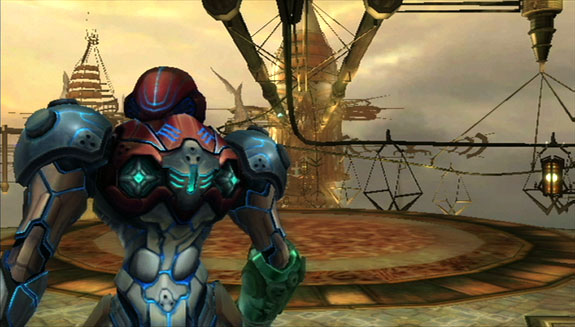
Corruption immediately stands out as different from the rest of the series by having cut scenes (although disclaimer: I haven’t played Echoes yet), thus trying to have some semblance of storyline other than shreds of information given in instruction manuals and plastered on Metroid Wiki pages. The story begins, as usual, on a space station that will shortly swarm with space pirates. Samus, with the help of her bounty hunter friends, fight back. Recurring dragon-pterodactyl Ridley shows up, challenging Samus to a Balrog-style duel as the two of them plunge indefinitely into a dark yawning chasm. Just as Samus and Team come close to saving the day, Dark Samus shows up and infects them with large amounts of phazon.  A month later, Samus wakes up, and rather than receiving the proper medical care due to a combat veteran coming out of a 30-day coma, the Galactic Federation forces tell her they’ve harnessed the phazon in her body for use in battle, and oh, by the way, wouldn’t she kindly go and hunt down the other bounty hunters who may have gone insane from the effects of phazon?

Samus's posse. She gets a posse in this game.

Samus’s posse. She gets a posse in this game.

Unfortunately, while I generally prefer detailed story lines in games over all else (to the point where I have played Xenosaga Episode I several times), it doesn’t fit Metroid. At least, not the way they did it. Rather than playing as the super-awesome solo bounty hunter single-handedly fighting her way through planet Zebes, Corruption portrays a Galactic Federation Military who must have exclusively recruited from the ranks of the Gotham City Police Department. Each new transmission relays an objective that would convey less risk if Samus had, say, a highly trained team of space soldiers to aid her, but for some reason, they all want her to do this herself. Trying to portray her as a silent protagonist, she comes off not just a little festering and resentful.

Upon starting the game, the player will first notice the nausea. While generally I don’t get sick playing first-person games, the notoriously precise Wii controller has a habit of zipping the view around unexpectedly, or losing contact with the sensor and leave Samus twirling in circles. Fortunately, I adjusted to this after about two hours of playing, but the first-person perspective may not always provide the most realistic game experience. Judging from the exploration aspects that the original games shared with the Legend of Zelda, one might think that a 3rd-person over-the-shoulder view would work as well for Samus as for Link (They picked that perspective for Ocarina of Time, apparently because they thought players would want to see a cool character like Link. I guess Samus probably also gets paid 70% of what the male video game heroes make as well…) Still, that brings up another issue I had with the game–the decreased focus on adventuring and exploration.

Not many games give you the option of ripping the life right out of your enemies. This one does.

Not many games give you the option of ripping the life right out of your enemies. This one does.

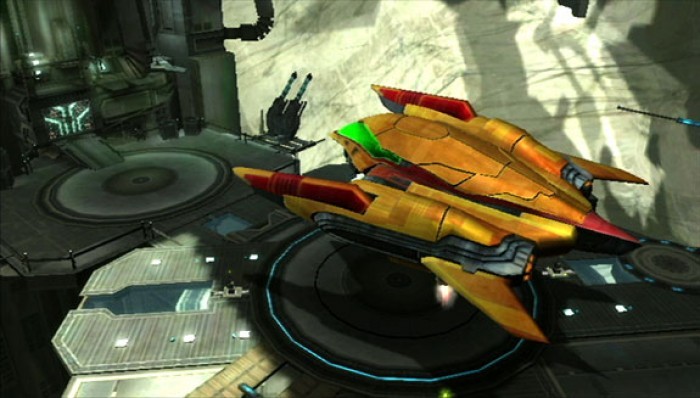
The first Prime game takes place immediately after the original Metroid. So it makes sense that Samus has her high-jump boots and morph ball and missiles (even if it doesn’t make sense that she has the grapple beam, space jump, and plasma cannon). However, early-game disaster naturally strips her of all the weapons, armor, and bonuses in order that she can start over again, making for a cliched story, but a satisfying game. In Corruption, that doesn’t happen. She begins with the morph ball, bombs, space jump, and a form of the grapple beam, and just keeps them. This sends Metroid on a trend like the Legend of Zelda. Items in both series originally helped characters reach new areas, fight enemies easier, and improved movement. Once activated, the player could use them creatively at any point on the map. Now, items have much less pizazz. They have specific uses, interacting with easily-identified objects in the environment, and only have a worthwhile use at those spots. It makes new items much less exciting to gain, and raises questions about why so much of the galaxy’s architecture favors inhabitants with morph balls and bombs at their disposal.  Can everyone morph? If so, why don’t we see anyone else do it? Why can’t we find store fronts filled with morph balls?

Oh, hell no! Platforming...my arch-nemsis.

Oh, hell no! Platforming…my arch-nemsis.

The game borrows the central hub idea from Metroid Fusion, except that you travel to different planets to reach new areas, and while in Fusion you began to discover that each sector of the ship connected with the others, you can’t get that unfolding sense of lost-in-a-labyrinth horror you get from the atmosphere of the 2-D games. (Taking into account the series connection with the “Alien” movies, introducing non-aggressive characters also takes away from the sense of loneliness). And of course, the super-detailed environment, while graphically impressive, sometimes feels like playing in a magic eye picture, forcing you to stare at it for hours before seeing the supposedly simple tasks the designers wanted you to notice. They offer you a map, but the 3-D stylized blocks they give you works about as well as solving a rubik’s cube blindfolded. Twisting, zooming and panning through it reveals nothing more than a sense of throbbing astigmatism.

I don’t want to give the impression that I didn’t like the game, though. In fact, I thought the Wii controls drastically improved the Prime series, and (for a while at least) I got no small amount of pleasure from ripping the fixtures off of walls with my grapple beam. Boss battles became a little repetitive in this area, though, as most of them require shooting at obnoxious, fast moving targets in order to reveal a weak spot that would stun the boss long enough to rip off a segment of armor so you could switch into hyper mode in order to actually deal damage.  Hyper mode–attainable because of Samus’ phazon infection–added nice features to the game, allowing overpowered blasting, shooting, and electrocuting when whittling enemies down with the charge beam got too boring, and unlike other games’ super modes, you can switch into it at any time (at the cost of some life energy), rather than just when you fill up a gauge or collect enough items or take enough damage–in most games, this usually happens just after I finish a boss or other section where such a bonus would actually benefit me.

Other than your ship, the game gives you about one save station per planet. Prepare yourself to lose hours of progress.

Other than your ship, the game gives you about one save station per planet. Prepare yourself to lose hours of progress.

Metroid Prime 3: Corruption can’t really compete with the 2-D Metroid games, especially Super Metroid, Metroid Fusion, and the original, but it does offer some satisfying aspects, and offers a nice challenge without sending you scrambling for a walkthrough every other room. Still, I may write to Nintendo and demand back all the hours of my life wasted from stupid deaths because they only give me one save station per planet.

Sands of Destruction – NDS

Title

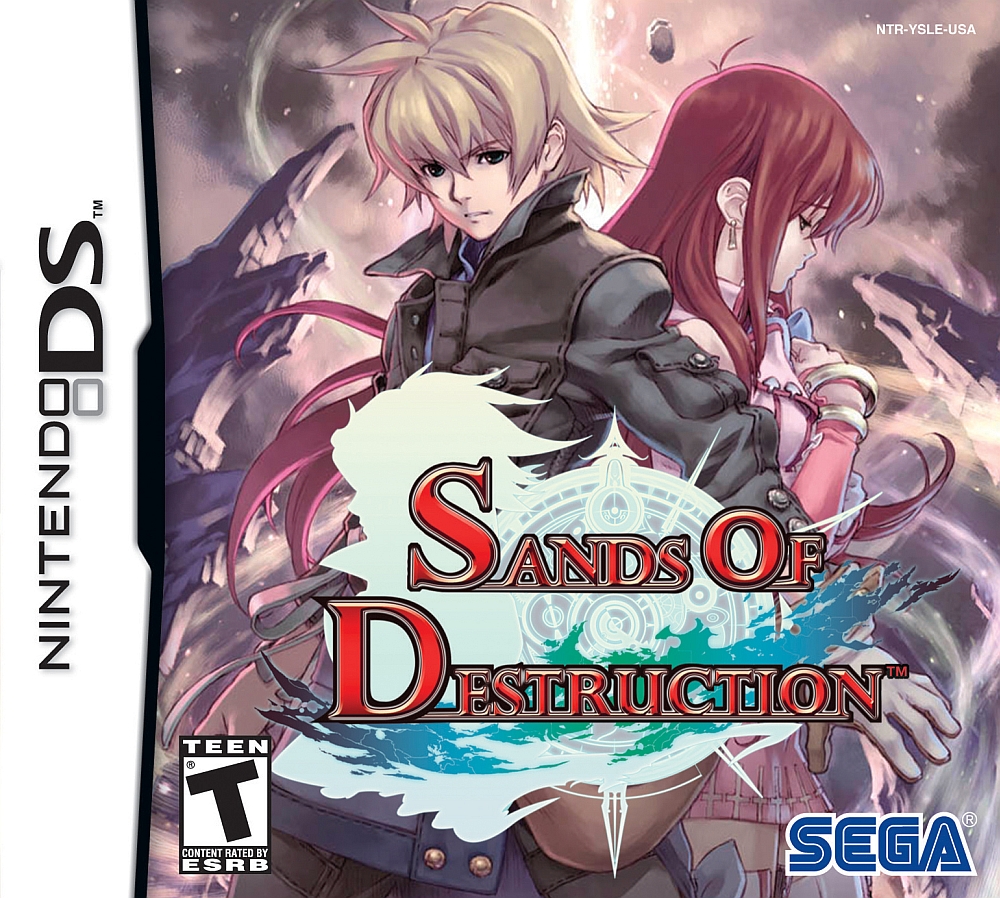
If I had to list off the best games ever made, of course Chrono Trigger and Final Fantasy VI would sit near the top. Every list of best RPGs or best SNES games and even a bunch of best-game-ever lists pick one or the other. Still, an often overlooked gem for the Playstation wins out over both of them: Xenogears. But I played it recently, and with 75 or so hours of game play, I doubt I’ll come back to it soon. Plus, while I can play Chrono Trigger over and over without getting bored with the story (and watch Back to the Future for days straight…must have something to do with time travel), overplaying a finely crafted drama like Xenogears tends to devalue the story. Fortunately, the list of people who love the game begins with the team who designed it, and thanks to their endless quest to make lightning strike as often as possible, they’ve hoisted the same battered rod used for Xenogears and Xenosaga, and enough metal remained that it channeled a trickle of electrons into an NDS game called “Sands of Destruction.”

The player can rotate the map like in Xenogears. Except in about half the areas. Because fuck that!

The player can rotate the map like in Xenogears. Except in about half the areas. Because fuck that!

From the beginning, the story clearly strives to lead the same life as big brother Xenogears; both games focus on the exploits of a twat with a personality often found only among the most noble and kind-hearted sacks of flour, who accidentally annihilates his entire village and everyone in it. Both protagonists learn they have the chosen power to do something that generally sounds like a bad idea; Xenogears’ Fei has the strength and technology to slay god, while in Sands of Destruction, a clutter of fliers reveals to Kyrie (Greek for “Lord”) that he has the power to destroy the world and should promptly join the World Annihilation Front and get on that. Then both Kyrie and Fei get taken prisoner on a sea of sand by a kind-hearted, whip-wielding pirate, et cetera, et cetera, then they kill god.

Unfortunately, Sands of Destruction doesn’t come close to the 75 hours that Xenogears had to develop their story. As much as I surrounded myself in rosaries and doused myself in holy water when I learned I had to slay god, by the end of Xenogears, I knew I needed to exterminate the sick bastard and started combing eBay for a cheap Ghostbuster proton pack. In Sands of Destruction, the WAF distributes orders like it desperately wants you to see its band perform, but for all the confetti you pick up by the end of the game, no one has given you a single reason why you need to put the world down. It certainly doesn’t feel like an impending apocalypse; no one points out frogs going extinct, polar bears balancing on ice floes, the dead rising from the grave and the virtuous ascending into heaven, or polar vortexes ruining an already cold Minnesota summer.

"In a game so bland they couldn't figure out what to do with the second screen half the time."

“In a game so bland they couldn’t figure out what to do with the second screen half the time.”

Rather than spending time developing character, conflict, or even asking the pretty young girl who rescues you from jail why the world sucks so much, the game sends you on one pointless task after another so that you run into the beast lords, twelve anthropomorphic rejects from Winnie the Pooh, mowing them down one after another without any real idea of what they’ve done to oppress the human population or ruin the world. In addition to the beast lords, Kyrie crosses paths with primal lords, titanic gods who appear to govern the whims of nature. These primal lords accept the inevitable apocalypse with a positive spirit and a chipper attitude, but still attempt to re-decorate their houses with his bowels to show the ungrateful brat a lesson about what happens to him if he ignores his chores to go gallivanting around not destroying the world. That’ll teach him! The story plays out entirely without any motivation for or investment in the quest at hand, and in the ending sequence after you kill god and find out that “creating your own world” means making everything exactly the same except for replacing all the sand with water, I couldn’t help but wonder why anyone really had to do anything. I mean, no one really seemed all that thirsty before, and the sand ships seemed to work just fine. Any mystique or meaningful interpretation behind the story becomes flimsy and transparent to anyone with a few weeks of Beginning Latin under their belt. Only one character kept my attention for any length of time, mostly out of the novelty of a teddy-bear bounty hunter with a gruff, middle-aged, man’s man voice. He joins the party because he wants to take in one of the characters for her bounty, then just sort of goes along with all their plans and quests without any real explanation. Also more of a novelty interest, one of the early villains speaks in the angriest, most self-absorbed gay lisp I have ever heard. I might suggest playing the game simply for the voice acting, except for the long, unskippable pauses between lines of dialogue.

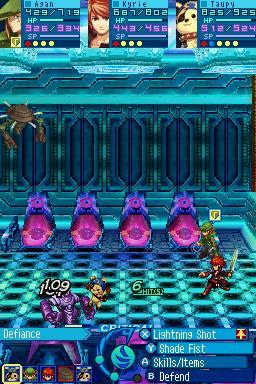
The game really likes to make you wait. Much like in Xenosaga, characters get two attacks per turn, sometimes earning an extra attack through–as far as I can tell–pure fucking chance. Enemies, however, can chain together about as many attacks as they feel like, often not quitting until at least one character dies. Factor in useless animations where they spasm like a raver in the advanced stages of Parkinson’s, and enemy turns become useful moments to get stuff done around the house. Go make a sandwich. Vacuum the floor. Do your taxes. Eat that sandwich. Don’t worry. Your characters won’t take their turns any time soon. You won’t miss anything. The battles display a turn order like in Final Fantasy X or Xenosaga, but not with enough accuracy that it lets you plan out a strategy or anything. Nope. Enemies can cut their way into the sequence whenever they like, certain characters will forget about their turns entirely, and every so often they’ll even trade order, making the display more of an annoying distraction than useful information.

Taupy dealt about 10 times the damage as Kyrie. I used him often.

Taupy dealt about 10 times the damage as Kyrie. I used him often.

It feels like Sega developed and published this game at gun point; as if they pounded out a rough draft and never bothered fixing any of the problems with it. Kyrie attacks as if I equipped him with a pair of used chopsticks, while a few of the other characters can deal about 100x the damage that creatures can take. They try to balance this out by giving enemies obnoxiously high evade rates, which I’ve said before only turns battles into endless sessions of watching battle animations like you have to remember them for a test. Similar to Xenosaga and Xenogears, attacks correspond directly to buttons, with X delivering a single hard-hitting attack, and Y dealing a flurry of blows, each one dealing as much as a single X attack, and a system of magic attacks, fully powered up, allows characters to expend SP to almost deal as much damage as a single X attack. I advise you to tape down the Y button and open up a bag of chips to eat with the sandwich you made during the boss fight.

Teddy bear kicking the shit out of someone.

Teddy bear kicking the shit out of someone.

Character customization had potential, allowing the player to power up attacks at the expense of accuracy or accuracy at the expense of attacks. Magic attacks traded off power and SP cost. Still, only ever using the one attack, I didn’t feel any sense of urgency in strategizing how I’d level them up. I hit the attacks I used and then just dicked around with the rest of my customizing points to keep them from piling up. Furthermore, by the time I got to advanced magic spells, I started noticing that players simply can’t use certain attacks that they learn. At various points during the game, players learn “quips,” short phrases that they can repeat in battle. Unlike most useless battle cries, these have effects, usually support statuses, that can actually make a difference. Each character learns a total of five, and can equip…four. Again, the game doesn’t really press you to make the difficult choices.

Most dungeons consist of only a few screens, padded out with all the tedious puzzles they could think of and enemy encounters so frequent that the Toyko metro system during rush hour has more breathing room. And that serves as a good metaphor for this game. It has a lot of good things in it, but not enough elbow room to use it for anything constructive. Most of this game only exists to pad out a handful of interesting ideas into a full-length (about 20~25 hours), marketable product for the NDS, and tedious methods for making a game feel longer without actually giving us a reason to play it tend to amount to an Asian train ride; you may have gotten somewhere, but only at the expense of an unpleasant journey, and you get off feeling like someone either owes you an apology or dinner.

Ragnarok: The Fate of Gods

Hey everyone! Special super extra bonus entry this week! I get to clue you in on one of the most amazing book offers a video game fan could ever ask for. Just kidding! Actually I just want to subject you to some shameless self-promotion. But still, if you enjoy video games–which you should, if you read this blog–you would enjoy this book.

Ragnarok: The Fate of Gods tells the story of a swordsman struggling to survive in a Post-Apocalyptic Orwellian dystopia, terrorized by monsters and ruled by a reclusive overlord. I could tell you more of the plot, but I’d just end up repeating all the information on the Amazon Page.

Why should I pitch this book here? You mean, other than the fact that I have very few meager sources of income and would appreciate the $1.97 royalty per copy sold? Well, when I wrote it, I blended a lot of common themes from video games, popular science fiction, and myth. Particularly if you enjoy RPGs–and most specifically Final Fantasy, Xenogears or Xenosaga–you should read it.

Unfortunately, no, you can’t find print copies, only the Kindle edition, BUT you can read it via a free kindle app if you don’t have your own e-Reader. Also, amazon has made the book available (in English) on many of their multinational websites; good news to all my non-American readers. Just search for “Ragnarok Fate of Gods.” Otherwise, to buy via the American site, follow this link.

Keep in mind that I have a masters degree in publishing–I didn’t just hammer this out over a weekend and slap a price tag on it. You’ll get some high quality stuff here, and it’ll only cost you three dollars.

And if you like it, please leave a review on Amazon for others to find. And then tell two friends…and have them tell two friends…

Thanks!


Duck Tales: Remastered – PS3

Because they couldn't make Mighty Ducks jokes in the 1980s.

Because they couldn’t make Mighty Ducks jokes in the 1980s.

I finally got around to playing the Duck Tales: Remastered edition that I first heard about last year. Before I start, I should explain that I approach games like these very carefully, like opening a can of root beer you found on the floor of your car; you can open it if you want, and you may even enjoy it, but you have a better than average chance of something exploding in your face resulting in a mess that leaves you with a sense of utter disappointment. Duck Tales has two problems in this department. For starters, Disney made it to cash in on the popularity of their cartoon–yes, people still watched the show when this game came out–and game adaptations of movies or tv (much like movie or tv adaptations of games) tend to maximize their entertainment potential when buried deep within the earth (I mean that seriously…look up the Atari ET Game Burial). Fortunately, we dodged that bullet back in 1990, when the game surpassed expectations.

Still, the PS3 edition still does something that makes me cringe whenever I hear about it. If you remember the year or two following the release of the PS1, one of the big game publishing trends liked to re-release old Atari or arcade port compilations, usually with only one or two games you feel like playing until you actually buy the game and play them, tossing the disc aside like a torn Kleenex rag. In a way, they did resemble the use of Kleenex, though, since you only pull them out momentarily to interrupt what you really want to do with your time. Yes, I know it sounds weird to devote my time to praising the value of old games, but re-releasing them on high-end consoles just doesn’t make a whole lot of sense. Imagine having the power to render images of 3-dimensional polygons on a 32-bit, CD-based system, and trying to sell the technology with Pac Man. It wastes the capabilities of the console, and let’s face it; you could take a massive dose of Ritalin and get bored with Pac Man after five minutes.

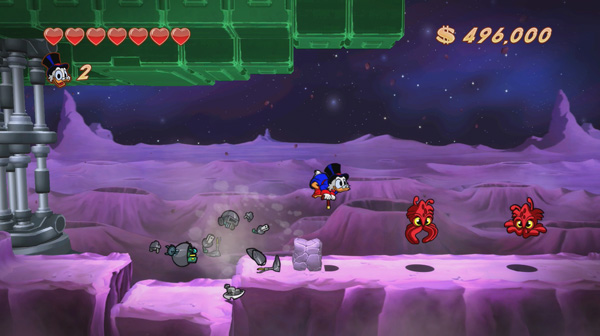
One small step for a duck; one giant leap for a duck with a pogo-stick cane.

One small step for a duck; one giant leap for a duck with a pogo-stick cane.

But those collections merely port the games, doing nothing to touch them up visually or to add worthwhile aspects to game play. How does an NES re-make stand up on a console 4 generations after its debut? Not bad, it turns out. The game starts off a little confusing, opening with the original 8-bit midi rendition of the Duck Tales theme used for the NES release. I feel that sends a mixed message–do they want a nostalgic game, in which case why change anything, or will we see how the PS3 can revitalize an old favorite, in which case, why not update the midi? A trivial point, I know, but not half as trivial as my next complaint; why do we always have to push the start button to load opening menus? Doesn’t that just add useless coding to the game?

I’ll stop. I swear. Anyway, the game actually works well. They’ve flushed out the story from the NES edition by, well, adding a story. Someone busts the Beagle Boys out of prison, and of course they flock to the one spot in town where they can reliably find a pile of three cubic acres of cash. Scrooge fights his way into his own money bin, fending off the Beagle Boys who have appropriated his Rube Goldberg Brand security system, but finds Big Time Beagle more interested in Scrooge’s new painting than the vault. After delivering a brutal thrashing–as we could only expect would come from a sixty-year old 1%-er who wears a waistcoat, spats, and top hat sporting a cane–he discovers a treasure map inside the picture, leading him to five of his characteristic adventures across the globe. And the moon. Cut scenes added to the individual levels, however, suggest something sneaky afoot.

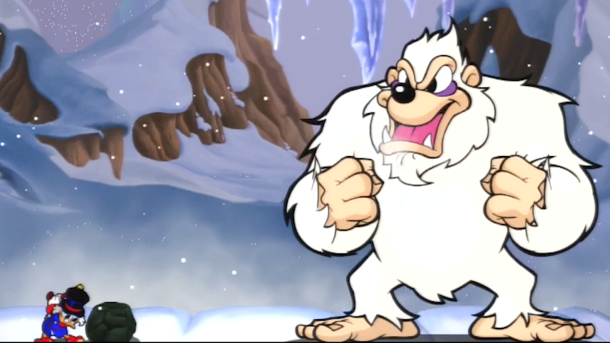
In case you hadn't yet figured out that jumping on the monster's head wouldn't work.

In case you hadn’t yet figured out that jumping on the monster’s head wouldn’t work.

I really can’t say too much against this game–which actually makes it a bad choice to write about on a humor blog. The story they built up around the pre-existing framework actually does what every movie or tv game should strive to do; re-create the feeling of the TV show in an environment immersive to the player. I sincerely have to commend the writers, who captured characterization perfectly, creating conflicts and scenarios that blend in seamlessly from those you’d see in the television series. Most episodes had some character basis for Scrooge’s shenanigans; he’d feel old, so he’d hunt for the fountain of youth, or Webby would rue her life as a little girl, so she’d drink from a magic spring that would make her the size of Queen Kong. This game doesn’t have that; they focus entirely on the adventure. Also, they missed the perfect chance for a Duck-pun in naming the boss of the game “Count Dracula Duck” instead of “Count Drake-ula” or “Count Duckula” (but that one may have had legal ramifications). Otherwise, I can’t complain.

The game features voice acting by as many of the original actors that Disney could get a pulse from. The ironically named Alan Young–also famous for playing Wilbur on Mr. Ed, and appearing in “The Time Machine”–nails the high spirit and energy of Scrooge McDuck. Magica deSpell once again channels Natasha Fatale, voiced by the immortal June Foray–97 years old, we can only hope she takes good care of herself so that she has another 97 years left to voice such beloved characters. Frank “Fred From Scooby Doo” Welker provides the voice of the Beagle Boys, and Russi Taylor and Terence McGovern also reprise their roles. Unfortunately, some actors couldn’t make it on account of well…remember that pulse thing I told you about? I only put about 50% joke into that. Brian George, though, fills in a very close match for Flintheart Glomgold, and Chris Edgerly passes for Gyro Gearloose. They didn’t seem to put in a lot of effort for a replacement Fenton Crackshell. Instead of Hamilton Camp, they must have gone with “Some guy they found in the break room.”

Game play loosely resembles the original, but each level has a new layout, and rather than the dash-straight-for-the-end strategy from the NES version, they each have their own objectives that encourage exploration through the entire stage. The bosses come back with a vengeance, adding new attack patterns, making them much more challenging than your average koopa troopa. Also, the game includes a tutorial level–for those of you too inept to figure out a game that uses the D-pad and two buttons–and a new final stage. They get rid of all backtracking through the Transylvania level, which didn’t make a duck load of sense in the first place, so the game feels like an improvement. The game’s ended expands greatly from the brief newspaper article of the NES version showing you your score. Instead, the story concludes, the game flashes shots of its concept art, and you get to sit back and enjoy a list of credits so detailed that you learn the names of everyone from the executive producer to the the part-time janitorial staff for the European P.R. department.

Scrooge's office building, the money bin. I hear the employees fill the suggestion box with requests for stairs.

Scrooge’s office building, the money bin. I hear the employees fill the suggestion box with requests for stairs.

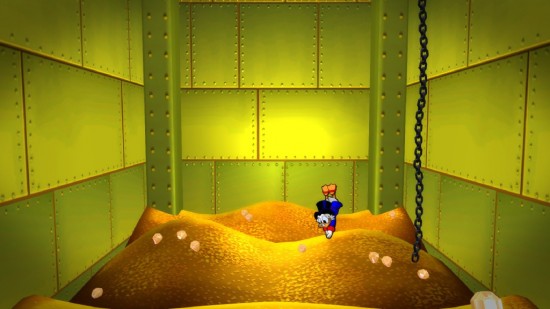
The gems represented one of the biggest frustrations from the NES version; no matter how much you picked up, you didn’t actually get any richer. You couldn’t trade Scrooge’s fortune for the cost of an SNeS. In the PS3 version, however…you still can’t. But the money goes toward unlockable concept art in an in-game gallery. And when you’ve unlocked all the pictures, the money goes toward filling the money bin, which you can dive into and swim through between levels, an activity that will keep you amused for at least the amount of time it takes you to climb back out of Scrooge’s stash. You might even swim a few laps back and forth before your mind drifts off to thoughts of Pac Man.

If you thought the water pressure in your swimming pool would crush your ears, try diving to the bottom of this sucker.

If you thought the water pressure in your swimming pool would crush your ears, try diving to the bottom of this sucker.

I didn’t cover the game until now because of the price. I liked the NES version and wanted to play the Remastered edition, but I didn’t know whether the $20 for the disc (or the $16 for those of you who don’t feel compelled to buy a hard copy). I still don’t know if the few hours of play time justified the cost, but I feel like it offers enough reason to replay the game (build up your cash pile) that I don’t mind the cost, and I figure when the NES version came out, I probably paid at least $50.

Castlevania III: Dracula’s Curse – NES

RetroArch-0611-134745In my Aria of Sorrow review, I confessed that I had previously had all the contact with Castlevania that one might want with a $50-or-less prostitute, rather than with a long-running, beloved horror game series. After finally beating the first game (admittedly, through the liberal use of save states), I thought I’d enjoy running through the other NES installments, playing them as I may have back in the late 80s. Unfortunately, the very special brand of whale shit we get from Simon’s Quest will require more practice in meditation and emotional control, until I reach a state of tranquility that enables me to transgress some of the most awful gameplay this side of Dr. Jekyll and Mr. Hyde. So instead I worked my way through Castlevania III: Dracula’s Curse.

RetroArch-0611-160656A few hundred years before Simon Belmont whipped it good through Transylvania, a similar problem came along for his great-grandfather, Trevor. At that point, the Church had excommunicated the Belmont family because the scared people, a problem that today would have earned the Belmonts a position as Cardinal, or at the very least GOP Congressional candidate. However, when Dracula moves his family to town, guess who comes crawling back to the scary, superhuman vampire killers. Trevor has to fight his way through the Transylvania countryside to rescue powerful figures imprisoned by the vampire, and he can take one of them with him on his journey. Afterwards, he whips his way through a castle in exactly the same condition that we see two hundred years later with Simon (at least Dracula likes to keep his home in a consistent state of disrepair) until he comes face to face with the D-Man himself.

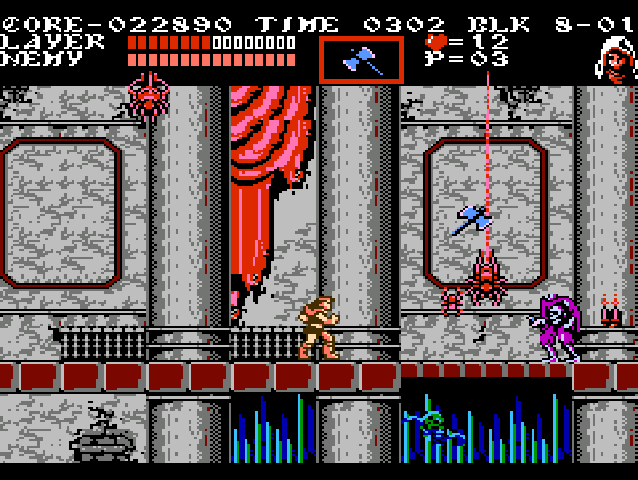
RetroArch-0611-155840Returning to the form of the original, the game opens with a powerful image: Trevor Belmont kneels in prayer at the remains of an altar in a ruined church, then stands up. It’s simple, uncontrolled by the player, and makes an extremely powerful statement. I can’t exactly describe that statement, but believe me. Statement. It makes one. Anyway, from there, the action begins. Much like the first game, Castlevania III has elements of platforming, elements of run-and-gun games like Mega Man, and elements of moving a refrigerator from a truck into your 3rd-floor apartment. Yes, dysarthria must run in the family, as Trevor, like Simon, moves, turns, jumps, and dodges with the urgency of a rascal with low batteries. At least in this game, this feels deliberate. While Simon came off as obnoxiously suicidal, hurling himself backwards and off any nearby ledges at the slightest stub of a toe, Trevor’s movement issues play off the random attack patterns of the enemies, a move that ramps up difficulty rather than simply frustrates players.

RetroArch-0611-173952Don’t get me wrong, though; it frustrates players as well. However, Simon’s Quest deserves recognition for its contributions to Dracula’s Curse, namely unlimited continues and a password system. Konami still made this game harder than Chinese calculus on viagra, but at least now you don’t have to slog through the first few levels only to never see the later ones. Theoretically. Furthermore, this game lets Trevor partner up with other skilled characters who have a beef with the head honcho. Grant, the acrobat, moves faster than Trevor and can cling to walls and walk on ceilings. The infamous Alucard has a mid-ranged attack in up to three directions at the same time, can turn into a bat, and single-handedly begins the phenomenon of the Japanese spelling Dracula’s name backwards as if they’ve discovered the most clever, insightful and symbolic literary device and not at all a stupid trick to come up with a funny name. Sypha, another vampire hunter, also allegedly has some reason you’d want to use her instead of Trevor. Apparently she can use magic, although I got stuck with her for the majority of the game and never quite figured out how. Trevor has the strongest attack, and generally works better than the others, but occasionally their skills (especially the acrobatics) come in handy. Furthermore, to get these characters, the map offers multiple paths, allowing a different play experience each time through the game.

Interesting side note, something I wish I had known going into the game; you can only take one character with you at a time. If you pick up Grant (the first one available), and then run into either Alucard or Sypha, they’ll give you the option to take them with you. If you accept, Grant ditches you without warning.

RetroArch-0611-135219Beyond that, the game does justice to the original. The music and scene design creates a worthwhile atmosphere, sub-weapons (all exactly the same as before) add variety to strategy. Death still puts up a bitch of a fight, and you fight Dracula in the same room at the top of the stairs with the same crescent moon in the background. If you liked the first game, you’ll like this one too. Probably the only drawback, bosses don’t stand out as famous monsters. Sure, a few of them return, but I like to think that the others asked for too much money to appear in this game, so Konami had to find other actors willing to play the parts.

RetroArch-0611-174633

Dracula’s Curse also employs a primitive sort of New Game + concept. Not uncommon for games from the 80s, finishing the game gives you the ending credits–which differ depending on which character you got stuck with–and then plopping you right back at the beginning of the game, still with the character you picked up (and apparently, you can’t get the other characters…at least, I couldn’t get Grant again, after he ditched me with Sypha on the previous round). However, on the second play through, it ramps up the difficulty from “brutally punishing” to “setting your couch on fire with rage.” The levels have extra enemies, and some end-game enemies replace simpler, easier to dodge monsters from earlier on. I’ll confess I only lasted two levels on this setting.

Shining Force II – Sega Genesis

You cannot pass!

You cannot pass!

Last year around this time I decided to indulge in a bucket list game of mine: Shining Force. Given the choice between all the options released for the Sega Genesis, I randomly decided to begin with the first title that bore the name, all the while hearing over and over from sources online that the sequel blew that game out of the water. So in the mood for an old-school RPG, I pulled out Shining Force II and prepared for it to impress me with…a game almost completely indistinguishable from the first. Don’t misunderstand me, the first Shining Force more than justifies the cost of a Sega Genesis. But I had hoped that the improvements touted across the internet might include a story not ground from the same petrified chunk of mammoth shit, or a menu system a little cleaner than a congressman’s after-hours activities. Sadly, the game fails to deliver on both counts.

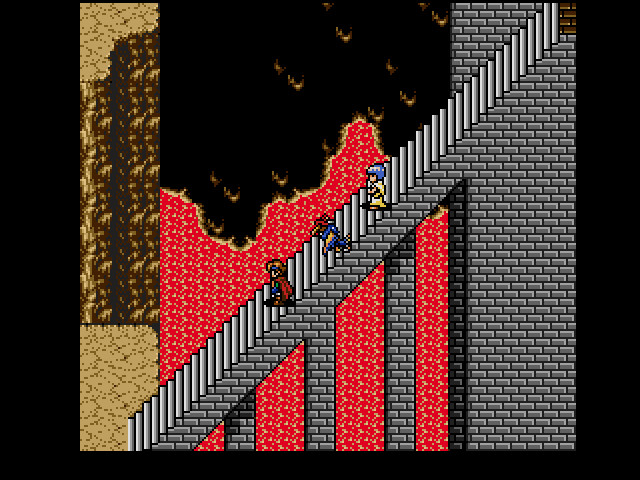
Davey Jones?

Davey Jones?

Shining Force II centers around tactical role-playing. As the leader of the force, the hero, dubbed “Bowie” in all media except for the game itself, commands a cast of characters with rudimentary job classes, mostly determined by species. Centaurs come equipped with all the important parts of the horse, so they make good cavalry. Dwarves make good, stout, infantry, while elves tend to work best with ranged weapons. Still, so as the king can cite examples in opposition to passing any civil rights legislation, you’ll occasionally get magic-using elves or humans, a centaur with a bow, or some other such crossover. For the most part, classes only determine what type of weapon the character will use, or in the case of magic-users, their spells and MP. The game’s primary difference involves a cast of hidden characters, each with special requirements to fulfill before they’ll join you. Furthermore, while all your characters should receive a promotion at level 20, you can promote some (apparently) to alternative classes. On both counts, I can’t say for sure whether or not I unlocked any of these, since even the main story often fails to clarify the steps you need to take to advance.

But we don't have the courtesy to do this during battle, of course.

But we don’t have the courtesy to do this during battle, of course.

The story begins with a careless thief (but one with a good heart!) unsealing an ancient Devil on Granseal island. This demon unleashes his hosts upon the world. They possess one king, try to kill another, suck the princess into an alternate dimension, and somehow embed two jewels into Bowie’s neck. Shaking off this pretty intense body modification as no more than modest bling, Bowie sails with the other survivors to the continent in order to found a new Granseal. He meets a phoenix named Peter who somehow becomes an important character, they travel around, do…stuff…and somehow they find the Peruvian Nazca drawings in this fantasy world otherwise unrelated to Earth, fly back to the island, and face off against a host of devils, demons, cliches, and WTFs.

Ah, yes, a translation to rival the works of Hemmingway, Milton, and Chaucer

Ah, yes, a translation to rival the works of Hemmingway, Milton, and Chaucer

Much like the previous game, the plot serves as an engine (albeit a badly tuned engine with a few pistons not firing and the “check” light constantly blinking on the dash) to get players from one battle to the other as fast as possible. While many games of this era can defend themselves with the “poorly translated” argument, Shining Force II has a special kind of bad writing that you only see when both the writer and the translator habitually abuse strong narcotics. The kind of writing that, while not overtly suggestive, makes dialog such as “They took my jewels” and “Don’t touch it! I’ll shake you off” sound like they lifted it right out of Leisure Suit Larry. One of the primary cliches–I mean, antagonist with a heart of gold who joins you after a major epiphany–suffers from one of the worst mistransliterations I have ever seen; rather than squaring off against the valiant Baron Ramon, the game expects you to take seriously repeated encounters with a villain named Lemon. However, I think I’ll grant my coveted Drunken Developer award to the end of the game where they can only break the curse on the sleeping princess with yet another cliche, and the characters hold a meeting to choose which one can deliver the true love’s kiss. While I never doubted for an instant that Bowie would get all the action here, they actually disappointed me by suggesting your healer–the blue-haired, sparkly-eyed elven priestess–could have possibly broken the curse, and then didn’t follow through on that.

Honestly, until that point, I didn’t think any of the characters had an inkling of personality behind them. They join your party out of the blue and fade into obscurity almost as quickly. To save space (presumably) on the cartridge, battle menus display character classes as four-letter abbreviations, such as RNGR, PGNT, RDBN, and SDMN, which I can only assume stand for Ringer, Pageant, Robber Barron and Sadomasochist, respectively.

Squid!!

Squid!!


The battle system helps this game stand on its own. Battles occur on the map, but like the first game they switch to an isometric animated environment whenever a character acts. Like any other tactics game, characters have a certain distance they can move per turn, each attack has its own range and effect areas, and different attacks seem to affect enemies differently. The limited number of attacks and the inability to customize characters make it a very rudimentary strategy game, but it plays well and forces you to think about your actions (even at one point dropping you onto a chess board and making you fight the pieces). Unlike the first game, you can freely explore the map and return to areas previously visited. Rather than having a set number of battles, they’ve introduced random encounters, which always seem to follow the same presets–kind of a nice gesture, I guess, but since you retain any experience when you die, it really makes level grinding unnecessary unless you really need some quick cash.

The system for awarding exp, though, leaves a lot to the imagination. The amount you earn after each attack seems about 10% dependent on whether the attack connected or missed, 10% on whether it defeated the enemy, and 80% on whether the game feels like giving you only 1 exp. Also on my list of criticisms, I’d like to add that I enjoyed the opportunity to explore the map (on account of having that option in every RPG released since the 1980s.), but the game didn’t always clarify where to go or what to do. At all. I felt good when I got a cannon and read that it could destroy rocks while also remembering a rock from halfway back to the beginning of the game that blocked my path. However, when I got there: nothing. Only by looking up a walkthrough did I learn it wanted me to backtrack to New Granseal and talk to a random guy outside the weapon shop in order to get ammunition. And while the game should take the blame for not giving me so much as a hint, I end up looking like a dumbass who tried to shoot a gun with no bullets.

Should I mock the mass of amalgamated hair, or the softball stuffed down her dress?

Should I mock the mass of amalgamated hair, or the softball stuffed down her dress?

But I have to look really hard for those flaws; while I appreciate a strong story, I can look past that to see the strong gameplay. I can’t comment on the music since I turned the sound off and played the game while watching seasons 3-5 of Dexter–all the while, of course, not missing out on storyline for Shining Force. Looking back at last year’s entry on the original game, I did the same thing with the sound. Losing track of how many times I compared the two games, I can say confidently that Shining Force II really stands out as an excellent jewel (hehe) of a game; I just disagree with the assessment that it surpasses the first.

Kingdom Hearts II – PS2

Mickey Mouse: Bad Ass Warrior King

Mickey Mouse: Bad Ass Warrior King

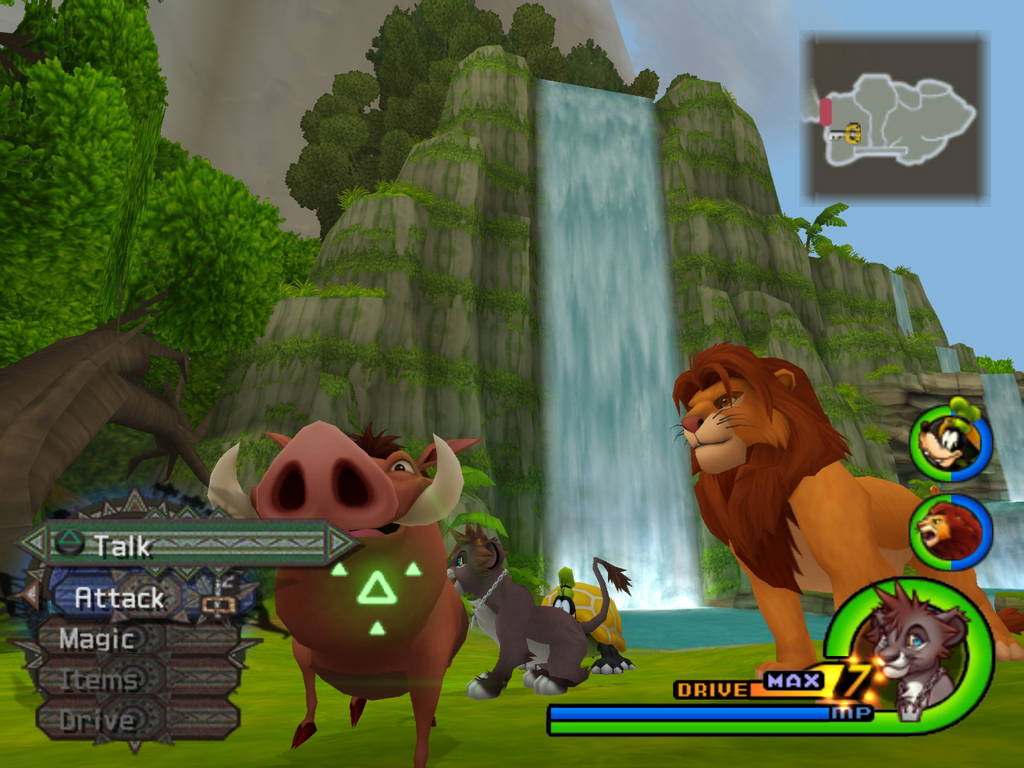
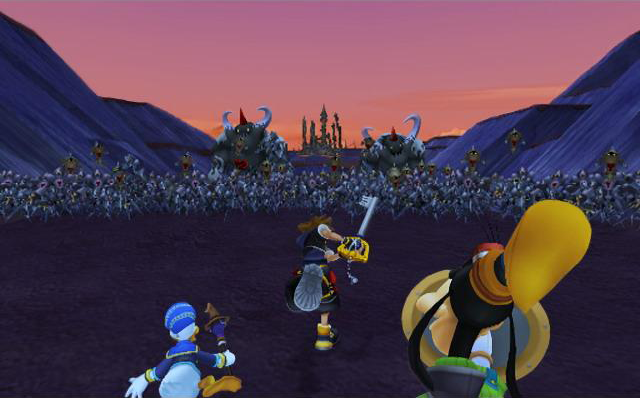
The keen reader may notice by now that I did not begin my entry today with a twenty-page instructional guide on the cleaning, gutting, and harvesting of sperm whales. Odd as that may seem, I have a very solid justification for that decision; nobody wants to read boring irrelevant shit just to get to the interesting part of the article. Likewise, my primary criticism of Kingdom Hearts II stems from that same philosophy. Normally in a game that involved a substantial amount of story, I’d begin by describing a brief summary of the most relevant points of the plot. However, this game doesn’t really have any. The overarching plot once again focuses on Sora. Once again, the primary conflict involves the race of Heartless swarming through the ragtag amalgamation of worlds that any other game would have the decency to call a galaxy. Square-Disney introduces a mechanic in which a strong-willed person who becomes a Heartless actually separates into a Heartless and a “Nobody,” which as you can surmise from the name, also has no heart. The strongest of the Nobodies have formed an organization to protest that they have no right to exist, and Sora must stop them (yeah, I’ll get to that later). So slide your disc into your PS2, select the “New Game” option, and then prepare yourself for the non-stop thrill ride of watching some other kid spend his last week of summer vacation in the most average, mundane way possible…for three solid hours!

Hot tuna frittata?

Hot tuna frittata?

While I feel Kingdom Hearts II generally improves upon its predecessor, even in the area of storyline, the game needed plenty of editing. While the character Roxas needs an introduction, that introduction does not need to occupy the first three hours (two if you know the secret) of the game, and they definitely could have set either a faster pace or a less mundane story arc for us to follow. No one wants to whack a ball for a crowd endlessly in order to earn pennies toward a train ticket so Roxas can ride to the beach with his friends (which the game never bothers to tell you that you don’t actually need to do: your friends will make up the difference). See, unfortunately, once you pass that part, the game paces itself quite nicely, and since the first game appealed more to Final Fantasy fans more Disney, they instituted a darker, more adult storyline. However, in order to get that far, you almost need to have a fetish for the Lion King in order to summon up the patience to slog through this pointless hazing in order to get to the actual game.

And you'll stay there until you finish them all, young man!

And you’ll stay there until you finish them all, young man!

The game itself plays quite nicely. They sped up the irritating gummi ship sections and got rid of the gummi ship builder from the first game that worked with the learning curve and intuitiveness of ancient Sumerian cuneiform. The different worlds feel larger and more fun to go through, and you visit most of them twice for shorter episodes. This game pretty much only suffers from the writing skills of a burgeoning romance novelist who recently suffered a series of strokes rendering the language portion of their brain as useful as a lump of mashed potatoes. I loved the moment when Mickey showed up like Yoda and went all epic-warrior-king on the heartless, but while the darker story makes it better than the original, their tolerance for “dark” ends with well-tanned guys with beards. Don’t believe me; try to find a copy of “Song of the South” on DVD.

Already a short game to begin with, they could have shaved probably 40 minutes off the total play time if they hadn’t insisted on every single character chiming in at least once with a chorus that names the protagonists. “Sora. Donald. Goofy.” Because the player might forget, and the game can’t keep our interest in any better way than by constantly reminding us of this, seemingly to the exclusion of actually giving names to the members of Organization XIII. I understand that the Tron world has to sound computer-y, but I feel someone at some point during the editing process should have caught the potential double entendre in Tron repeatedly talking about his many “user friends.” And ending each episode with “we did it,” “way to go,” or just a raucous chorus of laughter from a gathering of characters reminded me of the cliches that resonate through the creative writing class assignments of the most inept writers our language has to offer.

They didn’t get rid of the Winnie the Pooh world, but they made it more tolerable by comparison to the Little Mermaid level. Rather than swimming through the sea fighting Heartless, they turned it into a music/rhythm game. Still, that could work, right? Alan Menken’s genius score for the film certainly…what, now? They introduce original songs? Songs that first-semester musical composition students use for toilet paper. Songs that challenge me to find as many interesting ways as possible to say “bad writer” in one entry. You get to do “Part of Your World” and “Under the Sea,” but they’ve cut and hacked them like a drunken lumberjack so they don’t sound good anymore. They even marvelously missed the point of rhythm games, as the triggers don’t line up with any discernible beat in the music.

The game gives Sora new duds for each world. This may not sell the game for them.

The game gives Sora new duds for each world. This may not sell the game for them.

The first game ran with the idea that Sora couldn’t “meddle” with the natural course of events in any world, and merely had to get in, lock the keyhole, and get out. Kingdom Hearts II on the other hand has an ankle-deep puddle from trying to flush that notion down the drain as fast as possible. Sora deposes Scar, bargains with Hades for the fates of the dead, single-handedly rescues China from the Mongol hoards, and deletes both Commander Sark and the Master Control Program. Near the end, Maleficent appears, willing to fight off a swarm of heartless and allow Sora to go on to defeat the final boss (presumably for her), and when Sora protests, Mickey says, “They’re doing what their hearts command. We can’t interfere.” Unless, of course, they do something antagonistic, in which case they can interfere liberally. The final boss has his own heart’s command (never mind that he allegedly has no heart) and Mickey and Sora fully intend to interfere with him. And that raises another issue: The Organization of nobodies, according to the exposition, has no right to exist. They have no hearts and no recognition as people, and only want the same shot at life that everyone else has. In order to accomplish this, they need to destroy the Heartless. But the game tells us to fight them, so we must stop their, uh…evil?

In case pressing X to attack strains your efforts, you also have the option of pressing triangle

In case pressing X to attack strains your efforts, you also have the option of pressing triangle

Munny has as much value in this game as in the last: absolutely none whatsoever. The synthesis requires so many rare items that trying to level up your synthesis moogle garners the same wasted-time feeling as the game’s prologue. In a miserably failed attempt to make the menus easier to navigate, they’ve added “reaction commands,” triggered at special moments with the triangle button. While they look impressive in battle, they pretty much amount to just a fancy name for quick-time events, or in the events that occur outside of battle, slow-time. (I can’t tell you the hours of enjoyment I get from, instead of talking to an NPC, “approaching” or “persuading” them with the not-necessarily-timely use of a single button press.)

Magic has less relevancy than before, and I got to the end of the game before I realized I had never bothered to see what “magnet” magic did. Summon spells have a little more application than before, but still require navigation of convoluted menus in real-time, so Sora’s best option usually involves mashing the attack button and maybe hoping for a reaction command. They’ve added a “drive” feature, which allows Sora to briefly change form into…well, mostly himself, but usually much better at bashing enemies with his key club…I mean, “blade.” However, this relies on using Donald and Goofy’s power to make the transformation, and the game likes to remove them from your party on any pretense, making one of the most useful and interesting additions to the game completely inaccessible half the time.

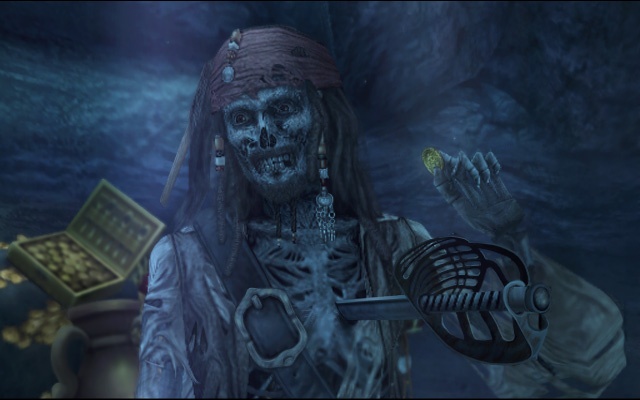
It doesn't take much effort to see through Disney's attempt to capitalize on the popularity of a non-animated feature.

It doesn’t take much effort to see through Disney’s attempt to capitalize on the popularity of a non-animated feature.

But keep in mind that I focus on the negative because it makes more interesting reviews. I actually do like this game, and quite a bit. It seems geared more toward the Final Fantasy crowd, as I mentioned, which means you can find easter eggs, like naming all the regular nobodies after Final Fantasy III/V/Tactics job classes (although the fact that they can make the nobody dancer grab me, flip me around, bash my head, and toss me halfway across the battlefield, but the FF Dancer class usually trips over their own feet so often for the most mediocre effects that I won’t use it even as a challenge kind of pisses me off) I like the darker tone and the faster pace, watching Riku go through the mother of all awkward adolescent body changes, and having Jack Sparrow as a playable character. The story, while not well-written–the Disney movie worlds all have some lame lesson about hearts and no connection with the plot of the Organization–feels complete enough that I don’t really feel they need to make a Kingdom Hearts III (especially as they won’t release it for anything except the PS4). And let’s not forget that no RPG would feel right without a gigantic final boss monster and a fight on a field with no visible ground.

Mickey Mousecapade – NES

RetroArch-0611-012316

Each Mickey Mousecapade cartridge contains a hidden Mickey soldered onto the circuit board, so kids, remember that after you spend the money to obtain this increasingly rare artifact from game history, you should immediately crack it open with your dad’s hammer (not without adult supervision) so you can behold the awesome glory of a circle intersecting two slightly smaller circles. Interesting bit of trivia, yes, but I don’t know if it amazes me more that Disney, Capcom, and/or Hudsonsoft thought they should put it there, or that someone actually found it. For the record, if you couldn’t detect the sarcasm in my first sentence and actually took that suggestion to heart…then go on eBay right now, buy a copy of “Conker’s Bad Fur Day” and send it to me via USPS Priority Mail. After that, I can send you my wish list…I’ve wanted a powerful telescope for a while…But if you didn’t fling the cartridge to the ground and stomp on it like a tarantula you suddenly discovered climbing up your arm, try putting it in your NES and playing it.

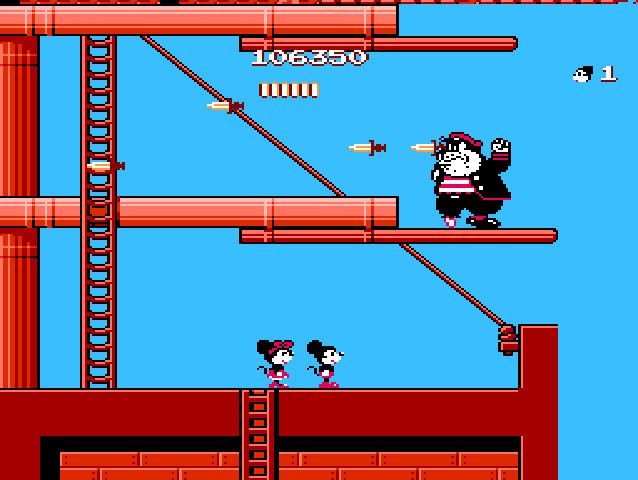
RetroArch-0611-011547After playing through the Kingdom Hearts games and thinking, “What a bizarre, but novel idea,” it occurred to me that Disney had released video games containing nonsensical assortments of intellectual property since at least the 1980s. Unlike the Square-Enix designed plot of Kingdom Hearts in which Maleficent abducts Alice, then later uses a host of Disney villains, including Pete as a recurring mini boss, to foil the plans of the team of Disney heroes, Mickey Mousecapade features a team of Disney heroes, fighting their way through a gauntlet of Disney villains, including the recurring mini boss Pete, to defeat Maleficent in order to rescue the captive Alice. (What a novel idea!) I gather they intended for the games characters to surprise English-speaking players as the instruction manual only says Mickey needs to rescue “a friend,” and the English release replaces many Alice in Wonderland themed bosses and enemies with an appetizer sampler of characters.

Porcine Kamikaze belong to the same genus as the lemming.

Porcine Kamikaze belong to the same genus as the lemming.

The game has little consistency between its five stages, which may actually work in its favor, varying the game play just enough so that players don’t realize the absurdity of the premise, the cliched platforming, and that they can finish the game entirely within the length of time it takes to watch one episode of Family Guy. The first and the last stage involve an almost Resident Evil style exploration, where Mickey and Minnie search through buildings looking for weapons and keys, then backtrack through the labyrinth to unlock doors to help them progress to the boss. The fourth level takes this screen-by-screen exploration and reduces it to a single path through four screens. The second stage involves side-scrolling platform jumping without the option to travel left to previously visited screens. The third stage does this as well, but de-emphasizes platforming in favor of searching for hidden exits that will either move you forward to the next area or back to a previous one.

"Stop slacking off and come follow me into this dangerous wilderness!"

“Stop slacking off and come follow me into this dangerous wilderness!”

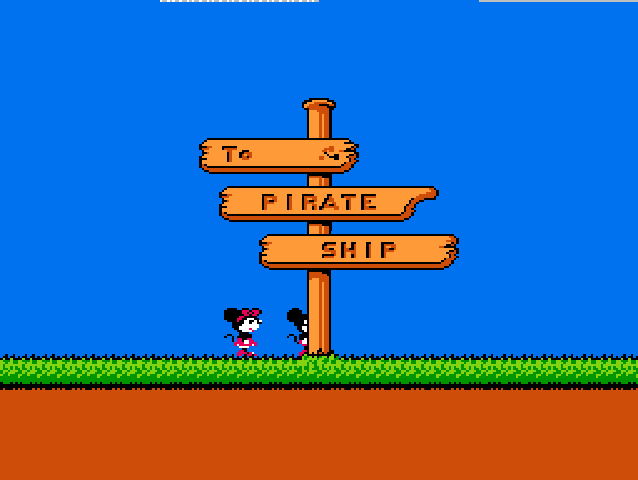
Each stage begins with a pointless but not unpleasant animation involving Mickey approaching a sign that designates the direction–always “right”–to and name of the next stage. He’ll read the sign, then call for Minnie, who I suppose drifted off in sleep, began building a nest or sought out cover from passing hawks. She’ll then come running, the two will pass off right and the stage will begin. The player controls Mickey, mostly. Minnie tags along, like a girl following around the Little Rascals, acting like one of the guys but not quite responding to player controls correctly. Unlike Mickey, she can complete the game without ever obtaining her weapon (a shooting star), thus rendering her only purpose to weigh down Mickey, forcing him to overshoot ledges so she doesn’t fall to her death behind him and wait for her to catch up before going into the next room. While mostly irrelevant to game play, she can, in fact, get a weapon, and even though it fires only once for every two stars that Mickey shoots, she doesn’t take damage from enemies, which makes her useful as Mickey can manipulate her into standing on the front lines in certain areas like the women at the Cliven Bundy ranch. (My apologies to anyone who reads this after October 2014 and has no idea what that means)

The Pirates who don't do anything; they just stay at home and direct all passers-by and law enforcement agencies to their exact location

The Pirates who don’t do anything; they just stay at home and direct all passers-by and law enforcement agencies to their exact location

From there, each stage has its own quirks and annoyances that make you wonder things like, “If the goal of the Fun House requires unlocking the door to get out, why did Mickey enter in the first place,” or “Why do seasons in the woods change depending on which tree you walk into rather than the passage of time,” or even “What type of pirate would keep their ship in one place, then put up signs telling people how to find them? Each level has hidden treasures revealed by a steady bombardment of radiation from your stars, but only in the Fun House and Castle levels do you risk releasing some sort of psychotic owl who kidnaps Minnie and imprisons her in a statue. The woods, as mentioned requires you to memorize a path to find your way from season to season, otherwise you can get lost pretty easily.

...no guards. No wall. No chains. Why the hell did I have to save you?

…no guards. No wall. No chains. Why the hell did I have to save you?

Still, it’s a small game world after all, so the variation keeps it interesting. The game puts up enough of a fight to keep you from whipping through it like a teacup ride, and…okay. No more stupid Disney jokes. The only real complaint I have left doesn’t even affect game play; when you finally beat Maleficent into a surprisingly short and squat bloody pulp, you finally come face to face with Alice…as she dozes gently…propped up against a tree. Outside. With absolutely no chains, guards, or other objects to suggest imprisonment. She could have walked away at any time, but instead felt like calling Mickey, the big boss mascot, away from his busy schedule of theme park appearances and cartoon cameos in order to come get her.

But really, I can’t find much more to say on the subject. A lot of these simple NES games don’t have much substance to them, so they either have something worth playing for fifteen minutes to an hour or they don’t. This one, I’d say, does. Now if you’ll excuse me, I think I’ll get back to Kingdom Hearts II.