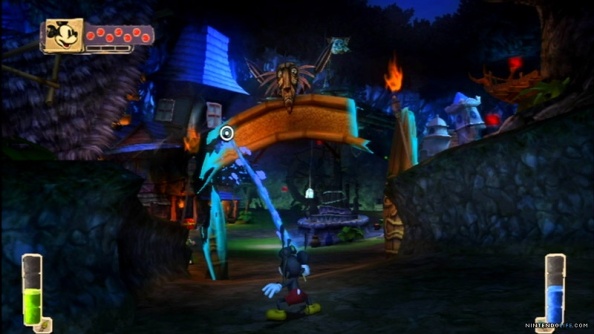
Epic Mickey – Wii

Epic Mickey2

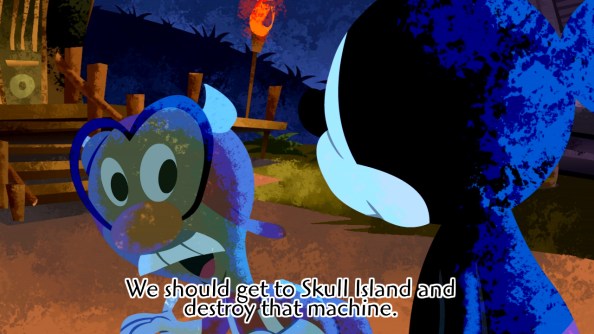
A gremlin serves as Mickey’s Navi. Gremlins spend the bulk of the game repairing busted machinery, which either indicates the Wasteland is so damaged that they can only repair things, or that Disney has no idea of what a gremlin does.

Mickey Mouse stands as one of the most recognizable icons of all time. Lately, the little black-faced rodent has been eclipsed by Mario, proving that Americans hate anything more complex than a plate of spaghetti and a stupid accent. Even so, Mickey has still won votes in every presidential elections since 1928. In 2008, he beat Santa Claus, Joe the Plumber, and Jesus, and with 11 votes nationwide, he clearly has twice as many supporters as Jill Stein. Perhaps that’s simply America’s attempt at saying they want a leader who’s animated, unlike so many half-dead politicians (and, you know…Donald Trump), but if Mickey has so much charisma that America would follow an animal who literally can’t feed himself or get out of bed without a team of at least 20 people (You know…like Donald Trump), then it’s a wonder that Disney holds the rights to such a famous piece of intellectual property and does nothing more with it than pass out cheap felt-and-plastic hats to kids who coat them with a gallon of saliva and drop them behind the couch as soon as they get home. Other than the short that ran before Frozen, I can’t remember a single Mickey movie or cartoon since The Prince and the Pauper in 1990, and his animated TV appearances reduce him to the role of an MC. However, Disney still allows him to come out of his retirement home every now and then to run around, wreaking havoc in the occasional video game, of all things. And nine times out of ten, as is the case with Mickey Mousecapade, Mickey Mania, Kingdom Hearts, and now Epic Mickey, the theme of that game is remembering all the classic characters Disney has used up and left by the wayside like a futon in front of a frat house.
Epic Mickey 2.5

A home for forgotten characters, unless Disney really wants to use one that people remember.

Kingdom Hearts, turned the lovable trickster scamp into a Norse God, a mighty warrior-king, vanquishing enemies with a legendary sword, clad in his armor of…bright red hot pants. (Because nothing says, “Where dreams come true,” like a story about hearts and souls being torn from a person’s spirit.) Epic Mickey follows that disturbingly dark tone, sending the titular hero into The Wasteland, a gloomy, twisted model of Disney’s theme park built by Yen Sid (Yes…the sorcerer’s name is officially Yen Sid. Because nothing says “Magic Kingdom” like following the naming conventions of the Satanic Church.) to house all of the characters lost or forgotten over the years,
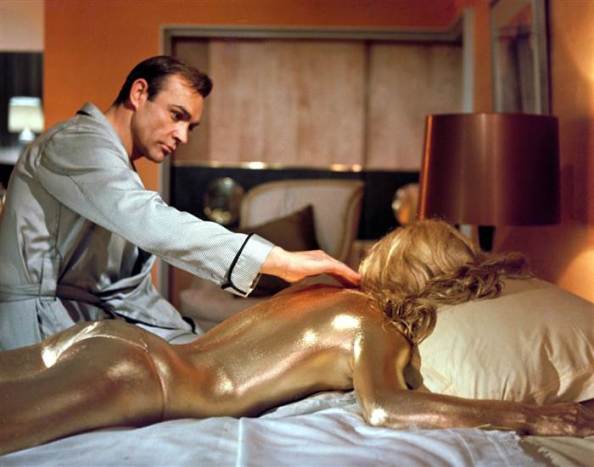
goldfinger

Poor Goldfinger…he just wanted to be friends with her.

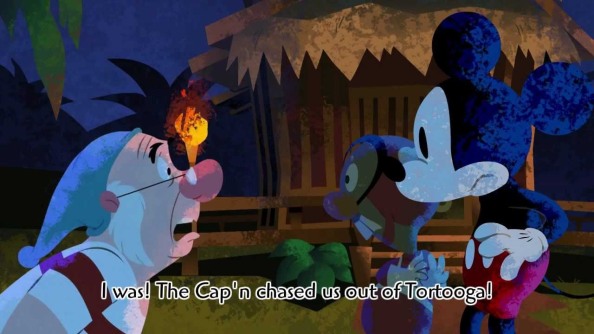
So short version, Mickey spills a jar of paint thinner on the model, which unleashes the Shadow Blot monster. We’re supposed to view this symbolically as Mickey eclipsing all the other characters and literally as the sin he must atone for. However, I can only imagine Yen Sid was planning some Old Testament style rampage, keeping that thing right next to the Wasteland. Mickey gets sucked into the model and absorbs some of the Blot’s aspects, which apparently means he gets a magical paintbrush that shoots out both paint and thinner and lets him hose down the environment like a porn star. Disney apparently decided that Mickey was wasting his potential to be a dick to people, and thought he could use a moral choice at the very least. You have the option to solve most puzzles by either obliterating part of the landscape with thinner or by repairing it with paint. Same option for enemies. You can convert them by slathering them in paint, at which point they swarm the unconverted and beat them with copies of The Watchtower until Mickey can’t get a clear shot even if the Wii Mote didn’t interpret cross hairs over the enemy as the desire to make Mickey ejaculate paint all over his shoes. Or you could straight-up murder them and get the health items and paint/thinner refills they drop. The only difficult thing about that decision is whether or not you want to see Mickey Mouse acting like Dexter. But that’s not to say the game is simplistic. You get to make a whole bunch of moral choices, like whether or not to find the scattered limbs of your animatronic friends and put them back together. Or the moral choice to help or deny the human pirate in his quest to woo the cow of his dreams. Congratulations on the bestiality quest, Disney. (Although it isn’t the first time you’ve swung that way…)
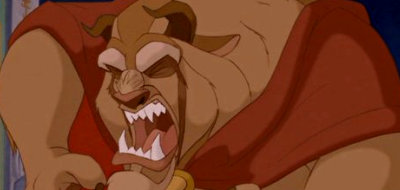
Beast

The Beast’s orgasm face.

Epic Mickey 4

Now you don’t have to walk under such a bland scenery element.

Still, the bulk of your time will be spent spraying your various goos all over the landscape, trying to find the occasional interactive spot. Other than that, any potentially clever gameplay that let’s the player express themselves artistically is pretty much just a way to spend the bulk of the 10-hour game wasting time changing colors from bright to dark. And even though the paintbrush does amount to nothing more than a glorified paintball gun, the enemies seem like a formality more than anything else, as they appear only occasionally and fight back with all the vigor of a severely depressed lemming. The game play isn’t as inspired as it could be, but it certainly doesn’t suck…at least not until the final stretch, when it shifts from “exploring the wasteland and taking on quests” to “avoiding holes like you’re jumping over a gonorrhea clinic.” My old nemesis. Designers who completely missed the point of Mario. These people think, “I like coffee! I’ll boil it down until it’s pure, black sludge, and then it will be awesome!” These are the people who read Harry Potter and then write their own 1000-page novel on quidditch.
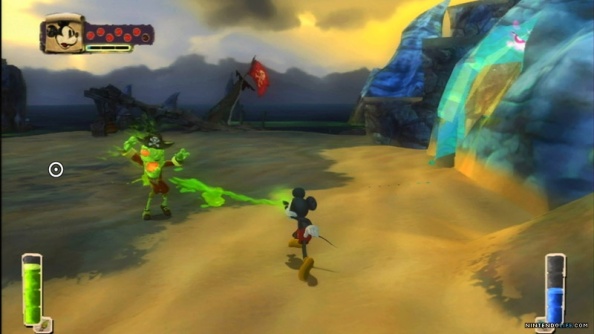
Epic Mickey 3

Mickey pulling what I call “Judge Doom’s Dip” on a monster that just wanted to be his friend.

It’s not a terrible game, even if it doesn’t know where to end. If it does a saving grace, it’s that it’s actually pretty interesting to view Disney through a darker lens (although maybe not literally. Walking out onto dark sections of floor is more dangerous than Russian roulette.). And while a modicum of interpretation can usually reveal some dark, unintended message behind kids’ stories, Disney actually thought this out, decided “We want to show the misery our beloved mascot inflicted on all these characters by eclipsing them with his fame,” and then proceeded to buy the rights to Oswald the Rabbit, Walt’s very first character, for the express purpose of having him rule over the Wasteland, harboring a resentment toward the mouse. Because nothing says, “The Happiest Place on Earth” like a 90-year grudge held by a cartoon rabbit.

Shining in the Darkness – Sega Genesis

RetroArch-0730-072327

Lecherous slugs. Hermaphrodites, if the cursor is any indication.

Sequels are a strange phenomenon, and opinions of them tend to be so emotionally charged that people fire out accidental kamehameha waves if you bring them up. Movies like Batman and Robin, Jaws 4, Cabin Fever 2, and anything from Saw…let’s say 3 onward…are generally experiences slightly less favorable to ringworm, what with characters as interesting as your local H&R Block staff and plots that make C-Span look like a Quentin Tarrantino masterpiece. However, mention video game sequels, such as Mega Man 2, Final Fantasy VI, Resident Evil 4 and Silent Hill 2, and fans will melt down their own gold fillings to make a trophy for the game designers. I’ve played two of the Shining Force games before, and while I haven’t launched into auto-dentistry practices yet, I can get excited enough by them to pry the lid off the series and dig around for game #1. So today I’ll write about Shining in the Darkness, the crawly, grindy RPG for the Sega Genesis that somehow metamorphosed into a brilliant tactical game by the next instalment, like a maggot transforming into a unicorn.

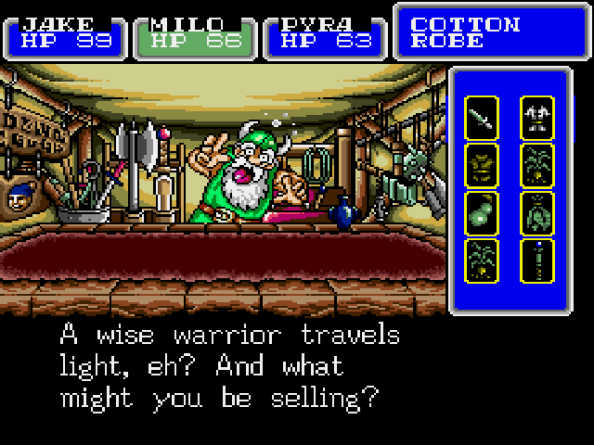
RetroArch-0730-105537

I’ll tell you what I’m not selling…cocaine. I think you’ve had enough.

Shining tells the story of a young boy chosen by mystical forces to be the hero. When his father accepts a job as the winter caretaker of a secluded hotel, the boy must use his supernatural psychic powers….wait, no, that’s not right. It’s just a collection of cliches. Evil wizard, kidnapped princess, chosen hero, incompetent king who would rather send lone adolescents into a major combat area than his army of seasoned veteran knights. The game doesn’t really tell a story so much as tries to justify dropping you into a pit of monsters and sealing off the exit as quickly as possible. The titular “shining in the darkness” is probably nothing more than the radioactive glow of cramming so many unstable tropes together in one game. Even Wikipedia discusses the story condescendingly: In a 2009 interview, Hiroyuki Takahashi (credited for “writing” and producing the game) recalled… ; The overly-simplistic storyline presents more of an imitation attempt at fantasy narratives, similar to a third-grader trying to write his own novel, or Terry Brooks writing The Sword of Shannara.”

RetroArch-0730-210840

I prefer to think of this less as an abusive scene where a hero is punished for saving the world, and more in the lines of, “Hey, this is getting good…”

But in a way, the simplistic design makes the game appealing. One town for shopping, one castle for major story events, and one dungeon, where you’ll spend the bulk of the game committing the standard, tireless acts of murder so common to the role-playing genre—you know, like Call of Duty, but with sentient crabs instead of Middle-Easterners. The dungeon takes the form of a labyrinth, and between Phantasy Star, Brandish, and Shining in the Darkness, I’ve spent so much time in labyrinths lately that I’m thinking about putting on a frizzy blond wig, shoving a codpiece down my tights and spouting David Bowie songs. You navigate the maze from a first-person perspective, which in these older games can sometimes feel like trying to follow a set of Google Maps directions with a plastic Viewmaster duct taped to your face, but the layout is actually designed well enough that you don’t usually end up treading a path around the same circular hallway for thirty minutes before you even realize you’re not making any progress. In fact, if you explore with a mindset of consistently following either the left or the right wall, you’ll generally find that maps only slow you down. [Note: Maps will not slow you down…unless, of course, you find the ones on www.gamefaqs.com that only have 70% of the notable locations marked. My recommendation? Play the game the old fashioned way…with a book of graph paper and a pencil.]

RetroArch-0731-012515

In Soviet Thornwood, egg cooks you.

The game carries a certain nostalgic charm, a description which unfortunately carries with it the implication that the player will wave his sword in front of him until so many monsters have died that the decomposing gases trapped at the bottom ignite the large mountain of bodies you’ve accumulated. I know I criticize almost every older RPG for mass murder, monster holocaust, or some other variation on attempts to purge the biodiversity from their game worlds until even the Tea Party would get bored with the racial purity, but it does tend to detract from any enjoyable gameplay in a lot of otherwise great games. In Shining in the Darkness, the enemy encounter rate is so high that it feels more like a Japanese subway car than a gladiatorial dungeon, but the game loses a lot of its sexiness when you start murdering monsters who are just trying to look for a place to sit on their way to work. Unfortunately, you need to kill every living being you stumble across (except for, you know…the princess. But you also don’t have to rescue her, either.) if you want to progress enough to beat the game.

RetroArch-0730-125116

You’re lost and wounded, deep underground with no civilized life form around for miles? Hmm…that’s awfully nice armor you’re wearing…

While fun for the first half of the game, Shining in the Darkness really starts to lose its appeal once you’ve finished your test of merit to enter the upper floors of the labyrinth. At that point, the game turns into an endurance test, pushing your patience at grinding. With each successive attempt, you make just enough progress to grease the way for the next attempt to thrust deeper. The monsters become just a little more complacent, and you can go faster and faster each time, but you have to spend a good long time working on penetration in order to…I’m sorry. I got distracted. But the game tends to lose scope of why it’s fun to play by that point. It becomes clear that nearly every enemy you face dies at the slightest glare from the hero, or passes out with a double-tap from your two assistants. Meanwhile, the enemies slowly wear you down like a swarm of earthworms wrapped in sandpaper.

RetroArch-0730-214157

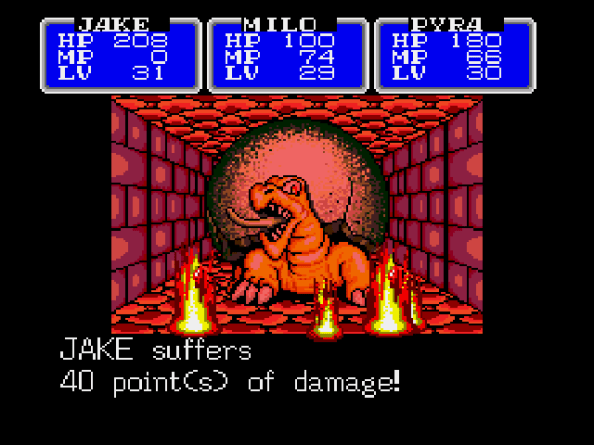
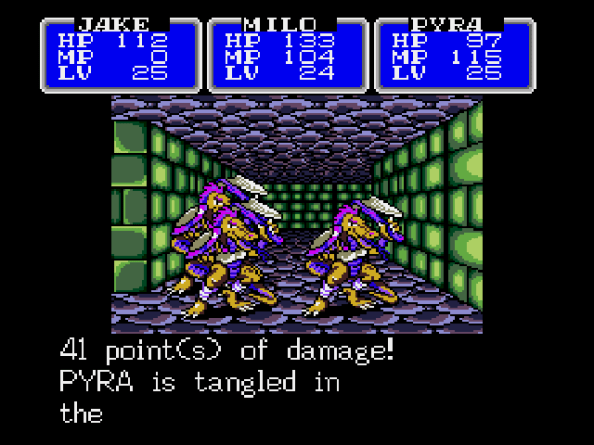
Malligator deals 41 points of damage, then strikes a pose to show off his bitchin’ hair.

At the beginning, Shining in the darkness comes across as a fun, nostalgic dungeon adventure, elegant in its simplicity. By the end, it turns into more of a Netflix marathon as you mindlessly follow walls through what must be Woodstock for monsters, until your hero with the peripheral vision of a rat with its head stuck in a toilet paper tube has enough HP to withstand the magic attack that the boss spams at you. But, of course, once you’ve invested that much time into a game, you keep going with the faith that the game will pay off like the Nigerian Prince you know it to be.

Brandish – SNES

RetroArch-0730-053208

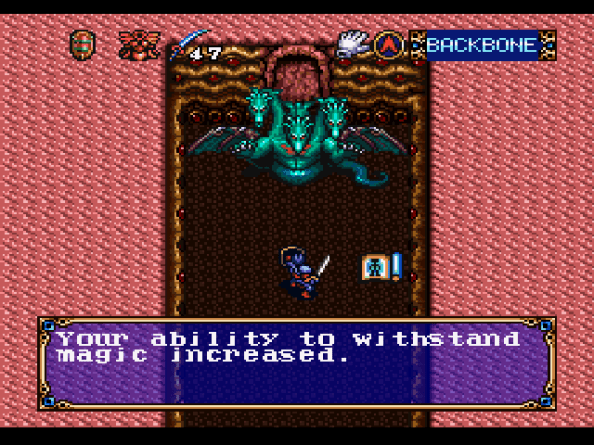
In the same way that getting shot develops an ability to withstand bullets.

I suppose I commonly stretch the definition of “retro” on this blog. A lot of what I review isn’t retro at all; Wii, PS3…books. Honestly, I’m starting to feel like a myopic hipster, clinging to the good old days of blackberries and flip phones and rejecting the ever-so-trendy man-bun-lumbersexual look in favor of coiffing my hair to resemble a freshly frosted cupcake / toothpaste advertisement / steaming dog shit resting atop my head. The point being, if I’m trying to reach into the past while only grabbing things I can reach from the couch, I’m doing it wrong. In my defense, it’s easier to go out and buy games for the Wii or the PS3—much in the same way it’s easier to buy an iPhone than a hand-cranked Victrola—but I have to remember my roots periodically so as not to get carried away. One root to remember involves an SNES game I rented one weekend in high school and completed 75% before I had to return it. Well, it may have taken me nearly two decades to get around to it, but I finally finished the SNES…uh, classic?…Brandish.

RetroArch-0729-130001

…I don’t know. It might be worth it to let her catch me.

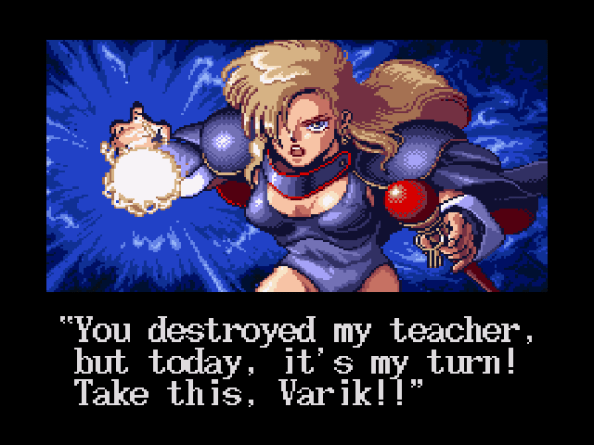
An adventure RPG, Brandish opens with a story of a greedy king transformed into a monster before the powers that be decide to punish all the innocents in the kingdom (No, I’m not talking about a Trump presidency) by burying the entire land deep in the earth. And then everyone forgets about it, so really, have we lost anything? I mean, if New York were to vanish off the face of the planet, you can bet that even Texas would put that in their textbooks until doomsday. South Dakota, on the other hand, could be gone already and none of us would know about it for decades. Thousands of years in the future (in Brandish, not Dakota), the player-character, Varik, is being chased by Alexis, a blond sorceress wearing traditional high-level fantasy armor who wants to kill him for “destroying [her] teacher,” a plot point that ends up as thoroughly as the rationale behind making a Tetris movie. Their fight opens up a hole in the ground and the two fall to the deepest point of a 45-floor labyrinth, fortunately avoiding impaling themselves on all those high-level monsters and…you know…floors…closer to the surface. Because damn it, that’s how this works!

RetroArch-0730-011809

Fuckin’ sphinxes. They’re like rats, infesting the labyrinth and leaving their “riddles” all over the place for you to step in.

Varik then proceeds to explore his way to the surface through a top-down perspective, and before I go any further, I need to address something. You may notice upon taking your first steps, that you can only move forward and backward, and that any attempts to turn left or right induce a nauseating change of scenery. Well, apparently the developers couldn’t be bothered to animate sprites for moving side-to-side or toward the player. I guess rather than change direction, it was easier to make the entire map rotate 90 degrees to one side. Fortunately, when the mighty dragon sunk the kingdom, he installed a few ball-bearing casters so the residents wouldn’t have to worry about silly things like turning. There’s a reason no other game has controls that fucked up; it’s because people who think like that can’t make it to work because they get stuck at intersections waiting for the road to turn. Congratulations! You took tank controls, a design scheme that frustrates players by making them feel like they’re guiding a drunken sorority girl to the bathroom to puke, and simulated the puking experience for the player as well. It turns out that the game is a port of a computer game from 1991, so that may have had something to do with it, and I did figure out that you could strafe from side to side by holding L or R. Still, developers, can we just consider “character moves in direction pushed on D-pad” to be both public domain and a mechanic that doesn’t need improvement? Anything weirder than that, and players are going to accept it about as well as a Neo-Nazi at an NAACP convention.

RetroArch-0729-125835

What do you mean there’s no ethnic diversity in fantasy? That dragon clearly has a Cthulu somewhere in his family tree.

Beyond that—but don’t get me wrong, that’s a pretty significant “that”–I’d say Brandish could be considered a hidden gem for the SNES. It does get a lot of things “right” for the genre; labyrinth full of monsters, useful items and magic, challenging yet logical puzzles, and a surprisingly healthy system of commerce for a lost civilization full of vicious bloodthirsty monsters and a handful of shop keepers. The gameplay centers around making your way through the labyrinth, but every floor manages to find some unique feature to introduce, so even though my eyes wound themselves together like a case of testicular torsion in my head, I never felt the game was slow-paced or repetitive. It was kind of like being in the movie Labyrinth. Except the labyrinth is underground. And there aren’t any muppets. And Sarah is replaced with a man in armor. And David Bowie is actually a Lovecraftian monster that shoots fire from his…let’s go with “appendages,” and Hoggle is a fiery, magic-wielding sex kitten…okay, so it’s nothing like Labyrinth. But it has a nice, adventurous feel to it nonetheless.

Some boss fights are hellishly difficult, a problem augmented by the fact that all the swords you find seem to be forged with the highest quality peanut brittle, and a lot of monsters are either resistant to magic, or it outright slides off of them like they’ve been heavily varnished. The game offsets this by allowing you to save whenever you like. I recommend you save often, but even with the best of precautions, be prepared to become as familiar with the logos and title sequence like a pole is with a stripper’s thighs.

RetroArch-0730-032724

“How is the game?” “Lobsterrific!”

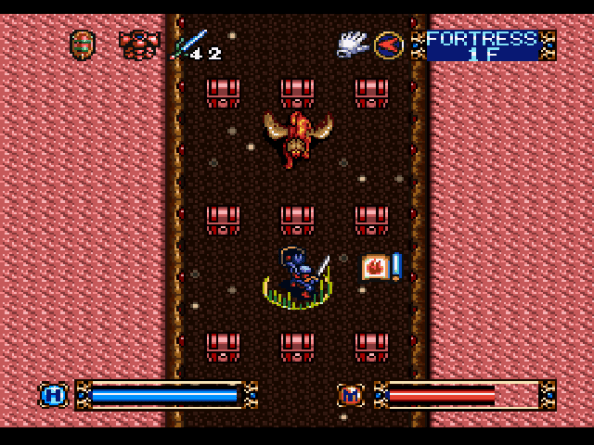
The one other aspect of this game that irritates me like a pair of boxers made from the prickly side of Velcro strips is the menu interface. The select button opens the menu, which freezes certain functions like attacking or defending. The game keeps going to let you do things like cast magic or drink health potions without needing to equip the item, but at certain critical moments when your skin is bursting at the seams and you’re about to spill messy innards all over the floor, you may literally not be able to go on unless you drink that potion. I may be spoiled by all those other games where the monsters take their legally mandated 15-minute break whenever you call a time out to root through your sack of accumulated crap, but I find it just downright rude if an enemy doesn’t shut off the flame thrower long enough for me to rub on some burn ointment. Even more obnoxious are level-up text boxes. These things will pop up whenever you gain a level, increase your arm strength or your knowledge, or improve your magic endurance. And it also disables certain functions until it goes away. I really do believe it’s important to celebrate the small things in life, but honestly I’d rather wait until the giant lobster I’ve been hacking to pieces is wounded enough to lose consciousness (at the lest) before I raise a glass in a toast to my newfound ability to not feel quite as bad when giant lobsters remove my kidneys.

RetroArch-0729-130619

Uhh…do you really have to look at me that way when you say that?

The Big Rewind – Libby Cudmore

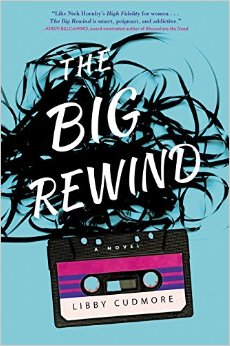
Big RewindI am beyond thrilled to announce that our own Glam Geek Girl has published her first novel, The Big Rewind! Now, if any of you are even remotely more astute than an average Fox News viewer, you might have already noticed that a) I know the author, b) I didn’t immediately call for her to be boiled alive in a tub of Velveeta and c) I linked to the best place to find the book, and you’ll probably be correct in assuming that the odds of me saying the book is terrible are about the same as C-3PO declaring his undying love for Han Solo in the next Star Wars movie (although considering the quality of The Force Awakens, I suppose that’s not out of the realm of possibility.) That’s what’s called “killing the tension.” As a writer, it makes as much sense to do that as to film Girls Gone Wild at an AARP convention; you might as well not go in if you already know there’s nothing you need to see. But even if you don’t decide to trust a review that I swear isn’t as biased as an autobiography of Kanye West, you should give the book a chance. If you’re a regular reader of this blog, then you either enjoy pithy quips and witty observations about the world, or you’re a chronic masochist hell-bent on destroying yourself with my lame humor. Either way, consider this quote from the first paragraph of The Big Rewind:

Six months ago a Swiss Colony Christmas catalog had arrived on the first chilly breath of fall, and I devoured it with the intensity of a teenage boy on his first porn site.

All I’m saying is you might like the way Ms. Cudmore writes.

Libby Cudmore

The woman herself is a mystery wrapped in a riddle wrapped in an enigma, then dipped in chocolate and wrapped in a brightly decorated tinfoil wrapper and put on display on the impulse rack at your local grocery store.

The book opens with a murder—a good move on the part of a mystery novel. The story opens with Jett Bennett, a trendy young woman doing temp work for a private investigator firm and living in a neighborhood with a serious infestation of hipsters. Jett finds a mix tape meant for her friend and neighbor, KitKat, thusly named because someone clearly broke them off a piece…of her head…with a rolling pin, leaving Jett to discover the body. (Cue the waterworks of disingenuous, mourning hipsters all queuing up to claim they loved KitKat before she was cool.) KitKat’s sister humbly requests that Jett solve the murder. It’s kind of like asking your friend who works the information desk at the hospital to look at that thing growing out of your foot; having neither money nor patience to do things properly tends to drive down the qualifications of the professional help you seek. (Or, at least, that’s what Lucy told me when I paid her for psychiatric help.) So Jett dives into the only clue she has, the mix tape, and begins to delve into the sick and twisted mind of a . . . well, not a murderer, but at least someone who would send a bunch of re-recorded songs to someone hoping they can pull out the exact same interpretation of a message probably more easily expressed with a clearly written sentence or two.

I’m a big fan of Jim Butcher’s Dresden Files, and I’ve read a fair amount of mystery novels…possibly including the source novel for the film “Who Framed Roger Rabbit”…and I enjoy the challenge of trying to solve these crimes…which usually hinge on hidden motives, information withheld from the reader, or psychologically unreal characters with contrived, cockamamie ideas that put the “Alien Invasion!” ending of Watchmen to shame. But even though Butcher writes a compelling story, he and other mystery writers will handcuff themselves to the bedposts of their genre hoping for a night of kinky passion before realizing they lost the key. Most mysteries begin with a parade of informants and potential suspects, all floating by the protagonist like little boats of fish at a sushi buffet. The Big Rewind flouts these conventions, though, as Jett’s first steps on the case involve realizing that most people give or receive mix tapes at some points in their lives, and didn’t she have a box full of tapes from old boyfriends that she, herself, was having trouble moving past?

Steely Dan

After a passionate night with Steely Dan, Libby experiences a moment of regret, realizing she only did this to hurt Billy Joel. And then she really enjoyed the fact that she hurt Billy Joel.

What follows is a story reminiscent of Nick Hornby’s High Fidelity, in which Jett winds up reviewing her past to figure out how best to move forward with her life. By the end of the novel, I felt like I would have been satisfied if they hadn’t even solved the murder, just for the character progress made by the protagonist. They do solve the murder, but it seems to be present not for its own sake—like so many other entitled, self-indulgent mystery bastards—but to show the extreme side of mixing songs for people. (I, too, have received mix tapes that made a rolling pin upside the head seem like the better way to spend an afternoon.) Libby Cudmore clearly understands how to make her genre work for her. Instead of those passive authors who handcuff themselves to the bed and hope for the best, Cudmore dons her best leathers, hog-ties the genre, and whips it into submission until it cries out that it’ll do whatever she wants.

…and Libby, if you’re reading this…yes, I realize how awkward that mental image was.

Okay, so obviously this all smells like a good long belch after a meal of scented candles and Glade Plug-ins, and I can tell you’ll think I’m exaggerating unless I open the window and fan it all outside before the odor forces you into a coma. If I could say anything against The Big Rewind, the early chapters of the book read like Cudmore fit all her favorite songs and pop culture references into a shotgun and pelted her readers in the face, hoping to hit a soft spot. (Which she did, when she mentioned playing through Zelda II: The Adventure of Link) About 90% of the musical buckshot, though, went right past me. However, there’s a rather poignant message near the end of the book that actually requires the reader to feel that way, which makes it all the more meaningful in the long run, after you’ve picked all the references out of the craters on your face. So it makes sense as an artistic choice.

I realize I’ve been discussing this in pretty vague terms, even compared to my usual style, but it’s a freaking mystery! No spoilers! And it’s worth reading. If you do decide to pick up The Big Rewind, please consider buying it new. I know you can get it for a penny on amazon, but here’s a secret: the seller gets the $3.99 shipping charge, but because amazon charges a minimum of $1.60 in sellers fees, plus the starting rate of $2.61 for media mail, that means the big name used book stores who can afford to sell books that cheap are literally paying $0.21 per book to put other book stores out of business! And that’s the one serious thing (other than, “I liked the book”) that I’ve said today. No joke. If you buy it used, you’re supporting used book stores. If you buy it for a penny, you’re actually giving the finger to used book stores. But if you buy it new, you’d be supporting a talented, up-and-coming author who genuinely loves her career as a writer.

The Monkey King: The Legend Begins – Wii

Monk1

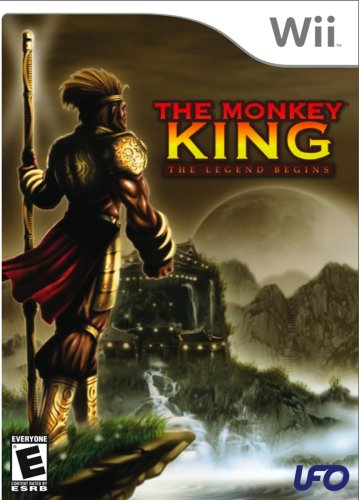
The publisher’s choice of box art, traditionally styled depiction, yet dull and unrepresentative of gameplay…

“Five dollars? Eh. Why not?” What better way is there to sum up the national epic for over a billion people, a brilliant, comedic satire mixed with a deep and insightful meditation on Buddhism and other traditional beliefs of China? An afternoon of boredom led me to explore a skeezy pawn shop, where I found “The Monkey King: The Legend Begins,” and figured “Why not try to overcome malaise by seeing what they did to this timeless myth?”

To be fair, a six-hundred year old book loved by the planet’s most populous nation is bound to more pointless adaptations than the entire Marvel and DC universes combined, and by the law of averages, some of them are bound to leave a taste in your mouth like coffee filtered through an old pair of Hanes briefs. So really, if I tried to protest every bad or unfaithful adaptation of Journey to the West, I’d be left with zero free time, a bill for cardboard sign making that rivals my mortgage, and an unreasonable hatred of Dragonball. So why not look at the game on its own merits?

Monk2

…versus the alternate art, which is accurate, but more visually assaulting than Where’s Waldo hyped up on Red Bull.

Immediately upon booting up the game, I noticed that the d-pad wouldn’t let me select menu options and the select button was way at the bottom of the Wiimote. Don’t laugh. I’ve never actually encountered a Wii game that wanted me to hold the controller sideways.

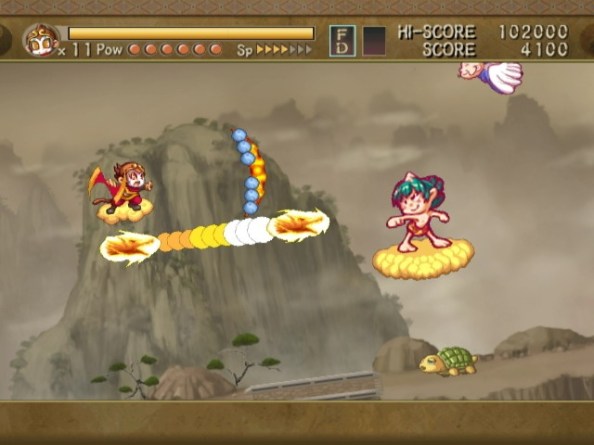
Gameplay reminds me of old arcade shooters, like Galaga or Gradius—because when I think of an epic meditation on spirituality and enlightenment, I think “Space Invaders.” The legendary Sun Wukong (or if you so choose, the unique and pointless Mei-mei) flies through China on his cloud, spinning the magical staff that, in the book, can grow or shrink to any size the monkey king wants, but which in the game shoots out a glowing orb. Because you can’t have a space shooter without lasers, right? Even if it isn’t set in space. And depicts events that occurred in the 8th century.

Honestly, there’s not too much I can say about this game. It’s a traditional arcade style. It’s fun, I guess, in the way that Dairy Queen is fun—you like it every time, but there’s never anything new about it, you really wouldn’t want to go there all the time, and whenever I go it plays a bad satellite radio station of all the songs from the 1950s that were so bad, the entire decade tried to set them on fire and bury the ashes so new music would grow, but it just festered in the ground until it sprouted something with the maddening powers of Cthulu. Er, well, you get the point. The music in the game is a little grating.

Monk3

Tilt, and the whole world tilts with you.

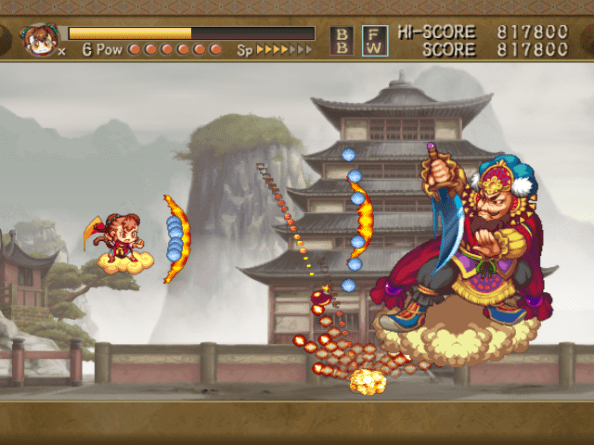
The one unique feature involves the system’s motion controls. If you tilt the controller in the direction you’re flying, you start careening through the level like a deer on collision course for a Volkswagen Beetle. If you tilt the other way, you slow down and become a much easier target for the dozens of enemies trying to dye your clothing with their viscera. An interesting idea, even if it does display a fundamental misunderstanding of gravity, as though the core of the earth were swinging back and forth from Los Angeles to Saudi Arabia. Unfortunately, it’s a little too tempting to exploit. Every time you die, your next life comes back, blinking invincibly (as trauma patients often do when leaving the ICU). During this time, you can launch into turbo mode and skip through 25% of the level. Sometimes, if you position yourself at the right spot, you can do this even when not invincible and hit the boss in moments.

Monk4

…And a boss fight. There. You’ve seen pretty much everything.

The game is short, but still feels padded. You work through five stages, then a boss rush stage that calls itself “hell,” but hands out power ups like Halloween candy. And then you fly through all five stages again, literally backwards, starting with the bosses and then heading back toward the beginning.

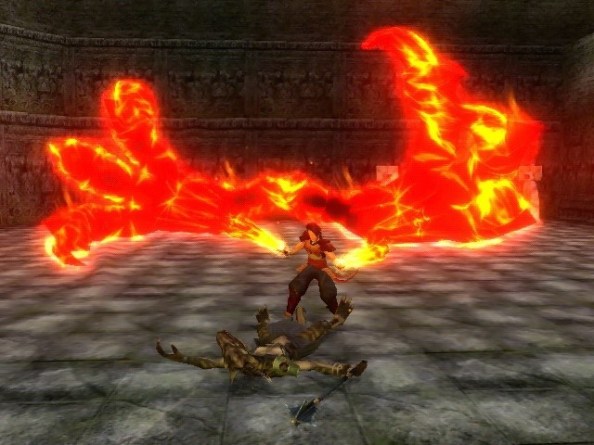
Also, I know there’s a lot of violence in the book, and I know I read an abridged translation, but I don’t seem to recall pigs with rocket launchers in Journey to the West.

Dragon Blade: Wrath of Fire – Wii

Dragon_Blade_-_Wrath_of_Fire_CoverartI love Fantasy narrators. Can you imagine if everyone talked like that?
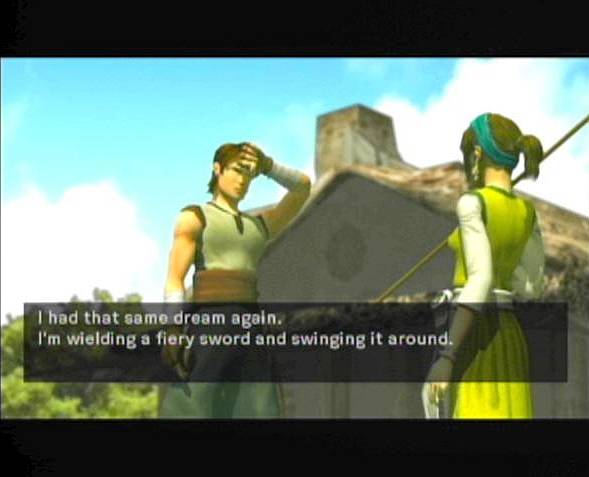
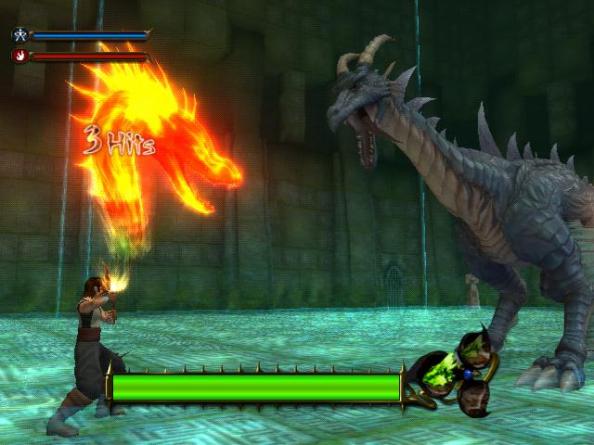
In ages long past, a great hunger drove the mighty warrior to seek out the legendary meat lovers pizza, which came to him in a vision.  He quested long to come to the sacred Hut of Pizza, whereupon he requested his meal from the wise sage who took him in from the cold and seated him in the warm light at yon table that, lo, was beside the TV showing Sportscenter.  But there he sat, long forgotten by the world, and the hunger devoured him from within.  Lost to the temple monks, none arrived with the Tray of Serving, nor did any ask if he wanted his flagon of Mountain Dew restored to its former glory.  Now a wrathful shell of his former self, the mighty warrior must take up arms and battle his way into the great kitchens to reach the office beyond, where he shall face the Lord Manager of the Hut of Pizza, lest he never leave the realm.

Thus begins Dragon Blade: Wrath of Fire.  An uninspired little bundle of tropes, clichés, and trite I picked up in a Game Stop for 80 cents.  When I thought, “That price is nothing to shake a stick at!” I should have considered that this was a Wii game, played entirely via shaking stick method, and not very well at that.

Dragonblade1

She got as far as “fiancee” before I started measuring her for a coffin.

Dragon Blade opens with a story pieced together with the refused shat out and flushed away by other fantasy clichés.  The young hero has a dream of being a chosen one, then gets a spiritual companion who tells him to go out and collect pieces of something.  Then someone razes his village to the ground because no fantasy world would be complete without an all-powerful organization that harbors grudges against idyllic backwater towns.  Either that or these people have a primitive understanding of motivation.  “Happy New Years everyone! In order to help you finish that novel, start that diet, and finally get around to that yard work you’ve been putting off, I’ve burned your house to the ground! Go get ‘em, tiger!”  Then after the hero’s girlfriend dies in a scene so bad, Anita Sarkeesian felt it like Obi-Wan felt the destruction of Alderaan, we begin an adventure full of hacking and slashing down a linear corridor!

Dragonblade3

Despite not being an actual blade, they at least went so far as to make it dragon-like.

Well-crafted names can make or break a fantasy story.  Unfortunately, names are almost required to sound like a toddler vomited up a bowl of Alpha Bits along with a few Scrabble tiles they swallowed, but a good writer can make names sound natural (Samwise, Eddard, Laurana), exotic (Daenerys, Chewbacca), or meaningful (Gandalf, Han Solo).  A bad writer can make names that sound like something you pulled out of a garden or read off a prescription bottle.  Dragon Blade falls into the latter category with names like Vormanax, Norgiloth and—our hero—Dal.  The first major boss battle is a dragon named Jagira, which would have only been an acceptable name if they were writing Thunder Cat fan fiction.  One can only assume the half-assed lazy attempt at scribbling out an opening paragraph and relying on an assumption that fantasy readers won’t care if it sounded as awful as a banjo in a wood chipper.  I mean, I know that game developers don’t really care much about story, but could they have at least scraped together a few coins and pulled in some starving, wanna-be screenwriter and….holy crap the story was written by Richard Knaak!

Seriously? They hired one of the better Dragonlance authors, the man who gave us The Legend of Huma and Kaz the Minotaur, and he wrote out this shit? That’s gotta be a mistake on Wikipedia’s part.  Although, the game clearly isn’t about story.  After the opening cinematic, the game limits itself to a few lines of dialogue before boss battles, sort of a pre-battle, fantasy smack-talk.  The real focus is on the hack-and-slash action and well-crafted, challenging boss fights.

Dragonblade2

Props for interesting dragon design. Then immediate revocation of said props because I never got far enough to see more than one.

So that’s top-notch, right? I can say this strongly and confidently about the action in this game: meh. Just meh. It’s not the worse thing in the world, and I suppose there’s currently a large following for games so difficult you measure progress in Dragonball Z minutes. But there’s a difference between games that are crafted to be challenging and games that fuck with the controls to prevent success. Once more, this game is in the latter category.  I once wanted to find a Wii game that accurately allowed me to simulate sword fighting; this is not that game. Dal swings his sword with such flourish that each attack animation represents an excellent time to go make a sandwich, use the restroom, or go clean the basement. With controls so slow and unresponsive, the best I could do was initiate attacks while the enemies were still charging at me and hope that they would be kind enough to impale themselves on my sword. The motion controls carefully sense whether you’re swinging the Wiimote up, down, left, right, or stabbing forward, and translate them all into a sort of side-slash, incapable of hitting anything below Dal’s waist or at eye level. This gets rather annoying while chipping away at bosses.  The fights with the dragons seem to have received the majority of the developers’ attention, trying to create impressive and fun battles.  But in an effort to make the fights last longer, their defence is so high that you might as well be whittling down their scales with a safety pin.

dragon_blade_wrath_of_fire_004

I love this game this much!

Ultimately, the difficulty turned me off. Beyond that, I suppose the game wasn’t terrible. It was simplistic, but that’s okay at times. However, I find the blurbs on the box that advertise “unique two-handed combat” a bit disingenuous when the game brings absolutely nothing new to the table.  It’s like finding a loaf of bread at the store that’s spelled out “fresh” with mould spores.

Dragonlance: War of Souls

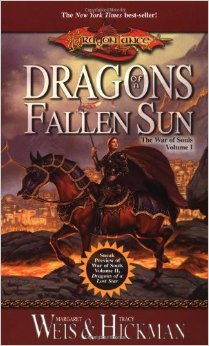
Fallen SunBack in sixth grade, I was riding high off of Fantasy. My dad read me the Hobbit in fourth grade, Lord of the Rings in fifth, and in sixth grade I dove back into both books, trying to get that same fix (Dear gods, have you ever noticed how often I talk about drugs in this blog? It’s like Jay and Silent Bob have a wordpress account and a history of being stuffed into lockers.). Anyway, my tolerance was increasing, so I had to up my dose. And lets face it, Lord of the Rings is great and all…but where are the fucking dragons? Smaug was a fricken badass. Where can I get more of the good stuff? Don’t try to slip me Puff. I need the hard core stuff, man! Well, around that time, my parents shuffled me off one evening to a friend’s house while they went off bowling or something, and I uncovered one of the most dramatic and wonderful discoveries of my life (no, it wasn’t pot). My friend showed me her late father’s (we all miss you, Burt!) library. This guy had stuffed so many sci-fi and fantasy novels into this room that they lowered his heating bill. This full grown adult was a huge nerd, operated an arcade, and read stuff that I thought only existed in, well, fantasy. That’s when I realized that grown-ups didn’t have to be boring, and I could enjoy reading about dragons without feeling like I was wasting a life better spent learning how to manage hedge funds. And fortunately, my friend’s mom let me pick out some books to take home with me. I picked out one with a dramatic pose of Merlin on the cover, as well as the novelization of Star Wars (ghost written by Alan Dean Foster, whom I wrote about in May). But like I said…I needed dragons. And fortunately, Burt had me covered there.
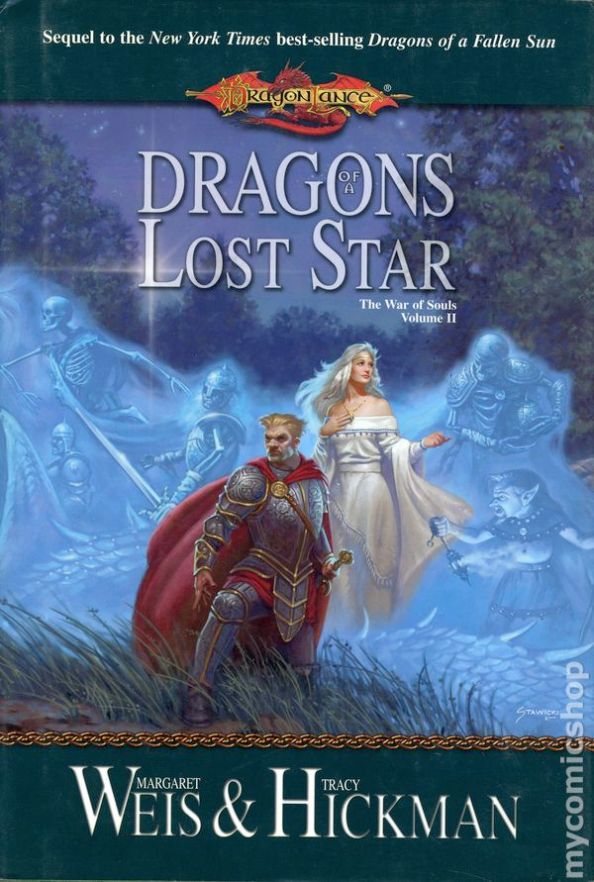
I found a book that not only had a dragon on the cover, but in the title and in the name of the series as well. “Dragons of the Autumn Twilight” looked like a good read, and judging by the more than sixty Dragonlance books now sitting on my bookshelf, I chose wisely. Still, apparently Dragonlance gets as much hate with online critics as it did with…well, anyone who saw me reading one of the books in high school. Yes, I know that vitriolic criticism is kind of a prerequisite for Internet comments, but authors Margaret Weis and Tracy Hickman wrote the Chronicles trilogy, followed by the Legends trilogy, and wound up creating a world people wanted so much more of that TSR published nearly 200 other novels set in the same universe. So what if their prose isn’t up to King James Bible standards? Something about their stories is worth reading (I actually have a more academic analysis of their scenarios and an explanation why Raistlin became the poster child for disenfranchised smart kids who resent pep rallies and wouldn’t get within fifty meters of a football without a marching band around, lest it trigger a fatal asthma attack…but you’d have to take my class to study with me. Contact the admissions office in the Tower of High Sorcery, Palanthas.).

Lost StarWeis and Hickman are absolute masters at crafting two things: complex, psychologically real characters with an evil alignment, and interesting scenarios. One of my favorite cliffhanger endings of all time is from one of their “Second Generation” novellas, in which Tanis’ son is invited into the Qualinesti nation and offered the crown, only to find out he’s been set up as a puppet king. Forbidden from entering the elven nation himself, Tanis offers parting advice for how to manipulate the political game to fight for control. Another ending comes at the end of Dragons of Summer Flame, in which the gods of Krynn are forced to abandon their creation, and the mortal world has to learn to live without magic, divine influence, or guidance. I finished both of those books thinking, “I want to read that story!” But on account of not being able to write all 200 books themselves, Weis and Hickman had to abandon their creation to authors who treat it with as much respect and sincerity as someone saying, “I promise I won’t get mad,” “I swear I won’t use your credit card to buy porn,” or “I’ll return the Millennium Falcon without a scratch.”
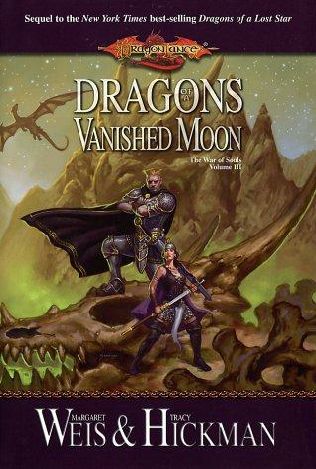
Jean Rabe’s Fifth Age trilogy understood the “no magic” edict about as well as a comatose, double-amputee diabetic understood “no sugar,” and she must interpret the term “psychological realism” to imply that chance encounters with Cthulu are a reasonable and common occurrence. And veteran Dragonlance writer Douglas Niles thought long and hard about “Gilthas becomes a puppet king and learns to manipulate Qualinesti politics to reclaim power,” and decide it was perfect except for the politics…and the idea of a puppet king…and the Qualinesti setting…and Gilthas. So getting to this weeks topic in a roundabout way, Weis and Hickman’s War of Souls trilogy appears to be an attempt at repairing the damage inflicted and lost opportunities squandered by previous authors.

Vanished MoonSo…the War of Souls begins with Mina, an 18-year-old girl who comes out of storm, prophesying like an Evil Jesus about the One God of Krynn. She makes a few predictions, heals a minotaur’s stump arm, and then proceeds to rise through the ranks of the Dark Knights, waging a stealthy, political conquest of the Silvanesti nation. Meanwhile, Goldmoon wakes up and finds her 18-year-old body restored, while Laurana (who is still about 18 years old in elf years) develops a complex political relationship with the Dark Knight governor of the Qualinesti. And, of course, Tasslehoff makes up for being dead by traveling forward in time, because apparently readers couldn’t possibly grasp the wonders of Krynn unless we see it through the eyes of a child…a child who’s over a hundred years old and has seen absolutely everything that can happen in a world with dozens of sentient races and as many types of magic and unique locales.
As expected from a writing skill honed by decades of experience, the War of Souls plot is actually pretty complex and difficult to summarize here. While most of the action in the first two books occurs in the elven nations, there are over a half dozen factions each vying to accomplish their own goals, including the lord of the dark nights trying to stem the rising popularity of Mina, the Krynn dragons who resent their foreign dragon overlords, the dragon overlords who want to destroy each other for more power, Mina who wants to advance the One God’s agenda, Mina’s knights who don’t give a damn about the god and just want to obey the 18-year-old girl’s every command—you know, like Evil Christians—the Qualinesti who struggle with Dark Knight occupation, the Silvanesti who struggle with their isolationist policies, the wizards who just want magic to come back, the Solamnics who just want to crusade against something evil, and Tasslehoff who finds himself a bit unnerved that everyone keeps saying that Chaos was supposed to kill him.

For a series dedicated to the struggle and balance between good and evil, Weis and Hickman successfully avoid all the ethnic cleansing that naturally sprouts up around authors like Tolkien or Brooks. Dragonlance is as much about good and evil as Taco Bell is about fine Mexican cuisine. Character motivation has always been a source of fascination, and the most fascinating thing about the War of Souls is to see which factions ally with each other for what goals, and which characters betray each other like college students calling “shotgun” on the way to the Waffle House; for example, like how Weis and Hickman throw Rabe and Niles under the bus.

If there’s one thing I could say against the book, it’s that it seems to break sequence with proper escalation. Chronicles told us about a war that prevented an evil goddess from entering the world. In Legends, the main character sought to let that goddess into the world so he could fight her, and whichever one emerged victorious, it would still probably trigger at least some amount of apocalypse. By Dragons of a Summer Flame, they ramped up the stakes to find something that would threaten the gods themselves. So when I picked up the War of Souls, I imagined something so epic it would make the finale of Dragonball Z look like an episode of the Smurfs. Instead, they go back to the god-trying-to-enter-the-world plot.Not that it was a bad plot, it’s just that compared to the material that came before, this felt as exciting as Mr. Rogers’ Neighborhood.

And I guess I have to admit, I kind of miss the pacing and adventuring from their earlier novels. You no longer get to explore ancient ruins, lost temples, or travel through time. This is more thoughtful and introspective, and while it’s very good for what it is, it almost feels like the fantastical elements are phoned in. Laurana has her moment in the sun again, which is kind of exciting, but a little less than what the character is capable of. Raistlin makes a cameo appearance, but it feels more like fan service than something that actually drives the plot. But still, I’d recommend it for fans of the series, especially anyone who hated Jean Rabe’s novels and wishes things could just reset back to the way they were before, like a nice, concise cartoon.

Speaking of which…do you think there’s any chance we’ll see “Dragons of a Winter’s Night” after they slaughtered Autumn Twilight with an 80-minute condensation of the novel?

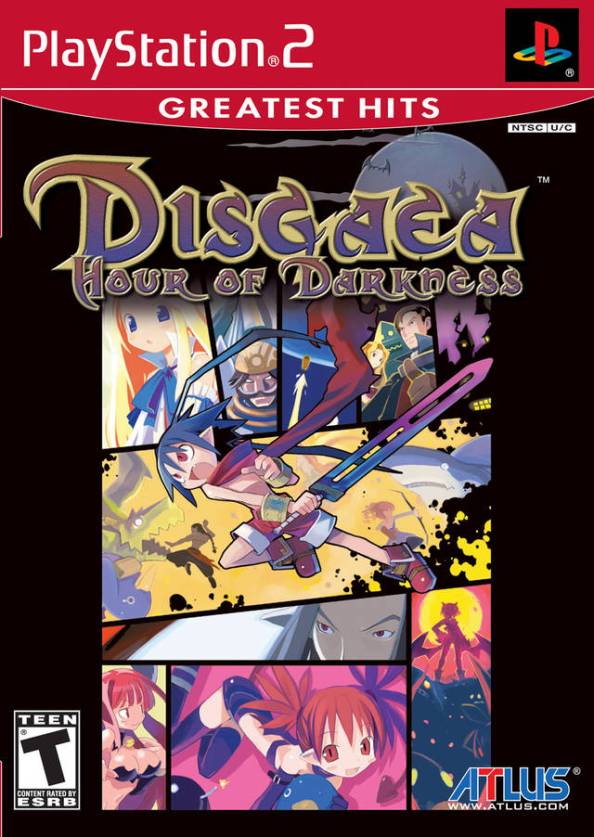
Disgaea: Hour/Afternoon of Darkness – PS2, PSP, NDS

GH_PS2CoverSheet10_06Despite only two weeks passing since my last entry, I haven’t written anything for nearly two months. Instead of spending my time playing video games like a good, responsible 32-year-old, I’ve been working backstage at our local production of 42nd Street, a show so bad that it literally tries to justify its lack of plot by telling the audience ”At least the girls are hot!” And while yes, they were, I’m not yet sure it makes up for working a 20+ hour a week job for no pay, being forced to listen to the same misogynistic songs with no relevance to the story. Really. The only character with any internal conflict in the whole show is the antagonist, who eventually decides that having an accomplished career on Broadway was simply holding her back from what she really wanted in life: a husband. Still, there’s a sunny side to every situation, and sitting through hour after thrilling hour of watching people exercise with metal shoes provides an excellent counterpoint to make a horrible, tedious, level-grinding RPG not seem as bad.

In The Money

Okay…so maybe it was a *little* worth it for the backstage costume changes.

Thankfully, there’s a PSP port of Disgaea, Nippon Ichi Software’s magnum opus, their lightning bolt of inspiration, which after it struck, they sequestered themselves in a rubber-lined mine shaft hoping for that lightning to strike again. Disgaea tells the story of Laharl, prince of the Netherworld, who wakes up after a short two-year nap to find out that his father, the Demon Overlord, has died, and that all his vassals are as eager to swear fealty to Laharl as if the ring they had to kiss had a raging case of herpes. Together with Etna, the one vassal who remains faithful to him only because she can’t double-cross him if he’s her enemy, they set off on a quest to build power and overcome all the rivals for the throne. But when he foils an assassination attempt by angel trainee Flonne, a character straight out of a remake of It’s a Wonderful Life written by Seth MacFarlane, she introduces the concept of love into his black heart and textbook creative writing class scenarios ensue. The story is simple. Character goes on quest, learns something about himself. No twists or turns. But it’s well written, has a cartoonishly dark sense of humor done in an anime inspired episodic format, and next to the plot of 42nd Street, Disgaea is Citizen Fucking Kane.

Dis1

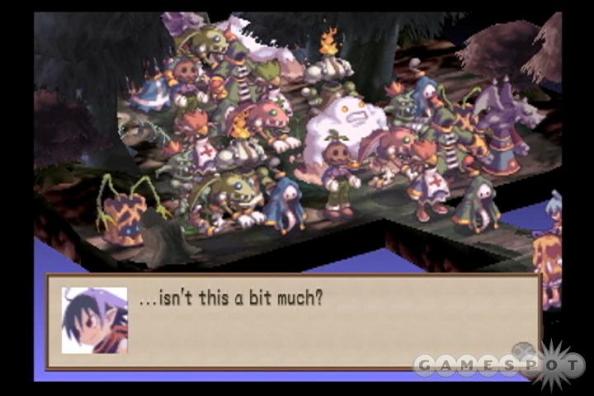
NIS is so good at cramming things into small spaces, they’re permanently banned from Old Country Buffet

However, NIS seems to have interpreted the “Less is More” philosophy as meaning “Less story is more room for piling on additional, confusing gameplay mechanics.” In what has become NIS’s trademark move, they have patched together ideas from at least a dozen other games, resulting in something convoluted, yet intriguing. It’s sort of like buying a car with a lighthouse on the top—you don’t really understand it, but it gives you some options you wouldn’t have had otherwise. Unfortunately, none of these are thoroughly explained unless you buy the strategy guide, and you can’t even look them up on the Internet since the game doesn’t mention them at all, so you wouldn’t know about anything you could. For developers who want people to think their games are fun, tutorials should not require top-level governmental security clearances. Although for reference, even the American government managed to let information about Watergate, Monica Lewinsky and WMDs slip, and none of those existed for the purpose of enhancing an enjoyable experience (Well…maybe Lewinsky). Maybe NIS could give the government a few pointers..

Dis2

…I tried. I can’t come up with anything to say about this that’s funnier than anything anyone said about George Bush’s snack food assassination attempt.

That isn’t to say they’re bad features. In fact, for the most part, they bring a lot to the tactical RPG genre. Take geocrystals, for instance. Regions of tiles on battle maps are sometimes color-coded, and any crystal growing on that color tile imbues every tile of that color with its properties—sort of like “The floor is hot lava,” if certain regions could also be “the floor is bubbling acid,” “the floor is delicious ice cream” or “the floor will increase the chance that your masseuse will give you a happy ending.” This reminded me fairly strongly of the battle judges from Final Fantasy Tactics Advanced, except I had the ability to change and manipulate the rules, if I went and stood on the hot lava anyway, I could just take the 20% damage without bringing the game to a halt, and I didn’t hate them more than the dog from Duck Hunt.

Dis3

I know my candidates have to have at least level 500 before I’ll vote for them.

Also, gone are the days of wandering from node to node hoping for a random battle encounter. In Disgaea, players can fight monsters in Item World, a randomly generated dungeon within items. Players can use this to upgrade item stats, collect stat bonuses to move freely from item to item, or simply to grind levels. Because why stop at level 99, when you could stop at level 9999? And why stop there when you could reset your characters to level 1 and do it all over again? I did have fun with Disgaea, but you might be able to guess that it’s a rather time-consuming game. In fact, I’ve put more hours into this than I have Fallout or Skyrim. My game timer is on 140 hours with only a small amount of the extra content touched. That’s almost six straight days—that’s enough to kill two Korean kids back-to-back! I don’t care what you’re doing for six straight days, it’ll get old. Ever go camping for six days straight? Once the moss takes root, you end up looking like Treebeard. For the less active readers, six days of sitting on the couch eating ice cream and…well, it’s not moss, but something will take root. Hell, you can’t have six days of sex. I’ve tried…you start to get sore after about an hour or two.

Dis4

When you need a full gross of characters to pick from. Because that one point of difference in attack will make or break the game.

Every thing in the game is designed for the purpose of raising your stats, which makes it easier to level up, which in turn allows you to raise your stats. It’s a mobius strip of grinding. And having so much variation in level just means you’re as evenly matched with the enemies as a rhinoceros on steroids versus a freshly baked apple turnover. Unfortunately, near the beginning of the game, Etna managed to strike a lucky shot against a supposedly unkillable monster, thus bumping her up about thirty levels (at which point, she rightly could have slain Laharl and spent the rest of the game as the overlord). From that point on, the game simply alternated between tedium of leveling up and the boredom of mowing through enemies. I haven’t even touched on some of the more interesting features of the game, like making proposals to the Netherworld senate, which allows you to bribe the senators—much like the American senate—and to “persuade by force” when they reject your proposals. There’s also a weird infusion of 1950s sci-fi about two-thirds of the way through the story. All of that was fun, but when I realized that I was really just having fun with a colorful GUI for Algebra, I thought I should move on to a new game.

Give it a shot, though, if you’ve got a week.

Getting back into the swing of this comedy thing after a few weeks off. Working on a book review, since those seem to be popular, and maybe one of these days I’ll get around to finishing my post on Luigi’s Mansion.

Chrono Cross – Playstation

gfs_50218_1_1I’ve reviewed enough games by now that I’m convinced Shigeru Miyamoto is the only game developer on the planet who actually knows how to make a game, and that all other successful games get it right purely by accident. I envision the industry like a Looney Tunes episode, where developers just blunder through a hazardous landscape of booby traps, stepping in just the right spots to avoid the poisoned arrows, leap over the crocodile pit, and dodge the falling anvil to let it fall on the villain’s comically inept henchman. And then we get Chrono Trigger. But having paid close attention for three years, always looking for something absurd to criticize, I feel like I’ve started to notice every corpse with an anvil for a head and every crocodile picking his teeth with the wire frames of eyeglasses.
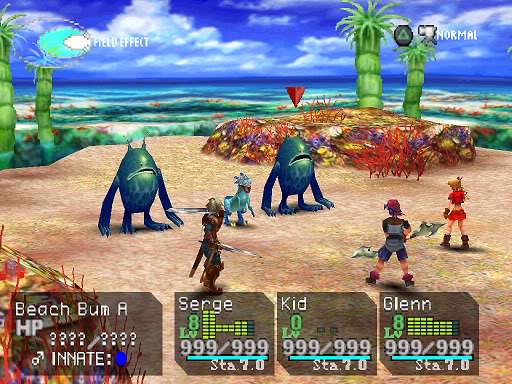
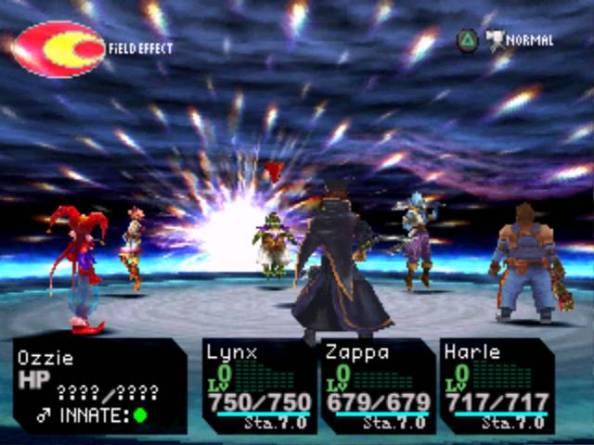
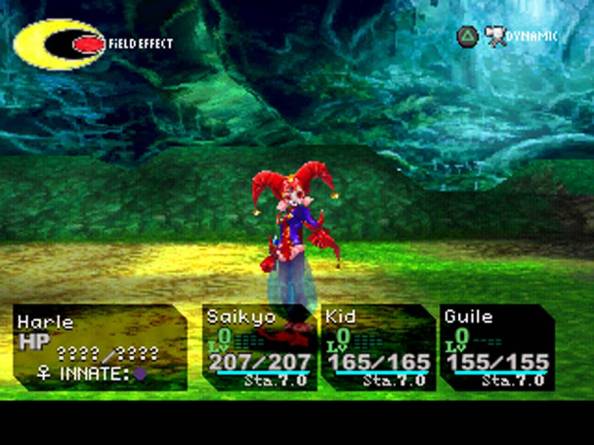
chronocross2

Serge fights Not-Nus alongside Not-Schala and Not-Frog

Specifically, I’ve reviewed enough RPGs that I feel I could easily cover them with my own version of a Cosmo quiz to tell me whether my relationship with any game is going to be hot and steamy, or whether I should just break it off early so as not to waste the best years of my life. If I could only match up witty comments with one of those scan-tron bubble sheets for the tests you take in high school to determine whether or not your teachers get paid, I could hammer out reviews three times a week. So this week I’d like to look at Chrono Cross sternly, shake my finger like its mom and say, “You should know better,” by examining things it does that developers need to stop doing.

1. Too many playable characters. (Forty-five? Are you trying to tell a story or start a football team?)

2. Only three characters at a time. (Two, really, since game designers have this notion that a character can live a lifetime as a ninja master or a military tactician, but if they don’t have the spiky-haired teenage protagonist at the head of their party at all times, they won’t have enough wits about them to jam their straws in their juice boxes.)

3. Characters who are as unique and distinct from one another as a box of Cheerios. (and with almost as much flavor)

4. Fewer options in combat than the space invaders. (Drop down, reverse direction, increase speed, versus Chrono Cross’ Attack, use magic)

5. Bland story that drops a piano full of convoluted plot points on your head just before the final boss fight.

6. Lack of explanation of battle system. (Eh…it’s better than Cross Edge)

7. Lack of direction from plot-point to plot point. (The NSA usually has more information to go on when cracking international codes than the player does when advancing the game)

gfs_50218_2_297

More characters than you can shake a gate-key at.

To be fair, a lot of games have worse problems. But I’ve never liked playing games where focus is taken off of plot development in favor of getting enough characters to create a successful pyramid scheme. And with the “mute bastard” trope, where the main character has the personality of your average tree and no character consistent enough to speak for him, of course the story will come off as less coherent than your average Trump voter. Yes, a few of them do have unique and interesting skills, but the majority of them can only do some variation of “deal damage with X-elemental qualities,” but the elements only matter when one of them accidentally heals a monster, and you can equip any type of magic on any character to equal effect. Chrono Cross sells itself on offering a New Game+ to let the player collect all 45 characters. Congratulations, Square, not only did you reduce Chrono Trigger to Pokemon, but you totally missed the point that the reason we gotta catch ‘em all is because they’re all unique monsters!Chrono Cross did have some clever ideas. Rather than try to write a coherent sequel to a time travel story–something that Crimson Echoes did with all the grace of Swan Lake as performed by a herd of wildebeests, and that Back to the Future only pulled off with enough plot holes to make it look like it survived one of the Jigsaw Killer’s puzzles–they focused on the idea of parallel universes and realities that could have existed, but didn’t. And it’s actually kind of brilliant that they managed to incorporate branching paths and player decisions that create mutually exclusive events so that not all things can happen in a single play-through.

Harle

Well someone at Square is a Batman fan…

But here I have to shout out a big apology to Crimson Echoes. While previously I accused the fan-made game of a variation on point #5 from above, I now have to respect them for taking the shreds of plot that sound like Square sewed them together from the scraps of cloth found in boxes in their grandma’s attic and making them sound like they all came from the same, if not convoluted, story. After an entire game’s worth of traveling between two parallel universes, recruiting a party larger than Woodstock, and finding bits of information that hint toward what happened during and after Crono’s battle with Lavos, we find out that the dragon gods are really just out for revenge for Lavos falling on the reptites. And once that crimson star is dropped on you, you go into the final dungeon.

Dragon

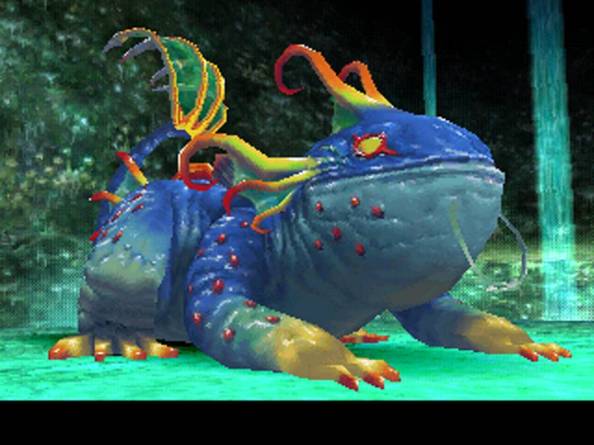
You’ll need people with intelligence when taking on this dragon. Fish. Thing.

But for some reason, I got through it. Perhaps that reason might be that although I recently resolved not to waste times with games I don’t enjoy, old habits are hard to break. I did like some aspects of the game. Yasunori Mitsuda’s score, as usual, was a pleasure to listen to, although–much like the rest of the game–it sounded like he just threw in discarded scraps and rough drafts of songs that he ultimately didn’t use in Xenogears. The weapon smithing system seemed interesting, although it petered out halfway through the game. And, of course, the game did score 10/10 by some critics, so perhaps there is something intangible about the game that’s worth my time.

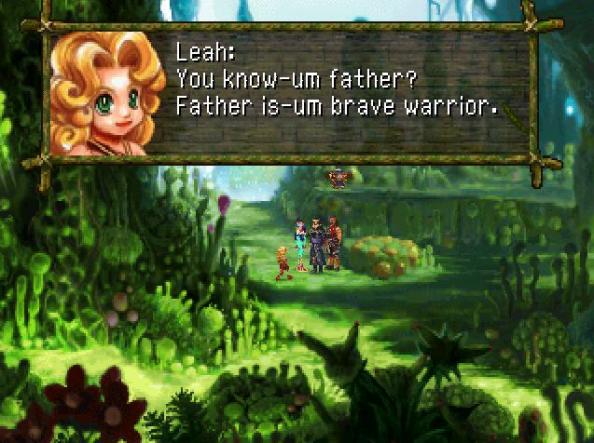
Leah

Not-Ayla joins your party!

But I’m still a little scared to try out Radical Dreamers. Maybe I should just stick to replaying Chrono Trigger until my brain melts.

Hyperdimension Neptunia – PS3

Dungeon

Mmmm…gameplay.

Long time readers know I generally regard licensed games like an extremely loud party in the neighbor’s apartment; I never asked for it, don’t really want it, and when I’m confronted by one I end up spending hours of my life thinking, “Isn’t there something I’d much rather be doing with my life?” We all know what’s wrong with them: low-effort design that replicates popular games that have preceded it while simultaneously stripping away all the best parts. They’re rushed jobs with very little thought or care into making them fun, selling themselves solely on the idea that people will pay $50 to have a plastic disc or cartridge with the same name as that movie they saw last summer. But honestly, why even wait for a movie or TV show to come along that needs to be licensed before? Couldn’t we develop a game with the same lack of effort, without the need to pay expensive licensing costs?

Hyperdimension Neptunia answers that question with a resounding, triumphant, “Meh.” This PS3 RPG offers overly simplistic design and gameplay that make NDS games look like virtual reality. The story, which I can only describe as “The 50 Shades of Grey to Sailor Moon’s Twilight,” is so shallow you couldn’t drown a hamster in it. The opening scene establishes four goddesses have spent the last few aeons fighting each other in “The Console War,” a conflict explained with all the clarity of a Loch Ness Monster photo. After a fiercely intense battle, three of the goddesses descend to the human realm of “Gamindustri,” while Neptune, the fourth goddess, plummets head-first into the ground, inflicting her with a pretty severe case of Writers’ Convenience Amnesia.  Neptune, named for the canceled Sega Neptune console, bears a striking resemblance to another air-headed, ditzy, immature, meatball-haired young girl named for a heavenly body. She soon begins to collect a posse: Compa, named for the game’s partner developer Compile Heart; IF, named for another developer, Idea Factory; Gust, another developer; and Nisa, named for Nippon Ichi Software of America–who all follow Sailor Moon archetypes: Compa, the demure smart one; IF, the strong-willed, competent yet independent one; Gust, the weird one of notably unusual stature; and Nisa, the exuberant, capable heroine who has been fighting crime since long before Neptune’s quest began. Together, they travel through the four nations of Planeptunia (Sega Neptune), Lastation (Playstation), Leanbox (XBox) and Lowee (Wii). I honestly don’t know whether to chalk this game up to Sailor Moon Fan-Fiction or Sega misconstruing the audience who would enjoy such a grandiose inside joke.

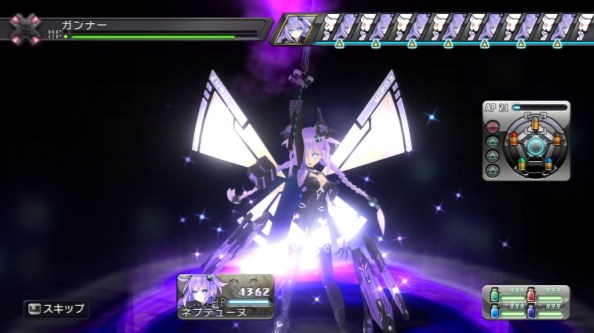
Neptunia Transform

In the name of the moon, I’ll punish you…for churning out thinly-veiled intellectual property theft disguised as bad fanfiction.

Because ha-ha! Isn’t it funny that we’re talking about corporate competition satirically–except without the wit, humor, or even enough subtlety to catch a dead cow unaware. Hyperdimension Neptunia clearly wants to be funny, but resorts to humor that wouldn’t meet the standards of a 10th-season episode of the Big Bang Theory. If one of the easiest ways video games introduce levity is by breaking the fourth wall; Neptunia treats the line between game and audience like a piñata filled with wine glasses. Cut scenes are almost as lazy as the humor, consisting of character art over dialogue boxes, much like common fare in a DS game. At first, I thought something seemed off about this, but then I realized that the artwork was moving, although after finishing the game I still can’t be sure if they meant to give the illusion that their game was animated, or if they just wanted to see the girls’ breasts jiggle; however, far from wiggling like appealing sacks of jello, the animation swells and fades slowly. Far from coming off as sexualized or even resembling a character’s chest rising and falling as they breath, the sprite animation moves slowly and subtly enough to induce a faint sense of nausea, perhaps in attempt to sicken any players not yet turned off by the story or gameplay.

The game itself follows the trope of “Heroes traveling the world to help people, who all coincidentally have problems that require monsters at the center of dungeons to be slain.” Honestly, RPG worlds must be wonderful places, where no one ever needs a ride to the airport, someone to feed their cat while on vacation, or their grandchildren to figure out how to get their computer’s display right-side-up again. If a problem can’t be solved with excessive amounts of fantasy violence, then damn it, it isn’t a problem! Unless, in this case, it’s something easily resolved in a cut scene. Furthermore, if the quest doesn’t involve a crystal cave, chances are there’s nothing worthwhile inside it, as at least 25% of the dungeons visited are modestly labyrinthine crystal caves.

Poseidon_Neptune_Greek_God_Art_03

Known affectionately by her friends as Nep-nep, Neptune travels the world on wacky adventures, experiencing zany antics with her best friends, Compa and Iffy.

And it’s not just dungeons that suffer from less diversity than the NHL; if the player isn’t selecting quests and cutscenes on the world map or navigating miniature labyrinths, then you’re in battle. Unlike Cross Edge, Neptunia’s battle system isn’t quite plagued with enough problems to make the Black Death look like a mild pollen allergy, but it’s easy to tell that the same team of developers had a hand in both games. The most notable problem is that depending on what phase of attack you’re in, the cancel and attack keys can switch between the circle and square buttons. These are never things you want to get confused. I have a black belt in Korean kendo, and I never once learned that the best way to sheathe my sword was to embed it in the nearest esophagus, nor has anyone suggested that the best way to ward off murderous samurai is to sheathe my sword and toss it to the bottom of a lake. What’s worse, those are pretty much the only options for action in battle. Yes, you can change the technique used for each attack in the menu, but you can’t cast magic or use items. Healing and support effects are limited, and require possession of a certain amount of any number of four distinct items, and every effect uses a combination of the same four items, which not only requires a huge supply, but makes as much sense as using Windex for glass, counter tops, floors, strep throat, gasoline, cat food and geometry homework. But assuming you have stocked your bomb shelter with enough of the stuff to last a nuclear winter, you still have a certain number of points you use to raise the percentage of time each skill is used, and then only if a certain condition–like taking damage or defending–is met. In short, combat is dull and repetitive, and has pretty much the same result as a chemistry field trip to a casino to learn about limiting reagents. The cherry on top of this sundae of bland is the option to skip attack animations. While some of them are fun to watch once or twice, specific battle timers still run through the animations, including the length of time before an enemy restores defenses. While skipping the animations saved me from playing this game well into the summer of 2017, I don’t think battles where numbers magically fall away from combatants’ life totals would entertain me if I had a a briefcase full of pot.

Nepnep

Neptune wakes up next to a note. Never a good sign.

Let’s see…what else can I complain about? Because both battle and the story give you fewer options than your average presidential election, most items you collect do little more than make your inventory look like the floor of a nine-year-old’s bedroom. Except for Neptune, Compa, and IF, you have to purchase the right to use additional characters as DLC, along with costume items and probably a handful of weapons and accessories. The bosses are as boring, simplistic, and repetitive as an Earth Wind and Fire album. Except for the playable characters and literally only two others, all other dialogue is spoken by generic silhouettes. Oh, and the five or sicks music tracks repeated through the game generally make as much sense as syncing up the Ride of the Rohirrim and the Battle of Pelennor fields with the Benny Hill theme. Except, unlike Hyperdimension Neptunia, I’d probably play it more than once.

What the hell does hyperdimension mean, anyway? They use the term in Disgaea, too…

MyGreatCaptureScreenShot2014-06-2612-25-50_zpsad9ab458

Is that a metaphor for this game?

(Sorry guys, but I’m going back to posting every other week for a while. In addition to being swamped with work, I’ve also taken on a stage manager position for 42nd Street, which will take up the next six weeks of my life…also, I’ve started playing Disgaea, which could easily take up the next six months.)