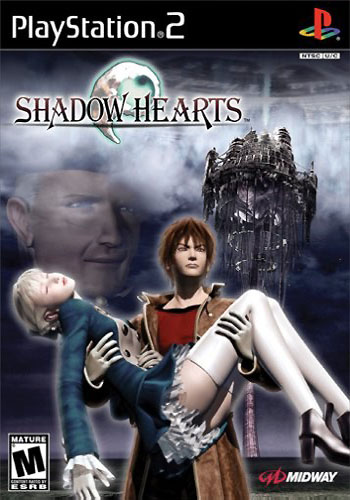
Shadow Hearts – PS2

Shadow Hearts holds the distinction of having the most kick-ass box art of all time.

Shadow Hearts holds the distinction of having the most kick-ass box art of all time.

Hehehe.  Let’s talk writing for a bit.  Hehehe.  Villains have made derisive laughter an art form. People love it.  I used to practice my evil laughter as a kid.  Hehehe. It even merited an Austin Powers gag. Hehehe.  Used correctly, it can create an air of menace by painting a game’s enemy as powerful and confident, a daunting task for the hero. Used incorrectly, it gives the impression that he may wander off in the middle of the battle looking for something to eat.

And sadly, Shadow Hearts leans in the direction of the latter, with villains and heroes alike floundering in the aftermath of a dentist-office gas explosion.  While I love the series, I can’t help but admit the flaws in the writing.

The first game in the Koudelka universe branded with the series’ title, Shadow Hearts introduces Yuri, the harmonixing youth with a heart of gold and a soul full of filthy, horrible monsters.  Hearing a voice in his head telling him to rescue Alice, the damsel in distress, from the Japanese Army who hold her prisoner on a train bound for Shanghai.  Finding the Japense soldiers dead, Yuri squares off against an English gentleman who goes by the name of Bacon, a moniker that, when shouted in a spirit of anger and vengeance, equates the game’s antagonist with clogged veins and heart disease.  After receiving a thorough trouncing, Yuri summons the strength to leap into the stratosphere while carrying Alice (because in video games, injuring people only makes them stronger) and the two land in the first of many episodic, horror-themed, RPG adventures.

I’ll spare the details of the rest of the plot because they simply don’t matter.  For a story with so many things going for it, the actual action of the story could have coalesced from the flotsam of sunken B-horror films. They don’t fit together well, but the game wants us to focus on them, even going so far as to devote major cut scenes to ghost-story backgrounds for minor bosses. At one point, Yuri and Alice stumble onto a village terrorized by a ghost who kills a new victim each night.  When the elder tells them about the ghost, she really hams it up.  Real people supposedly have died, and this monster has put Alice under the fatal curse, and this woman squeezes out onomatopoeia that would make five-year-old girls giggle.

Kinky! The second of four games, the female lead has gone up to about a B-cup. Future games will push those boundaries.

Kinky! The second of four games, the female lead has gone up to about a B-cup. Future games will push those boundaries.

But you don’t play Shadow Hearts for the plot, you play it for the premise.  Oddly enough, the character development and relationship between Yuri and Alice carry the story.  As a harmonixer, Yuri fuses with monsters to gain strength in battle, but the demons possessing him take their toll on his soul. The battle system furthers this aspect of the story; characters have sanity points they must maintain, and every time Yuri transforms, his sanity points drop drastically. Running out of points drives characters into a berserk state where they can’t distinguish friend from foe, and it counts towards a K.O., depriving them of exp at the end of battle.

In what I consider a fascinating treatment of a hero (even an anti-hero), Yuri can’t withstand the effect this has on him.  He succumbs to insanity and destroys Shanghai.  Later, after she brought him back to his senses, Alice tries to save Yuri’s soul by offering her own to the god of death.

Er…spoilers…

Torture...mini skirts...peg leg...there's so much going on in this scene I can't withstand the power.

Torture…mini skirts…peg leg…there’s so much going on in this scene I can’t withstand the power.

And in that aspect, one of my major beefs with the series emerges, because Alice’s fate changes depending on which ending you get, and while the player can work through some interesting challenges to get the good ending, the easy ending to achieve actually feels more satisfying.  Yuri struggles for peace in his soul during the whole game, and he owes much of that peace to his relationship with Alice.  The fact that his peace requires her death provides a darkly poetic irony to conclude the story, and also to propel him into a frustrated angst that moves him to action in the sequel.

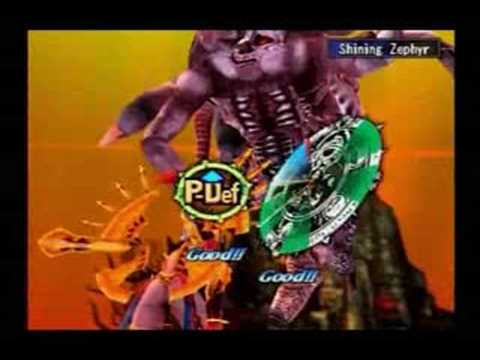
On a technical aspect, the game doesn’t vary too much from its successors, Covenant and From the New World.  The judgement ring still stands between you and nearly every action you perform, including magic, physical attacks, items, and interacting with the non-combat environment.  While I’ve previously praised this idea (somewhat) for making the game more engaging, I sometimes feel that it doesn’t always make sense; I would think the whims of fate have very little to say in whether or not you can pick up kettle from a table.  That more often falls under the whims of degenerative neuromuscular disorders, which don’t seem to bother Yuri most of the time.

One staple of modern RPGs becomes extra annoying in this game; the three-character party.  Too many games feature multiple characters as a selling point, only to limit you to a three-member team.  Furthermore, they generally require you to stick with whatever twat they’ve decided to make protagonist (I’m looking at you, Legend of Dragoon!), which pretty much limits you to two characters.  Now, while I’d play with Yuri more often than other characters, I still enjoy all the others–in fact, Shadow Hearts has made a name for itself by introducing bizarre characters in every game, so I hate cutting anyone from the team.  Furthermore, I grew very fond of Zhuzhen, the Chinese wizard, but halfway through the game, the new characters eclipsed his power in a way that made him obsolete.  I liked the ol’ coot, and for some reason they paired up Yuri with a new old-guy friend in Covenant, so he sadly drops out of the story.  Margarete, the “alluring female spy” also intrigues me–mostly because if you google her name, pages about Mata Hari pop up.  Sadly, Mata Hari dies during World War I, so I guess they had a reason for keeping her out of the sequel.

First of many appearances by the judgement ring

First of many appearances by the judgement ring

The game has math issues as well. The bonus for hitting the judgement ring in the strike zone adds only a small boost to attacks, noticeable only at mid-game levels and not effective until end-game levels.  Every enemy has one of six different elemental affiliations, but using opposing-element attacks has all the effect as mounting a spatula to the end of a bayonet. Support spells grant similar half-hearted measures, akin to increasing your defensive capabilities with a fine, state-of-the-art sheet of newsprint, or increasing your speed by thinking about a Roadrunner cartoon you saw as a kid. Halfway through the game I realized I could take off all stat-increasing equipment and replace them with accessories that grant status immunity and still suffer no noticeable loss in power or defense.

The unwelcome house-guests of the soul take inspiration (mostly) from the suits of a tarot card deck.

The unwelcome house-guests of the soul take inspiration (mostly) from the suits of a tarot card deck.

Fortunately, the game knows it failed miserably, as evident by the fact that the sequels fix all of the complaints I just raised here.  Elements and status attacks have a noticeable impact in Covenant and FTNW, equipment offers helpful bonuses, and parties consist of four members.  Furthermore, the game recognizes that just because characters don’t enter battle, they also don’t vanish entirely, and the subsequent games let you switch out the main characters when you don’t feel like using them.  I always thought the convention of peek-a-boo style party forming didn’t make sense.  At one point during Shadow Hearts, in his quest for the ultimate weapon, one of my characters had to fight his brother one-on-one.  Unfortunately, little bro KO-ed my fighter, and even though five other playable characters witnessed this event and still had full control of their senses and perfect health, I found myself staring down the business end of a Game Over screen.

Maybe it wouldn’t bother me as much if I hadn’t saved over an hour earlier…

Sorry for the infrequent posting, but school demands more attention. I’ve been on a Shadow Hearts kick lately, so expect a review of Covenant next. Afterwards, Anne wants me to play The Last Story for Wii, and I’d like to go to a Sega or SNES RPG, so that should be interesting. Don’t touch that dial.

Shadow Hearts: From the New World – Playstation 2

Shadow.Hearts.full.787296
Playing video games regularly for over twenty years, I’ve absorbed them into my identity, and constructed an elaborate vision of the afterlife based on them.  Once I die, I’ll unlock the New Game + option and restart my life from birth with all the possessions and experience from my first life.  Using this advantage, I can explore the world in more detail and test out the alternatives to decisions I made the first time through.  Eventually, by discovering every available potential story line, I’ll unlock the “Good Ending.”

Think Buddhism, but without the discipline or commitment.

Still, this scenario relies heavily on the assumption that the “Bad Ending” comes more easily and that I actually desire the “Good Ending.”  Unfortunately, the Shadow Hearts series routinely flouts this concept, rewarding players for overcoming enticing challenges with good endings written with the appeal of an off-Broadway musical version of Twilight.  So I have to decide between extending my stay in a game with a colorfully dark atmosphere and impossibly well-conceived side quests or walking away from a deep contemplation of malice and monstrosity in the human soul with a positive, bubbly, can-do attitude toward the world.

Let me rewind, though, and start from the beginning–of the third game.  Shadow Hearts: From the New World rounds out the trilogy of games about a man with demons fused into his heart searching for love, acceptance and purpose in a Europe and Asia torn apart by the malice preceding World War I by creating an epilogue starring none of the same characters, demons, or setting as the first two games and taking place well over a decade after they ended.  But in spite of the awkward continuity break, the game actually turned out pretty good.

Quack, quack, quack!

Quack, quack, quack!

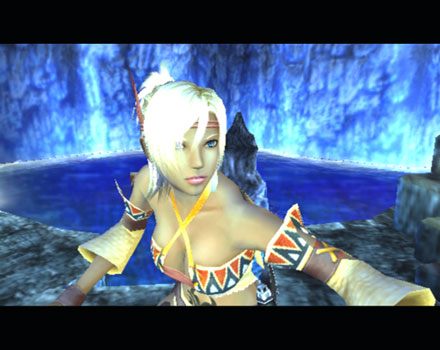
Nautilus has played with combining the irreverent with the dark, and by this game they managed to construct a world of Lovecraftian horrors that will leave you rolling in the aisles.  You play as Johnny Garland, sixteen-year-old boy detective and the least interesting character in the entire Shadow Hearts series.  As the game opens, the creepy Professor Gilbert, on sabbatical from his quest to become the kingpin gangster in Gotham City, hires Johnny to track down a missing person.  Unfortunately, his career in investigation comes to a dramatic end when a monster materializes and eats the guy he’s tracking.  But to prove the adage that every time God shuts a door, he opens a peep show, Shania, an Aryan Native American with breasts the size of all three pair owned by protagonists of the two previous Shadow Hearts games and Koudelka put together.

Seriously...I'd play it just for this guy.

Seriously…I’d play it just for this guy.

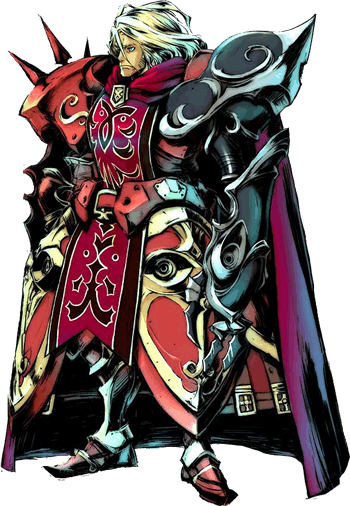
Now you may remember me praising Samus Aran for contributing her femininity to a story that doesn’t ask for or need her gender in the least.  Considering my stance there, I’d come off as incredibly hypocritical and misogynistic if I confessed to favoring Shania because I enjoyed watching her.  Well, yeah, she has the anatomical proportionals a Barbie Doll and kind of gives off the vibe that no one can focus a story around a Native American unless their standing ovation happens in the players’ pants, but to that I say one thing: Frank Goldfinger.  Very shortly after Shania joins your party, you encounter the middle-aged Frank hiding behind a cloth sheet as three monsters pound the snot out of him.  When he emerges bragging about how neither Johnny nor the monsters ever saw him, he claims to have studied the Brazilian Ninja Arts in order to protect the United States.  At that point, the game’s message rings through like an air raid siren in a library; don’t interpret anything seriously.  The irreverent, nonsensical characters count among the games strongest features.  If you partake in a certain side quest, you even realize that each one supposedly embodies one of the seven deadly sins, a very interesting bit of symbolism until you realize that Gilligan’s Island actually pulled it off much better.

Yeah, it LOOKS easy...

Yeah, it LOOKS easy…

Like previous instalments of the series, combat revolves around the Judgement Ring, a spinning dial that asks the player to activate it at very specific points in order to determine the success and effectiveness of attacks and spells.  While many RPGs suffer from excessively repetitive combat that often forces you to just hit “X” over and over until the battles end, the Judgement Ring offers a more engaging system that asks you to hit “X” more often and at very specific times than those games.  Oddly enough, it works. It encourages players to aim for minuscule strike zones to buff up their power, which increases the chances of missing altogether and screwing up the attack.  For a mechanic intended to represent the unpredictable whims of fate, it creates a sense of control over the battle that few other games can rival.

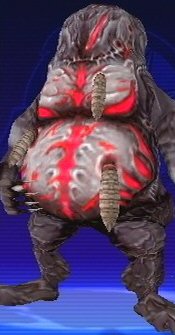
In addition to the characters and the combat system, the game design and atmosphere make the game worth playing.  I enjoy the works of H.P. Lovecraft, but holy hackney Batman, his stories sound like he threw the Oxford English Dictionary into a garbage disposal and dumped it onto a page covered in glue.  So what I really mean when I say I enjoy Lovecraft is that I enjoy Shadow Hearts and appreciate his influence on them.  Nautilus painted a dark world with vibrant colors.  The unorthodox monster design offers something more grotesque than the standard vampire, werewolf, zombie, or other human- and animal-based design.  I’d pay $50 for a Shadow Hearts 4 just for the artwork.

Shftnw_mon_038

Well, mostly non-humanoid

Well, mostly non-humanoid

Like the monsters, the game itself gives us something refreshingly unorthodox.  Most RPG developers work within the fantasy genre, with sci-fi as their backup.  The real-world, alternate-history setting of this series, and I understand the New World setting for all I mock it.  It didn’t make sense at the end of Covenant to continue with Yuri’s story, while the Americas provide an untapped source of history and landmarks to work with.  It provides enough background to qualify for the series; the judgement ring, lottery games, a wacky vampire from the Valentine family, Roger Bacon and his porn addiction, and the emigre manuscript.  While the plot doesn’t wow me with complexity, they use events and ideas from previous games to prevent the story from falling into formula.  The plot of From the New World springs primarily from Nikolai Conrad’s release of Malice in Covenant, along with the running theme that no one has ever successfully resurrected the dead using the emigre manuscript.

While many found it a weak follow-up to the games starring Yuri Hyuga, and the game itself didn’t make enough money to ensure continuation of the series, the game doesn’t disappoint.  This forgotten/hidden gem perfects the judgement ring combat system and adds an entertaining complexity to the magic system and combo attacks.  Also, I bought the soundtrack for this game (and for Covenant) because it created such a perfect mood.  Bottom line: don’t play From the New World expecting a strong story or a familiar protagonist (although enough characters make cameos to keep it entertaining); play the game because Nautilus perfected their art and won’t likely make any more instalments of a great, atmospheric series. And breasts. Large, but not quite comically large breasts.
shadownewworld393

Radiant Historia – NDS

Image

I’ve done it!  After thirty-six hours of gameplay and a handful of short games to stall for time, I’ve finished Radiant Historia for the NDS!

Years ago, as a result of being forced to read Melville, Dickens, Dumas, and other people desperately in need of an editor, much of my fantasy intake shifted from Tolkien, Dragonlance novels and Terry Brooks (or as I call him, “Diet Tolkien”) to RPGs.  I tell you this not because I’ve made a habit of starting my posts with boring personal stories, but to let you know ahead of time that I like a lot of games that probably don’t deserve it, mostly based on the story or the setting.

If you’ve ever read a fantasy novel or slogged through any fantasy RPG, you’ll find Radiant Historia comfortingly familiar as it follows the genre’s traditional format of taking ideas used elsewhere and slapping them together like the last few leftovers in its fridge; it’s never eaten them together before, but going to the store before dinner would take too much effort.  As a result, fantasy always gives us something new and exciting that may not always smell right or look right, but damn it, it’s new!
Image
The story opens with your standard issue ongoing-war-between-two-nations and has your run-of-the-mill vaguely-supernatural-force-working-behind-the-scenes.  The main villain wants to annihilate existence, a motivating force brought to absurdity in Final Fantasy, and most of the plot twists were dragged kicking and screaming right out of Star Wars.  Also, following the current trend of modern games, the characters look as though the artist took the Sumo Diet approach to design, where they put the pencil on the paper and didn’t stop drawing until their jaw got tired.

Special Intelligence operative, Stocke, receives a book from his superior along with instructions to rendezvous with an informant.  On his mission, a battle breaks out and he has to get to safety with his two comrades.  The game forces him to choose between the escape route on the left and one on the right.  He immediately picks one that leads to a brutal slaughter at the hands of the executioner for the enemy kingdom.  However, the book warps him into an M.C. Escher painting which gives him the option of replaying portions of his life.  Already knowing the wrong answer, Stocke takes the right path, his comrades survive, the kingdom repels the invasion, and the very fabric of space and time accidentally splits open into two separate histories.  Teo and Lippiti, two children who guard the gates of history, give him the quest to set history back on its intended course. Image

Honestly, I could think of a hundred more useful applications for time travel than “setting the course of history right,” many that make me wonder if naming the protagonist “Stocke” was entirely coincidental, and the rest of which had previously been suggested by Scott Evil, only to be shot down as inconsequential paradoxes.

While people may complain about cliches and hackneyed writing, I might remind you that no one actually wants an original story.  Tolkien himself just blended images from Norse myth, Arthurian legend, Shakespeare and an ungodly knowledge of European languages.  And don’t forget Terry Brooks, who drew from a list of sources all the way from Fellowship of the Ring to Return of the King.  So I find that area of the story highly forgivable.

But the aspect of multiple histories sets it apart from other stories in the genre.  Promotional material compares the game to Chrono Trigger because of the ability to travel through time, but that doesn’t tell us anything other than Atlus wanted to boost sales by comparing their game to one of the most popular RPGs ever released.  Time travel in Chrono Trigger extends outside of the characters’ lifetimes and manipulates events important to the world, much like Back to the Future (and while I’m on the subject, look up your dates people before posting those ‘this is the date that they went to’ on your Facebook or Pinterest page).  Radiant Historia more closely resembles Groundhog Day, in which the protagonist relives events on a personal timeline with the opportunity to rectify poor decisions he made earlier in the game.  The tutorial at the beginning explains that these choices will branch off into alternate histories.

I’d like to pause here because this idea spices up the game with a mechanic that shouldn’t really be as original as it comes off.  RPGs and video games in general spring up from the excitement a player gets over influencing the course of events; however, most often they have no more choice than whether they’ll win this battle or pursue a new career as electronic carrion.  The availability of alternate histories means that the story no longer carts the player from battle to battle; it actually becomes part of the process of playing. I would play more games if they worked this into their concept.

Unfortunately, Radiant Historia falls short of using this expertly.  You make one decision early in the game that splits the universe into two different histories, but nearly every choice you make afterwards has two possible outcomes: continue along the path of history, or die suddenly and miserably, at which point the game warps you back to a point so far back that you’ll have to warp forward just to make the correct decision to move forward with the game.  It gives you the option to skip cut scenes, but if you fought any battles between where you are and where you need to be, you just have to suffer through them.  For most of the game, I actually felt as though I were playing through a poorly constructed choose-your-own-adventure book.

While the game does include some novel uses for time travel, it feels like the developers discovered what they could do with it as they went along.  Early on, you fall into a noticeable groove of moving ahead until you needed a skill or item that could only be obtained in the alternate history, switching over to that time line, then repeating that process.  I didn’t find it incredibly difficult to figure out how to progress when they began to deviate from that process, but on one or two occasions I felt more like I was playing Pong than an RPG, warping back and forth, fighting the same battles over and over while trying to figure out at which specific point in time the game wanted me to swipe the tools lying out on a table in a room I visited at during at least five different game events.

An hour or so into the game, I began to notice that I hadn’t had the chance to fight yet.  The game opens with a long expanse of plot, after which you have the opportunity to swing your sword once or twice in a tutorial, only to return to another stretch of story.  While I enjoyed Xenosaga, I managed to tolerate the endless hours of expository babble inserted between game events, but on the NDS, the amount of backlit text I need to read makes me acutely aware that my eyeballs are slowly melting back into my head.  Furthermore, like most RPGs, dialog has a tendency to repeat itself, adding Radiant Historia to the list I mentioned earlier of people who desperately need editing.
Image
But when the combat did pick up, the battle system really showed some ingenuity.  The game places enemies in random locations on a 3 x 3 grid.  The characters, lining up in a style only seen in classic RPGs and firing squads, concentrate special attacks that push or pull the enemies into specific locations, giving them the chance to employ other attacks that target specific shapes or areas, or just allowing a single attack to hit multiple enemies at once.  Effective manipulation of this system results in combo, with longer chains giving you a higher combo level.  For higher combo levels, the game awards greater experience at the end of battles.  At first, I enjoyed this system.  It gives the player options.  All too commonly, RPG battles get repetitive and boring since for all the special attacks available, “Attack” usually ends up being the best option, so you can win most fights by holding down the “enter” button.  Radiant Historia, however, forces the player to use special attacks, and the random placement of enemies requires a different strategy for each battle.  Furthermore, for the cost of a slight drop in defense, any character can exchange turns with any ally or enemy to change the order of attacks.

ImageI enjoyed having such a complex, yet easy-to-use system, so it disturbed me quite a bit when I found out that the battles still felt repetitive.  It took me a while before I realized why: this game is incredibly easy!  After I learned how to effectively manipulate the system, I became more of a photographer than a medieval warrior, making slight adjustments to line up the enemies, make sure they didn’t close their eyes, and then snap the picture to end the fight.  In fact, only the final boss gave me any trouble at all, and mostly because he occupied all nine spots on the grid.  See, while the player has an arsenal of choices for finishing a battle, the enemies can’t do much except fight.  As Valkyrie Profile 2 taught me, allowing either the enemies or the player to do something that the other can’t tends to make the game as balanced as someone who blows up abortion clinics to show how pro-life they are.

Still, by the time combat turned into a bad date that I somehow couldn’t ditch at the restaurant, the story had arrived with the meal that gave me the excuse to ignore it.  I always enjoyed something about the game, which I understand doesn’t ring praises to high heaven about it, but Radiant Historia deserves attention at the very least for pioneering concepts I hope to see more often in the future.  Or, perhaps, they could go back in time and introduce them into past games instead.