 Despite only two weeks passing since my last entry, I haven’t written anything for nearly two months. Instead of spending my time playing video games like a good, responsible 32-year-old, I’ve been working backstage at our local production of 42nd Street, a show so bad that it literally tries to justify its lack of plot by telling the audience ”At least the girls are hot!” And while yes, they were, I’m not yet sure it makes up for working a 20+ hour a week job for no pay, being forced to listen to the same misogynistic songs with no relevance to the story. Really. The only character with any internal conflict in the whole show is the antagonist, who eventually decides that having an accomplished career on Broadway was simply holding her back from what she really wanted in life: a husband. Still, there’s a sunny side to every situation, and sitting through hour after thrilling hour of watching people exercise with metal shoes provides an excellent counterpoint to make a horrible, tedious, level-grinding RPG not seem as bad.

Okay…so maybe it was a *little* worth it for the backstage costume changes.
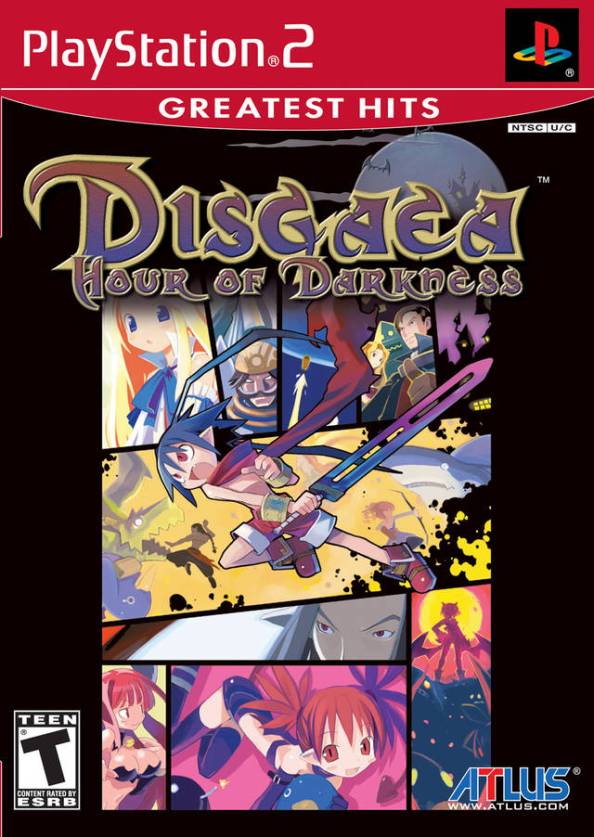
Thankfully, there’s a PSP port of Disgaea, Nippon Ichi Software’s magnum opus, their lightning bolt of inspiration, which after it struck, they sequestered themselves in a rubber-lined mine shaft hoping for that lightning to strike again. Disgaea tells the story of Laharl, prince of the Netherworld, who wakes up after a short two-year nap to find out that his father, the Demon Overlord, has died, and that all his vassals are as eager to swear fealty to Laharl as if the ring they had to kiss had a raging case of herpes. Together with Etna, the one vassal who remains faithful to him only because she can’t double-cross him if he’s her enemy, they set off on a quest to build power and overcome all the rivals for the throne. But when he foils an assassination attempt by angel trainee Flonne, a character straight out of a remake of It’s a Wonderful Life written by Seth MacFarlane, she introduces the concept of love into his black heart and textbook creative writing class scenarios ensue. The story is simple. Character goes on quest, learns something about himself. No twists or turns. But it’s well written, has a cartoonishly dark sense of humor done in an anime inspired episodic format, and next to the plot of 42nd Street, Disgaea is Citizen Fucking Kane.
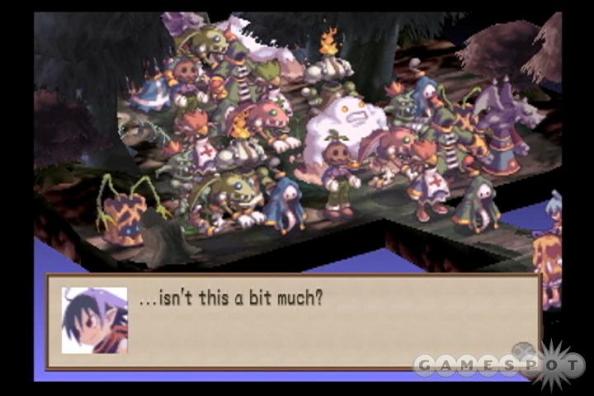
NIS is so good at cramming things into small spaces, they’re permanently banned from Old Country Buffet
However, NIS seems to have interpreted the “Less is More” philosophy as meaning “Less story is more room for piling on additional, confusing gameplay mechanics.” In what has become NIS’s trademark move, they have patched together ideas from at least a dozen other games, resulting in something convoluted, yet intriguing. It’s sort of like buying a car with a lighthouse on the top—you don’t really understand it, but it gives you some options you wouldn’t have had otherwise. Unfortunately, none of these are thoroughly explained unless you buy the strategy guide, and you can’t even look them up on the Internet since the game doesn’t mention them at all, so you wouldn’t know about anything you could. For developers who want people to think their games are fun, tutorials should not require top-level governmental security clearances. Although for reference, even the American government managed to let information about Watergate, Monica Lewinsky and WMDs slip, and none of those existed for the purpose of enhancing an enjoyable experience (Well…maybe Lewinsky). Maybe NIS could give the government a few pointers..

…I tried. I can’t come up with anything to say about this that’s funnier than anything anyone said about George Bush’s snack food assassination attempt.
That isn’t to say they’re bad features. In fact, for the most part, they bring a lot to the tactical RPG genre. Take geocrystals, for instance. Regions of tiles on battle maps are sometimes color-coded, and any crystal growing on that color tile imbues every tile of that color with its properties—sort of like “The floor is hot lava,” if certain regions could also be “the floor is bubbling acid,” “the floor is delicious ice cream” or “the floor will increase the chance that your masseuse will give you a happy ending.” This reminded me fairly strongly of the battle judges from Final Fantasy Tactics Advanced, except I had the ability to change and manipulate the rules, if I went and stood on the hot lava anyway, I could just take the 20% damage without bringing the game to a halt, and I didn’t hate them more than the dog from Duck Hunt.

I know my candidates have to have at least level 500 before I’ll vote for them.
Also, gone are the days of wandering from node to node hoping for a random battle encounter. In Disgaea, players can fight monsters in Item World, a randomly generated dungeon within items. Players can use this to upgrade item stats, collect stat bonuses to move freely from item to item, or simply to grind levels. Because why stop at level 99, when you could stop at level 9999? And why stop there when you could reset your characters to level 1 and do it all over again? I did have fun with Disgaea, but you might be able to guess that it’s a rather time-consuming game. In fact, I’ve put more hours into this than I have Fallout or Skyrim. My game timer is on 140 hours with only a small amount of the extra content touched. That’s almost six straight days—that’s enough to kill two Korean kids back-to-back! I don’t care what you’re doing for six straight days, it’ll get old. Ever go camping for six days straight? Once the moss takes root, you end up looking like Treebeard. For the less active readers, six days of sitting on the couch eating ice cream and…well, it’s not moss, but something will take root. Hell, you can’t have six days of sex. I’ve tried…you start to get sore after about an hour or two.

When you need a full gross of characters to pick from. Because that one point of difference in attack will make or break the game.
Every thing in the game is designed for the purpose of raising your stats, which makes it easier to level up, which in turn allows you to raise your stats. It’s a mobius strip of grinding. And having so much variation in level just means you’re as evenly matched with the enemies as a rhinoceros on steroids versus a freshly baked apple turnover. Unfortunately, near the beginning of the game, Etna managed to strike a lucky shot against a supposedly unkillable monster, thus bumping her up about thirty levels (at which point, she rightly could have slain Laharl and spent the rest of the game as the overlord). From that point on, the game simply alternated between tedium of leveling up and the boredom of mowing through enemies. I haven’t even touched on some of the more interesting features of the game, like making proposals to the Netherworld senate, which allows you to bribe the senators—much like the American senate—and to “persuade by force” when they reject your proposals. There’s also a weird infusion of 1950s sci-fi about two-thirds of the way through the story. All of that was fun, but when I realized that I was really just having fun with a colorful GUI for Algebra, I thought I should move on to a new game.
Give it a shot, though, if you’ve got a week.
Getting back into the swing of this comedy thing after a few weeks off. Working on a book review, since those seem to be popular, and maybe one of these days I’ll get around to finishing my post on Luigi’s Mansion.
 I’ve reviewed enough games by now that I’m convinced Shigeru Miyamoto is the only game developer on the planet who actually knows how to make a game, and that all other successful games get it right purely by accident. I envision the industry like a Looney Tunes episode, where developers just blunder through a hazardous landscape of booby traps, stepping in just the right spots to avoid the poisoned arrows, leap over the crocodile pit, and dodge the falling anvil to let it fall on the villain’s comically inept henchman. And then we get Chrono Trigger. But having paid close attention for three years, always looking for something absurd to criticize, I feel like I’ve started to notice every corpse with an anvil for a head and every crocodile picking his teeth with the wire frames of eyeglasses.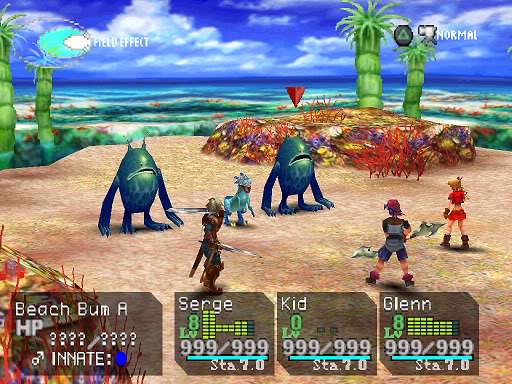
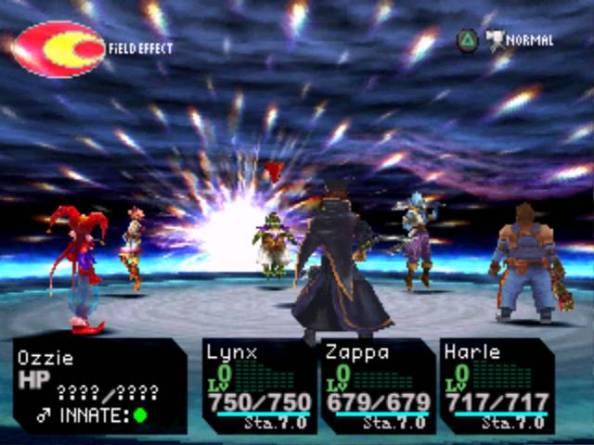
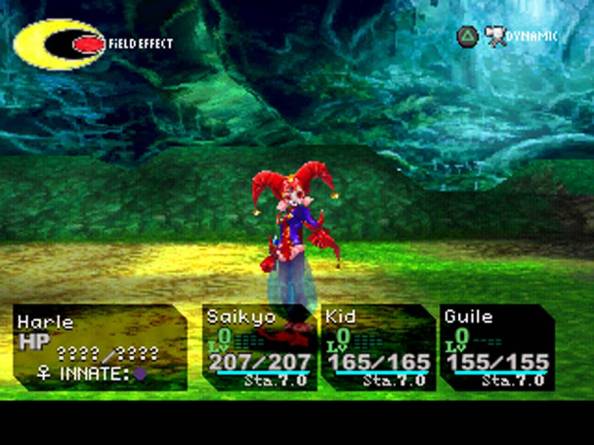
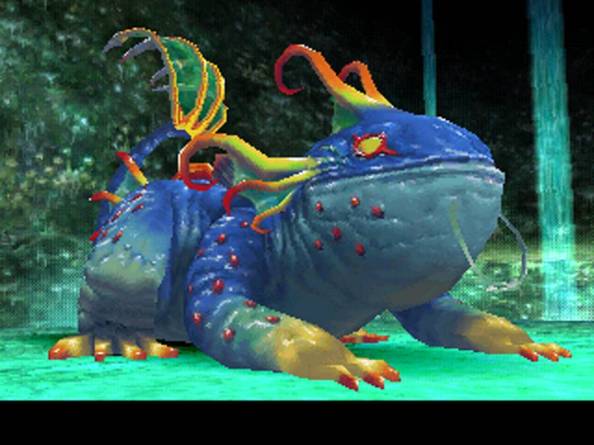
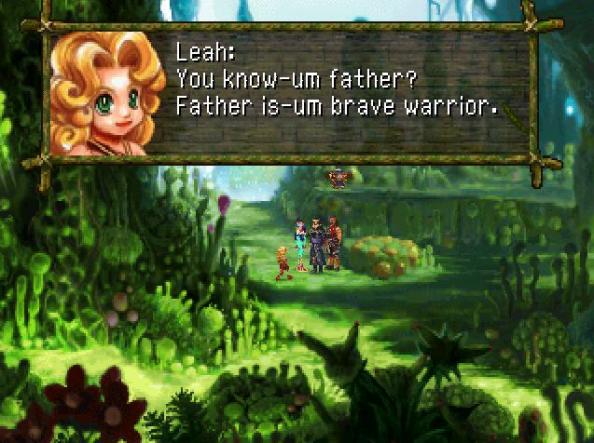
 My latest foray into addictive time-killers is Angry Birds: Fight, which has glued me to my phone every time I get two minutes not immediately filled with something stimulating and exciting. Like many free-to-play games, it offers me rewards and bonuses if I consent to watching ads that try to pitch more free-to-play games which will inevitably offer me more chances to watch videos pitching more free-to-play games until they’ve saturated my time so badly that we repeat the 1983 video game crash while everyone on earth stares at their phones in wonderment of games that could be way more awesome than the games they’re currently playing. Alas, as much as I’d love to bemoan the commercialized state of affairs of modern gaming, the game industry has historically been as all-about-the-art as Donald Trump’s hair stylist. (Low-hanging comedy fruit, I know.) If you don’t believe me, pick out your favorite franchise, and ask yourself how reasonable it is that the in-game world undergoes drastic geological cosmetic surgery from one installment to the next. Sadly, the evidence that developers slap franchise names on games to help them sell stacks up like a life-sized Jenga tower, ready to crumble under its own weight and concuss you with its logs of disappointment.
 The story…well, they say if you put a bunch of monkeys in a room hacking on typewriters, they’ll eventually produce the complete works of William Shakespeare. Assuming that’s true, the monkeys will produce the Heroes of Mana story long before they ever crank out something mildly resembling a sonnet. Roget, first mate of the Night Swan, his captain Yurchael, and an assortment of poorly written anime stock characters (including such favorites as eternally optimistic cutsey girl and grim mercenary with a conflicted past) crash in the wilderness after realizing their own leaders set them up. Why they villains fitted the Night Swan with a mafia-esque car bomb, the game never really explains, but that fear becomes a self-fulfilling prophecy as our intrepid heroes vow to halt the evil they suddenly assume must exist. Blah blah blah, plot lines in and out, a character who gets his ass creamed like chicken soup every time he shows up but somehow manages to inspire fear in the heroes, convolution at its finest, more characters than a story really needs to follow over the course of 27 battles…and one of the monkeys writing this thing must love cliches, because near the end they pull a Luke-I-am-your-father moment, which Roget (and the players) shrug off with a hearty disinterest. In the end, nothing is accomplished. Evil may have retreated, but no one knows or cares why, and the player moves on to story that makes more sense, like Moby Dick, or the United States Tax Code.







 Video Game Underworld