The Legend of Zelda: Majora’s Mask – N64, Game Cube, 3DS

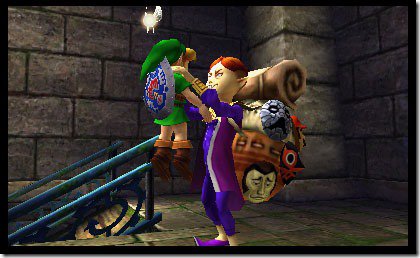
Link, who signed on with the Happy Mask Company in Ocarina of Time, learns that pyramid schemes often shake down their employees for money.

Link, who signed on with the Happy Mask Company in Ocarina of Time, learns that pyramid schemes often shake down their employees for money.

So…uh….I…I honestly don’t know how to start this one. Having harbored an unnatural obsession with the Zelda series since it only contained two games, I really can’t fathom why it took me so long to play Majora’s Mask. Back in high school, my income range fell in the category of “nothing” to “whatever rupees I could earn cutting grass,” and the idea of paying for the N64 expansion pack just to play two games didn’t seem like an efficient use of money. In college, Walmart pulled a nasty trick on me, forcing me to wake up early on Black Friday, risk my life in a fluorescent dungeon of shoppers under the promise that their Game Cubes would come bundled with the Zelda collectors’ pack. After defeating the boss (re: paying the cashier) and escaping, I found the dungeon item did not quite live up to said promises (seriously…fuck you, Walmart, even a decade later). So I didn’t even own the game until 2009 when I bought the collectors’ pack on eBay, and I didn’t get around to playing the game until Anne got bored at the Mall of America and bought the 3DS Remake. So finally, nearly fifteen years after its release, I can stand here confidently to say:

“What the fuck does everyone love about this molderm-infested pile of dodongo shit?”

Yes, I know people revere Majora’s Mask as a fan favorite, an original idea, darker in tone than any other game in the Zelda series. But I played it. The game plays like a fan hack of Ocarina of time. They used ideas so original, they must have programmed them into the game before even putting them down on paper, making them about as effective as applying hemorrhoid cream using an angry hedgehog. And while the story has a handful of dark moments, I suspect that the true popularity of the game stems from the “Ben Drowned” urban legend and the “Dead Link” game theory.

Uh...Goodnight Moon. I'll just close my curtains now...and pass up my usual night lite in favor of a 10-gauge shotgun.

Uh…Goodnight Moon. I’ll just close my curtains now…and pass up my usual night lite in favor of a 10-gauge shotgun.

The story begins by implying that Link has embarked on a quest to look for Navi, who ditched him after Ocarina of Time, most likely annoyed beyond reason at the obnoxious elf-kid’s refusal to look at anything or listen to a word she had to say. Link falls into a hole in a tree and comes out in Termina, Hyrule’s own version of wonderland, where the Skull Kid from OoT has stolen Majora’s Mask, a powerful artifact cursed with a complete and utter lack of back story or explanation, and wants to use it to pull the moon (which apparently has suffered from a raging steroid addiction and a series of botox injections gone horribly wrong) to Termina, terminating everyone. And Link only has three days to stop him. Fortunately, Link had caught Hyrule’s Bill Murray Marathon before he left, and decides to pull a full-on Groundhog Day to get the job done.

Up yours kid. You made me wet in the last game. And it took so long to bake that cake, too.

Up yours kid. You made me wet in the last game. And it took so long to bake that cake, too.

The game reuses a number of graphics from Ocarina of Time, giving the impression that Nintendo hacked their own game to develop a new one. A number of characters appear identical to characters in OoT, including the Spirit Temple boss, Twinrova, both apparently alive and well (or not, if you subscribe to the dead Link theory), running a brewery in a swamp like redneck moonshiners. OoT revolved around magical songs that affected the environment, so Majora’s Mask does too. Except it wants to revolve around the use of masks to solve puzzles, so the game spreads these elements a bit thin. Except for a few core masks and the bunny hood (the greatest time saver since the Pegasus shoes), I used each mask once or twice, if at all, and except for the three songs recycled from OoT, I never memorized any of the music–of course, since they have all the melodic appeal of a dog jumping on a piano, that may account for my lack of interest–and since most songs have very limited uses, I needed to glue myself to a walkthrough to realize when the game wanted me to play one.

Link busts a move to commemorate the only time he will ever use the dance mask.

Link busts a move to commemorate the only time he will ever use the dance mask.

And the rest of the game felt just as convoluted. Also like a lot of fan hacks, the designers nail technical aspects of coding the game felt, but they lack the art required to design a well-flowing story and logical gameplay. Actions and items required for progressing in the story don’t usually make themselves apparent until you wander in circles enough to finally piss you off enough to find a walkthrough online and read through that instead of the game. In addition, they made the challenge platforming-heavy. Majora’s Mask includes a number of sections that require careful jumps, precise timing, and dodging enemies and obstacles, and if you screw up, it rewards you with a long fall and the chance to replay a good section of dungeon all over again. I spent hours hopping from platform to platform, only to miss by a hair or get broadsided by an enemy only to go through a half dozen rooms, re-solving the puzzles in each one.
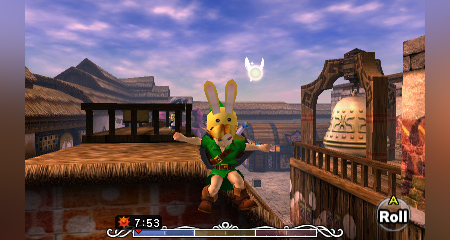
The Bunny Hood: Because continuously rolling across Hyrule field didn't actually make you move faster.

The Bunny Hood: Because continuously rolling across Hyrule field didn’t actually make you move faster.

Most sources I found praise this game for introducing unique concepts to an otherwise formulaic franchise. I agree, they used original ideas that had a lot of promise, but you could force Epona to ride link and praise it as an original idea, but it still forces Link to bend over to let a horse mount him. Most noteworthy, Link has to use the Song of Time to replay the three-day period prior to the moon apocalypse. Props to Nintendo for taking the time loop idea straight out of the X-Files, Doctor Who, Star Trek, Stargate, Buffy the Vampire Slayer, Supernatural, The Twilight Zone, Once Upon a Time, Sesame Street, and dozens of other TV shows and calling it “original,” but they didn’t do it carefully enough. Tracking down people and items with virtually no hints or logic in a four-dimensional space just ends up in–my old nemesis–pulling up a walkthrough online and periodically glancing over at the game to monitor your progress.

And on the note of progress, the Groundhog Day mechanic usually means if you don’t entirely complete a story event, destroy the temple boss, find all the faeries in the dungeons, receive a major item or learn a song before the moon falls, you have to start over from the very beginning. To add insult to injury, you lose all your bombs, arrows, rupees, and other minor items and key items every time you reset the timer. Only major items, like the bow or the hookshot, stay in your inventory. Even temple bosses come back to life. I had to defeat one three times because his death transformed one area from winter to spring. At this point, Nintendo, just admit you only wanted to pad out the play time. I don’t like games with timers, especially when they add to that stress by forcing you to replay pointless sections and puzzles.

Ever play Ocarina of Time and wish you could play as something cool like a Gerudo or a Sheikah? Well good news, in Majora's Mask, you can fulfill your lifelong dream of playing as a dried out bush!

Ever play Ocarina of Time and wish you could play as something cool like a Gerudo or a Sheikah? Well good news, in Majora’s Mask, you can fulfill your lifelong dream of playing as a dried out bush!

I found the game boring, tedious, and repetitive. But in light of the hoards of fans ready to lynch me for not liking the game, I guess I could summon up the kindness and good will to use only the phrase “kicked in the head.” My opinion on the story–which focuses more on side-quests than, well…the focus of the story–did change after completing the “Anju’s Anguish” quest (finished courtesy of my laptop battery, which allows me to keep a walkthrough open for three full hours without plugging in!). The moment between Kaefi and Anju, just moments before the moonfall apocalypse, drew me in enough to completely change my mind on the story, and I resolved to search for more of these quests…only to find just one other listed in the walkthrough. Then I ended up playing the same four rooms of the Ikani Fortress on repeat for two hours, and I rescinded my previous change of opinion.

I’d rather play Spirit Tracks. At least the boredom of riding a train for a 25-hour game doesn’t raise my blood pressure and bother my neighbors with me screaming at the game.

Oh yeah. This douchebag shows up. Suddenly Navi doesn't seem so bad, does she?

Oh yeah. This douchebag shows up. Suddenly Navi doesn’t seem so bad, does she?
Final Fantasy VI – SNES, GBA, Playstation, Android/iOS

The original Insane Clown Posse

The original Insane Clown Posse

Like most people over the age of thirty–at least, those who play video games–Super Mario Bros hooked me. I took one dose, one afternoon at a friend’s house, and that spiraled into a life-long addiction and tens of thousands of dollars I had to scrounge up and commit to feeding my problem. But Mario only acted as a gateway drug. I didn’t really settle into a specific class…er, genre…until the early nineties, when my cousins, on their annual visit to Northern Michigan, brought their Super Nintendo with them along with a little unheard of gem called “Final Fantasy VI.” Er…Final Fantasy III. Whatever. The one with Terra and the espers. I didn’t realize that Square had raised the bar on RPGs forever with this game. I just knew I could play it over and over until the chocobos come home. So, like those in my age range, FFVI became the standard against which I will judge all other RPGs. But how, pray tell, does it stack up as a game by itself?

Well, it turns out that when you use a game as a standard to measure itself, it comes out rather well.  In fact, I couldn’t find anything in which it failed to perform. There. End of article. I can’t remember having an easier time reviewing a game! But…I suppose for the sake of filling out some reading material, I should elaborate.

1/1200 of nothing! Give me the next two minutes of my life back!

1/1200 of nothing! Give me the next two minutes of my life back!

Final Fantasy VI follows a long-term trend in FF games to update technology and streamline design until eventually they’ll have as much in common with the fantasy genre as “The Jetsons,” and instead of riding around on flying boats like in FFIV, the characters will travel on the S.S. Enterprise or the Millennium Falcon. Wait…what? Anyway, FFVI falls in a steampunk-ish world where a power-hungry emperor has discovered the lost power of magic and couldn’t think of any better use for it than building mech armor that protects everything from the waist down, leaving all the soft, vital organs exposed to the swords, lances, and crossbows used by the rebels. Coming out of a magical apocalypse, scholars warn the emperor about using magic, as it might repeat the global destruction from a millennium ago. This makes as much sense as a comet passing over the White House and calling off the raid on Osama bin Laden because we don’t want to repeat the horrible tragedy at the Battle of Hastings.

Just slowly replace the entire script with Star Wars references, and pretty soon you'll have a game as popular as Star Wars.

Just slowly replace the entire script with Star Wars references, and pretty soon you’ll have a game as popular as Star Wars.

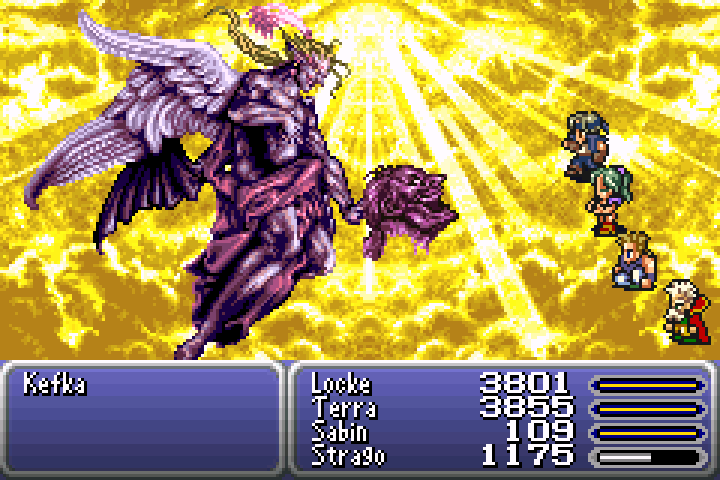
Anyway, the Empire uses Terra, a half-human, half-esper, half-protagonist, for her innate magical power. Then the Returners, a group of rebels, rescues her and hopes to use her for her innate magical power. But we don’t mind, because the Empire used a mind-control device to enslave her, whereas the Returners just used good, old fashioned, natural guilt. Because Tolkien taught us that kings always have our best interests at heart, while Star Wars shows us that emperors only want to blow up our planets and strike us dead with lightning. The Empire wages war to collect magic and subdue nations until the Emperor’s “court mage,” Kefka decides to destroy the world and rule the rubble heap as a god. The heroes rush to stop him. Then they lose. Failing to avert the apocalypse, the second act of the game takes off in a non-linear direction in which the player must find all the lost characters, then hunt down side quests that give them each a reason for living.

This game, as I’ve mentioned, defines “good RPG” for me. The story provides fourteen fully unique characters, each with a single unique special skill. Except for two, none of them learn magic naturally or in a pre-programmed order.  All spells are taught by equipping magicite (the petrified corpses of fairy-tale monsters, the Espers) in whatever configuration or order the player chooses. Each character has a certain configuration of base stats, suggesting a use for the character (The old mage, Strago, has higher magic power than physical power, while if you try to teach magic to your ninja, Shadow, you’ll find he has about as much aptitude for casting as a one-armed, epileptic fly fisherman…so about the same as every other ninja that Square tried to improve by giving low-level black magic powers), but magicite often grants stat bonuses when a character levels up, so the player can also customize these. I’ve only played two RPGs that have better character customization mechanics than FFVI: Final Fantasy V and Final Fantasy Tactics. So with all these fabulously creative systems, naturally Square moved on to FFVII, where you forge your characters with as much care as it takes to put books on a shelf, and who have all the unique features of an NES with a sticker on the top.

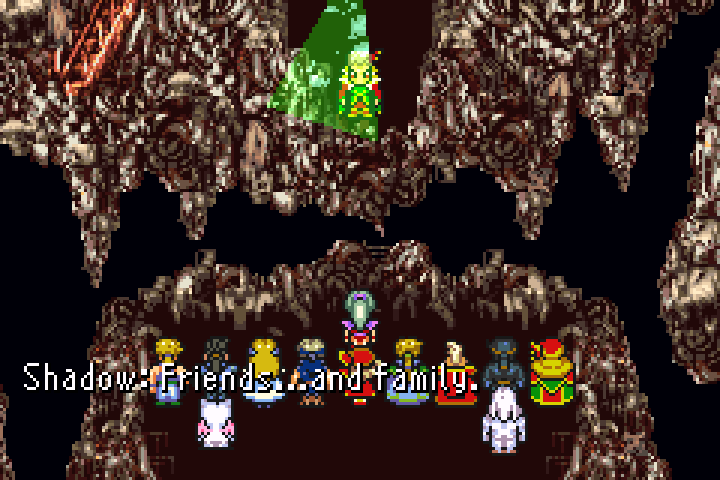
So I know we have to fight an epic battle to save all of existence in about three minutes, but this seems like the best time to tell Relm I'm her father.

So I know we have to fight an epic battle to save all of existence in about three minutes, but this seems like the best time to tell Relm I’m her father.

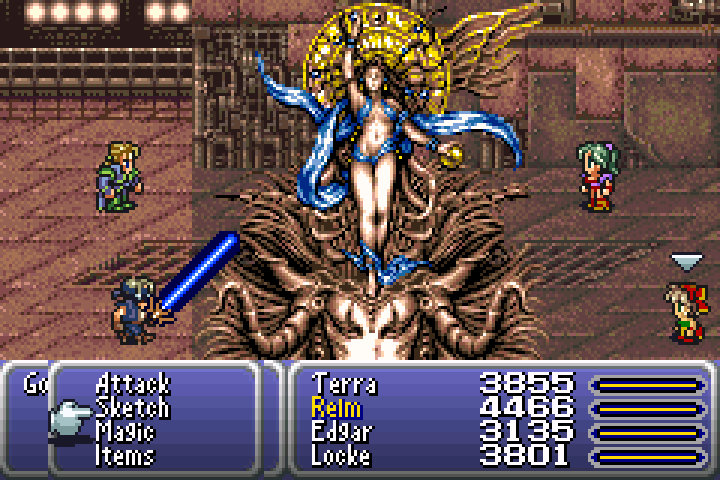
So when I joked about comparing FFVI to itself earlier, I may have lied somewhat, as it actually does exceed the standards it set. While the SNES version reigns supreme in the hearts of those who played it, I actually recommend playing the Game Boy Advanced version, which gives the game an upgrade akin to using a chainsaw to cut down a tree instead of a pocket knife. While Ted Woolsey’s original translation may have won the hearts and minds of 14-year-old boys who listened to the Pimsleur Japanese free sample so they can criticize the subtitles of Sailor Moon episodes, the GBA translation reads as though people actually speak the language used in the story.  It corrects mistakes such as “Lete River,” “Fenix Down” and “Gradius” (Lethe, Phoenix, and Gladius), it allows Cyan and Doma to exercise a Japanese culture rather than bleaching them whiter than a Disney Princess, and it un-censors a lot of the original story.  It also turns some of Woolsey’s garbled nonsense into meaningful dialog. “This kid’s loaded for bear” now reads as “When you showed up, I thought you were one of Vargas’s bears.” (After which, the game humorously speculates on Sabin’s sexual orientation.) Furthermore, Shadow, who learns of his relationship with Relm through a series of dreams, no longer drops that bomb on her just before the final battle, instead suggesting it more subtly.

Look away children! The Goddess statue will steal your soul way if you see her without those extra blue pixels covering her legs!

Look away children! The Goddess statue will steal your soul way if you see her without those extra blue pixels covering her legs!

This most recent playthrough, I decided to watch Star Trek on Netflix while I worked on some side quests. In easily the weirdest moment I’ve ever had playing video games, I look up from FFVI to hear Kirk talking about espers. The term “esper” refers to someone with the ability to practice ESP at will. That, I suppose, clarifies the connection with magical monsters about as well as a six-year-old with cholera clarifies a public swimming pool.

This...might take a little more strategy than "Stick him with the pointy end."

This…might take a little more strategy than “Stick him with the pointy end.”

While the second act glorifies non-linear side quests, RPGs always contain the flaw of running out of stuff to do as soon as all the highest-level weapons, armor and magic becomes available. Like the other GBA ports of the SNES FF games, FFVI adds bonus dungeons to the end. The major dungeon, the Dragon’s Den, resurrects the eight dragons, presumably with a mixture of phoenix down, high doses of caffeine, and anabolic steroids. After making your way past these new challenges, you fight the Kaiser dragon. With even a moderate attention toward leveling up, the game’s final boss will drop faster than a politician’s pants in a truck stop bathroom, and I have literally destroyed him in a single attack on more than one occasion. The Kaiser dragon, on the other hand, puts up more of a fight than a triple-amputee undergoing chemotherapy, so his addition not once, but twice, spruces up gameplay by a healthy amount. He appears a second time in the other bonus dungeon, a 100-battle fight through various enemies and bosses encountered throughout the game.

Also, nostalgic lenses can successfully make the Three Stooges funny.

Also, nostalgic lenses can successfully make the Three Stooges funny.

Yes, I’ll fully admit I may see the game through nostalgic lenses, an unfortunate pair of glasses that look back on high school without the crippling social anxiety or need for anti-depressants, but I’ll also gladly confess to all the standard RPG schlock that comes along with the package. For instance, disposable tents (“I put it up, damn it! What more do you want? You don’t actually expect we’ll need to heal or sleep ever again, do you?”), a comically large cast, thus ensuring you spend half the game trying to decide which four characters to put in your party and denying any of them a significantly flushed out back story and personality, and some carelessly written scenarios, in which the game wants us to question the loyalties of a character who never even hints at ulterior motives, at one point having Kefka place a sword in her hands. At that point, expecting her to do anything but stab him with it would make less sense than dumping a pizza on your lawn every night and expecting the raccoons to not build tiny condominiums under your deck.

This most recent playthrough, I decided to watch Star Trek on Netflix while I worked on some side quests. In easily the weirdest moment I’ve ever had playing video games, I look up from FFVI to hear Kirk talking about espers. The term “esper” refers to someone with the ability to practice ESP at will. That, I suppose, clarifies the connection with magical monsters about as well as a six-year-old with cholera clarifies a public swimming pool.

With extra weapons, armor, espers, spells, and dungeons, plus with a translation that suggests at least one person on the development staff spoke more than one language, the GBA version clearly surpasses the original. However, even the original holds high standards that many games developed recently still fail to live up to. Square filled FFVI with as many options for customizing characters and exploring the worlds as possible, as well as a level of detail and culture into their world that gives even the post-apocalyptic landscape a more appealing atmosphere than our car-exhaust-choked Earth. If you happen to fall into an age range that didn’t hit this game’s popularity at its peak, go out and find a copy. You shouldn’t have trouble; they ported it to just about every system imaginable. Why? Well…I guess the more ports they make, the easier they can hide from the fact that THEY STILL HAVE NO PLANS FOR A 3D REMAKE!! Get your act together Squeenix!

And just for fun, let's add in some cactus juice. Only mildly hallucinogenic!

And just for fun, let’s add in some cactus juice. Only mildly hallucinogenic!

Joust – Arcade, Atari, NES

Joust Box Scan (Front)

Fun fact: Geoffrey of Monmouth, the early 12th century author who practically invented the King Arthur we know and love, also invented jousting. Geoffrey wrote about games where knights would put on their team colors, and the cheerleaders would refuse to put out for any knight who didn’t knock at least three guys off their horses. “In this way,” wrote Geoffrey, “the skanky hos stopped fucking everyone in sight and the men finally had an incentive for not getting themselves killed in battle.” (I may have paraphrased somewhat.) Based on images stitched into the Bayeux Tapestry sixty years before Geoffrey wrote, in order to actually develop games in which soldiers tried to pull off a “Christopher Reeve” on their friends, knocking them brutally off a charging horse, they first had to develop the proper technology to actually keep them on said horses–without proper bracings, shoving your lance into another dude (to win the chance to shove your lance into one of the cheerleaders) would end up knocking you off your horse as well.

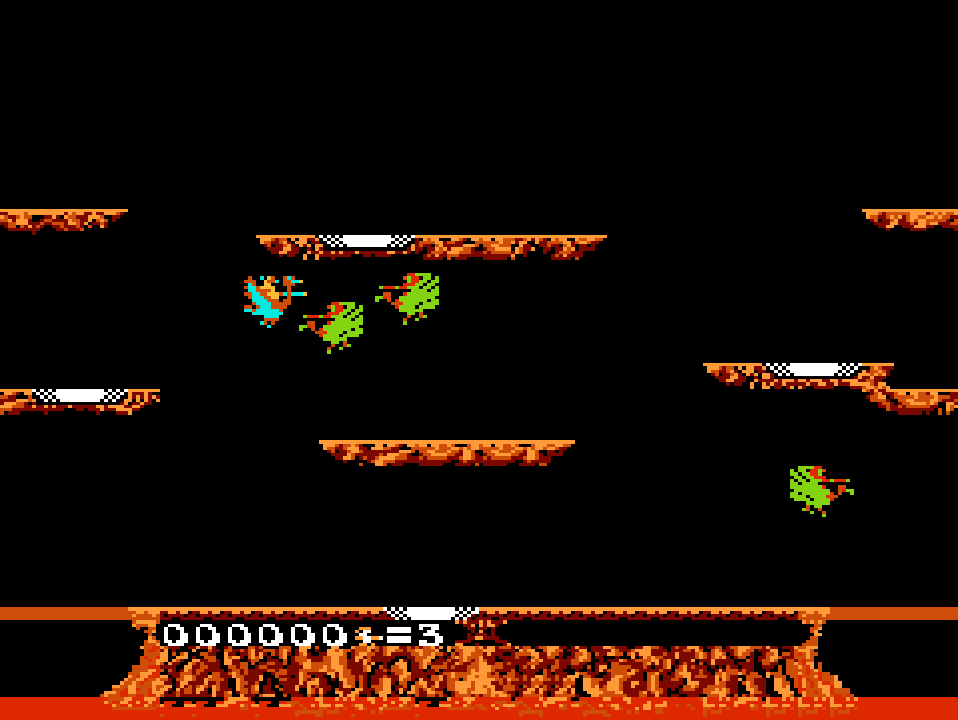
Here you see me jousting...

Here you see me jousting…

But hey, don’t worry about all that! Because the 1982 Arcade classic Joust eliminates all that by placing its knight on the back of a less-popularly used tournament mount. An ostrich. And you fight other knights riding buzzards. This avian interpretation of a medieval game seems rather eclectic, but gameplay almost necessitates this. Remember in the early 80s, only vector graphics games dared attempt a 1st person perspective (remember the 1983 Star Wars game?), and a 2-dimensional game on a horse really limited a players options for stabbing an opponent. The use of the discount chocobo allowed programmers to make the best use of the playing field. As for their choice of using a flightless bird…don’t ask. I can’t even guess, let alone make it sound smart.

Jousters, riding aforementioned ostriches attempt to fly around a small screen knocking other knights off their buzzards. It took me a while to figure out how to do this. At first I thought I needed to build up a reasonable speed, but that didn’t work. I thought hitting the “flap” button at just the right time might do something special, but I still ended up un-ostriched. In the end, it turns out you had to have a slightly higher altitude than your opponent. At any speed. So you just jump on them. Like in every video game ever. Afterwards, the enemies drop eggs that you have to collect within a certain time frame or else, of course, other knights will hatch, with a buzzard standing by for it to jump on and continue jousting. The game definitely has its quirks.

And here you see me jousting, but with lava pits. Congratulations. You've seen the whole game.

And here you see me jousting, but with lava pits. Congratulations. You’ve seen the whole game.

So this all seems rather easy. The environment doesn’t change much–occasionally opening up small lava pits on the ground–and beyond the occasional stray pterodactyl, you don’t have a huge variety of knights to un-buzzard. The true challenge that Joust offers stems from the need to constantly spam the “flap” button to keep aloft, combined with your ostrich careening forward with the momentum of a cargo train and the elasticity of a golf ball hit into a concrete tunnel. Slow to upper-moderate mashing of the flap button will slow your decent by varying amount. Fast mashing of the button maintains your altitude, usually to keep you steady on your track to deflect like a super ball off one of the platforms. If you want to gain altitude, you’ll have to spam the flap button with the up-and-down speed and stamina one can only develop after decades of chronic masturbation. Since getting married, I may have lost that skill. Fortunately, I have use of a turbo controller.

And really…that describes the entire game. The quirkiness held me rapt for a grand total of five minute, and I think the first time I played it I forced myself to keep going at least to the 10 minute mark, but by then I realized the gameplay didn’t intend to change much. It didn’t get harder. It didn’t offer new challenges, scenery, enemies, or even palate swaps. It just sat there, asking me to keep giving it quarters to keep riding the ostrich. Fortunately, I decided that if I use “riding the ostrich” as a euphemism, I can have a lot more fun for free. Joust 2: Survival of the Fittest looks a little more promising for long-term play, though.

Special thanks to JD for the suggestion. Sorry it took me eight months to get to it, but it took me almost that long to track down the game.

Paperboy – Arcade, NES, Sega Master System, Game Boy, Game Boy Color, DOS, etc.

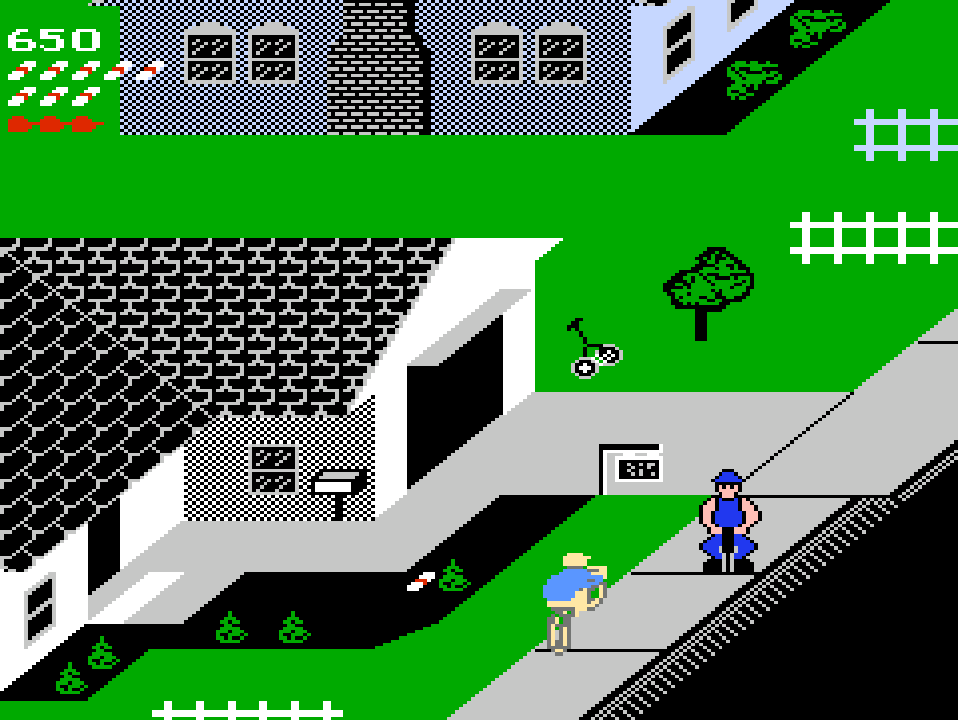
Yea, though I bike through the suburbs of death...

Yea, though I bike through the suburbs of death…

By a show of hands…or comments, I guess…how many of you had a paper route as a kid? Any of you slip through the cracks of child labor laws that somehow determined that riding a bike around town during the pre-dawn hours didn’t constitute any form of endangerment or deprivation of education? Because if I wanted to strut through the fifth grade flashing huge bankrolls (usually dimes or quarters) the only options I had as a pre-teen involved walking the streets delivering our small town gazette riddled with spelling errors, inaccuracies, and menial events passing off as news, or I could lug bags full of steel clubs through a field dodging little white balls careening towards my head at 290 kilometers an hour (180 mph for my American readers). But alas, I never had a paper route. So ironically, instead of having a job to enable my horrible video game addiction, I played a video game to simulate the experience of having a job.

Include this under "signs you don't have a large enough news market to sustain a newspaper."

Include this under “signs you don’t have a large enough news market to sustain a newspaper.”

Released for the arcade in 1985, Paperboy faithfully re-creates all the obstacles and challenges of delivering newspapers, including urban terrain, rabid dogs, careless motorists, swarms of bees, runaway lawnmowers, zombies, and the specter of death. As the paperboy, the game tasks you with never stopping your bike–the newspaper doesn’t pay you to lallygag, after all–and chucking your papers at everything that does or does not move. For every bundle of papers you pick up, you may toss one or two at someone’s doorstep–or extra points for their mailbox–but the rest you need to take down zombies, stop lawnmowers in their tracks, and threatening and vandalizing anyone with the audacity to not subscribe to the Daily Sun. That last note raises a point of interest, since all the Sun headlines revolve around the paperboy himself–thus rendering it only slightly more interesting than my hometown’s Mining Gazette–usually commenting on either his failure to deliver papers or his attempts at vandalism. I’d think, given the scenario, non-subscribers probably wouldn’t feel all that compelled to spend money to learn about the destruction of their own property, and any subscriber who failed to receive a paper wouldn’t necessarily need a Ph.D. to figure out the content of anything they missed.

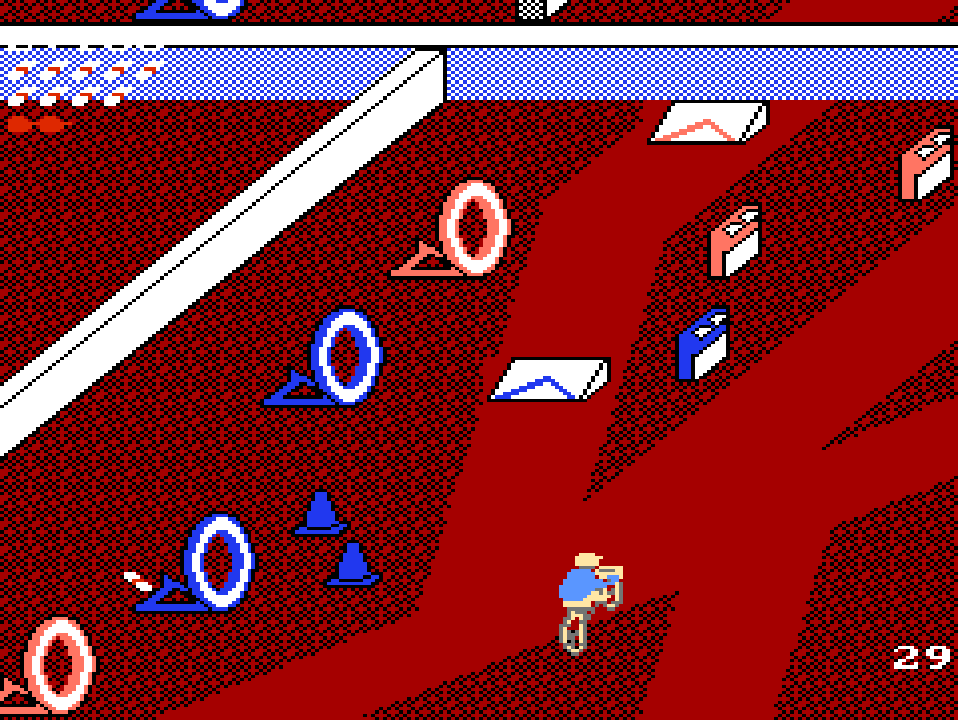
Accurately simulating all the targets, ramps, moving jumps, and mechanical spikes you'll encounter in your chosen profession as a delivery boy.

Accurately simulating all the targets, ramps, moving jumps, and mechanical spikes you’ll encounter in your chosen profession as a delivery boy.

At the end of each day’s route, you navigate through a training course, a testament to the 30-year vintage of the game, since no employer in 2015 would dare pay to ensure quality and competence in their employees. On the other hand, wasting money on newspapers for the purpose of cluttering up people’s yards and smashing windows to extort subscription money sounds exactly like current business practices. Still, the thought of putting money into researching a throwable paper with the power to stop a Model-A dead in its tracks sounds both wonderfully progressive and about as useless as a Jehova’s Witness knocking on St. Peter’s Basilica. But I guess all these little inconsistencies just help to make Paperboy a timeless classic.

All right! Just a few more customers to piss off and I won't have to lift a finger anymore!

All right! Just a few more customers to piss off and I won’t have to lift a finger anymore!

The game doesn’t pull any punches. Essentially an eclectic obstacle course, you have to correctly identify customers’ homes and place the papers precisely on their doorsteps or mailboxes. Just a bit off, though, and you’ll ensure the tunnel-visioned morons will never find the papers, and you’ll lose them as customers. Also, they’ll cancel their subscription if you break one of their windows, or just miss their house entirely. You can earn new customers by making perfect deliveries for one day. Allegedly. Developed for the arcade, Paperboy aimed to take your money from you as fast as you could throw papers to earn it, so you have about as much chance at making a perfect delivery as you have of finding a girl on an Internet dating site who doesn’t want to you to sign up for her webcam subscription.

Just a guy with his jack hammer out pounding the side walk. Completely innocent.

Just a guy with his jack hammer out pounding the side walk. Completely innocent.

Parents worried about violent games never even stopped to consider the vicious cycle in Paperboy–you play a paper-throwing simulator, thus compelling you to chuck newspapers like you brought a wheelbarrow full of rocks to an Old Testament stoning, only to earn more money to throw away at the arcade. Don’t you miss the 1980s? (Keep an eye on the skies…Doc Brown should show up with his DeLorean soon, if you want the chance to steal it) But as much as I enjoy Paperboy (with the arcade version slightly beating out the NES version), I don’t really like bikes much at all. My hometown–as well as my current town–both grew out of hillsides. So half the time I tried riding a bike, I’d either careen downhill in a sonic boom of panic, or slowly trudge uphill in a slow painful, slog, like a slave rowing a viking longboat. That might also explain why my local paper eventually replaced the traditional paper boy with a middle-aged woman with three teeth and an SUV, who would drive right up onto people’s lawns so she didn’t have to get out of the car to stick the papers in the mailboxes. So to celebrate my hatred of a transportation method that requires me to balance all my weight on a hard rubber knob under my testicles, next week I’d like to turn to a historically more traditional and far less painful mount: the ostrich.

Sneak King – XBox, XBox 360

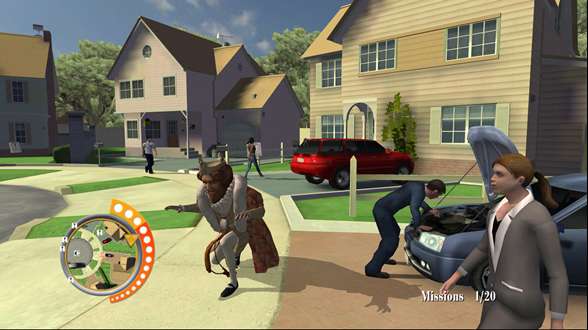
For those of you who don’t remember, back in the early 2000s, Burger King’s marketing department discovered the line between “cleverly funny” and “call-the-cops disturbing” and decided to straddle that line like a 600-pound man balancing on a bicycle seat. They released a series of commercials in which a chibi-headed king approached people in awkward scenarios or appeared in unusual hiding places, only to pull a Burger King menu item out of his robes, after which a voice-over would tell you about said item if not just to distract you from wondering about the amount of Rohypnol the King may have just slipped an innocent bystander. Shortly after this, however, the marketing department decided to double down on this method of selling hamburgers by associating them with a masked stalker, and released the game Sneak King (ah, sneaking! I see what you did there!) for the XBox and XBox 360.

Uhh...I don't know whether I should include a trigger warning in this caption or call the police on my game. Even the commercial campaign looks at this and says, "Dude...a little too far."

Uhh…I don’t know whether I should include a trigger warning in this caption or call the police on my game. Even the commercial campaign looks at this and says, “Dude…a little too far.”

Honestly, I don’t know how to describe this one. It feels like a casual game, except it obviously plays on a console (since mobile phones in 2006 had all the processing power of a ham sandwich). I could almost compare it to a licensed game, as it aims to re-enact the commercials, but I find something almost unclean about the thought of Burger King not only charging me for their advertisements, but also labeling it “some assembly required.” At its core, Sneak King relies on stealth, a bold move considering most games include stealth elements more to give the appearance of variety than as an option they actually expect people to use, much like McDonald’s including a salad on their menu to let them shout out to gainsayers, “look! We have healthy options!” Although considering Burger King’s extensive history of game development and the game’s mechanics themselves, I can only assume they made this decision out of sheer coincidence.

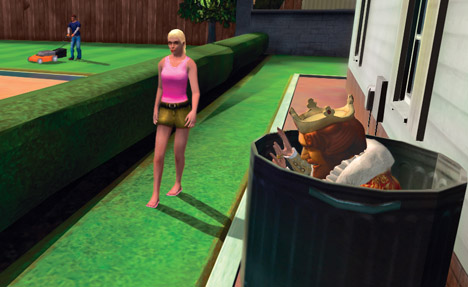
In Sneak King, you take on the role of the King, ostensibly sneaking up on people to deliver food, although the NPCs have almost as much visual prowess as a one-eyed hedgehog with its head stuck in a traffic cone, so as long as you don’t barge through a busy intersection, the game pretty much boils down to how fast you can locate hungry people and get to them before they double over in pain and pass out cold, an activity I generally engage in only after eating Burger King food. This does pose a reasonable challenge, however, as these characters only blip on your radar immediately after their first hunger pangs, and afterward must be located entirely by looking for the people with thought bubbles over their heads dangling burgers just out of reach. From beginning to end, the entire process can take less than thirty seconds, so unless the King includes a shot of insulin with their meal, I doubt that any food hiding in his royal tights can save these people from slipping into a diabetic coma.

They actually can see him...they just pretend they can't. If you avoid eye contact, you don't have to talk to him.

They actually can see him…they just pretend they can’t. If you avoid eye contact, you don’t have to talk to him.

The challenge of racking up higher and higher scores provides the primary appeal of the game. Certain factors can multiply your score, such as how often people have spotted you, how close you get to the target before giving them food, and how much flourish you use to bestow the royal meat unto your subjects. However, you can increase your score fivefold by crawling into a barrel, dumpster, toilet stall, or any other hiding place before your hungry victim strolls by. This, sadly, doesn’t work very well. Despite having plenty of hiding places in each level, the NPCs all move on a programmed circuit, and most of them don’t get close enough to the hiding places for this to work. Furthermore, the ones that do either don’t get hungry at the right times, or they’ll spot the King slowly easing himself into his hidey-hole like an old man into a hot bath, a swimmer into Lake Superior in June, or a Carolinian politician into the thought of taking down the Confederate flag. Each of the four levels has twenty different missions, and those that require you deliver from hiding places usually end up with me finding one well-trafficked dumpster, then squatting in it for upwards of fifteen minutes while I wait for enough people to come by to get their hot, delicious burger and its distinctive aftertaste of rotting vegetables and soiled diapers.

Hello yon construction worker. Care you to partake in mine portable toilet burger? Sadly, it possesseth not the used-condom bouquet of my trash burgers, but you'll find the accompanying buzzing of flies a synaesthetic delight of flavor!

Hello yon construction worker. Care you to partake in mine portable toilet burger? Sadly, it possesseth not the used-condom bouquet of my trash burgers, but you’ll find the accompanying buzzing of flies a synaesthetic delight of flavor!

The King can also increase his score by presenting food with flourish, which involves hitting a button at the right time to stop a meter. Again, given Burger King’s inexperience with games, I think we can understand how they’d include an option that makes the game look fancier without actually making it more fun. Not that we have to forgive them for it. The King has three levels of flourish (which vary from stage to stage), and no matter how many times you’ve seen it before, you still have to sit through every second of his stupid white-boy dance.

I imagine the Jaws theme playing here.

I imagine the Jaws theme playing here.

Adding even more unnecessary time onto the game, each of the four stages has twenty different missions. The developers tried their best to introduce variety into these challenges, but when playing a stealth game and getting the mission, “Let five people see you,” one tends to get the impression that the designers have checked out and just want to get paid their $3.99 (with the purchase of an extra value meal…later reduced to $0.99, for understandable reasons).

Sadly, the game really kept me amused for a few hours. Mostly, however, I attribute this to the novelty of the situation. It also felt somehow unique, and I liked the initial aspect of increasing scores, while it provided a rare example of a game without competitive aspects. (When researchers study violent games to “pro-social” games, I wonder if they use Sneak King as “pro-social.”) Still, about halfway through, the difficulty spiked by about a thousand times, which comes off more as poor design and testing than an intentional challenge curve, and by then the game had gotten repetitive enough, the flaws noticeable enough, and my constant battles with the camera obnoxious enough, that while I liked playing it for a little while, I would rather finish a large fries pulled from the King’s tights out of a garbage can than Sneak King.

But the creepy first-person mode, if nothing else, merits this game a spot in my WTF category.

The Legend of Zelda: Skyward Sword – Wii

Damn...I feel sorry for that bird in about twenty minutes. I had a lot of girl problems in high school, but thankfully I never had to worry about a sentient car.

Damn…I feel sorry for that bird in about twenty minutes. I had a lot of girl problems in high school, but thankfully I never had to worry about a sentient car.

Let’s run an experiment. Take out a piece of paper and a pencil (I’ll wait…you good? Good) and write down as many words or phrases as you can that should describe a Zelda game. My list includes things like “adventurous,” “open-world exploration,” “beautiful and grand,” “colorful races and characters,” “excellently designed bosses and dungeons,” or my personal favorite, “clever use of items and tools.” Now make a list of words and phrases that should never under any circumstances describe any installment of the series. To throw out a few examples, try “fetch quests,” “overly linear,” “monotonous transportation,” “small, repetitive world,” “a species of testicle-shaped fruit creatures, “tedious puzzles lurking around every corner,” “Jar-Jar Binks” and any combination of the terms “motion controlled” and “Parkinson’s disease.” Congratulations, you now have a standard for judging Skyward Sword!

...okay, so I'll admit I find her kind of endearing. But I liked the elegant princess-goddess of wisdom better. At least for the purposes of a Zelda game.

…okay, so I’ll admit I find her kind of endearing. But I liked the elegant princess-goddess of wisdom better. At least for the purposes of a Zelda game.

Traditional Zelda games emphasized the open-world exploration, allowing the player to tackle dungeons in virtually any order (save for the few that required specific items to access or complete). I loved this. It let me plan out my game as something unique each time. Maybe I want to get the white sword before going into the first dungeon, or pick up the power glove before any thing else so I could access any location in the Dark World. Or not. Maybe I want to pick up the bow first, or scour the land for 250 rupees to get the blue ring. Maybe I want to ignore the swords entirely and get through as much of the game as possible with just the bow. Despite limitations on graphics and memory, the early incarnations of Link made replaying the game more fun. And while I somewhat understand why they required a linear dungeon order in Ocarina of Time, I would have preferred otherwise, and at least they left plenty of overworld quests open to choice. Sort of.

Unfortunately, each progressive game has doubled down more and more on this linear progression, and in Skyward Sword you don’t seem to have any say in what you do at any given time, as though you asked Nintendo to help you with a science fair project, and three hours later they run out of things for you to hold in place, so they send you upstairs to get it coffee so they can finish the project for you. And remember when you said you liked the fact that the game made you think? Well guess what, they’ve installed plenty of puzzles! Challenging, obtuse, and tedious puzzles lurking around every corner. Convoluted puzzles that make you feel stupid. And if overestimating player intelligence didn’t go far enough, they also manage to underestimate it, too.

Oh no! If only someone had designed this game in a way that let me swing my sword sideways! Like every other Zelda game!

Oh no! If only someone had designed this game in a way that let me swing my sword sideways! Like every other Zelda game!

Seriously Nintendo…two hours of tutorials? You put a motion-controlled sword in our hands and then need to tell us how to swing it left, right, up and down (yet no tutorial for the bug net, which handles about as well as you could expect…assuming Link had an advanced case of Parkinson’s disease)? Did you think we didn’t hear the constant beeping tone denoting low health, that we needed our sidekick to remind us that we need to find hearts? Did you? Really? Because of all the game’s sins, nothing tops saddling you with a companion so obnoxious that you’ll yearn for the halcyon days of “Look!” and “Listen!” and even Jar Jar Binks seems like a step up.

Apparently Nintendo felt the ambiguously gendered Zoras no longer creeped out players enough.

Apparently Nintendo felt the ambiguously gendered Zoras no longer creeped out players enough.

Link’s companion for Skyward Sword, Fi, grated on my nerves like a a block of soft cheese shoved through a fine mesh made of razor wire. Unlike Navi, who would point out useful objects and locations, the King of Red Lions who gave interesting back story and helpful objectives, and Midna, who gave Link super powers, Fi’s main objective compels her to repeat what other characters have only just finished saying. The Chief of the Kiwkis (a species of testicle-shaped fruit creatures) tells you the other kikwis have wandered off and he needs help finding them? Enter Fi to tell you that you should go look for the kikwis. The water dragon asks you to obtain sacred water to heal her wounds? Fi shows up to tell you that you can heal the dragon’s wounds by finding sacred water. Have you encountered your fiftieth time-shift stone, which you’ve used to solve all the previous desert puzzles? Don’t worry! Fi will explains that you can use time-shift stones to solve *this* puzzle. And notice that I didn’t say “how you can use time-shift stones.” That might actually venture into the realm of useful information. Even when you ask her for hints or for mission objectives, she’ll only paraphrase what another character told you, or give you such vital information as “Find hearts to refill your health” or “Bombs help you blow stuff up!”

I like sword fighting as much as the next guy, but this doesn't quite seem grand enough for a Zelda boss.

I like sword fighting as much as the next guy, but this doesn’t quite seem grand enough for a Zelda boss.

As the spirit of the sword and a creation of the goddess–yes, we apparently have a fourth goddess that no one will ever talk about again–she does serve a role in the plot. Namely, every time Link retrieves the MacGuffin currently in vogue with the latest dungeon, a message from the goddess will awaken in her memory banks. She then zips around the chamber like Tinkerbell on Ice because apparently she can only communicate these messages via interpretive dance. Still, for all it adds to what little story I found, I would have preferred walking up to the altar to find a note pinned to the treasure; “Dear Hero: Fire temple next. Eldin Volcano. Best Wishes. -G.” Oddly enough, though, Fi annoyed me the most when she calculated statistics. “Master, I calculate a 95% probability that this enemy guards the item you seek.” “Master, I calculate a 85% chance that you will need a sword to attack these monsters.” “Master, I calculate a 90% chance that if we go to the next dungeon, the game will progress.” Dear Nintendo, you can’t have a character rattle off probabilities like C-3PO (Yes, I just compared Fi to the two most obnoxious characters in the Star Wars universe) without that 5% chance that she gets it wrong!

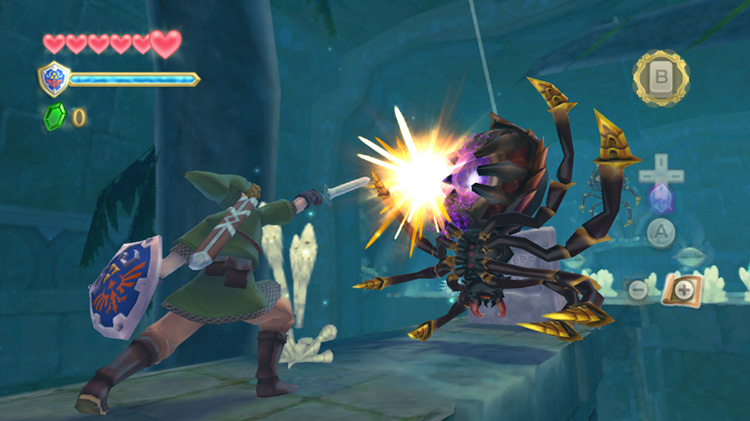
This skulltula requires precise physical manipulation to expose and hit its weak point. Fortunately, the controls work so perfectly it almost feels psychic! No motion sensing problems at all!

This skulltula requires precise physical manipulation to expose and hit its weak point. Fortunately, the controls work so perfectly it almost feels psychic! No motion sensing problems at all!

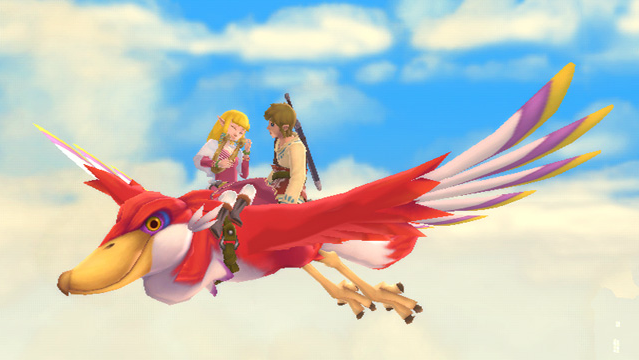
But in other news, we all remember all those hours spent sailing the Great Ocean in the Wind Waker, and how Nintendo took those complaints and doubled down on them, giving us the Phantom Hourglass and Spirit Tracks, each one delivering even more monotonous transportation than the one before. Well, fear not, as Skyward Sword offers an airborne mode of tedious travel. As a resident of Skyloft, Link flies a Crimson Loftwing, a giant bird who soars leisurely through the sky in an attempt to arrive fashionably late. The Wii motion control gives you all the precision and handling as flying a stack of Kleenex through a strong breeze, and any quests or games that require the bird rely more on you getting lucky than getting better.

The overly linear design places obstacle after obstacle in Link’s path, each one requiring something you’ll find somewhere else. None of these fetch quests progress the plot or even make game play interesting. Curiously enough, though, I clocked in at roughly 40 hours by the end, a number quite common for RPGs and adventure games. That and the four hours it took to get to the first dungeon give off a strong vibe of Nintendo having nothing to put in the game. After the first five or six hours of chasing Zelda, I got through the first dungeon and came face-to-face with an honest-to-Nayru “Your princess is in another castle” message. Well, you get honesty points for all but admitting that you have absolutely no new ideas.

Red Steel 2 – Wii

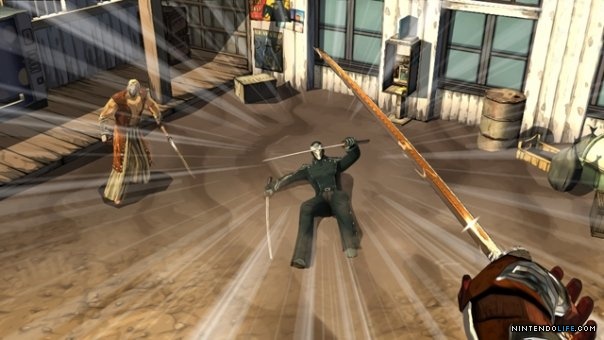
Just call me "The Man With No Name--Clint Yojimbo."

Just call me “The Man With No Name–Clint Yojimbo.”

By a show of hands, how many of you wouldn’t have nurtured your video game addictions if you hadn’t secretly harboured fantasies of picking up a sword and mowing down orcs? Same here. In spite of my deeply ingrained pacifism, I, too, have always yearned for the opportunity to perpetuate fantasy violence and dashing heroics. I suspect a fair number of people at Nintendo share my anti-monster sentiments as well because, well, you tell me; when a console developer decides to control an entire generation’s worth of games by waggling a stick, what else could they have in mind besides sword fighting? Good thing for us, the Nintendo Wii has infallible technology that in no way lets you control games with all the precision of an epileptic break dancer on an electric fence.

Having a black belt in Haedong Kumdo (Korean Kendo), I wanted to see exactly how well I might hold up in a sword fight. After spending a few years waiting for roving bands of samurai to raid Duluth, I decided I might need to step up my game if I wanted to put myself to the test. Fortunately, Google proved slightly more reliable than 21st-century American ronin, and it led me to Red Steel 2, touted as the best game on the Wii for realistic sword motion control. Not as fortunately, it also rooted itself in flashy combo moves and magic attacks, chucking enemies–who have the physical prowess of a bored teenager on barbituates–at you with the urgency and expediency of a government bureaucracy. But the motion controls…yeah. Wicked responsive. And mostly irrelevant.

Thankfully, the Delorean made it safely back to 1985.

Thankfully, the Delorean made it safely back to 1985.

Red Steel 2 feels like Bioshock spent too much time watching Akira Kurosawa films and Clint Eastwood spaghetti westerns. Seemingly aware of the connection between the two genres, the game takes place in a steam-punk-ish version of the Wild West, filled with biker gangs and samurai clans. Our not-so-subtly no-named Man-With-No-Name hero (I’ll call him “Clint” for short) begins the game tied to a motorcycle, trying to go for an inner tube ride. Except without the inner tube. Or the water. After his body becomes frictionally acquainted with the majority of the desert, he manages to break free to seek revenge on the man who used him as a human dust mop. As this Ramen-Noodle Western progresses, we learn that Clint possesses the Kusigari clan’s greatest treasure, the last remaining Sora Katana. Furthermore, the game’s antagonist, Shinjiro, in attempts to capture the secrets to forging these katanas, decided to force the Kusigari clan to talk by murdering them all, except, of course, for the notoriously taciturn Clint, who decides that he may as well double up on his revenge missions and hunt down Shinjiro as well.

Ineffective Gun Control Method: If you make guns cost over three years' salary, only millionaires like Dick Cheney can murder people. The only thing that stops a millionaire with a gun is a good guy with a gun.

Ineffective Gun Control Method: If you make guns cost over three years’ salary, only millionaires like Dick Cheney can murder people. The only thing that stops a millionaire with a gun is a good guy with a gun.

Clint begins his mission by entering Caldera, a Rapture-esque town with claustrophobic streets, no residents, houses, or civil amenities of any kind. It does, however, have trash lining the streets, along with enough smashable junk to fill the Sea of Japan. The game functions primarily as a money-collection simulator, faithfully representing the experience of a homeless man rooting through trash. Except in Red Steel 2, every box, barrel, pay phone, crate, table, beer bottle and rocking chair lying about in the streets has about 24 bucks just waiting to pour out at the slightest tap from your sword. Despite the game’s planned battles and a handful of random enemy encounters, I spent most of the game gleefully bullying inanimate objects, threatening them with my sword, shaking them down for their loose change. I did get to spend it here and there, but the game gave me so much of it that I never had to budget, or make a decision between two upgrades on sale. I always seemed to have enough. The game gave me so much money that it became a glaring plot hole, actually. Generally when a community has so much money that they throw it out with the trash, the town won’t have so much a problem with gang warfare as they will with runaway inflation.

Hold the A button and you can block bullets without all the flashy effort of a Jedi knight

Hold the A button and you can block bullets without all the flashy effort of a Jedi knight

Wii motion controls improved significantly on those used in Skyward Sword–a fact made even more impressive by the fact that Red Steel 2 predated the Zelda installment by a year and a half. While the game does have a strong relationship between on-screen action and player motion, saying that it faithfully represents battlefield kendo would, to say the least, misrepresent kendo. It would, to say the most, prepare thousands of players for a short lives as shish kebabs should they ever need to repel an invading shogun. I personally suggest one of two styles for playing the game. First, you can find a two-handed sword to fit the Wii mote into–or as I did, just hold the wii and the nunchuck at about the right distance apart and try not to flap yourself with the cord too often–and wield it as closely as possible to a real katana. The game doesn’t require such wild, flailing motions, but it certainly encourages them, and you might as well have some fun with it. This does, however, invoke one of the biggest annoyances with the Wii controller–the fact that they always seem to combine characters’ view and aiming your weapon with the same motion controls. So when the game recommends a strong wind-up before attacking, I raise the control above my head, then end up slashing menacingly at a distant cloud that could care less about the pissant little cowboy flapping his arms on the ground.

Or you could take the more utilitarian approach to the game, ignore what it tells you to do, and sit sedately on your couch, flicking your wrist gently. Either way won’t make much difference to gameplay, as the enemies shamble about, moving around like trees bending in a strong breeze and attacking you with the same level of confidence I displayed talking to girls my freshman year of high school. You don’t especially need a VATS system to find an opening on these guys.

If you want to kill a ninja, you must fight like a ninja.

If you want to kill a ninja, you must fight like a ninja.

I should also mention that combat mixes sword play with gun fights, but who cares? Except in one or two instances, you don’t need the gun, and when faced with the prospect of wasting ammo in order to point at the screen and press a button, or to save bullets and swing the controller like an Olympic-class dwarf tosser, I nearly always chose the option that made me feel like a ninja. You also learn combo moves as the game progresses, which tend to power you up until you fall into a range of skill somewhere between Goku and God, and I had to actively force myself to use regular sword strikes so as not to finish battles simply by repeating “The Guillotine,” “The Tiger,” or “The Reaper,” the latter of which tends to immediately murder anything not considered “final” enough a boss. The game’s developers, however, apparently didn’t think they had made it easy enough what with the nuclear-powered sword, enemies doped up on ether, and giving you enough money to make Montgomery Burns to kiss up to you. No, they also insist on putting you through an extensive tutorial for every new skill you learn!

Note: carrying your sword like a baseball bat only tends to open up your "strike zone."

Note: carrying your sword like a baseball bat only tends to open up your “strike zone.”

Each time it gives you a skill, the in-game sensei appears. His pedagogical methodology involves playing you a video of a girl white enough that she could pass for Samuel Jackson’s photo negative, who daintily swings her Wii mote until you can reproduce her motions. Then you have to pull off the move, usually twice. Then you’ll have to perform it three times in a row. Then you’ll usually have to do it once more so the game can tell you that you can also use the combo to kill enemies. And you endure these tutorials until the very end of the game.

So I didn’t hate Red Steel 2; in fact, in the right frame of mind I could play it for hours on end. I just don’t think it quite passes for the virtual sword-fighting experience I’ve always waited for. The enemies don’t put up much of a fight, and it couldn’t often keep up with my movements. I’d recommend it as your run-of-the-mill Bioshock-with-a-Sword video game, but I’d still hold out for something a little less gamey and a little more virtual reality-ish. Dear Square Enix: Please remake Bushido Blade for the Wii.

Star Tropics – NES

RetroArch-1110-101726
Six months into 2015, I still haven’t finished my New Year’s Resolution of finishing the shelf of books, movies and games that I bought last year without having the time to read, watch and play, respectively. Combined with my slackerism, skipping a collective month and a half of updates, and I haven’t played a Ye Olde Fashioned Game since March (Technically longer, but I only keep track of when I publish articles, not play the games). Lucky for you, the part I ordered to connect my PS2 to my TV in my new house came from China and decided it wanted to see the world before settling down into its new life in America, so it shipped through Malaysia (and probably Venus, judging by the time it took to get here), leaving me with nothing to play but the classics.

This doesn't actually foretell your doom. The prophet just played a Simon and Garfunkle album before you walked in.

This doesn’t actually foretell your doom. The prophet just played a Simon and Garfunkle album before you walked in.

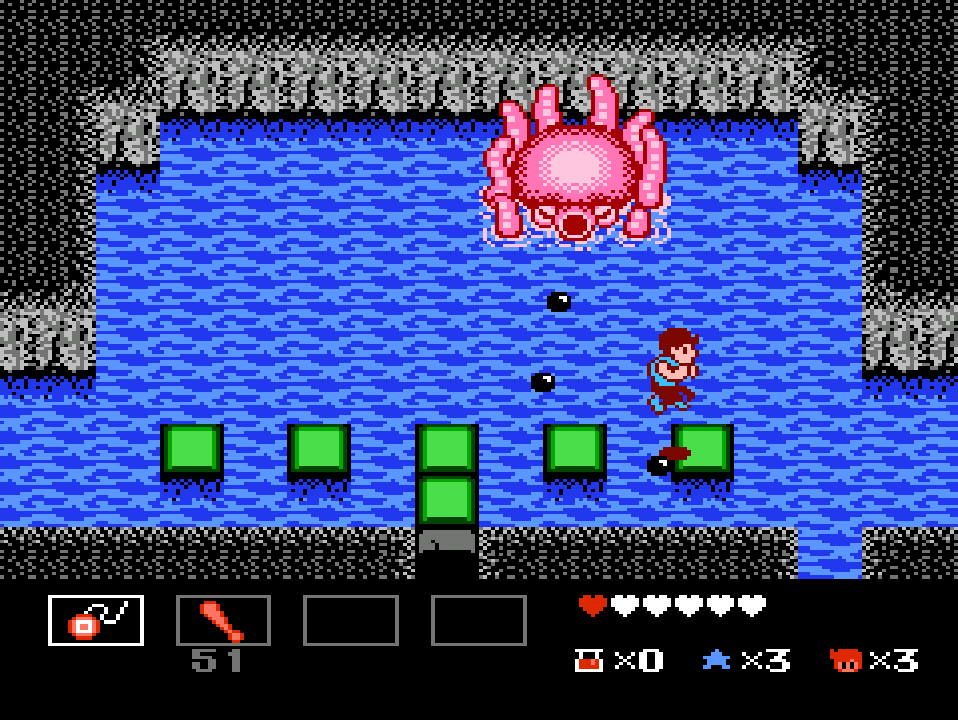
Enter Star Tropics, a game I had heard about, but never turned to until one night of Dorito-fueled boredom caused me to binge on five minute attempts at NES games until I found one that held my attention for a sixth minute. This interesting little anomaly of a game has apparently never seen the light of day in Japan, an idea about as likely as an altar boy who has never seen the private recesses of his priest’s rectory. The anomalous nature stops there though, as the gameplay seems to rip off, er…”blend”…the better parts of both NES Legend of Zelda games and the early Final Fantasy. To top it off, the entire game adopts a theme different from the standard-issue Medieval-slash-fairy-tale setting, except for an alien-themed final dungeon tacked on to the end like the Kingdom of the Crystal Skull trailing after the Indiana Jones movies.

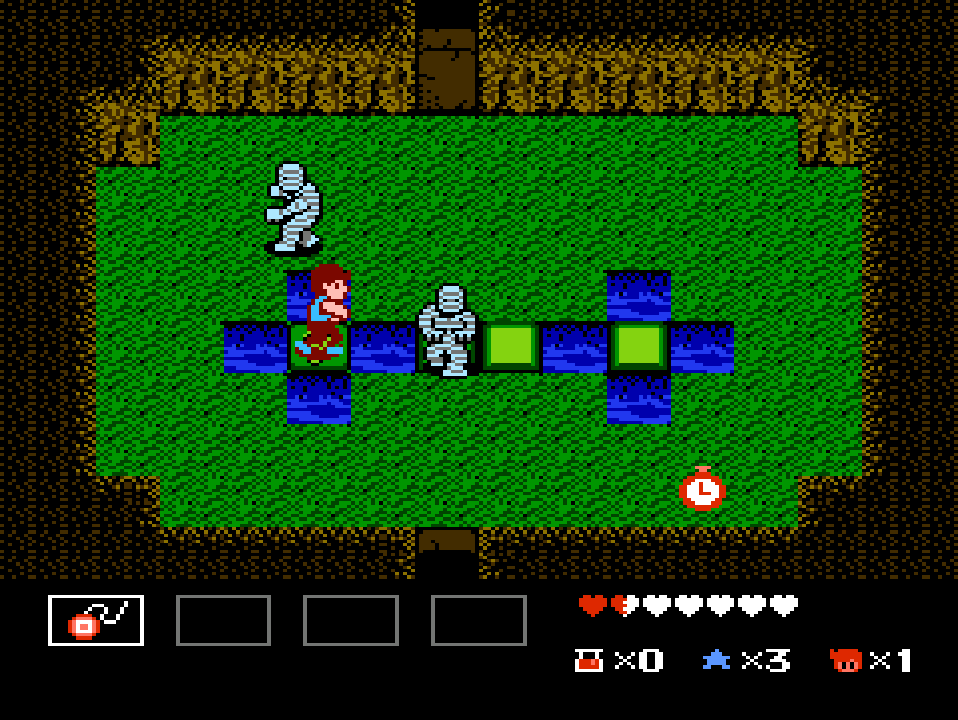
Underground labyrinth? Check. Mummies? Check. Stopwatch that freezes monsters? Check. Heart meter? Check. Yup. We've got the Legend of Zelda...with a yo-yo.

Underground labyrinth? Check. Mummies? Check. Stopwatch that freezes monsters? Check. Heart meter? Check. Yup. We’ve got the Legend of Zelda…with a yo-yo.

The story centers on Mike, a stout-hearted, wholesome American boy who somehow lives in a nation of small undeveloped tropical islands. Much like Earthbound’s Ness, Mike slaughters aliens with a yo-yo, aided by some good old-fashioned baseball paraphernalia (although I hear neither one wants to take credit for inspiring M. Night Shyamalan to make Signs). Mike’s uncle, Dr. Steven Jones, has disappeared, and the quest falls upon his nephew to find him–while simultaneously rescuing a civilization of freeloaders who send a lone boy to fight hoards of menacing invaders. You know. Standard video game routine.  Dr. J has left you a submarine that will take you from island to island to wipe out the biodiversity of Star Tropics’ extensive cave system as you search for clues for your uncle’s whereabouts. And find him abducted by aliens.

...somehow I think they felt a little too comfortable with their source material.

…somehow I think they felt a little too comfortable with their source material.

Immediately on booting up, you’ll find the familiar Legend of Zelda save slots and name registration. Star Tropics clearly takes a lot of inspiration, especially its combat system, from the original Zelda game, although it adds the ability to jump, something Link seems to have forgotten how to do after the Adventure of Link. While exploring underground ruins, Link–er, Mike–fights a series of bats, mummies, skeletons and…octoroks? Really? They don’t even want to try to hide it? Okay, then. Although the core gameplay does come off as derivative of Zelda underworlds, it almost feels like Nintendo had 16-bit hopes for Star Tropics, as they’ve increased sprite size and made weapons and items a little more useful, if not somewhat less versatile. When in the overworld, the sprites shrink, Mike walks around safely without enemy battles or random encounters, and you may notice more of a Final Fantasy aesthetic, including a vehicle for easy travel between islands. Although some might criticize such blatant rip-offs, I might point out that they took things that work from games people enjoy and made something genuinely fun to play. Remember: even Tolkien ripped off all his ideas from somewhere else.

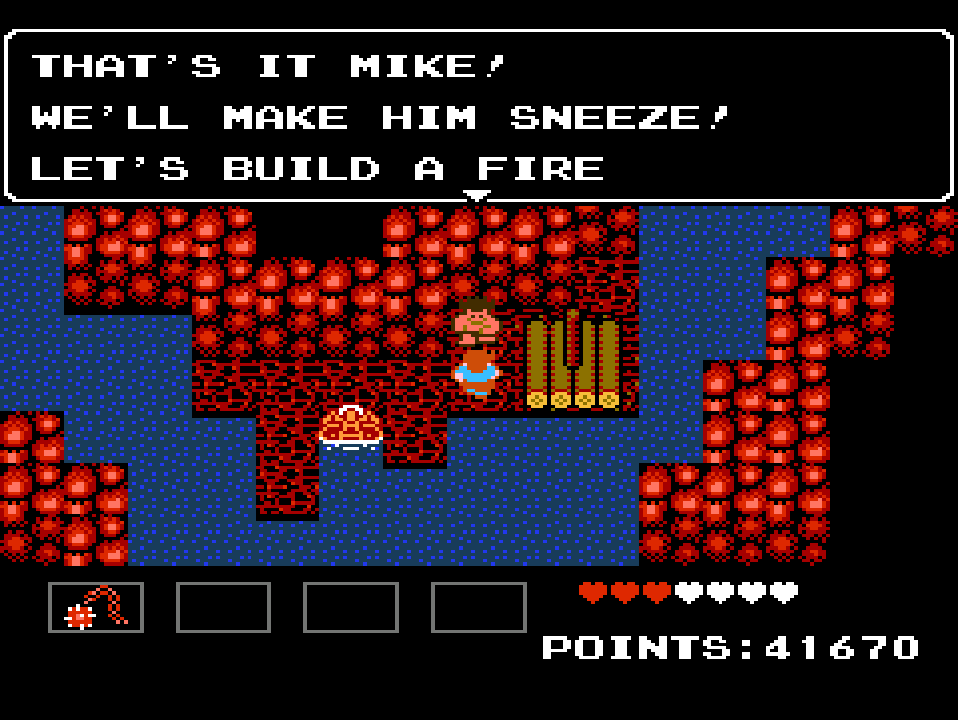
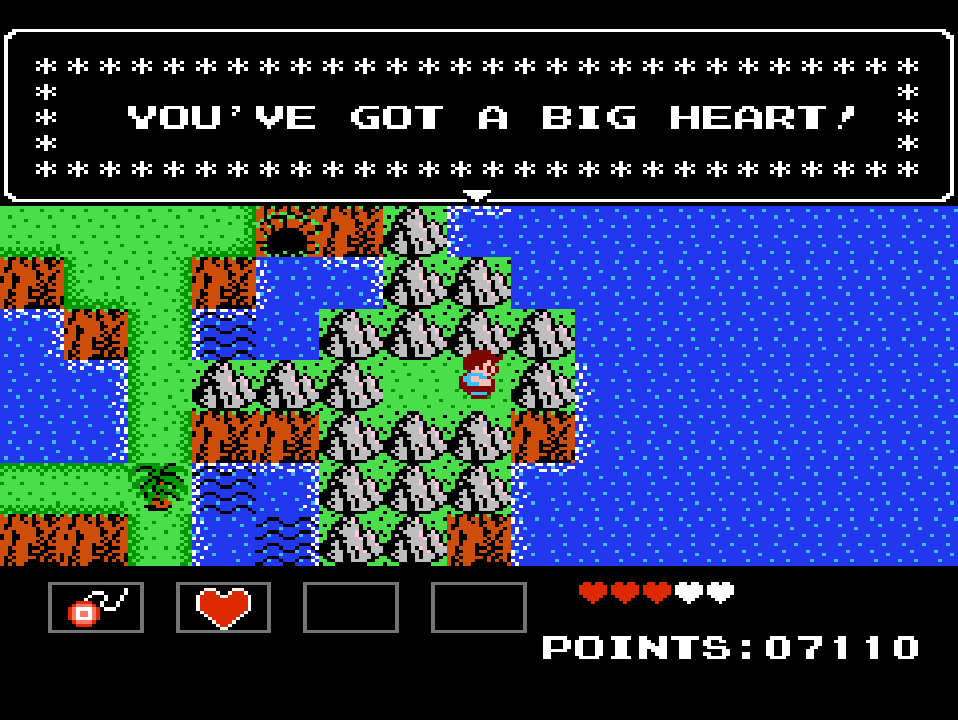
What happened then? Well in Whoville they say, Mike's short life meter grew one bigger that day.

What happened then? Well in Whoville they say, Mike’s short life meter grew one bigger that day.

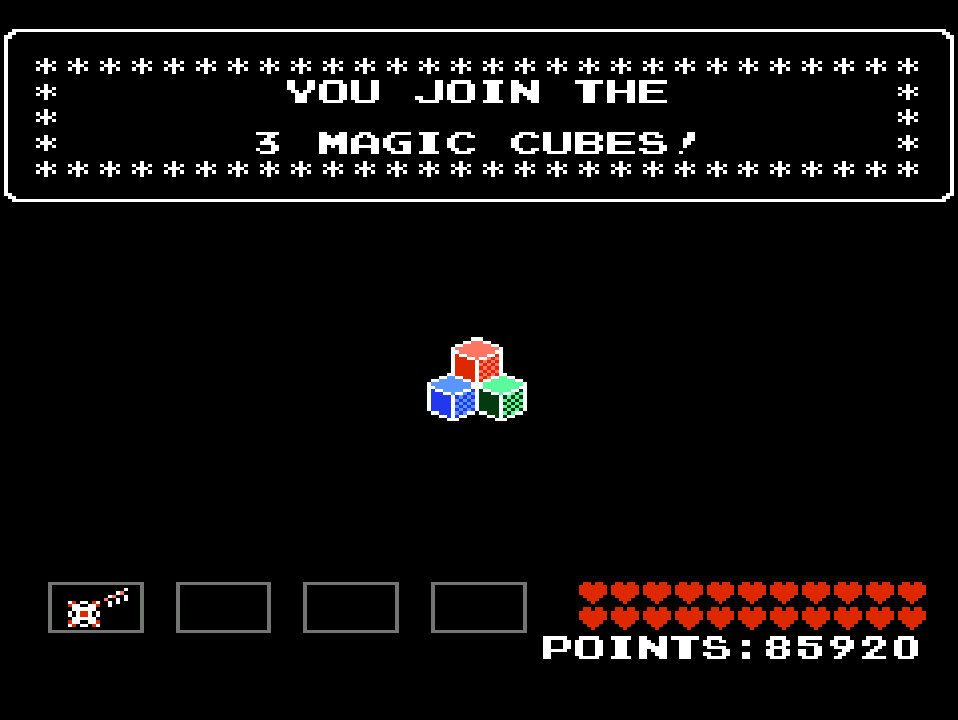
One of the less-fortunate features carried over from the Legend of Zelda gave me no end of problems and eventually broke me down to the point of using save states to cut back on endless hours of repetition. Although Mike’s life meter grows every time he discovers a big heart, his cardiomegaly apparently takes its toll on his health as he starts each new life afresh with three whopping hearts. I didn’t like this in Zelda, but at least enemies in that game had the common decency to offer you their still-beating hearts as you ripped them from their chests. Monsters in Star Tropics rarely pony up as organ donors, leaving the player to fend for himself at all costs in a perilous world of fast-moving enemies chasing after a protagonist with sluggish controls and pockets full of honey and snausages. Late in the game, as an effect of what I will generously call a glitch (well, more of a son-of-a-glitch), I picked up an item to increase my life gauge to full, after which it proceeded into a cut scene, saved the game, trimmed my life down to three hearts, then deposited me immediately in front of one of the major final bosses.

Legend of the Hidden Temple 2: Olmec's Revenge. I don't remember the temple guards trying to disembowel the Blue Barracudas.

Legend of the Hidden Temple 2: Olmec’s Revenge. I don’t remember the temple guards trying to disembowel the Blue Barracudas.

The soundtrack sports a definite Harry Belafonte vibe, and more than one enemy gave the game a “Legends of the Hidden Temple” feel (alas, though, the parrot sports red, not purple, feathers) As for difficulty, Star Tropics ranks somewhere between “wake up early and exercise” and “only one more Dorito,” but if the NES has built up a reputation for anything, their games carved themselves a niche as the most popular girl in school: more attractive and desirable than the rest of the competition, but subtly more aggressive than a playground bully and no compunctions about treating you as brutally as they want (not to mention a certain affinity for using the phrase “blow me” before a stubborn refusal to cooperate after nothing you do turns them on). If many games, though, just hate you outright (…Dr. Jekyll and Mr. Hyde), Star Tropics may just friend-zone you. Just as frustrating, but at least you still enjoy it. Jeez, I have got to stop extending my metaphors. Or at least, stop telling Anne stories of the girls I knew in high school.

RetroArch-1110-143752

So...I went through all of this because I wanted to play Q-Bert?

So…I went through all of this because I wanted to play Q-Bert?

Resonance of Fate – PS3, XBox 360

10_calendar_1280_1024After nearly a month of not writing, final exams, dealing with irate students, and jumping through legal hoops to buy a house with a yard that retains water like a camel with a bladder obstruction, I’ve just finished Resonance of Fate. After finishing Heavy Rain–which ironically now threatens to slide my house into Lake Superior–I thought a good old fashioned RPG would hit the spot and provide me with some enjoyable stress relief after long days of dealing with insane bureaucrats in exchange for a salary comparable to the average burger-flipper, albeit with slightly less job security. A word of advice–when a game’s timer immediately indicates a capacity for triple-digit hours at the beginning, you may want to reconsider going through with it. And about three hours into Resonance of Fate, I already despised it.

You can do her hair, undress her everywhe-ere! Yes, Resonance of Fate claims its Barbie Doll simulator as its most entertaining feature.

You can do her hair, undress her everywhe-ere! Yes, Resonance of Fate claims its Barbie Doll simulator as its most entertaining feature.

And when I say I despised it, I mean to say I’d rather play Pin The Tail on John Goodman than Resonance of Fate. Trying to walk through an actual mine field would cause less stress than combing through the walkthrough of this game. Learning the finer points of cattle enema application would not only interest me more than the story, it would also feel more rewarding and leave me with a more refined product. I have not hated a game this much since the first time I played through Valkyrie Profile 2. However, I realized that games like Valkyrie Profile 2 and Final Fantasy Tactics only inspired blood-vessel-bursting levels of rage because I didn’t fully understand how to play them. So I gave it a chance and spent some time learning the complexities of the battle system.

So now when I say I despise this game, understand that if any game deserves ritualistic immolation, Resonance of Fate does. I would rather bathe in a cauldron of bacon grease than go through this game again. If you offered me a choice between a PS3 controller currently running this game, or a bare, uninsulated cord plugged into a 120v outlet, I think I would suffer fewer adverse health effects from the bare cord.

Because who wouldn't want to dress like a second-rate high school football mascot and chuck toys at kids' heads? This game manages to take the color out of Christmas.

Because who wouldn’t want to dress like a second-rate high school football mascot and chuck toys at kids’ heads? This game manages to take the color out of Christmas.

“Pony up, Jake,” you say. “Stop whining and tell us why you hated it.” Fair enough. For starters, critics have praised the game for its original battle system, which revolutionizes the tired old menu-based RPG format. And it rightfully deserves that credit. A semi-tactical game–like Valkyrie Profile–I really enjoyed the complexity of combat once I finally learned it. But learning took forever. Players can access a virtual instruction manual while in combat, which I found indispensable; mostly because the sadistic bastards locked the optional tutorial. The tutor in the arena offers to teach you the ins and outs of the gun-based fighting style, but only after you’ve accomplished each technique at least once in battle. I hated my Calculus teacher in college, but at least she didn’t turn me away, saying, “Come back once you’ve successfully landed a probe on Saturn!” And if that doesn’t immediately earn it status as the most useless tutorial ever, accomplishing the techniques didn’t actually unlock the tutorial. Sega’s pedagogical style reminds me a lot of your grandfather dropping you into the the middle of Crystal Lake, telling you the dead kid wants to drag you under, and figuring that sheer panic will teach you to swim.

But since no one actually learns that way, I think you deserve a simplified explanation. For starters, you have two types of damage to contend with, scratch damage and direct damage. Only scratch damage really matters, as weapons that deal direct damage have all the destructive power of flicking safety pins at someone, hoping they’ll unclasp and stab someone through their jeans. Deal scratch damage to enemies and their armor by running (and nearly always jumping), and that’ll whittle down their health. However, it doesn’t always stay damage. In order to get it to stop regenerating, use direct damage to make it official. Think of scratch as writing a schedule on a calendar in pencil, and direct as tracing it over in pen to make it official.

Roll for initiative. Pass Go to collect $200, then proceede to the conservatory to make your accusation.

Roll for initiative. Pass Go to collect $200, then proceede to the conservatory to make your accusation.

From there, in order to deal damage effectively in any way, you want each character to run between the other two–which uses up part of a gem gauge–for as many turns as you can, then pull off the special attack, making sure each one stands as far apart from each other as possible with no obstructions anywhere along the path. Seriously…your characters can only run in straight lines, and if they so much as nick their elbow on a wall, enemy, or each other, they’ll drop everything and sit there until the others have also given up. Thank you, Sega, for developing passive-aggressive character traits in combat.

The biggest problem with this gem system–other than characters completely incapacitated by the concept of side stepping those pesky support columns–occurs when one of the characters receives enough damage to reach critical status. At this point, several things happen to change the flow of battle. First, you lose the ability to run or perform the special attack. Second, your weapon strength drops considerably and the rate of fire slows to a crawl, sending your accuracy down to the level of Stevie Wonder in an archery tournament. Third, the enemies usually start regenerating health at alarming rates. In other words, Resonance of Fate doesn’t just want you to game over, it wants to make the process as painful as possible. After all, it has three digits in the game timer, and it desperately wants you to use it all. Hitting a critical state led to an inevitable game over except in rare, miraculous circumstances. And it costs you, by the way. Just like in Dragon Quest, resurrection comes with a hefty price. Fortunately, you can’t do a lot else with the money in this game, so if you just keep all your items until you want to buy something, then sell them for the cash, you should drain your wallet to the point where restarting can’t drain anything else from you.

If the barrel of the gun makes the bullet go faster, then twelve barrels ought to make it go warp speed! And with all those scopes, you can't miss! Do a barrel roll!

If the barrel of the gun makes the bullet go faster, then twelve barrels ought to make it go warp speed! And with all those scopes, you can’t miss! Do a barrel roll!

For the record, once I got the hang of the combat system, I did sort of get into it. For a while. However, if the game didn’t already have a major strike against it for making me go back to school to get a degree in Resonance of Fate Combat, I rescinded any thoughts of praise when I realized that the technique I described above doesn’t change. Ever. Leveling up appears helps you minimally if at all, and you don’t really learn new skills or abilities. While customizing your weapons offers an interesting side-challenge, it improves them unnoticeably at best (and not at all at worst), and the dozen or so accessories available in the game don’t offer any unique changes to combat or even noticeable addition to basic stats. In fact, the Johnny-One-Note theme runs so deep in this game that they only seemed to use three colors for everything; white, over-saturated gray, and kind of a dull, whitish-gray red. And if Sega didn’t attain the pinnacle of blandness with that, they built dungeons as a series of square battlefields with nondescript, cubic obstacles scattered here and there.

As you can see, this scene contains two and a half colors and zero geographical features. The rest of the game doesn't have any more color, but it has twice as many features.

As you can see, this scene contains two and a half colors and zero geographical features. The rest of the game doesn’t have any more color, but it has twice as many features.

Fortunately, even the shittiest of games can pull itself out of the deepest compost heap with a stellar story. Unfortunately, Resonance of Fate doesn’t have a stellar story. I might stretch the bounds of journalistic integrity by claiming it even has a story. I picked up that they lived in a sci-fi steampunk world built like a clock. The three protagonists work as “hunters,” meaning they do odd jobs for people in this society that seems to have an unusually high need to fill things with bullets. The obvious villain appears regularly in cut scenes to wax about his spite for God, which games these days seem to throw in as though the singular ruing of God’s name will earn edginess points and rocket it to the same literary depths of Xenogears. Each person has a crystal, and if it shatters they die. Something about human experiments, which again completely misses the point of why other games succeed. And…I really didn’t follow it any more than that. If it did have any more plot, it lost me in its extensively long side quests and battle sequences. Spreading forty minutes of cut scenes over a 100+ hour game aids the memory about as effectively as a gallon of whiskey and a pound of weed.

Heavy Rain – PS3

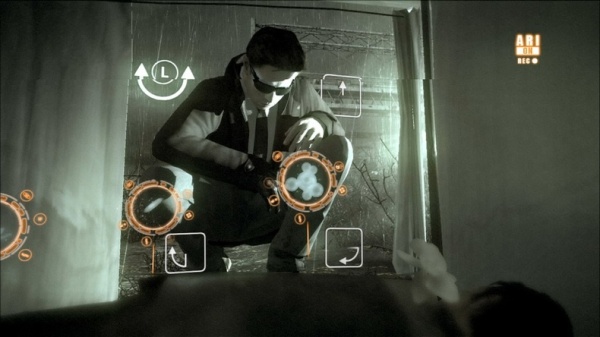
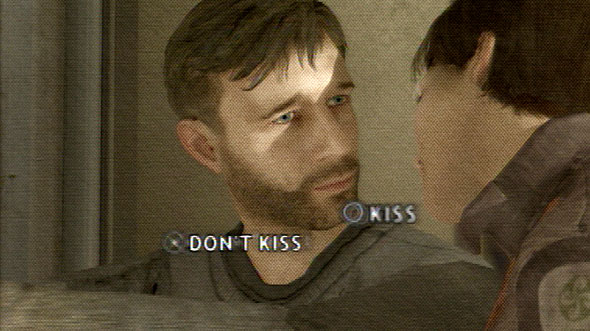
heavy-rain-ethan Fun fact: Occasionally, literature professors will pick up some medium of story after throwing tantrums about its inherent shittiness and realize they actually kind of like it. When this happens, they invent terms like “graphic novel” and “electronic narrative” to avoid that awkward moment where they have to fess up to reading comic books and playing video games. Everything eventually gains respect, even if only in a historical context–I personally hope to have fully decomposed and fertilized a nice, tall tree by the time music historians begin to discuss the Bieberesque Period. While “electronic narrative” may carefully disguise the term video game, those who discuss Heavy Rain tend to employ a second layer of euphemism, listed on Wikipedia as “Interactive Drama,” or in plain English, “Choose your own adventure.”

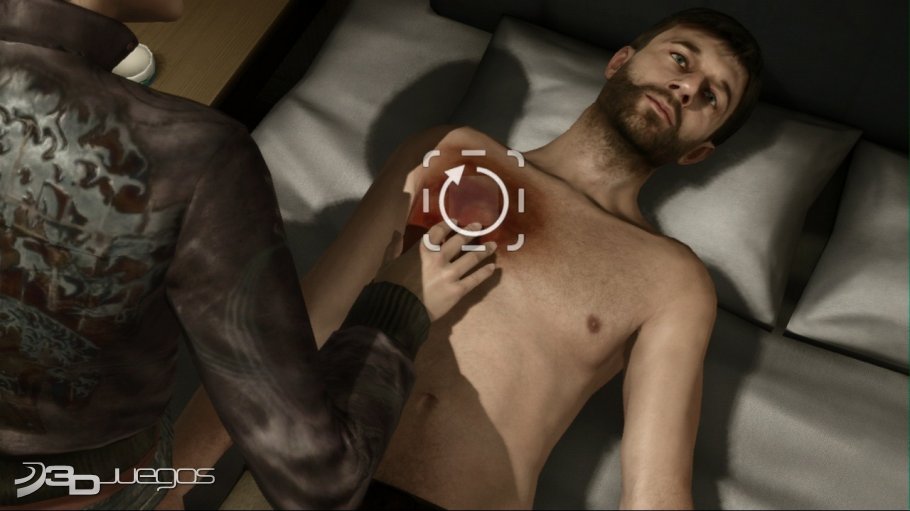
heavy-rain-playstation-3-ps3-407 Heavy Rain, belonging to the serial-killer noir thriller genre, immediately you choose such adventurous things as taking a shower versus taking a piss, wandering around your kitchen like an idiot versus wandering around the backyard like an Alzheimer’s patient, or turning on the radio and finding the music obnoxious versus just leaving it off to save time. I suppose not every story has to begin in media res, but the opening to Heavy Rain just feels like someone wanted to apply an onslaught of quick time events to their daily routine. You might describe it as God of War without the emotional intensity, mythologically inspired story line, and fast-paced fight scenes, but I prefer to think of it as Goat Simulator without the goats. For the first few hours of the game, the most fun I had was while the game installed on my PS3, and the install screen said, “Psst. Look in the game box. I put some paper in it. Let’s do some crafts!” And by the time the game began, I had successfully made a macabre little origami…penguin? Seal? Something.

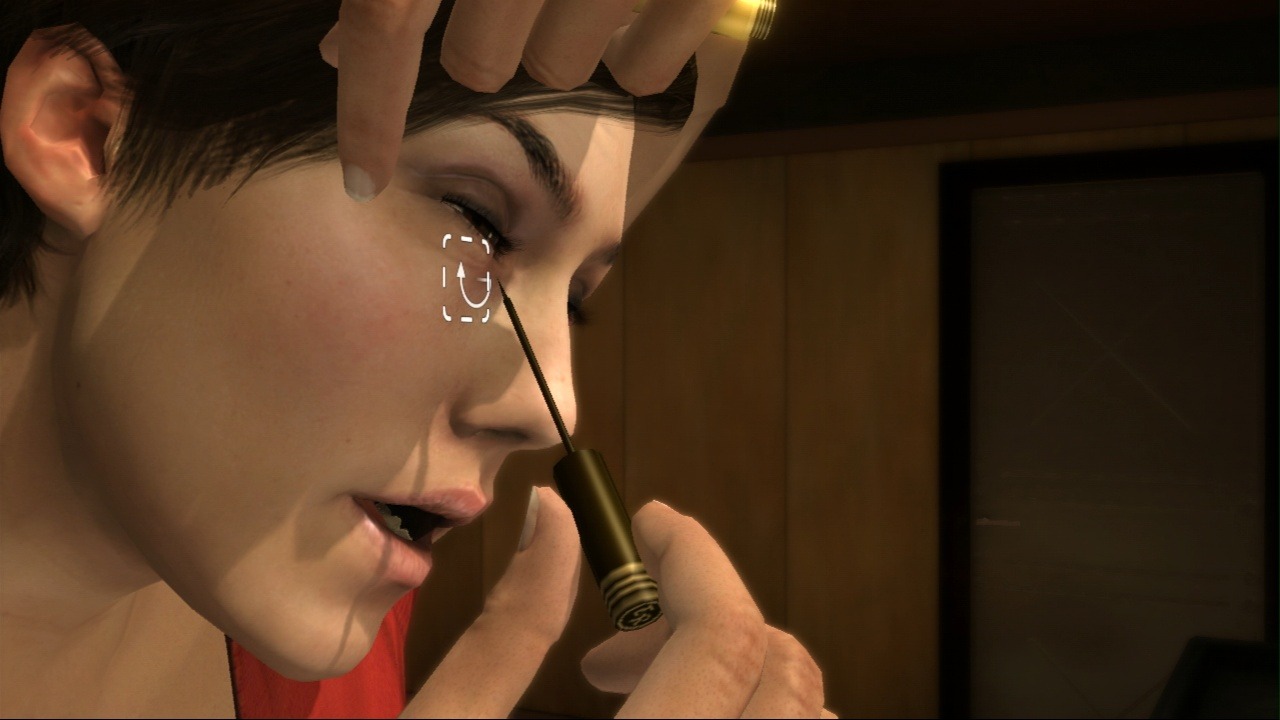
heavy-rain-madison-paige In the game’s defense–sort of–you really need to spend the first few hours of the game figuring out how to walk. Apparently, to make up for the lack of any real gameplay, the developer, Quantic Dream, decided to challenge the players by fucking with any sense of intuition in moving the character. Rather than the time-honored-and-beloved “tilt stick to move in that direction,” or even the eventually-tolerable-once-you’ve-played-every-Resident-Evil-game “press up to go forward and left and right to turn,” Heavy Rain opted for an original “tilt the stick to move character’s head in a seemingly random direction, then press and hold R2 to have their legs lurch forward in that direction without giving their torso any warning.” And if unintentionally spinning circles like a dog with Alzheimer’s who keeps forgetting that he wanted to chase his tail doesn’t sound like a stellar game, opening the menu to try to change the control scheme revealed both the helpful suggestion and the developers’ literary limits by suggesting I tilt the left analog stick to “orientate” my character.

heavy_rain-1113074 Now that I’ve quickly scanned everything I’ve written, worried that I, too, threw in some boneheaded non-word somewhere, I can say that the story does get better later on, although I very nearly didn’t make it after the game glitched out three minutes in, removing any option to do anything except walk in circles. The opening half hour or so exudes such a stench of happy-perfect-American-family-dream that I might have fumigated my Playstation if the absurd cesspool of bliss didn’t telegraph the inevitable death like the Bat Signal in a subway tunnel. For a game that sells itself on its emotional impact, they may want to rethink the appropriateness of making their audience react to tragedy with relief and excitement for things to come.

heavy-rain-screenshotAs the player, you alternate control of four characters involved in the investigation of a child’s disappearance presumably at the hands of the origami killer, following each one as they do random, daily tasks like handing someone a business card, buckling their seat belt, helping their kids with homework, and changing diapers. Each character has their own stake in the plot. Ethan Mars has to sit through a series of discount Saw puzzles, Norman Jayden investigates for the FBI while struggling with some sort of drug addiction, and Scott Shelby follows his own P.I. instinct while presumably struggling with a donut addiction. Occasionally, they’ll follow leads and learn clues as to the identity of the killer or the location of the abducted kid. But more often, they’ll engage in high-stakes QTE fights with people that have no bearing on the plot other than to make you think the pacing has picked up. However, just as often they’ll fail to find any excuse for an action sequence, so to make up for that they’ll play tense, dramatic music. In every scene.

heavy_rain_52 Having said that, I actually really liked the game. Despite stemming from the Choose-Your-Own-Adventure family, the choices run the plot together seamlessly. Walking toward a character might trigger a cut scene, while picking up an object you hadn’t noticed and then walking toward the character might have triggered something else. Often times, consequences make themselves immediately visible. Shoving the crime lord to the right versus to the left has the consequence of what side of the room he’ll fall. Some, like the diaper simulator, may have no apparent consequence. But whatever happens, you just have to live with that, which critics have reviewed as an innovative, yet unforgiving system. I wish more games would operate this way. “Slippy crashed on Titania? Well, we’ve got a job to do. Maybe we’ll pick him up later.” “Ouromov shot Natalya? Well, I guess I can hack Boris’ password myself.” “The giant angler fish ate Tidus? Good! Let’s move on to the tolerable characters now.” Heavy Rain’s decision-consequence system effectively means you can’t get stuck. Having spent an hour last night working on a boss fight in Resonance of Fate, giving up in anger well past my bed time, I can honestly say more games need this sort of system.

Modern expectations for thrillers demand a shocking twist ending, and while I’d much rather have dramatic tension than some schmuck introduced at the last minute, Heavy Rain tries too hard to impress you. Naturally, you meet the killer early in the game, introduced as just another character. Mystery writers have used that technique for a hundred years. But in a desperate effort to prevent you from guessing his identity, the character performs a number of tasks that–without revealing too much–make as much sense for a killer to perform as for a lion to hire a contractor to repair the fence at the zoo. The game even goes so far as to show you a scene that, in the dramatic reveal at the end, turns out to have played out completely different, despite having no reason for the player not to trust the narration. They even try to play up cliches, such as making you think Ethan kidnapped his own kid as though he had always wanted an odd number of fingers, but had to give himself a good excuse to hack it off.

504300-heavy-rain-playstation-3-screenshot-squeezing-the-answers Boiled down to essentials, Heavy Rain tells a good story, and the QTEs don’t get in the way too much, but in the end it feels like a handjob from a prostitute–sure, the resolution satisfies you, but you could have had more. And even if you like getting jerked around at the end, you know you have to wait a while before going back to try out the other endings.