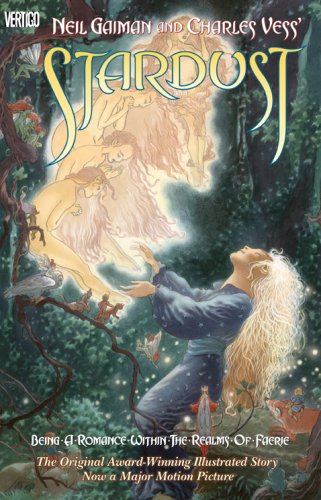
Stardust – Neil Gaiman (Illustrations by Charles Vess)

stardust

If you asked who I thought the best living fantasy authors are today, I’d have a tough time deciding between George Martin and Neil Gaiman. I’d go with Martin when I’m in the mood for a medieval soap opera, equal parts a history of the War of the Roses, a Martin Scorsese film, and a phone book filled with typos. He writes entertaining material, but sometimes feels a little like reading soft-core porn. Neil Gaiman also displays human sexuality in his work, but at least when I read his books, I have the luxury of not feeling creepy for reading a 15-year-old’s lesbian love scene written by a man in his sixties who looks like Santa in a sailor hat. But if Martin draws from history, Gaiman draws from mythology, giving his works a distinctively more magical feeling to them.

Martin Playboy

Just ho’ ho’ ho’-ing. Sit on Santa’s lap and tell him what kind of package you want him to give you.

Such is the case with Stardust, written to resemble an English/Celtic faerie romance. While modern fairy tales usually revolve around pixie dust and happy thoughts, benevolent, wish-granting godmothers and violent, blood-thirsty giants, traditional faerie myths are much more compact, giving the fae folk both magical skills and an overwhelming desire to skewer your spleen like a cheese cube on a toothpick.  These folk live in faerie (the same way nuns live in nunneries and fish live in fisheries), on the other side of a wall guarded by the Night’s Watch a detail of humans from the village named–in the tradition of the English to boil both their language and their food down to a simple, flavorless, unappealing mass–Wall. In a lengthy prologue, Gaiman explains that faerie is far too dangerous for mortals, so humans are forcibly kept safe on their own side of the wall and discouraged from crossing over to pick fruit or to have faerie anchor babies, the latter of which sounds like an excellent idea to Dunstan Thorne, who crosses the wall at the one time every nine years when it’s permitted to do so, not because it becomes less dangerous, but because there’s money to be made.

Dunstan attends the famous 9-year Wall Market in faerie, and encounters a beautiful young woman selling baubles, chained to her post, a slave who isn’t paid and can’t leave until the moon loses her daughter in the same week when two Mondays come together, which are terms enforced by a centuries-old woman standing guard at the door–pretty much like the standard deal for modern Wal-Mart employees, except without the blue vest. The two of them steal off into an X-rated area of faerie, and months later a basket filled with an anchor baby is left on Dunstan’s doorstop. The majority of the book follows the faerie baby on his quest to discover that teenage love is a beautiful, magical thing akin to getting one’s fingernails ripped out with pliers while jabbing a pencil in one’s eye whilst one is entirely engulfed in flames. Young Tristan offers to cross into faerie to retrieve a falling star as a testament to his love for a girl who clearly would much rather be dating the captain of the football team. Fortunately for Tristan, the fallen star happens to be a beautiful girl. However, as far as anthropomorphic gas balls go, she’s pretty popular, and since faerie is a dangerous place, they find themselves pursued by enough conflict to fill out a 200-page novel filled with elaborate illustrations on every page.

Because of its style, Stardust would be an excellent gateway drug for the fanciful, imaginative adolescent or teenager to make the transition to the hard stuff–Medieval romances written in Middle-English. It has a nice blend of traditional and more modern faerie stories that would appeal to plenty of fantasy readers, and although it does bound into acknowledgement that mammals often enjoy fornication, the material is not so extreme that it would harm any but the most fragile and delicate of readers, the kind who would probably cry outrage at having to read about sextants and sackbuts.

Final Fantasy Tactics (War of the Lions) – PS1, PSP

Tactics5

God kept you distracted while I stole the princess! He also drives the getaway chocobo and is the patsy taking the fall for the caper.

As I begrudgingly abandoned Cross Edge and moved it from my shelf of “games I play again” to my shelf of “things I can slide under a barfing cat to protect the carpet,” I thought I’d look back at why I feel the need to slog waste-deep through trails of shit just to get to the end so I can verify, “Yes, indeed, I’m covered head to toe in fecal matter!” as if somehow upon completing the journey it would magically turn into whipped cream and the breasts of strippers. See, every time I encounter a game with a horrendous learning curve and I wind up with so many game overs during the early game that it looks like Jack Kevorkian threw a party in a nursing home, I think, “I’m just playing it wrong! This will probably get really fun once I figure out how to play it! After all, I loved Final Fantasy Tactics!”

Final Fantasy Tactics is that one good moment in a bad relationship with the JRPG genre when she fawns over you like a school girl, but hasn’t yet devolved into constant mind games and psychological torture. It’s where she hooks you with just a sweet enough personality that you think, “I know she loves me deep down inside! She did before” Meanwhile your friends make reservations for you on the psyche ward for the moment the truth finally hits and the local Perkins kicks you out at 3:00 in the morning for blubbering over the waitress and not ordering anything. FFT is an amazing game, probably one of the best in the series, but when I got it in 9th grade, I hated it and getting from the beginning to the end was a complete pain. But that’s because the only tactical game I had ever played was chess, and I had as much talent for chess as Stephen Hawking has for competitive Lindy-Hop. I tried to get through the game by power leveling and brute force, which loses its effect against an artificial intelligence with even a modicum more computing power than your average kumquat.

But I digress. The story follows Ramza Beoulve, which only on my most recent playthrough did I realize is supposed to be pronounced like “Beowulf.” Ramza is the youngest son of a high ranking noble, enrolled in an academy that trains knights to keep the peace in the kingdom. Also present is Delita Heiral, a commoner protected and sponsored by Ramza’s father. Together, they tactically romp their way through the Ivalice countryside, strategizing their way through nobles and peasants alike, hunting down rebellious metaphors, rogue themes, and other literary concepts escaped from a high school English class. The two come into conflict when Ramza decides to help rescue Delita’s sister, and Delita decides that noblemen view commoners with the same lusty gaze they’d give a box of condoms; they’re something they’d really like to get the chance to use. Without giving much more away, because the story truly is one of the strongest features of the game, FF Tactics tells a more complete, concise, and less pornographic version of Game of Thrones.
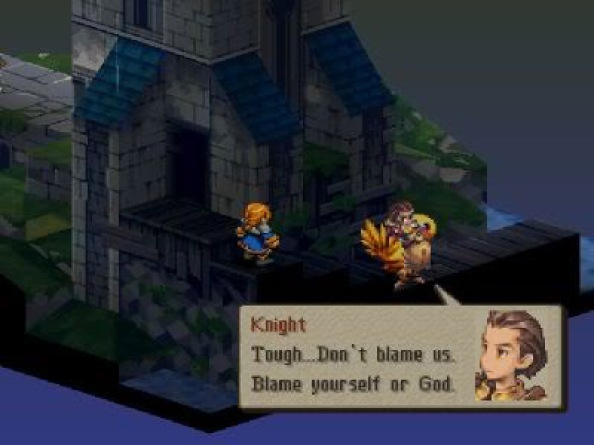
Tactics4

Davos? I think George Martin was a Final Fantasy Fanboy.
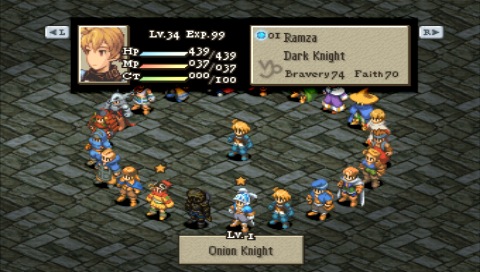
Tactis1

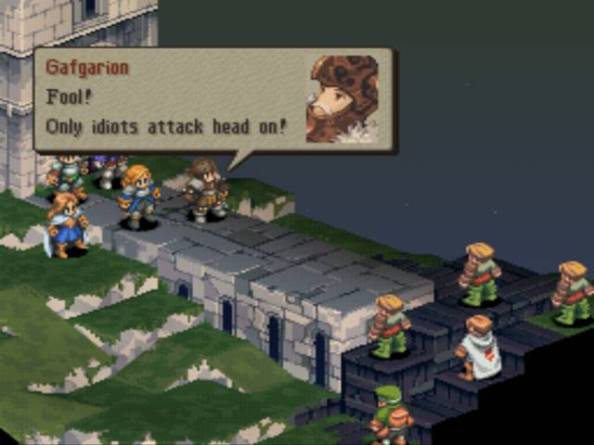
Fools! Step a few meters to the side and then attack!

While the story is better than almost all of the main series games, it truly shines when it comes to the combat system. Of course it’s a tactics game, which means some standards apply. Grid-based combat. Strategies dependent on enemy formations and terrain and a host of other features.  More characters to train, maintain, and manage than the U.S. Department of Defense. But the job system from Final Fantasy V received a sleek new upgrade. Characters change job class to learn different types of skills. Skills are purchased with accumulated job points, so there’s no need to learn them in any set order. Rather than allowing one skill from another class to be equipped, characters have their class’ action commands, a secondary set of action commands from any other class they’ve learned, one counter-skill from any class, one innate skill, and one move skill. Most people don’t have as much ability to customize themselves the way you get to mold and craft these characters. Dozens of different playthroughs have the potential to be unique experiences, which of course is why I always learn the dual wield skill from the ninja and equip it on a samurai, then teach all my characters to jump like a dragoon in order to survive that one boss battle in Riovanes castle.

The character customization, however, leads to the only two real flaws that I can see in this game (once I figured out all the other flaws were actually mine). The first is the crystallization of wounded combatants. Being a reasonably difficult game, your soldiers tend to drop like a flock of sea gulls flying through a particularly thick cloud of chlorine. From there, you have the standard Final Fantasy options for revival–phoenix down, raise spell, or wait until the end of battle and watch as a good night’s sleep cures an axe in the forehead–but they fail more often than a newly released Windows operating system. Only chemists can learn the item skill, and other classes that equip it need a second ability in order to administer items to characters more than a dick’s length away, so characters often spend several rounds of combat charging up the defibrillator while nearby enemies perform drum solos on their skulls. The big catch, though, is that if someone stays down for five rounds of combat, he’ll turn into a crystal, which can refill another character’s HP and MP, or on a good day randomly selects one of the hundreds of skills learned by the deceased and gives it to the living in a sad mockery of the half dozen hours spent training the now-rotting sack of meat.
Tactisc3

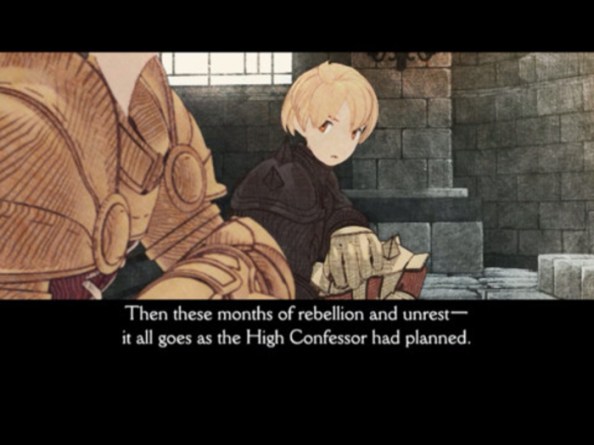
The church is the only character more likely to have “done it” than the butler.

Beyond an obnoxious gameplay mechanic that encourages me to regularly exercise the reset button and the nerfing of magic until it has the accuracy of trying to drop tennis balls in a glass of water from the international space station, nothing about this game feels worse than dismissing units. With a limit of 24 characters and a tendency to pick people up like a politician in a brothel, you’ll inevitably have to make room by kicking someone out of the group at some point, and each one of them–chocobos included–will lay a guilt trip on you that would make your mother proud. “I beg you, do not say these things! I swear I will prove my worth to you. I swear it!” “Are you certain of this? I thought us faster friends.” And even the non-human characters: “(It looks upset at being told to go home, mayhap because it has no home to go to.)” And the game won’t go easy on you–if you accept a monster into your party at all, soon you’ll notice an egg in your roster, and they’ll keep breeding until you have no choice but to look your beloved pet in the eye and tell it to fuck right off, then to pause the game for ten minutes and cry like your cat just died.
Tactics2

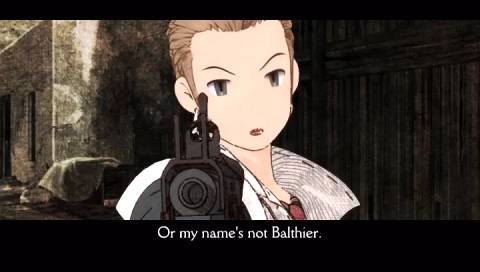
What better role for a leading man than a secret character cameo?

Originally called just Final Fantasy Tactics–before they released two “advanced” games that were, quite honestly, a step backward–the game had a re-release on the PSP, given the subtitle “The War of the Lions,” probably to make it sound all Medieval-y like the historical War of the Roses. The remake ramps up the difficulty, which isn’t bad unless you aren’t prepared for it, but it might force you to spend a few hours more than usual looking for random battles to build up job points–level means nothing in FF Tactics, but skills make or break an assault party. The remake adds some extra hidden characters, such as Balthier from FFXII, who I assume is there to make up for the fact that Cloud, hidden in the original as well, starts off with less prowess in combat than your average toddler with down syndrome, and it takes at least a half dozen hours to improve him to the point where he can get close enough to the enemy to be slaughtered without a fight.

The remake also includes animated cut scenes with voice actors, as well as a new translation that makes the story less like poring over historical journals and a little more like an immersive Medieval fantasy world, where no one can run to the privy without flowery language, as if Shakespeare were describing their bowel movements.

Splinter of the Mind’s Eye (Star Wars) – Alan Dean Foster

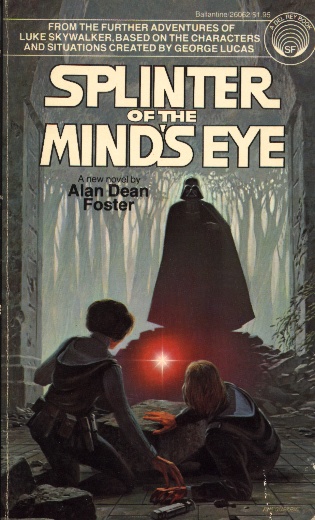
Splinter_of_the_Minds_EyeWho would have ever thought that Star Wars would turn out a failure? Trick question! For starters, anyone who’s lived through the prequels. There are few things that generally can enrage people to the point where their blood pressure is higher than that of a decapitated Anime character. One of these things is mentioning the terms “Republican” or “Democrat” in the presence of the opposite. Otherwise, it’s just the Star Wars prequels. So try to understand when I say I love the prequels almost as much as the classic trilogy. I love them from the pointy little tip of Amidala’s crown to the metal hunk of bounty hunter digesting at the bottom of the sarlacc pit. And I tell you this story because I want you to understand the sheer amount of masochism required that when I find out Lucas had planned a low-budget alternative to the Empire Strikes Back in case a New Hope flopped, my first thought was, “I need to read this!”
Back when George Lucas commissioned Alan Dean Foster to ghost write the novelization to A New Hope, he also suggested a side-project, a plan B, an option to implement if no studio trusted him with so much as a coupon for IHOP, let alone a film budget. So Foster wrote a 200-page novel called Splinter of the Mind’s Eye, which could be easily adapted to film, allowing Lucas to continue losing fan support even if he couldn’t afford the grandiose spectacle of Melatonin known as pod racing. Foster set his story in a dense jungle filled with mist that reduces visibility to less than the distance across a cheap, pay-by-the-hour film studio, and eliminates as many characters as possible without resorting to wrapping a twist tie around a woolly sock puppet and calling it a wookie.

The story opens with Luke and Leia en route to planet Circarpous when they crash land on Mimban, both planets named after Lucas and Foster spent a half hour staring at a hand of Scrabble tiles until they sounded like real words. From there…well, it’s safe to say “stuff happens.” They wander through the jungle, find a town, get captured by the Empire. There’s something about a magic rock and then suddenly they’re in a cave where they talk an indigenous tribe into getting themselves killed to save the beautiful white people. I don’t really know. This is what happens when plots start to get old; their minds start to go, and suddenly they’re wandering down the street, going into other people’s houses, and eventually you find them stripped naked, trying to stuff their clothes into an ATM and asking people for quarters.

Case in point, Foster’s grasp of these characters seem to indicate he uses 10W-40 motor oil and Astro-glide as a hand lotion. For all his trash talk, Darth Vader might have been blowing off steam playing street hoops, or preparing for his next rap battle. After blowing up the Death Star, Luke must have started injecting testosterone intravenously, as his vaguely whiny personality has subsided out of fear for his nearly constant need to mount Leia. And what Foster has done with the princess is bad enough that the resulting disturbance in the Force would incite feminists everywhere to have an aneurysm. The character who, after coming face-to-face with an inept rescue squad on the Death Star, shot out the grate on a garbage chute and commanded everyone to dive in now can’t go more than two pages without complaining about the mud on her dress, the lack of good makeup on planet Mimban, or the fact that Luke comes up with a half-dozen brilliant plans to save their lives by masquerading her as a servant. In the movie she was Rambo with a laser, and Foster transformed her into Willie Scott from Indiana Jones and the Temple of Doom. At one point, Leia actually uses the phrase, “Do you know who I am?” and suddenly the book felt less like a Star Wars novel and more like watching Kermit the Frog carry Miss Piggy through a swamp.

What did I expect, though, when I heard this was supposed to become a low-budget movie? Another trick question: words are cheap. Just because a film has to use a limited number of actors and take place on a single planet doesn’t mean the story itself has to sound like it was pieced together from random pages pulled out of the dumpster behind Stephanie Meyer’s office. The book deserves credit for essentially starting the Star Wars Expanded Universe series, although honestly that’s like crediting whichever Medieval monk penned the first piece of erotica–it was going to happen anyway. The fact that this was the first is more coincidental than influential, but an interesting read for the hardcore Star Wars fan, or nerds like me who are interested in alternative drafts of stories. It had potential to be a fun little side-story to the main series, but then again, I could also say I have the potential to be the first Rock-star Astronaut President of the United States.

Super Mario Sunshine – Game Cube

MS2

A few weeks ago I wrote about New Super Mario Bros, which I found more nostalgic than “new,” and except for the multiplayer, I found it rather lacking in the “Bros.” department. I happened to like that game, despite my usual disdain for Mario, who quite honestly, has become a bit of a sellout since his return from Dinosaur Land. Well, in my opioid haze of nostalgia, I happened to forget the mowing-the-lawn-with-fingernail-clippers experience of most platform games, and I thought I’d check out Super Mario Sunshine. After sitting in front of my computer for fifteen minutes trying to think how to cleverly introduce the game, the only thing I can really say about Mario Sunshine is how much it made me appreciate my Amazon seller account.

MS4

Sure, they look cute, but try smuggling a box of them into a movie theater.

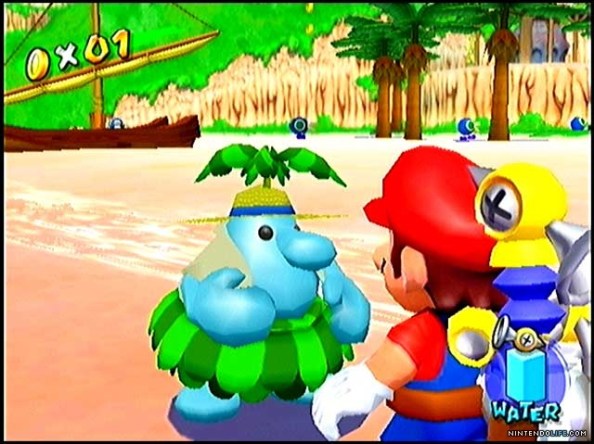
As I established in my New Super Mario Bros. post, attaching a complex story to a Mario game shows about as much understanding and respect for the series as a game of Pin the Tail on the Rembrandt. A quick glance at the ol’ timeline o’ Mario games reveals, well, two things, really. First, that Mario is replicating at the pace of a well-fed bacterial colony (despite the legion of pills Dr. Mario has been popping) and we should probably get a cream or something to treat the infection. Second, that Mario Sunshine was one of the first to attempt a rational story behind the “plumber takes mushrooms, sees flying turtles, talks to dinosaurs” scenario. After their last big adventure, Mario and Peach go on vacation, drawing a complete blank on what happened the last time they took a holiday arriving on a tropical island populated by morbidly obese nerds candies, they find a pile of sludge and a Mario impostor. Naturally, no one can tell the two of them apart, even though the evil Mario’s swirly blue texture from hat to boots would be enough to spark the light bulb over Lois Lane’s head. After a short trial, the Nerds slap Mario with community service, charging him with cleaning all the sludge and graffiti off their island.

MS4

…Hermes?

While Sunshine obviously wants to piggy-back of Mario 64‘s success, I do lament the old days when Mario could wrap his legs around a pole and slide down like an ostentatious stripper, then put that level to rest. Instead, like every other game since the N64 era, it becomes a scavenger hunt. While you searched for stars in Mario 64, Mario Sunshine has you out collecting–you guessed it–all the M*A*S*H memorabilia available on ebay! Just kidding, you have to look for suns to resolve some side plot where half the island is covered in shadow, and you’ll do this by repeating the same half-dozen levels until the extended electrical strain melts your game cube and starts a minor house fire. The problem is, even in the revitalized, 3-dimensional Mario 64, which also repeated levels enough to give Dora the Explorer and aneurysm, it still felt a little bit like a Mario game. You stomped goombas, chucked koopa shells, and chased mushrooms that grew out of the foundation of Peach’s castle.

Mario Sunshine, on the other hand, removes the classic enemies, pipe transit system, and there isn’t even an airborne punctuation mark hanging out anywhere in this tropical paradise–but they retained precarious ledges over bottomless holes as though we only play video games because we have a gravity fetish and wish to simulate the deaths of 1930s stock brokers. Most of the gameplay centers around use of Mario’s water cannon, and using that to spray enemies and walls. 3D platformers almost always play like frisbee golf during a hurricane, but you’d have better luck putting out your house fire by grabbing the fire hose by the hydrant end than you would aiming the water cannon. Certain segments even require simultaneous running and spraying, both tasks operated by the control stick, and since the water cannon uses an inverted aim, it gets rather difficult to hold it both up and down at the same time.

MS3

Will someone explain to me how spraying a squid with water is supposed to hurt it?

I’ve often heard it said, though, that if you put enough monkeys in a room with typewriters, they’ll eventually pound out the proper coding to control a Mario game. Mario Sunshine controls entirely unintuitively. One lovely example is climbing around on wire grates, as in Super Mario World, but with an extra dimension. When climbing vertically, the B button flips the gate to the other side while the A button detaches Mario and launches him into the vast, empty sky like a bra at a One Direction concert. However, when climbing and/or dangling horizontally, the A button flips the gate and the B button detaches you. I spent a lot of time falling and climbing before deciding I really didn’t need that sun after all, after which I went back to the hub world and searched for more levels, hopping from rooftop to rooftop as though Mario would rather be playing Assassin’s Creed–and honestly, so would I.

While in elementary school, I harbored this deep, shameful secret: I had beaten Mario 2 and 3, but I could never get past world 8-2 in the original game! Only much later did I realize that Super Mario Bros. was harder to get through than Chicago during rush hour. However, at Anne’s insistence, I’ve recently begun to tell myself that I don’t need to finish games that make my hair prematurely gray (note: my barber has been finding gray hairs since I was in 11th grade). Redeeming features? Running around underneath the hub city is the closest we’ll ever get to see Mario doing actual plumbing. Also, I got a kick out of buying stars from a giant tanuki who we never see from the waist down (google “tanuki” images if you don’t get it. NSFW). Still, a 21st-century video game that still uses lives may become a self-fulfilling game feature. The more times it makes me restart at the hub world just to get to the one difficult ledge I keep falling off, the more I feel that the “Game Over” screen is a wise truth I must accept.

Marios

If a shot of penicillin won’t relieve the burning, I suggest fumigation. And stay away from fire flowers in the future.

On a related note, check Amazon for a new copy of this game, appearing soon!

The 9/11 Report: The Graphic Adaptation – Sid Jacobson

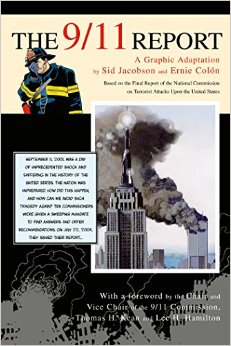
911I read a lot of science-fiction and fantasy, but sometimes I wonder if all those epic battles, thrilling worlds and imaginative scenarios might just be a little too exciting. Dangerously thought-provoking. So sometimes, to alleviate all the strain that comes from wonder, creativity and awe, I have to dive right into your plain, old-fashioned recreational reading like a lengthy government document. I tell you, there’s nothing like a tedious analysis of our nation’s security capabilities to make me feel relaxed, settle my blood pressure, and make my brain activity flatline, putting me into that near coma-like trance that tells me there’s no longer any danger of any of those deadly, vicarious thrills that so commonly lay up readers in hospital beds, where they have naught to do but read, thus creating an inescapable cycle. Fortunately, for the time-efficient reader who may not have the time to read through 592 pages of tedious analysis, or for those of us who just want to spice up our recommendations for improved national resistance to terror with a few colorful pictures, I can recommend The 9/11 Report: The Graphic…uh…novel?

So not technically a graphic novel, this adaptation of the National Commission on Terrorist Attacks’ epic dissertation on the September 11th terrorist attacks challenges everything we’ve ever thought about our ability to use the phrase “epic dissertation.” Produced by Marvel Comics veterans Sid Jacobson and Ernie Colon, the book distills information into a 129-page summary that makes it easier to swallow, much in the same way that a can of WD-40 makes it easier to swallow a big chunk of asphalt. It makes a sort of sense, though, that this story would find its way into a comic book, what with the popular culture immortalizing the fire fighters and police officers as godlike super-heroes who can evacuate tall buildings before they’re a simple mound, and the cartoonishly evil scheming on the part of bin Laden and his goons that set up a rather accurate comparison to super-villains (except, well…successful). However, the fact that Jacobson is noted for creating the character Richie Rich, prominent child of wealth hoarders who has a kind, heart of gold, makes me wonder if there wasn’t anyone with a stronger grasp of realism to explain the problems faced by America. You know, like Stephen Colbert.

I joke, but the adaptation is rather artfully done, opening with an timeline of the horrifically unsettling events occurring on all four planes before slipping into the horrifically boring events of the analysis that followed. Not exactly having characters to follow, we learn a lot about individual terrorists, although they mention names as though they were tired of Microsoft Word judging their ability to spell, and so identities are virtually indistinguishable–you know, the way most Americans view anyone from non-English-speaking countries. I went in expecting something ridiculously propaganda-laden, but except for a single panel that depicts George W. Bush as a tall, powerful man with broad shoulders, a pointed jaw, and a sharp, military crew cut, I didn’t feel like any political bias seeped into their interpretation, and I have to say I enjoyed the drawing of Bill Clinton that looked like Phillip Seymour Hoffman, but not as much as Karl Rove’s depiction as the love child of Peter Pettigrew and the fat kid from the Goonies…drawn as though he appeared in a Ren and Stimpy cartoon.

Obviously written as a way to introduce–I imagine–high school students to either political science and non-fiction reading, the book has some flaws. As most parts lack plot or even at times any sequence of events, most of the drawings end up being random, unnamed, middle-aged white men, with about 10% of them turning out to look like Bill O’Reilly, standing around staring smugly out of the page as though they’re waiting for the reader to trigger an elaborate prank they set up. Also, while they do a good job of distilling the information into smaller paragraphs and explanations, they often took out text verbatim, without realizing that a subtle depiction of Han Solo in a terrorist lineup doesn’t make the language easier to understand, so the report still comes off as drier than Ann Coulter’s vagina on a Saharan sand dune next to a drawing of a mirage. Still, I’d much rather read 129 pages–which I managed to do in less than a day–than 592, and I think there’s some important stuff in here for both high school students and adults. For example, did you know that the commission recommended America adopt a foreign policy based on empathy, where we pump funding into foreign education and try to assuage some of the things that pissed off terrorists in the first place? Spoiler alert: we didn’t do that.

But really, more government documents need to be written using comic sans.

New Super Mario Bros. – NDS

Back of Box

Sometimes I get tired of posting the box cover art. Here’s the back cover. Maybe it’ll tell you more than the backs of PS3 games.

If any video game character has become like a bad house guest, it’s Mario. He’s long overstayed his welcome, keeps showing up when no one asked, always tells the exact same story, abuses your pets, and spends all day either doing mushrooms or digging up your potted plants because he suspects you planted pot (a.k.a. “Fire flowers”). But even though he gets fiercely competitive every time your old pal, Sonic, comes over, and none of the Smash Brothers really want to play with him, we all give him a pass and humor him every time he shouts, “Hey, watch me jump on this turtle,” and the turtle dies, and he finishes up with his catch phrase, “It’s a-me, Mario!” like we’re all supposed to look up with sparkling eyes as though we’re not tired of his shit and still want to be seen in public with him. Wouldn’t it be great if we could all forget the mess he’s become, all his tiresome celebrity cameos, and the fact that he totally sold out and is practically the only non-Minecraft video game with his own line of merchandise? (*Outside of Japan, of course) Thankfully, about ten years back (Holy piranha plants; am I old!) Nintendo released a nostalgic game that brings Mario back to his glory days, giving him the chance to relive his teenage heartthrob days all over again.

Bowser

After fighting the same boss eight times in the original, NSMB trusts you enough to think you only need one more go at it.

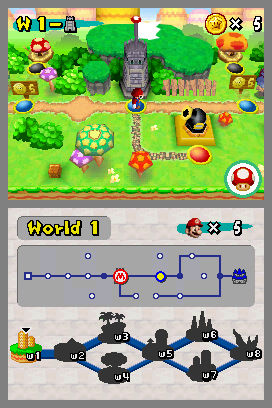
New Super Mario Bros for the DS strips Mario of all that dead weight he’s picked up over the years: gimmicky play mechanics, 3-dimensional controls, and any attempts at developing a plot around the original scenario that clearly failed to learn from the Super Mario Bros. movie. Gameplay resembles the original 1985 NES game with updated 2.5-D graphics and borrows lightly enough from Mario 3 and Super Mario World that, with any luck, the other games won’t notice their stuff missing and NSMB won’t have to return any of it. Mario runs and jump and ya-hoos his way through mostly horizontal side-scrolling levels, wandering into every fortress, castle and ghost house along the way, hoping to find Peach like Rick Grimes hoping to find Carl, or like a Jehovah’s Witness hoping that they’ll finally convince someone to convert. Standard power-ups join you along the way, like the traditional mushroom Mario takes to get high–sorry, I meant “tall”–and the flower that leaves him with a curious burning sensation. There’s also a mini-mushroom that shrinks Mario down to the size of his Italian cultural respect, which mostly allows him to access hidden areas, but also gives him the ability to walk on water as if he didn’t have enough of a Jesus complex to begin with.

Map

Eight worlds, but you only have to play through six. Good thing they made a Mario game for people who hate Mario games!

The story is simple; Bowser Jr. kidnaps Peach, and Mario has to get her back. Done. No need to present King Koopa’s tragic back story, develop a psychological analysis of Mario, or to reveal any shocking, Darth Vader-style twists. As much as I play games for the stories, Mario, much like black jack and prostitution, was created solely for fun and profit. These characters are as psychologically real as Veggie Tales fan fiction. They’re two-dimensional, and the best way to show that is to, well…make them two-dimensional.

Jelly Mushroom

The Mushrooms are tired of Mario walking all over them. Today, they fight for their independence.

Level exploration takes center stage in New Super Mario Bros. While some have criticized the game for being too easy, I actually appreciate the fact that they’ve shifted the emphasis back away from precariously hopping from platform to platform over an endless series of bottomless pits as though the only way to Bowser’s castle was over a convention of plate-spinners. Levels aren’t too difficult, so the adventure feels like a merry romp through the Magical Mushroom Kingdom rather than a test of skill and endurance of spirit that would break most U.S. Marine Corps members. Power-ups add an additional level of exploration. The mini-mushroom, as mentioned, allows access to tighter areas (insert your own Princess Peach joke here), while the mega-mushroom gives Mario the ability to enact his monster truck fantasies of smashing everything in his path–bricks, enemies, pipes that lead to vital areas in the level–into tiny bits. By far, though, my favorite power-up has to be the blue turtle shell, which gives him stylish new duds, allows him to hide from most attacks, and to spin along the ground bouncing off objects like a rogue bumper car fueled with Red Bull and Mountain Dew.

And….that’s it. The game is nostalgic, but not exactly a good subject for a dissertation. It’s fun. It’s easy. And it’s the perfect game to play to kill time while backstage at a play or when listening to your father-in-law read “A Christmas Carol” for the gazillionth year in a row. But beyond that, it’s not exactly as interesting as, say, a retro-style Final Fantasy game, or a pangolin that fires lasers.

Mickey Mania – SNES, Sega Genesis, Sega CD

RetroArch-0611-172717

Mickey Mania is described in the DSMV as the compulsive need to encourage Disney to make crap by handing them your money. Or in George Lucas’ case, Star Wars.

RetroArch-0611-174350

…This is so disturbing, even Mickey’s life meter is trying to hitch a ride out of town.

My job here isn’t an easy one. As I don’t expect you all rush to ebay (as much as one can “rush” to a website) to find copies of these games, and that you’re not seriously mulling over whether or not to play these and need an expert’s opinion to tip you over the edge one way or the other, the only  possible reason you’d read this blog is that I make the posts mildly entertaining. Even considering I’ve dropped the challenge where I don’t use any form of the verb “to be” (go back and check entries from my first two years of posting), I have to find just the right games to make fun of. If a game is too good, it may be hard to find flaws in it, but if it’s too bad, I have to worry about properly expressing the comedic aspects, which aren’t as easy as just showing where a game misses the point worse than Burger King’s attempt at green ketchup (not to mention my concern with too many manatee jokes). But then I find those Goldilocks games, the “just right” combination  of playable and pointless that makes them stringently bland…and I have to find a way to make them at least interesting enough to talk about.  Enter Mickey Mania: The Timeless Adventures of Mickey Mouse, a perfect blend of half-assed and carefully-developed, released to commemorate a birthday that no one cared about by revisiting short films that no one had seen.

RetroArch-0611-180244

…I don’t think Disney has ever done anything as disturbing as this.

People love celebrating milestones, but when they do, they usually choose nice round numbers: 10 years, 25 years, 50, 75 and 100 all make the cut. But for whatever reason, Disney thought Mickey’s 65th birthday was a big deal. I wonder if most beloved cartoon characters fade into obscurity around their 63rd or 64th year (Poor Jeoffrey, the Peccary). When Disney came up with the idea of commemorating their contribution to the order of rodentia with a video game, they only had six months to hit their deadline. Fortunately, they decided to take a little more time to make the game playable, but not enough to actually give it anything unique or innovative. They thought the game would be carried by having actual Disney animators! work on the design, missing the point of a game in that special way that my mother misses the point when she asks why I still play Super Nintendo games when technology has improved so far over the last twenty years, then goes to the closet to pull out Scrabble and Monopoly.

RetroArch-0611-180522

Mickey Kong

So Mickey’s 66th birthday present plays as an okay platformer, if not a consistent one. In general, Mickey jumps through levels avoiding enemies, most of which he can defeat by jumping on their heads. He also collects marbles, which he can throw at enemies. Beyond that, each stage seems to have been put together by designers taken from different parts of the Small World, selected in the manner of 18th century slave ships, where they are chained to their work with no common language to talk to the designer next to them. Three of the levels have bosses–although apparently in non-North American releases, more stages have these. Most stages allow use of marbles, but Mickey loses them every so often (much like the designers). Almost all the stages scroll from the side, but one rotates around a tower while another features Mickey charging straight at the player like an angry moose (as he is, in turn, chased by an angry moose). Mickey apparently is looking for various avatars of himself in some weird, meta-identity crisis, but a few of these avatars make no appearance within the stages themselves.

RetroArch-0611-173927

Why does this look obscene?

Probably the worst oversight of the design, though, is that they based each of the six stages (seven for non-SNES releases) on classic Mickey cartoons except for one on classic Mickey cartoons that pre-date 1950. Only The Prince and the Pauper stage was based off a cartoon in players’ living memories; the rest are even older than my father. This wouldn’t be such an issue today, but they weren’t commonly played cartoons, and Disney had the audacity to release this game almost a decade before the invention of youtube, so none of these levels had any meaning for me.

RetroArch-0611-173551

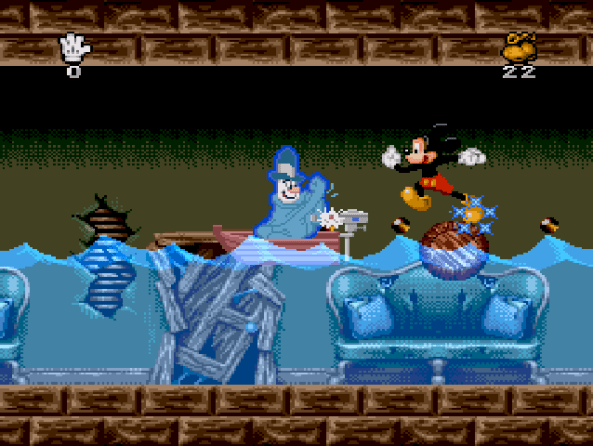
Rather than walking on the ground, you can walk on a barrel.

But they were designed beautifully. The game is nice to look at and puts in key details that–unbeknownst to players–come straight out the games. The Steamboat Willie stage even includes a gradual shift from monochrome to color (A curious choice, to say the least, since only the final stage is based off a cartoon animated in color. Perhaps they just wanted to show up The Wizard of Oz. Take that, filmmakers from 60 years ago!). The game is pleasant to look at and not too difficult, so you can get through most of it in a single sitting, even if it has all the replay value of a chicken sandwich. And the inconsistencies actually make it interesting, as you’re not stuck simply jumping on heads for two hours like a cute, child-friendly sadistic serial killer.

RetroArch-0611-182012

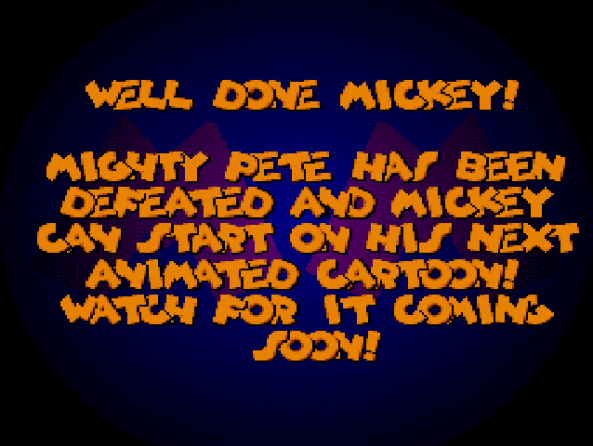
Congratulations on giving us money for this game you finished in an hour! Now give us more money!

Teenage Mutant Ninja Turtles: Turtles in Time – Arcade, SNES

RetroArch-0611-162908

…am I interrupting something?

As I’ve established in recent posts, I currently have about as much spare time as a 120-year-old end stage cancer patient; therefore, I’ve needed to stray from my usual RPG/Survival Horror predilections to find games I can finish in a short afternoon. Even better, though, why not cash in on the gaming industry’s Paris-Hilton-level of ambition and write about a game that didn’t bother to make any contributions to its genre, innovations for gaming, or changes to any previous games in general? Why not write about a game exactly like one I’ve already written about, thus raising this circle of laziness to college-student-on-pot-who-still-has-a-few-days-before-the-term-paper-deadline-to-get-started proportions!

RetroArch-0611-170800

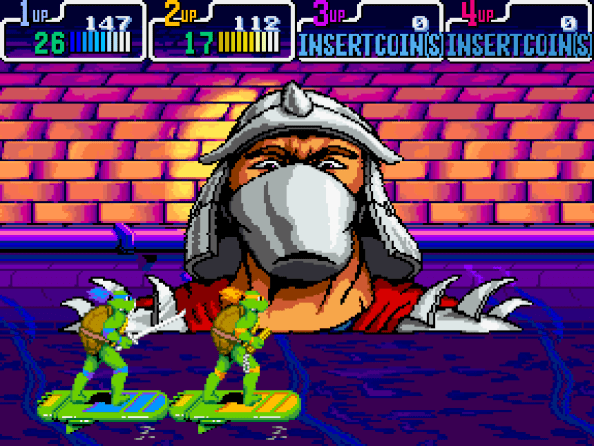
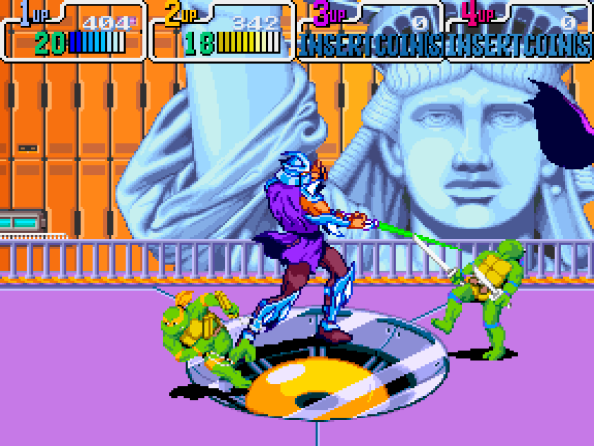
Shredder’s script here reads, “Prance with lightsaber.”

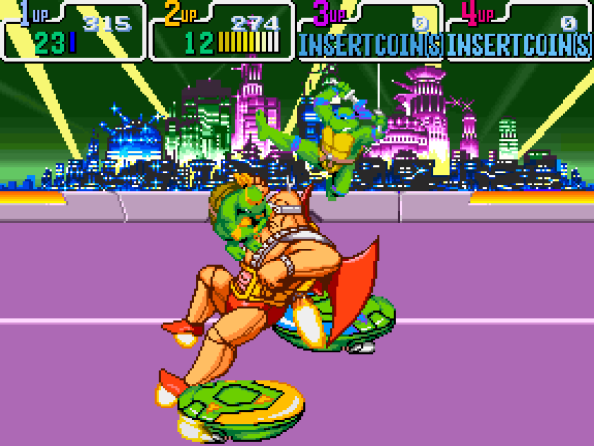
In my TMNT II: The Arcade Game post, I described how even though the original NES Ninja Turtle game was well-conceived, fun to play, and unique, the simple facts that a) it was not the arcade game and b) it had a jump in the third stage so difficult that it rendered the rest of the game inaccessible, made the game only slightly less disappointing than The Force Awakens. As such, Konami released it the following year on NES. But unable to allow their fan base to experience any more satisfaction than a eunuch in a brothel, they had to release an even better arcade game the following year. And by “better” I mean essentially identical to any other beat-em-up game released between 1987 and the Second Coming.

RetroArch-0611-163038

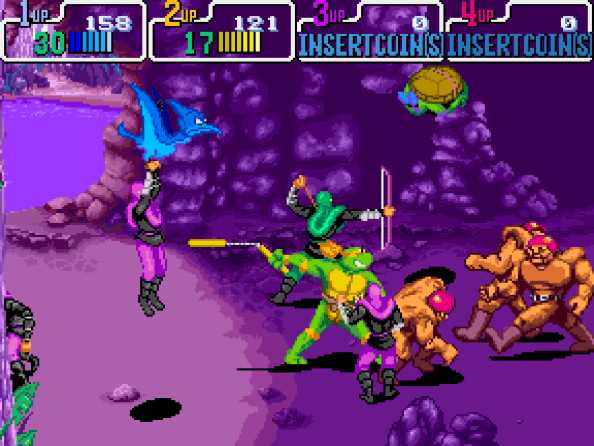
The tactical advantage of being air-lifted in a meter off the ground by a pterodacty ready to die of exhaustion is somewhat underappreciated in the shadow of using medieval weaponry while you have access to the entire history of weaponry.

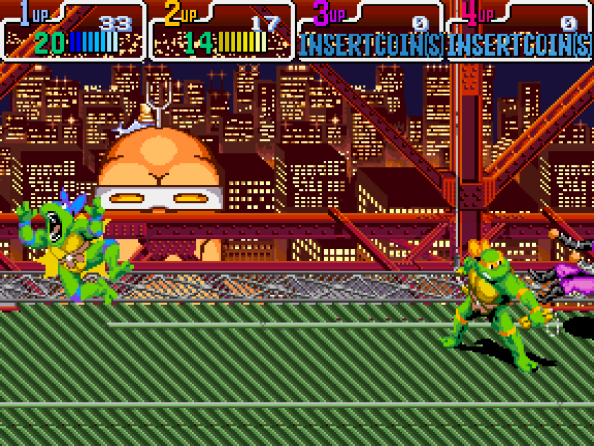
TMNT: Turtles in Time tells the story of a villain who we’re supposed to respect as a badass super-ninja, but who really has less a grip on reality than the Creation Science Museum. The Shredder has invented time travel, but rather than manipulating his knowledge of the future in a Biff-Tannen-style bid for fortunes that would humiliate Donald Trump, or even studying all the crucial battles in history in order to sweep through the past and conquer the entire world, he opts to enact a cockamamie vengeance on the Ninja Turtles under the assumption that he only loses to them time and time again because he’s never faced them from the back of a velociraptor on the deck of a pirate ship. I suppose we’re not supposed to ask how the Shredder formed an alliance with pterodactyls and fire-breathing deinonychuses, although I assume it wasn’t a hefty salary. Shredder seems to have spent so much on the time machine that his foot soldiers can’t afford anything more than medieval weaponry, even in the distant future. He could have probably evened out the odds against the turtles if he had sold the technodrome and bought an AK-47. Although if the Turtles have taught me anything, it’s that slicing the solid-steel barrel off of a gun with a sword leaves it as useless as a squirt gun filled with jello.

RetroArch-0611-163556

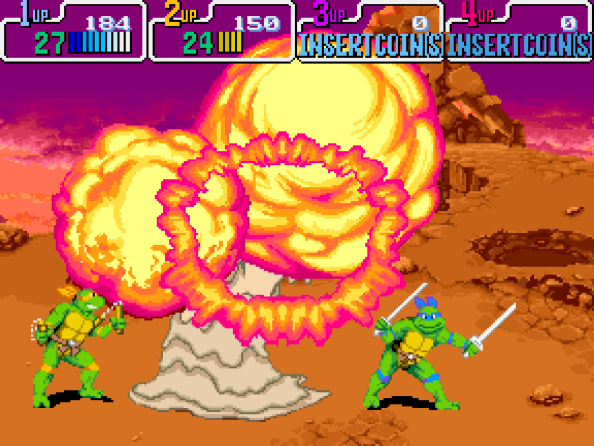
Exploding mud. Taking a page from Goldeneye’s playbook here.

The game plays…literally like every other beat-em-up game to that point. You have an attack button and a jump button. Enemies come at you. Go get ‘em, tiger. To Turtles in Time’s credit, though, they did improve a handful of things. If you hit the attack button multiple times, the game will cycle through a short series of attacks, rather than repeating the same animation over and over like a buzzfeed gif with no caption. Occasionally, you’ll pick up a foot soldier and chuck them at the screen; I don’t exactly know how and the game only gives instructions when that knowledge won’t interfere with you putting more quarters in the machine. The game is, however, designed to do just that. Like any good arcade game, Turtles in Time puts you at a severe disadvantage. Bosses, in particular, have an excessive amount of health, and they don’t do that thing where they start flashing as they get weaker. It often left me wondering how many times I had to stab a guy in the head before he started showing signs of fatigue.

RetroArch-0611-165545

Why do I feel like something obscene is going on here?

Beyond that, I really can’t say much about the game. You progress through levels. You drop in your entire college savings fund. You fight the monsters from the live-action Turtles movie as though Bebop and Rocksteady are the only henchmen in super hero history that are too delicate to survive routine pummelings. You eat pizza off the ground. A mud monster explodes. Michelangelo makes nun-chucks look like a weapon that wouldn’t constantly give its user accidental concussions. You chase around Kraang in his homoerotic Cho-Aniki bodysuit for a while. Then you fight Shredder.

I still think “Foot Clan” would be an awesome name for a band.

RetroArch-0611-161458

Okay, I KNOW something obscene is happening here.

Ender’s Game – (Mork calling) Orson Scott Card

Ender

The results of a head-on collision between Mega Man and Tron while on the Small World ride at Disney World.

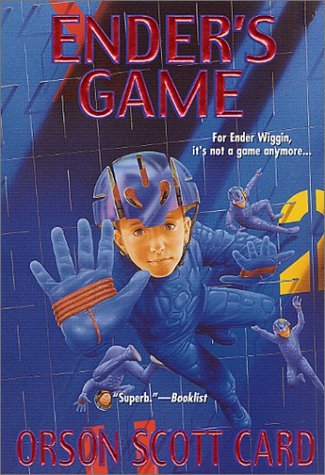
Here’s one that relates to video games! Sort of! For sci-fi nerds like me, no adolescent novel has come close to the acclaim given to Orson Scott Card’s novel, Ender’s Game. I’d like to think that I would have loved the book had I read it when I was ten. It plays into every young nerd’s fantasies about saving the world from aliens, living in outer space, and playing video games non-stop for six years without getting in trouble. The problem is, I first read this book when I was 32, with an IQ higher than my shoe-size that enables me to read the novel as a juvenile combination of Starship Troopers and Full Metal Jacket, with all the psychological realism of a Stephanie Meyer novel.

Ender’s Game follows the exploits of an average six-year-old boy, who enjoys going to school, playing soldier with his big brother, and psychotically murdering the hell out of other six-year-old boys who defy his will. Fortunately, the government is interested in young boys with an aptitude for ruthless slaughter. Earth has, over the past century or so, repelled a handful of invasions by an alien species known as “buggers.” As Card is an outspoken homophobe, I can only assume that he assigned this name intentionally, as like their Earthling counterparts, the buggers’ very existence makes a lot of Earth men uncomfortable. And like many outspoken homophobes, Earth’s answer for the buggers is to murder them out of existence. So when Ender is caught slaughtering one of his classmates who likewise makes him feel uncomfortable, the International Fleet hails him as a tactical genius.

I’ll repeat that; murdering a six-year-old because he scares you makes you a tactical genius. And Ender is so much a genius, that they want him to command the army as soon as possible. Apparently no one in this world had ever thought that “hurting your enemies” was a particularly effective combat maneuver. It sure explains why my attempts to launch Little Debbie cakes at people and invite them to a rousing game of Magic: The Gathering hasn’t deterred the last few people who tried to mug me. So the I.F. takes Ender up to their orbiting combat school to prepare him for battle.

And then be prepared to read about training. And school. And combat simulations. The book turns into Full Metal Jacket, if you replaced all the social commentary with vague descriptions of schoolwork. Although to be fair, Card does allow Ender to murder someone once or twice (once.) just to spice things up. Of course, far from receiving realistic, believable consequences, Ender is praised for being violent enough to frighten Quentin Tarantino. See, while Card wants to write about a tactical genius, it becomes apparent that he, himself, knows very little about tactics, and so rather than devising clever situations for a witty protagonist to reason his way through, Card just has all the supporting characters repeatedly tell the reader how awesome Ender is, and we’re just supposed to roll over like a dutiful whore and accept whatever nonsense he shoves at us without question.

But aside from rampant homophobia, sexism and anti-semitism, fantasies about being a persecuted Christian, enough brutality to make Mortal Kombat look like Sesame Street, and for some reason a strange obsession with fart jokes, the book presents characters slightly less realistic than a Salvador Dali painting. Ender is a six-year-old who responsibly assumes a full-time training regimen. His sister becomes an Internet phenomenon, influencing public opinion under the pseudonym Demosthenes, while his older brother decides to take over the world with inflammatory youtube comments. Props to Card for predicting social media–even though he did somewhat overestimate the effect of flame wars–but trying to explain your lack of skill to create young characters–characters who have more in common with Tryion Lannister and Thorin Oakenshield than with Harry Potter and Ron Weasley–by saying, “Well, they’re smart” has the same effect as Jeffrey Dahmer telling the judge, “Well, I was hungry”–it makes us want a little more explanation.

The book may have redeeming qualities toward the end, but Card sticks to his convictions the way Bill Clinton recounts his sex life. There’s some literary parsley garnishing the end about understanding an opponent diminishing the desire to kill them. But he also includes a handful of other really interesting ideas that dry up faster than the ink on the page. I ended up losing sympathy for the book when Card suggests that the moral course of action would be establishing an age of neo-colonialism on the homeworlds of our slain victims–it is, after all, what Elton John From Outer Space would want.

However, Ender’s Game is a classic member of the sci-fi cannon, and as such it must appeal to someone. I recommend this book for an audience of psychopaths, homophobes (or, really, anyone who was weirded out by Flash Gordon), or just any young boy with delusions of grandeur.

Galaga – Arcade

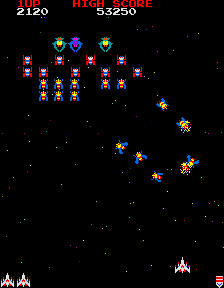
Galaga

Twice the ships! Twice the firepower! Twice the target for the space bugs!

This blog gets viewers so rarely, I’m starting to think I may actually be writing an M. Night Shyamalan film. So whenever I have to switch to bi-monthly updates instead of weekly ones, I can’t help but think that will be the final nail in the coffin, the act that will dethrone me from my lavish lifestyle of fame, fortune, a diet consisting entirely of ramen and twinkies, and a driveway that turns into applesauce if it rained at all within the last decade. Unfortunately, since blogging wouldn’t pay the bills if the electric company issued me a refund for ten years of overcharging me, so I sometimes have to focus on other things, such as a horror novel that will probably get published as soon as the Republicans and Democrats finally agree on something (which with my luck, they’ll outlaw reading and writing), a comedic history of Duluth using sources with less historical continuity than the Star Wars prequels, not to mention I’m attempting to get licensed to teach public school, which involves less knowledge of the stuff you’re teaching and more learning how to avoid the temptation to go ballistic with a ruler when a classroom of 35 kids decides they’d rather re-enact the Iliad than read it. So here’s Galaga, the first of a series of games that I can play in an afternoon, write a few paragraphs about, then schedule it to post sometime in March.


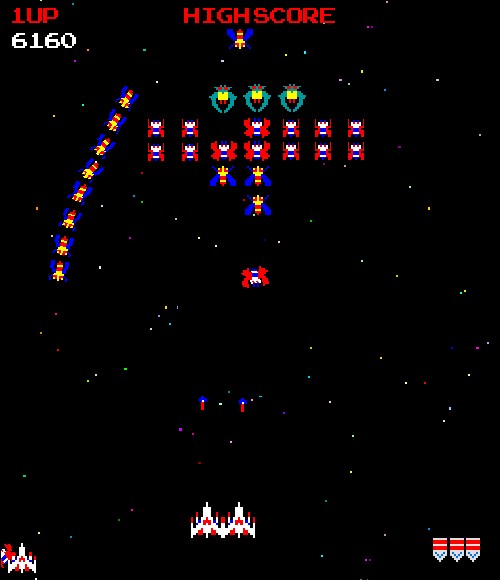
It’s Space Invaders on steroids. There. Done. See you in two weeks!


GalagC

Space bugs apparently need wings to fly through a vacuum.

Seriously, though. I just spent about a half hour after writing that last sentence trying to think of something else to say. This game clearly belongs in a 1981 arcade. It effectively holds my attention for about a quarter’s worth of my time (have you ever noticed there’s no symbol for cents on the keyboard? That’s pretty obnoxious), and that’s even taking inflation into account. I’m sure in 1981, the idea of sliding a pixelated spaceship back and forth at the bottom of the screen while spamming the attack button could have held me in rapt attention well beyond the 45 seconds it took for the game to reduce all three of my lives to shrapnel. With a pocket full of quarters and the technology for better games still years away, the game works like a Nigerian prince scam. You feel invested in the game, and that one time you blew up–that was just a stupid mistake. If you drop in another quarter, you’ll get much more play time on this next round.


Nowadays, a quarter isn’t so much an investment as a game of chance, “I think I can get in and out of the game store in twenty minutes if I only put one coin in the meter,” or even, “They quit enforcing the meters at 5:30. What are the chances I’ll get a ticket in the next thirty minutes?” Games are also generally better designed. Outer space has three whole dimensions, Galaga. Your ship moves on a line. That’s two dimensions you’re just refusing to use. “There’s an enemy approaching from the left. I have literally an infinite number of directions I can go to evade, most of which I could literally travel for eternity without hitting anything, but if I can’t go exactly 90 to my immediate right, life isn’t worth living.”


So…Galaga…worth playing? Maybe if your father contracted malaria from a mosquito and you have the overwhelming urge to seek revenge on giant space bugs. The enemies provide the only really interesting aspect to the game, swooping in like a flock of drunken geese with their bug-like wings flapping uselessly in the vacuum of space.  But once you’ve seen that, you’re just playing Space Invaders, in color, without the shields. I rank it with Moby Dick as a timeless classic about an epic battle that also doubles as a sleep aid.

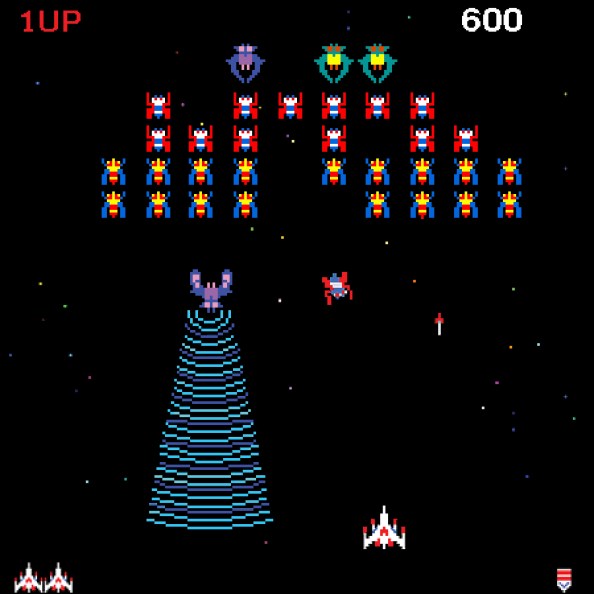
Galagb

Yep…and here’s a space bug with a tractor beam. Not a lot of variety in Galaga screenshots.