Super Scribblenauts – NDS

Super-Scribblenauts-Coming-This-Fall

As an English writing and literature student, I had to deal with the following on a daily basis.  “English majors, we just love words! Don’t you just love words? I love words.”  Well, no actually.  If I cared at all about random sequences of molecular vibrations, I’d have studied music.  Ideas mean much more to me, and the idea I’d like to discuss here concerns the use of words in Super Scribblenauts.

Super Scribblenauts, a game that requires no scribbling or sailing skills and that I can describe as  just “pretty good” at best, focuses on solving simple puzzles of varying convoluted-ness by summoning physical objects from an arsenal of anything, literally ANYTHING…that the programmers had the foresight to program into it; just speak (er, type) the word and it shall appear! So long as it doesn’t involve profanity, racism or sexual innuendo.  Blood death and violence seem fine, though.  I created an “exotic dancer,” once, but since adjectives have about the same effect as labeling your leftovers with a sharpie and hoping that someone will recognize what it means, the game just gave me a ballerina. Sigh…I was really looking forward to the colony on Mars for a brief moment.

In each level, Maxwell, the extraneous protagonist who has apparently wrapped his head with an iPhone cover, needs to collect the game’s macguffins called Starites.  Often times, the player must meet certain conditions before the starite will appear, such as adjective levels that may ask to create something with the characteristics of both a dwarf and a giant.  While I tend to enjoy creative, free-flow problem solving, most players with an IQ high enough for self-awareness may tend to over think these problems, as I did when I didn’t immediately create a “small giant” or a “big dwarf.”

I have to admire a game that encourages weirdness.

I have to admire a game that encourages weirdness.

Most levels require Maxwell simply to get from point A to point B, navigating certain obstacles such as trees, spikes, lava pits and wedding guest lists.  The game encourages the use of new words to solve each puzzle, which keeps it interesting for a while.  Eventually, however, the problems become a little convoluted, and I found that using “wings” pretty much got me around any obstacle I needed.  I also became quite adept at using a combination of ropes, balloons and a fan to put things exactly where I wanted them. Certain levels require you to think up objects to fill a school or grocery store or something.  One level asked me to create a super hero, and to my utter, childish delight, I put in a “cape,” “dead parent” and “bat” and out popped a masked avenger!

Still, the entertainment value of summoning chupacabras, robotic dinosaurs, napalm, ninjas, demons from the pits of hell, and cats that eat spaghetti wears off after a while.  Since the game rewards use of new words with all of a pleasing, cash-register “ding,” I found myself questing for synonyms.  I found the thought of a game made by running a dictionary through a garbage disposal intriguing, but it disappointed me with its lack of words.  I’m sorry, but you took the time to program in Moby Dick, the Great Flood, the Necronomicon and nitrous oxide, but you missed “jewelery store?” Also, some items tend

Your tauntaun will . . . uh, freeze?

Your tauntaun will . . . uh, freeze?

And as I mentioned in my Phoneix Wright article, creative games usually fail when the player has to tell the game how to think. Many of the objects in the game exist, apparently, only for novelty value, as the programmers felt that not everything really needed to function. Maxwell can’t quite figure out that the acid may help more if he took it out of the container.  One level asked me to find a safe way for a man to jump off a cliff, so I attached a bungee cord to his waist and a rock and then watched the guy run in circles scratching his head, while waiting for a “ding” that never came.  Some puzzles seem to enjoy kicking me in the groin with convoluted answers, but hey, I should have just known that the janitor would clean a mess, but not dirt, the doctor would save someone from a snake, but not cyanide pills, and that a psychiatrist would only check on a patient if they’d seen a big hairy spider.

Even if you can summon the object you want, it may not come in a useful form.  A few times, I wanted to walk across a pit, so I asked for a plank, only to get something immovably vertical.  I could only create fans that pointed left, and ramps that sloped upward to the right. Adjectives don’t reliable alter items either, and while “gold bridge” did in fact summon a bridge made of gold, the system didn’t register any qualities that went with it, so I actually had to destroy it after it started floating away on a light breeze.

As puzzle games go, it played rather nicely.  The novelty lasted long enough and some problems did require a decent amount of thought.  The player has the option to play through most levels on advanced mode, which means they have to solve the puzzle three times without repeating any words.  I tried that for a while, but opted against it in the long run, to save my nerves.

Duck Tales – NES …(woo-ooh!)

Scrooge Moon Treasure

If I reach the ripe old age of 110, find myself immobile in a nursing home bed, unable to speak and peeing through a tube, and I’ve left a living will detailing that only one TV show play constantly in my room to let me reminisce about my youth in those last precious moments of existence, that one show would have to be…

…well, Rescue Rangers, to be honest. But if they could alternate between two programs, every other episode would be Duck Tales (then, I think, given the third option, I really enjoyed “Get Smart” around fourth grade or so).  Rescue Rangers and Duck Tales truly represented a time when Disney put forth an extreme effort into their afternoon programming.

Stop complaining, Scrooge. I come from Northern Michigan. This is a light dusting for us.

Stop complaining, Scrooge. I come from Northern Michigan. This is a light dusting for us.

Now I can see all you wagging your heads in front of your screens thinking, Jake, Jake, Jake…everyone remembers their childhood as more wonderful and praiseworthy than everyone else’s.  But like Phoenix Wright, I make no claims without evidence (lest my conduct reflect badly on my client).  Prior to the 2012 Presidential Election, everything I understood about economics–and retained after graduating high school–I learned from Duck Tales.  Scrooge McDuck taught his nephews some fairly complex lessons about investment and saving.  He showed, through example, why keeping three cubic acres of cash sitting in a monolithic building marked with a dollar sign might demand ridiculously excessive security and a lot of sleepless nights.  Look up an episode called “The Land of Tra La La,” and you’ll see a hypothetical scenario illustrating the effects of inflation.  Even today, when politicians suggest to me that I only need to find more difficult work if I want to increase my income, (goodbye teaching college, hello digging ditches!) I hear Uncle Scrooge’s mantra, “Work smarter, not harder,” and I remember his admission that he succeeded as a result of determination, thought, risk, and luck (remember his lucky number one dime, so coveted by Magica DeSpell?), making me wonder why we elect people easily outwitted by a cartoon duck.

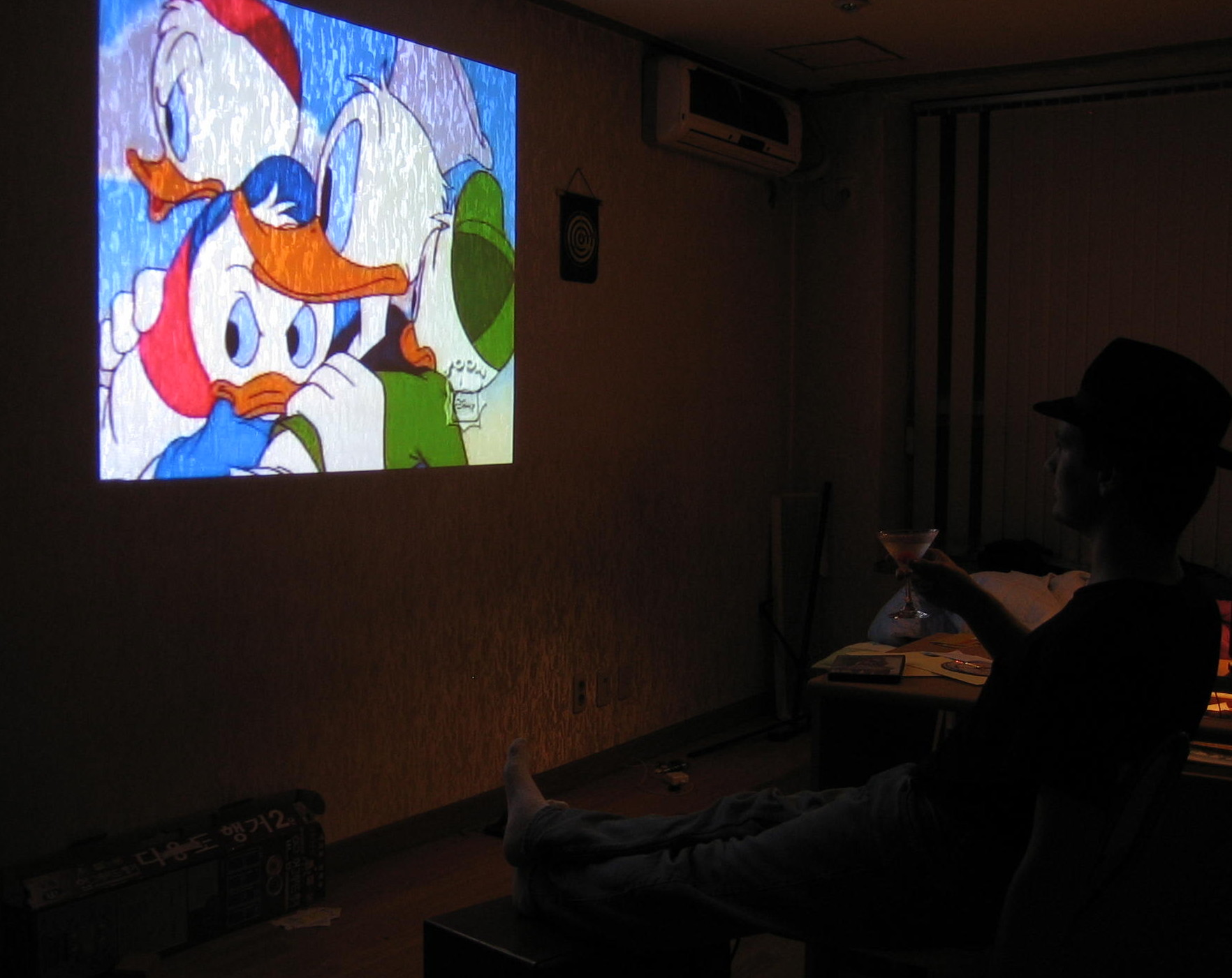
Doesn't everyone watch Duck Tales on their wall while drinking martinis in a fedora?

Doesn’t everyone watch Duck Tales on their wall while drinking martinis in a fedora?

Anyway, if your kilts are cursed enough that you missed out on being under ten years old from 1987 to 1990, go out and find the show.  Find some kids to show it to, or just watch it by yourself.  If your birth year does fall in the eighties, maybe you won’t necessarily remember the TV show, but you probably remember the NES game.  Capcom, it appears, has remastered the game and released an expanded version for Steam, PS3, Xbox 360, and the WiiU! Quackeroonies!

Except I promised I’d play through my giant stack of games before I bought any more, so I’ll write about the 8-bit version instead.

While that probably sounded a bit disappointing, the original Duck Tales game blessed a few bagpipes of its own when first released in 1989.  Congress hadn’t yet passed the law requiring the quality of games adapted from movies or TV to be equal to or less than that produced by unpaid interns who stay up until four in the morning because they can’t go home until they finished their other work.  A lot of the game’s features not only stayed true to the tone and design of the cartoon, it also put the player in adventure situations like Scrooge might actually encounter. (You may laugh at the fact that I bring that up, but have you ever tried playing the NES Back to the Future adaptation?)

Yep...even the duck is a better golfer than me.

Yep…even the duck is a better golfer than me.

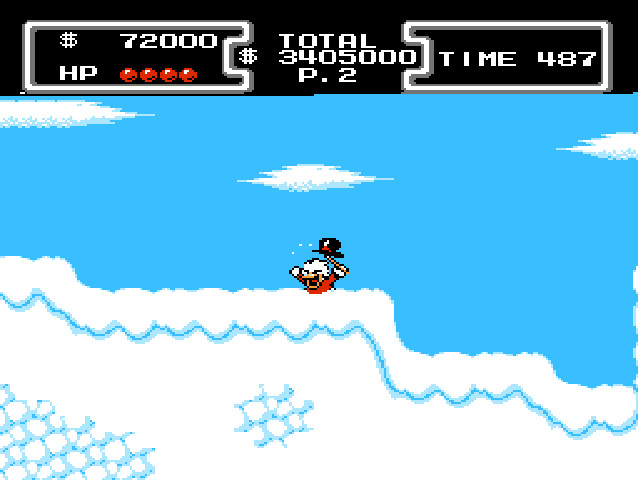
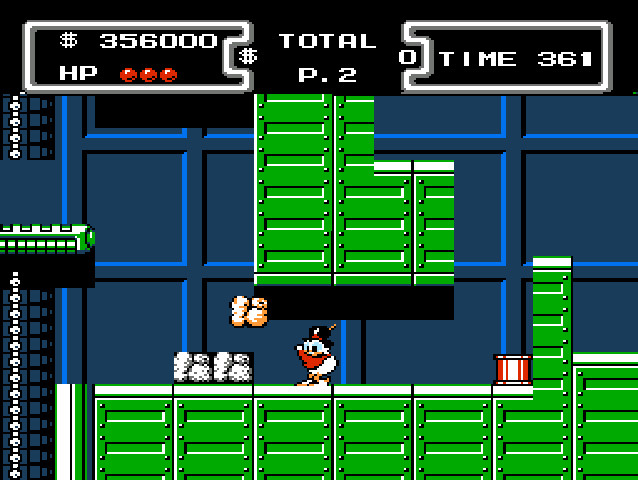
Scrooge McDuck, in a startling development of character that would make even the most hardcore fans shrug with astonishing indifference, wants to increase his fortune.  Rather than merge with other corporations, invest in stocks and savings, or buying up other businesses, firing all the employees, then liquidating all their assets right into his Money Bin, he feels that world travel would best suit his needs, as apparently we could find diamonds sprinkled everywhere from here to the moon if we just look hard enough.  In true Mega Man fashion, the player selects non-linearly from five stages, each which contain a treasure guarded by a boss and numerous diamonds found hiding in the stage or dropped by enemies.  Scrooge uses his cane–which doubles as a pogo stick and triples as a golf club–as his only defense.

This set up, I think, makes the game more about exploration than plowing through to the end.  Stages branch off, and each path contains diamonds, health upgrades, hidden treasures, key items, or extra lives.  Many items remain invisible until Scrooge crosses certain points in the area to reveal them.  So not only can we choose the order of levels, but we also can decide how long we want to spend in any one place.  And while the treasure value only serves as a score, which no one cared about after it ceased to mean “free game” or recognition by other upstanding arcade patrons, putting a dollar sign in front of it somehow makes it feel like a more worthy goal.

Hey guys....what'cha doing in there?

Hey guys….what’cha doing in there?

Other characters from the series appear to help you by offering advice, breaking through walls, or throwing baked goods at Scrooge, who gobbles them down like a diabetic with low blood-sugar.  Although the game keeps text to a minimum, they did try to retain certain speak mannerisms for most of the characters (although I don’t know if I can forgive Bubba’s lapse in not referring to the main character as ”Scooge”).

Despite being a platformer, I actually have a good time when playing this game. Something about bouncing around on a pogo-stick cane just mesmerizes me, and I can remember zoning out in third grade, imagining Scrooge hopping around the lines on the classroom walls.  My third grade teacher didn’t care for me much.  Of course, when I started subconsciously picking up economic theory in kindergarten, I set myself down a path where most of my teachers would accuse me of having an attitude problem. (Until I got to grad school. They liked me. I guess it evens out).

Moral of the story? Video games make you smarter. (No, really) So go play Duck Tales.

Metroid: Zero Mission – Game Boy Advance

Like the 80s never went away.

Like the 80s never went away.

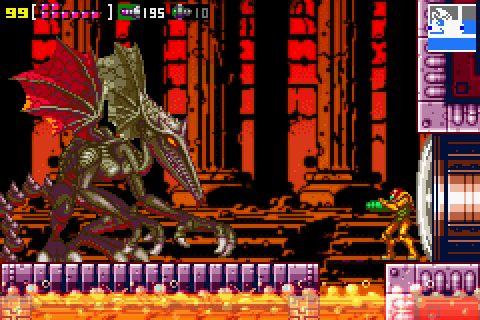
As I’ve written before, I like Samus Aran.  She managed to break through gender assumptions after a programmer casually mentioned, “Hey, what if the person in the suit was a chick?” and everyone at Nintendo just went with it.  Unfortunately, every subsequent game turns her into some sort of space-floozy who rewards you with a striptease based on how fast you finish, and the animation in Metroid: Zero Mission makes her vaguely reminiscent of a Barbie doll, but hey, it takes a real woman of the 1980s to pull off shoulder pads the way she does.

The fact that the original game came out in 1986 does actually reflect on Samus as a character during Zero Mission.  She explains the game’s premise in the opening sequence: “Now I shall finally tell the tale of my first battle [on planet Zebes]…my so-called Zero Mission.”  Great! We’d love a remake of the original! Except that the 2004 “enhanced” remake actually plays like someone’s mom trying to tell a story about what happened nearly 20 years ago, and not getting it quite right.

I once caught a lizard THIIIIIIS big!

I once caught a lizard THIIIIIIS big!

“No mom, you didn’t get the speed booster until Super Metroid…sorry, I don’t remember you being stalked by a giant centipede….I swear Kraid gets bigger every time you tell the story.”  Furthermore, the bonus level tacked on to the end of the game, during which she loses her power suit, sounds like an aging beauty queen trying to remind the young folk how hot she used to be.

This guy would appear occasionally, take a few missiles to the eye, then leave. Never explained. Never beat him. I named him "Wikipede"

This guy would appear occasionally, take a few missiles to the eye, then leave. Never explained. Never beat him. I named him “Wikipede”

See, we played the 1986 game.  We know what happened.  Samus can’t fool us by adding exciting stuff to the story.  Calling Zero Mission a remake of the original is like calling a BLT sandwich a remake of a pig.

That brings up the questions as to how far developers need to go when doing a remake.  Honestly, the 1986 Metroid only really had two flaws with it: lack of an in-game map and the need to camp out in front of pipes for hours until enough monsters popped out to refill your energy tanks.  Except for these things slowing the game considerably, I wouldn’t change a thing about it.  According to Wikipedia, Nintendo “enhanced” the re-make to play more like Super Metroid.  Pardon me, but if we want a game to feel more Metroid-ey, shouldn’t we remake the later games to feel more like the original?

Still, Zero Mission improved upon the original gameplay in a number of ways.  For starters, they give you a map, and they designed each area to look distinct from the rest.  I always felt like navigating the 1986 planet Zebes had a difficulty curve akin to looking for a bathroom in the metro when all the signs are written in Chinese.  Furthermore, the extra items available do allow for more abilities, giving more control to the player, and video games mean very little without control.

How did this...

How did this…

...turn into this?


It would almost help to think of Zero Mission as a reboot rather than a remake.  The game does resemble Super Metroid and Metroid Fusion, and while I did get occasionally get stuck expecting the same sequence of events as the 1986 game, it actually does a pretty good job of forcing and guiding the player in the right direction.  I also enjoyed the addition of the quasi-animated cut scenes.

I didn’t as much care for the bonus level, however.  After defeating Mother Brain, Samus escapes the obligatory time bomb (shout out to Mother Brain, the original number one Load-Bearing Boss) only to be shot down.  She crashes on Zebes, which somehow robs her of the large metal suit strapped to her body, and all the gizmos and gadgets that went with it.  She’s left with her skin-tight blue body suit and a pistol that will stun most enemies if you let it charge up between shots.  She somehow reasons that she should embark upon a forced stealth mission through the space pirates’ mothership to regain her suit and steal an enemy ship.

While forced stealth may have actually worked in Batman: Arkham Asylum, it detracts from the point of Metroid.  Batman lives for stealth.  Arkham Asylum gives the player neat ninja-like options for sneaking around and mixes it with a healthy amount of beating the shit out of bad guys.  Metroid, however, relies on action and tool using.  When you strip that away from Samus, all you have left is a metaphorical form-fitting blue body suit which leaves nothing in the gameplay to the imagination.  Sneak sneak sneak.  Don’t fight the badguys.  Did they see you?  Well, you can run away or die.  I know game makers feel obliged to deliver more hours of gameplay than they used to, but sometimes the padding just reaches the point of absurdity.  The map of the mothership, if you compare it to the map for the rest of the game, has about as much tunneling as half of the entire planet Zebes.  Since you get your suit back halfway through it, that means that you have to crawl, sneak, dodge, and flee your way through an area about one quarter the size of the rest of the game.

Then when you get the suit, it powers up to let you use the space jump, plasma beam, and you get power bombs shortly afterwards, and the rest of the level (again, about 1/4 of the size of the main planet) consists of powering through enemies who crumble like flies under your god-like might.  The game becomes too easy, and it stays too easy for too long.

I’d probably have no doubts about the game, but this final level throws me off.  I could easily suggest Zero Mission.  If you play with the mind frame that the game uses similar areas and items as the 1986 Metroid, but expands greatly on the world, then it becomes like Super Metroid; entirely new, but charmingly familiar.  However, the bonus level introduced boredom and tedium as a prerequisite for actually finishing the game.  While I may not condemn the game merely for that, I would like to end my post today with a letter to the Powers That Be:Dear Game Makers,
Forced stealth sucks.  No one likes it.  Stop using it.
Sincerely, Everyone

Shining Force – Sega Genesis, Game Boy Advance

When you wish upon a copyright infringement lawsuit...

When you wish upon a copyright infringement lawsuit…

Let’s have a quick word about how to increase endgame difficulty.  You want the game to feel more challenging near the end.  That way it works toward a climax, following a natural plot arc.  Some games do this better than others.  For instance, some bosses fight with status attacks.  Others will introduce bosses as random enemy encounters.  Valkyrie Profile II demanded I use the level 64 character they introduce for the final battle when even the easy enemies can vaporize all my level 90 characters like a meteor entering the earth’s atmosphere. Still, most games will bump up the level or stats of endgame enemies to give them a slight edge over the player.

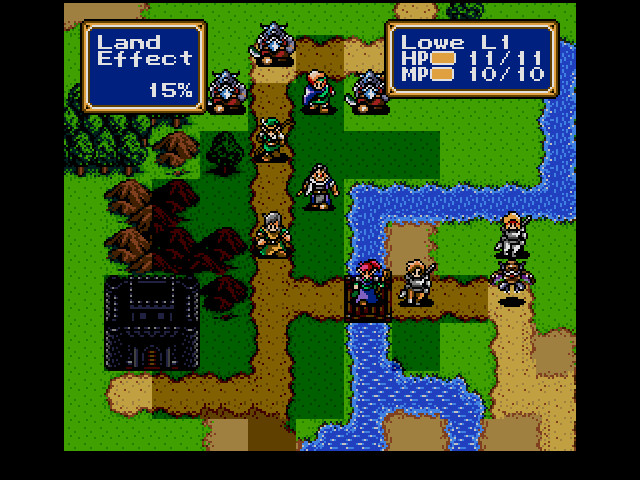
However, raising the enemies’ evade rates doesn’t accomplish this as much as the Shining Force developers seemed to think it did.  Watching characters swipe the air like an epileptic in a dance club feels less exciting than, say, going outside and slashing bushes with foam pool noodles or watering your lawn with a water pistol.  This contributes to slowing the pace of a tactics game in which most battles start with bottlenecking your characters or putting them so far from the enemies that, if they worked together, they could measure the speed of light.

...have we met?

…have we met?

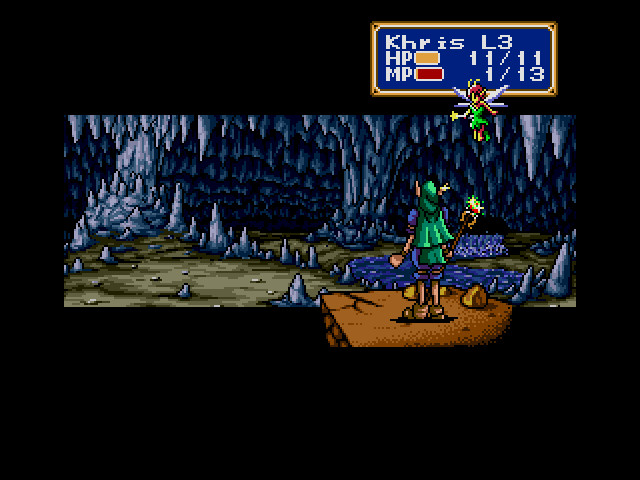
Not that they would do that, mind you, because like many mill-ground fantasy stories, Shining Force weighs itself down with themes like “Light is good” and “Dark is bad.”  The game opens with the formulaic war-between-two-countries-with-a-supernatural-threat-looming-vaguely-on-the-horizon.  The rival military general shows up looking like he dumped a life-size Wooly Willy set over his head and kills the king.  On his deathbed, the King gives you the order to form the Shining Force and defeat the darkness.  Light good.  Dark bad.  The enemy leader calls himself Darksol and he plans to resurrect the ancient Dark Dragon (who is neither dark, nor a dragon).

Would I be asking too much for a well-written fantasy story that doesn’t draw morally unconflicted characters in a black-and-white scenario?  I thought about rewriting that last sentence to get around using the phrase “black-and-white.”  Why do we have to associate black and white with evil and good?  I don’t know about anyone else, but I find a bit of darkness rather pleasant when I’m trying to sleep, or sneak up on a ninja or get dressed in a room full of people.  A little more subtle conflict might make a more interesting story.  In fact, for most of the game I turned off the music (which didn’t prevent it from echoing in my head like The Master’s drums) and listened to a Jim Butcher audiobook in order to get a good fantasy story. The bulk of the plot just involves moving from one excuse to start a battle to the next.  In fact, at one point, after fighting a hoard of monsters outside of a town, the man at the gate casually remarks, “Sorry about that.  We thought you were someone else,” at which point I just tip my hat, wish him good morning, and waltz on by as though I’m not headed to a priest to resurrect my comrades murdered as a casualty of mistaken identity.

Shining Force-000001While it seems like they wrote the story in as much time as it took to look up a formula and transcribe it into the game, Shining Force does have strong points.  The game centers on battles–and when I say “centers,” it also rights, lefts, ups and downs on it too.  Don’t expect side quests or even random enemy encounters–all battles are programmed and static–but the strategy aspect makes up for the minimalist approach to this RPG.  I enjoyed FF Tactics more than many of Final Fantasy’s main-series installments, and Shining Force feels like a somewhat simplified version of Tactics.  Battles take place on a grid map, characters have different classes that affect their stats and the range of attacks, and while they can’t switch between them like FFT’s job system allowed, they can receive a “promotion” to a slightly better class once they reach level 10.

I can also praise the game for allowing the player to keep any exp they earned in battles they lost.  I can’t tell you how many times I’ve taken an unexpected turn for the worst, then realized “I haven’t saved in an hour!”  Those moments make me acutely aware that time only moves in one direction, and that I’ve wasted hours careening toward death in front of the TV with nothing to show for it.  Shining Force, however, lets you stay at your new level, making the next round a little easier.  Although they probably included this to let players level-up in a game with no random encounters, I’d appreciate seeing this feature more often in RPGs.

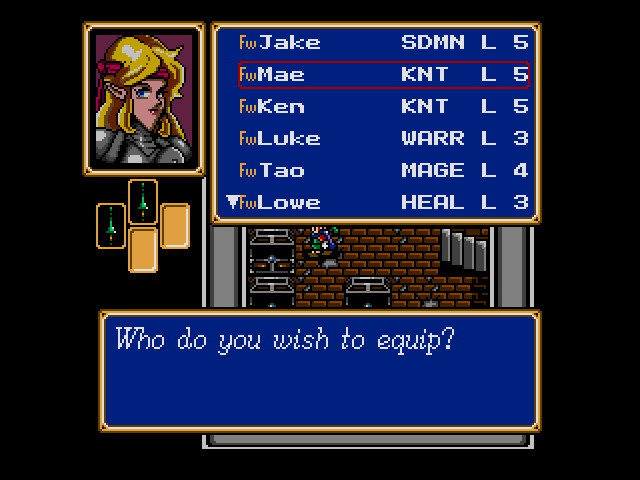
New menu box . . . every time. . . can't stand it...but at least inventory management isn't as bad as in Skyrim.

New menu box . . . every time. . . can’t stand it…but at least inventory management isn’t as bad as in Skyrim.

While I appreciate the fast pace after playing some interminably slow Zelda games, I do have a complaint about the menu system, in which the player flips through single options box-by-box, resurrecting characters one at a time, transferring single items from character to character, purchasing and equipping items one-by-one, and needing to open a new menu and flip through all the options each time.  With Final Fantasy V already on the shelves for a full year, you’d think some of the programmers would figure out, “Wow! RPG menus don’t have to be complete shit!”

Like Final Fantasy Tactics, characters level up upon completing actions in battle, which again I mostly support.  However it leads to a common problem of healers never leveling up because they don’t act as much as any of the other characters.  Another option to gain experience might help.  At least in FF Tactics I could bounce rocks off my comrades’ heads until I had enough MP and JP to learn support spells.  Shining Force doesn’t give even that much.  I went into the final battle without effective cure spells because my healer was less than half the level of some of my other characters.

But don’t let the flaws get in the way of enjoying the game.  I made it through in about a week and a half, never feeling like the pacing dropped much, and only encountering minor frustration at whiffle battling enemies with high evade rates.  I finished the game feeling I enjoyed it very much, and look forward to the sequel.  Which I won’t play right away. Maybe some shorter games first.

Until this point in the game, they called him "Kane"

Until this point in the game, they called him “Kane”

A few notes before I leave, Shining Force has also been published for the Game Boy Advance, although it has a new subtitle, “Rise of the Dark Dragon.”  While I didn’t play that version, word on the net says they improved the translation massively and may have resolved some of the plot vacancies I mentioned earlier.

Journey – PS3

journey Slide

Does Journey fit nicely into the theme of retro games? No.  Probably, years from now when casual gamers have forgotten that any platform ever existed other than the PS5 and the XBox Pi, we can all come back to it and marvel at how an old-school game surprisingly still entertains us, but for the moment, it remains at the forefront of advances in technological, narrative, and musical progress.  Did Anne decide to play through it this morning while I needed something to write about during the time it takes me to finish Shining Force?  Welcome to my blog!  Look forward to a Sega Genesis review within the next week!

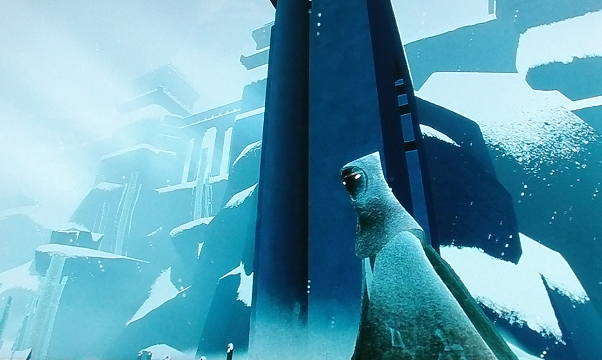
While I have more praise for Journey than most games, the initial description of what it is sounds about as appealing as clipping expired coupons from the supermarket to add to your grandma’s “collection.”  Developers and copywriters slap together promotional tidbits like “storytelling without words” or “a cerebral, haunting experience” or other such nonsense. Lead developer, Jenova Chen, claims he wanted to escape the modern idea of video games as being “shoot, kill, win,” so he built Journey around metaphorical themes of life and death.  The main character, a little jawa/bird creature, appears to the player in a desert.  He/she (shklee?) spies a tall mountain in the distance with a glowing pillar of light.  The rest of the game is simply the journey to that mountain.

Ignore that description.  I’ve seen sacks of flour with more pizazz than that.  The game does push envelopes, yes.  It doesn’t keep score, pit you against enemies, punish poor gameplay with “game overs,” but it does retain a lot of the aspects of video games that make it enjoyable to play.  It stresses exploration, with the main character able to find hidden glyphs that increase the length of its scarf, which gives the player the capability to fly short distances depending on that length.  In addition, some stages have monsters that can shorten the scarf; however, since it only cuts it in half, the player can never entirely lose it, and the normal course of the game doesn’t require flight anyway.

Yeah, yeah...everyone uses this image. It's the best from the game, but the rest are worth seeing, too.

Yeah, yeah…everyone uses this image. It’s the best from the game, but the rest are worth seeing, too.

I’ve often ridiculed the concept of high definition, since most people have low-definition eyes.  Yet I have to drop all pretenses for this game; the high definition world it creates adds every detail imaginable to the exploration.  Furthermore, the fully orchestrated score interacts with the player, changing seamlessly to match the emotion of the main character and its actions at any given moment.  Lost for witty comments to make here, I find myself slack-jawed and dumbfounded at the sheer brilliance of the composer (Austin Wintory) and programmers.

All though I will argue the storytelling value of plenty of video games dating back to the SNES-era RPGs, Journey may be the key to introducing the “electronic narrative” into the literary canon.  While the storytelling-without-words aspect takes itself much more seriously than Buster Keaton or Charlie Chaplin, the game does it using the full advantage of the technology, something that no movie or book could do; it uses social gaming.  And it uses it well, which surprises me.  The game connects to the internet and matches up two players who happen to be playing through any given point at the same time.

This accomplishes several things worth mentioning.  First, it reduces the urge to look up a walkthrough.  More experienced players–as denoted by the level of design on their cloaks–tend to show less experienced players where to find glyphs, several of which the player can’t actually reach on their own.  Furthermore, players discover in colder levels the value of huddling together for warmth.  All the while, the only “verbal” communication available is a small chiming sound made by the O button.  Without giving away too much, this feature of the game actually expands the story, again making me react with deer-in-the-headlights amazement.

Jackass...leaving me to freeze whie he bangs his head on a fricken wall...jackass

Jackass…leaving me to freeze whie he bangs his head on a fricken wall…jackass

Still, the best feature of the game also doubles as its most frustrating, as you’ll often get paired with players who somehow manage to express their amount of sheer idiocy with only actions and a small chime.  Having gone through the game a few times, I consider myself more of a mentor-player, and on one playthrough I attempted to show a newer player some of the secrets that others had shown me.  At one point, this guy started chiming like crazy, presumably to get my attention, then started walking over and over into a rock wall.  Figuring I should derive some meaning from it, I too walked into the rock wall.  Nothing happened.  I chimed a few times to get his attention, then got frustrated and left him still bashing his head repeatedly on the rocks, and I finished the colder sections of the game on my own.

The game often induces a calm feeling when I play it, but much like family, the stress level and frustration entirely depends on the random people you get stuck with, except you don’t have to worry about awkward Thanksgivings with them. It also affects your actions as a player.  A considerate mentor figure on your first few plays could turn you into a kind, caring, father figure to another newbie down the road, just like encountering morons and jackasses could set you down a bad path where you cooperate with no one, keep all the glyphs to yourself, and end up smoking, getting tattoos, and riding your Harley up and down the mountainside at all hours of the day and night.

I do plan on saying more about Journey (hopefully more entertaining, but good games are actually much harder to write about than bad ones), but as I mentioned before, this could make video games more literary, so I’ve put it on my Intro to Literature syllabus this fall–that’s right, come to the University of Minnesota Duluth and we’ll teach you video games! Until then, the game doesn’t cost much, and you have your choice of downloading it or buying the three-pack with Flower and…uh…that other game.  Although the impact wears off with subsequent playthroughs, Journey should leave the player with an emotionally soothing feeling upon finally reaching the mountain.

Phoenix Wright: Ace Attorney – NDS

Objection

Phoenix Wright does for the legal profession what the Trauma Center games do for medicine, which happens to be pretty much the same thing McDonald’s does for fish; sliced it open and yanked out its guts until nothing remained except the few tasty remnants that everyone likes, then padded it out with a nice slice of cheese and a bun to make it appetizing. While my initial reaction may sound like I don’t like the game, keep in mind that Court TV and the Surgery channel really don’t rank as high in the ratings as such masterpieces as “The Bachelor” and “Jersey Shore.” I’d like to make a joke here about viewers’ preferences, but reading through the Wikipedia page on Jersey Shore doesn’t really give me any information on what the show actually is.  So as it stands, most people would rather watch 42 minutes of nothing than to learn anything–anything at all–about medicine or the legal process.

However!

…we’ve got endless hours of Scrubs, E.R. Chicago Hope, M*A*S*H, Doogie Howser, Grey’s Anatomy,  House, Ally McBeal, Night Court, the People’s Court, Judge Judy, Judge Joe Brown, JAG, Perry Mason, Law & Order, Law & Order: Criminal Intent, Law & Order: LA, Law & Order: Special Victims Unit, and Law & Order: Trial by Jury.  Just to name a few.

So while the Anime Kabuki Courtroom Melodrama that is Phoenix Wright may not prep us very well for the LSAT, we can sit back and enjoy it simply for being an Anime Kabuki Courtroom Melodrama.

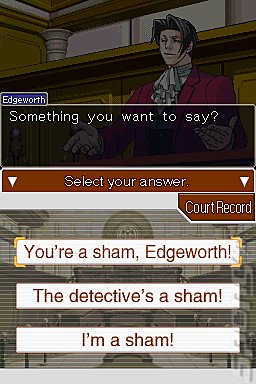
largePhoenix Wright: Ace Attorney tells the story of a 24-year-old who clearly has not aced his profession and only barely qualifies as an attorney.  While the life of the NDS hasn’t entirely ended yet, this game holds a special distinction of “retro,” as gameplay derives from the standard point-and-click adventures of ages long past.  Playing as Phoenix, you explore crime scenes to collect data and evidence to help build a case in defense of your clients.  You can talk with witnesses and other key figures, present them with evidence you’ve found to initiate reactions which lead to more information, and use the DS touch screen to zero in on specific details of a scene you’d like to examine.  At regular intervals in the investigation, you enter the courtroom, where you listen to witness testimony and try to point out all their flaws either by presenting them with your evidence or by shouting out any obnoxious thought that pops into the game writers’ heads concerning key statements in their testimony.

While the game springs from the genre of murder-mystery, it also puts a new twist on the subject.  Most of the time, the player knows who dunnit from the beginning of the case, and in all five cases, you figure out the identity of the murderer well before the end of each episode.  The real genius of Phoenix Wright is not in guessing who the criminal is, but requiring the player to provide proof that pins them to the crime.  This eliminates the possibility for intuition, “cop instincts,” personal bias, “just knowing,” and all the other special-kind-of-stupid arguments that my students use every time I assign a researched persuasive essay.  A goal that aims for evidence instead of the verdict? Can I require video games on my syllabus?

Still, no one has yet developed a video game that can communicate with its players fluidly, and when it demands logic and deduction skills, this can get rather frustrating.  You can’t gather evidence, then waltz into court and say “I’d like to suggest that the witness is trying to frame the defendant based on the grudge he bears from this old case file and the fact that not two, but three shots have been fired from this gun.”  Nope. You have to wait until just the right moment, when the judge demands you present a certain piece of evidence, or you have something that contradicts a witnesses’ statement.  And even that defies intuition at times:

_-Phoenix-Wright-Ace-Attorney-DS-_“Can you prove the defendant was not present on the crime scene at the time of the murder?”

“Well let’s see, I have a photo of the crime scene that he isn’t in, a photo of him halfway across town in a movie theatre, his movie ticket time stamped for the exact time of the murder, his car which is still broken down in front of the movie theatre, and I’m just now receiving a phone call from the defendant stating he’s been trapped in his car since the murder and would sincerely like for one of us to let him out before he starves to death.”

“I don’t see what you’re getting at, Mr. Wright.”

“Umm…well…here’s the janitor’s mop, which he said he cleaned the floor with when he found the body, but there are no traces of dirt on it. If the defendant had been present, he would have left traces of soil from the lawn behind with every foot step!”

“Brilliant, Mr. Wright!”

Murder mystery retains popularity from the satisfaction people get when the figure out the mystery.  People like to feel smart, but sometimes picking through evidence can feel like trial and error.  And you can’t really influence the story any other way, not being able to communicate with the game takes you out of the story.  I felt even worse when I figured it out, then presented my evidence, and they explained an entirely different course of events than those I suspected.  During the final case, the sheer amount of evidence and difficulty of the logic forced me to look up a walkthrough a few times, and at one point after looking up what I needed to present and hearing the explanation given in the story, I still didn’t understand how point A led to point B.

Compounding the frustration, Phoenix Wright: Ace Attorney relies on text more than most games.  While I’ll admit that every word did serve a purpose and they probably couldn’t have trimmed the story much more than they did, it does make the game, especially the later, more difficult trials, drag on much longer than I really enjoyed.  At the very least, they could have offered us the option to skip through text we’d already read, or maybe just changed the system to display all the text in each box at one time, rather than spelling it out for us letter-by-letter as though some tiny stenographer living in the cartridge were transcribing the dialog for us in real time on a sticky typewriter.

Also obnoxious: the game’s insistence on display any emotion other than bland disinterest by having the screen flash white and shaking the character sprites. By the end of major revelations an a-ha! moments, I felt like I needed aspirin and a break from the game to prevent myself from having a seizure.

As mentioned, the localization team seemed to drop all pretenses of courtroom verisimilitude, dropping ideas like “innocent until proven guilty beyond reasonable doubt,” confusing the fifth amendment right not to self-incriminate as a special right held by the police chief to refuse to give any sort of testimony, requiring the real murderer to be unmasked before a “Not Guilty Verdict” can be declared, and my personal favorite, implying that murder by accident or self-defense still qualified for prison sentences, which implies the characters follow the Divine Command Theory of morality, which the western world abandoned a thousand years ago (Look it up…it’s used in Beowulf) in favor of judging people by their intentions instead of just their actions.  But really, accurate courtroom procedure would prove even more tedious than reading through a novel of flashing text letter-by-letter.  Phoenix Wright keeps us entertained by forcing it’s players to think through the evidence to solve murders while amusing themselves by the dramatic kabuki poses made by the characters as they battle wits.  I’d like to look into the sequels, just maybe not right away.

(Notes: Also available for GBA in Japan and WiiWare in U.S.)

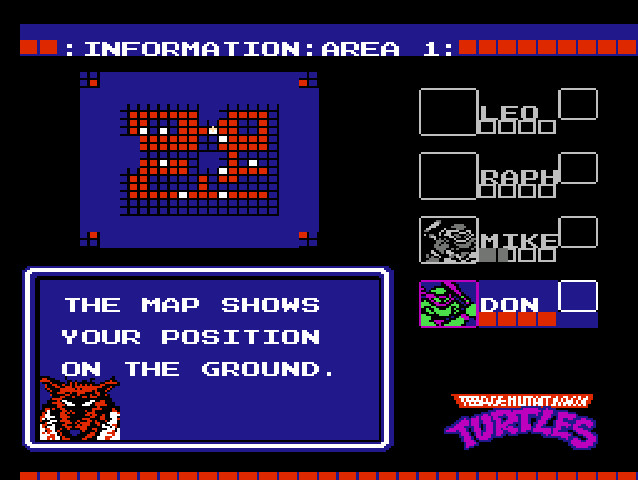
Teenage Mutant Ninja Turtles (1989) – NES

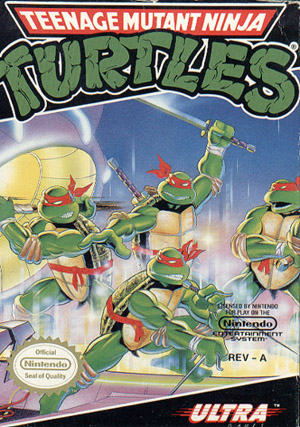
Did it bother anyone else that they were ALL Raphael?

Did it bother anyone else that they were ALL Raphael?

The Teenage Mutant Ninja Turtles rose to fame in the late 80s, attaining the height of their popularity in the early 90s.  Together with the Mighty Morphin’ Power Rangers, adjectives thrived during this time. The kids–myself included–just couldn’t get enough color-themed monster-fighting super-heroes, yet the forces of consumerism, which conquered both good and evil, happily tried to give us just that.  In 1989, a new cabinet started appearing in arcades.  Just another beat-em-up game at heart, to find the true beauty of Teenage Mutant Ninja turtles, you only had to dive skin-deep. (Hey, kids are allowed to be shallow!)

The popularity of the Turtles arcade game sent many people into stores to pick up the NES Ninja Turtle game released the very same year. Many rushed home after hounding their parents for this game, ripped open the box, shoved the cartridge into their NES, bent their connector pins ever so minutely toward total system shutdown and hit the start button…

…only to be miserably disappointed by the game they found.

While the internet raves about the 1989 NES game’s good reception and commercial success, I can’t help but wonder if it would have the same reputation if people hadn’t thought they could own a copy of the arcade game.  Everyone I remember who enjoyed TMNT video games had fonder memories of the beat-em-up than the NES game.  But memory doesn’t record like a camera, I know, and as my mother proves every time she tells people how I’d wet my pants playing video games because I refused to pause for bathroom breaks, sometimes people can completely fabricate memories.  Now if I only had evidence of this disappointment…say, a port of the arcade game to home systems immediately after the first game’s release…or even future games returning to the beat-em-up genre…

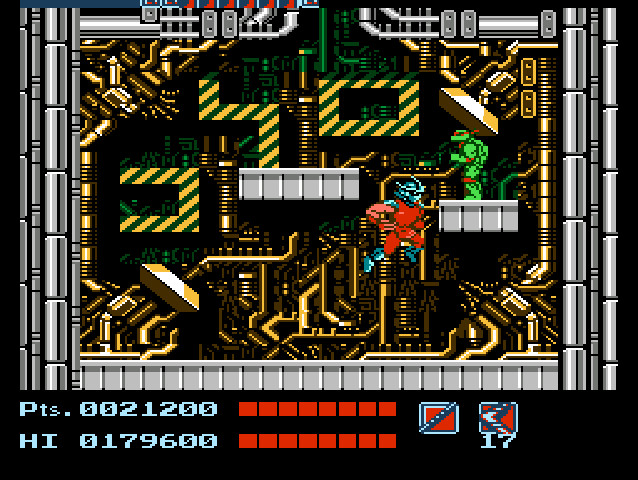
I have to respect a villain who does his own fighting...but Shredder was kind of a pushover after the rest of the game.

I have to respect a villain who does his own fighting…but Shredder was kind of a pushover after the rest of the game.

Still, I’d like to get at–in a roundabout way–the fact that the 1989 NES version of the Teenage Mutant Ninja Turtles actually surpasses the arcade game in a few ways…several ways…most…eh…well, let me ask you this; have you ever seen the 1978 animated “Lord of the Rings,” then compared it to Peter Jackson’s films? For the arcade release, Konami simply slapped a green, amphibious skin on the same game that’s been released over and over for what by now has got to be close to 25 years.  But the NES release blended side-scrolling action with a top-down sort of explorable map, while include an underwater swimming stage and a character select screen that let you switch between any turtle at any time.

Splinter looks really creepy in 8-bits

Splinter looks really creepy in 8-bits

I recently dug out the 1990 live-action film, which made me wonder…well, two things actually.  One, who sat down and thought “You know who’d make a good Donatello? Corey Feldman!” What, did Woody Allen and George Burns turn down the role?  And two, why does Hollywood feel the need to burn away everything popular with a series and then misinterpret the premise?  That’s like saying, “You know what people love? Strippers! So let’s record two hours of grandpa Fred prepping for and receiving his colonoscopy and call it the same thing! He is naked, after all!” People enjoy playing the Ninja Turtles game because they didn’t do that.  They released a game because people watched the TV show, and when they bought the game it resembled the show.  You fight Bebop and Rocksteady in the first level, save April, get a message from Shredder saying that he kidnapped Splinter, and then you chase him in the turtle van, then the blimp, and assault the Technodrome.

Stupid Mario never thought of this, did he?

Stupid Mario never thought of this, did he?

You get to do a lot of ninja-ey stuff like spin flips, grapple from building to building, and throw shurikens.  Furthermore, the game employed animated cut scenes between levels, which have now become a standard tool in creating down time while maintaining interest in the game.  When I looked up the release date, it shocked me how long ago they made this game, since it seemed well-developed even for a NES era game.

As opposed to the other guy who wears cheese graters on his shoulders?

As opposed to the other guy who wears cheese graters on his shoulders?

TMNT takes a few cues from Castlevania, including the detailed backgrounds, the secondary weapons, the enemy life display, and the brutal, unmerciful, harsh unforgivingness of the difficulty.  Whereas Simon Belmont leapt through the ledges of Dracula’s castle with the agility and control of a horse-drawn golf cart, the turtles all feel remarkably easy to control.  However, at times, dozens of enemies could criss-cross their way across the screen, and navigating safely around them reminded me of searching for a place to stand on the train during rush hour in Seoul (you’ve seen the videos of attendants pushing crowds of people into the metro? I’ve been in that crowd).  I discovered that not all turtles are equal.  Donatello’s staff has reach, but rather than handicap him in strength, he deals twice as much damage as any of the other characters.  Meanwhile, Raphael and his sai provided a useful target any time I couldn’t avoid taking damage, since his attack pretty much required me to get close enough to the enemy to pull his beard and tell him what I wanted for Christmas.

Theoretically, you could finish Castlevania with nothing but patience.  You may have to replay certain parts, but you had unlimited continues and only had to restart the level each time.  TMNT isn’t quite as generous.  It offers you two continues, and since each level involves a map full of explorable stages, getting knocked back to the start feels like more of a blow.  I wanted to write about the game though, but needed to get through to the end, so I ended up using save states.  I’d say though that it feels more manageable than Castlevania–except for two rooms of instant-death spikes and one long hall full of powerful enemies just before Shredder, it feels like a little practice would help reach more of the game just on the regular lives and continues.

This room! ....ARRGHH!

This room! ….ARRGHH!

Except for the afforementioned rooms of spikes, platforming elements remain mostly absent, so the player can concentrate on his ninjutsu.  Falling into holes or water won’t kill you, but it will wipe you back to the beginning of the stage (one tricky jump kept me from finishing level 3 for YEARS).

Despite unrelenting difficulty cutting off access to the later levels without hours of practice, TMNT does a lot of the right things to tempt the player into coming back for more.  Although it had the misfortune of not being the arcade game, it’s worth attention, as it provides countless replayable hours of Corey-free entertainment.

(Coming up soon, Phoenix Wright: Ace Attorney.  Most of the games I’ve written about so far have been those I’ve played in the past.  Soon I’d like to move onto those that are completely new to me.  I’m thinking of going through either a Sega or SNES RPG next.  Any thoughts?)

Twilight Princess – Game Cube, Wii

Me and My Scary, Impish Shadow

I’ve already established here that I enjoy longer games, so most of the time I don’t bat an eye at a game being 37 hours long; after all, I played through Fallout, Skyrim, FFXII, Xenogears and Xenosaga.  However, games that pad themselves out to fill a mandatory game-length limit have a tendency to turn my eye-batting into baseball-batting.  I tried to like Twilight Princess, I really did.  I thought I may have scathed it a little too much in my Oracle of Ages/Seasons article, so I flushed away five years of good sense and went back to it.

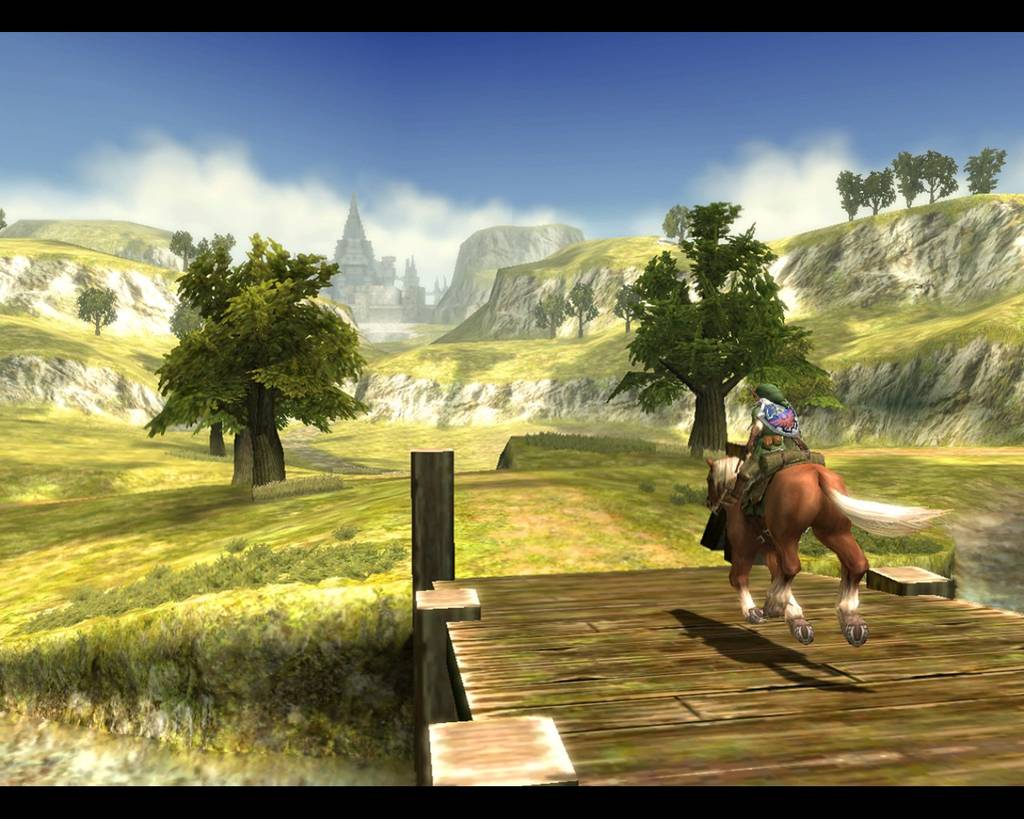
You know what I’ve never thought when playing a Zelda game?  “This sure is great, but it would be much better if the world were bigger and had less stuff in it.  Some endless tedium would give me a nice chance to look at the scenery some more!”  I don’t quite understand what Nintendo felt would be so appealing about magnifying the size of Hyrule to an area roughly the size of the moon, then filling it with absolutely nothing.

But I could compare Twilight Princesses lack of tasty filling to the lack of dust mites on your pillow; you can find shit if you know where to find it, and you probably stick your head in it all the time, but you’ll never see it on your own.  Whereas previous games like to taunt the player, dangling heart pieces just out of reach of the player to watch us rear up on our hind legs, dance a little, then plummet hundreds of meters off a cliff because don’t have hover boots, Twilight Princess hides its items, making you stare at them like a magic eye painting, trying to make sense of the image everyone else claims they can see.  Quite honestly, unless you play the game with a walkthrough in your lap, you’ll struggle just to complete the main story.

And this is about it...for thirty six hours...that's over a day, you realize.

And this is about it…for thirty six hours…that’s over a day, you realize.

See, Twilight Princess doesn’t limit its convoluted searches to bonus items; seemingly everything requires a drawn-out examination of a large area until you find one hidden path that you can jump to in wolf form after you’ve received the item to move a statue and done so while singing Carmina Burana in the nude with octoroks pelting you in the head.  Puzzles don’t have clear solutions either.  For example, at the beginning of the game they run you through a tutorial to show you how to wrestle a charging goat.  Therefore, it would make perfect sense when trying to get past the goron sentry who likewise charges at you, you’d know the procedure.  Right? Wrong.  Turns out you have to intuitively figure out to backtrack to the forest village and talk to the mayor so you can learn the ways of sumo.  And just for good measure, he tells you that it’s impossible to stop a charging goron without iron boots.

Simple.

The entire game does this to you.  Nothing turns a fast-paced game into a slow-paced movie faster than trotting around in circles like an idiot or diving for a walkthrough every time you get stuck.  I like challenge, but not insurmountable challenge.  (I’ve long hated games that require walkthroughs–I see them as an insidious plot to require people to drop $100 instead of $50, buying the “strategy” guide along with the game.)  For the amount of frustration put into adventuring, the in-game rewards usually feel like let-downs, especially after your 35th hour of finding small-value rupees in every chest, with cash being about as useful as a backpack full of Chuck-E-Cheese game tokens.

And the tedium doesn’t end with the adventuring–the items in the game show a truly bewildering lack of inspiration.  Most are useless after the dungeon you receive them.  Early in the game, you go through a lengthy fetch-quest to obtain a slingshot, only to receive the bow in the second dungeon.  If Link had tossed the slingshot into the lava at that point, I wouldn’t have noticed it missing.  Previous instalments of the series asked you to find clever uses for dungeon items, or to use them to reach the aforementioned dangling goodies.  These items often have one use only–the ball and chain breaks ice. Just ice–and you rarely use them at all until the obligatory use-every-weapon segment in the final dungeon, when you suddenly have to remember, “Hey, didn’t I get a boomerang in this game?” and to figure out that you can use it to put out fires. Likewise, bosses feel simple and uninspired, and I even beat one without taking any damage as he just swam around in circles, kindly offering me his weak point to latch onto and stab until he died.

Unless you're the lead dog.

Unless you’re the lead dog.

Link and Shadow Link, ready to serve you with fava beans and a nice chianti

Link and Shadow Link, ready to serve you with fava beans and a nice chianti

The game simply drags on too long to keep my interest.  I finished in thirty-six hours.  Do you remember my Radiant Historia time?  Also thirty-six.  Game designers tweak games to provide a precise length of play time.  Adventure/RPGs currently run about 35 hours, while action games run between 8 to 10.  SNES-era RPGs often wrapped up in 24 hours.  (Or perhaps I just have a very consistent way of tackling similar games…I can’t be sure) This practice leads to padding, and Twilight Princess pads itself more than a menstruating hockey player pulling a hot pan out of the oven.  Dungeons typically require two hours to finish instead of one hour (as in Ocarina of Time and Wind Waker), and in between you occasionally have to rescue the Spirits of the Macguffins by dealing with their cockroach problem using your wolfish powers of Raid, and there will be no side-questing until you finish.

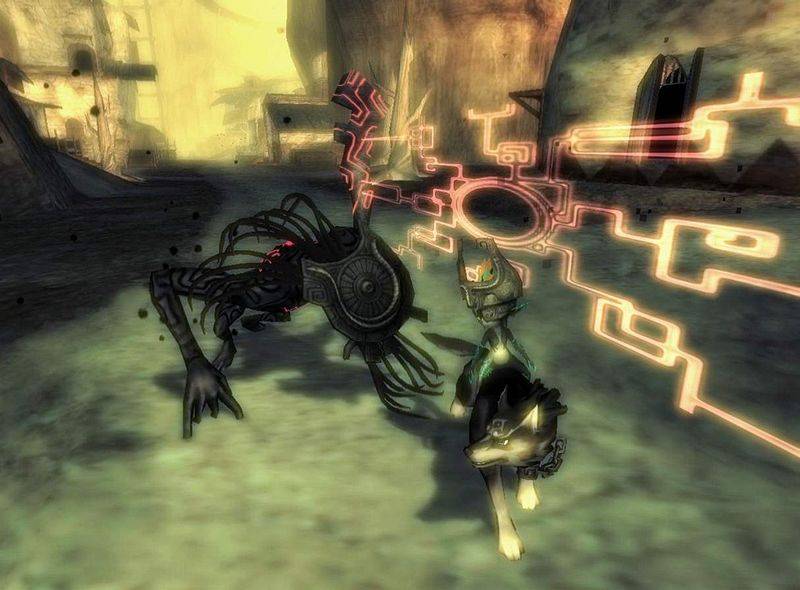
For all I disliked it, Twilight Princess did some things right.  The ability to transform into a werewolf that I previously descried as “gimmicky” actually adds an interesting element to the game, and plays off the familiar idea of Link traveling between parallel worlds.  Midna proves herself as a companion perhaps not quite as knowledgeable as Navi, but darkly intriguing and vital to the story.  But the game truly excels at setting tone.  The themes of twilight and shadow cast this game in a different light than others.  Atmosphere and mood usually stay consistent throughout the game. Nintendo even designed the light-hearted race of sentient chickens to look creepy as hell. If you have a flair for gothic overtones, I suggest playing through Twilight Princess at least once.

With Skyward Sword disappointing so far, I don’t think we have to wait long before even Gannon gets tired of coming back to Hyrule.  He’s used all his brief stints of freedom to conquer the kingdom, but he knows they never last long.  Pretty soon he’ll break free of his prison and find greener pastures, and then we won’t have to worry about hunting the eight legendary whatevers for a princess who doesn’t show the slightest interest in the hero.

It's not me, it's you...okay, it's you.

It’s not me, it’s you…okay, it’s you.

Sorry for the long delay in posting, but as I mentioned, I go for longer games.  The semester starts in three weeks, so at that point look forward to probably no more than one entry per week. Coming up soon, though, I’ll have Phoenix Wright: Ace Attorney, or possibly Teenage Mutant Ninja Turtles.

And if you’re fans of the classics, take comfort in knowing that for part of the boss battle, Gannon takes the form of a pig.

And hey, I made it through the entire post without a single Alpo joke!

Skyward Sword – Wii – Initial reactions

This isn't combat.  You realize he's just using "the all-powerful sword forged by the goddesses" to mow the lawn, right?

This isn’t combat. You realize he’s just using “the all-powerful sword forged by the goddesses” to mow the lawn, right?

Link deserves a lot of credit for what he does.  In Ocarina of time, he rolled out of bed to slog through spider-infested lumber after only a short search for a sword and shield.  In Link to the Past, he wakes up and immediately saves the princess in his pajamas. In the Wind Waker, not only does he get jostled from a sound sleep at the start of the game, but he does so without killing the obnoxious little sister who wakes him up; then he gets dressed, has a quick lesson with a sword, and starts his first monster safari, one can only imagine to use their hides for sheets and blankets for his next big fit of narcolepsy.

I guess Nintendo wanted to build the impression that Hyrule’s archetypal hero must be someone who can accomplish herculean tasks with little or no preparation.  I like this. It gives me a unique way to bond with Link.  Sometime in college I started to realize that normal people couldn’t do this, that it took them hours before they can muster enough brainpower to stumble to the toilet and figure out how to flush.  One of my roommates even once challenged his alarm clock to a snooze-marathon; he managed to sleep for two hours straight, five minutes at a time.

A wooden sword? Did you whittle this yourself while sitting out in front of your cave yelling at the hoodlum octoroks to stop tearing up your yard?

A wooden sword? Did you whittle this yourself while sitting out in front of your cave yelling at the hoodlum octoroks to stop tearing up your yard?

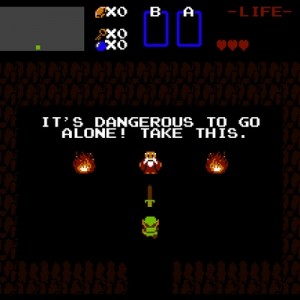
Of course, this holds bigger implications for the Zelda series.  Beyond the simple metaphor of beginning of a journey, giving the hero a call to action and all that literary blatherskite, it demonstrates an expectation of pacing for each individual game.  The original dropped Link into Hyrule so desperate for action that he grabs the first sharpened stick he sees and starts stabbing monsters right away. The Adventure of Link doesn’t even ask him to find a sword!

I got Anne a Wii and Skyward Sword for her birthday.  Since I’m droning my way through Twilight Princess, I’ve noticed a few things.  One, I can only take so many large-scale Zelda games at a time before I go batty and try creative feng shui to open my front door.  And two, newer Zelda games pace themselves in such a way that watching sap leak from a tree reaches a thrilling conclusion before Link does.  In Twilight Princess, I didn’t get a sword for an hour and a half, and when I did I couldn’t quite hold it between my paws.  Skyward Sword tops this, with nearly two hours of initial hellos, heys, and re-teaching fans of the series that Link holds a grudge against all things terra cotta.  Three hours into the game, Anne has barely reached the “hero’s call” moment to initiate the plot, and has dicked around in the woods, warming up to the weird new race of the game, wining and dining them before they feel comfortable enough with Link to go out with him on a big date to the first dungeon.

Furthermore, even though Navi ticked off fans with her constant cries for attention, and Midna never offered any useful suggestions for advancing the quest, the new companion has the personality and emotional range of a sack of flour.  Honestly, I almost compared her to an anthropomorphic instruction manual, but I used to enjoy reading through instruction manuals.  She comes off like a placeholder that developers forgot to replace with a real person before they released the game.

I do find the sky setting intriguing, though.  Not so much for the unique ideas it brings to the series to make it unfold like a new story rather than a further re-hash of Ocarina of Time, but rather for the trend that Nintendo seems to have established.  The Wind Waker gave us a water-themed world, and Skyward Sword boast an air theme.  I half-expect the next big Zelda release to take place entirely underground, followed by, I don’t know, a game where Hyrule has inexplicably relocated into a volcano.

While I haven’t played through the entire game yet and therefore can’t officially submit a review, my initial impression of the game leaves a bland taste in my mouth–the kind of taste you only get when you’ve eaten an entire bag of Doritos and the salt has temporarily burned your taste buds into numbness.  I do enjoy games with well-developed, complex plot, but Nintendo needs to learn that long tutorials, useless fetch quests, and a speed-dating approach to learning the characters in the game isn’t the same as useful exposition.  Link traditionally begins each game by waking up, not by putting the player to sleep.  It reminds me that players can’t assume a game will be good just because the series on the whole has kept up a good name in the past.

Advice for future releases.

Advice for future releases.