Duck Tales – NES …(woo-ooh!)

Scrooge Moon Treasure

If I reach the ripe old age of 110, find myself immobile in a nursing home bed, unable to speak and peeing through a tube, and I’ve left a living will detailing that only one TV show play constantly in my room to let me reminisce about my youth in those last precious moments of existence, that one show would have to be…

…well, Rescue Rangers, to be honest. But if they could alternate between two programs, every other episode would be Duck Tales (then, I think, given the third option, I really enjoyed “Get Smart” around fourth grade or so).  Rescue Rangers and Duck Tales truly represented a time when Disney put forth an extreme effort into their afternoon programming.
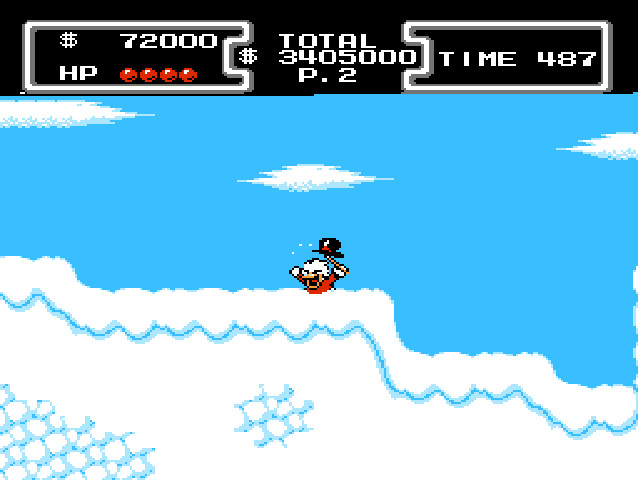
Stop complaining, Scrooge. I come from Northern Michigan. This is a light dusting for us.

Stop complaining, Scrooge. I come from Northern Michigan. This is a light dusting for us.

Now I can see all you wagging your heads in front of your screens thinking, Jake, Jake, Jake…everyone remembers their childhood as more wonderful and praiseworthy than everyone else’s.  But like Phoenix Wright, I make no claims without evidence (lest my conduct reflect badly on my client).  Prior to the 2012 Presidential Election, everything I understood about economics–and retained after graduating high school–I learned from Duck Tales.  Scrooge McDuck taught his nephews some fairly complex lessons about investment and saving.  He showed, through example, why keeping three cubic acres of cash sitting in a monolithic building marked with a dollar sign might demand ridiculously excessive security and a lot of sleepless nights.  Look up an episode called “The Land of Tra La La,” and you’ll see a hypothetical scenario illustrating the effects of inflation.  Even today, when politicians suggest to me that I only need to find more difficult work if I want to increase my income, (goodbye teaching college, hello digging ditches!) I hear Uncle Scrooge’s mantra, “Work smarter, not harder,” and I remember his admission that he succeeded as a result of determination, thought, risk, and luck (remember his lucky number one dime, so coveted by Magica DeSpell?), making me wonder why we elect people easily outwitted by a cartoon duck.
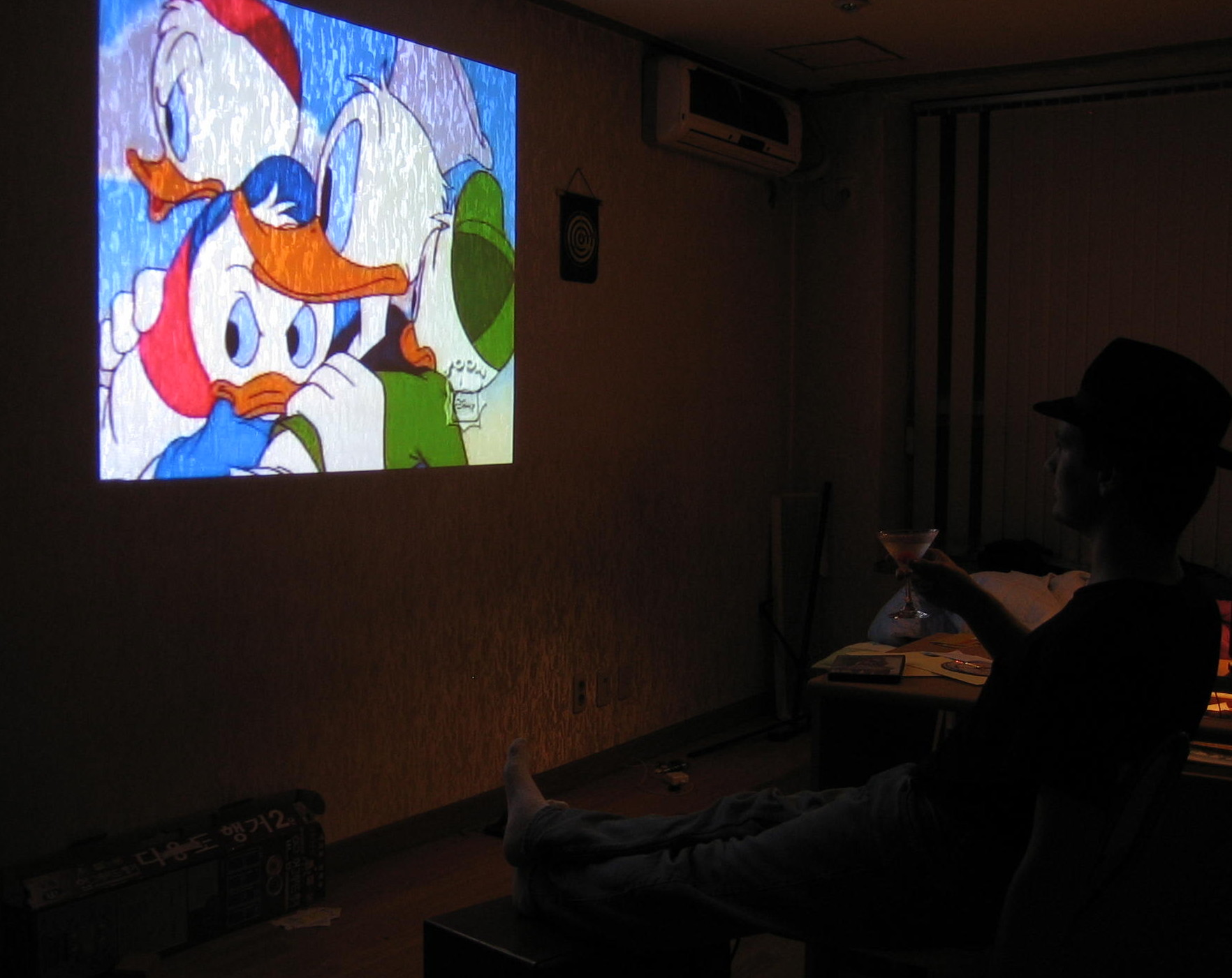
Doesn't everyone watch Duck Tales on their wall while drinking martinis in a fedora?

Doesn’t everyone watch Duck Tales on their wall while drinking martinis in a fedora?

Anyway, if your kilts are cursed enough that you missed out on being under ten years old from 1987 to 1990, go out and find the show.  Find some kids to show it to, or just watch it by yourself.  If your birth year does fall in the eighties, maybe you won’t necessarily remember the TV show, but you probably remember the NES game.  Capcom, it appears, has remastered the game and released an expanded version for Steam, PS3, Xbox 360, and the WiiU! Quackeroonies!

Except I promised I’d play through my giant stack of games before I bought any more, so I’ll write about the 8-bit version instead.

While that probably sounded a bit disappointing, the original Duck Tales game blessed a few bagpipes of its own when first released in 1989.  Congress hadn’t yet passed the law requiring the quality of games adapted from movies or TV to be equal to or less than that produced by unpaid interns who stay up until four in the morning because they can’t go home until they finished their other work.  A lot of the game’s features not only stayed true to the tone and design of the cartoon, it also put the player in adventure situations like Scrooge might actually encounter. (You may laugh at the fact that I bring that up, but have you ever tried playing the NES Back to the Future adaptation?)
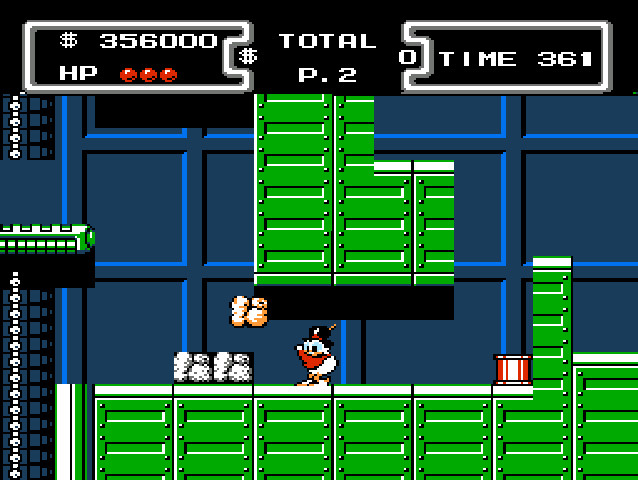
Yep...even the duck is a better golfer than me.

Yep…even the duck is a better golfer than me.

Scrooge McDuck, in a startling development of character that would make even the most hardcore fans shrug with astonishing indifference, wants to increase his fortune.  Rather than merge with other corporations, invest in stocks and savings, or buying up other businesses, firing all the employees, then liquidating all their assets right into his Money Bin, he feels that world travel would best suit his needs, as apparently we could find diamonds sprinkled everywhere from here to the moon if we just look hard enough.  In true Mega Man fashion, the player selects non-linearly from five stages, each which contain a treasure guarded by a boss and numerous diamonds found hiding in the stage or dropped by enemies.  Scrooge uses his cane–which doubles as a pogo stick and triples as a golf club–as his only defense.

This set up, I think, makes the game more about exploration than plowing through to the end.  Stages branch off, and each path contains diamonds, health upgrades, hidden treasures, key items, or extra lives.  Many items remain invisible until Scrooge crosses certain points in the area to reveal them.  So not only can we choose the order of levels, but we also can decide how long we want to spend in any one place.  And while the treasure value only serves as a score, which no one cared about after it ceased to mean “free game” or recognition by other upstanding arcade patrons, putting a dollar sign in front of it somehow makes it feel like a more worthy goal.

Hey guys....what'cha doing in there?

Hey guys….what’cha doing in there?

Other characters from the series appear to help you by offering advice, breaking through walls, or throwing baked goods at Scrooge, who gobbles them down like a diabetic with low blood-sugar.  Although the game keeps text to a minimum, they did try to retain certain speak mannerisms for most of the characters (although I don’t know if I can forgive Bubba’s lapse in not referring to the main character as ”Scooge”).

Despite being a platformer, I actually have a good time when playing this game. Something about bouncing around on a pogo-stick cane just mesmerizes me, and I can remember zoning out in third grade, imagining Scrooge hopping around the lines on the classroom walls.  My third grade teacher didn’t care for me much.  Of course, when I started subconsciously picking up economic theory in kindergarten, I set myself down a path where most of my teachers would accuse me of having an attitude problem. (Until I got to grad school. They liked me. I guess it evens out).

Moral of the story? Video games make you smarter. (No, really) So go play Duck Tales.
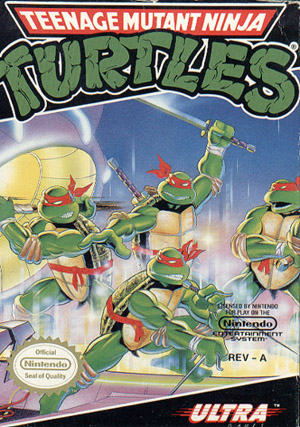
Teenage Mutant Ninja Turtles (1989) – NES

Did it bother anyone else that they were ALL Raphael?

Did it bother anyone else that they were ALL Raphael?

The Teenage Mutant Ninja Turtles rose to fame in the late 80s, attaining the height of their popularity in the early 90s.  Together with the Mighty Morphin’ Power Rangers, adjectives thrived during this time. The kids–myself included–just couldn’t get enough color-themed monster-fighting super-heroes, yet the forces of consumerism, which conquered both good and evil, happily tried to give us just that.  In 1989, a new cabinet started appearing in arcades.  Just another beat-em-up game at heart, to find the true beauty of Teenage Mutant Ninja turtles, you only had to dive skin-deep. (Hey, kids are allowed to be shallow!)

The popularity of the Turtles arcade game sent many people into stores to pick up the NES Ninja Turtle game released the very same year. Many rushed home after hounding their parents for this game, ripped open the box, shoved the cartridge into their NES, bent their connector pins ever so minutely toward total system shutdown and hit the start button…

…only to be miserably disappointed by the game they found.

While the internet raves about the 1989 NES game’s good reception and commercial success, I can’t help but wonder if it would have the same reputation if people hadn’t thought they could own a copy of the arcade game.  Everyone I remember who enjoyed TMNT video games had fonder memories of the beat-em-up than the NES game.  But memory doesn’t record like a camera, I know, and as my mother proves every time she tells people how I’d wet my pants playing video games because I refused to pause for bathroom breaks, sometimes people can completely fabricate memories.  Now if I only had evidence of this disappointment…say, a port of the arcade game to home systems immediately after the first game’s release…or even future games returning to the beat-em-up genre…

I have to respect a villain who does his own fighting...but Shredder was kind of a pushover after the rest of the game.

I have to respect a villain who does his own fighting…but Shredder was kind of a pushover after the rest of the game.

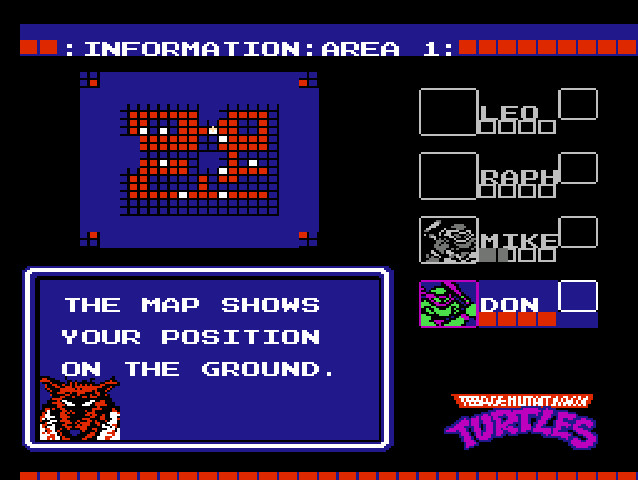
Still, I’d like to get at–in a roundabout way–the fact that the 1989 NES version of the Teenage Mutant Ninja Turtles actually surpasses the arcade game in a few ways…several ways…most…eh…well, let me ask you this; have you ever seen the 1978 animated “Lord of the Rings,” then compared it to Peter Jackson’s films? For the arcade release, Konami simply slapped a green, amphibious skin on the same game that’s been released over and over for what by now has got to be close to 25 years.  But the NES release blended side-scrolling action with a top-down sort of explorable map, while include an underwater swimming stage and a character select screen that let you switch between any turtle at any time.

Splinter looks really creepy in 8-bits

Splinter looks really creepy in 8-bits

I recently dug out the 1990 live-action film, which made me wonder…well, two things actually.  One, who sat down and thought “You know who’d make a good Donatello? Corey Feldman!” What, did Woody Allen and George Burns turn down the role?  And two, why does Hollywood feel the need to burn away everything popular with a series and then misinterpret the premise?  That’s like saying, “You know what people love? Strippers! So let’s record two hours of grandpa Fred prepping for and receiving his colonoscopy and call it the same thing! He is naked, after all!” People enjoy playing the Ninja Turtles game because they didn’t do that.  They released a game because people watched the TV show, and when they bought the game it resembled the show.  You fight Bebop and Rocksteady in the first level, save April, get a message from Shredder saying that he kidnapped Splinter, and then you chase him in the turtle van, then the blimp, and assault the Technodrome.

Stupid Mario never thought of this, did he?

Stupid Mario never thought of this, did he?

You get to do a lot of ninja-ey stuff like spin flips, grapple from building to building, and throw shurikens.  Furthermore, the game employed animated cut scenes between levels, which have now become a standard tool in creating down time while maintaining interest in the game.  When I looked up the release date, it shocked me how long ago they made this game, since it seemed well-developed even for a NES era game.

As opposed to the other guy who wears cheese graters on his shoulders?

As opposed to the other guy who wears cheese graters on his shoulders?

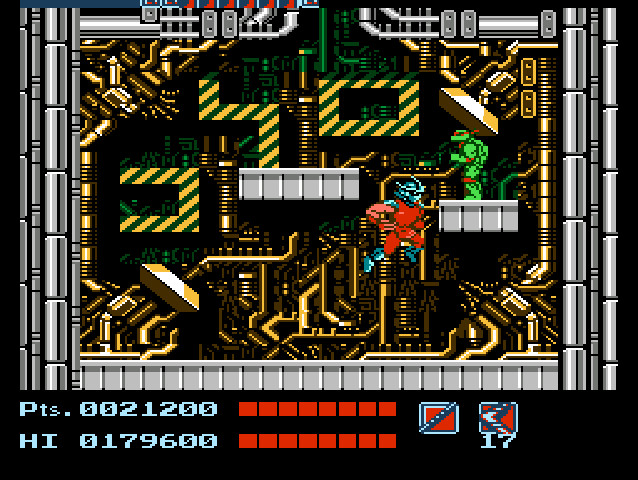
TMNT takes a few cues from Castlevania, including the detailed backgrounds, the secondary weapons, the enemy life display, and the brutal, unmerciful, harsh unforgivingness of the difficulty.  Whereas Simon Belmont leapt through the ledges of Dracula’s castle with the agility and control of a horse-drawn golf cart, the turtles all feel remarkably easy to control.  However, at times, dozens of enemies could criss-cross their way across the screen, and navigating safely around them reminded me of searching for a place to stand on the train during rush hour in Seoul (you’ve seen the videos of attendants pushing crowds of people into the metro? I’ve been in that crowd).  I discovered that not all turtles are equal.  Donatello’s staff has reach, but rather than handicap him in strength, he deals twice as much damage as any of the other characters.  Meanwhile, Raphael and his sai provided a useful target any time I couldn’t avoid taking damage, since his attack pretty much required me to get close enough to the enemy to pull his beard and tell him what I wanted for Christmas.

Theoretically, you could finish Castlevania with nothing but patience.  You may have to replay certain parts, but you had unlimited continues and only had to restart the level each time.  TMNT isn’t quite as generous.  It offers you two continues, and since each level involves a map full of explorable stages, getting knocked back to the start feels like more of a blow.  I wanted to write about the game though, but needed to get through to the end, so I ended up using save states.  I’d say though that it feels more manageable than Castlevania–except for two rooms of instant-death spikes and one long hall full of powerful enemies just before Shredder, it feels like a little practice would help reach more of the game just on the regular lives and continues.

This room! ....ARRGHH!

This room! ….ARRGHH!

Except for the afforementioned rooms of spikes, platforming elements remain mostly absent, so the player can concentrate on his ninjutsu.  Falling into holes or water won’t kill you, but it will wipe you back to the beginning of the stage (one tricky jump kept me from finishing level 3 for YEARS).

Despite unrelenting difficulty cutting off access to the later levels without hours of practice, TMNT does a lot of the right things to tempt the player into coming back for more.  Although it had the misfortune of not being the arcade game, it’s worth attention, as it provides countless replayable hours of Corey-free entertainment.

(Coming up soon, Phoenix Wright: Ace Attorney.  Most of the games I’ve written about so far have been those I’ve played in the past.  Soon I’d like to move onto those that are completely new to me.  I’m thinking of going through either a Sega or SNES RPG next.  Any thoughts?)

Castlevania – NES

Image

Honestly, I swear I’m going to get around to Radiant Historia and Twilight Princess one of these days!

I have a problem, which you’ll soon recognize, of gravitating toward longer games–Final Fantasy, Xenosaga, Fallout, etc–which all have the ability to keep me entertained for hours on end, but don’t exactly provide reams of reading material to those of you kind enough to listen to me ramble like an old man telling stories of “the war” and “kids these days” and other cliches of the sort. So to appease the hungry beast that is the internet, I’ve shot through a few quicker games for some material.

So here’s Castlevania! A horror/adventure/semi-platformer for the Nintendo Entertainment System. You play as Simon Belmont, intrepid vampire slayer on a merry romp through Dracula’s castle armed with only your trusty whip–one of the kinkier, yet lesser known methods of destroying vampires.  Yet business must be good for everyone’s favorite impaler since his ventures apparently merged with every other horror movie from 1920 to 1960, and other famous denizens of the genre appear to be doing Vlad’s dirty work for him while Simon works his way up the corporate ladder.

Yet I still have a problem since I want to review Castlevania, but I’ve never managed to power through to the end before.  NES-era gameplay relied on extreme difficulty to promote replay value.  While Nintendo managed to create a regiment of games with a 20+ year fan base, more than a few fans would have appreciated the chance to play through more than the first three levels.  Once or twice.  After all, I did shell out 50 bucks a piece for these things at a time when my allowance was 50 cents a week if I kept my bedroom clean and did all my chores, and let me remind you that the front-loading design of the NES meant that the games I could pay for wouldn’t always work.

All things are possible, though, through practice, so now that my system reliability allows me to play whenever I want, I hunkered down and did what any self-respecting player who wanted bragging rights would do.  That’s right, I cheated my ass off and used save states.

No, I don’t actual claim to have legitimately beaten the game. Yes, I’d still like to do it the old-fashioned way.  However, considering how often I had to reset my fight with Death in the penultimate stage, it would have taken me days to get good enough to beat him–only if I never shut off the machine. Continuing after a game over means you have to plow through parts of the game you know you can finish only for a meagre shot of honing your skill on an enemy who will, in all likely hood, present you with instant death (both literally and metaphorically, in my case). Image

Despite the cleverness and creativity NES developers put into their games, if I had to rate their bag of tricks to up replay value on a scale from “Hand Purse” to “Mary Poppins,” it wouldn’t even hit the scale.  They didn’t have a bag. They had a sheet of fabric, torn, threadbare, and vaguely malodorous from being passed around by so many games.  I can imagine the meetings they had at work. “We’ve got an idea for a game!  We’ll build a tone reminiscent of classic horror films, using well-known monsters as the stage bosses!”  “Great, but what reason will they have to play it again? Should we rely on detailed level design and dark, catchy music?” “No! Let’s just up the difficulty so they’ll only be able to play the first three levels!”

Brilliant idea. See, I like Castlevania. I liked it enough to play those first three levels over and over again, and the game does have a lot going for it. But as I mentioned, NES games cost $50 a shot, which means the game ran me over $15 a level. Not particularly a wise investment.  Between that and the fact that Simon handles like a combination of a refrigerator and a lemming add a level of frustration that I commonly despise in more modern games.

Seriously, though, I don’t exactly feel inclined to cooperate with a protagonist who hurls himself meters backward, often off the nearest ledge, every time he gets a paper cut.  Watch the speed runs on youtube–players manipulate the distance you launch yourself when hit to add distance and height to jumps.

Yet we still play this game–I still play this game–years later, and Konami finds the series profitable enough to have made well over forty installments since this game appeared in 1986.  For all its faults, something must more than make up for it to give it such a reputation.  I believe it relies heavily on the tone.  The game opens as Simon approaches the gates of a crumbling, Gothic castle in the middle of night.  From there, background design only gets more detailed, giving the player a sense of placing themselves in a classic horror setting using only the 8-bit technology of the NES. Image

Pitting Simon against well-known baddies, such as Frankenstein’s monster, the Mummy, Death, and Dracula, gives players a sense of familiarity with the game.  NES games relied on the instruction book to provide the premise of a story, so employing characters that already had stories built a solid texture into the experience.  Furthermore, the power-up tools–holy water, crosses, daggers–are also staples of the horror genre, which furthers immersion.  In a system limited to 8-bit processing, Konami employed a string of techniques to expand Castlevania beyond what the NES could actually accomplish by itself.  This contributes to the long-lasting value of the game and makes it still worth playing today.Image

Also, not to backpedal too much, but while the difficulty exceeds reason, the fact that the game poses such a strong challenge does make me want to return.  It becomes a goal, rather than just a game.  Sure, it induces wrathful symptoms–shaking hands, throat sore from screaming, frothing at the mouth–but at its heart, the difficulty shows that the game cares enough to make you want to come back. I’ve heard the sequels surpass the original in difficulty, but I still look forward to summiting K2 after climbing this Everest.

Bubble Bobble Sequels – Initial Reactions

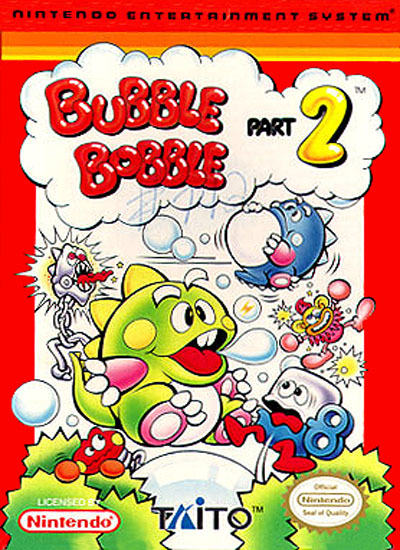
Yesterday’s review on Bubble Bobble piqued my curiosity to look into the series, so I read up on the sequel games and played a bit of Bubble Bobble 2. Image

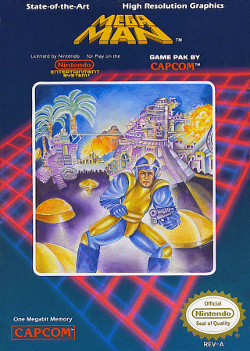
Image I’ll include a formal review later, but I felt inclined to share my thoughts. See, I usually laud the video game industry as the one area of storytelling that understands how to improve on the original instalment of a series.  If Hollywood had produced the first Mega Man game, one look at the promotional art would have sent him to rust on the scrap heap. Don’t believe me? Just look at what they did to the Star Wars prequels, the Jaws movies, and thank the higher deity of your choice they never made any sequels to The Matrix (No they didn’t! Shut up!) Meanwhile, Final Fantasy, the Legend of Zelda, Metroid, Resident Evil, and a plethora of other games all succeeded right from the beginning, but it’s hard to argue that their sequels didn’t show them up at every chance.

Image

Bubble Bobble, however, missed the boat entirely, and only survived onto sequels because the shark from the Jaws sequels was too stupid to eat it. The games all have very nice graphics, some even updating to 16-big home systems such as the Sega Genesis, and have much smoother mechanics and presentation, but as the whole philosophy of my blog states, better technology does not automatically ensure a better game!

Bubble Bobble 2–officially titled “The Story of Bubble Bobble 2” features a similar gameplay to the first. As sequels go, it’s not as bad as the rest. You’re still playing as Bub and Bob, the Bubble Dragons from the first game. Rather than 100 stages played through in order, the game grants you some degree of control over which path you take. The game even introduces boss fights, where you drink a potion that allows you to spit rainbow bubbles, and pop them to cause damage. Image

I’m glad to see Bub and Bob came out of the closet on that one. To add further innuendo, one of the bosses appears to be a female tanuki (sorry…you’ll have to find your own image there). Don’t even ask me how that one works.

Unfortunately, the two player mode, one of the better aspects of the first game, goes so far as to damage the mechanics of the sequel. Play is parallel, like the original Mario Bros, and it doesn’t run cooperatively, like Mario 3, where players clear levels to help the other advance. In fact, while on single player mode, you can resume play mid-stage when you get hit, but two-player mode ends the turn to alternate to the next player.

My initial reaction is that the game is worth playing, but not for more than one player.  And since the multiplayer option gives most of the value to the first game, that adds up to a big strike against Bubble Bobble 2. The following sequels don’t even sound interesting, as they’ve turned the loveable cartoonish bubble dragons into … wait for it … regular people. I’m sorry, Taito. You’ve lost me.

Yet, as I mentioned earlier, I write this after a ten-minute session of playing the game and a late-night boredom-induced scouring of the internet for images of bubble dragons. When I get a chance, I’ll focus on writing a more formal review.

Coming up soon: Radiant Historia for the NDS. I’m working my way through Twilight Princess since I felt the beating I gave it in my Oracle of Ages/Seasons review may have been done with a outdated stick, so don’t pick up the crap raining from the fairy pinata just yet. Anne wants to watch that one, though, so it may be a few weeks before I get that one posted.

Bubble Bobble – Nes, Arcade

Image

Having crawled out of the womb and into the era of Donkey Kong, I’ve spent my entire conscious life watching the evolution of modern gaming.  Unfortunately, as Forrest Gumpy as it feels to have witnessed something historical that I take a deep interest in, I’ve had to face the onslaught of humorless dicks who have never played a game in their life calling me an anti-social, violence-crazed, killer-in-the-works.  But while I’m tallying up the number of football injuries versus the collective maimings incurred in the last twelve months of high school football, I have to concede with these people on one point; the sheer mass of games like Halo, Call of Duty, Modern Warfare, and all the other testosterone-dripping, military propaganda scenarios being released now do kind of point to a preoccupation with violence. But hey, when the amazon reviews for Game of Thrones complain about too much sex without a word on all the appendages lost in the series, I think our societies obsession with bludgeoning one another goes a little beyond the monkey-see-monkey-do argument against video games.

What these people fail to see is the plentiful cornucopia of games that don’t wallow in their own wrath.  Yes, it’s very nice of Jenova Chen to develop a game that gets away from the shoot-kill-win mentality, but it would be nice if people could remember that games like this already do exist.  Let’s go back to, say, 1986 and examine a little gem called Bubble Bobble.
Image
As a reviewer, there’s really not much to describe. You play as Bub and Bob, two Bubble Dragons that resemble Godzilla chibis. Instead of shooting a gun, you breath bubbles.  Instead of killing enemies, you trap them in said bubbles, then pop the bubbles to turn them into food.  Yes, I suppose you could go all Mufasa on me and imply that that’s a metaphor for the Circle of Life, but I say, “Screw you! It’s fun!”  As always, the ultimate test of a game’s value is how much you enjoy it, and while it’s less violent than your standard cartoon, Bubble Bobble manages to radiate enough bright colors and simple-yet-addicting gameplay to have kept my interest over the last several decades.

The game has a simple learning curve.  Hit start.  Three monsters?  Try blowing a bubble.  Easy enough. Pop them and sit back for 99 more levels of this!  But Bubble Bobble manages to avoid a repetitive feel for the most part.  The shape of the levels forces the player to change tactics to solve puzzles in gameplay.  How do you pop the bubble when you can’t reach it?  How do you get to a monster trapped inside a shape?  Certain levels change game physics and make bubble float or sink differently (and in one case, much more quickly) than usual.
Image
I don’t mean to give the impression the game is perfect, though.  As much variety as it introduces, a hundred levels can become a little repetitive from time to time.  Furthermore, the level designs sometimes get too fun and wind up with pits or nooks that your bubble dragon can get stuck in.  When that happens, you’d better hope the monsters can still kill you (which causes you to respawn in your starting position) or that you recruited another player who’s savvy enough not to get stuck.  

Another minor point, while the large variety of fruit, veggies, snack food, and other bonus items does add to the ability to get excited over cartoonish details, it does sometimes work against the player.  With dozens of items that do no more than grant point, sometimes it’s hard to realize that some times increase your speed, let you stream bubbles faster, or even warp ahead several stages. Perhaps, though, part of the challenge is to recognize which items to prioritize before they time out and vanish.

Difficulty, as to be expected from NES-era games, resembles breaking a pine log with your fist; you know it’s impossible, but it looks like fun so you’ll gladly pulp your hand into a maraca trying to do it.  The game does offer continue options.  On the NES, restarting after a game over gives the option to begin at any stage you previously cleared since turning the machine on, while the arcade system, with a spirit of capitalism that would make games that require DLC bow down in reverence, only asks for another coin to keep Charon from ferrying you back out of the building.

Differences between the arcade and home versions don’t amount to much beyond that.  The cabinet systems allow for better detail on enemies, fruits, and the tiles that make up the levels, but the NES version includes background music.  Granted, after 99 levels of the same song, it’ll start to echo through your living room long after you’ve shut the game off, but I still say it was kind enough for the game developers to include one.  

Fun, simple, and non-time-consuming, Bubble Bobble doesn’t have much to offend anyone.  I’m sure a handful of gamers view themselves as “serious” and wouldn’t be caught dead playing anything doesn’t involve trying to imagine how fun it would be to get shot in battle, but chances are most people will find something about this game to like, no matter what their taste in games.