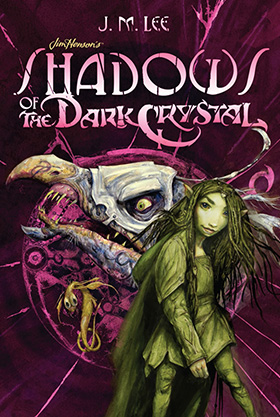
 If books were children, the treatment I’ve given them lately may not land me in jail, but I might get a stern talking-to by Social Services. Oh, the ironies of teaching literature, spending all day long with books and coming home without enough energy to charge a cell phone while it’s still on. If I had book shelves beneath my stairs, I could compare myself to the Dursleys, literally keeping Harry Potter in the pantry all the time. As such, I feel that the last few books I’ve read, I’ve been about as fair and balanced as a rusted-out bathroom scale shoved in a closet in a Fox News studio. Fortunately, I’ve found one I can get through and enjoy without the regret of wasted time and money you get when the high class escort girl you hired isn’t the one from the picture on the website. What’s more, the book stems from the world of the 80-minute Jim Henson production, The Dark Crystal. Managing to make a movie-based book that expands the lore and, what’s more, manages to capture the Jim Henson feel without the muppets, is a task that ranks up there with slaying the Nemean lion, destroying the One Ring, and reading a presidential ballot when you want to vote for the guy who hates words. But somehow, author J.M. Lee managed to bring skeksis back with his book, Shadows of the Dark Crystal.
 The book serves as a distant prequel to the Dark Crystal film, set way back in a time when gelflings weren’t harder to find than a Mormon strip club. In fact, the skeksis employed them as guards in their palace, and the gelflings served with a sense of pride, patriotism, and Stockholm syndrome that would rival that of even Hispanic and female Trump voters. (Preemptive apology for any political tone in today’s post, but I’m writing less than a week after the election, and we in the U.S. are currently a little worried that our hallowed democracy and electoral college will soon be replaced with “Trial By Stone!”) Naia, a swamp gelfling, receives word that her brother, one of the aforementioned guards self-flagellating themselves in service to Trump’s Satan’s Parakeets, is on trial for treason. The only thing preventing the skeksis from beating him over the head with a lead bucket of propaganda for an hour—mostly to tenderize the meat for later—and using the remaining pulp to thicken their soup is that they can’t find him. But since punishment is always entertaining whether or not there’s a legitimate crime to go with it (as per standard Republican philosophy), the skeksis insist that someone stand trail in his place, and call for a member of his family (dear God, I’m glad Trump can’t read. This book would give him too many ideas.). From there, Naia begins her journey to discover a horrible, dark, and twisted secret that anyone who’s seen the movie kind of already sort of knew.
For starters, she discovers the Crystal is no longer pure and white, but dark and corrupted (which finally breaks the trend of Republican comparisons, as the GOP is somehow all four of those at once). I thought about marking that as a spoiler, but again like the Republicans, anyone who’s paying attention has known that since 1982. Furthermore, the dark secret Naia needs to tell the world is that the skeksis have been eating the gelflings, draining their essence and turning them into empty husks to use as slaves, much like…okay, do I even have to keep saying this? [sigh] Sadly, we’ve been promised that the federal minimum wage is going the way of the gelfling.
Enough political stuff. Let’s return to a cheerier subject: a world ruled by the iron fists of a group of bloated, decomposing lizards with a wardrobe that looks like a drag queen who’s been run through a wood chipper.
Author J.M. Lee does a marvelous job showing us things we’ve known about for 35 years. And while that sounds like my normal humor rhetoric, I’m actually serious. Jim Henson, the Rembrandt of Muppetry, does such an amazing job of creature design and world building that the finer aspects of his own story fly by like a heavy dose of gamma radiation—it may be invisible, but it’s still there, and it affects us deeply, way down inside, in a way that changes us forever. Before reading Shadows of the Dark Crystal, I had always looked at the essence-draining like any other ticking clock in an adventure movie. But the treatment Lee gives it in his book would send chills down Stephen King’s spine (although considering he’s responsible for a book with a climactic showdown with flying clams who devour an airport, that may be a low bar to jump).
Naturally, no book would be fun to write about if it were flawless enough to be the child of Mother Theresa and Jesus. The pacing, especially in the early-middle part of the book, drops with a lot of introspection and a burgeoning love plot with a gelfling singer-songwriter one-hit-wonder that thankfully pays off like a Wells Fargo savings account. Ultimately they don’t shoehorn the romance in, but like the Wells Fargo account, it makes me wonder if there were a better way I could have invested my resources. I mentioned Jim Henson’s world building and creature creation before, which admittedly is responsible for much of the film’s success and everyone’s fascination with mangy vultures dressed like Elton John if he were in the Thriller video. Lee, on the other hand, could start a game of Minecraft with the goal of making a birch tree. Almost none of the creatures he creates are unique or expand the world in any way. Granted, if he had done something stupid like create a race of Big Bird monsters, I’d probably be even angrier, but the reason I read novels like this is because trying to get my fix of an excellent movie that’s only 80 minutes long is like trying to enjoy a box of porn that contains nothing but a DVD with the sex scene from Terminator, a screenshot of Jennifer Connelly from Career Opportunities, and a Medieval manuscript illustrated by a monk who lived in an entirely male community for sixty years.

And I thought my yearbook photo was bad…
Fortunately, despite the flaws, the novel delivers. Now if you’ll excuse me, I’m assuming Trump was inaugurated about a week ago, which means I have to find a gelfling before the Great Conjunction or he’ll live forever. In which case, I’m moving to New Zealand.
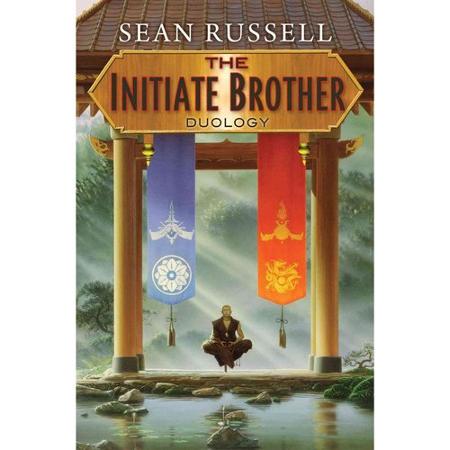 Generally, I only read fantasy as a way to kill time before they can jack me into the Matrix and send me directly into Middle Earth or Krynn or the Star Wars galaxy. Despite that fact, I’m not actually well-versed in modern fantasy novels or authors. It’s pretty rare that my reading list doesn’t resemble a queue of hipsters leading into a Chipotle, so on those rare occasions when I have nothing specific to read, I like to go to Barnes and Noble and pick up random authors I’ve never heard about. This practice makes me realize that for a culture that teaches us not to judge books by their covers, it’s rather irritating that we’ve set up our system of consumer commerce in a way that requires us to literally judge books by their covers. Which is how I ended up with The Initiate Brother Duology, a book about the size of a toaster that contains The Initiate Brother and its sequel, the Gatherer of Clouds. Today I’ll review the Initiate Brother. Or rather, half of the Initiate Brother.
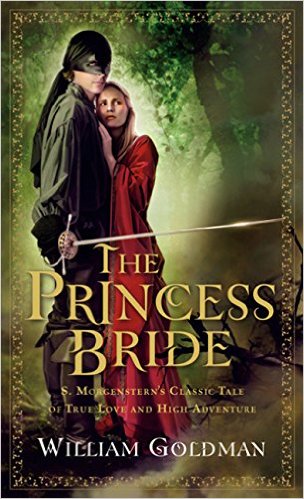 Could there ever be a better tale of winning love, fighting evil, pursuing evil and buckling swashes than The Princess Bride? Yeah, probably. But the movie is still a cult favorite today, and since I don’t want people coming after me with candles and ceremonial daggers and other cultish cutlery, I have to find a tactful way of trashing the book. Much like the Elixir of Life, the Loch Ness Monster, flying cars and universal wifi, mentioning in public that a movie might be better than its book runs the risk of having people cart you off to a hospital and giving you a coat with extra-long sleeves. Nevertheless, I’ve read the entire main story, some of the forwards and special messages, and the first few pages of the “sequel chapter,” Buttercup’s Baby, and I’m so underwhelmed with the story that I stopped writing in the middle of this sentence because cleaning up a backpack that my cat peed on sounded more interesting.
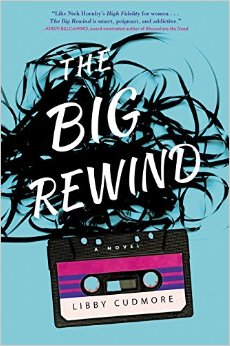 I am beyond thrilled to announce that our own

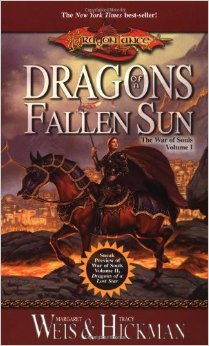 Back in sixth grade, I was riding high off of Fantasy. My dad read me the Hobbit in fourth grade, Lord of the Rings in fifth, and in sixth grade I dove back into both books, trying to get that same fix (Dear gods, have you ever noticed how often I talk about drugs in this blog? It’s like Jay and Silent Bob have a wordpress account and a history of being stuffed into lockers.). Anyway, my tolerance was increasing, so I had to up my dose. And lets face it, Lord of the Rings is great and all…but where are the fucking dragons? Smaug was a fricken badass. Where can I get more of the good stuff? Don’t try to slip me Puff. I need the hard core stuff, man! Well, around that time, my parents shuffled me off one evening to a friend’s house while they went off bowling or something, and I uncovered one of the most dramatic and wonderful discoveries of my life (no, it wasn’t pot). My friend showed me her late father’s (we all miss you, Burt!) library. This guy had stuffed so many sci-fi and fantasy novels into this room that they lowered his heating bill. This full grown adult was a huge nerd, operated an arcade, and read stuff that I thought only existed in, well, fantasy. That’s when I realized that grown-ups didn’t have to be boring, and I could enjoy reading about dragons without feeling like I was wasting a life better spent learning how to manage hedge funds. And fortunately, my friend’s mom let me pick out some books to take home with me. I picked out one with a dramatic pose of Merlin on the cover, as well as the novelization of Star Wars (ghost written by Alan Dean Foster, whom I wrote about in May). But like I said…I needed dragons. And fortunately, Burt had me covered there.
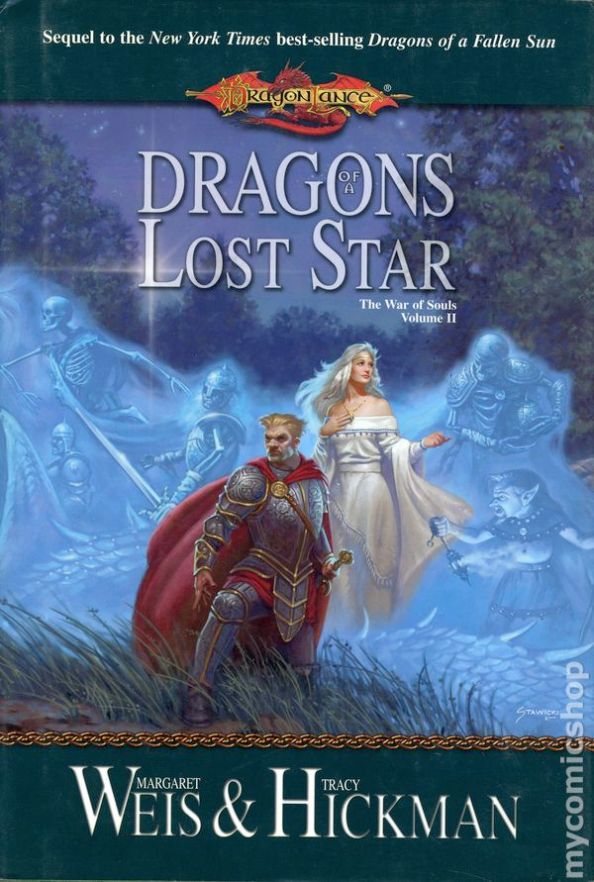 Weis and Hickman are absolute masters at crafting two things: complex, psychologically real characters with an evil alignment, and interesting scenarios. One of my favorite cliffhanger endings of all time is from one of their “Second Generation” novellas, in which Tanis’ son is invited into the Qualinesti nation and offered the crown, only to find out he’s been set up as a puppet king. Forbidden from entering the elven nation himself, Tanis offers parting advice for how to manipulate the political game to fight for control. Another ending comes at the end of Dragons of Summer Flame, in which the gods of Krynn are forced to abandon their creation, and the mortal world has to learn to live without magic, divine influence, or guidance. I finished both of those books thinking, “I want to read that story!” But on account of not being able to write all 200 books themselves, Weis and Hickman had to abandon their creation to authors who treat it with as much respect and sincerity as someone saying, “I promise I won’t get mad,” “I swear I won’t use your credit card to buy porn,” or “I’ll return the Millennium Falcon without a scratch.”
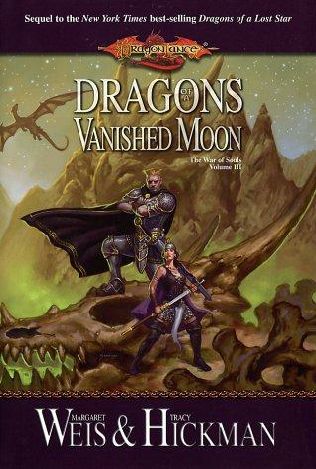 So…the War of Souls begins with Mina, an 18-year-old girl who comes out of storm, prophesying like an Evil Jesus about the One God of Krynn. She makes a few predictions, heals a minotaur’s stump arm, and then proceeds to rise through the ranks of the Dark Knights, waging a stealthy, political conquest of the Silvanesti nation. Meanwhile, Goldmoon wakes up and finds her 18-year-old body restored, while Laurana (who is still about 18 years old in elf years) develops a complex political relationship with the Dark Knight governor of the Qualinesti. And, of course, Tasslehoff makes up for being dead by traveling forward in time, because apparently readers couldn’t possibly grasp the wonders of Krynn unless we see it through the eyes of a child…a child who’s over a hundred years old and has seen absolutely everything that can happen in a world with dozens of sentient races and as many types of magic and unique locales.
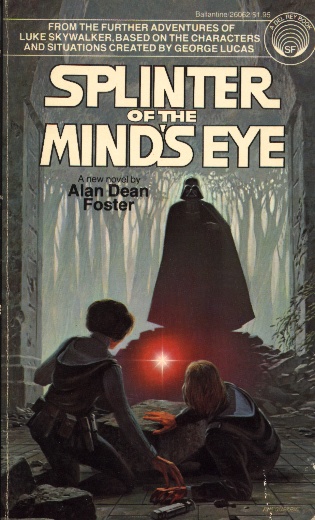 Who would have ever thought that Star Wars would turn out a failure? Trick question! For starters, anyone who’s lived through the prequels. There are few things that generally can enrage people to the point where their blood pressure is higher than that of a decapitated Anime character. One of these things is mentioning the terms “Republican” or “Democrat” in the presence of the opposite. Otherwise, it’s just the Star Wars prequels. So try to understand when I say I love the prequels almost as much as the classic trilogy. I love them from the pointy little tip of Amidala’s crown to the metal hunk of bounty hunter digesting at the bottom of the sarlacc pit. And I tell you this story because I want you to understand the sheer amount of masochism required that when I find out Lucas had planned a low-budget alternative to the Empire Strikes Back in case a New Hope flopped, my first thought was, “I need to read this!”
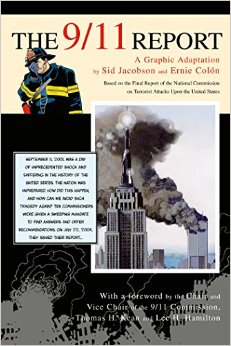 I read a lot of science-fiction and fantasy, but sometimes I wonder if all those epic battles, thrilling worlds and imaginative scenarios might just be a little too exciting. Dangerously thought-provoking. So sometimes, to alleviate all the strain that comes from wonder, creativity and awe, I have to dive right into your plain, old-fashioned recreational reading like a lengthy government document. I tell you, there’s nothing like a tedious analysis of our nation’s security capabilities to make me feel relaxed, settle my blood pressure, and make my brain activity flatline, putting me into that near coma-like trance that tells me there’s no longer any danger of any of those deadly, vicarious thrills that so commonly lay up readers in hospital beds, where they have naught to do but read, thus creating an inescapable cycle. Fortunately, for the time-efficient reader who may not have the time to read through 592 pages of tedious analysis, or for those of us who just want to spice up our recommendations for improved national resistance to terror with a few colorful pictures, I can recommend The 9/11 Report: The Graphic…uh…novel?
 Video Game Underworld