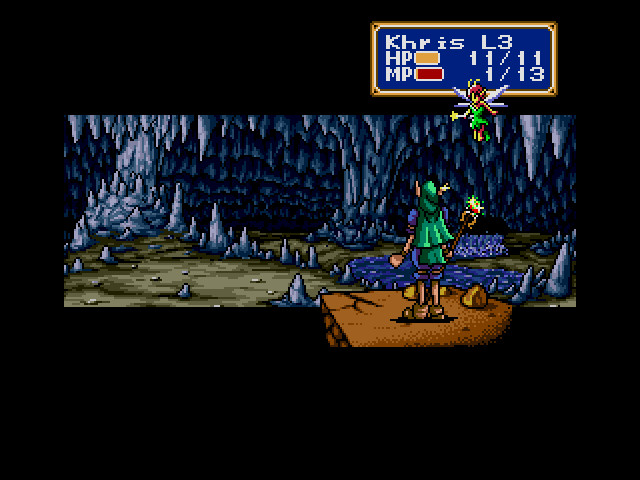
Shining Force – Sega Genesis, Game Boy Advance

When you wish upon a copyright infringement lawsuit...

When you wish upon a copyright infringement lawsuit…

Let’s have a quick word about how to increase endgame difficulty.  You want the game to feel more challenging near the end.  That way it works toward a climax, following a natural plot arc.  Some games do this better than others.  For instance, some bosses fight with status attacks.  Others will introduce bosses as random enemy encounters.  Valkyrie Profile II demanded I use the level 64 character they introduce for the final battle when even the easy enemies can vaporize all my level 90 characters like a meteor entering the earth’s atmosphere. Still, most games will bump up the level or stats of endgame enemies to give them a slight edge over the player.

However, raising the enemies’ evade rates doesn’t accomplish this as much as the Shining Force developers seemed to think it did.  Watching characters swipe the air like an epileptic in a dance club feels less exciting than, say, going outside and slashing bushes with foam pool noodles or watering your lawn with a water pistol.  This contributes to slowing the pace of a tactics game in which most battles start with bottlenecking your characters or putting them so far from the enemies that, if they worked together, they could measure the speed of light.

...have we met?

…have we met?

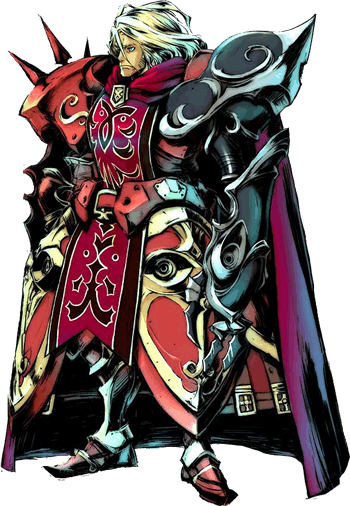
Not that they would do that, mind you, because like many mill-ground fantasy stories, Shining Force weighs itself down with themes like “Light is good” and “Dark is bad.”  The game opens with the formulaic war-between-two-countries-with-a-supernatural-threat-looming-vaguely-on-the-horizon.  The rival military general shows up looking like he dumped a life-size Wooly Willy set over his head and kills the king.  On his deathbed, the King gives you the order to form the Shining Force and defeat the darkness.  Light good.  Dark bad.  The enemy leader calls himself Darksol and he plans to resurrect the ancient Dark Dragon (who is neither dark, nor a dragon).

Would I be asking too much for a well-written fantasy story that doesn’t draw morally unconflicted characters in a black-and-white scenario?  I thought about rewriting that last sentence to get around using the phrase “black-and-white.”  Why do we have to associate black and white with evil and good?  I don’t know about anyone else, but I find a bit of darkness rather pleasant when I’m trying to sleep, or sneak up on a ninja or get dressed in a room full of people.  A little more subtle conflict might make a more interesting story.  In fact, for most of the game I turned off the music (which didn’t prevent it from echoing in my head like The Master’s drums) and listened to a Jim Butcher audiobook in order to get a good fantasy story. The bulk of the plot just involves moving from one excuse to start a battle to the next.  In fact, at one point, after fighting a hoard of monsters outside of a town, the man at the gate casually remarks, “Sorry about that.  We thought you were someone else,” at which point I just tip my hat, wish him good morning, and waltz on by as though I’m not headed to a priest to resurrect my comrades murdered as a casualty of mistaken identity.
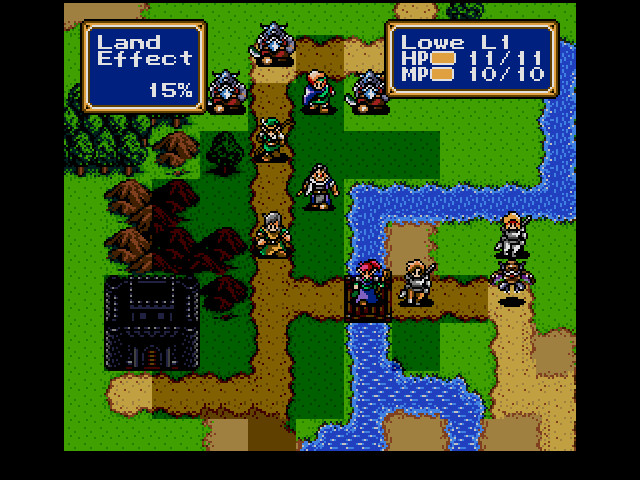
Shining Force-000001While it seems like they wrote the story in as much time as it took to look up a formula and transcribe it into the game, Shining Force does have strong points.  The game centers on battles–and when I say “centers,” it also rights, lefts, ups and downs on it too.  Don’t expect side quests or even random enemy encounters–all battles are programmed and static–but the strategy aspect makes up for the minimalist approach to this RPG.  I enjoyed FF Tactics more than many of Final Fantasy’s main-series installments, and Shining Force feels like a somewhat simplified version of Tactics.  Battles take place on a grid map, characters have different classes that affect their stats and the range of attacks, and while they can’t switch between them like FFT’s job system allowed, they can receive a “promotion” to a slightly better class once they reach level 10.

I can also praise the game for allowing the player to keep any exp they earned in battles they lost.  I can’t tell you how many times I’ve taken an unexpected turn for the worst, then realized “I haven’t saved in an hour!”  Those moments make me acutely aware that time only moves in one direction, and that I’ve wasted hours careening toward death in front of the TV with nothing to show for it.  Shining Force, however, lets you stay at your new level, making the next round a little easier.  Although they probably included this to let players level-up in a game with no random encounters, I’d appreciate seeing this feature more often in RPGs.
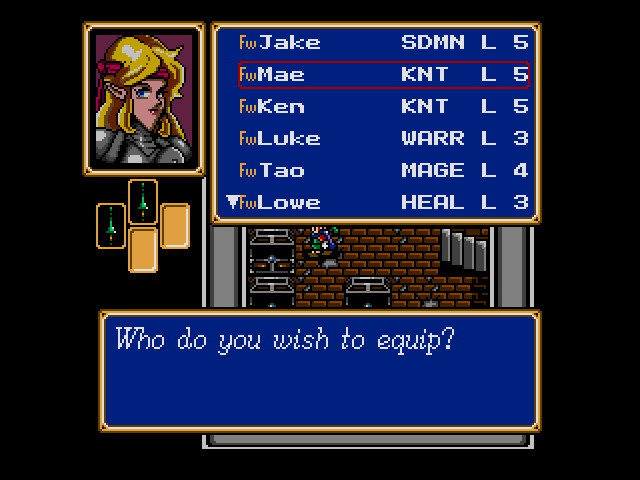
New menu box . . . every time. . . can't stand it...but at least inventory management isn't as bad as in Skyrim.

New menu box . . . every time. . . can’t stand it…but at least inventory management isn’t as bad as in Skyrim.

While I appreciate the fast pace after playing some interminably slow Zelda games, I do have a complaint about the menu system, in which the player flips through single options box-by-box, resurrecting characters one at a time, transferring single items from character to character, purchasing and equipping items one-by-one, and needing to open a new menu and flip through all the options each time.  With Final Fantasy V already on the shelves for a full year, you’d think some of the programmers would figure out, “Wow! RPG menus don’t have to be complete shit!”

Like Final Fantasy Tactics, characters level up upon completing actions in battle, which again I mostly support.  However it leads to a common problem of healers never leveling up because they don’t act as much as any of the other characters.  Another option to gain experience might help.  At least in FF Tactics I could bounce rocks off my comrades’ heads until I had enough MP and JP to learn support spells.  Shining Force doesn’t give even that much.  I went into the final battle without effective cure spells because my healer was less than half the level of some of my other characters.

But don’t let the flaws get in the way of enjoying the game.  I made it through in about a week and a half, never feeling like the pacing dropped much, and only encountering minor frustration at whiffle battling enemies with high evade rates.  I finished the game feeling I enjoyed it very much, and look forward to the sequel.  Which I won’t play right away. Maybe some shorter games first.

Until this point in the game, they called him "Kane"

Until this point in the game, they called him “Kane”

A few notes before I leave, Shining Force has also been published for the Game Boy Advance, although it has a new subtitle, “Rise of the Dark Dragon.”  While I didn’t play that version, word on the net says they improved the translation massively and may have resolved some of the plot vacancies I mentioned earlier.

Journey – PS3

journey Slide

Does Journey fit nicely into the theme of retro games? No.  Probably, years from now when casual gamers have forgotten that any platform ever existed other than the PS5 and the XBox Pi, we can all come back to it and marvel at how an old-school game surprisingly still entertains us, but for the moment, it remains at the forefront of advances in technological, narrative, and musical progress.  Did Anne decide to play through it this morning while I needed something to write about during the time it takes me to finish Shining Force?  Welcome to my blog!  Look forward to a Sega Genesis review within the next week!

While I have more praise for Journey than most games, the initial description of what it is sounds about as appealing as clipping expired coupons from the supermarket to add to your grandma’s “collection.”  Developers and copywriters slap together promotional tidbits like “storytelling without words” or “a cerebral, haunting experience” or other such nonsense. Lead developer, Jenova Chen, claims he wanted to escape the modern idea of video games as being “shoot, kill, win,” so he built Journey around metaphorical themes of life and death.  The main character, a little jawa/bird creature, appears to the player in a desert.  He/she (shklee?) spies a tall mountain in the distance with a glowing pillar of light.  The rest of the game is simply the journey to that mountain.

Ignore that description.  I’ve seen sacks of flour with more pizazz than that.  The game does push envelopes, yes.  It doesn’t keep score, pit you against enemies, punish poor gameplay with “game overs,” but it does retain a lot of the aspects of video games that make it enjoyable to play.  It stresses exploration, with the main character able to find hidden glyphs that increase the length of its scarf, which gives the player the capability to fly short distances depending on that length.  In addition, some stages have monsters that can shorten the scarf; however, since it only cuts it in half, the player can never entirely lose it, and the normal course of the game doesn’t require flight anyway.

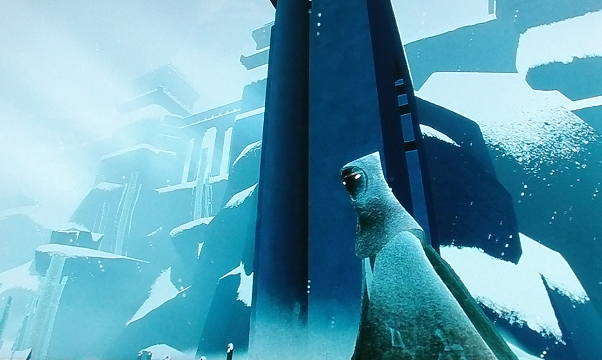
Yeah, yeah...everyone uses this image. It's the best from the game, but the rest are worth seeing, too.

Yeah, yeah…everyone uses this image. It’s the best from the game, but the rest are worth seeing, too.

I’ve often ridiculed the concept of high definition, since most people have low-definition eyes.  Yet I have to drop all pretenses for this game; the high definition world it creates adds every detail imaginable to the exploration.  Furthermore, the fully orchestrated score interacts with the player, changing seamlessly to match the emotion of the main character and its actions at any given moment.  Lost for witty comments to make here, I find myself slack-jawed and dumbfounded at the sheer brilliance of the composer (Austin Wintory) and programmers.

All though I will argue the storytelling value of plenty of video games dating back to the SNES-era RPGs, Journey may be the key to introducing the “electronic narrative” into the literary canon.  While the storytelling-without-words aspect takes itself much more seriously than Buster Keaton or Charlie Chaplin, the game does it using the full advantage of the technology, something that no movie or book could do; it uses social gaming.  And it uses it well, which surprises me.  The game connects to the internet and matches up two players who happen to be playing through any given point at the same time.

This accomplishes several things worth mentioning.  First, it reduces the urge to look up a walkthrough.  More experienced players–as denoted by the level of design on their cloaks–tend to show less experienced players where to find glyphs, several of which the player can’t actually reach on their own.  Furthermore, players discover in colder levels the value of huddling together for warmth.  All the while, the only “verbal” communication available is a small chiming sound made by the O button.  Without giving away too much, this feature of the game actually expands the story, again making me react with deer-in-the-headlights amazement.

Jackass...leaving me to freeze whie he bangs his head on a fricken wall...jackass

Jackass…leaving me to freeze whie he bangs his head on a fricken wall…jackass

Still, the best feature of the game also doubles as its most frustrating, as you’ll often get paired with players who somehow manage to express their amount of sheer idiocy with only actions and a small chime.  Having gone through the game a few times, I consider myself more of a mentor-player, and on one playthrough I attempted to show a newer player some of the secrets that others had shown me.  At one point, this guy started chiming like crazy, presumably to get my attention, then started walking over and over into a rock wall.  Figuring I should derive some meaning from it, I too walked into the rock wall.  Nothing happened.  I chimed a few times to get his attention, then got frustrated and left him still bashing his head repeatedly on the rocks, and I finished the colder sections of the game on my own.

The game often induces a calm feeling when I play it, but much like family, the stress level and frustration entirely depends on the random people you get stuck with, except you don’t have to worry about awkward Thanksgivings with them. It also affects your actions as a player.  A considerate mentor figure on your first few plays could turn you into a kind, caring, father figure to another newbie down the road, just like encountering morons and jackasses could set you down a bad path where you cooperate with no one, keep all the glyphs to yourself, and end up smoking, getting tattoos, and riding your Harley up and down the mountainside at all hours of the day and night.

I do plan on saying more about Journey (hopefully more entertaining, but good games are actually much harder to write about than bad ones), but as I mentioned before, this could make video games more literary, so I’ve put it on my Intro to Literature syllabus this fall–that’s right, come to the University of Minnesota Duluth and we’ll teach you video games! Until then, the game doesn’t cost much, and you have your choice of downloading it or buying the three-pack with Flower and…uh…that other game.  Although the impact wears off with subsequent playthroughs, Journey should leave the player with an emotionally soothing feeling upon finally reaching the mountain.

Phoenix Wright: Ace Attorney – NDS

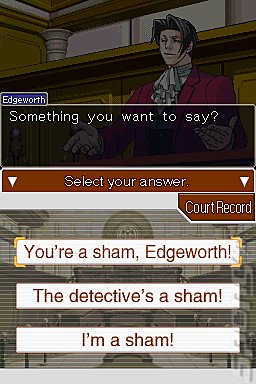
Objection

Phoenix Wright does for the legal profession what the Trauma Center games do for medicine, which happens to be pretty much the same thing McDonald’s does for fish; sliced it open and yanked out its guts until nothing remained except the few tasty remnants that everyone likes, then padded it out with a nice slice of cheese and a bun to make it appetizing. While my initial reaction may sound like I don’t like the game, keep in mind that Court TV and the Surgery channel really don’t rank as high in the ratings as such masterpieces as “The Bachelor” and “Jersey Shore.” I’d like to make a joke here about viewers’ preferences, but reading through the Wikipedia page on Jersey Shore doesn’t really give me any information on what the show actually is.  So as it stands, most people would rather watch 42 minutes of nothing than to learn anything–anything at all–about medicine or the legal process.

However!

…we’ve got endless hours of Scrubs, E.R. Chicago Hope, M*A*S*H, Doogie Howser, Grey’s Anatomy,  House, Ally McBeal, Night Court, the People’s Court, Judge Judy, Judge Joe Brown, JAG, Perry Mason, Law & Order, Law & Order: Criminal Intent, Law & Order: LA, Law & Order: Special Victims Unit, and Law & Order: Trial by Jury.  Just to name a few.

So while the Anime Kabuki Courtroom Melodrama that is Phoenix Wright may not prep us very well for the LSAT, we can sit back and enjoy it simply for being an Anime Kabuki Courtroom Melodrama.

largePhoenix Wright: Ace Attorney tells the story of a 24-year-old who clearly has not aced his profession and only barely qualifies as an attorney.  While the life of the NDS hasn’t entirely ended yet, this game holds a special distinction of “retro,” as gameplay derives from the standard point-and-click adventures of ages long past.  Playing as Phoenix, you explore crime scenes to collect data and evidence to help build a case in defense of your clients.  You can talk with witnesses and other key figures, present them with evidence you’ve found to initiate reactions which lead to more information, and use the DS touch screen to zero in on specific details of a scene you’d like to examine.  At regular intervals in the investigation, you enter the courtroom, where you listen to witness testimony and try to point out all their flaws either by presenting them with your evidence or by shouting out any obnoxious thought that pops into the game writers’ heads concerning key statements in their testimony.

While the game springs from the genre of murder-mystery, it also puts a new twist on the subject.  Most of the time, the player knows who dunnit from the beginning of the case, and in all five cases, you figure out the identity of the murderer well before the end of each episode.  The real genius of Phoenix Wright is not in guessing who the criminal is, but requiring the player to provide proof that pins them to the crime.  This eliminates the possibility for intuition, “cop instincts,” personal bias, “just knowing,” and all the other special-kind-of-stupid arguments that my students use every time I assign a researched persuasive essay.  A goal that aims for evidence instead of the verdict? Can I require video games on my syllabus?

Still, no one has yet developed a video game that can communicate with its players fluidly, and when it demands logic and deduction skills, this can get rather frustrating.  You can’t gather evidence, then waltz into court and say “I’d like to suggest that the witness is trying to frame the defendant based on the grudge he bears from this old case file and the fact that not two, but three shots have been fired from this gun.”  Nope. You have to wait until just the right moment, when the judge demands you present a certain piece of evidence, or you have something that contradicts a witnesses’ statement.  And even that defies intuition at times:

_-Phoenix-Wright-Ace-Attorney-DS-_“Can you prove the defendant was not present on the crime scene at the time of the murder?”

“Well let’s see, I have a photo of the crime scene that he isn’t in, a photo of him halfway across town in a movie theatre, his movie ticket time stamped for the exact time of the murder, his car which is still broken down in front of the movie theatre, and I’m just now receiving a phone call from the defendant stating he’s been trapped in his car since the murder and would sincerely like for one of us to let him out before he starves to death.”

“I don’t see what you’re getting at, Mr. Wright.”

“Umm…well…here’s the janitor’s mop, which he said he cleaned the floor with when he found the body, but there are no traces of dirt on it. If the defendant had been present, he would have left traces of soil from the lawn behind with every foot step!”

“Brilliant, Mr. Wright!”

Murder mystery retains popularity from the satisfaction people get when the figure out the mystery.  People like to feel smart, but sometimes picking through evidence can feel like trial and error.  And you can’t really influence the story any other way, not being able to communicate with the game takes you out of the story.  I felt even worse when I figured it out, then presented my evidence, and they explained an entirely different course of events than those I suspected.  During the final case, the sheer amount of evidence and difficulty of the logic forced me to look up a walkthrough a few times, and at one point after looking up what I needed to present and hearing the explanation given in the story, I still didn’t understand how point A led to point B.

Compounding the frustration, Phoenix Wright: Ace Attorney relies on text more than most games.  While I’ll admit that every word did serve a purpose and they probably couldn’t have trimmed the story much more than they did, it does make the game, especially the later, more difficult trials, drag on much longer than I really enjoyed.  At the very least, they could have offered us the option to skip through text we’d already read, or maybe just changed the system to display all the text in each box at one time, rather than spelling it out for us letter-by-letter as though some tiny stenographer living in the cartridge were transcribing the dialog for us in real time on a sticky typewriter.

Also obnoxious: the game’s insistence on display any emotion other than bland disinterest by having the screen flash white and shaking the character sprites. By the end of major revelations an a-ha! moments, I felt like I needed aspirin and a break from the game to prevent myself from having a seizure.

As mentioned, the localization team seemed to drop all pretenses of courtroom verisimilitude, dropping ideas like “innocent until proven guilty beyond reasonable doubt,” confusing the fifth amendment right not to self-incriminate as a special right held by the police chief to refuse to give any sort of testimony, requiring the real murderer to be unmasked before a “Not Guilty Verdict” can be declared, and my personal favorite, implying that murder by accident or self-defense still qualified for prison sentences, which implies the characters follow the Divine Command Theory of morality, which the western world abandoned a thousand years ago (Look it up…it’s used in Beowulf) in favor of judging people by their intentions instead of just their actions.  But really, accurate courtroom procedure would prove even more tedious than reading through a novel of flashing text letter-by-letter.  Phoenix Wright keeps us entertained by forcing it’s players to think through the evidence to solve murders while amusing themselves by the dramatic kabuki poses made by the characters as they battle wits.  I’d like to look into the sequels, just maybe not right away.

(Notes: Also available for GBA in Japan and WiiWare in U.S.)

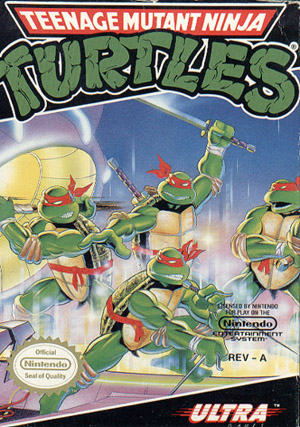
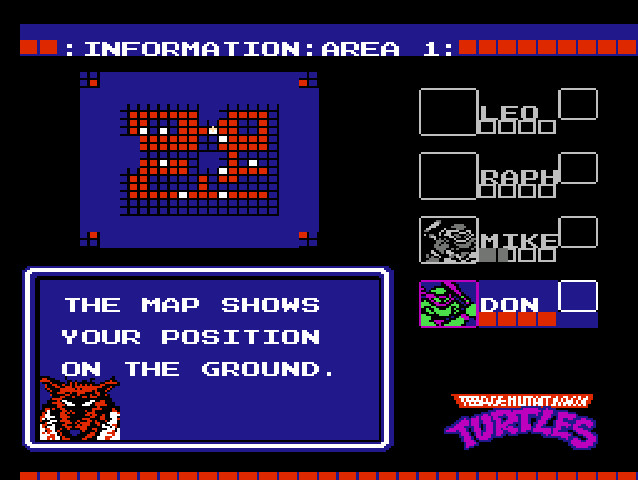
Teenage Mutant Ninja Turtles (1989) – NES

Did it bother anyone else that they were ALL Raphael?

Did it bother anyone else that they were ALL Raphael?

The Teenage Mutant Ninja Turtles rose to fame in the late 80s, attaining the height of their popularity in the early 90s.  Together with the Mighty Morphin’ Power Rangers, adjectives thrived during this time. The kids–myself included–just couldn’t get enough color-themed monster-fighting super-heroes, yet the forces of consumerism, which conquered both good and evil, happily tried to give us just that.  In 1989, a new cabinet started appearing in arcades.  Just another beat-em-up game at heart, to find the true beauty of Teenage Mutant Ninja turtles, you only had to dive skin-deep. (Hey, kids are allowed to be shallow!)

The popularity of the Turtles arcade game sent many people into stores to pick up the NES Ninja Turtle game released the very same year. Many rushed home after hounding their parents for this game, ripped open the box, shoved the cartridge into their NES, bent their connector pins ever so minutely toward total system shutdown and hit the start button…

…only to be miserably disappointed by the game they found.

While the internet raves about the 1989 NES game’s good reception and commercial success, I can’t help but wonder if it would have the same reputation if people hadn’t thought they could own a copy of the arcade game.  Everyone I remember who enjoyed TMNT video games had fonder memories of the beat-em-up than the NES game.  But memory doesn’t record like a camera, I know, and as my mother proves every time she tells people how I’d wet my pants playing video games because I refused to pause for bathroom breaks, sometimes people can completely fabricate memories.  Now if I only had evidence of this disappointment…say, a port of the arcade game to home systems immediately after the first game’s release…or even future games returning to the beat-em-up genre…

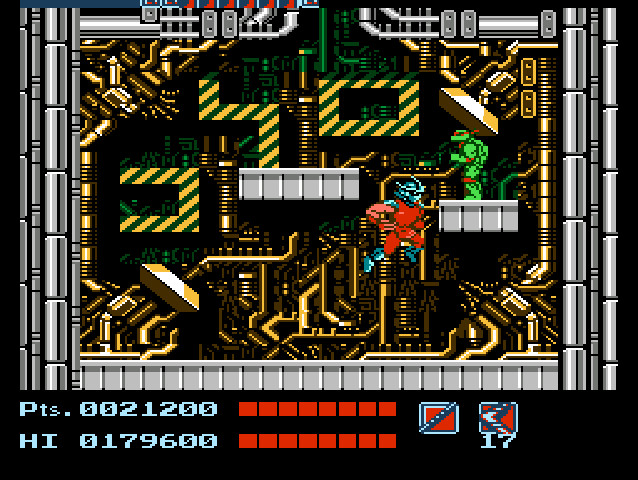
I have to respect a villain who does his own fighting...but Shredder was kind of a pushover after the rest of the game.

I have to respect a villain who does his own fighting…but Shredder was kind of a pushover after the rest of the game.

Still, I’d like to get at–in a roundabout way–the fact that the 1989 NES version of the Teenage Mutant Ninja Turtles actually surpasses the arcade game in a few ways…several ways…most…eh…well, let me ask you this; have you ever seen the 1978 animated “Lord of the Rings,” then compared it to Peter Jackson’s films? For the arcade release, Konami simply slapped a green, amphibious skin on the same game that’s been released over and over for what by now has got to be close to 25 years.  But the NES release blended side-scrolling action with a top-down sort of explorable map, while include an underwater swimming stage and a character select screen that let you switch between any turtle at any time.

Splinter looks really creepy in 8-bits

Splinter looks really creepy in 8-bits

I recently dug out the 1990 live-action film, which made me wonder…well, two things actually.  One, who sat down and thought “You know who’d make a good Donatello? Corey Feldman!” What, did Woody Allen and George Burns turn down the role?  And two, why does Hollywood feel the need to burn away everything popular with a series and then misinterpret the premise?  That’s like saying, “You know what people love? Strippers! So let’s record two hours of grandpa Fred prepping for and receiving his colonoscopy and call it the same thing! He is naked, after all!” People enjoy playing the Ninja Turtles game because they didn’t do that.  They released a game because people watched the TV show, and when they bought the game it resembled the show.  You fight Bebop and Rocksteady in the first level, save April, get a message from Shredder saying that he kidnapped Splinter, and then you chase him in the turtle van, then the blimp, and assault the Technodrome.

Stupid Mario never thought of this, did he?

Stupid Mario never thought of this, did he?

You get to do a lot of ninja-ey stuff like spin flips, grapple from building to building, and throw shurikens.  Furthermore, the game employed animated cut scenes between levels, which have now become a standard tool in creating down time while maintaining interest in the game.  When I looked up the release date, it shocked me how long ago they made this game, since it seemed well-developed even for a NES era game.

As opposed to the other guy who wears cheese graters on his shoulders?

As opposed to the other guy who wears cheese graters on his shoulders?

TMNT takes a few cues from Castlevania, including the detailed backgrounds, the secondary weapons, the enemy life display, and the brutal, unmerciful, harsh unforgivingness of the difficulty.  Whereas Simon Belmont leapt through the ledges of Dracula’s castle with the agility and control of a horse-drawn golf cart, the turtles all feel remarkably easy to control.  However, at times, dozens of enemies could criss-cross their way across the screen, and navigating safely around them reminded me of searching for a place to stand on the train during rush hour in Seoul (you’ve seen the videos of attendants pushing crowds of people into the metro? I’ve been in that crowd).  I discovered that not all turtles are equal.  Donatello’s staff has reach, but rather than handicap him in strength, he deals twice as much damage as any of the other characters.  Meanwhile, Raphael and his sai provided a useful target any time I couldn’t avoid taking damage, since his attack pretty much required me to get close enough to the enemy to pull his beard and tell him what I wanted for Christmas.

Theoretically, you could finish Castlevania with nothing but patience.  You may have to replay certain parts, but you had unlimited continues and only had to restart the level each time.  TMNT isn’t quite as generous.  It offers you two continues, and since each level involves a map full of explorable stages, getting knocked back to the start feels like more of a blow.  I wanted to write about the game though, but needed to get through to the end, so I ended up using save states.  I’d say though that it feels more manageable than Castlevania–except for two rooms of instant-death spikes and one long hall full of powerful enemies just before Shredder, it feels like a little practice would help reach more of the game just on the regular lives and continues.

This room! ....ARRGHH!

This room! ….ARRGHH!

Except for the afforementioned rooms of spikes, platforming elements remain mostly absent, so the player can concentrate on his ninjutsu.  Falling into holes or water won’t kill you, but it will wipe you back to the beginning of the stage (one tricky jump kept me from finishing level 3 for YEARS).

Despite unrelenting difficulty cutting off access to the later levels without hours of practice, TMNT does a lot of the right things to tempt the player into coming back for more.  Although it had the misfortune of not being the arcade game, it’s worth attention, as it provides countless replayable hours of Corey-free entertainment.

(Coming up soon, Phoenix Wright: Ace Attorney.  Most of the games I’ve written about so far have been those I’ve played in the past.  Soon I’d like to move onto those that are completely new to me.  I’m thinking of going through either a Sega or SNES RPG next.  Any thoughts?)

Twilight Princess – Game Cube, Wii

Me and My Scary, Impish Shadow

I’ve already established here that I enjoy longer games, so most of the time I don’t bat an eye at a game being 37 hours long; after all, I played through Fallout, Skyrim, FFXII, Xenogears and Xenosaga.  However, games that pad themselves out to fill a mandatory game-length limit have a tendency to turn my eye-batting into baseball-batting.  I tried to like Twilight Princess, I really did.  I thought I may have scathed it a little too much in my Oracle of Ages/Seasons article, so I flushed away five years of good sense and went back to it.

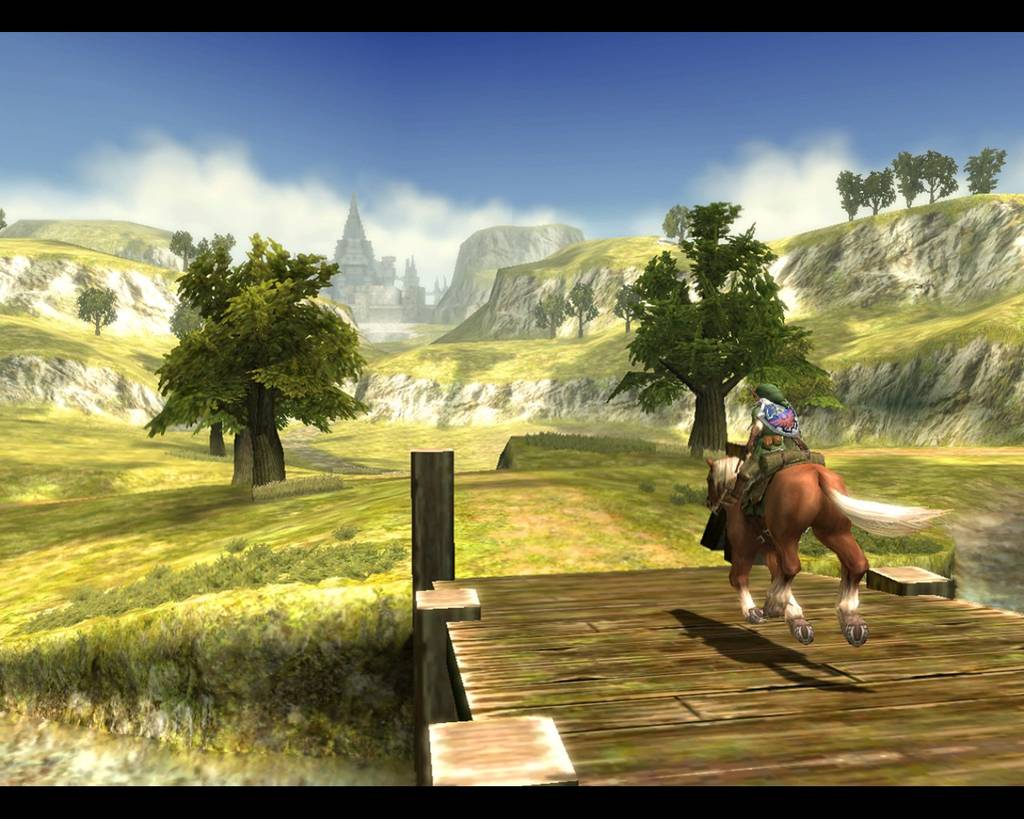
You know what I’ve never thought when playing a Zelda game?  “This sure is great, but it would be much better if the world were bigger and had less stuff in it.  Some endless tedium would give me a nice chance to look at the scenery some more!”  I don’t quite understand what Nintendo felt would be so appealing about magnifying the size of Hyrule to an area roughly the size of the moon, then filling it with absolutely nothing.

But I could compare Twilight Princesses lack of tasty filling to the lack of dust mites on your pillow; you can find shit if you know where to find it, and you probably stick your head in it all the time, but you’ll never see it on your own.  Whereas previous games like to taunt the player, dangling heart pieces just out of reach of the player to watch us rear up on our hind legs, dance a little, then plummet hundreds of meters off a cliff because don’t have hover boots, Twilight Princess hides its items, making you stare at them like a magic eye painting, trying to make sense of the image everyone else claims they can see.  Quite honestly, unless you play the game with a walkthrough in your lap, you’ll struggle just to complete the main story.

And this is about it...for thirty six hours...that's over a day, you realize.

And this is about it…for thirty six hours…that’s over a day, you realize.

See, Twilight Princess doesn’t limit its convoluted searches to bonus items; seemingly everything requires a drawn-out examination of a large area until you find one hidden path that you can jump to in wolf form after you’ve received the item to move a statue and done so while singing Carmina Burana in the nude with octoroks pelting you in the head.  Puzzles don’t have clear solutions either.  For example, at the beginning of the game they run you through a tutorial to show you how to wrestle a charging goat.  Therefore, it would make perfect sense when trying to get past the goron sentry who likewise charges at you, you’d know the procedure.  Right? Wrong.  Turns out you have to intuitively figure out to backtrack to the forest village and talk to the mayor so you can learn the ways of sumo.  And just for good measure, he tells you that it’s impossible to stop a charging goron without iron boots.

Simple.

The entire game does this to you.  Nothing turns a fast-paced game into a slow-paced movie faster than trotting around in circles like an idiot or diving for a walkthrough every time you get stuck.  I like challenge, but not insurmountable challenge.  (I’ve long hated games that require walkthroughs–I see them as an insidious plot to require people to drop $100 instead of $50, buying the “strategy” guide along with the game.)  For the amount of frustration put into adventuring, the in-game rewards usually feel like let-downs, especially after your 35th hour of finding small-value rupees in every chest, with cash being about as useful as a backpack full of Chuck-E-Cheese game tokens.

And the tedium doesn’t end with the adventuring–the items in the game show a truly bewildering lack of inspiration.  Most are useless after the dungeon you receive them.  Early in the game, you go through a lengthy fetch-quest to obtain a slingshot, only to receive the bow in the second dungeon.  If Link had tossed the slingshot into the lava at that point, I wouldn’t have noticed it missing.  Previous instalments of the series asked you to find clever uses for dungeon items, or to use them to reach the aforementioned dangling goodies.  These items often have one use only–the ball and chain breaks ice. Just ice–and you rarely use them at all until the obligatory use-every-weapon segment in the final dungeon, when you suddenly have to remember, “Hey, didn’t I get a boomerang in this game?” and to figure out that you can use it to put out fires. Likewise, bosses feel simple and uninspired, and I even beat one without taking any damage as he just swam around in circles, kindly offering me his weak point to latch onto and stab until he died.

Unless you're the lead dog.

Unless you’re the lead dog.

Link and Shadow Link, ready to serve you with fava beans and a nice chianti

Link and Shadow Link, ready to serve you with fava beans and a nice chianti

The game simply drags on too long to keep my interest.  I finished in thirty-six hours.  Do you remember my Radiant Historia time?  Also thirty-six.  Game designers tweak games to provide a precise length of play time.  Adventure/RPGs currently run about 35 hours, while action games run between 8 to 10.  SNES-era RPGs often wrapped up in 24 hours.  (Or perhaps I just have a very consistent way of tackling similar games…I can’t be sure) This practice leads to padding, and Twilight Princess pads itself more than a menstruating hockey player pulling a hot pan out of the oven.  Dungeons typically require two hours to finish instead of one hour (as in Ocarina of Time and Wind Waker), and in between you occasionally have to rescue the Spirits of the Macguffins by dealing with their cockroach problem using your wolfish powers of Raid, and there will be no side-questing until you finish.

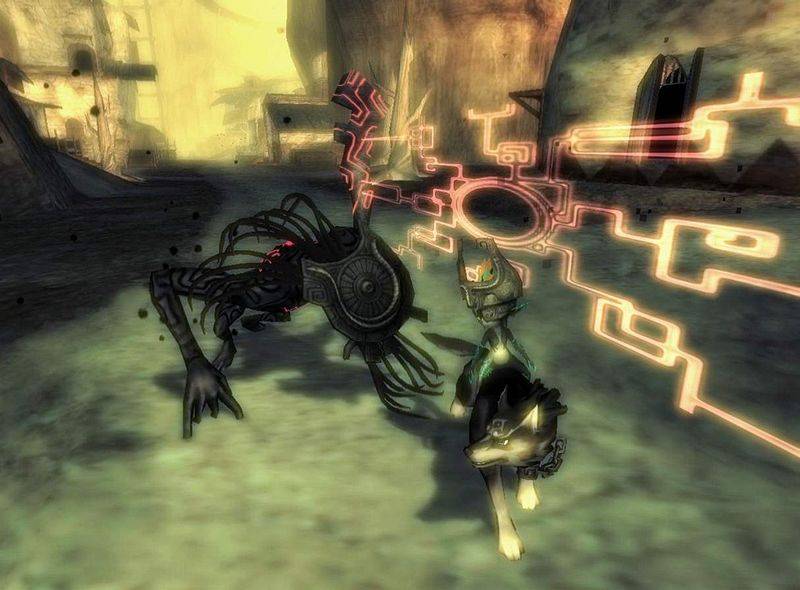
For all I disliked it, Twilight Princess did some things right.  The ability to transform into a werewolf that I previously descried as “gimmicky” actually adds an interesting element to the game, and plays off the familiar idea of Link traveling between parallel worlds.  Midna proves herself as a companion perhaps not quite as knowledgeable as Navi, but darkly intriguing and vital to the story.  But the game truly excels at setting tone.  The themes of twilight and shadow cast this game in a different light than others.  Atmosphere and mood usually stay consistent throughout the game. Nintendo even designed the light-hearted race of sentient chickens to look creepy as hell. If you have a flair for gothic overtones, I suggest playing through Twilight Princess at least once.

With Skyward Sword disappointing so far, I don’t think we have to wait long before even Gannon gets tired of coming back to Hyrule.  He’s used all his brief stints of freedom to conquer the kingdom, but he knows they never last long.  Pretty soon he’ll break free of his prison and find greener pastures, and then we won’t have to worry about hunting the eight legendary whatevers for a princess who doesn’t show the slightest interest in the hero.

It's not me, it's you...okay, it's you.

It’s not me, it’s you…okay, it’s you.

Sorry for the long delay in posting, but as I mentioned, I go for longer games.  The semester starts in three weeks, so at that point look forward to probably no more than one entry per week. Coming up soon, though, I’ll have Phoenix Wright: Ace Attorney, or possibly Teenage Mutant Ninja Turtles.

And if you’re fans of the classics, take comfort in knowing that for part of the boss battle, Gannon takes the form of a pig.

And hey, I made it through the entire post without a single Alpo joke!

Skyward Sword – Wii – Initial reactions

This isn't combat.  You realize he's just using "the all-powerful sword forged by the goddesses" to mow the lawn, right?

This isn’t combat. You realize he’s just using “the all-powerful sword forged by the goddesses” to mow the lawn, right?

Link deserves a lot of credit for what he does.  In Ocarina of time, he rolled out of bed to slog through spider-infested lumber after only a short search for a sword and shield.  In Link to the Past, he wakes up and immediately saves the princess in his pajamas. In the Wind Waker, not only does he get jostled from a sound sleep at the start of the game, but he does so without killing the obnoxious little sister who wakes him up; then he gets dressed, has a quick lesson with a sword, and starts his first monster safari, one can only imagine to use their hides for sheets and blankets for his next big fit of narcolepsy.

I guess Nintendo wanted to build the impression that Hyrule’s archetypal hero must be someone who can accomplish herculean tasks with little or no preparation.  I like this. It gives me a unique way to bond with Link.  Sometime in college I started to realize that normal people couldn’t do this, that it took them hours before they can muster enough brainpower to stumble to the toilet and figure out how to flush.  One of my roommates even once challenged his alarm clock to a snooze-marathon; he managed to sleep for two hours straight, five minutes at a time.

A wooden sword? Did you whittle this yourself while sitting out in front of your cave yelling at the hoodlum octoroks to stop tearing up your yard?

A wooden sword? Did you whittle this yourself while sitting out in front of your cave yelling at the hoodlum octoroks to stop tearing up your yard?

Of course, this holds bigger implications for the Zelda series.  Beyond the simple metaphor of beginning of a journey, giving the hero a call to action and all that literary blatherskite, it demonstrates an expectation of pacing for each individual game.  The original dropped Link into Hyrule so desperate for action that he grabs the first sharpened stick he sees and starts stabbing monsters right away. The Adventure of Link doesn’t even ask him to find a sword!

I got Anne a Wii and Skyward Sword for her birthday.  Since I’m droning my way through Twilight Princess, I’ve noticed a few things.  One, I can only take so many large-scale Zelda games at a time before I go batty and try creative feng shui to open my front door.  And two, newer Zelda games pace themselves in such a way that watching sap leak from a tree reaches a thrilling conclusion before Link does.  In Twilight Princess, I didn’t get a sword for an hour and a half, and when I did I couldn’t quite hold it between my paws.  Skyward Sword tops this, with nearly two hours of initial hellos, heys, and re-teaching fans of the series that Link holds a grudge against all things terra cotta.  Three hours into the game, Anne has barely reached the “hero’s call” moment to initiate the plot, and has dicked around in the woods, warming up to the weird new race of the game, wining and dining them before they feel comfortable enough with Link to go out with him on a big date to the first dungeon.

Furthermore, even though Navi ticked off fans with her constant cries for attention, and Midna never offered any useful suggestions for advancing the quest, the new companion has the personality and emotional range of a sack of flour.  Honestly, I almost compared her to an anthropomorphic instruction manual, but I used to enjoy reading through instruction manuals.  She comes off like a placeholder that developers forgot to replace with a real person before they released the game.

I do find the sky setting intriguing, though.  Not so much for the unique ideas it brings to the series to make it unfold like a new story rather than a further re-hash of Ocarina of Time, but rather for the trend that Nintendo seems to have established.  The Wind Waker gave us a water-themed world, and Skyward Sword boast an air theme.  I half-expect the next big Zelda release to take place entirely underground, followed by, I don’t know, a game where Hyrule has inexplicably relocated into a volcano.

While I haven’t played through the entire game yet and therefore can’t officially submit a review, my initial impression of the game leaves a bland taste in my mouth–the kind of taste you only get when you’ve eaten an entire bag of Doritos and the salt has temporarily burned your taste buds into numbness.  I do enjoy games with well-developed, complex plot, but Nintendo needs to learn that long tutorials, useless fetch quests, and a speed-dating approach to learning the characters in the game isn’t the same as useful exposition.  Link traditionally begins each game by waking up, not by putting the player to sleep.  It reminds me that players can’t assume a game will be good just because the series on the whole has kept up a good name in the past.

Advice for future releases.

Advice for future releases.

Just Dance 2 – Wii

Just_Dance_2_Coverart

If you’ve developed some small inkling of my taste in games, you might realize I enjoy clever concepts, well-written stories and thoughtful gameplay that evokes appropriate tone and an immersive experience.  Well, go grab a welding mask and all the bottles under your sink because I’m going to blow that image to kingdom come. At this point, imagine me standing up from my folding chair, facing the other shy, timid members of my support group and admitting to myself and the world, “My name is Jake, and I’ve played dance games.”

This really shouldn’t shock anyone.  If you’ve found your way to this blog, I’d wager my last three paychecks on “You Being a Couch Potato” to win, place, and show.  I’d even throw in a side bet that, like me, you spent most of high school wondering why the idiots catch all the breaks.  Put quite simply, the academic lifestyle doesn’t suit us as human beings.  Despite what we tell ourselves, even being an intelligent species doesn’t count for much in this world. Don’t believe me?  Why don’t we compare human population and evolutionary history to that of the cockroach and then come back to the question, “Who is mother nature’s pet?”

No, ours is a peaceful, sedentary life.  We move on a geological scale, and then usually for no reason other than to pee or change the game.  Think I’m exaggerating?  When I lived in Korea, I found that once every few years or so, some poor overworked Asian kid will play Starcraft for three days straight with no food, drink, or sleep and drop down stiffer than Rick Santorum at a Fire Island rave.  As gamers of the fantastical rather than the athletic, we sometimes have to put in extra effort in order to…you know…stay alive.

As such, Anne has for years tried to get me to play Dance Dance Revolution.  After all, it’s a game, right?  It shouldn’t bore me like regular exercise does.  Still, I can’t stick with it for more than a few days.  DDR has serious problems.  First of all, the hardware sucks.  Despite my overly large feet, I hit the target buttons on the pad with the accuracy of someone trying to hit a mosquito with a water pistol in a football stadium while blindfolded and getting assaulted by angry badgers.  Furthermore, to get the cords to run from the TV to the console to the pads, I have to completely rearrange my living room.  And yes, I’m well aware of the absurdity of descrying physical labor in preparation for exercise, but I get the right to complain because, bottom line, it makes me not want to play the game.

However, Just Dance, Ubisoft’s answer to the music/rhythm/dance genre, makes wonderful use of the gimmicky Wii controls in order to solve pretty much all of these issues.  You just strap the Wii remote to your wrist, find a spot with a little bit of space where you won’t put your fist through a lamp shade or trip over the coffee table and give yourself a concussion, and get your proverbial groove on.  After selecting your song, a radioactive neon humanoid avatar appears and starts dancing.  The player simply mirrors the actions they see.  Periodically, like the arrows in DDR, a pictorial description of the next move will slide onto the screen which make as much sense as translating Egyptian hieroglyphs, but with practice and repetition they give the player a better idea of the dance moves.

The glowing, indistinct faces ensure that Ubisoft doesn't have to pay anyone likeness rights.

The glowing, indistinct faces ensure that Ubisoft doesn’t have to pay anyone likeness rights.

While DDR focuses entirely on the lower body like some sort of post-modern Riverdance, the Wii remote emphasizes the upper body.  Quite frequently this made me neglect the footwork, but often I found that getting the lower-body moves right actually made the upper body moves easier.  Never involving myself much in the clubbing scene, modern dancing always makes me feel awkward and dorkish.  Just Dance doesn’t solve that problem completely, but forcing me into a complete dance routine feels much more natural than clomping around a square-meter size pad, an activity much better suited to popping mass quantities of bubble wrap.
Just Dance grinds DDR into pulp on one other feature–the music.  While DDR seemed to operate under the suspicion that contemporary night clubs invented the concept of “dance,” Just Dance appears to understand that physical expression of music can span beyond the trite, vapid beats of techno.  We bought Just Dance 2 specifically for the song list it offered, which contained Hot Stuff (Donna Summers), Jump in the Line (Harry Belafonte), Soul Bossa Nova (Quincy Jones, but you’d recognize the song as the theme to Austin Powers), and other genres, such as a song by Elvis and even a Bollywood dance number.  It’s as though the designers wanted to give you a selection of experiences, rather than just “Select song. Listen to the beat. Step on arrows.”  As a caveat, yes I should admit that most of the time you’ll be shaking your ‘mote to techno dance music, but I appreciate the alternatives, and may even spring to buy Just Dance 4, which would be the first game to ever Rickroll me, and also includes the Time Warp, a song I already basically know the moves for (Just a jump to the left, right?)  As an added bonus that will benefit both the music lover and the fat, lazy slob who needs to exercise alike, Just Dance plays the entire song for you, rather than just the 90 to 120 second bastardization you get from DDR.

One side of me wants to mock modern game designers–Nintendo most of all–for trying to develop video games for people who don’t really want to play video games.  Yet the other side of me realizes that in this mad dash to increase their profits (which may end up alienating traditional players like myself), they’ve actually made the practice more mainstream.  At thirty years old, I can whip out my Nintendo DS in public and not be shunned and avoided for the sociopathic freak that everyone used to think I was.  So while Just Dance or DDR may target the ditzy sorority/fraternity crowd looking for party games, I have to tip my hat and offer a certain amount of respect to them.  Furthermore, whether they intended to or not, these games promote public health.  They’ve found a way to let me exercise by disguising it as something I find interesting, so I might just have to recommend the game to anyone who spends a large chunk of their life glued to a screen.  And also I’d recommend an industrial strength solvent. You shouldn’t glue yourself to anything.  That’s unhealthy.

Super Metroid – SNES

RetroArch-0713-103210

I might say I like the original Metroid, but I’ve heard other people say they like coffee or wine, and I always find myself wondering why.  They might be good ideas, but one taste leaves a bad taste in your mouth and the feeling that you’ve just wasted a little bit of time and a lot of money.  I’ve made it through Metroid, although if I didn’t dig up a map online, the game would have lasted long enough for me to realize that every room differed from the others only by location, and since the developers didn’t have the foresight to include a ball of string among the gear Samus finds on planet Zebes I had no way of knowing whether or not I was actually progressing through the game.  I also find refilling life a bit tedious since it requires camping out by pipes, toasting enemies as they pop out one at a time until I’ve consumed enough monster s’mores to rival a seven course meal in order to refill my energy tanks.  Modern developers, I’m afraid still insist on padding out games with long tedious fetch quests and back tracking.  Metroid Prime spent an entire game sending me to the farthest edge of the map from wherever I happened to be standing as though the game were a popular kid trying to find amusing ways to get rid of me whenever I tried to hang out with the cool crowd.

Fortunately, though, Nintendo has provided us with a period of their history when they made games that challenged us without being convoluted, and as such, today I bring you a review of Super Metroid!

At least, I’d like to review it, but that would require thought, objective reasoning, integrity, yada yada.  But I’ve played this game far more than any other game I’ve written about yet, and don’t really see much of a downside. Nintendo conceived the series as combining the action/platforming aspects of Mario with the adventure and item collection from the Legend of Zelda.  I don’t know whether to credit them with brilliance for figuring out how to make platforming games bearable, or with more luck than the human mind can fathom since they managed to add platforming to Zelda and not screwing up completely. For further spice, Yoshio Sakamoto, in a power play move I outlined in my Pitfall review, ripped off tone, setting design, and a name for a recurring antagonist from Ridley Scott’s 1979 film, Alien.

Super Metroid follows the continuing adventures of Samus Aran, intergalactic bounty hunter, role model for young girls, and prime candidate for Miss Universe (having been one of only a few women in the gaming world to have actually lived in the Universe), as she hunts down the galaxy’s last remaining metroid larva.  Stolen by Space-pterodactyl-dragon-thing, Ridley of the Space Pirates, she tracks it to the planet Zebes, home world of Samus and the extinct Chozo race, as well as the setting of the first game.

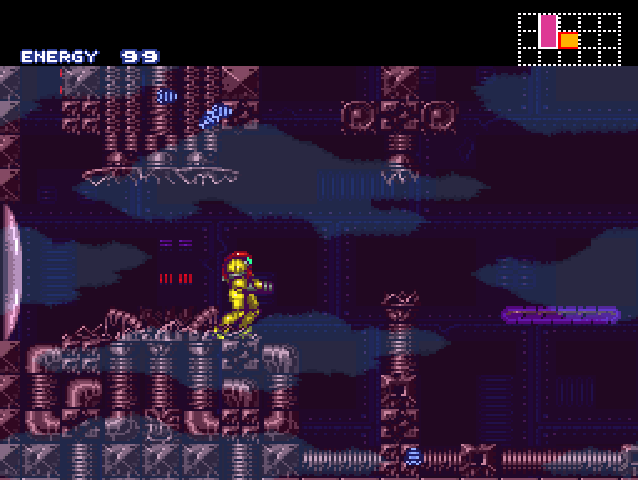
RetroArch-0713-075234The brilliance of Super Metroid shines through very early on in the dismal, gray, creepy section of the game.  Samus lands on a seemingly abandoned planet, and immediately explores areas identical to the few areas from the NES game that actually stood out from the others.  Having lived on a planet that takes millions of years to move continents, I’ve often found video game geography a curious phenomenon that redesigns plate tectonic structure sometimes within a matter of hours.  While an entirely new map does give a fresh new take to each instalment of a series, the fact that a few areas present actually make sense to be there helps make the game seem a little more plausible.

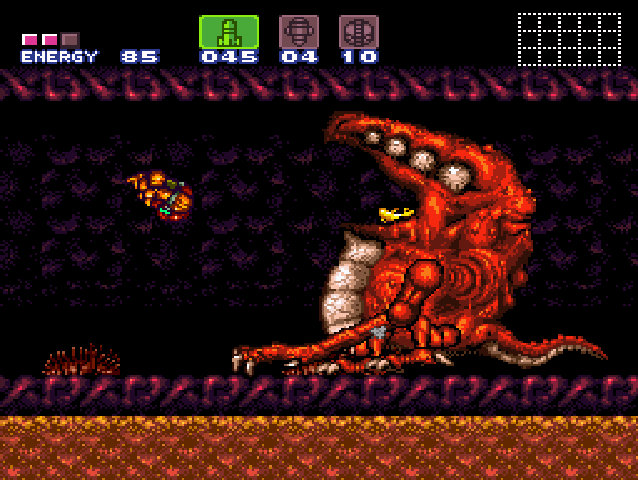
RetroArch-0713-082146While I’m on the topic of geography, Nintendo bestowed another gift upon us, an in-game map!  Honestly, I jest, but as the lack of a map seriously hampered the players ability to finish–or play through–the first game, simple changes such as this make the game highly valuable. Other additions to the game just add flavor.  Samus once again travels through the plant-infested tunnels of Brinstar and the liquid-hot ‘magma’ of Norfair, but also takes a swim through Maridia and explores a wrecked ghost ship on the surface.  Some old bosses return–as a prank played on fans of the original, you fight a kraid who is proportionately the same size as the 8-bit morbidly obese uncle to Godzilla, only to find out that the real Kraid has grown to double-screen size.  New bosses and mini-bosses join the mix, each with a unique attack pattern.

Samus finds new items on planet Zebes, which as usual make me question the sanity of Chozo engineers.  While people in a fantasy-inspired medieval setting could reasonably find uses for all of the items in The Legend of Zelda (at least, the first handful of games), I still wonder what use a sci-fi bird race has for an item that turns them into a ball, especially considering that a majority of Americans would pay top dollar for a device just like it, but that works in the opposite direction.  Still, tools such as the spring ball, space jump, and screw attack give the player a certain satisfaction out of being able to explore new areas and reach new items.  Many games place high-value power ups in difficult to reach spots, ensuring that once the player reaches them, they’ve already completed so much of the game that the new item may surpass all else in coolness, but becomes absolutely worthless since there’s nothing left to use it for.  Super Metroid, though, offers the ability to increase missile, super missile and power bomb capacity, so the player has the opportunity to use high-value items to locate useful missile upgrades near the end of the game.

CrocomireSuper Metroid adds up to a colorful, in-depth game that you can still play through in under three hours.  If NES developers kept falling back on beefing up difficulty to enhance replay value, then current-console developers can share their guilt for buffing up play time.  Yes, it’s nice for a game that cost $50 to last a little while before you get tired of it and throw it on the heap, but that doesn’t mean we’ll never want games we can play in a day, and some games just drag on indefinitely–by the tenth hour of turning giant stone gears in God of War, I can just about feel the burn for myself.

Metroid, on the other hand, not only takes less than three hours, it also rewards you for completing it that fast! The quicker you finish, the more parts of her power suit Samus takes off after the end credits.  This feature of the game holds me up (shut up! That wasn’t a pun!) a bit, though. The NES Metroid featured a character that everyone–developers included–assumed came equipped with standard action-hero genitalia.  Near the end of the project, one programmer mentioned offhand how neat it would be if the person in the suit was a girl.  The rest of the team ran with it, and as a result, the original Metroid ended with a surprisingly powerful statement on gender roles and assumptions in society, along with giving us a positive female role model (however manufactured she may actually be).

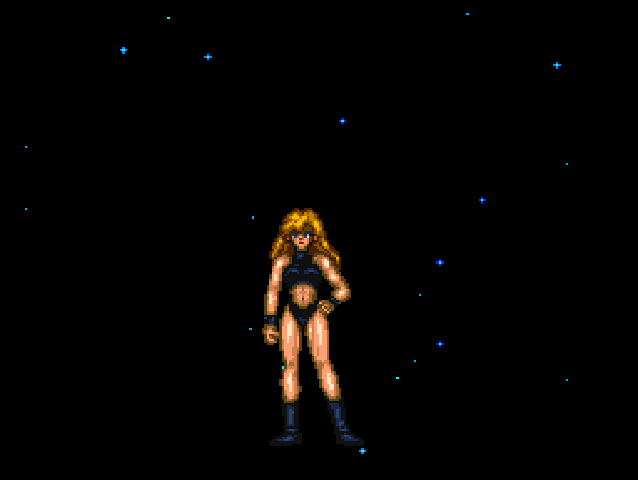
Still, she took off the suit regardless of your performance (shut up! I’m not making puns!) in the first game.  Here, she offers it as a reward, and the broken-down gender roles patch themselves up and slather on a new coat of cement.  The purpose of setting this as a goal does nothing more than prey on a young male audience desperate for any sort of vicarious, pixellated sexual encounter they can pretend they’re having.  If I had to pick out a flaw in this game, I’d have to say the goody at the end turns Samus into pre-adolescent nerd porn.  Hopefully, the fact that she’s a kick-ass female Boba Fett with no goofy femme problems or love affairs shoehorned into the story (I’m ignoring “The Other M” for the time being) will cover up this indiscretion.  And if you don’t agree, here’s a picture of Samus in a bikini:

Samus gets naked. Mostly.

Sexy…if you go for women from the 1980s.

Radiant Historia – NDS

Image

I’ve done it!  After thirty-six hours of gameplay and a handful of short games to stall for time, I’ve finished Radiant Historia for the NDS!

Years ago, as a result of being forced to read Melville, Dickens, Dumas, and other people desperately in need of an editor, much of my fantasy intake shifted from Tolkien, Dragonlance novels and Terry Brooks (or as I call him, “Diet Tolkien”) to RPGs.  I tell you this not because I’ve made a habit of starting my posts with boring personal stories, but to let you know ahead of time that I like a lot of games that probably don’t deserve it, mostly based on the story or the setting.

If you’ve ever read a fantasy novel or slogged through any fantasy RPG, you’ll find Radiant Historia comfortingly familiar as it follows the genre’s traditional format of taking ideas used elsewhere and slapping them together like the last few leftovers in its fridge; it’s never eaten them together before, but going to the store before dinner would take too much effort.  As a result, fantasy always gives us something new and exciting that may not always smell right or look right, but damn it, it’s new!
Image
The story opens with your standard issue ongoing-war-between-two-nations and has your run-of-the-mill vaguely-supernatural-force-working-behind-the-scenes.  The main villain wants to annihilate existence, a motivating force brought to absurdity in Final Fantasy, and most of the plot twists were dragged kicking and screaming right out of Star Wars.  Also, following the current trend of modern games, the characters look as though the artist took the Sumo Diet approach to design, where they put the pencil on the paper and didn’t stop drawing until their jaw got tired.

Special Intelligence operative, Stocke, receives a book from his superior along with instructions to rendezvous with an informant.  On his mission, a battle breaks out and he has to get to safety with his two comrades.  The game forces him to choose between the escape route on the left and one on the right.  He immediately picks one that leads to a brutal slaughter at the hands of the executioner for the enemy kingdom.  However, the book warps him into an M.C. Escher painting which gives him the option of replaying portions of his life.  Already knowing the wrong answer, Stocke takes the right path, his comrades survive, the kingdom repels the invasion, and the very fabric of space and time accidentally splits open into two separate histories.  Teo and Lippiti, two children who guard the gates of history, give him the quest to set history back on its intended course. Image

Honestly, I could think of a hundred more useful applications for time travel than “setting the course of history right,” many that make me wonder if naming the protagonist “Stocke” was entirely coincidental, and the rest of which had previously been suggested by Scott Evil, only to be shot down as inconsequential paradoxes.

While people may complain about cliches and hackneyed writing, I might remind you that no one actually wants an original story.  Tolkien himself just blended images from Norse myth, Arthurian legend, Shakespeare and an ungodly knowledge of European languages.  And don’t forget Terry Brooks, who drew from a list of sources all the way from Fellowship of the Ring to Return of the King.  So I find that area of the story highly forgivable.

But the aspect of multiple histories sets it apart from other stories in the genre.  Promotional material compares the game to Chrono Trigger because of the ability to travel through time, but that doesn’t tell us anything other than Atlus wanted to boost sales by comparing their game to one of the most popular RPGs ever released.  Time travel in Chrono Trigger extends outside of the characters’ lifetimes and manipulates events important to the world, much like Back to the Future (and while I’m on the subject, look up your dates people before posting those ‘this is the date that they went to’ on your Facebook or Pinterest page).  Radiant Historia more closely resembles Groundhog Day, in which the protagonist relives events on a personal timeline with the opportunity to rectify poor decisions he made earlier in the game.  The tutorial at the beginning explains that these choices will branch off into alternate histories.

I’d like to pause here because this idea spices up the game with a mechanic that shouldn’t really be as original as it comes off.  RPGs and video games in general spring up from the excitement a player gets over influencing the course of events; however, most often they have no more choice than whether they’ll win this battle or pursue a new career as electronic carrion.  The availability of alternate histories means that the story no longer carts the player from battle to battle; it actually becomes part of the process of playing. I would play more games if they worked this into their concept.

Unfortunately, Radiant Historia falls short of using this expertly.  You make one decision early in the game that splits the universe into two different histories, but nearly every choice you make afterwards has two possible outcomes: continue along the path of history, or die suddenly and miserably, at which point the game warps you back to a point so far back that you’ll have to warp forward just to make the correct decision to move forward with the game.  It gives you the option to skip cut scenes, but if you fought any battles between where you are and where you need to be, you just have to suffer through them.  For most of the game, I actually felt as though I were playing through a poorly constructed choose-your-own-adventure book.

While the game does include some novel uses for time travel, it feels like the developers discovered what they could do with it as they went along.  Early on, you fall into a noticeable groove of moving ahead until you needed a skill or item that could only be obtained in the alternate history, switching over to that time line, then repeating that process.  I didn’t find it incredibly difficult to figure out how to progress when they began to deviate from that process, but on one or two occasions I felt more like I was playing Pong than an RPG, warping back and forth, fighting the same battles over and over while trying to figure out at which specific point in time the game wanted me to swipe the tools lying out on a table in a room I visited at during at least five different game events.

An hour or so into the game, I began to notice that I hadn’t had the chance to fight yet.  The game opens with a long expanse of plot, after which you have the opportunity to swing your sword once or twice in a tutorial, only to return to another stretch of story.  While I enjoyed Xenosaga, I managed to tolerate the endless hours of expository babble inserted between game events, but on the NDS, the amount of backlit text I need to read makes me acutely aware that my eyeballs are slowly melting back into my head.  Furthermore, like most RPGs, dialog has a tendency to repeat itself, adding Radiant Historia to the list I mentioned earlier of people who desperately need editing.
Image
But when the combat did pick up, the battle system really showed some ingenuity.  The game places enemies in random locations on a 3 x 3 grid.  The characters, lining up in a style only seen in classic RPGs and firing squads, concentrate special attacks that push or pull the enemies into specific locations, giving them the chance to employ other attacks that target specific shapes or areas, or just allowing a single attack to hit multiple enemies at once.  Effective manipulation of this system results in combo, with longer chains giving you a higher combo level.  For higher combo levels, the game awards greater experience at the end of battles.  At first, I enjoyed this system.  It gives the player options.  All too commonly, RPG battles get repetitive and boring since for all the special attacks available, “Attack” usually ends up being the best option, so you can win most fights by holding down the “enter” button.  Radiant Historia, however, forces the player to use special attacks, and the random placement of enemies requires a different strategy for each battle.  Furthermore, for the cost of a slight drop in defense, any character can exchange turns with any ally or enemy to change the order of attacks.

ImageI enjoyed having such a complex, yet easy-to-use system, so it disturbed me quite a bit when I found out that the battles still felt repetitive.  It took me a while before I realized why: this game is incredibly easy!  After I learned how to effectively manipulate the system, I became more of a photographer than a medieval warrior, making slight adjustments to line up the enemies, make sure they didn’t close their eyes, and then snap the picture to end the fight.  In fact, only the final boss gave me any trouble at all, and mostly because he occupied all nine spots on the grid.  See, while the player has an arsenal of choices for finishing a battle, the enemies can’t do much except fight.  As Valkyrie Profile 2 taught me, allowing either the enemies or the player to do something that the other can’t tends to make the game as balanced as someone who blows up abortion clinics to show how pro-life they are.

Still, by the time combat turned into a bad date that I somehow couldn’t ditch at the restaurant, the story had arrived with the meal that gave me the excuse to ignore it.  I always enjoyed something about the game, which I understand doesn’t ring praises to high heaven about it, but Radiant Historia deserves attention at the very least for pioneering concepts I hope to see more often in the future.  Or, perhaps, they could go back in time and introduce them into past games instead.

Pitfall – Atari

Image

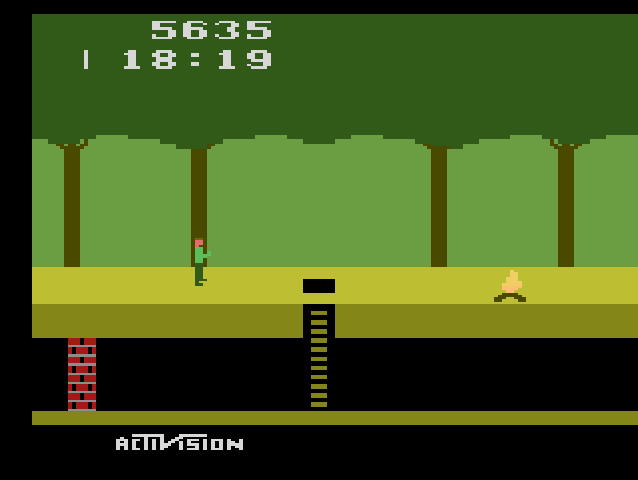
Good news! I finally fixed my obnoxious Atari 2600 problems, so now I can game the proverbial school so old, its age actually exceeds the real high school I attended.  Released in 1982, the game I’d like to write about today holds the rare distinction of being a video game older than me. That’s right, I’m reviewing Pitfall, in case your eye didn’t immediately wander to the screenshot at the top of this post.

Donkey Kong appeared in arcades in 1981, and a year later Activision released Pitfall for Atari systems.  People loved these games.  They had a simple concept, yet provided enough challenge that many people never saw the end.  In this way, Pitfall and Donkey Kong began the scourge of frustration known as the platformer genre, much like two drug dealers who generously shoot a free sample of heroin directly into your veins, giving you the rush of pleasure followed by a decade of dependency, stress, bankruptcy, wasted time, and anger issues while never quite living up to that first dose.

Despite Donkey Kong’s title as arguably the first platformer, Pitfall introduced many of the features we now associate with the genre: side-scrolling levels that take up multiple screens, a number of different enemies and obstacles, the possibility of death by falling into holes, a timer, and a score counter that means absolutely nothing compared to the bragging rights of having actually finished the game.  You play as Pitfall Harry, a character with a name unfortunately easy to pervert at an elementary school lunch table.  As Harry, you run through a jungle of various assorted dangers including crocodiles, rattlesnakes, scorpions, deep pits, and…uh…campfires?

Image

Your goal is to accumulate a vast amount of wealth by picking up treasures just lying around in the wilderness for anyone to take them.  The design of the character and the tone of the setting evoke powerful images of…oh, hell with it.  It’s Indiana Jones without the nazis.  Game designers in the eighties loved to push the bounds of plagiarism–but in a good way–and they based all the best games off concepts they saw in movies.  Doesn’t Donkey Kong climbing up the side of a building with a girl bring anything else to mind?  (Just do me a favor and don’t tell me what movie Burger Time came from.)  I find this amazing considering that any game licensed and based on a movie today contains less fun than a lump of coal, with slightly lower replay value.

Image

But I’ll play this game, and not for the badly pixelated Harrison Ford, either.  As much time as I’ve spent comparing them, Pitfall upped the ante for Mario.  It gave us other things to do in a game besides dodging barrels.  It gave us the concept of attack patterns–yes, you get the rolling logs like the barrels from Donkey Kong, but it also introduces snakes that Harry has to jump over, scorpions that move back and forth, making those jumps more difficult, and crocodiles who periodically open their mouths to swallow you like a gazelle stupid enough to drink from the river.  Holes proved fatal, as far as I know for the first time in video game history, and the player had multiple ways to clear them, either by jumping from crocodile to crocodile like a gazelle too stupid to walk around the small, circular pond, swinging from a rope–at which point the game plays an awkward sound that I eventually figured out was supposed to sound like Tarzan, or he could time his dashes across expanding and contracting pits.

While the historian in me loves the significance of Pitfall, the player in me can’t exactly pinpoint why I tolerate it so well.  It remains, by no stretch of the imagination, the first of the modern platformers.  It sends me on long, challenging levels fraught with instant deaths, and it erase all my progress at the slightest step into the shallow water and forces me to start over.  I can’t say that my limited exposure to this game in my youth makes it new and exciting now–I never played Sega until recently, yet one minute of Sonic the Hedgehog and I’ll break records for how fast I can shut off the game.

Image Image

I’d put my money on the difficulty level.  The game pushes you back–you can’t win after only an hour or two of trying.  Yet at the same time, the pacing of the enemies and obstacles don’t wear your nerves.  You handle one or two problems on a screen.  Can you jump to the swinging vine?  Okay, now try it with rolling logs.  You did that?  Great.  Now jump over this rattle snake while dodging logs.  Different problems combine to make new challenges, but you get to deal with these problems in a reasonable manner.  Platform game designers often place too much emphasis on small platforms and large pits, shifting the focus of the entire game to avoiding a plummet to your doom.  Pitfall includes that challenge, but in moderation; you can’t cross certain ponds without jumping from croc head to croc head without falling into the water or stepping kindly into their teeth, but this sort of obstacle only shows up every once in a while, and as soon as you’ve proven your skill at not dying, it goes the hell away for a little while!

Modern platformers can’t handle the concept that once you’ve gotten the hang of something, demanding that you repeat that skill ad infinitum only produces two outcomes: lynching yourself with the controller cord in anger over making a stupid mistake, dying and being sent back to the beginning of the level, or becoming helplessly bored.

Pitfall definitely piques my historical interests, and certainly shows an example of designers pushing past the bounds of their technology.  Granted, the inane infantile nature of the platforming genre doesn’t exactly endear itself to me, so I have to admit I doubt I’ll form fond memories of playing Pitfall until I wet myself because I can’t pry myself away from it long enough to use the toilet, I will break down and say I don’t suffer quite enough while playing it that I’d never go back to it.  I could definitely find worse things to do while I’m waiting for a pizza to arrive.