The Greedy Cave – Android

I spent all of the fall semester student teaching! And while I do so enjoy working a full-time job for no pay while being charged thousands of dollars in tuition to tick off a box on a checklist to let me get a job I’ve done for over a decade, it does tend to fill up my time with pointless busywork. So here’s a review from Anne, currently in rehab for Android game addiction!

the-greedy-cave-apk-003

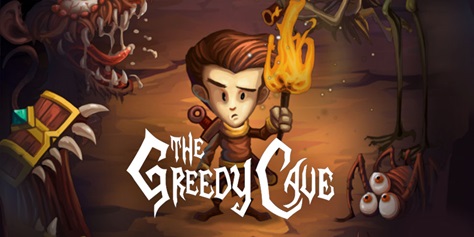
Recently, I found and downloaded a free-to-play game for Android called Greedy Cave. This is not a new release or anything, I’m just, as usual, so late to the party that even the clean up crew has finished up and left. That being said, I found myself becoming more and more caught up in the game. I had to sit there and think about one of the phrases in that last sentence, ‘caught up’. I almost wrote immersed, then deleted the letters and wrote enamored but of course that wasn’t right either.

This is not a game you play to enjoy. That is not to say it is a bad game. In fact, the creators of this game have discovered one of the oldest tricks in the gaming handbook and are doing it quite well. This trick is to create a level grinding game that rewards you in several ways. The first is that discovery and the act of moving through the levels will lead to prizes. Wow, acknowledgement for doing what we’re meant to do, thanks for the participation prize. But it happens just rarely enough that we keep wanting to move forward. Additionally, by moving forward you gain gold and also open chests, both of which get you better gear. Now, this in and of itself isn’t exactly stimulating but here is where the developers shine; when a player goes out into the over-world, they are forced to walk by other players and let me tell you, the first time you have to walk up to the weapon forge wearing a hat made of sticks tied together and what looks like someone ran off with Tarzan’s loin cloth while a host of Korean avatars walk, sit, and even fall asleep wearing armor that makes them look like Sith Lords, Nazgul, or King Arthur, you start looking to find better armor fast.

I have put close to thirty hours into this game so far which, having played through Disgaea a couple of times and having racked more than 200 hours up on one of those play throughs that probably doesn’t sound like much but remember that this is a phone app. There is nothing inherently wrong with phone apps but why am I putting this kind of time into a game that has no end in sight and which comes down to a hard core gamer’s version of dressing up paper dolls. Yet, I can’t seem to walk away. Trails of Cold Steel, a game I spent money to buy new when I never buy new has sat unplayed for nearly a week and a half for a game that asks one to follow narrow corridors, fight monsters, open boxes, and dress up so they can go down slightly different colored corridors, fight slightly harder monsters, open fewer chests, and dress up like someone prepping for Comic-Con.

But remember, I don’t have a problem. I can quit anytime I want to…I just need slightly better armor first so if you’ll excuse me.

Shovel Knight – Computer, 3DS, PS Vita, PS3, PS4, XBox One, WiiU

shovel-knight

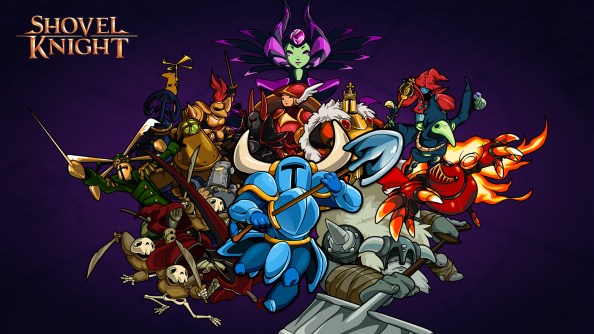
Shortly, all games will legally require artwork wherein all the game’s characters stampede outwards from the box in dramatic recreation of either the Big Bang or a Kool Aid commercial.

Shovel Knight? Meh. Might as well see what all the fuss is about.

If you haven’t heard of Shovel Knight by now, then congratulations for having successfully avoided the wave of fan-made, kickstarted indie games that constantly threaten to take the game industry by storm and put an end to the soulless vacuum of triple-A games developed by people who know what they’re doing. Okay, so that’s a bit harsh, and I’ve said before I’m convinced that Shigeru Miyamoto is the only one who actually knows how to make a game, and anyone else with a modicum of success has just blundered upon it accidentally, enabling them to go on to make other games that have a chance of being good. Sort of a video game evolution, like a dolphin who manages to survive global warming because some random mutation made it enjoy swimming around in boiling Coke. While the indie movement is praised as revolutionary, I suspect it’s simply spreading out funds, talent and attention and it won’t stop until every game out there is as bland as Call of Duty, Madden and Rock Band. (At that point, no doubt, developers will want to capitalize on the craze of blandness and come up with games that creatively put instruments in the hands of football teams and make them go out and fight brown people.) Don’t believe me? Ask yourself why we have a thousand TV channels that all show reality TV, or why we have hundreds of musical genres that all suck.

Still, in spite of the musical smegma and TV programming that will shortly be replaced by high-definition mirrors, every so often we get something good. Likewise, in the world where everyone with a “Unity for Dummies” book is trying to publish a reinvigorated spiritual successor to what they view as the under-appreciated adaptation of Where’s Waldo for the NES, sometimes a game comes along that shines so brightly in the sunrise that the world stops and turns in unison to gaze on the wonders that private developers have wrought into being.

Shovel Knight is not that game.

streetpass

Honestly, I’m not even sure if this is a screenshot from the game or if there’s been some expansion released.

Let’s start with the formalities. Shovel Knight takes place in a world where brutal violence by an elite aristocracy is looked on as cute and quirky, so long as the knights are paired up with mundane objects or themed personae rejected by the worst of indie comic book villains. Fresh off a marathon of indie horror movies, Shovel Knight fights with a sharp wit and an undeserved feeling of righteousness and indignation for those who lead a morally inferior lifestyle. Just kidding! He bludgeons his enemies on the head with a shovel. Having shoveled on my own once or twice, I can say those things don’t like to cut through grass roots without the weight of an obese manatee pushing down on them. A knight fighting with a shovel may sound cute, but we’re talking about a painful and slow death here. At least with a razor-sharp broadsword, your enemies will suffer clean deaths, bleeding out in moments. Anyway, Shovel Knight has a friend named Shield Knight. Shield Knight, presumably pissed off that she got saddled with the same character class as Goofy from Kingdom hearts, ditches the loser who would swagger onto the battlefield with a paintbrush after watching The Karate Kid. Then a bunch of other knights appear and…something. I guess Shovel Knight feels the need to prove the tactical superiority of yard work.

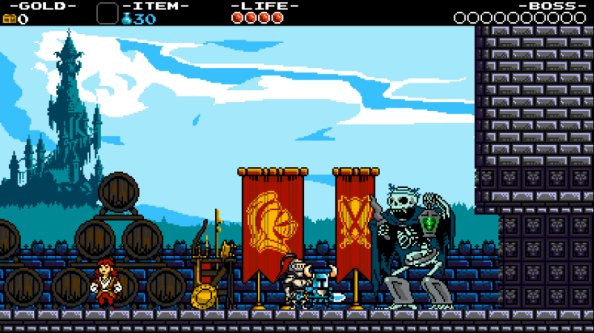
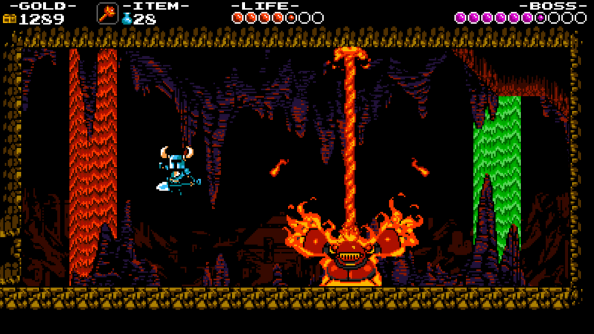
Okay, on the surface, I’ll give it this much; Shovel Knight is brilliantly conceived, well-executed, and hits on most of the right retro qualities to potentially make it a fun game. The game feels like Capcom’s Duck Tales more than anything else, although the stage layouts feel more like Mega Man, the overworld map is in the style of Mario 3, and there’s a town with simple quests Shovel Knight can accept, kind of like…Wikipedia goes with The Adventure of Link. Why not? Sounds good. I admit that during the first stage, I had a lot of fun learning the ropes, digging crap out of the ground, and hopping around on my pogo-shovel without questioning it any more than I did the fact that Scrooge McDuck apparently uses a pogo-stick as a cane. After the tutorial stage, I moved onto the town, thinking it could be really fun trying to collect special items in each stage and trade them for equipment and upgrades. Brilliant! Finding a way to expand on retro games without losing the 8-bit feel!

Then I spent an hour and a half trying to get through the next stage without snapping my 3DS in half.

The other trend spreading like gonorrhea through the fan-rom-hack and indie-game community is to make games hard. Really hard. Like, hard enough that when you beat them you feel a wave of remorse for working on the game with a dedicated passion that you could have used to cure cancer or reverse climate change. After all, the harder the game, the better, right? Why can’t every game be Kaizo Mario?

Let’s talk. Hard games aren’t inherently good games. Some good games are hard. Some hard games are good. The reason people make hard games isn’t because they’re more fun to play, it’s because they’re easier to make. I always questioned why Bowser didn’t knock down some of the platforms over his lava pits, or why he didn’t just build a wall around the first level to prevent Mario from reaching the flagpole. (Although, economic experts in the Mushroom Kingdom suggest the wall would cost billions of dollars to build, staff and maintain, and it wouldn’t stop Mario from entering level 1-2 on a legal visa and overstaying his visit) These things would have been really easy to do and they would have made the game impossible—which means best game ever, right?

screen_09

This looks exciting. Too bad I couldn’t make it that far.

No. See, it takes nothing to hack Castlevania to put a boss rush in level one. But does the player have the skill right off the bat (heh, heh) to deal with five bosses at once? Do they have the equipment and power-ups necessary? How many paths can the player take to avoid damage—too many and the game is boring, too few and they won’t be able to progress, get frustrated, and stop playing the game. Making a game hard is easy. Making a game difficult and playable takes skill and effort. Shovel Knight? It’s fun, has game play about as challenging as Duck Tales, and seems well-designed. And if you die, there are no checkpoints. If you spend ten minutes on a level and fail, you have to spend another ten minutes just to get another chance to practice what you screwed up. And this breaks the game, raising it to frustration-level hard. I’ve had this complaint before. After proving to the game that you can accomplish something, you shouldn’t have to keep doing it. If Shovel Knight were math, you could get a problem on your differential calculus homework wrong and it would send you back to Kindergarten to teach you how to count to ten.

If you want a good example of a game that is so hard it is literally impossible, but done so well that people can’t get enough of it, I’m sure whatever device you’re reading this article on has some version of Tetris.

shovel-knight-screenshot-18

Gladly.

Google Cardboard

google-cardboard-virtual-reality-vr-headset-3d-glasses-01

Ladies and gentlemen, the ultimate in technological gaming.

First entry of the new year! Or for those of you reading this in the year 2045 when mankind has dwindled to a few mutated remnants of its former glory, who have sparked the WordPress server to life using a bicycle generator in attempt to discover the meaning behind the hellish post-apocalyptic wastes slowly strangling you to extinction, 2017 might be a bit of a look back. But in honor of progress and the future and technology and all that shit, I’ve been fooling around with virtual reality lately!

Sadly, I didn’t suddenly fall into a small fortune and get an Occulus Rift, or even get in tight with engineers to try out a prototype AR system like the Microsoft Hololens or even as much as the voyeuristic dream, Google Glass. Actually I’m a big fan of Google. If a company that saves me from a $75 a month phone bill by giving me free service and I will gladly overlook any potential shady business deals, human rights violations, political bribery or attempts to block out the sun. One of their better ideas, Google Cardboard, offers a method of experiencing virtual reality for only $15…and the cost of a high-end smartphone. Literally just a specially cut cardboard box with lenses, Google Cardboard gives you all the thrills of depth perception with all the dignity of a schnauzer licking the hardened cheese out of a pizza box.

google-cardboard

She’s either playing virtual spelunker, or she hasn’t figured out that her phone isn’t on.

The phone—in my case a Samsung Galaxy S3—uses the Google Cardboard app to play other VR apps in stereo like a crappy Pink Floyd music video knock off. You simply scan the QR code on the viewer…and then spend three days trying to calibrate it by hand so you don’t have to sit there with your eyes crossed so fiercely that they can see each other. After finally getting the calibration website working, I found out I had to pass off my 6cm lens separation as 10.5 cm. Then after making peace with the fact that Google now thinks I’m a sentient bobble head, I was ready for some VR.

The first thing I wanted to do was pretend the Middle Ages didn’t suck and that I could use magic and kill monsters without any risk of pain. So I found a game called VR Fantasy. This places you squarely in the middle of a labyrinth (Apparently people who live in fantasy worlds can’t think of any better method of pest control than architecture.). You play the role of an idiot blindly spinning circles in your living room while watching a sword levitate in front of you. All in all, the game was worth a play through, but had some issues to work out. Namely, since everything is controlled by the single button Google Cardboard gives you to vicariously tap your screen—thus taking the one real thing you could do to interact with the game and making it virtual—that means that menu options get a bit rough at times. The interface to look down and pass the cursor dot over the foot icon activates and deactivates with a sensitivity often only seen what Scooby and Shaggy try to run from a monster. And when you do successfully activate the walk-forward option, you move with a punishing lack of urgency. I swear there were 90-year-old rogues and barbarians passing me on their walkers. I don’t know if gout-ridden asthmatics are a unionized force, but they no longer have to worry about being underrepresented in fantasy games. This all culminates in an epic showdown with a hero suffering from ennui and a boss who must be nursing a severe hangover. Next.

play-minecraft-with-google-cardboard-1024x639

Now you can add to the graphic realism of a game known for having intentionally unrealistic graphics!

What game does everyone want to play on a system designed to make a fantasy world feel real to you? Minecraft, a game that gives you painted Legos that look like they were spit out by a 3D printer stapled to an Atari 2600. So I downloaded Vrcraft. And stood on a diving platform staring down at a lush meadow that I had no way of reaching. I’m not sure which is worse: pretending the world is real but only having one button to send all your controls via Morse code, or realizing that you need a game controller for your phone that you need to operate while pressing a cardboard box to your face. Next.

Jurassic came as two separate apps. One puts you in an enclosed jungle setting, allowing you to observe carnivorous dinosaurs either on foot or riding on the back of one, and the other lets you do what any rational human would do when encountering a fascinating animal that hasn’t walked the earth for 65 million years—kill it, thus ensuring at least another 65 million years before they have another shot at life. The hunting game isn’t bad. All you have to do is spin around, aim, and pull the trigger when you see the dinosaur. The virtual dinosaur tour strives to emulate the tour from Jurassic Park a little too well, as you don’t see anything except a tyrannosaur and a pair of raptors.

Cherry Blossom bills itself as a tool for relaxation. It looks more like a guy dicking around with unity who drew a tree in three dimensions and figured out how to overlay a layer of falling pink petals. That’s it. You stare at a fucking tree. There’s not even a background. I can’t even think of a clever way to describe that because “staring at a fucking tree” is probably the most exaggerated form of boredom anyone has ever come up with.

cardboard1

In virtual reality, you’ll no longer feel inadequate about your penis!

The next game on the list actually managed to pry open my wallet and extract a handful of coins from my clammy, dead, decomposing hand. Simply called Alone, the game lets you emulate a world with no other humans around, although chances are good that any early adopter of VR technology would consider such an emulation rather redundant. The free demo puts you on a couch, watching TV. Again, this doesn’t quite count as a brilliant and revolutionary implementation of virtual reality technology, but after a few moments of watching flickering scenes of what I can only assume is a bad porno, creepy stuff starts to happen. Granted, if you’ve ever watched a Japanese horror film, you’ll be able to check off every box on your bingo card, but here’s where the VR actually makes a difference. At least until you buy the full version, move on to the second scenario, and quiver in terror as an understudy for Candy Land crawls out of the closet and you feel so bad for it that you feign a scream or two just to boost its confidence.

itchy

…leave him alone. Grandpa Itchy needs some personal time.

So even the best of these games can only keep up the quality through a demo. Can no one come up with a fascinating use of virtual reality that will improve my life as all the science-fiction movies have promised since the Star Wars Holiday Special? Then it struck me. What one thing has pushed forward technology by leaps and bounds since some caveman first learned he could smash a log with a rock? What one thing drove people to disseminate wood block printing, theatrical lighting systems, the television, DVD camera angles and particle accelerators for quantum physics?

Porn. (Give CERN a few more years. I’m sure you won’t be as upset as you think you will about the hole they’re working on.)

Why not? It didn’t take me long to find a set of VR porn games—which all charged money and gave no demos—and a handful of videos. Now, since humanity never gets tired of watching each other have sex, there’s quite a range out there, even with the relatively meager selection for tech geeks. Some of them even consent to put you in the 1st person perspective. However, it sometimes felt a little odd to warp myself onto the bed next to the forty-year-old biker who looks like he’s getting blown for the first time since getting out of prison. Oddly enough, the remedy for this situation comes from the area of the sex industry usually known for writhing tentacles and comically large amounts of viscous fluid: hentai.

cardboard3

It’s like actually reading a real National Geographic article!

Having grown up with an unnatural predilection for Sailor scouts that bordered on something psychiatrists might discuss at a conference, but which nonetheless usually had more positive results than my interactions with real girls, I always wanted an anime girlfriend. Fortunately, through the magic of virtual reality I…well, I still have no idea what it’s like, but at least I can pretend to have sex with one as long as I don’t expect things like physical stimulation, verbal interaction, or human contact. So basically, it’s exactly like my interaction with real girls. Except naked. But even that comes with a drawback as the phone was so close to my eyes that I could count every pixel on the screen, thus making the finer details blur together as though I was watching her on the news and they wanted to protect her privacy.

And I guess that pretty much embodies my main complaint with Google Cardboard. It’s fun to screw around with and you might as well give it a shot considering the price tag, but they can’t hook up an app to your brain to stimulate your senses. And even if the field of vision wasn’t narrower than a Southern Baptist’s list of acceptable prom dates, if you pay even the slightest bit of attention to your peripheral vision, you won’t so much feel you’ve been immersed in a virtual world as you were diving head first for the last Kleenex and got stuck in the box. So play around with it, but don’t get your hopes up. The term “virtual reality” doesn’t describe Google Cardboard quite as well as “sitting really really close to the screen, slowly disintegrating your optic nerves with blinding radiation.”
MAME Roulette

Hey! The year’s almost over! At least, it will be by the time you read this. I’m actually writing this on August 10th, but I can still anticipate wanting a week off, so I’ve gone to Maui for Christmas! So I thought I have all these games in MAME that will probably never see their own week’s entry, so I might as well pick a few at random and tell you all about them.

Akuma-Jou Dracula

Haunted_Castle_(Arcade)_03

Belmont is either going to punch Dracula with an oversized cartoon fist, or he’s about to go super saiyan.

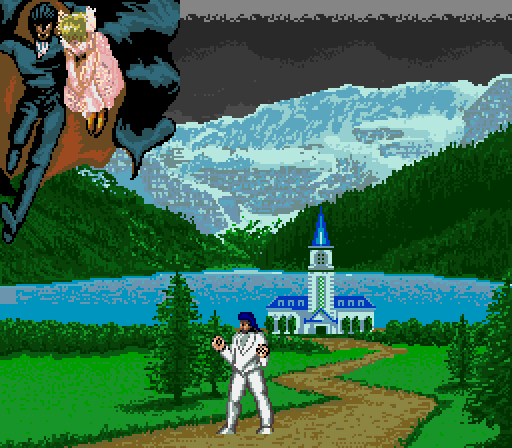
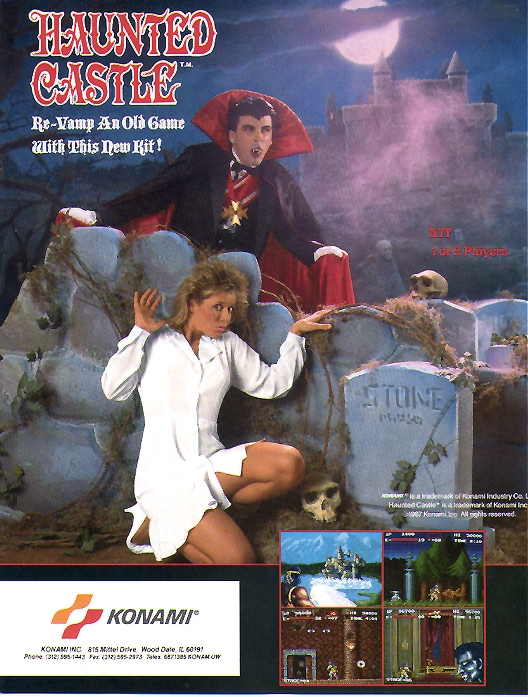
Wait, this name sounds familiar…this is the Japanese name for Castlevania! Known as Haunted Castle in America, this is everything you’d expect of an arcade Castlevania. When you drop a quarter in the slot (or, on MAME, hit the lesser-expensive select button) it plays the tone of a wolf howling. Nice touch. Next, you’re treated to an introductory scene of a bride and groom walking through a field when Dracula swoops in and abducts the girl. Come on, Konami. I know the whole save-the-princess theme is a tried-and-true video game trope, but I don’t really think that’s Dracula’s M.O. He’s more of a “love ‘em and eat ‘em” kind of guy. And I’m certain he’s not likely to stage an abduction in broad daylight next to a man known for staking down vampires like a tent. But hey, whatever. It’s a Castlevania game. And it plays pretty much like all the console games, with the hero (I assume a Belmont, but it’s an arcade, not a library) strolling through a graveyard full of hell spawn like he’s just out getting some fresh air. Oddly enough, while he walks with all the urgency of farm machinery, when he jumps he becomes lithe and airy, like Tarzan of Transylvania. There aren’t too many surprises here, but it’s worth noting that the bats are annoying as fuck, flying around like snowflakes. I could have made it twice as far without them. Oh, and also, no matter how many quarters you pump into the machine, you still only get a limited number of continues. Next game.

Haunted Castle

This is either a bad ad for an arcade game, or a good ad for a bad porn. Either way, nothing’s getting turned on.

Frogger

Frogger

The hydrophobic amphibian waits in the street to end it all. Trust me. He’s better off.

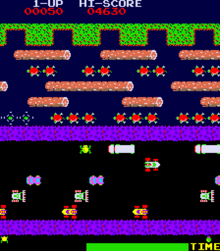
This 1981 classic takes little to review. You try to get across a road alive, then try to cross a pond. It’s hard. End of story. Unless, of course, you want to stop to ask why the frog dies if he jumps in the water. He’s a frog. An amphibian: a name that implies a dual life both on land and in the water. One would think that successfully navigating the frog to his home would do a massive disservice to evolution, allowing the species to pass on genes that make them violently allergic to their own habitat. And what exactly is a “frogger”? The word appears to be a noun. Frogger: (n) One who frogs. What does frog mean as a verb? I can only gather from the context that “to frog” means to dress in a black and white striped shirt, don a beret, and wander around town talking like Maurice Chevalier. However, the dictionary disagrees with me, listing the definition of “to frog” as “to hunt and catch frogs.” That, of course, means that rather than the player-character, the only actual froggers in the game are the alligators eying you up like a green cheesecake bouncing toward the river and the speeding cars looking to polish the asphalt with your vascular system. Way to go, Konami. You really frogged that one up.

Gimme a Break

Gimme

Fun fact: there’s absolutely no way to make this caption interesting.

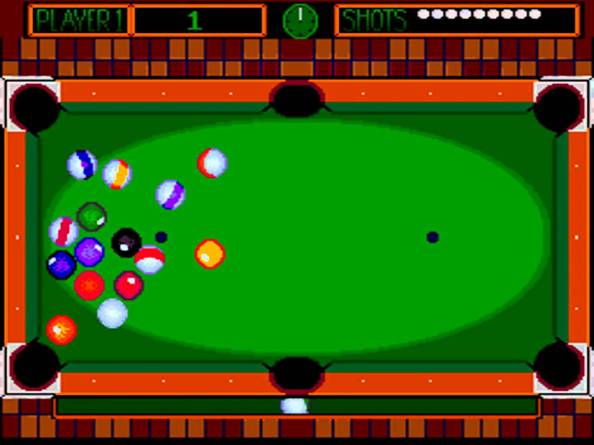
In the late 80s, I don’t tend to remember a lot of kids scrambling to the arcade after school to play simulated pool, so I can only assume that this game was created for barflies who were too drunk to be trusted not to launch the billiards into the bartender’s head or jab another patron in the crotch with what is basically a blunted javelin. So for a mere twenty-five cents, the “too drunk to remember being acquainted with language” demographic can roll around a trackball in this mostly pointless game. Very few rules of the game are observed, and you basically just chuck the q-ball around the table until every other ball has been sunk into a pocket. It’s even more pointless when you realize that any subliminal advertising for Kit-Kat will be lost when the player blacks out the events of the evening. Also, I’m playing on MAME, which is emulating the trackball about as well as George W. Bush trying to disguise himself as a Harlem Globetrotter. Also like George Bush, no matter where I aim, all my shots go right.

Gun Dealer

gundealer010

Nice guns.

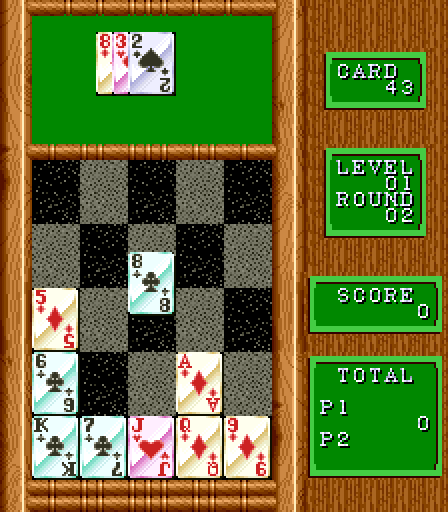
This sounds cool! Gun Dealer! A game that obviously puts you in the dangerous lifestyle of an illicit arms salesman, eluding capture from the feds! And hey, it has a hot anime chick holding a tommy gun on the intro screen!


Gun Dealer

It’s Tetris. It’s Tetris with a deck of cards. This game delivers on the “dealer” promise, but you’d have better luck finding guns in a Yankee Candle store. I was starting to think the idea of Tetris where instead of lines, you make poker hands would be an interesting idea, but then I realized that with five columns you could just drop cards into columns of the same suit and rack up a string of flushes. I think there’s more to it than that because after the first round it didn’t seem satisfied with my performance, took my quarter and ran, but I think I’ll chalk that one up to a mutual break up.

Penguin-kun Wars

Penguin Kun Wars (J)

I think I’ve played this game in real life…when I was six years old.

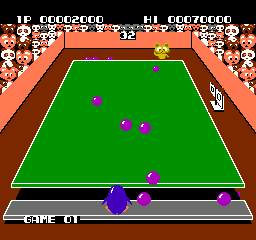
This is easily the weirdest yet oddly playable game on this list today. Somewhat reminiscent of Japanese game shows, Penguin-kun Wars pits an army of chibi animals against one another in a no-holds-barred, fight-to-the-death, er…ball rolling tournament. You play as the titular Penguin-kun, facing off against your cute, cuddly opponents, trying to bash their heads in by rolling balls across a table. It turns out, the object is to get all the balls on the other side of the table at one point, while your opponent does the same. Barring that, there’s a time limit, and the player with the least balls after one minute wins. Yes, that’s pretty much the opposite of most real-life men’s sports, but I think Lance Armstrong set a noble precedent. Unfortunately, Penguin-kun can’t dope up, so this game is pretty challenging, but not quarter gobbling. There’s a strategy. If you can smack your opponent once, then hit him again before he wakes up, you’ll have the few seconds you need to grab all the balls and shoot them to the other side, allowing you to advance to the next match in the tournament while your opponent likely advances to several years of physical therapy and reconstructive surgery.

Illusion of Gaia – SNES

RetroArch-0801-173125

Much like many in the animal kingdom, the ancient warrior of light, when threatened, will wet himself as a defense mechanism.

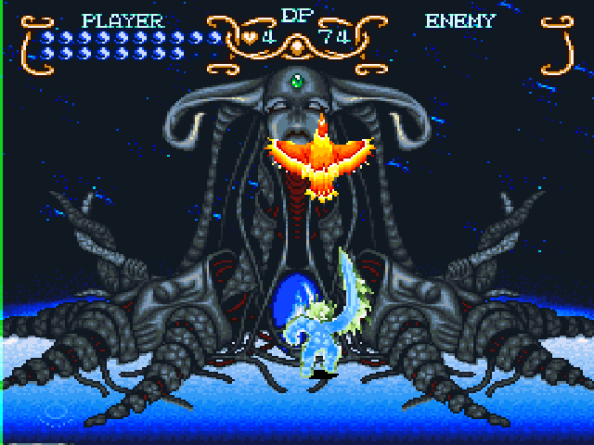
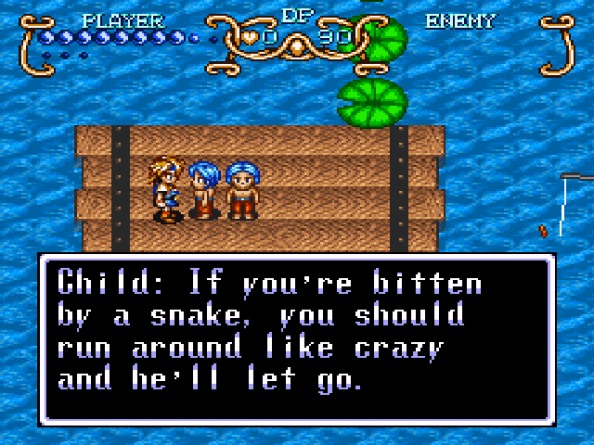
And now a game that needs no introduction…but since I have to write one anyway, I had never heard of Illusion of Gaia when I pulled it out of the $10 clearance bin at Walmart. Yes, it could have been a broken, miserable, unplayable experience that left me empty and soulless, my lack of satisfaction made exponentially more crushing with every dollar I spent on it, but I had to face the facts, I would never get back the $2.50 I had spent renting Mario is Missing, nor would I get back the hour and a half of my life I sacrificed for a trivia game designed for people working their way up to the challenge of Dora the Explorer. And hey, it didn’t look half bad. The reason I had never heard of it probably came from the measly 650,000 copies it sold worldwide, less than half of which sold in the U.S.A. While that’s a big number and I wouldn’t mind selling 650,000 of anything (provided it’s not something bad like indentured servants or square cm of advertising space via tattoo), other games such as Link to the Past and Final Fantasy VI sold several million copies worldwide. And since Illusion of Gaia is in the same class of game as those two, get out your dark hoods, sacrificial knives and grab a spare chicken, because we’re going to celebrate Illusion of Gaia as a bona fide cult classic!

RetroArch-0801-134035

This is the most fun I had since playing the merchant in Dragon Quest IV.

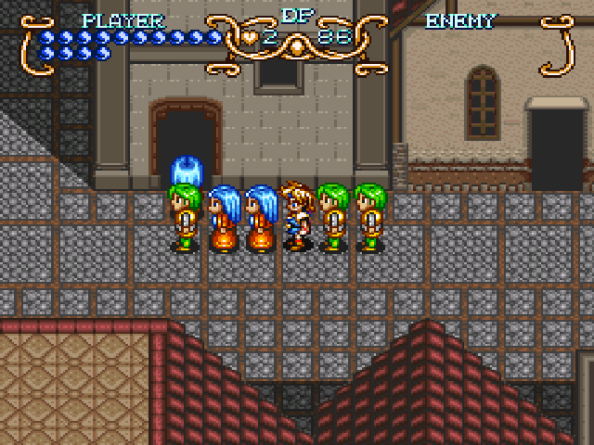
Illusion of Gaia follows young Will, a boy who faces down swarms of demons armed with nothing more than a flute. And while that could set up an interesting Zelda-style mechanic where you use music to lull your opponents to sleep or pacify their hateful heart, Will doesn’t follow the path of the spooney bard so much as the style of Bam-bam Rubble. Gaia, the spirit of the earth, tasks will will traveling through the world’s ancient ruins to collect mystic statues that will enable him to destroy a comet careening toward their certain destruction. And the stingy broad doesn’t even offer so much as a “Heart” power ring. So Will travels the world with his friends, and we get to witness all his adventures, mishaps, the zany relationships between characters, the wonderful oddities along the way, and also the sheer devastation caused by the mystical comet in the past coupled with a dark subplot about a slave trade. You know. Good fun for a 15-year-old boy. The story is actually very good, a downright miracle when you realize it’s so poorly-written. Dialogue, especially near the beginning, reads like expository writing at a tourette’s convention, a collecting of disparate, unsolicited facts prematurely ejaculating themselves into the conversation. In one extended cut scene, Will announced that he’s starting to develop feelings for the princess. And then he drops unconscious with a case of scurvy. So the player has to let a lot of stuff slide, but the story moves along in a sensible manner like it should.

RetroArch-0801-125220

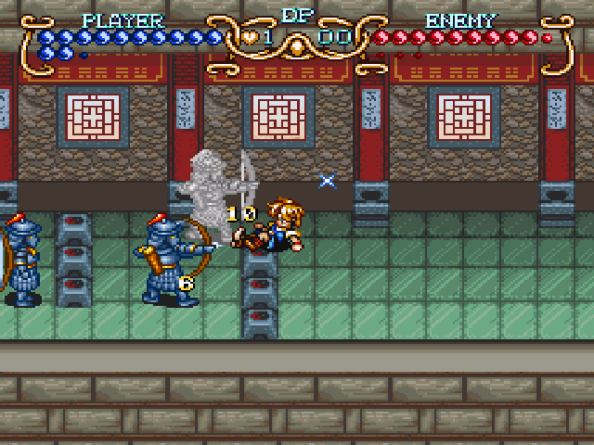
Will defaces a UNESCO World Heritage site, the Chinese Terra Cotta Soldiers.

The game technically plays out in our world, presumably in the far future after the comet has pulled its Chernoble impression six or seven times, halting world progress and handing evolution over to the whims of Salvador Dali. Will visits several real-world locations, such as the Nazca lines, the Incan ruins, Ankor Wat, the Great Wall of China. Still, the game plays fast and loose with geography, as though the developers failed their world map quiz in high school and decided to re-write the map so their answers would be correct. The Nazca lines are no longer on the same continent as the Incan ruins, Europe is now a single city somehow located west of China, but east of Cambodia, and Egypt is way off in the Northwest.

RetroArch-0801-122901

…good luck with that.

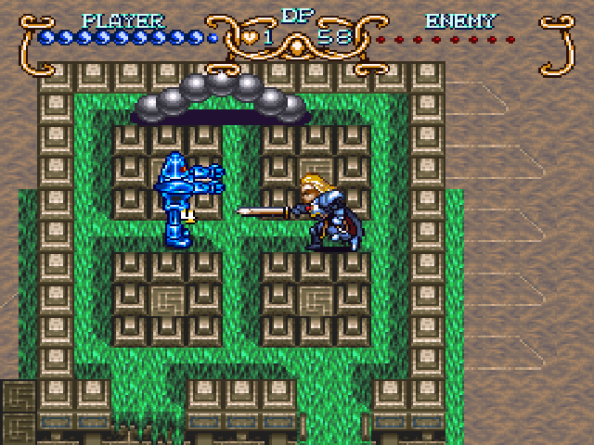
The combat system, aside from exhibiting a brutal violence toward band instruments, steals from action RPGs like Secret of Mana, while employing a unique system of leveling up. Rather than earning experience or equipping items, Will gets a stat bonus by clearing all the monsters in any given area (which he can only do once per area). With a limited number of stat increases, the difficulty in later stages depends on how thoroughly you can ethnically cleanse the earlier stages—which isn’t all that difficult, considering the generous head start that 16th century Spanish explorers gave you. Later on, the game ramps up the difficulty not only by making enemies harder, but by hiding one or two in each area. Not a bad idea, really, although it was a little frustrating running through the Ankor Wat hedge maze like Jack Torrence, playing a murderous game of Where’s Waldo as I hunted down the lone hedge monster I needed for my upgrade.

RetroArch-0801-100509

Freedan fights ancient Nazca robot while a string of anal beads looks on.

Will doesn’t have to run around jabbing his flute into things for the entire game. At various points he can transform into the Dark Knight Freedan, or Shadow, the bio-weapon made from the comet’s light, in what has to be the weirdest metaphor for puberty I’ve ever seen. Freedan and Shadow are both stronger than Will, but each character has a unique set of abilities that will be required to progress, so like any troubled teen, you’ll spend a lot of time altering your body in order to fight the evil establishment. While Will can perform special acrobatics, Freedan can reach across long distances, and Shadow can…make puddles on the floor like a dog that hasn’t been housebroken, all three characters have telekinetic powers. While mostly this is only good for a. collecting the mostly-useless items dropped by enemies and b. making the case that Will is “the chosen one,” it can also be used to block most projectile attacks. Because the best way to dodge a bullet is to stand right in front of it and pull it towards you with psychic force.

RetroArch-0801-115217

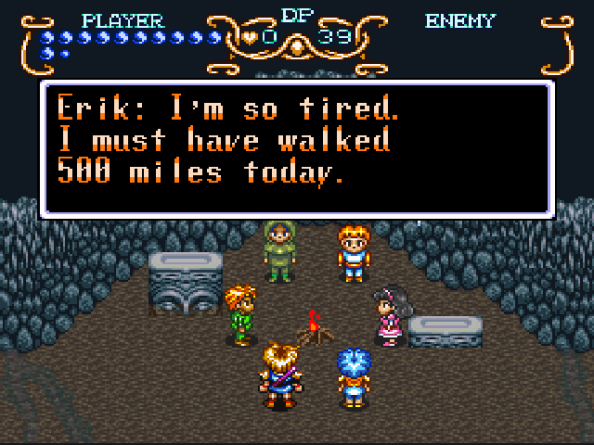
And I would walk 500 more…

I say the enemy drops are mostly useless as with very rare exception, they’re all gems that serve the basic purpose of Mario’s coins. That’s right. Illusion of Gaia has a life system. Instead of going back to the beginning of the stage when you die, if you’ve collected at least 100 gems, you’ll only go back to the beginning of the room you’re in. With severely diminished health. And any healing items you used before death are gone for good. And healing items are rare enough that they could be the subject of the next Indiana Jones movie. In most cases, it would be far easier to reset the game and start over from the last save point than to take the free life the game offers.

RetroArch-0801-074450

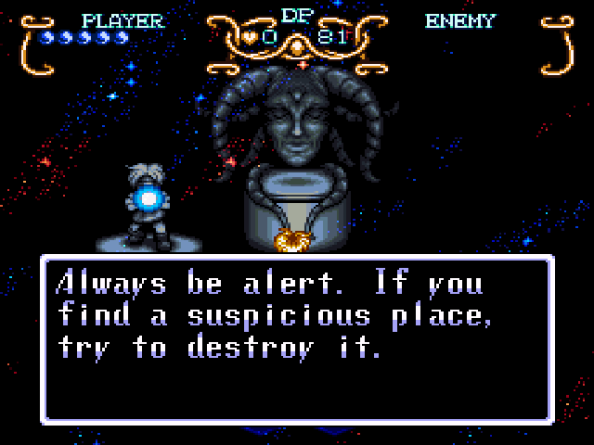
The George W. Bush homeland security policy. Gaia does a wicked harsh cavity search.

But really, these issues don’t amount to anything that might dissuade me from playing the game. Some of the more serious crimes involve key items being introduced with a text crawl so slow that it sets off a bomb on a bus somewhere and an end goal so confusing that even the main character questions why you’d want to replace the natural fantasy world with a modern urban sprawl. But if anyone told me these flaws actually amounted to something, I’d probably react the same was as if someone gave me a ticket for jaywalking.

Zelda II: The Adventure of Link – NES, Game Cube, GBA

RetroArch-0731-192006

After having retrocookie’s background set to a scene from Zelda II: The Adventure of Link for maybe a year and a half, it occurred to me that maybe I should have an entry for the game itself. Zelda II, you see, has a number of notable distinctions, being the final game in the Zelda chronology (providing you don’t give yourself an aneurysm trying to figure out the official timeline), the first game to introduce a magic meter, the first appearance of Volvagia, Shadow Link and the Triforce of Courage, and it’s easily the most hated and least played game in the series because Nintendo completely abandoned the gameplay of the original to bring you Super Mario RPG. Oh, and it’s hard enough that King Leonidas could build a wall out of the Link corpses you’ll leave littered on the side of the road. But aside from the unfortunate fact that they mixed this game with 4 parts Mario, 2 parts Dragon Quest, 3 parts Castlevania with a shot of green food coloring to nominally call it a Zelda game, it’s actually a pretty good game in its own right.

RetroArch-0731-202004

Link’s slides of his vacation to Easter Island.

The instruction manual describes the story like a heated debate between two Nintendo employees who couldn’t agree on why Link is still romping through Hyrule slaughtering octoroks like a burgeoning serial killer who hasn’t quite moved up to humans yet. Either an ancient prophecy finally got its act together, stopped drinking and sent its resume to Link, expressing an interest in a career of waking up narcoleptic princesses, or Ganon’s minions have put out a hit on Link, and he needs to stay alive long enough to get the Triforce, which I guess will scare them off. I don’t know. The game kind of leaves that point gaping like a meteor impact crater by the end. Link still has a hit out on him. If Ganon’s minions sacrifice him—which sounds as much like a sacrifice as giving up abstinence for Lent—and drizzle his blood over the pile of ash that used to be Ganon, the pig comes back to life.

RetroArch-0801-023344

Fuck you, Nintendo of America Censors! Look what I got! Religious iconography! (But they insisted on renaming the temples as “palaces”)

But whatever the reason, Link sets off. The overworld map gives a top-down perspective, but unlike the first game, you don’t fight enemies on the map itself. Rather, you contend with random encounters. But unlike the jarring Final Fantasy shifts that hit you like the raptor you never even knew was there, these enemies appear as groups, wandering the map like a touring punk band, and if Link touches them he has to fight his way out of the mosh pit to escape. These encounters, as well as towns, caves, bridges, and dungeons, play out as a side-scrolling platformer. Yup. A side-scrolling platformer. Nintendo took the most original idea they’ve had since Super Mario Bros, and turned it into…well, Super Mario Bros. The side-scrolling combat is interesting, to say the least. Link can attack and defend in both upper- and lower-body positions. He can also learn a downward stab that lets him stomp his enemies like a goomba, or combine an upward stab with the power glove to let him break bricks above his head. But Link earns experience, while Mario doesn’t. (Although after rescuing the same damn princess for 25 years, it would be nice if he had enough experience not to leave Peach alone in turtle-infested waters. Or maybe he could put two and two together concerning all those kidnappings.)

Link also learns magic. In each town, he can gain access to an old man who adds another rabbit to his hat. Usually, though, they won’t just scrawl out avada kedavra on a sheet of paper and point you at the monsters threatening to enslave the world. Nope. Usually you have to do some chores. One old man lost his trophy to a thieving goriya, and I guess his high school basketball record is so important to him that he won’t teach the “jump” spell until he gets it back. Some requests make sense, like rescuing a child lost in the wilderness. But one woman wouldn’t let me in to see the elder until I walked over to the fountain next to the house, cupped some water in my hands, and poured it down her throat. Only two elders didn’t ask me to turn my pockets out to rifle through the results of my latest scavenger hunt. One gave me the shield spell freely, but I had to find the other old man, who had stuffed himself into a fireplace.

RetroArch-0801-020544

If I had a hammer…

Dungeon items, on the other hand, are as disappointing as a bachelor’s degree in English: they’re time-consuming to obtain, completely useless, and only serve to let you move on to get another one just like it, but even harder to get. Out of the eight main items, six of which are found in dungeons, only the hammer and the whistle do more than create a passive effect, and only the glove and arguably the hammer do anything but open up a path to get to the next area of the map. All other items are used once or twice and then take up space in your inventory, like an Englebert Humperdink 8-track your grandma gives you at Christmas—you know you’re never going to use it, so it sits in a box doing nothing but preventing you from the crushing guilt of throwing out your grandma’s present.

Retro

…it’s not what it looks like! Unfortunately. And did I mention that this, faeries, and a “life” spell are the only ways to regain health?

The game is as hard as a Cialis overdose, and while you can continue as many times as you’d like, after three lives you go back to the beginning of the game, starting over in Zelda’s bedroom as though you’re trying to fill up a punch card to get your tenth burrito free. I’ll attribute this to either a glitch or a translation error, as the instruction manual clearly states that if you continue from a dungeon, you’ll restart from the dungeon entrance. This only works in the final temple, but by temple four, the walk alone from the start of the game is enough to kill you out of boredom, if the monsters don’t mug you along the way. It’s a good thing that video games don’t need realism any more than the beef at Taco Bell, or Link might be tempted to skip town before the assassins find him and let the princess sleep for another thousand years or so. It’s not like anyone needed her for anything until now.

Shadow of the Colossus – PS2

Shadow

Take it easy, buddy. Just put down the Washington Monument and no one will get hurt.

Shadow of the Colossus is one of the most beloved, well-developed and artistic games of all time. It tells a beautiful, somber story about one man’s fight against death, metaphorically represented by the hero, Wander, being dwarfed by the titanic proportions of his enemy. A vast, lonesome world provides a stark counterpoint to themes of companionship; Wander does not fear death like Gilgamesh—who is vaguely referenced in the name of the god whose help he seeks—nor does he attempt to cheat death. Rather, death has robbed him of companionship, and he will sacrifice health, life, or his soul for her resurrection, and the emptiness of the world emphasizes that Wander has little else to fill his life with other than the departed girl he lovingly places on the altar at the beginning of the game. It is touching, emotionally powerful and calls upon conflict the human race has suffered since its inception. The game is precisely controlled, strikingly detailed, and viscerally perfect. Shadow of the Colossus well deserves its reputation as one of the best games ever made.

That being said, let’s make fun of it!

Shadow Head

Shake it like a 100-meter tall Polaroid picture trying to make the photographer plummet to his death!

Shadow of the Colossus would best fall into the genre of puzzle-platformer where the platforms attempt to bring about your grizzly death. In order to free the essence of Dormin, the god who can resurrect the girl, you have to slay sixteen beasts ranging in size from a Volkswagen Beetle to New Hampshire. Mostly this involves discovering and exploiting the Colossi’s weaknesses and attack patterns to find a way to climb to the top, then stabbing them to death while they try to shake you off. It’s like trying to shave a cat (don’t ask…bad weekend), except if the cat shakes off the razor, you don’t usually need to hire a Sherpa to get back to work. Beyond that, it’s rather difficult to find a unifying thread for the game. There are no fights except the sixteen boss battles, and between each Colossus’ unique body design and interactions with the surrounding environment, you won’t reuse strategies other than “Stab it in the head!”

Shadow Sta

Do you mind explaining why you need to aim with a sword?

That strategy, however, raises one point of contention I have with the game. Stabbing the Colossi requires two separate actions: first, pressing the button to raise the sword over the monster’s vital spot, then pressing the button again to stab once a strength gauge has charged. However, since they try to throw you off like they’re twerking with Parkinson’s, you spend a good deal of time flopping around like a carp. All you need to do is hold R1 and not run out of strength—although later bosses challenge this with their prolonged bouts of epilepsy—but during that time Wander will not perform any sword related action. Really dude? It only takes one arm to stab. You really can’t use any of that wacky waving inflatable arm flailing tube man momentum to get a hit or two off while you’re waiting for Clifford to dry himself off?

Shadow Horse

Having no way to tell Agro to stop, I had to improvise.

I get why the game controls are a little on the convoluted side. While they’re difficult to master, it helps to know exactly what will happen when you use a specific button combination. In other games, merely shifting the camera angle can confuse the mechanics, as if you spoke a phrase it didn’t learn in the first two chapters of Introduction to Spanish, so it just started talking louder and adding “o” to the end of each word. The weak point in this scheme, though, is Wander’s horse, Agro. Required for traveling and for fighting a few battles, Agro handle’s like Link’s Epona, if she had shown up for her driver’s exam after half a bottle of Smirnoff. With broken glasses. And a hairline fracture in her foot. Only a few weeks out of playing Haunting Ground, I’m not sure I like game animals who realistically ignore commands. Realism is a wonderful thing—to a point. But we need to sacrifice a certain amount of it in order to make games fun. In the 35 square km world, we have mountains, forests, lakes, valleys, deserts and grassy plains. If they had scaled this realistically, the game would have a much larger map and we’d be measuring play time in weeks and months instead of hours and minutes. I’d rather an unrealistic horse that obeys commands and doesn’t try to reenact Thelma and Louise into nearby canyons when I give him a slight nudge to follow the path. After eight hours of gameplay—spoiler alert—I was not sorry to Yoshi him into a canyon on my way to the final Colossus. Not that Wander always controls much better. Half the time I tried to mount Agro I wound up hopping up and down like I was showing off my new pair of moon shoes. Even worse, when Wander takes hits, he stays down for eight full seconds. That doesn’t sound like much in writing, but in the middle of a fight that feels like slipping into a minor coma.

Shadow pig

This colossus could easily ride an elevator.

While it deserves its reputation, most of what people had told me about the game turned out not to be true. I did fight a lot of monsters large enough to have their own climate systems and geological patterns, but at least half of them were less than colossal, about four or five didn’t have much in the way of shadows, and at least two of them probably get pissed off at SUV drivers who pull up next to them at stop lights. People had also told me the twist ending revealed the peaceful, gentle nature of the colossi you slaughter throughout the game. Personally, I don’t find a lot of kittens in animal shelters who carry school bus sized cutlery, and I’m pretty sure that petting zoos tend to avoid the llamas who fire lasers out of their eyes.

Shadow Bow

Judging whether the attack will do more damage against the stone, or the shag carpet it wears like a burka

I felt pretty good about making it through this game—for the most part—without needing a walkthrough. The puzzle-solving aspect really pressed me, but most of them could easily be solved by wits alone. While it rarely happens, I like buying games that don’t try to sell me a strategy guide, although sometimes the game isn’t as helpful as it thinks it is. Dormin often gives you hints if you don’t make any progress for a while, but one time I desperately needed help, I sat on a rock out of reach of a graboid for ten minutes and he didn’t say anything. Later, in another fight, he told me, “Find the hidden vital spot.” Great job, sensei! You’ve just given me a clue so vague it sounded like the entire premise of the game! I’ve seen better education coming from South Park’s Mr. Garrison. I eventually figured out what he meant, but solving the puzzle involved exploiting an attack the colossus hadn’t ever used against me, not exactly the epitome of intuitive. Elsewhere, apparently you can increase your stats by attacking the lizards that roam the lands or finding fruit trees throughout the world. Which I figured out after only…the entire game. Do I get hard mode points for finishing the game without them?

But meh. I’ve yet to find a game good enough that I can’t mock, and I sort of have an obligation to do so. But go play it anyway.

————————-

Note: If you were wondering about my reference to Gilgamesh, the game’s god, Dormin, is Nimrod spelled backwards. Nimrod was the biblical name of Gilgamesh, the 4500-year-old Sumerian King who attempted to cheat death and receive immortality. Obviously, he failed.

We Love Katamari – PS2

Katamari - TitleWhenever some self-described family values advocate implies that merely standing in close proximity with a video game will turn someone into a bloodthirsty, gun-toting, murder factory, I generally have two reactions. First, I wonder why they’d find that a problem as the bloodthirsty, gun-toting murder factories tend to vote for family values candidates. Second, I want to give them a Katamari game and challenge them to hate anything after playing one of the best video games of all times. But I don’t do that. Why? Well, as bright, colorful and happy as the game may be, I’ve never heard anyone scream with as much sheer terror as a cubic representation of a Japanese citizen as they’re crushed under the weight of the continents rolled up and shot out into space.
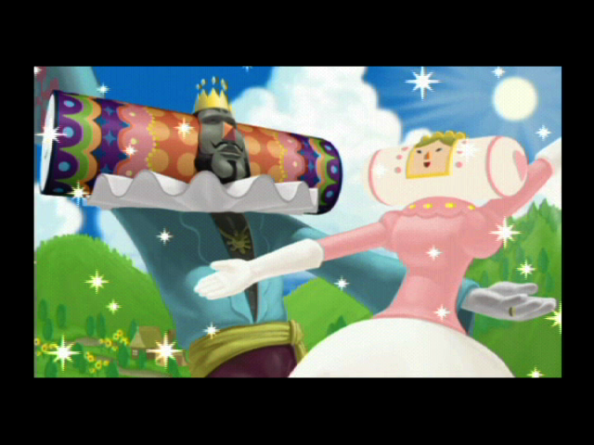
Normally when I come to the part where I describe the game, I do my best to use colorful similes and goofy language to come up with a sort of police sketch of what you should keep away from. I suppose that may work with Katamari, if you first understand that the police artist and the witness are both drunk, and the witness is trying to describe someone he saw on an acid trip while watching Sesame Street. There are just too many layers of weird to do anything except talk about the game exactly as it is. More or less.

Katamari - King

Figures that a man the size of a small moon would find a girl with breasts like the Stay Puft Marshmallow Man.

We Love Katamari follows the original Katamari Damacy, and while the plot isn’t exactly the second incarnation of Donnie Darko, you need a little of the original story to understand the plot. The King of All Cosmos, a high ranking celestial warden and clear product of the Burger King fucking the Statue of Liberty on top of a gay pride parade, had destroyed the stars. He then heaved the burden of fixing the sky onto the Katamari Prince, a sentient Tic Tac with a torso. Stars, as the creationists will ruin their pants when they hear, do not come from gravity pressurizing nebula gases until a fusion reaction occurs, but instead from rolling up piles of junk with a sticky tennis ball (sorry to ruin your post-orgasm delight, creationists) starting with small items and working your way through to larger ones.

Katamari - Fireflies

Gathering fireflies for the stupid SOB trying to read in the woods at night.

Apparently, something about amassing a collection of spherical garbage really resonated with people’s souls, though. It spoke to them on a personal level that other lesser complex games simply couldn’t. And the players demanded a sequel. The developers, caught by surprise, decided to work We Love Katamari around a similar presence, assuming that the humans who populate the world in the game want to be crushed under the weight of a planet full of junk and then shot out into space just as much as the players wanted to crush them and then deprive them of the only known habitable speck of rock in the universe. And so We Love Katamari gives them the horrible deaths they so desire, as the King demands the prince perform tricks and feats in exchange for the ego-stroking adoration of the common, little folk, and also making the planets he forgot about in the last game. Just picture Donald Trump, but without the malice, and with a more natural skin tone.

katamari_damacy_2_60

Wait ’till Cletus and Bobby-Jo get a load of my haul! We’re gonna need a bigger yard!

While the original focused on rolling up as many objects as possible to create a star that satisfies the male size obsession of a 10,000 km tall man with a David-Bowie-Labyrinth bulge and facial hair that makes his chin look like two pair of testicles facing off in an Old West gunfight, the sequel…pretty much does the same thing. But it dresses it up differently, so you don’t have to roll around the same levels doing the same thing. You still collect enough junk to fill thousands of rednecks’ lawns, but with each request from a fan, the game adds a challenge to keep it interesting. One level asks you to keep a fire burning on your katamari, while another asks you to look for valuable objects instead of progressively larger ones. Another task replaces your katamari with a skinny sumo wrestler and makes you look for food, force feeding him until he’s big enough to fight the yokozuna (and athersclerosis). The assignments sometimes feel too easy, but Katamari isn’t about winning or losing. It’s about that obsessive-compulsive need to pick up every item in sight, growing larger and larger and listening to the satisfying pop of ordinary objects suddenly joining the mass and the screams of terror as dozens of innocent people are crushed into oblivion. And then you get to ride a rainbow! But hey, if you still feel the game is easy, the King will gladly mock and belittle your katamari at the end of each level unless it’s large enough for his liking. But as a man with a package large enough to be granted a name by the International Astronomical Union, he’s tough to impress.

Katamari - Plants

Plants: the one thing not found on redneck lawns.

I have yet to play a bad Katamari game. The series is like masturbation; yeah, there will be some people who don’t like it, but you can safely assume those people either have no hands or have actually, legitimately gone blind (as opposed to, I suppose, illegitimate blindness?). We Love Katamari adds a wider variety of levels, tasks, and cousins to the original game, multiplying the pleasure of wandering like a tourist through contemporary Japan, picking up any random objects and marveling at them like you’ve never seen a toilet before.

Katamari - Toilet

When you don’t just want to poop, but rather convert your feces to a high quality carbon gem and use it to focus a laser.

Final Fantasy Explorers – 3DS

Ex

With this elaborate and detailed box art consisting of…the logo against a white background…you know this is going to be good! No, wait, the other thing. A minimal effort on Square’s part to blandly cash in on the nostalgia that should be driving their major titles.

The Final Fantasy series has always carried a lot of charm. They use colorful characters, fantastic creatures, and surprisingly deep stories that make them fun to play. Unfortunately, the last main series game I played, FFXIII, has all the charm of a conversation with that angry uncle at Thanksgiving—it’s overtly racist, you know it will only go in one direction, and after fifteen minutes everyone is pretty sure they’d rather be doing something else. FFXV isn’t shaping up to look much better, what with replacing chocobos with cars, castles and kingdoms with modern urban landscapes, and women with a strongly worded letter to the fans about how girls are icky and should probably put down the PS4 controller and go back to making them a sandwich. Since the main series of late seems afraid to use all the assets that made Final Fantasy a hit—such as the job system, iconic creatures, exploration and estrogen—the only place I can look for that classic charm is in spin-off titles.

Ex Yuna

Dress up as or transform into your favorite FF protagonist! Or just go play that game instead!

Final Fantasy Explorers certainly doesn’t shy away from the classics. The game starts as your personally designed character is looking for a crystal and is instead attacked by a tutorial level. However before you can press Y to attack, they realize that Bahamut, Legendary King of the Dragons, Recurring Series Icon, and Khaleesi of the Great Grass Sea, might not be a great monster to start you out on. So you run away, find yourself in the lone town on the continent of Amostra, and sit there and read an instruction manual as some NPC tells you all about the battle system. It won’t likely win any awards for most cleverly designed tutorial level, but fortunately the combat never strays from “Press a button to attack, press two buttons to use a special attack and press three buttons to use a super special attack.” You push the control stick in the direction you want to move and the D-pad swings the camera. Again, it doesn’t intend to train anyone for brain surgery (save that for Trauma Center), but too many games I’ve played act so desperate for innovation that the characters can only move in a straight line if you hold R while alternating between B and Select while reciting the Pledge of Allegiance to a nude photograph of Betty White.

Ex Alex

Be our guest, be our guest. Fight a castle. Feel impressed!

The plot of Explorers is a Neo-Orwellian examination of the deepest parts of the human psyche as told through archetypal representations of fantasy beasts. Just kidding! You’re on an island looking for shit. Crystals, eidolons, random junk you find on the ground, pathways to find more junk on the ground: it doesn’t matter! It’s all good. Naturally, like many quest-based RPGs, exploration always entails a decent amount of of violent slaughter. Video games tend to follow the philosophy of British Colonialism in that if they haven’t murdered something wherever they go, they can’t say they’ve truly been there. So once you’ve traveled around, rolling up an island’s worth of random shit in your Final Fantasy Katamari, you return to town, buy abilities you’ve upgraded from v1.01 to v1.02, forge yourself some new armor with a few extra coconut fibers over the vital areas, upgrade the small chocobo feather scotch-taped to your sword to a large feather with duct-tape, and then set out into the world to upgrade to v1.03, replenish your coconut supplies, and hunt around for an exceptionally fluffy black chocobo.

Ex Knight

Of course, considering the rarity of items required to forge job-specific armor, we’re probably looking at a white mage.

Most of the story takes place off-camera, with NPCs reporting missions and events that sound way more exciting than “Quest: Defeat 5 Malboros.” Even the big, climactic break-into-the-final(re: only)-dungeon scene happened while I was out sparring round 4 with the same eidolons I’d been fighting since my very first stroll to the end of the block. So much happened outside of my direct involvement, that when the NPCs started singing my praises as though I’d just single-handedly sacked the city of Troy, I started wondering if they only dubbed me the Great Hero so I’d be flattered enough to accept a quest named “Coal Miner’s Canary,” so they could judge how strong of a hose they’d need to wash explorers’ innards off their prize crystal.

Ex Gyrados

Save yourself the time leveling up your Magikarp and go straight for the Gyrados.

Yes, the game gets pretty repetitive after a while, and the endless, pointless quests seem to continue Square’s latest trend of having no confidence in themselves if they can’t make their games at least partially resemble MMOs. But here I should point out that I didn’t play the game as intended, multiplayer via internet connection. Maybe I ruined the game with my stubborn refusal to play with 11-year-olds who are convinced that misogyny and racial slurs are terms of endearment. Explorers comes with a travel phrasebook full of things to say to other players, and much like a foreign language phrasebook, you can’t say anything else. Personally, though, I’ve seen people act like jerks playing Journey, where the only method of communication is honking at each other. Still, the socially averse can still fill out a party by taking a break from Katamari junk collecting and spend some time playing Pokemon. Sometimes instead of the regular item, a monster will drop an “atmalith,” which I presume to mean you drag their bloated corpse back to the Poke-hospital in town in order to revive them to fight for you, or Frankenstein them onto another monster to make them stronger. Fighting with monsters has some advantages, as they revive themselves after being defeated and can occupy enemies long enough for you to recharge some AP. On the other hand, I couldn’t use anything larger than a cactuar since demons and malboros in my party kept photobombing the camera, blocking the view of my character.

Ex range

Judging distance for ranged attacks is not easy. If ONLY there were some way they could have used the 3DS hardware to make it easier to gauge depth…

Even if it might be nice to have one or two other aspects to the game, the combat itself works pretty well. You change freely between classic Final Fantasy jobs, purchasing skills to perform in combat. By evoking the super-special abilities in combat, you can permanently enhance these skills, although these enhancements tend to feel like gluing tea candles to the Bat Signal. Combat skills and dashing use AP, which regenerates slowly over time or quickly when using the basic physical attacks. This mechanic works well when using physical fighters, but my Time Mage felt a bit like a ponce running up to Bahamut in the heat of battle and slapping him with a book—the sort of thing I imagine fundamentalist Christians dare each other to do as teenagers. Even in less dire situations, such as traveling from one side of the island to the other, it sometimes gets bothersome to stop periodically and mercilessly beat unsuspecting animals to death just for the privilege of running instead of walking. Use of an “airship” allows you to start each quest from strategic points around the island, but once you’ve begun there is no fast travel option, so you pretty much have to settle in for the long haul and pretend you’re watching the Boston Marathon with cosplay.

Final Fantasy Explorers wins points for reviving the feel of earlier Final Fantasy games—even while FFXV promises to revive the feel of Cloud’s Group Room adventure at the Honey Bee Inn—but loses them again for designing a game that churns out quests on an assembly line, repetitively performed by a character with the growth rate of a pine tree.